Let’s Give the OPC a Class Name–USCGC Newcomb (WMSM-915)

The procurement process for the Offshore Patrol Cutters is well underway. Three conceptual designs have been selected for further development. Challenges to the selection process have been rejected. There should be decision on the final design and contractor about the end of next year.

Perhaps the ships might feel closer to reality if there were a class name. I like the fact that we have been naming ships for notable figures in the history of the Coast Guard and its predecessor services as was done for the Bertholf and Webber Class cutters. Lets continue that with the Offshore Patrol Cutters.

Newcomb02

Frank H. Newcomb

Our friend Bill Wells tells the story of First Lieutenant, Frank H. Newcomb (Captain Commandant upon retirement), CO of the Hudson when it towed the Navy torpedo boat Winslow to safety from under Spanish guns in the port of Cardenas, Cuba during the Spanish American War.

uss_winslow_cardenas_text

Revenue Cutter Hudson towing USS Winslow while underfire from Spanish guns.

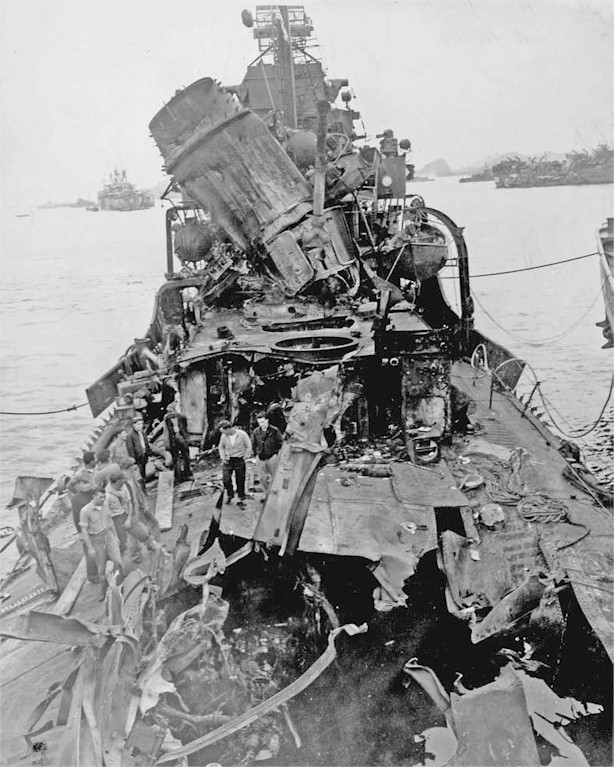
Newcomb was honored by the Navy as namesake for a Fletcher class destroyer, DD-586, USS Newcomb. She had a short but eventful history. In spite of not being commissioned until November 1943. She and another ship sank the Japanese submarine, I-185. She provided naval gun fire support at Saipan, Leyte, Iwo Jima, and Okinawa. As flagship of destroyer squadron 56, she lead a night torpedo attack on a Japanese Fleet during the Battle of Surigao Strait. She scored at least one torpedo hit on the Battleship Yamashiro, which was sunk in the battle, and like her namesake, while under fire, she towed a damaged ship, USS Albert W. Grant (DD-649), to safety. Off Okinawa she survived five (or six) Kamikaze hits.
USS_Newcomb_Damage_1945
USS Newcomb, DD-586, after taking at least four and possibly as many as six kamikaze strikes

Newcomb’s career was not limited to his time on the Hudson. This short biography (pdf) by Atlantic Area Historian William H. Thiesen also talks about his peacetime leadership, and how Admiral Waesche personal chose Newcomb as namesake for a destroyer as the best representative of the Coast Guard.

http://www.uscg.mil/lantarea/ExternalAffairs/humanstories/FrankNewcomb.pdf

“While Newcomb distinguished himself commanding a cutter in battle, he spent much of his career working as a field officer and inspector for the United States Life-Saving Service. Throughout his career, Newcomb championed the rights of those whose efforts merited recognition and promotion. For example, when he had received the medal for his wartime exploits, he insisted that Hudson’s crew receive specially struck medals as well, and the cook and stewards mate became the first African Americans to receive such recognition.

“Many in the Coast Guard as well as the general public have heard the story of the service’s only African American Live-Saving Service crew, which manned North Carolina’s Pea Island Life-Saving Station beginning in 1880. Few may realize that it was locally assigned U.S. Life-Saving Service inspector, Lieutenant Frank Newcomb, who worked diligently behind the scenes to institute an African American crew at that station. In fact, the local community opposed the establishment of an African American manned lifesaving station and arsonists burned down the original station. Newcomb had to camp out at the remote site of the burned out Pea Island station during construction of a new building to prevent sabotage a second time. While no one should diminish the accomplishments of the Pea Island Station’s courageous African American crew, it was Newcomb who risked his career and reputation to institute Pea Island’s African American crew in the racially-charged South following the Civil War.”

There has never been a Coast Guard vessel named for Newcomb. I think it is about time.

If you have any other suggestions for namesakes for the class, please add them in the comments section.

“We Need More Coast Guard” says 7th Fleet

Waesche Carat 2012

NationalDefenseMagazine.org has a piece that reports the Seventh Fleet advocating for the Coast Guard.

There is an apparent error in that Capt. David Adams is identified as “Commander of the Navy’s 7th Fleet.” I assume they mean he is a spokesman for ComSeventhFleet. Nevertheless, the good news is that someone in 7th Fleet is advocating for the Coast Guard. The bad news is that the Coast Guard may not be, being recognized for what it is already doing.

The implied desire in the article that the Coast Guard send ships to the South China Sea to confront the Chinese Coast Guard,

“We have no white hulls in the Pacific, hardly,” Adams said. “We are going to have to fund the Coast Guard, not to do their conventional missions, but to come and help with the white-hull problem out in the Pacific.”

is probably a non-starter, both because of a shortage of Coast Guard assets and because the Coast Guard has no authority in the waters in question, but that may not have been what the Captain was really saying, although taking Philippine and Vietnamese fisheries enforcement officers aboard a National Security Cutter and using it for fisheries enforcement under their authority in the South China Sea could be interesting.

Dean Cheng, senior research fellow at the Heritage Foundation’s Asian studies center suggested,

“‘The Coast Guard is a civilian entity, and there is little reason to my mind that [it] should not exercise in conjunction with the coast guards and civilian law enforcement entities of American allies’ in the Asia-Pacific region, he said”

Mr. Cheng, must have missed USCGC Waesche’s participation in CARAT 2012, the transfer of two 378s to the Philippines and boats to Vietnam and really for the 1000th time, the Coast Guard is a military service.

(Actually very few of the China Coast Guard ships are repainted navy ships and most of their cutters are not as well armed as their USCG counterparts.)

What more can the Coast Guard do? We could certainly sell (or the State Department could give) cutters, boats, and aircraft to SE Asian countries and help train their coast guards. Foreign Military Sales of Offshore Patrol Cutters, Webber class WPCs, and HC-144s with subsequent training might be an instrument of foreign policy. There used to be a something called “seconding” whereby officers of one country filled billets in the armed services of another, but the USCG is not going to be enforcing their laws.

If the nations of Southeast Asia do as Bob Marley sang and “Stand-up, stand-up for your right,” and the Chinese gray hulls “over the horizon” are indeed tempted to intercede, I hope some haze gray 7th Fleet ships are near by to dissuade them from doing anything foolish. Coast Guard cutters will not.

Note, I changed this post after realizing I had misread parts of the referenced post.

Another Deepwater Horizon in Our Future

According to a report by the U.S Chemical Safety and Hazard Investigation Board as reported by gCaptain, the problems that caused the Deepwater Horizon disaster have gone unresolved.

“Industry practice and federal safety rules currently in place in the Gulf may not prevent another catastrophic spill, according to the report. U.S. regulations fall short of standards used for drilling off the coasts of Norway, Australia and the U.K., which require more rigorous, regular and independent safety-equipment checks, the agency said.”

The copyrighted Bloomberg story also reports government and industry reaction.

The CSB draft report can be found here.

Russia’s “coast guard” in the Arctic

Interesting short report from Russian Media about how they expect to handle emergencies in the Arctic, including the use of nuclear powered icebreakers.

Somehow this also got inserted into the article, “In April, Russian President Vladimir Putin announced a unified system of deployment for navy surface ships and new generation submarines.” so their kind of emergency may not be the kind of emergency that would first come to the USCG mind.

While this may not reflect only maritime experience, there was also an interesting admission, “According to the Russian Emergency Ministry there are more than 100 emergency situations in the Russian Arctic annually, both natural and man-made. There has been a steady increase in the number of incidents caused by humans, especially transport accidents (30%), and explosions and fires related to technical equipment (24%).”

Given the extent of Russia’s Arctic coast line they have invested heavily in icebreakers.

“Currently, Russia’s nuclear icebreaker fleet consists of four icebreakers, with two reactors each and 75,000 total horsepower (Rossiya, Sovetskiy Soyuz, Yamal and 50 Let Pobedy)(about the same power as the Polar class-Chuck), and two icebreakers, with one reactor each and 40,000 total horsepower (Taymyr and Vaygach).” (a bit less powerful than Healy-Chuck)

Chinese Drift Net F/V Seized in the North Pacific

CCGD17 is reporting an unusual fisheries case.

This seizure was a result of an international effort. The F/V was spotted by a Canadian CP-140 (similar to a P-3) and boarded by a team from Morgenthau assisted by two Chinese agents, 625 miles East of Tokyo (Japan was also listed as a participant in the operation). After violations were discovered, the vessel was detained and custody subsequently transferred to a Chinese Coast Guard cutter.

I can’t help but be curious what will happen to the vessel, its owners and crew, when the Chinese government seems to condone and even encourage violation of international fisheries norms elsewhere.

Canadian SAR Aircraft, C-27J a Leading Contender

DehavillandCC-115Buffalo01
442 Transport and Rescue Squadron De Havilland Canada DHC-5 Buffalo (CC-115)

Canada’s military seems to be having a lot of trouble with their procurement, new naval helicopter, new patrol vessels, and new SAR aircraft All have taken much longer than expected.

DefenseIndustryDaily reviews the status of their program to replace their existing SAR aircraft which are now overworked DHC-5 (CC-115) Buffalo on the West Coast and CC-130E/H Hercules on the East Coast, in the works since 2008.

According to the report, the C-27 appears to be the most likely choice, other contenders include the HC-144’s big brother the EADS-CASA C295, the C-130J, the Bombardier DASH-8, the DHC-5NG Buffalo being resurrected by Viking Air Ltd., and the Bell V-22.

CG issues Draft RFP for Second Phase of FRC Procurement

page1-640px-USCG_Sentinel_class_cutter_poster_pdf

The Acquisition Directorate is reporting that they have issued a draft Request for Proposal (RFP) for a new contract to build Webber class WPCs.

It will provide for options of either four or six cutters per year for seven years. If all options were exercised the maximum number of cutters that could be built would total 42, but this probably will not be the case.

In February 2012, the Coast Guard exercised a $27.2M option to purchase the “Procurement and Data License Package” for the Webber class Fast Response Cutters, so the Coast Guard can allow other shipyards to bid to build follow-on ships of the same class.

25 September 2013, the Coast Guard exercised an option for six more cutters. This resulted in a total 24 Webber class built or under contract. I believe this was FY2013 money and we will see another contract to exercise the final option on the existing contract bringing the total to 30, which leads to a question. There is a statement in the RFP that I find difficult to understand, B.2.(b) “The total number of cutters obtained under this contract will be limited to twenty-six (26).” All along the program of record has been 58 of these vessels. The maximum number of vessels that can be funded under the phase one contract is 30 cutters so why limit this second contract to 26 when we have a stated requirement for 28 more? Does the Coast Guard plan on making a sole source buy of two ships in FY2015 and award this contract in FY2016?

Why preemptively limit the buy to less than the total of the options anyway. There might be a change of plans that would increase the Coast Guard requirement. The Navy might want to buy some using our existing contract, or the Coast Guard might want to make a Foreign Military Sale purchase on behalf of a friendly foreign government.

Despite being probably the best candidate we will ever see (a mature program with a proven product, approved by the Department for full rate production, that will continue for at least another five years), I saw no indication that a multi-year procurement was considered. I would hope that savvy ship builders would offer this as an additional option. It is still not too late for the Coast Guard to obtain Congressional permission to award a Multi-year Procurement for these ships. Or for Congress to direct this money saving procurement method.

Canadian Coast Guard’s New Shipboard Helicopter

Bell B429

Defense Industry Daily is reporting the Canadians have selected the Bell B429 as their new shipboard Coast Guard helicopter

“The request for proposals closes on May 27, but rivals AgustaWestland, Airbus Helicopters Canada and Sikorsky have all signalled they won’t be submitting bids, leaving Bell and its model 412 chopper (actually the B429–Chuck) as the only contender…. The companies declining to take part are doing so because their aircraft are heavier than the maximum of 4,989 kilograms (11,000 pounds), a safety limit established for the decks of coast guard ships in the 1970s.

Industry sources said at least one potential bidder expressed concern that the standard was outdated and asked the federal government for data on how the weight restriction was calculated. The intention was to prove the decks could handle higher ratings, but officials just came back and said the standard was the standard.”

The Bell B429 is a twin engine helicopter with the capability of allowing single pilot flight in IFR (instrument flight rules) conditions, designed for the medivac market. It is about 2000 pounds lighter than the MH-65 but is otherwise similar in performance. There are a number of door options including clamshell doors in the rear and an option for retractable wheeled landing gear.

Australia, Does it Need a Coast Guard?

In Australia most coast guard functions are handled by the Navy and Air Force. DefenceIQ has an interesting discussion of this alternate arrangement of responsibilities and its shortcomings.

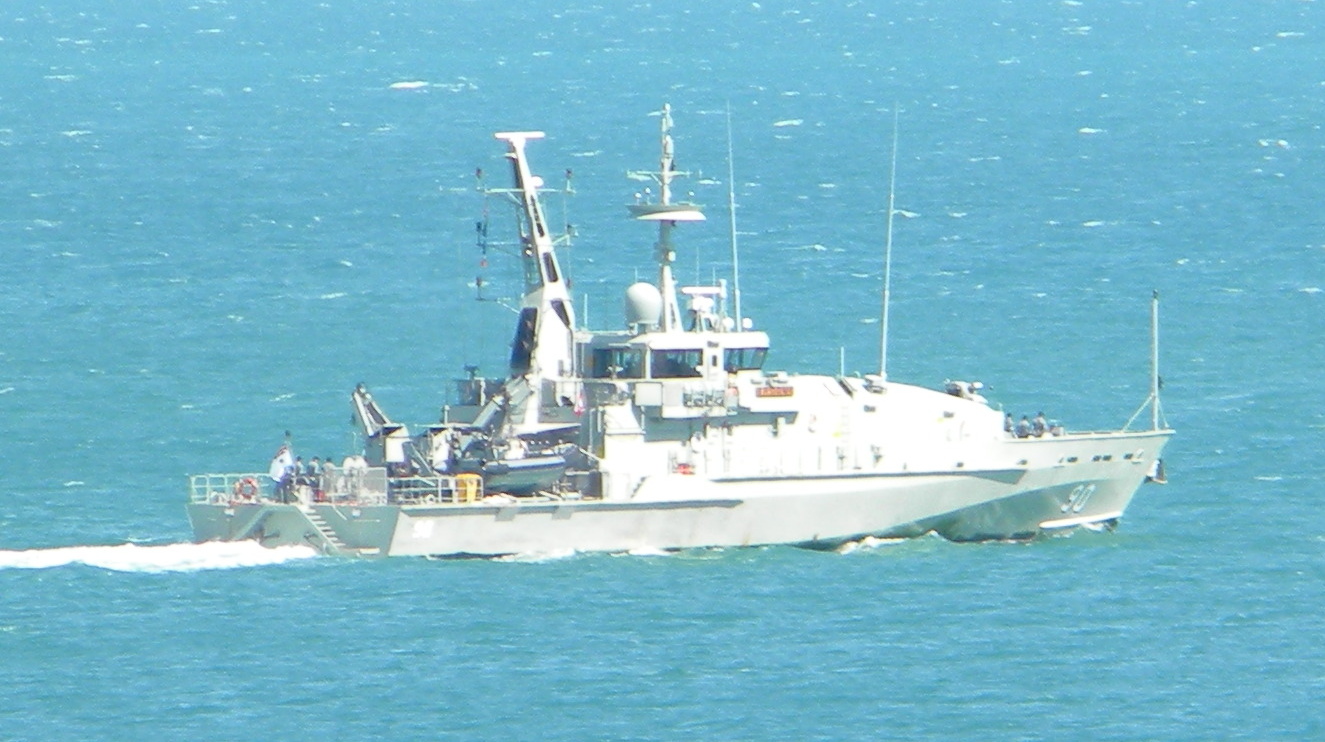
I also note the Australian Navy and their Customs service both operate similar patrol vessels, the Armidale class and the Cape class, and if anything the Customs’ Cape class are more capable.

Thanks to Lee for bringing this to my attention.

DefenseNews–Interview with Admiral Papp

DefenseNews has a short interview with outgoing Commandant, Admiral Papp. Generally nothing too surprising except perhaps the statement that he wrote fitness reports for all the CG flag officers every year and followed it up with counseling, certainly an onerous if extremely important task.

Overall an interesting and relatively short read.

I think I’m going to miss Admiral Papp.