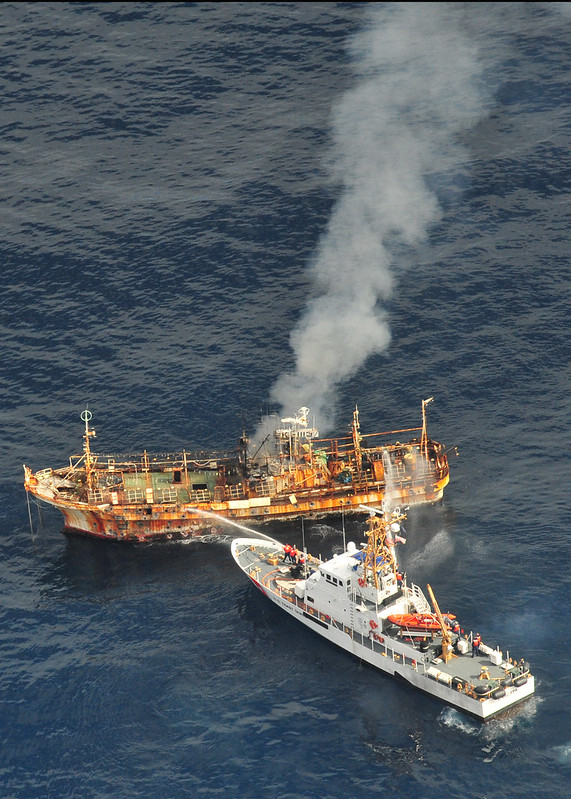
What Does It Take to Sink a Ship, Illustrated

A little over a year ago, I published a post entitled “What Does It Take to Sink a Ship.” It has proven perhaps my most widely read post. The recent sinking of the Japanese fishing vessel Ryou-Un Maru beautifully illustrates the point that ships can be very hard to sink by gun fire.

120405-G-ZZ999-The sinking of the Japanese fishing vessel Ryou-un Maru

  • Title: GULF OF ALASKA – The Japanese fishing vessel, Ryou-Un Maru
  • Summary: GULF OF ALASKA – The Japanese fishing vessel, Ryou-Un Maru, shows significant signs of damage after the Coast Guard Cutter Anancapa fired explosive ammunition into it 180 miles west of the Southeast Alaskan coast April 5, 2012.

Reportedly the USCGC Anacapa began the operation at 13:00 and the Ryou-Un Maru sank at 18:15. It appears that the F/V may have been hit 100 times by explosive 25mm projectiles. With no crew aboard to do damage control and probably with no real measures taken to ensure water tight doors were closed, it stayed afloat for over five hours and ultimately the Anacapa resorted to pumping water into the vessel to sink it.

120405-G-RS249-005-USCG responds to Japanese vessel in Gulf of Alaska

  • Title: 120405-G-RS249-005-USCG responds to Japanese vessel in Gulf of Alaska
  • Summary: GULF OF ALASKA – The Coast Guard Cutter Anacapa crew douses the adrift Japanese vessel with water after a gunnery exercise 180 miles west of the Southeast Alaskan coast April 5, 2012. The crew was successful and sank the vessel at 6:15 p.m. in 6,000 feet

This was a very small ship, probably less than 500 tons, the implications for our ability to stop a medium to large vessel with a determined crew on board, bent on using the vessel for a terrorist act in an American port should be obvious. With even crude and unsophisticated measures to protect vital machinery and control functions, a ship can resist a great deal of gunfire and continue to its objective.

Late Addition–Video of the sinking added 25 Dec. 2012

Another New icebreaker, No Not Coast Guard

gCaptain reports, Shell oil recently took delivery of a 360 foot icebreaker anchor handling vessel. This is the fourth icebreaker built by Edison Chouest Offshore in the last two decades. Two of them (Laurence M. Gould and Nathaniel B. Palmer) were chartered by the National Science Foundation to support their high latitude work.

Reportedly this is part of a continuing trend toward larger vessels to support oil drilling as it moves further off shore.

While it is certainly no Polar Class, it appears to be larger than either the Wind Class or the Glacier. Its good to know that if we wanted to quickly build an arctic patrol vessel that would not break the bank (reported cost $200M), there is at least one American shipyard up to the task.


Unconventional Chinese Rescue Cutter

The Chinese have built an interesting little ship with a trimaran hull, that appears to designed for one of their several coast guard type organizations. It is designated “North Rescue 143.”

It looks a little like a cross between a 110 and an Independence Class Littoral Combat Ship.

Of course this is not the first time the Chinese have shown an interest in non-conventional hull forms. There had been some indication they intended to use the basic form of their catamaran Type 022 (Houbei Class) missile boats as a patrol boat.


DOD Support for CG Arctic Presence

Navy Times is reporting Coast Guard efforts establish a presence in the Arctic are getting some support from USNORTHCOM.

“The Defense Department will help bolster the Coast Guard’s presence in the Arctic, the commander of U.S. Northern Command told the Senate Armed Services Committee.

“Army Gen. Charles Jacoby and Coast Guard Commandant Adm. Bob Papp signed a white paper March 13 that addresses capability gaps in infrastructure, communications, domain awareness and presence in the Arctic.”

Good to see a Combatant Commander (COCOM) supporting Coast Guard programs that serve his Area of Responsibility (AOR). This is in contrast to USSOUTHCOM’s silence regarding Coast Guard needs when it came to providing ships for drug interdiction.

The Navy Times article focuses on the proposed new ice breaker, but there appears to be more to it than that. Certainly there is a need for defense infrastructure in the Arctic and the Coast Guard may be seen as caretakers for facilities that could be augmented in times of crisis. Perhaps putting words into action, DARPA is working on systems that might facilitate “Domain Awareness” in the Arctic.

(It had looked like the Canadians were ahead of us in Arctic operations, but apparently they do not see it that way.)

The world is divided into six COCOM Areas of Responsibility. Coast Guard personnel serve in all of them. Coast Guard units are either permanently or frequently assigned to at least five of them. Hopefully Coast Guard participation is sufficiently valued that they will occasionally speak on behalf of the Coast Guard.


FY2013 AC&I Budget Request

Thanks to fiercehomelandsecurity.com, we have a summary of the FY2013 budget request for the Coast Guard. They also provide a link to the full budget justification.

I would like to focus on the AC&I portion and compare and contrast it with the FY 2012 appropriation which we talked about here.

Total AC&I funds go down from $1,463,968,000 to $1,192,309,000, a drop of almost 18%.

In the out years (FY 2014, 2015 and 2016) the AC&I budget is projected to rise above the FY2012 level.

A number of programs are zeroed out in FY 2013, either because they are cancelled, are on hold, or because they are complete. These include “In-service Vessel Sustainment,” Response Boat-Medium, HH-60 conversion projects, Long Range Surveillance Aircraft (C-130H/J), Rescue 21, Inter-agency Operations Centers (IOCs).

AC&I for vessels went up from $642M to $879.5M, but last year did not fund an NSC as this one does. As has been reported the seven and eighth NSC have been removed from the out-year budgets.

The breakdown for “vessels” (cutters, small boats and related equipment) looks like this:

………………………………………………….FY2012………..FY2013

Total for Vessels ……………………………….$642M……….$879.5M

  • Survey and Design – Vessels & Boats ….$6M ………….$2.5M (175 ft WLM begins)
  • In Service Vessel Sustainment (ISVS) ….$14M…………..(Restarts FY2014)
  • Response Boat – Medium (RB-M) ……$110M…………. (Complete)
  • National Security Cutter (NSC) …………$77M………….$683M
  • Offshore Patrol Cutter (OPC) …..………$25M……………$30M
  • Fast Response Cutter (FRC) …….……$358M………….$139M
  • Cutter Boats ………………………………$5M…………….$4M
  • MEC Sustainment ……………………….$47M…………..$13M
  • Heavy Icebreaker …………………………………………….$8M

Icebreakers:

There is a total of $770M identified for a new icebreaker in FY 2014, 2015, and 2017. Total acquisition cost “TBD.”

“The survey and design phase (for the new icebreaker) would last from the second quarter of fiscal 2013 through the fourth quarter of fiscal 2016, according to the justification.”

Offshore Patrol Vessels:

The $30M is to fund competitive design efforts by up to three short-listed competing ship building organizations.  This is expected to be a two step, three year design process beginning after the end of FY 2012, followed by a presumably three to four year construction process to hopefully deliver the first OPC before the end of calender year 2019. Surprisingly the out-years appear to provide for OPC construction at the rate of only one ship per year. Only $360M per year in FY2015 (first ship), 2016, and 2017. If we continue to build OPCs at only one per year it will take until 2043 to build the 25 projected by which time the newest 270 will be 53 years old. 2045 if we build two extra to replace the cancelled NSCs. (That would be truly ridiculous.) Stretching out the production run will inevitably lead to higher unit costs in contrast to the multi-year production contracts the Navy used for the Littoral Combat Ships (two five year contracts with options for up to 10 ships each).

Fast Response Cutters

The cutters are being built at a rate of four per year. Last years budget included funds for six. FY 2013 request funds number 19 and 20, and will keep the line going. FY 2014, 2015, and 2016 go back up to a $360M/year level.

AC&I for aircraft dropped from $354.4M to $74.5M.

Out years are all higher than FY 2012, as purchases of HC-144s are projected to go back up from $43M in FY 2013 to $220M/year for the succeeding three years and a total of $470M is projected for C-130s 2014-2016. Some notes of interest below:

“The LRS program continues efforts to extend the operating life and enhance the capability of the HC-130H fleet by replacing key component Center Wing Boxes (CWBs) and adding new capability (avionics-A1U), permanently defers the second avionics upgrade (A2U), and reduces the scope of the mission systems upgrade in favor of C-130J production. Consolidation of the C-130H and C-130J PPAs into one new LRS Project enables greater flexibility toward achieving an 11H/11J fleet configuration, which is expected to result in increased mission effectiveness and minimizes lifecycle cost. The eventual goal is to transition to an all C-130J fleet by the mid-2020s, when it will no longer be practical or affordable to keep the C-130H in service.”

“The Coast Guard intends to leverage FY 2012 funding initially intended for the H-60 Radar Sensor System for sustainment segments now underway, including life-limiting component recapitalization and replacement of obsolete components. These revised plans will focus resources on sustaining existing capacity and capability.”

Finally:

AC&I for “Shore, Military Housing and Aids to Navigation dropped from approximately $200.7M to 69.4M.

If we could get the Air Force’s nearly new C-27Js in lieu of HC-144s as has been discussed, it might allow us to build a second OPC each year.

(Note most of the cost breakdown information is found on page CG-AC&I-12)

High Latitude Region Mission Analysis Study–Summary of Summary

File:Polar Star 2.jpg

Thanks to the Coast Guard and http://www.fiercehomelandsecurity.com, we have a summary of the”High Latitude Region Mission Analysis,” that was given to Congress last year. You can get see it in the form of a pfd here.

Bottom line:

  • The Coast Guard requires three heavy and three medium icebreakers to fulfill its statutory missions.
  • Naval Operations Concept 2010 (NOC 2010) included a requirement for a year-round continuous heavy icebreaker presence in both the Arctic and Antarctic. The Coast Guard would require six heavy and four medium icebreakers to fulfill its statutory missions and maintain that continuous presence, if they are all conventionally manned and based in the US.
  • Using multiple crewing and basing two heavy icebreakers in the southern hemisphere (presumably Australia or New Zealand) both statutory and NOC requirements could be met by four heavy and two medium icebreakers.

How soon?:

“U.S. Sen. Mark Begich says the Coast Guard is including $860 million in its five-year budget plan for a new heavy polar icebreaker.”

     Even so, we probably will not see a new icebreaker before 2020. POLAR STAR commenced a major refit in May 2010 and is expected to return to service in late 2013, with a 6- to 7-year remaining service life. The Coast Guard’s only medium icebreaker, HEALY, will remain in-service until 2030. POLAR SEA is inoperative and is expected to be decommissioned this year.
     So one operational icebreaker until 2013. One heavy and one medium icebreaker 2013-2019. In 2020, POLAR SEA goes away and we are still at one heavy and one medium. Any Catastrophic failure and we are back to only one icebreaker.
     If we completed one heavy or medium icebreakers a year, by 2025, the Coast Guard could have the fleet required to meet our statutory responsibilities. Since we would be building OPCs concurrently, this would require a substantial increase in AC&I funding.
     A final note: It is not clear from the summary what constitutes a medium icebreaker. (Maybe it is in the full report.) HEALY is identified as “medium” and the POLAR SEA is “heavy,” even if the HEALY is actually larger. Presumably “medium” is less capable, as an icebreaker, than the POLAR class but more capable than the 140 foot icebreaking tugs. Would the MACKINAW (WLBB-30) qualify? How about the 225 foot JUNIPER class WLBs? the old WIND class breakers? the Canadian Arctic Offshore Patrol Vessels? One clue is that the projected price starts at $590M for a single ship and goes down to less than $560M each for four ships. That is about 69% the cost of a heavy icebreaker so presumably about 70% the displacement–larger than USCGC_Glacier (WAGB-4). Would there really be a point in making one or two ships of a different class, if they so close in size to the Heavy icebreakers?

China and South Korea Argue over a Submerged Rock

Another example of a boundary dispute you would have thought would have been resolved by reference to the United Nations Convention on Law of the Sea. (blogs.wsj.com/chinarealtime/2012/03/13/china-south-korea-in-row-over-submerged-rock/)

“China’s State Oceanic Administration chief declared last week that it was part of China’s ‘jurisdictional waters’ and covered by its maritime patrols.

“South Korea’s President, Lee Myung-bak, said Monday that the reef ‘will fall naturally into Korean-controlled areas,’ according to the Yonhap news agency. The same day, South Korea’s Foreign Minstry questioned China’s ambassador in Seoul over the issue.”

China and South Korea have had a series of meetings to delineate where the boundary between their EEZs lies, without resolution. (more here)

The rock, 4.6 meters below the surface, has an unmanned research station on it with a helicopter landing pad. It is “located 149 kilometers southwest of Korea’s southernmost island of Marado and 247 kilometers northeast of the nearest Chinese island Tongdao.” (source)

This dispute, coming on the heals of the murder of a South Korean Coast Guardsman by a Chinese fisherman (not the first time), is not going down well in South Korea.