Fiberglass four-man craft is typical of recent LPVs. Seized by Steadfast in the Eastern Pacific. Source: Dvids
The website “Covert Shores” has a couple of posts that purportedly show the latest fashion in drug smuggling vessels, here and here. Some great photos.
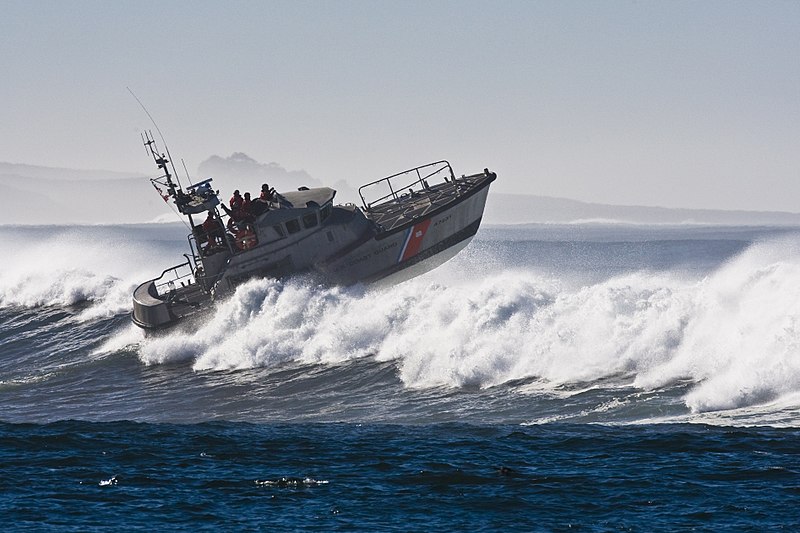
Third Round of Industry Input Sought On 47-Foot Motor Lifeboat Service Life Extension Program
July 13, 2018
A request for information (RFI) was released by the Coast Guard on July 12 for the 47-foot motor lifeboat (MLB) service life extension program (SLEP) as part of the In-Service Vessel Sustainment (ISVS) program. The Coast Guard is providing industry with the latest draft of the statement of work and specification along with access to the majority of the MLB technical data – drawings and technical publications – while seeking industry comments before making a formal solicitation for the contract, which has an estimated value of over $100 million.
This is the third RFI for the MLB; the first was released in September 2016 and the second in November 2017.
The MLB is the Coast Guard’s primary search and rescue platform in surf and heavy weather conditions. The fleet of more than 100 MLBs is approaching the end of its planned 25-year service life, and operational availability has been limited by parts availability and obsolescence issues. The SLEP will extend the useful life of the MLB by 20 years. The original operational capabilities and characteristics of the MLB will effectively remain the same, while efforts to enhance human system integration will be made where practical.
“This RFI answers questions posed through prior industry engagement,” said Cmdr. David Obermeier, deputy program manager for boats acquisitions. “It also gives industry the opportunity to provide additional feedback on the latest draft statement of work and specification.”
The RFI can be found here. The deadline to submit responses is July 27, 2018, at 2 p.m. EST.
“This project video shows the process from design to sea trials of a Hull Vane retrofit on the 52 m Offshore Patrol Vessel Thémis from the French Affaires Maritimes. The installation was done by CMN Cherbourg, which was also the builder of this vessel (delivered in 2004).”
I have posted on this particular innovation before, twice in fact, in 2017, “Hull Vane Claims Improved Performance,” and in 2015, “Hull Vane on an OPV,” but now we have another example and new information. This time the example is a mid-life up-grade on a vessel slightly larger but otherwise similar to the Webber class WPCs, the OPV Thémis from the French Coastguard (Affaires Maritimes) 409 tons, 6,310 HP, 52.5x9x2.27 meters (172.2×29.5×7.45 feet)
Comparison with the benchmark sea trials – conducted in January in exactly the same conditions – by CMN’s sea trial team showed a reduction in fuel consumption of 18 percent at 12 knots, 27 percent at 15 knots and 22 percent at 20 knots. The top speed increased from 19.7 knots to 21 knots.
The earliest post, “Hull Vane on an OPV,” reported the effects of applying the innovation to a 108 meter Dutch Holland class OPV, a ship very much like the Offshore Patrol Cutter (OPC).
They claimed a 12.5% reduction in fuel consumption, overall. Specifically they claimed. “…runs were done to determine the resistance at 5 knots, 12.5 knots, 17.5 knots and 22.5 knots, showing resistance reductions of 1.3%, 13.7%, 15.3% and 11.1% respectively.”
A 4% reduction in heave,
A 7%% reduction in pitch, and
A 13% reduction in vertical acceleration at the flight deck.
A comment on this earliest post, received from the Hull Vane team, noted.
“The performance is better however on the fuller-bodied and wider-transomed hull shapes like the typical US Coast Guard cutters, which we would very much like to do some work on.”
The Hull Vane web site has a number of publications, testimonials, and case studies, including a Nov. 2017 report on a 25 meter patrol boat. that claimed a 20% reduction in fuel consumption. It also noted “RPA 8 is the eighth vessel to be equipped with a Hull Vane®, and ten other ships which will have a Hull Vane® are currently under construction.”
As the new ships enter service, we will probably see the Webber class using more fuel than the 110s, and almost certainly the OPCs will use more fuel than the 210s and 270s.
I would think we would want to check this out, starting with contacting the Dutch Navy and the French Affaires Maritimes to get their take on the tests. Did they think they were successful? Are they going to use Hull Vane on their own ships? If not, why not? That would cost us very little. If the responses are positive, it would make a great R&D project. Bollinger might welcome the opportunity to try one out on a new construction Webber class. The baseline capabilities of the class are already well documented.
“U.S. Marine Corps Sgt. Robert Parkes, Marine Medium Tilt Rotor Squadron (VMM) 774 V-22 crew chief, poses in front of a U.S. Coast Guard Air Station Atlantic City HH-65 Dolphin on Coast Guard Air Station Atlantic City, N.J., June 14, 2018. The Marines conducted a forward air-refueling point for the first time – refueling an HH-65 with a VMM-774 V-22 Osprey. (U.S. Air Force photo/Ariel Owings)”
My first reaction, is that this is a good exercise for the Marines, but I had a hard time imagining how the Coast Guard might use this capability. There were times when we had to call on the Air Force Aerospace Rescue and Recovery Service to fly very long missions out to sea because Coast Guard helicopters did not have an aerial refueling capability, but this would not help us in those cases. On the other hand this might be useful in the Arctic where fuel stops can be few and far between. There aren’t many Marine assets in Alaska, but the Air Force might have a similar capability.
MarineLink provides what is almost certainly a quote of press release from Bollinger stating they hope to build the three heavy and three medium icebreakers the Coast Guard has been saying it needs in Tampa. They are reminding every one (hay, you guys in Congress) how many jobs this could mean for Florida.
This cannot hurt our case for building more than one icebreaker.
The nuclear-powered icebreaker Arktika in the Kara Sea. RIA Novosti archive, image #186141. Also keep reminding them how many icebreakers the Russians have and that the Chinese have one, are building one, and are planning a nuclear icebreaker.
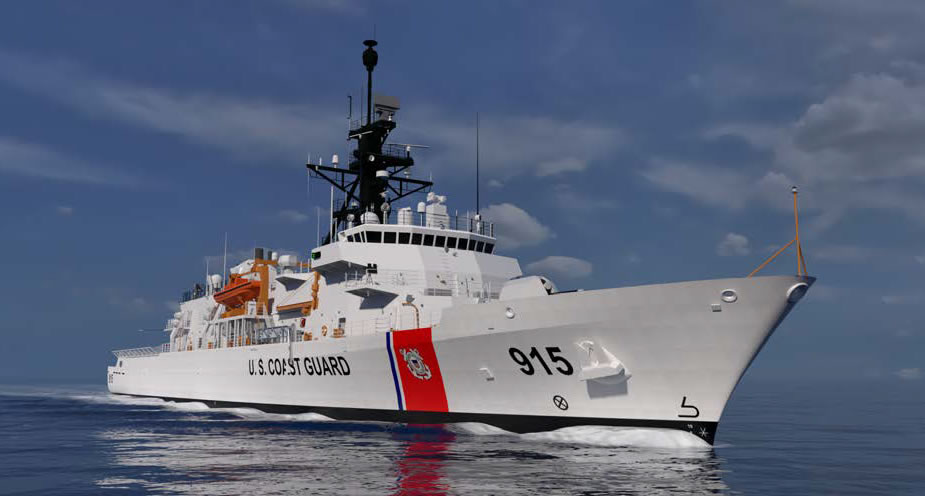
Rendering of Coast Guard Offshore Patrol Cutter. Eastern Shipbuilding Image
NavyRecognitions reports that, “Eastern Shipbuilding Group (ESG) has successfully conducted its Final Critical Design Review (FCDR) with the United States Coast Guard on 29 June 2018 for the Offshore Patrol Cutter (OPC) Program.”
Award for construction of the first of class, USCGC Argus, is expected in the Fall.
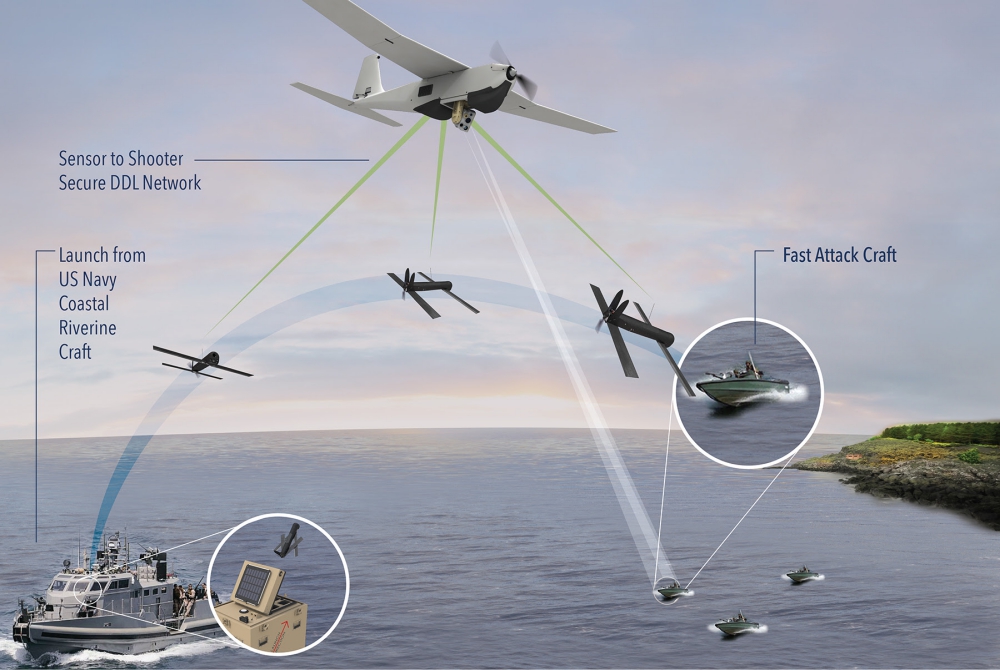
AeroVironment recently conducted a demonstration for the Navy, of how its systems might counter swarming Fast Inshore Attack Craft (FIAC). If the combination of systems works as advertised, it may be exactly what the Coast Guard needs to counter the small, fast, highly maneuverable end of the terrorists surface vessel attack threat spectrum. It is also small enough that it might fit on something as small as a Response Boat-Medium (RB-M). It would certainly fit on a WPB.
It appears to be precise and have minimal chance of collateral damage. It also has a man in the loop, allowing an attack to be aborted or redirected. It is also supposed to have a capability against other drones, presumably smaller, slower ones at low altitude. The combination consists of a Puma UAS to provide target detection, classification, and targeting, and the Switchblade “Lethal Miniature Aerial Missile System” (LMAMS). Switchblade is a missile but a very different one. It is an electric-powered, propeller driven, suicide drone.
The Puma and Switchblade both use the same control system.
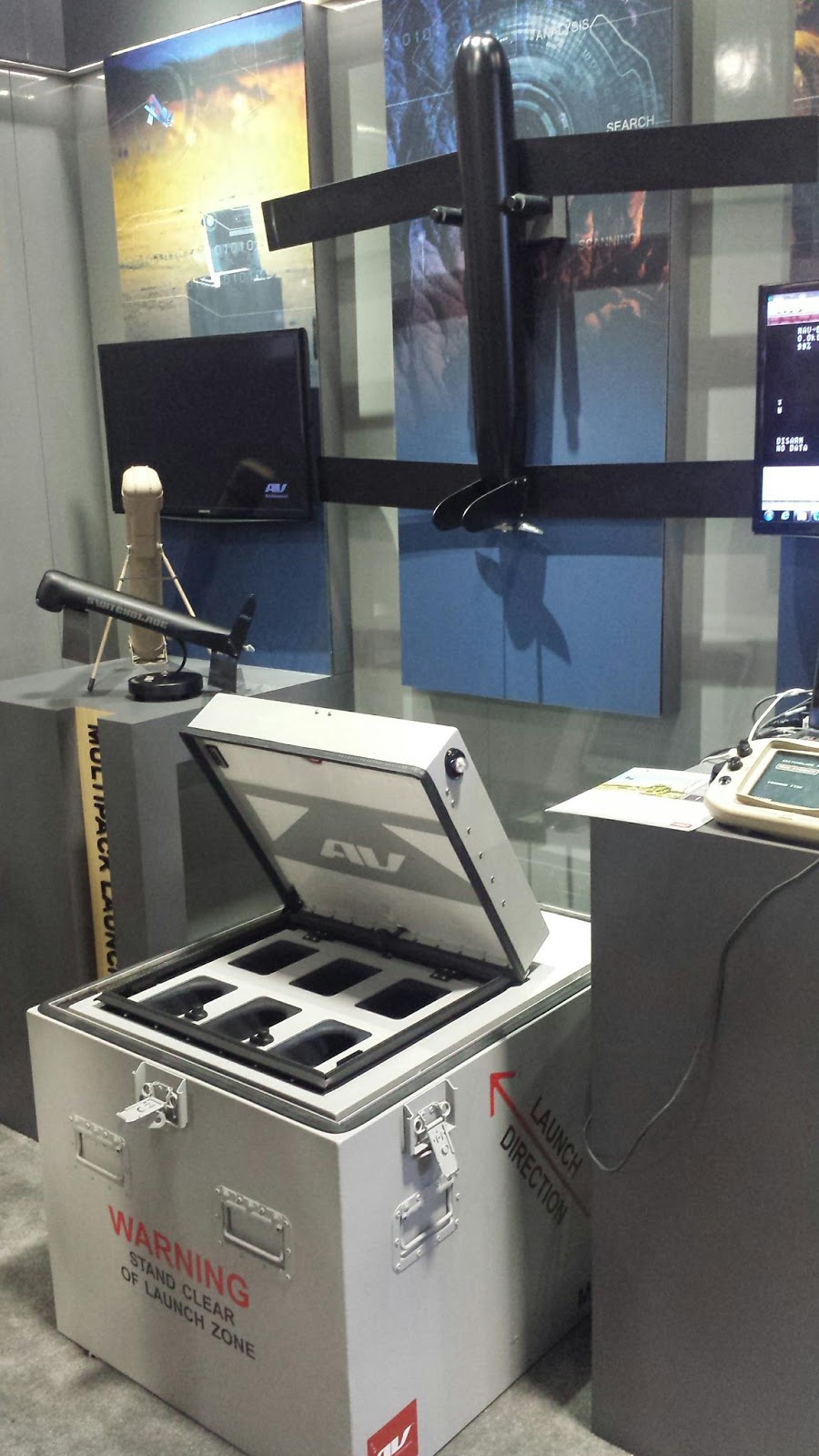
The Switchblade, seen being launched in the photo below, is very small. It is less than two feet long and weighs less than six pounds. The manufacturer’s data sheet is here.
Switchblade loitering munition
They have introduced a six-pack launch system. It weighs only 160 pounds fully loaded and is only 28″ wide, 34″ deep, and 28″ tall.
AeroVironment six cell Switchblade Launcher
Where might we use these? While these systems might become ubiquitous, if they work as advertised, there are a couple of units that stand out as having the most immediate need.
We have a Canadian report (actually more than one) that Customs and Border Protection marine units are intercepting, boarding, and questioning Canadian fishermen in a disputed area in the vicinity of Machias Seal Island “about 19 kilometres southwest of Grand Manan Island and east of Maine.”
In the past two weeks, at least 10 Canadian fishing boats from New Brunswick have been intercepted by U.S. Border Patrol agents while fishing in the disputed waters around Machias Seal Island, a spokesman for the fishermen says.
According to the report, “They’re in international waters, so border patrol shouldn’t be boarding Canadian vessels.”
Additionally it is reported the agents were asking questions about illegal immigrants. You have to appreciate the Canadians’ sense of humor.
The suggestion that the border agents were looking for illegal immigrants seems improbable, he said.
“That’s possible, but … the Gulf of Maine is not a major route for illegal immigrants sneaking into the United States,” Kelly said. “If anything, people are sneaking the other way. They’re trying to get out of the U.S. and into Canada to claim asylum.”
Just ran across a manufacturer’s web page that I thought might be interesting as an example of what can be accomplished in terms of arming smaller vessels. It is not the missiles so much as the launchers I found interesting.
These are two systems from Rafael. Rafael is the designer of the Typhoon gun mount we know as the Mk38 Mod2/3 being installed on the Webber Class WPCs and planned as the secondary weapon for the Offshore Patrol Cutter.
Typhoon MLS-ER
The first of these is the Typhoon MLS-ER (Missile Launch System–Extended Range) seen in the illustration above. The system includes the 8 km range Spike ER missile and reportedly can be installed on vessels as small as RHIBs. It is similar to Hellfire in capability, except that it has the potential advantage of providing for a man in the loop who can retarget or abort after launch.
You can see what appears to be a four round launcher mounted aft on the aft superstructure. The boat seen in the photograph is, I believe, a Super Dvora III. These boats are slightly longer than the Coast Guard 87 foot Marine Protector class WPBs, but are lighter displacement.The description of this boat says that they are armed with the Typhoon gun mount, Spike ER, and Hellfire. This makes me wonder if the missile launcher can launch Hellfire as well as Spike ER.
You can see the Spike ER, as well as the 25 mm gun in the Mk38, in operation in the video below.
Below is the Wikipedia description of the Spike-ER
Extended range or extra-long range version of the weapon. It was formerly also known as the NT-Dandy or NT-D. It has a minimum range of 400 m and a maximum range of 8,000 m (5.0 mi).[23] It has a larger diameter and is heavier than the other (older Spike missile–Chuck) systems, and is usually vehicle mounted. It is used by infantry, Light Combat Vehicle (LCVs), and helicopters. The Finnish Navy’s Coastal Jaegers also operate the version in the anti-ship role. The weight of the missile is 34 kg (74 lb 15 oz), the launchers are 30 kg (66 lb 2 oz) and 55 kg (121 lb 4 oz) respectively for the vehicle and air-launched versions. Penetration is around 1,000 mm (39 in) of RHA (Rolled Homogenous Armor–Chuck).
TYPHOON MLS NLOS has an eight cell Spike NLOS missile launcher and integrated Toplite stabilized observation and target acquisition system (same as on the Mk38 mod2). Photo: RAFAEL via defense-update.com
The Toplite is the same Electro-optic system mounted on our Mk38 mod2 gun mounts. The missile itself is about 50% larger than a Hellfire. The Wikipedia description is quoted below.
“Non Line Of Sight” is an ultra long-range version of the weapon, with a claimed maximum range of 25 km (16 mi). It is a significantly larger missile than other Spike variants, with an overall weight of around 70 kg (154 lb 5 oz). It can be launched from the ground or from helicopters. It was developed following lessons learned in the Yom Kippur War, which showed a need for a high-precision guided tactical ground-to-ground battlefield missile. Codenamed Tamuz (תמוז), the first variants entered service with the IDF in tandem with the Pereh missile carrier in 1981, though the existence of both was not revealed to the public until 2011. The Spike NLOS uses a fiber optic link similar to other Spike versions, but only out to 8 km, after which it employs a radio data link for command guidance.
In 2011 it also became known that in a highly unusual move, the British Army was hastily equipped with the missile, drawn directly from IDF inventory after being exposed to increasing insurgent attacks in Iraq and Afghanistan beginning in 2007. The UK initially acquired 600 missiles, which it designated EXACTOR-1 in British service, later procuring a more advanced variant designated EXACTOR-2. In a deal concluded on 6 September 2011, the South Korean government had agreed to purchase an unknown number of Spike NLOS missiles.
Rafael is working on expanding the missile’s versatility by enhancing the existing EO-IR/CCD seeker with semi-active laser (SAL) capability and different anti-armor, blast-penetration, and high-explosive fragmentation warheads to meet specific applications.
While I started this post to talk about the missile systems, it seemed the Super Dvora III also has features worth discussing.
This boat is very similar in size to the Marine Protector Class WPBs. Dimensions are 90×18.6×3.6 feet for the Israeli and 87×19.4×5.6 feet for the WPB. The all aluminum construction of the Israeli boat has yielded much lighter displacement, ranging from 58 to 72 tons full load for the Israeli boat compared to 91 tons for the WPB. The lighter displacement would presumably result in both higher speed and lower fuel consumption. I am hoping the next WPB will be composite construction on the assumption that that would combine these advantages with corrosion resistance and lower maintenance.
The Israeli boat initially used an articulated surface drive but switched to a water jet. Both allowed these boats to operate in very shallow water. The Israeli boat is also much faster than the WPB (45 knots compared to 25 knots) for a relatively modest increase in power. (4,175 v 2,950 HP).
The Super Dvora Mk III’s weapons can be slaved to a mast-mounted, day/night, long range electro-optic systems. We will probably want such a system on our next WPB. It could aid in SAR, Law Enforcement, and navigation as well as weapons control.
The Israeli boat does not have a stern boat ramp and may not be as sea worthy as the WPB, but WPBs really are our “fast response cutters” so dash speed is a significant characteristic. I would expect the next WPB to be larger, faster, and better armed. If it could also operate in shallower water than our current WPBs that would also be desirable.
Photo: Israeli Shipyards’ Shaldag Patrol Boat with Spike ER launcher on superstructure aft.
Thanks to Lee for bringing these systems to my attention.








 Chuck Hill's CG Blog