ALCOAST 464/21 SUBJ: WINNER ANNOUNCEMENT – 2021 HOPLEY YEATON CUTTER EXCELLENCE

USCGC Hamilton (WMSL-753) conducting port visit in Valletta, Malta on May 17, 2021. Coast Guard Photo

Just passing this along. I have added pictures and a link to a previous post. 

R 202101Z DEC 21
FM COMDT COGARD WASHINGTON DC
TO ALCOAST
BT
UNCLAS
ALCOAST 464/21
SSIC 1650
SUBJ: WINNER ANNOUNCEMENT – 2021 HOPLEY YEATON CUTTER EXCELLENCE
AND SUPERIOR CUTTERMAN AWARDS
A. COMDT COGARD WASHINGTON DC 141626Z SEP 21/ALCOAST 336/21

1. The Douglas Munro Chapter of the Surface Navy Association (SNA) is honored to announce and congratulate the recipients of the 2021 Hopley Yeaton Cutter Excellence and Superior Cutterman Awards. The winners were selected from an incredibly competitive pool of nominees.

2. The winners of the Hopley Yeaton Awards for 2021 are:

a. Cutter Excellence Awards

  • 1. Large Cutter: CGC HAMILTON (WMSL 753)
  • 2. Medium Cutter: CGC RESOLUTE (WMEC 620)
  • 3. Small Cutter: CGC ISAAC MAYO (WPC 1112)

b. Superior Cuttermen Awards

  • 1. Officer: LTJG Lauren Kowalski – CGC POLAR STAR (WAGB 10)
  • 2. Enlisted: YN1 Joseph DeVito – CGC RELIANCE (WMEC 615)

3. Cutter Excellence Award (Large) – CGC HAMILTON (WMSL 753):

a. Following her trans-Atlantic escort of the first Fast Response Cutters bound for service at PATFORSWA, CGC HAMILTON transited the Bosporus into the Black Sea where she conducted freedom of navigation patrols and operated and trained with Turkish and Romanian Naval Forces, the Georgian Coast Guard, and Ukrainian Maritime Forces. While deployed in the U.S. European Command AOR, HAMILTON conducted at-sea exercises and port visit engagements with the navies and coast guard of seven total international allies and partners; bolstering freedom of navigation in international waters of the Black Sea and building maritime domain awareness, cooperation, and interoperability with partner nation navies and coast guards. As Caribbean maritime migration levels increased to the highest levels in more than seven years, HAMILTON assumed command of surface operations in the Windward Pass, directing the employment of three major and four fast response cutters that successfully resulted in a dramatic decline in attempts by migrants to attempt the extremely hazardous voyage at sea.

b. Honorable Mentions for the Large Cutter Award are:

  • 1. CGC MUNRO (WMSL 755)
  • 2. CGC BERTHOLF (WMSL 750)

RESOLUTE conducts an at-sea transfer with CGC DILIGENCE. The transfer included a 77 Haitian migrants, their personal belongings, and a Creole interpreter. In total, RESOLUTE cared for 260 Haitian migrants. All migrants are given food, water, and medical attention once onboard a Coast Guard cutter. During a 56-day patrol, RESOLUTE provided overt presence in Northern Haiti to deter illegal and dangerous migration voyages. Photo by ENS Alex Cordes.

4. Hopley Yeaton Cutter Excellence Award (Medium) – CGC RESOLUTE (WMEC 620):

a. In 2021, CGC RESOLUTE safely conducted the largest single-unit, at-sea migration case in more than a decade (183 migrants, including 17 children and infants). RESOLUTE led rigorous dockside and underway trials for the new Cutter Boat-Large acquisition and delivered expert analysis of safety, compatibility, and suitability for a wide range of Coast Guard missions. RESOLUTE’s superb engagement with headquarters program sponsors and naval engineers supported successful acceptance and roll-out across the entire 210′ WMEC fleet. Highlighting a year with multiple SAR cases, RESOLUTE’s lookout detected people in the water, leading to the rescue of 8 migrants who had been treading water for 24 hours following the capsizing of their makeshift vessel.

b. Honorable Mentions for the Medium Cutter Award are:

  • 1. CGC LEGARE (WMEC 912)
  • 2. CGC HICKORY (WLB 212)

USCGC Isaac Mayo, Key West, Fla., Jan. 29, 2015. (U.S. Coast Guard photo by Petty Officer 3rd Class Mark Barney

5. Hopley Yeaton Cutter Excellence Award (Small) – CGC ISAAC MAYO (WPC 1112):

a. In 2021, CGC ISAAC MAYO conducted 108 at-sea boardings resulting in the disruption of 3,000 kgs of cocaine valued at $75 million. ISAAC MAYO conducted joint operations with Customs and Border Protection and Homeland Security Investigations during an operation to deter, detect, interdict, and inspect, targets of interest in the northern portion of Sector Key West’s area of responsibility. ISAAC MAYO led the way during Operation CHOKE POINT, an intradepartmental partnership with Customs and Border Patrol and Homeland Security Investigations, to board and inspect vessels operating in the Gulf of Mexico. Additionally, ISAAC MAYO developed a first-ever Tactics, Techniques, and Procedures for operating with a Customs and Border Patrol 45-ft Coastal Intercept Vessel, laying the foundation for sustained multi-agency asset employment far beyond historical operating limitations.

b. Honorable Mentions for the Small Cutter Award are:

  • 1. CGC RICHARD ETHERIDGE (WPC 1102)
  • 2. CGC CHARLES MOULTHROPE (WPC 1141)

6. Hopley Yeaton Superior Cutterman Award (Officer) – LTJG Lauren Kowalski – CGC POLAR STAR (WAGB 10):

a. LTJG Kowalski completed the USCG’s Afloat Icebreaker Training program and demonstrated outstanding professionalism in her role as USCG liaison officer and ice pilot for three months aboard the HMS PROTECTOR. In her capacity as ice pilot, she led the ship to set a new Royal Navy latitude record for surface ships. She managed operations and tracklines for the nation’s only heavy icebreaker, planning and navigating the 10,000 nm voyage for the Arctic Winter West 2021 deployment, through treacherous ice windrows, howling gales, and 10 days of perpetual winter darkness.

b. Honorable Mentions for the Superior Cutterman Award (Officer) are:

  • 1. LTJG William Stephens – CGC MAUI (WPB 1304)
  • 2. ENS Matthew Hall – CGC ANACAPA (WPB 1335)

7. Hopley Yeaton Superior Cutterman Award (Enlisted) – YN1 Joseph Devito – CGC RELIANCE (WMEC 615):

a. YN1 DeVito went beyond the normal duties of a Yeoman afloat by qualifying as an underway officer of the deck. In addition, YN1 DeVito qualified as boat deck safety, helm and lookout, boatswain mate of the watch, quartermaster of the watch, on scene leader for flight operations, detainee watch stander, boarding team member, force protection officer, .50 cal mount captain, .50 cal gunner, repair party leader, and inport officer of the deck. As the vice chairperson of the cutter’s newly formed Leadership and Diversity Advisory Council, he helped organize multiple events that improved the unit’s investment in the professional and personal development of its junior officers and enlisted members. As a Damage Control Training Team member leading training for Repair III, he trained more than 100 crew members in damage control. His superb expertise as a Yeoman resulted in zero discrepancies across 50 line items during the cutter’s Finance and Administration inspection.

b. Honorable Mentions for the Superior Cutterman Award (Enlisted) are:

  • 1. BMC Brian Cleversey – CGC RESOLUTE (WMEC 620)
  • 2. BM2 Nancy Worley – CGC HOLLYHOCK (WLB 214)

8. The winners will be recognized at the 2022 SNA National Symposium.

9. Bravo Zulu and great work to this year’s Hopley Yeaton Award recipients and nominees. This year’s nominees were selected by panels comprised of 61 active duty and retired permanent cuttermen from the rank of E6 to O8, with a collective 604 years of sea time. The sheer volume of praiseworthy nominees and high-quality award write-ups continue to impress. Thank you to all commands that submitted and reviewed nominations.

10. POC: LT Luke Trautwein at John.L.Trautwein@uscg.mil.

11. RDML Todd C. Wiemers, Assistant Commandant for Capability
(CG-7), sends.

12. Internet release is authorized.

“Special Operations C-130 Hits Target With A ‘Rapid Dragon’ Pallet-Dropped Cruise Missile” –The Drive

Coast Guard Aircraft at War

During World War II, we all probably know that the Coast Guard surface forces had a strong record of augmenting the US Navy in anti-submarine warfare and amphibious assault operations.

Coast Guard aviation’s contribution was considerably less significant. They continued to do SAR and flew anti-submarine patrols. By the end of the war, there was at least one Coast Guard squadron dedicated to anti-submarine patrols, but while generally aircraft were more successful than surface vessels against submarines, sinking about 400 U-boats, more than half of all the U-boats destroyed during WWII, all Coast Guard submarine sinkings were done by surface vessels.

During the Vietnam war, when the Coast Guard deployed 82 foot patrol boats and High Endurance Cutters off the coast as part of Operation Market Time, and buoy tenders serviced aids in Vietnamese waters, the Coast Guard’s aviation contribution to the war was limited to exchange pilots serving with the DOD units. Coast Guard aircraft supported LORAN stations that were vital to the war effort, but I have not heard of any Coast Guard aircraft participating directly in the Vietnam War.

During the first Iraq War, I seem to recall some Coast Guard aircraft assisted TRANSCOM with logistics. In addition, Coast Guard HU-25s monitored pollution that resulted from Iraqi sabotage of Kuwaiti oil facilities.

Generally, Coast Guard aircraft have played little or no role in America’s wars. It is not too surprising since warplanes tend to be specialized.

That may be changing. 

“Bomb Bay in Box”

The Air Force has been making rapid progress on a system that would allow cargo planes, including C-130s and perhaps C-27Js and C-144s to become cruise missile carriers. (An earlier test reported here.)

The system is roll-on/roll-off and requires no integration with the aircraft. 

Interestingly the most recent test appears to have targeted a maritime target. 

We certainly are not likely to see even Air Force transports doing this sort of thing routinely unless it is a truly big war or at least the desire is to launch a devastating number of missiles in single massive assault. 

Surprisingly, Coast Guard aircraft might be seen as the best transports to do this sort of thing, since their Minotaur systems provide the possibility of updating targeting information with organic sensors and doing post attack battle damage assessment if the environment permits. 

Coast Guard aircraft use becomes more likely if the conflict is worldwide, Air Force transports are otherwise engaged, and a nation, or nations, in the Western Hemisphere decides to take advantage of US distraction and attack an ally. 

It might also happen, if there is a wartime decision to sink all hostile controlled shipping. (That might follow a warning to masters to intern the ships within a reasonable time period.)

Naval News Coverage of Defence and Security Equipment International (DSEI), Sept. 14-17. 2021

Below I have provided the Naval News coverage of DSEI 2021. There are a few segments in particular that may be of interest.

In the Day 1 coverage:

  • 07:25 – VARD 7 115 Next Generation OPV. I think you can see the similarity to the Offshore Patrol Cutter design which is a VARD 7 110.
  • 10:09 – OMT’s MPV-80/12:52 – SH Defence “The Cube” modular mission module. The Danes have been making modular naval systems for decades and this is modularity on steroids. “The Cube” is a proposed system of standard container-sized modules. The MPV-80 is a modular OPV with 32 positions for “The Cube” modules.  

In the Day 3 coverage:

  • 00:47 – Royal Navy’s NavyPODS is another container-sized module proposal. Sounds like the Royal Navy may be considering using these on their River Class Offshore Patrol Vessels. 
  • 06:46 – AEUK SeaSense variable depth sonar. This is another ASW sensor that could be deployed on very small vessels. 
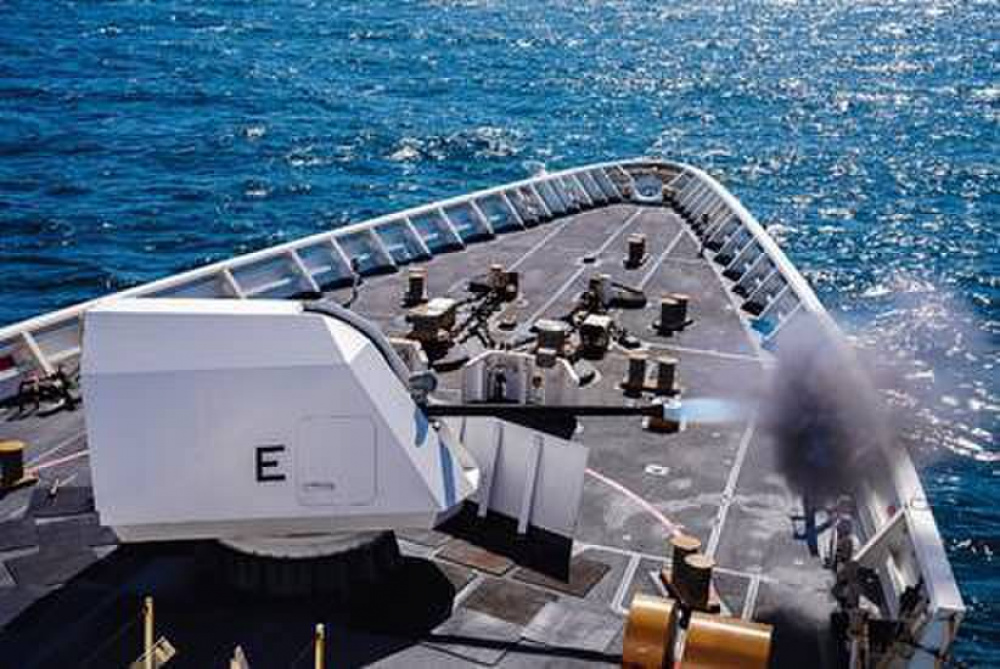
  • 07:27 – BAE Systems Bofors 40Mk4 naval gun system. This would make a good choice to arm smaller cutters or for use as a secondary on larger cutters. Right now, it’s not in the USN inventory and there is no integral fire control system, so. at least an Electro-Optic system would be required. The ammunition uses the same 3P fuse used on the 57mm Mk110 gun. For decades the Italians used 40mm guns for their CIWS. Most recently they have been using 76mm guns. The Royal Navy has recently adopted this mount to use as a secondary weapon and CIWS on the Type 31 class frigate

In the Day 4 coverage:

  • 04:55 – MSI Defence Ltd Seahawk 30mm naval gun system. We talked about this gun mount earlier, since it appears it will be the USN Mk38 Mod4. It is the reason I posted this video earlier. 

Day 1 at DSEI 2021 in London, UK. We focused on new anti-ship missiles, the Sea Breaker by Rafael, the Sea Serpent by IAI and Thales UK. We then take a look at two new OPV designs: The VARD 7 115 NGOPV and the MPV 80 by OMT. We then discuss with SH Defence about “The Cube” modular mission module.

  • 00:50 – Rafael’s Sea Breaker
  • 05:03 – IAI’s Sea Serpent
  • 07:25 – VARD 7 115 Next Generation OPV
  • 10:09 – OMT’s MPV-80
  • 12:52 – SH Defence “The Cube” modular mission module.

Day 2 at DSEI 2021 in London, UK. We focused on Naval Strike Missile (NSM) with Raytheon, the new Quadome 3D radar by Hensoldt, UAS integration with Thales and the MMCM program with Thales.

  • 00:15 – Intro
  • 00:53 – Raytheon’s NSM for SSGW
  • 04:12 – Hensoldt launches new Quadome 3D radar
  • 05:30 – Thales’ Unmanned wide area surveillance
  • 07:28 – Thales MMCM program

Day 3 at DSEI 2021 in London, UK. We talked to the Royal Navy about their NavyPODS concept. We then focused on mine warfare, talking to Patria and its acoustic sweep, and Atlas Elektronik UK (AEUK) ARCIMS and its payloads. We then talked to BAE Systems Bofors to get an update on the 40Mk4 naval gun program and learn about the T-650 heavy lift UAS which can carry a lightweight torpedo.

  • 00:12 – Introduction
  • 00:47 – Royal Navy’s NavyPODS
  • 02:53 – Patria’s acoustic sweep
  • 05:17 – Atlas Elektronik UK ARCIMS
  • 06:46 – AEUK SeaSense variable depth sonar
  • 07:27 – BAE Systems Bofors 40Mk4 naval gun system
  • 09:16 – BAE Systems T-650 heavy lift UAS

Final day at DSEI 2021 in London, UK. Naval News’ Editor-in-Chief, Xavier Vavasseur, takes you around the show floor and comments some of the new systems on display. We start with MBDA who was showcasing its future missile concepts (related to FCASW) as well as current portfolio of anti-ship missiles (SPEAR, SPEAR EW, Exocet, Marte, Sea Venom and Maritime Brimstone) and naval air defense solutions (Dragonfire, Aster B1 NT and CAMM / Sea Ceptor). We then take a close look at a scale model of the XLUUV on the TKMS stand and the MSI Defence Systems’ Seahawk 30mm naval gun system which was recently selected by the US Navy. Finally we talked to IAI’s Malcolm McKenzie to learn more details about Sea Serpent.

  • 00:47 – MBDA concept missiles for FCASW
  • 01:34 – MBDA SPEAR and SPEAR EW
  • 01:57 – MBDA Exocet MM40 Block 3C
  • 02:22 – MBDA Marte ER
  • 02:38 – MBDA Sea Venom
  • 02:48 – MBDA Maritime Brimstone
  • 03:08 – MBDA Dragonfire laser weapon system
  • 03:20 – MBDA Aster 30 B1 NT
  • 03:25 – MBDA CAMM / Sea Ceptor
  • 03:45 – TKMS XLUUV
  • 04:55 – MSI Defence Ltd Seahawk 30mm naval gun system
  • 05:26 – IAI Sea Serpent anti-ship missile


“Littoral combat ships in Mayport make the most of a year of restricted operations” –Defense News

Littoral combat ship Little Rock (LCS 9) is underway during a high-speed run in Lake Michigan during acceptance trials. Lockheed Martin Photo

Defense News reports on the activities of the eight Freedom class Littoral Combat Ships based in Mayport during the year since recognition of their combining gear problem. (LCS-5, 7, 9, 11, 13, 15, 17, and 19. LCS-1 and 3 are in San Diego.)

All their deployments have been with Forth Fleet, primarily doing drug interdiction with a Coast Guard LEDET aboard.

“But, the squadron commodore said, the formation also has seen its greatest operational achievements during that same time, conducting seven successful deployments to U.S. 4th Fleet that took hundreds of millions of dollars’ worth of drugs off the market, interrupted trafficking networks across SOUTHCOM, supported partners throughout Central and South America and pushed back against excessive maritime claims.”

The report provides some insights in the nature of the class problems. The problems were not limited to when both turbines and diesels were operating together, to achieve maximum speed.

they are forbidden from operating in two modes to achieve top speeds — operating both the gas turbine and the diesel engine for full power, and using the diesel engine in “boost mode”

It appears the clutches for the diesel engines were not up to the torque those engines provided and this has meant that the ships are using turbines for cruise speeds that the diesels would have been expected to provide.

What we found out then later after that was, when Detroit had the failure, is that it was more than just that combined mode; it was actually the torque on that clutch when the diesel engine was operating under the higher loads, causing the same degradation and failure,”

This has impacted their already short range.

“…diesel engine is your most economical mode, so you just have to watch the operational employment of the ship more to make sure that you’re managing your fuel consumption” as the ships relied less on the diesel engine and more on the gas turbine.”

These ships continue to have reliability problems.

Defense News reported in June the LCS Strike Team, alongside the newly established LCS Task Force, had identified 32 reliability problems and were focused on five for the Freedom-variant ships. In addition to the combining gear, that list included issues related to the diesel generator rigid mount, fuel lines, water jets and boat davits.

That means they are being kept on a short leash. That is to some extent good news for 4th Fleet and the drug enforcement effort, since they are still not ready to be deployed to Bahrain.

On the other hand, that means PATFORSWA is to some extent covering missions that the LCSs should be doing.

I am not sure it’s true, but it seems the LCS are not as effective as cutters in drug enforcement. It would be interesting to do a study of that. To determine if it is true, and if so, why.

Another impression is that while we have deployed HITRON helicopters on foreign vessels engaged in drug enforcement, the LCSs use only Navy helicopters.

“Coast Guard’s Schultz gives ‘full-throated’ support for UN sea law treaty” –Breaking Defense

Vice Adm. Karl L. Schultz, commander, Coast Guard Atlantic Area, speaks at the Coast Guard Cutter Benjamin Dailey commissioning ceremony in Pascagoula, Miss. Coast Guard Photo

Breaking Defense reports the Commandant’s remarks regarding the United Nations Convention on the Law of the Sea (UNCLOS) at a Navy League event.

Also reported were vice chairman of the Joint Chiefs of Staff nominee, Adm. Christopher Grady’s expressions of support for ratification.

What’s Going on With the Coast Guard News Website?

Every day I try to look at all the sites included in my “Recommended Blogs” list. This includes three USCG sites:

MyCG, which seems directed at Coast Guard personnel, has been very active. CG-9’s site is, as you would expect, less active but still seems to be informative.

“Coast Guard News,” which seems to be directed at the national press, has covered Coast Guard ongoing operations, but seems to have dried up. For some time, it has seemed to have been neglected with few changes and little new material. Currently the top story is dated October 20. I know a lot has happened since then.

What’s going on?

If the site is not going to be maintained, we should say so and put some kind of notice on the site to say where to find Coast Guard news.

“Troubled CBP Gets $3.7 Billion Infrastructure Boost While Coast Guard Gets Peanuts” –Forbes

US Capital West Side, by Martin Falbisoner

Forbes makes a case that DHS is directing money to Customs and Border Protection because it’s broken, while minimally funding the Coast Guard because it works.

The Infrastructure Investment and Jobs Act, better known as the Bipartisan Infrastructure Bill, did a lot for the U.S. Coast Guard. The Coast Guard, the maritime component of the sprawling Department of Homeland Security, got a $434 billion windfall (that has to be million vice billion–Chuck) to fund operations and pay for physical improvements.

That’s better than a kick in the head. But the service got mere fraction of the $3.7 billion Congress meted out to the Department of Homeland Security’s continually-troubled Customs and Border Patrol.

Unfortunately, there seems to be a tendency in government to throw money at agencies that are not performing, in hopes of seeing an improvement, and providing no additional funds to agencies that are providing a good return on investment, inverting good investment strategy.

He also points out that for whatever reason, despite numerous demands from Congress, the Coast Guard is not providing the information Congress needs to make an informed decision about the true needs of the service.

At least this time the Coast Guard had provided an unfunded priority list. In many previous years there was none. The “program of record” for cutter procurement was formulated in 2004 and has not changed in 17 years. The only Fleet Mix study was done in 2011, a decade ago. There is no long-term capital asset or ship building plan.

“If you fail to plan, you plan to fail.”

Thanks to formerdirtdart for bringing this to my attention. 

“Iran Boosts IRCG Navy’s Swarm Attack Capabilities” –Naval News

110 speed boats entered service with the IRGC Navy (IRIB News picture)

Naval News reports,

According to the Iranian news outlet IRIB News, the Islamic Revolution Guards Corps (IRGC) Navy received 110 indigenously made combat speedboats on December 11 during a ceremony in Bandar Abbas….

“This is the seventh delivery of such vessels. Their speed has climbed from 55 knots to 75 and 90 knots, with the next stage reaching 110 knots. The boats are equipped with missiles and rockets and are capable of operating efficiently under the IRGC’s indigenous radar network.”

It’s not impossible the Iranians are employing deception tactics and may be redelivering boats seen in previous delivery media events, but there is little doubt, they do have a lot of fast attack craft, making the Coast Guard’s PATFORSWA operating area a rough neighborhood. (More here, here, here, here, and here.)

Considering if PATFORSWA is ever in a fight with the Islamic Revolutionary Guard Corp Navy, the cutters will probably be protecting tankers or Navy high value units. In that case, frankly I think most of the smaller craft are intended as a diversion, the primary threats are the missile and torpedo equipped boats that will screened by a cloud of smaller boats. Still machineguns and rockets mounted on small boats could damage the cutters.

If you want to consider if we can deal with the Iranian tactics, you might want to look at this earlier post, Guns vs the Swarm.

“New Royal Canadian Navy Offshore Patrol Vessel Visits Norfolk After Circumnavigating North America” –USNI

HMCS Harry DeWolf in ice (6-8 second exposure)

We have talked about the Canadian Navy’s Arctic Offshore Patrol Ship (AOPS) before (more here). It is, in many ways an Offshore Patrol Vessel, that would seem right at home in the US Coast Guard. In fact, in addition to the six being built for the Royal Canadian Navy, two are being built for the Canadian Coast Guard.

I would not be surprised if the US Coast Guard opts to build something similar. This US Naval Institute News Service story provides a bit more insight into its operations and how it is being used.

The AOPS, like the Offshore Patrol Cutter (OPC), is a VARD design. It is based on the Norwegian Coast Guard Cutter Svalbard, that was capable enough to reach the North Pole on 21 August 2019. Svalbard also completed a scientific mission for the US in the Beuford Sea in 2020, when CGC Healy had a fire in one of its main propulsion motors and was unable to recover data contained in buoys she had deployed earlier.

Most surprising for me were the comments the ship’s use of containers,

At the briefing to press in Norfolk, which was broadcast online, he noted that sea-shipping containers aboard Harry DeWolf, not usually carried on warships, can be used as laboratories for science and researchers studying changes in the Arctic.

Gleason added that at all times the ship will have two containers loaded for humanitarian assistance and disaster relief to respond to emergencies when called upon.

Gleason said early on there was a key training scenario of responding in a mass casualty scenario. In it Harry De Wolf  worked with the U.S. and Canadian coast guards and naval vessels in treating and evacuating the injured aboard and taking them ashore.

On this mission to the North, Gleason said the containers had a real-time military mission. They “were used as underwater listening devices” for submarines. “Fortunately, we didn’t find any.”

I suspect the “underwater listening devices” for submarines was the Towed Reelable Active Passive Sonar, TRAPS system, (more here).