Case for a Second Great Lakes Icebreaker

Launch of USCGC Mackinaw (WLBB-30) on April 2, 2005. Photo by Peter J. Markham.

Recently in response to my post “Great Lakes–St. Lawrence Shipping: We Need Icebreakers” –Marine Link, in which I suggested that the Great Lakes icebreaker might serve as a prototype for the three planned medium polar icebreakers, there was a comment from an Academy classmate, Capt. Fred Wilder, USCG (ret.), that was intended to link to a press release from the Lake Carriers’ Association, but for some reason the link was lost. I requested a copy of the news release from Capt. Wilder which he provided. It is reproduced below.

A week after the post linked above, I posted on why we might need icebreaker assets that could be drawn on by the Atlantic Fleet, in the form of icebreakers that could serve in both the Lakes and in the Atlantic Arctic.

—–

Lake Carriers’ Association For Immediate Release   August 1, 2019

Iced Out: Study Reveals Loss of More Than $1 Billion Due to Inadequate Icebreaking Capabilities on the Great Lakes

CLEVELAND – The U.S. economy lost more than $1 billion in business revenue and 5,421 jobs due to inadequate icebreaking capabilities on the Great Lakes during the 2018-2019 winter season.

Due to this loss of business revenue, the federal government missed out on more than $125 million in taxes and in addition $46 million was lost by state and local governments. For perspective, that loss means the U.S. government could build a new Great Lakes icebreaker and recoup those costs in two years.

“In response to a question at a recent Congressional hearing, we polled our members about the delays they incurred due to inadequate icebreaking this winter,” said Jim Weakley, President of Lake Carriers’ Association. “Once we had the total number of tons delayed and total hours they were delayed, we were able to calculate the additional cargo we could have moved had the Coast Guard been able to meet the needs of commerce. Using the economic model updated in July of 2018 by Martin Associates, it was determined that U.S. Economy lost over $1 billion as a result of the steel not made and the power not generated by the coal and iron ore the U.S.-flag fleet could not move.”

With robust icebreaking capabilities paving the way for commercial shipping, U.S.-flag Lakers could have carried 4 million additional tons of iron ore and 879,210 additional tons of coal. In other words, Lakers could have done an additional 860 trips delivering iron ore to steel mills and 21 trips delivering coal to power generation plants.

“A dynamic fleet of icebreaking assets is absolutely critical for our regional and national economy, especially our domestic steel and power generation industries which were hit hard this past winter season,” says Mark W. Barker, president of The Interlake Steamship Company, which moves nearly 20 million tons annually crisscrossing the Lakes more than 500 times between March and January. “Robust icebreaking capabilities enable the Coast Guard to deliver on its mission to facilitate the flow of commerce across our Great Lakes.”

Mark Pietrocarlo, Lake Carriers’ Association’s board chairman, noted, “The U.S. Coast Guard was down four icebreakers for a significant period of time this past winter and for the first time in memory, no icebreaker was left on Lake Superior when the Soo Locks closed from January 15th to March 25th.  One icebreaker took seventeen months to repair, one was on the East Coast for a major overhaul and two others missed more than a month of icebreaking.”

“The economic impact on our customers and the supply chain they enable is significant and points out the need for a new icebreaker for the Great Lakes,” Pietrocarlo said. “Given the lost tax revenue the economic model calculated for the federal government, the payback period to the Treasury for the vessel is two years.  Infrastructure investment isn’t just about fixing the roads, we also need to maintain our marine highways.”

Beset in ice, the M/V Stewart J. Cort and three other Great Lakes vessels await the assistance of an icebreaker on Lake Superior

About the study:

To estimate the economic impact of inadequate icebreaking during the typical ice conditions experienced on the Great Lakes during the 2018 – 2019 winter season, Lake Carriers’ Association (LCA) asked U.S.-flag carriers to report their delays in hours and the number of tons carried during their delays.

The types of delays included being beset in the ice, at anchor awaiting an icebreaker, having to slow down due to inadequate icebreaking, waiting for Coast Guard permission to proceed, and waiting for a convoy to form.

In addition, hours lost due to repairing ice damage to vessels and the hours lost by vessels that delayed their initial sailing times due to inadequate icebreaking were factored in to the total.

LCA aggregated the fleet’s lost hours and tons delayed and determined that a total of 409,729 tons of coal were delayed for 206 hours.  It also calculated that 2,186,361 tons of iron ore were delayed for a total of 1,586.5 hours. Since the vessels reporting were a combination of “footers” and smaller vessels, we used an average of 42,000 tons per trip. It was also assumed that a typical round trip for a U.S.-flag Laker takes 96 hours.

—–

Economic Impact of Lost Tonnages due to inadequate icebreaking in the average winter of 2018/2019 (Source: Martin Associates)

4,000,000 ton loss of iron ore and 900,0000 ton loss of coal due to ice delays

JOBS 

  • Direct Jobs 1,925
  • Induced 1,666
  • Indirect 1,829
  • Total 5,421

PERSONAL INCOME (1,000)

  • Direct $106,912
  • Re-Spending/Local
  • Purchases $203,098
  • Indirect $80,454
  • Total $390,464

BUSINESS REVENUE  (1,000)

  • $1,044,044

LOCAL PURCHASES  (1,000)

  • $187,193

STATE AND LOCAL TAXES (1,000)

  • $46,429

FEDERAL TAXES (1,000)

  • $125,518

—–

The data, showing tons by commodity, lost by the U.S.-flagged Great Lakes fleet, was supplied by the Lakes Carriers’ Association to Martin Associates. The July, 2018 updated Economic Impact study of the Great Lakes and St. Lawrence Seaway – U.S. Flagged Fleet, developed jobs per ton and economic impact per ton ratios for iron ore, coal, limestone/aggregates and other dry bulk cargo.  These ratios were then applied to the estimated loss of 4,000,000 tons of iron ore and 900,000 tons of coal for the relatively average winter of 2018/2019.  The economic impacts of these delays are presented in terms of jobs and business revenue in table above.  For more information about 2018 Economic Impact study of the Great Lakes, go to http://www.greatlakesseaway.org/resources/reports.

ABOUT LAKE CARRIERS’ ASSOCIATION: Since 1880, Lake Carriers’ has represented the U.S.-flag Great Lakes fleet, which today can move more than 90 million tons of cargos annually that are the foundation of American industry, power, and construction: iron ore, limestone, coal, cement, and other dry bulk materials such as grain and sand. For more information contact Jim Weakley – 440-333-9995 / weakley@lcaships.com.
Coast Guard Day ALCOAST, “COAST GUARD’s 229TH BIRTHDAY”

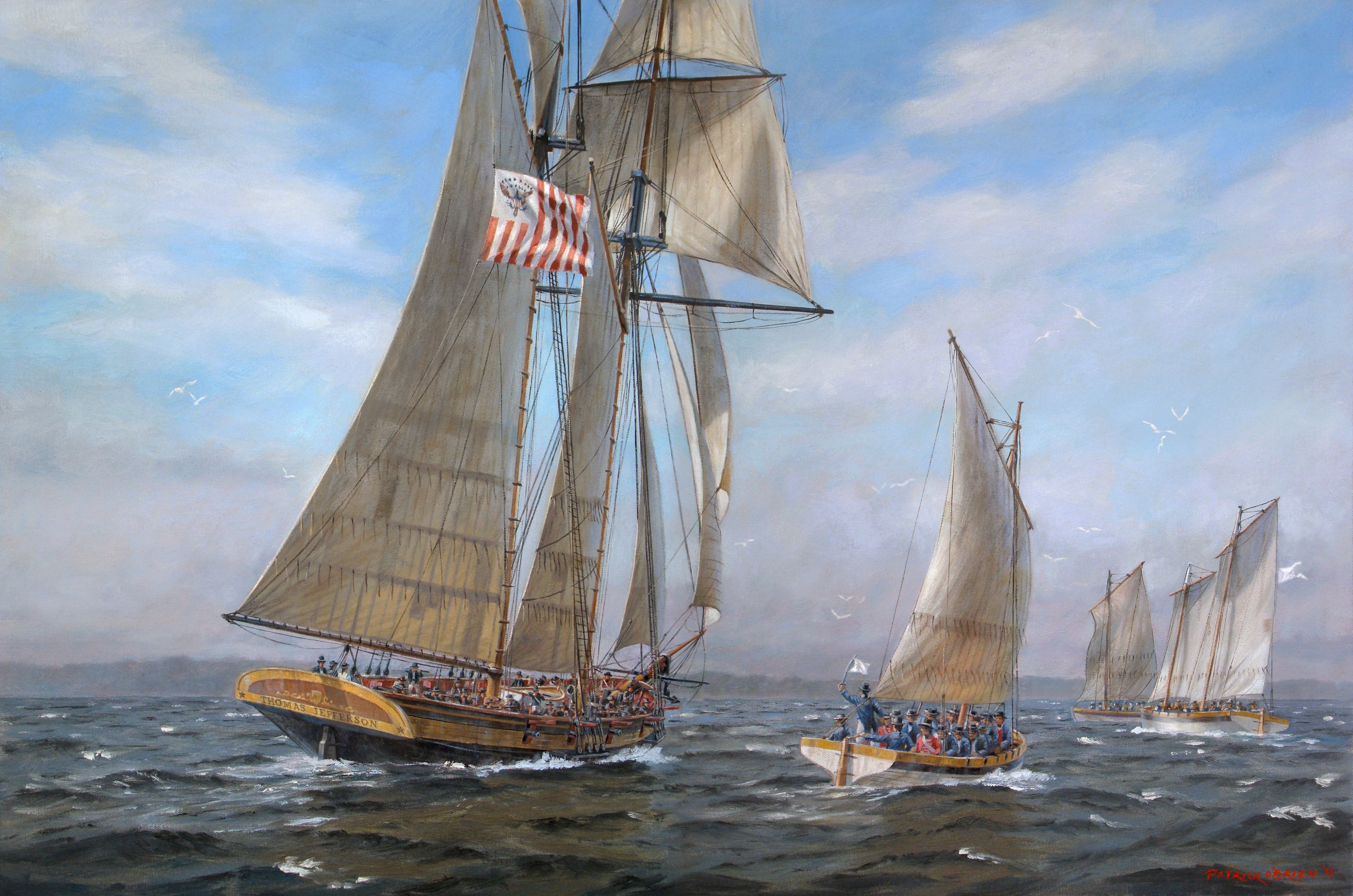
Revenue Cutter Thomas Jefferson captures three Royal Navy barges and personnel in Hampton Roads. US Coast Guard Collection.

Below you will find the text of the Commandant’s ALCOAST regarding the upcoming Aug. 4, “Coast Guard Day.”

I find it curious that it only talks about the Law Enforcement Mission, and almost exclusively drug enforcement, with only a mention of fisheries and no mention of alien migrant interdiction, environmental protection, or marine safety regulation. No mention of SAR, AtoN, Military Readiness (other than “maintaining our national security”), or recreational boating safety. Notably no mention of icebreaking either domestic or polar when we are seeking funding for icebreakers. No mention at all of the other organizations that were folded in to make the modern Coast Guard.

It is almost as if this is written for a specific audience. Makes me curious as to why it was written the way it was. 

(Incidentally Bill Wells is sure to point out that Alexander Hamilton did not create the Revenue Marine as a Service, and certainly not as a “military service.”)

ALCOAST 253/19
COMDTNOTE 5700
SUBJ:  COAST GUARD’s 229TH BIRTHDAY
1. Sunday, 4 August 2019, marks the Coast Guard’s 229th birthday.
2. The U.S. Coast Guard’s law enforcement mission is its oldest, and sets us
apart from other military services. After the American Revolution, Secretary
of the Treasury Alexander Hamilton was keenly aware of the need to protect
the Nation’s customs revenue, maintain coastal waters, and combat illegal
trade and piracy. On 4 August 1790, Congress, at the urging of Hamilton,
created the Revenue Marine, a military service designed to patrol coastal
waters and regulate the collection of tariffs. The Coast Guard proudly traces
its roots to that date, and for the past 229 years, the Coast Guard has served
the Nation with excellence.
3. The first recorded narcotics seizure by a cutter occurred on 31 August 1890.
A detail of four officers and eighteen men of the Revenue Cutter WOLCOTT boarded
and discovered a quantity of opium on the steamer GEORGE E. STARR. The vessel
and its illegal cargo were seized for violations of U.S. customs law.
4. On 16 January 1920, Prohibition became the law of the land. Given the mission
of preventing liquor smuggling into the United States, the Coast Guard saw a
rapid expansion of both facilities and personnel. By 1924, the “Rum War”
escalated. Smuggling from the sea, particularly along the East Coast, grew into
an immense, highly-coordinated criminal activity. That criminal behavior was met
with intensive and aggressive action by the Coast Guard. When Prohibition ended
on 5 December 1933, Coast Guard Headquarters reported: “The continued pressure
of Coast Guard preventative measures was a potent factor in reducing the volume
of the smugglers’ business and in bringing about a change of smuggling technique.”
5. By the 1970s, the Coast Guard faced an escalation of drug smuggling on the high
seas. This rapid growth of the maritime illegal narcotics trade drove the need for
highly-trained boarding teams and Law Enforcement Detachments (LEDETs), to specialize
in drug interdiction. On 1 November 1984, CGC CLOVER seized 13 tons of marijuana.
Three days later, CGC NORTHWIND became the first icebreaker to make a narcotics
seizure, capturing 20 tons of marijuana. On 8 May 1987, Coast Guard units seized 1.9
tons of cocaine. In 1989, the National Defense Act named the Coast Guard as the lead
agency for maritime drug interdiction.
6. Over the next several years, Coast Guard units continued to interdict drug
traffickers, seizing tons of marijuana and cocaine. CGC DAUNTLESS became the first
cutter in history to seize one million pounds of marijuana. In 2004, Coast Guard teams
intercepted and seized two ships near the Galapagos Islands, resulting in the capture
of more than 56,000 pounds of cocaine. In March 2007, CGCs HAMILTON and SHERMAN seized
42,845 pounds of cocaine aboard a Panamanian-flagged vessel.
7. Today, the mission continues. In July, CGC MUNRO, our newest operational National
Security Cutter, completed its first-ever counter-drug patrol in the Eastern Pacific.
The interdiction of a self-propelled semi-submersible (SPSS) on 18 June resulted in
17,000 pounds of cocaine, the largest single seizure since 2015. Nine total interdictions
resulted in nearly 40,000 pounds of illicit narcotics with a wholesale value of $569
million dollars. During the patrol, MUNRO’s crew worked closely with the Coast Guard’s
Helicopter Interdiction Tactical Squadron (HITRON), which celebrates its 20th anniversary
this year with over $21 billion in seized narcotics from airborne use-of-force interdictions.
8. As we celebrate the 229th birthday of the Coast Guard, it is evident that our first
mission remains one of our most important today. Coast Guard air and surface assets, as
well as our brave men and women, are tasked with enforcing fisheries laws, ensuring secure
ports and waterways, keeping illegal narcotics off our streets, and maintaining our national
security. We remain “Semper Paratus – Always Ready.”
9. ADM Karl Schultz, Commandant, sends.
10. Internet release authorized.

Stratton Participates in Talisman Sabre 2019

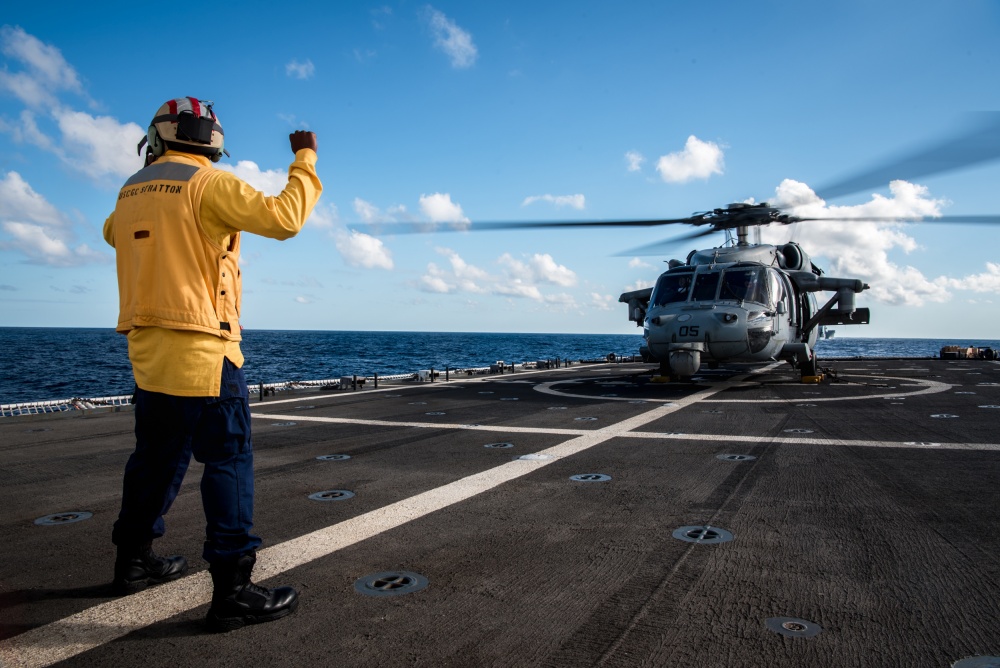
Lt. Wes Figaro, a pilot attached to Coast Guard Cutter Stratton, guides a Navy helicopter as it lands on the flight deck of Stratton in the Coral Sea July 11, 2019.  (U.S. Coast Guard photo by Petty Officer 2nd Class Jasmine Mieszala)

Below is a press release regarding USCGC Stratton’s participation in Exercise Tallisman Sabre 2019 hosted by the Australian Navy. This is a large biannual exercise. For the first time, Japan’s newly formed amphibious brigade participated in the amphibious landings as well as two Japanese ships. 

“Exercise Talisman Sabre will involve more than 34,000 personnel from Australia and the United States.

“Forces from Canada, Japan, New Zealand, and the United Kingdom will be embedded alongside Australian Defence Force personnel, and delegations from India and the Republic of Korea will observe the exercise. Eighteen nations from across the Indo-Pacific region have also been invited to an international visitors program.”

—-

U.S. Coast Guard story and photos by:
Petty Officer 2nd Class Jasmine Mieszala

The U.S. Coast Guard participated in Talisman Sabre 2019 in July, a bilateral exercise held every two years between the U.S. and Australia, and this year’s exercise marked the first for the Coast Guard since the exercises first began in 2005. TS 19 was designed to train U.S. and Australian forces across high-end, mid-intensity warfighting scenarios and to improve combat training, readiness and interoperability. This exercise illustrated the U.S., Australian alliance and the strength of military-to-military relationships in the eighth iteration of the exercise.

 “We supported 7th Fleet amphibious operations,” said Lt. Cmdr. Andrew Dunlevy, the operations officer aboard Coast Guard Cutter Stratton. “We were part of an amphibious readiness group that conducted a combined exercise to move Marines and associated equipment ashore in a simulated hostile environment.”

One of the Coast Guard’s primary roles in TS 19 was to serve as a forward screening vessel. As the force moved north, Stratton was sent as an advanced unit to help identify possible landing areas for amphibious operations and to ensure the water north of the force was clear of threats before the force moved in behind Stratton. The crew of Stratton used air and surface assets to conduct searches as part of the forward screen.

“We’re learning about what it means to be a part of this exercise – where we’re falling short, where we have capabilities to add and where we don’t,” said Dunlevy.

Stratton is currently the only Coast Guard cutter that has small unmanned aircraft system (sUAS) capabilities permanently attached the ship. The sUAS is capable of flying more than 16 hours, has a maximum speed of 60 knots and can provide real-time data to the ship to provide intelligence, surveillance and reconnaissance.

This capability allows the Coast Guard to provide real-time surveillance to battle staff and exercise planners, and it allows them to explore the skills and expertise the Coast Guard can bring to both exercises and real-world scenarios.

The Stratton is the Coast Guard’s third national security cutter (NSC) and is homeported in Alameda, California. National security cutters are the Coast Guard’s key interoperability platform in the afloat arena. NSCs are capable of executing challenging operations, including supporting maritime homeland security and defense missions, as well as operating in open ocean environments and supporting international partner agencies.

TS 19 included field training exercises, force preparation, logistic activities, amphibious landings, land force maneuvers, urban operations, air operations, maritime operations and special forces activities. The exercise provided an opportunity to conduct operations in a combined joint and interagency environment that increased both countries’ ability to plan and execute contingency responses, from combat missions to humanitarian assistance efforts.

“Talisman Sabre was key to the U.S. and to the Coast Guard because we were able to exercise relationships with our international partners, to conduct training necessary and to help maintain regional security, peace and stability,” said Dunlevy.

Though this is the Coast Guard’s first time participating in Talisman Sabre, the experience and knowledge gained from participating in the exercise is proving to be instrumental.

“We will provide an after-action report detailing how we were employed and how we think we could better add to the exercise next time,” said Dunlevy. “We hope the Coast Guard is invited back for the next Talisman Sabre. This has been a huge win for the Coast Guard.”

“More US Military Power Needed in Antarctic to Deter Malign Activity, General Says” –Military.com

The Coast Guard Icebreaker program is getting support from an Airforce General. Military.com reports Pacific Air Forces commander Gen. Charles Q. Brown is seeing signs that Great Power competition may be coming to Antarctica.

“The Arctic … is kind of a precursor to the way I look at the Antarctic,” Brown said. “The capabilities that we have in the Arctic are the same capabilities that we probably want to have in the Antarctic. And when I look at the competition, and the melting ice in the Arctic, and the competition with both Russia and China … we’ve got to pay attention to that,” he said.

Brown said he believes the South Pole “is just a number of years” away from being the same kind of focal point of competition for Russia and China that the Arctic is now.

While the treaty bans militarization and weapons use on the continent, it allows for the flow of military personnel and equipment into the region. In 1998, an additional measure was added to the treaty, called the “Protocol on Environmental Protection,” which stipulates that “any activity relating to mineral resources, other than scientific research, shall be prohibited.”

That measure is set to expire in 2048, Brown said. The general hinted there already may be non-sanctioned activity taking place in the region.

At some point in the future one of the several nations with interests in Antarctica is going to try to act on a claim to this the last land on earth without a recognized sovereign authority. When that happens we are going to see a land rush and likely a clash of some sort. When the Antarctic treaty was signed, seven sovereign states had already made claims to Antarctic territory. There were already conflicting claims between the UK, Argentina, and Chile. The US and USSR (Russia now as its successor) reserved the right to make future claims. Since then, three additional South American countries have declared that they have interests there, and China has taken advantage of the provisions of the treaty to allow it to become a major player in Antarctica.

Antarctica has been seen as a zone of peace, but unless a treaty can be negotiated that would allow it to be exploited as a condominium, to me it has the makings of a powder keg. 

“Joint Bomber Patrol Over the Pacific: The Russo-Chinese Military Alliance in Action” –Eurasian Daily Monitor

CSR Report RL33153 China Naval Modernization: Implications for U.S. Navy Capabilities—Background and Issues for Congress by Ronald O’Rourke dated February 28, 2014. Page 8 – Figure 1. Jin (Type 094) Class Ballistic Missile Submarine Source: Photograph provided to CRS by Navy Office of Legislative Affairs, December 2010.

The Jamestown Foundation’s Eurasian Daily Monitor reports on the implications of growing alliance between Russia and China reflected in their recent joint bomber patrols intercepted off S. Korea and Japan.

There is an interesting aspect to this growing alliance that might suggest more reason for US military construction and activity in the Arctic, which, in turn, may require more icebreaker support.

“Russian military expert Alexander Shirokorad…Building on earlier Russo-Chinese missile- and air-defense cooperation that necessarily involved the transmission of highly classified information between them…openly advocates for joint Russo-Chinese air- and missile-defense infrastructure in the Arctic. Unexpectedly, however, he also advances an entirely new concept of allowing Chinese nuclear-armed submarines to gain critical support from Russian Arctic ports. It is difficult to gauge to what degree Shirokorad’s article was meant to have been a justificatory trial balloon. But the piece clearly takes on additional significance when looked at in the context of the Pentagon’s annual report on China, which explicitly warns that Beijing may eventually start deploying nuclear submarines in the Arctic.”


“Hellenic Coast Guard Testing Tethered Aerostat for FRONTEX Mission” –Naval News

Aerostat being tested by the Hellenic Coast Guard for FRONTEX.

Naval News reports that the Hellenic Coast Guard is doing something of a 28 day comparison test between land based and Aerostat based surveillance systems on the island of Samos.

Putting a radar at 1000 meters should provide a radar horizon of about 70 nautical miles and allow detection of a 50 foot high target at up to 79 miles.

USCGC Robert Ward (WPC-1130) Makes First Eastern Pacific Transit Zone Drug Bust by an FRC

A Coast Guard Cutter Robert Ward crew member inspects and prepares to test suspected contraband seized from a suspected drug smuggling boat in international waters of the Eastern Pacific Ocean, July 16, 2019. Commissioned March 2, 2019, Robert Ward’s interdiction marks the first drug interdiction in the Eastern Pacific Ocean by a Fast Response Cutter. U.S. Coast Guard photo.

A recent press release suggests that we will be seeing new, different, smaller ships engaged in drug interdiction in the Eastern Pacific drug transit zone. This could be precedence for a new kind of operation. I will only quote a part of it.

SAN DIEGO, Calif. — The crew of the Coast Guard Cutter Steadfast (WMEC-632) is scheduled to offload more than 26,000 pounds of seized cocaine in San Diego Friday.

The cocaine, worth an estimated $350 million, was seized in international waters of the Eastern Pacific Ocean. The contraband represents six suspected drug smuggling vessel interdictions and the recovery of floating cocaine bales by the crews of two Coast Guard cutters off the coasts of Mexico, Central and South America between late June and mid-July.

Six of the interdictions were carried out by the Steadfast’s crew, one of the Coast Guard’s oldest cutters commissioned in 1968. One interdiction was by the crew of one of the service’s newest ships, the Coast Guard Cutter Robert Ward (WPC-1130) commissioned in March, and is not only the cutter’s first drug bust, but the first drug bust by a Coast Guard Sentinel-class fast response cutter in the Eastern Pacific Ocean. (emphasis applied–Chuck)

We have had a problem having enough ships on scene to take advantage of all the intel available. I have long suggested that the FRCs might be used in the Eastern Pacific, possibly with a supporting vessel. The Navy used one of their Cyclone class PCs for drug interdiction in the Eastern Pacific in 2018, confirming that the use of these smaller vessels was probably viable.

I had really expected Atlantic Area to do this first, since they have so many Webber class in the Seventh District (19, soon to be 20 FRCs), and they got them first (since 2012). Still the Eastern Pacific Transit Zone is a Pacific Area show, perhaps that is why it is PACAREA, using the Robert Ward, only the second West Coast CONUS FRC, commissioned little over four months ago, that took the initiative.

It looks like the Steadfast may have provided some support to the Robert Ward. This might have been facilitated by the fact that Steadfast is also a PACAREA asset.

Hopefully, if there were no unanticipated problems, this will be the start of a pattern of successful FRC deployments to the transit zone. To take full advantage of the concept, we really need Atlantic Area participation. They have far more assets and are actually closer to the transit zone. Excluding FRCs in the 14th and 17th Districts (Hawaii and the Western Pacific and Alaska) PACAREA has only four WPCs. They could maintain perhaps one FRC in the Transit Area continuously, while LANTAREA could maintain at least three and probably more.

Something we really should look at is, what is limiting the endurance of the vessels to five days? For a vessel of this size, it should be more like ten days. Feedback on the post linked above, suggest they are limited by “their very small dry-stores and refrigerator units, and the crew’s laundry.” Perhaps a ShipAlt is in order.

“Cutter Bertholf’s Indo-Pac Deployment Highlighted Coast Guard’s National Security Role” –USNI

The U.S. Coast Guard Cutter Bertholf (left) moves in formation with Philippine coast guard vessels Batangas (center) and Kalanggaman during an exercise on May 14. U.S. Coast Guard/Chief Petty Officer John Masson

This piece from Naval Institute News Service is worth a read. It is an illustration of what the Commandant was talking about here.

“Schultz: Coast Guard Expanding Western Pacific Operations” –USNI

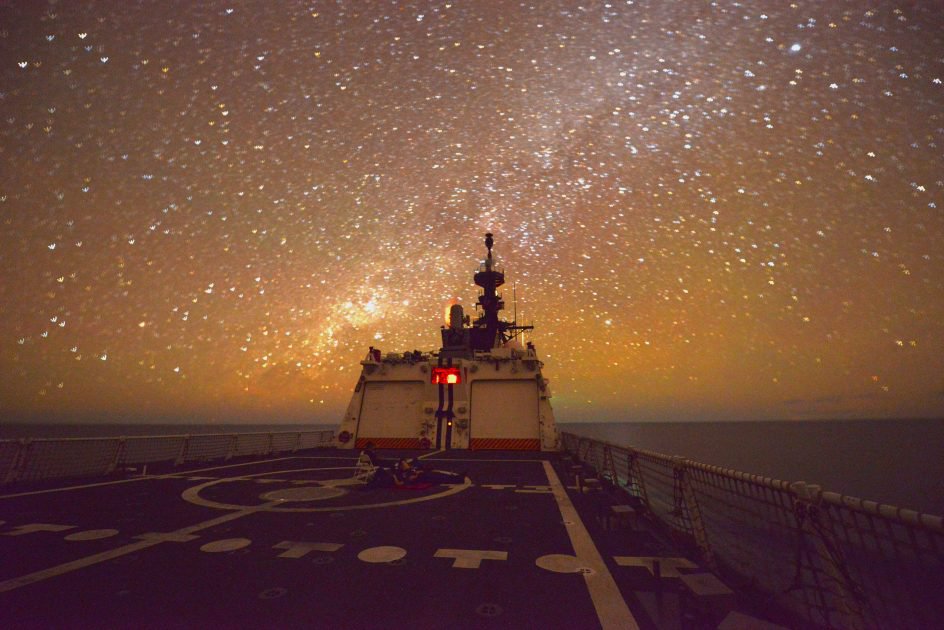
USCGC Bertholf (WMSL-750) crew members observe the stars from Bertholf’s flight deck as the cutter and crew patrol the South China Sea on April 21, 2019. US Coast Guard Photo

The US Naval Institute News Service is reporting,

KUALA LUMPUR – The U.S. Coast Guard will increase its presence and deployments to Asia – particularly around Oceania and U.S. Pacific territories – and test out a new operational deployment concept in the region, service head Adm. Karl Schultz told reporters on Thursday.

We have been seeing this happening. The Coast Guard has begun spending more time in and around the Western Pacific, particularly around US Western Pacific territories and Oceania.

The reference to use of a buoy tender as a mothership to support patrol craft operations looks like a test to see how useful the proposed basing of three Webber class cutters in Guam might be.

The Commandant suggested that the tender might partner with Australian, New Zealand, or Japanese vessels as well. He promised,

““In the face of coercive and antagonistic behavior, the United States Coast Guard offers transparent engagement and partnership,…”

There is no reason this should not work, hopefully it will lead to similar multi-unit operations in the Eastern Pacific drug transit areas where the Webber class could augment larger cutters.

“Let the Coast Guard Helm Alaskan Command’s Maritime Component” –USNI

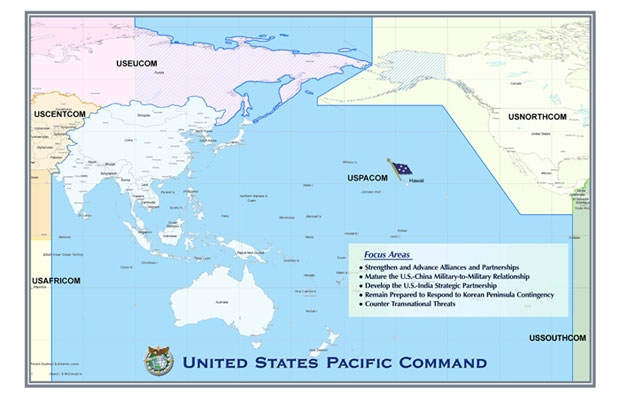
PACOM Area of Responsibilty

Two officers, one Army and one Air Force, both with experience in Alaska Command, find that the organization of naval support for the Command is problematic and suggest that making CCGD17 the Naval Component Commander is the solution.

In 2014, the subunified Alaskan Command was reassigned from Pacific Command to NorthCom. Alaskan Command owns the joint force activities in the land and air domains over Alaska and the Arctic and coordinates with Naval Forces Northern Command (NavNorth)—based some 4,500 miles from Alaska—for maritime joint operations. The Alaskan Command commander also is responsible to North American Aerospace Defense Command (NORAD) for the Alaskan region’s air defense and identification zone (ADIZ), which extends to the North Pole and along the eastern border of Russia. Currently, the maritime warning responsibilities in the Arctic are held at NORAD headquarters in Colorado, and maritime domain awareness responsibilities are retained with the NavNorth Commander in Norfolk, Virginia.

With three different chains of command, none of which own surface vessels around the waters of Alaska, Alaskan Command’s ability to conduct homeland defense is at risk because of a cumbersome command-and-control structure beset with the challenges of distance and limited expertise in operating in the Arctic. There is a more effective command-and-control structure to protect the homeland in the Arctic: establishing the U.S. Coast Guard as the Joint Force Maritime Component Commander of Alaskan Command.

This is recognition of a problem we looked at before, and my conclusion was that Alaska should be reassigned to PACOM. Short of that there is another alternative I will get to below, and they do seem to have a good workable proposal for a Joint Inter-Agency Task Force (North)

There has been almost no cooperation between the Navy and Alaska Command. That may be starting to change. In May the Navy conducted Exercise Northern Edge 2019. The Navy talked about this a relearning how to operate in the Arctic, but as far as I can tell, they never got into the Arctic. Apparently the Carrier Strike Group stayed in the Gulf of Alaska, but at least they did work with the Air Force in Alaska.

Admittedly the US Navy has limited capability in the Arctic.

“…the Navy’s minimal involvement in the region is for good reason: the Navy has limited Arctic capability, apart from submarines and patrol aircraft. Essentially, there are no current requirements levied on the U.S. Navy necessitating an Arctic presence.”

That also might be changing. It is not unlikely that the Navy will return in at least some fashion to Adak as it has in Iceland..

“Last year, the Navy indicated it would like to begin flying submarine-hunting P-8 Poseidon aircraft from Adak Island hundreds of miles off the Alaskan coast in the Aleutian island chain, which would put US aircraft at the westernmost airfield that can handle passenger aircraft in the United States.”

Joint Force Maritime Component Commander

To be the Naval Component Commander you have to be ready for high end conflicts as well as the more routine requirements. Submarines and Maritime Patrol Aircraft are critical assets for success in any major conflict in the Arctic. They are also forces the Coast Guard is not ready to command.

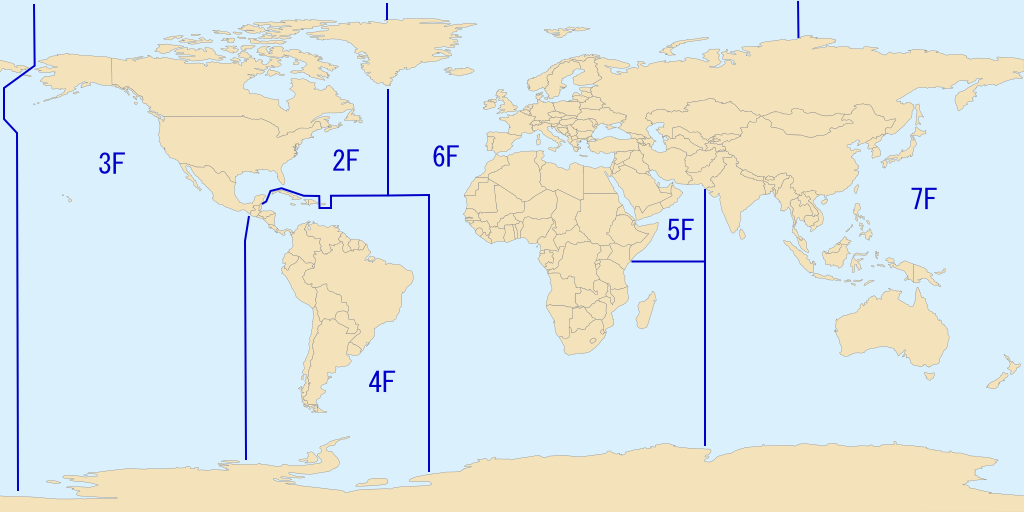
US Navy Fleet Organization

Surely that Maritime Component Commander should be Third Fleet. Additionally, as I noted earlier, It makes no sense to divide the Bering Sea and the Chukchi Sea between 3rd Fleet and 7th Fleet. Third Fleet should assume responsibility for all of PACOM’s Arctic waters including the entire Bering Sea and the Aleutians. (7th Fleet already has more than enough to do in the Western Pacific and Indian Ocean.)

Joint Inter-Agency Task Force (North):

Meanwhile it would make sense for the Coast Guard to participate in formation of a Joint Inter-Agency Task Force (North) for the purpose of Disaster Relief/Humanitarian Assistance, response to major SAR cases, and dealing with possible Russian, or even Chinese, Gray Zone operations in the Arctic.