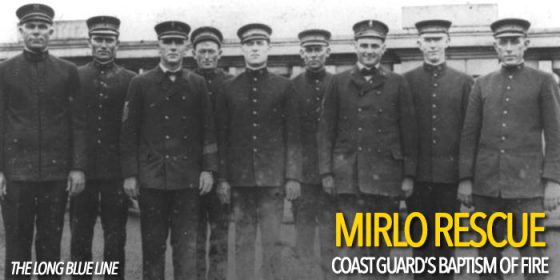
The Life-Saving Service crew that manned the Chicamacomico Station in 1918 when the famous Mirlo rescue took place. U.S. Coast Guard photo.
Coast Guard Compass brings us a great story, a wartime rescue of 42 men from a burning gasoline tanker.

The Life-Saving Service crew that manned the Chicamacomico Station in 1918 when the famous Mirlo rescue took place. U.S. Coast Guard photo.
Coast Guard Compass brings us a great story, a wartime rescue of 42 men from a burning gasoline tanker.

Navy photo
National Defense Magazine has a post looking at two “big Bets” by R&D labs, and the first of these is the Coast Guard R&D Center’s examination of unmanned systems.
The second half of the article is about the Office of Naval Research’s interest in high energy lasers.
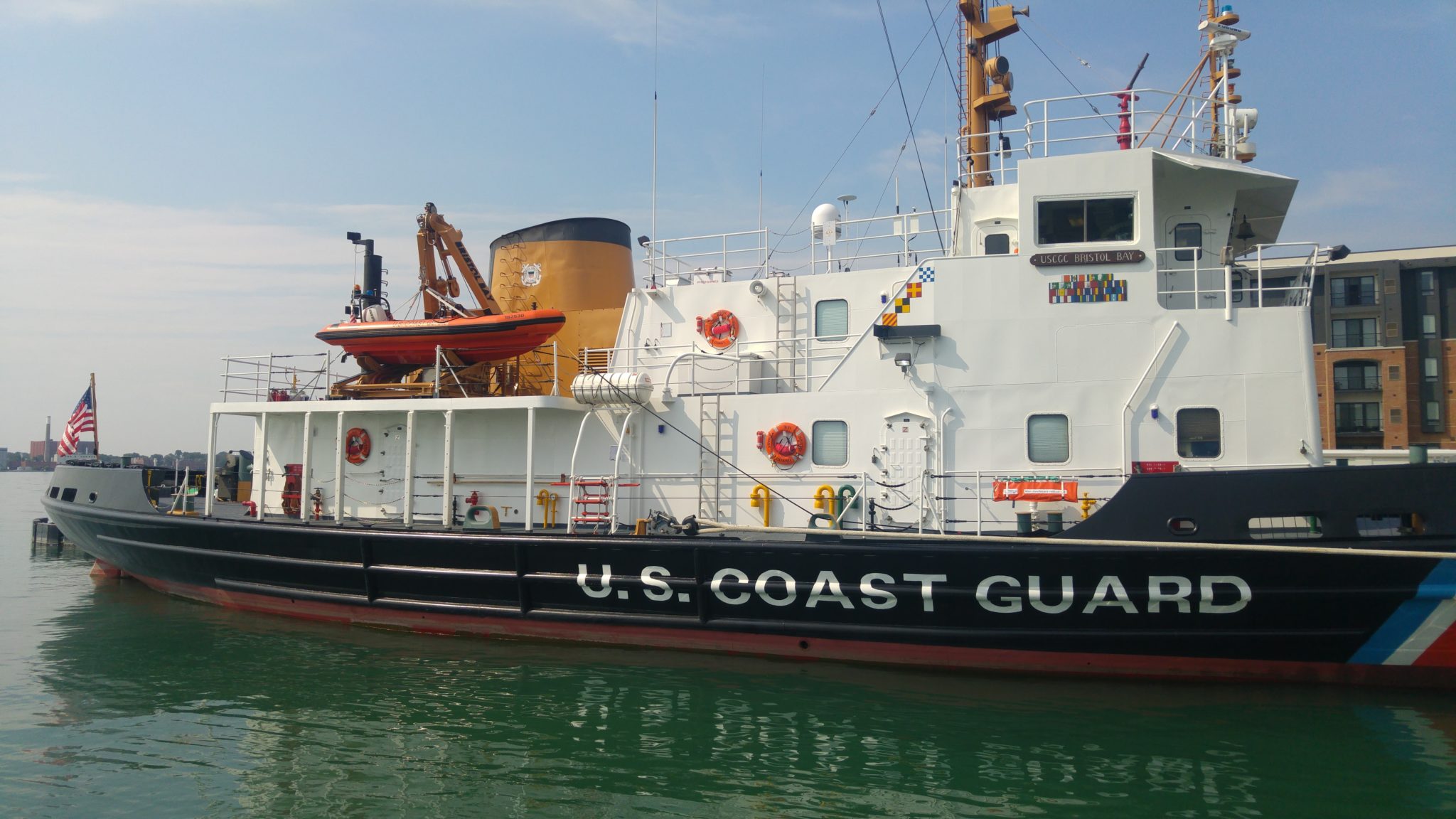
140 foot icebreaking tug with new davit
The In-service Vessel Sustainment Program modifications for the 140 foot domestic icebreaking tugs include a new davit that should make boat launching much quicker and easier. Compare the photo above with the earlier photo below. You can see that the O-1 deck has been extended out to the side of the hull and the new davit replaced a kingpost style derrick. Here is the vendor’s press release that provided the more recent photo. 
Katmai Bay (WTGB 101) is tied to the pier at Group Sault Saint Marie, Michigan, Sept. 2001. USCG photo by PA1 Harry C. Craft III
Thanks to Lee for bringing this to my attention.

Participants in the Tradewinds 2018 exercise. Seen here are U.S. Coast Guard Cutter Charles David Jr. (WPC-1107, most distant); the British RFA Mounts Bay (L3008, left), a Bay-class auxiliary landing ship dock; Canada’s HMCS Shawinigan (MM 704, right), a Kingston-class coastal defense vessel; and Mexico’s ARM Oaxaca (PO 161, foreground), an Oaxaca-class patrol vessel along with a Mexican helicopter AS365N3 Panther. 180616-N-ZZ999-0004.JPG Photo By: Able Seaman John Iglesias
CIMSEC provides a brief review of the SOUTHCOM sponsored 2018 Tradewinds exercise along with background information about current maritime security challenges in the Caribbean.
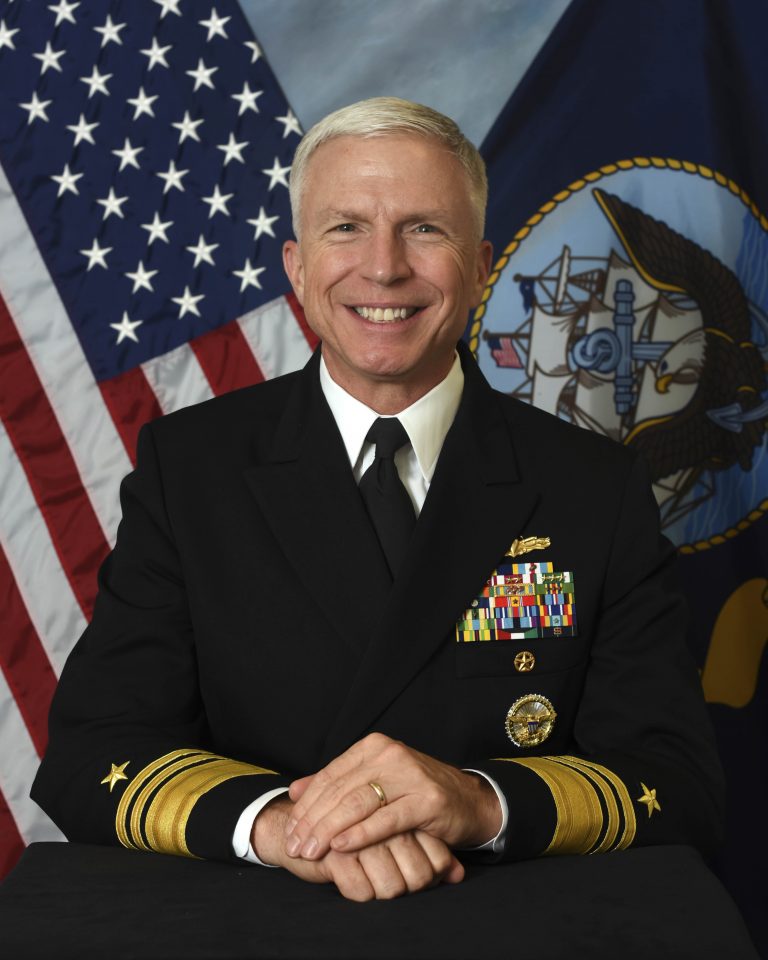
Vice Adm. Craig S. Faller. US Navy Photo
Navy Times reports that the nominee to replace Admiral Tidd as SOUTHCOM has been identified as VAdm. Craig S. Faller, currently Senior Military Assistant to the Secretary of Defense.
We know, if confirmed, most of his fleet will be painted white with racing stripes so this is potentially important to the Coast Guard.
gCaptain reports the Royal National Lifeboat Institution has a new class of 13 meter motor (Surf) Lifeboats that are unique in being waterjet propelled.
Comparing Wikipedia descriptions, the Shannon class are composite compared to aluminum construction for the Coast Guard’s 47 foot MLB. Displacement is lower (14.6 tons vs 18 tons). Length is slightly less (44’7″ vs 47’11”). Beam is slightly greater (14’11” vs 14’0″). Draft is less (2’6″ vs 4’6″). Speed is slightly higher (27 knots vs 25). Range is up (250 vs 200)

The RNLI vessel Shannon being recovered. RNLI photo
As reported in the Wikipedia description of the class,
Most Shannons are launched by a newly-designed launch and recovery system by which a tractor propels the lifeboat on its cradle into the water. The cradle is then tilted and acts as a mobile slipway as the boat is launched by release of a single chain from the wheelhouse, rather than the old carriage launched method of four chains being released by crew members on deck. Recovery is bow first onto the cradle, which then rotates through 180 degrees, enabling the boat to be launched again within ten minutes. Some Shannons will be kept afloat at moorings or a pontoon berth and the boats are also capable of being slipway launched, although only Swanage currently has a slipway launched Shannon. The boat at Workington uses the same unique davit crane system as the previous Tyne class boat.
Thanks to Lee for bringing this to my attention.
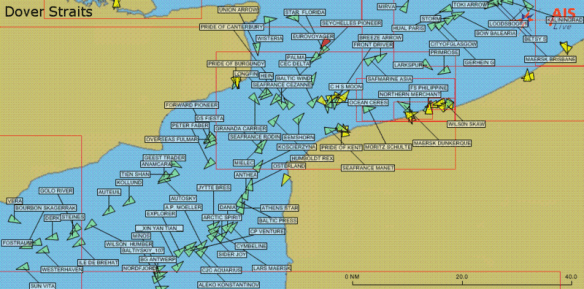
Display of maritime traffic provided by AIS. Only vessels equipped with AIS are displayed, which excludes most fishing boats, pleasure craft, inland navigation and vessels less than 300 tons. Location: Dover Straits/English Channel. Author: fr:User:Pline
Quoted below is a potentially important safety alert, #13-18, from the Coast Guard.
The U.S. Coast Guard has received reports from crews, ship owners, inspectors and other mariners regarding poor reception on VHF frequencies used for radiotelephone, digital selective calling (DSC) and automatic identification systems (AIS) when in the vicinity of light emitting diode (LED) lighting on-board ships (e.g., navigation lights, searchlights and floodlights, interior and exterior lights, adornment).
Radio frequency interference caused by these LED lamps were found to create potential safety hazards. For example, the maritime rescue coordination center in one port was unable to contact a ship involved in a traffic separation scheme incident by VHF radio. That ship also experienced very poor AIS reception. Other ships in different ports have experienced degradation of the VHF receivers, including AIS, caused by their LED navigation lights. LED lighting installed near VHF antennas has also shown to compound the reception.
Strong radio interference from LED sources may not be immediately evident to maritime radio users. Nonetheless, it may be possible to test for the presence of LED interference by using the following procedures:
If the noise floor is found to have been raised, then it is likely that both shipboard VHF marine radio and AIS reception are being degraded by LED lighting.
In order to determine the full impact of this interference, the Coast Guard requests those experiencing this problem to report their experiences to Coast Guard Navigation Center. Select “Maritime Telecommunications” on the subject drop down list, then briefly describe the make and model of LED lighting and radios effected, distance from lighting to antennas and radios effected, and any other information that may help understand the scope of the problem.
This Safety Alert is provided for informational purposes only and does not relieve any domestic or international safety, operational, or material requirement. Developed by the U.S. Coast Guard, Spectrum Management and Telecommunications Policy Division. Distributed by the Office of Investigations and Analysis. Questions may be sent to HQS-PF-fldr-CGF-INV@uscg.mil.
Four new Offshore Patrol Vessels (OPV) projects, totaling 20 vessels, have been reported.
NavyRecognition reports the French Navy has issued a Request for Information preparatory to procurement of six OPVs to operate from French overseas territories. They are seeking 22 knot vessels about 70 meters (230 feet) in length with facilities to support a vertical take off and landing (VTOL) unmanned air system (UAS). Given France’s recent history with OPVs these may look a lot like Offshore Supply Vessels.
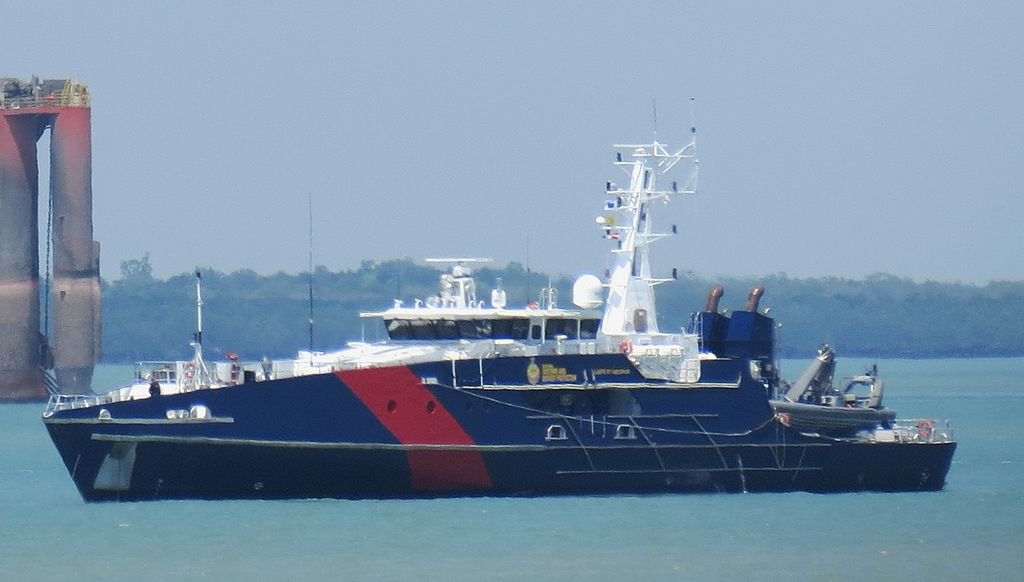
The Australian Customs patrol boat ACV Cape St George on Darwin Harbour in 2014, Photo by Ken Hodge
Australian Shipbuilder Austal has been contracted to build two Cape Class OPVs (illustrated above) for the Trinidad and Tobago Coast Guard. These are 58 meter (190 foot) 25 knot vessels with a 4,000 mile range. Ten have already been built for the Australian Navy and Border Force.
It appears Austal’s yard in the Philippines may be building six 80 meter OPVs for the Philippine Navy. These would reportedly be based on the Cape Class Patrol Vessels, but would be much larger, have steel hulls, and helicopter support facilities (helo deck certainly, but not clear if that would include a hangar).

Indian Navy Photo: INS Saryu, the lead ship of her class of advanced offshore patrol vessels of the Indian Navy
India is planning to procure six “New Generation Offshore Patrol Vessels.” It sounds like these will evolve from the Saryu Class OPV which are 2,230 tons displacement, 344 feet in length, 42 foot of beam, with a 12 foot draft with a speed of 25 knots. The Saryus are armed with a 76mm Oto Melara gun and two Soviet designed AK-630, 30mm six barrel Gatling guns (just forward of the funnels in the photo). They also have a hangar and flight deck for a HAL Dhruv medium weight helicopter. The new ships should be at least equal in capability.
CSIS and the United States Naval Institute (USNI) conduct an interview with Admiral Karl L. Schultz, the 26th Commandant of the United States Coast Guard, conducted 1 August, 2018.
Below I will attempt to outline the conversation, noting the topics and in some cases providing a comment.
The first question is about immigration. Coast Guard is the “away game.” minimizing the factors that push immigration to the US.
The Commandant does not expect a substantial increase in help from the Navy, because they are already heavily tasked, but would welcome any additional help.
06:30 Talk about Inland fleet. Congressional support is evident. $25M provided so far.
9:20 House Appropriations Committee decision to divert $750M from the icebreaker program to fund “the Wall” in their markup of the FY2019 budget bill. The Commandant is “guardedly optimistic”
11:30 Human capital readiness? Operating account has been flat and effectively we have lost 10% in purchasing power. Want to increase leadership training.
16:30 Support for combatant commanders.
18:00 Capacity building and partnering. Detachments working on host nation platforms.
21:00 Defense Force planning–Not going back to the MARDEZ model.
22:30 Situation in Venezuela/Preparation for dealing with mass migration.
24:30 Arctic forums–Need to project our sovereignty
29:00 UNCLOS
30:00 Maritime Domain Awareness (MDA)
32:30 Tracking cargo as an element of MDA
34:00 Cyber
36:15 High Latitude engagement/partnerships.
39:30 Perhaps the icebreaker should be the “Polar Security Cutter?”
40:00 International ice patrol, still an important mission.
41:00 CG role in response to Chinese aggressiveness in the South China Sea. In discussion with Indo-Pacific Command. Will see more CG presence there.
44:00 Offshore Patrol Cutter (OPC)–on track
46:30 Border issue — passed on that
48:00 Small satellites–we are looking at them
49:00 African Capacity building/cooperation. May send an MEC.
51:30 Tech modernization. Looking at it more holistically.
Other Coverage:
This interview prompted a couple of notable posts.
SeaPower’s coverage of the discussion is here. They focused on the growth of demands on the Coast Guard.
Military.com reported on the possibility of a greater Coast Guard role in South East Asia and capacity building in Africa. It probably should be noted that the title, “Coast Guard Could Send Ship to Pacific to ‘Temper Chinese Influence’,”is a bit deceptive in that the Commandant’s remark about tempering Chinese Influence was in regard to Oceania, the islands of the Central and Western Pacific. The Commandant was quoted in the Seapower post, “In the Oceania region, there are places where helping them protect their interests, tempering that Chinese influence, is absolutely essential.”
The following ALCOAST is quoted directly with minor reformatting to better fit the page..
R 020955 AUG 18
FM COMDT COGARD WASHINGTON DC//CG-9//
TO ALCOAST
UNCLAS//N07044//
ALCOAST 269/18
COMDTNOTE 7044
SUBJ: SOLICITATION FOR RESEARCH DEVELOPMENT TEST AND EVALUATION (RDT&E) IDEA SUBMISSIONS
1. The RDT&E Program is calling all Coast Guard Innovators to submit new potential project ideas for the FY20 R&D portfolio! Do you have a creative or innovative idea that could help address a current operational challenge or improve mission effectiveness? Now is the time to share them! All active duty personnel, civilians, contractors, and key stakeholders are encouraged to submit. Please check out our current portfolio and website here:http://www.dcms.uscg.mil/acquisition/rdte.
2. We will be collecting ideas through the CG_Ideas@Work website (https://cg-ideasatwork.ideascale.com), the Coast Guard’s idea crowdsourcing platform. You can submit your ideas directly to: https://cg-ideasatwork.ideascale.com/a/ideas/top/campaigns/21252. You can also upload a video (up to 1 minute in duration) to accompany idea submissions. If you do not yet have a CG_Ideas@Work account, you will need to register using your ‘.mil’ email address. If you are unable to access the idea submission form, you can submit your idea via email to: innovation@uscg.mil. Be sure to include the title, the problem statement, operational impact, and your contact information.
3. The deadline to submit ideas for the FY20 Project Portfolio is 12 September 2018. Submitted ideas will be reviewed and ranked according to their potential impact on CG missions; regardless of funding, feasibility, or policy. Stakeholders from across the service will meet 17-18 October 2018 to conduct the annual Idea Submission Review (ISR). ISR rank-ordered results are critical to the process of building the annual RDT&E Project Portfolio.
4. POC: Ms. Alexandra Swan, COMDT (CG-926), at: 202-475-3056 or Alexandra.P.Swan@uscg.mil.
For any questions or assistance with CG_Ideas@Work, please contact innovation@uscg.mil.
5. RADM M.J. Haycock, Assistant Commandant for Acquisition and Chief Acquisition Officer, sends.
6. Internet release authorized.
 Chuck Hill's CG Blog