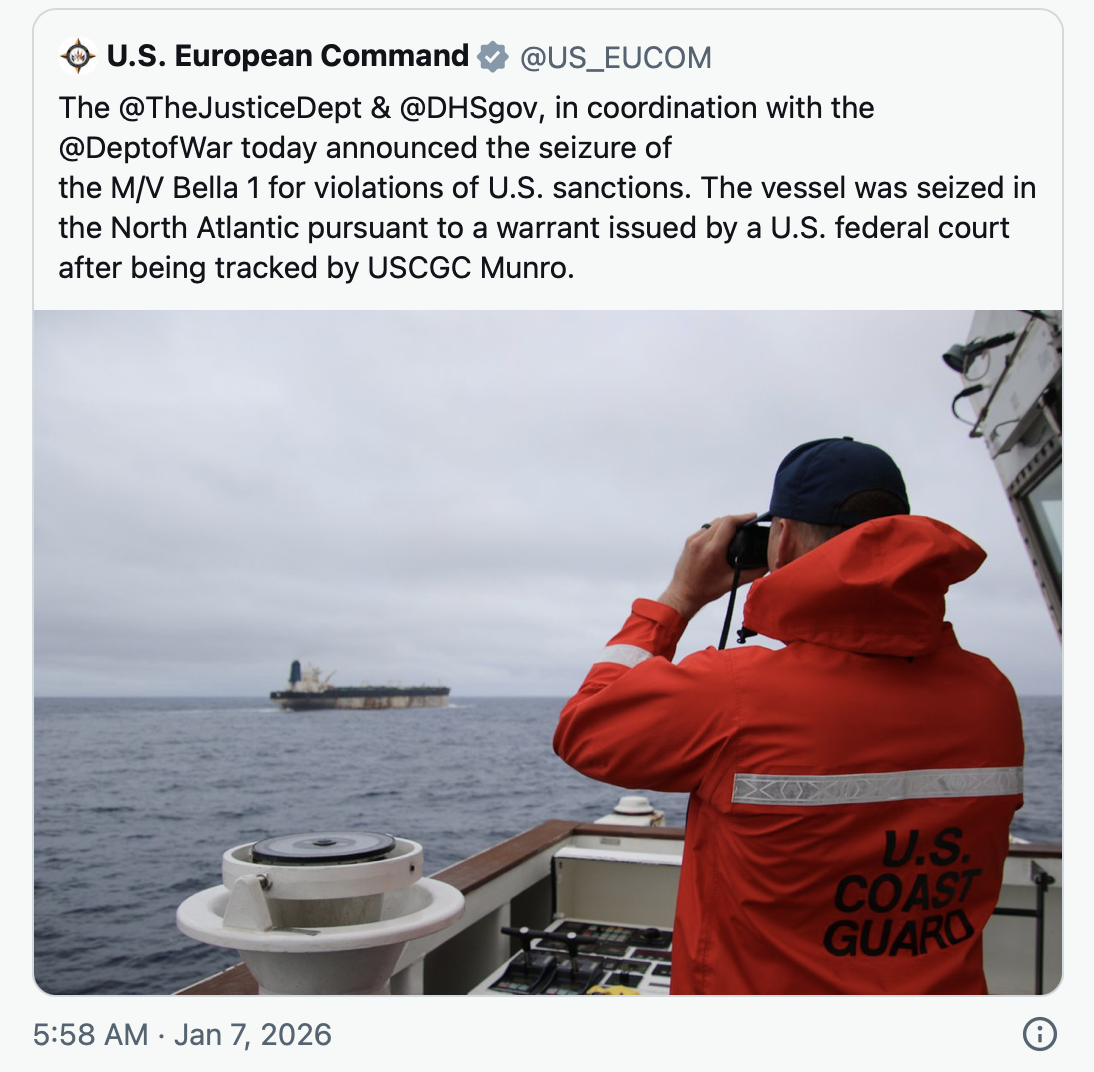
Lots of interesting things involving the Coast Guard happening lately. Recommend this report from The War Zone. Two tankers seized in one day thousands of miles apart, one reportedly protected by a Russian submarine.

Lots of interesting things involving the Coast Guard happening lately. Recommend this report from The War Zone. Two tankers seized in one day thousands of miles apart, one reportedly protected by a Russian submarine.

250323-N-NO146-1001 ARABIAN SEA (March 23, 2025) Illegal narcotics seized from a stateless vessel are stacked on the deck of the U.S. Coast Guard Sentinel-class fast response cutter USCGC Emlen Tunnell (WPC 1145) in the Arabian Sea. (Photo by U.S. Coast Guard) Photo is from the O-1 deck, forward of the bridge, looking forward.
Below is a news release from U.S. Naval Forces Central Command Public Affairs, March 24, 2025
MANAMA, Bahrain —
A U.S. Coast Guard fast-response cutter, working in direct support of New Zealand-led Combined Task Force (CTF) 150 of Combined Maritime Forces (CMF), seized 260 kilograms of illegal narcotics from a vessel in the Arabian Sea, March 19.
The Sentinel-class fast-response cutter USCGC Emlen Tunnell’s (WPC-1145) boarding team discovered and seized 200kg of methamphetamine and 60kg of heroin from the vessel. After weighing and documenting the haul, the crew properly disposed of the narcotics.
Royal New Zealand Navy Capt. Dave Barr, CTF 150 deputy commander, said this drug bust is a testament to the tenacity and expert seamanship of the Coastguardsmen on the Emlen Tunnell operating so far off the coast in challenging waters, and the ability to seamlessly integrate with the multinational CTF 150 staff.
“The waters in this area are full of legitimate fishing and trading vessels so it’s important to get this part right and accurately identify those vessels that are likely to be carrying narcotics,” said Barr. “A big part of our mission is to deter smugglers, so that those legitimate operators can continue to navigate freely to carry out their business.”
This interdiction is part of ongoing efforts to combat illicit drug trafficking in international waters and demonstrates the CMF’s continued commitment to safeguarding maritime security against malign non-state actors.
Emlen Tunnell is forward deployed to Bahrain. The fast response cutter is part of a contingent of U.S. Coast Guard ships operating in the region under Patrol Forces Southwest Asia (PATFORSWA). PATFORSWA deploys Coast Guard personnel and ships alongside U.S. and regional naval forces throughout the Middle East.
CTF 150 is one of five task forces under CMF, the world’s largest international naval partnership. CTF 150’s mission is to deter and disrupt the ability of non-state actors to move weapons, drugs and other illicit substances in the Indian Ocean, the Arabian Sea and the Gulf of Oman.
Combined Maritime Forces is a 46-nation naval partnership upholding the international rules-based order by promoting security and stability across 3.2 million square miles of water encompassing some of the world’s most important shipping lanes.

(February 7, 2025) Coast Guardsmen from the U.S. Coast Guard Sentinel-class fast response cutter USCGC Emlen Tunnell (WPC 1145) seize illegal narcotics from a stateless vessel in the Arabian Sea. (Photo by U.S. Coast Guard)
Below is a news release from Commander U.S. Naval Forces Central Command Public Affairs.
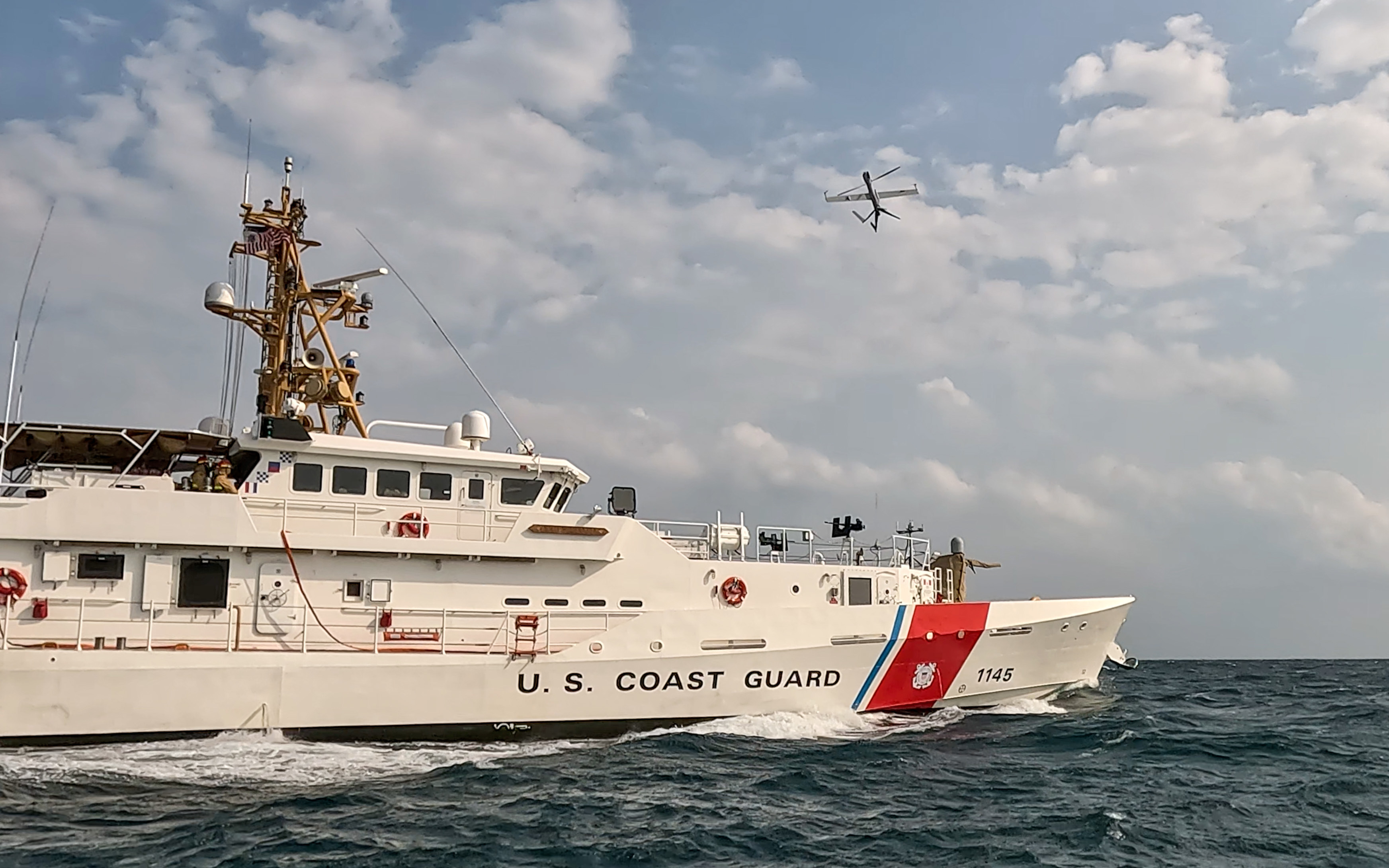
221207-N-NO146-1001 ARABIAN GULF (Dec. 7, 2022) An Aerovel Flexrotor unmanned aerial vehicle (UAV) takes off from U.S. Coast Guard fast response cutter USCGC Emlen Tunnell (WPC 1145) transiting the Arabian Gulf, Dec. 7. U.S. 5th Fleet’s Task Force 59 launched the UAV during Digital Horizon, a three-week event focused on integrating new unmanned and artificial intelligence platforms, including 10 that are in the region for the first time. (U.S. Navy photo)
ANAMA, Bahrain —
A U.S. Coast Guard fast-response cutter, working in direct support of New Zealand-led Combined Task Force (CTF) 150 of Combined Maritime Forces, seized nearly 2,400 kilograms of illegal drugs from a vessel in the Arabian Sea, Feb. 7.
The interdiction by the Sentinel-class fast-response cutter USCGC Emlen Tunnell (WPC-1145) represents CTF 150’s first drug seizure since New Zealand assumed command Jan. 15.
The cutter’s boarding team discovered and seized 2,357kg of hashish from the vessel. After weighing and documenting the haul, the crew properly disposed of the narcotics.
Commodore Rodger Ward, commander of CTF 150, said he’s proud of the team effort that went into making this interdiction a reality after only a few weeks in command.
“Our command is a small cog in a system focused on interdicting illicit trafficking on the high seas,” Ward said. “This is a team effort and this bust would not have been possible without the support of the 46 nations who make up the Combined Maritime Forces.”
Ward noted that every bust we make reduces the flow of finances to terrorist organizations. “This is why we’re here, to contribute to maritime security and protect the rules-based international order,” he said.
Emlen Tunnell is forward deployed to Bahrain. The fast response cutter is part of a contingent of U.S. Coast Guard ships operating in the region under Patrol Forces Southwest Asia (PATFORSWA). PATFORSWA deploys Coast Guard personnel and ships alongside U.S. and regional naval forces throughout the Middle East.
CTF 150 is one of five task forces under Combined Maritime Forces, the world’s largest international naval partnership. CTF 150’s mission is to deter and disrupt the ability of non-state actors to move weapons, drugs and other illicit substances in the Indian Ocean, the Arabian Sea and the Gulf of Oman.
Combined Maritime Forces is a 46-nation naval partnership upholding the international rules-based order by promoting security and stability across 3.2 million square miles of water encompassing some of the world’s most important shipping lanes.
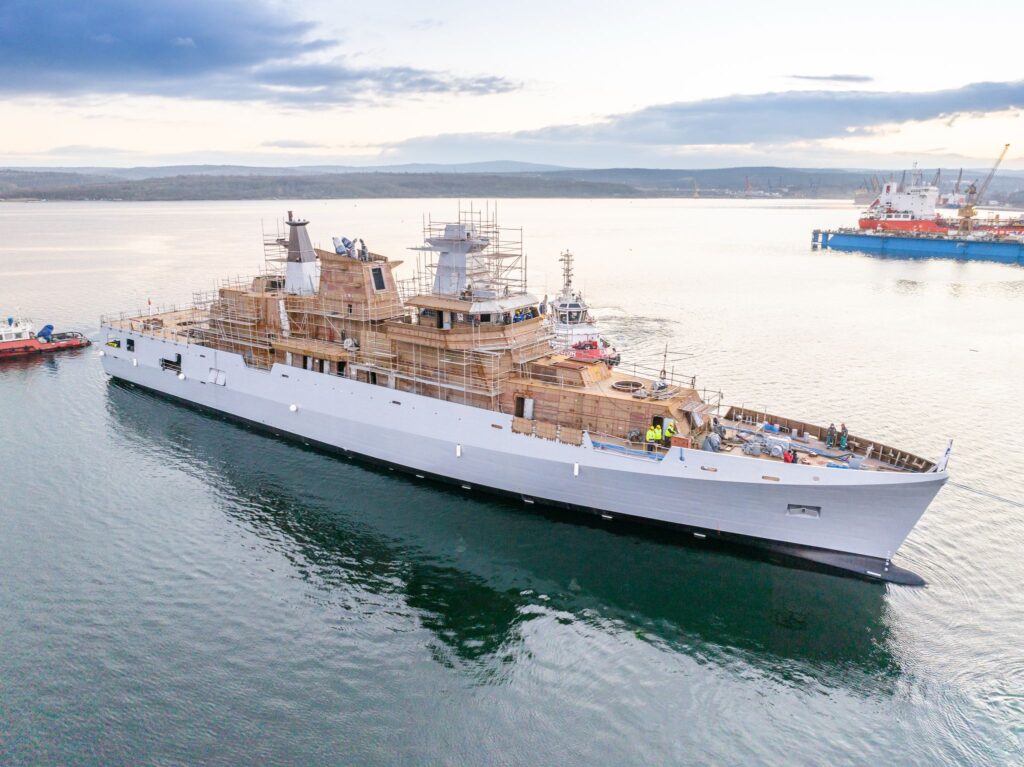
The second of two MMPVs (Multipurpose Modular Patrol Vessels–Chuck) was launched ahead of schedule. According to the contract, it was supposed to take place in April 2025. The two MMPVs are being built under a contract signed November 12, 2020 between the Bulgarian Ministry of Defence and the German shipbuilding group Fr. Lürssen Werft (now NVL – Naval Vessels Lürssen). The vessels will cost about BGN 984 million gross (about EUR 503 million).
These are a significant step up from the earlier Lürssen designed 80-meter Darussalam class built in Germany for the Royal Brunei Navy and the Arafura class building in Australia.
They are to be equipped with two twin launchers for RBS15 Mk3 anti-ship missiles, 8 cells for MBDA VL MICA surface to air missiles, Leonardo OTO Super Rapid 76mm gun, Rheinmetall Millennium 35mm CIWS, and 324mm light weight ASW torpedoes. They will have a SAAB combat management system and a hangar for a Eurocopter AS565MB Panther helicopter, an aircraft that is an evolution of the H-65 design.
Specifications indicate:
These ships remind me very much of the new Damen designed Pakistani 2,600 ton, 98 meter OPVs. The layout is much the same:
Reconfigurable space is becoming common but what really sets these two classes apart from other OPVs is the VLS launchers for small surface to air missiles. On the slightly larger Pakistani ships, which appear more capable, the missile is a bit larger and the gun smaller. The Pakistani ship also has a pair of 30mm guns similar to the Mk38 Mod4.
I think we are going to start seeing this general layout on more OPVs in the future.
Given the need for more than the currently planned 36 large cutters, and the increasingly hostile geopolitical environment, building something like these smaller, cheaper, but more combat capable ships, in greater numbers, rather than the last ten planned OPCs might be worth considering.
I would suggest we could build a cutter with configurable space sufficient to support a towed array, a flight deck, hangar, and magazines sufficient to support an MH-60R, eight Mk41 VLS (sufficient for16 ESSMs and four vertical launch ASROCs) forward of the bridge. Launchers for up to eight Naval Strike Missiles (we don’t need to carry the missiles themselves all the time), SeaRAM, and one or two 30mm Mk38 Mod4s. This should all be possible on a 25 knot ship of less than 3000 tons.
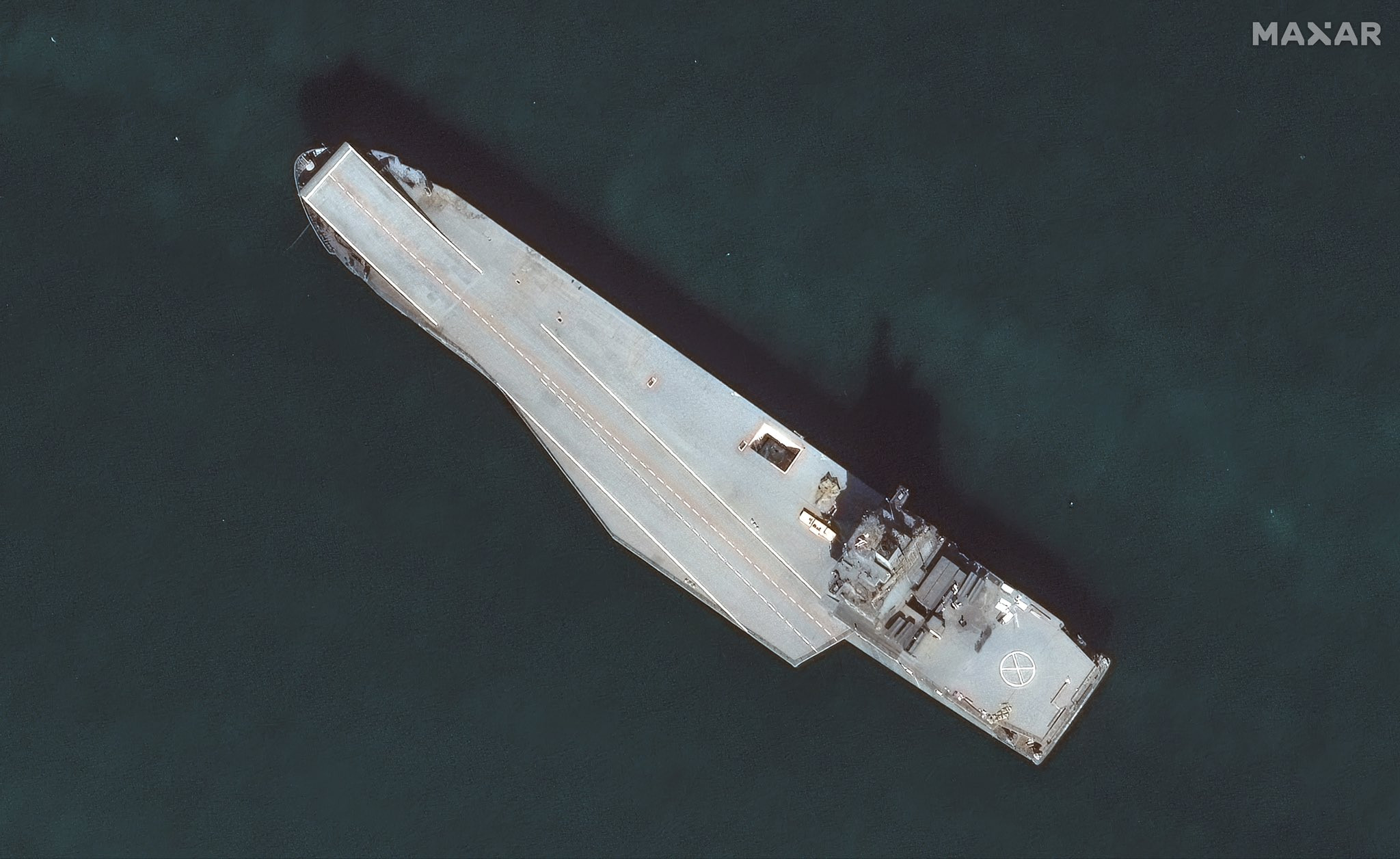
Satellite image of the drone carrier I.R.I.S. Shahid Bagheri (C-110-4) by Maxar Technologies. Note the open aircraft lift and boxed anti-ship missiles behind the superstructure. There appears to be a UAV under netting ahead of the superstructure. This may be a Gaza or similar type
Well, drones are in the news so why not. Drone carriers are becoming a type.
“Covert shores” has an excellent overview of how Iran is converting merchant ships to fulfill naval tasks.
Some are armed with ballistic or cruise missiles.
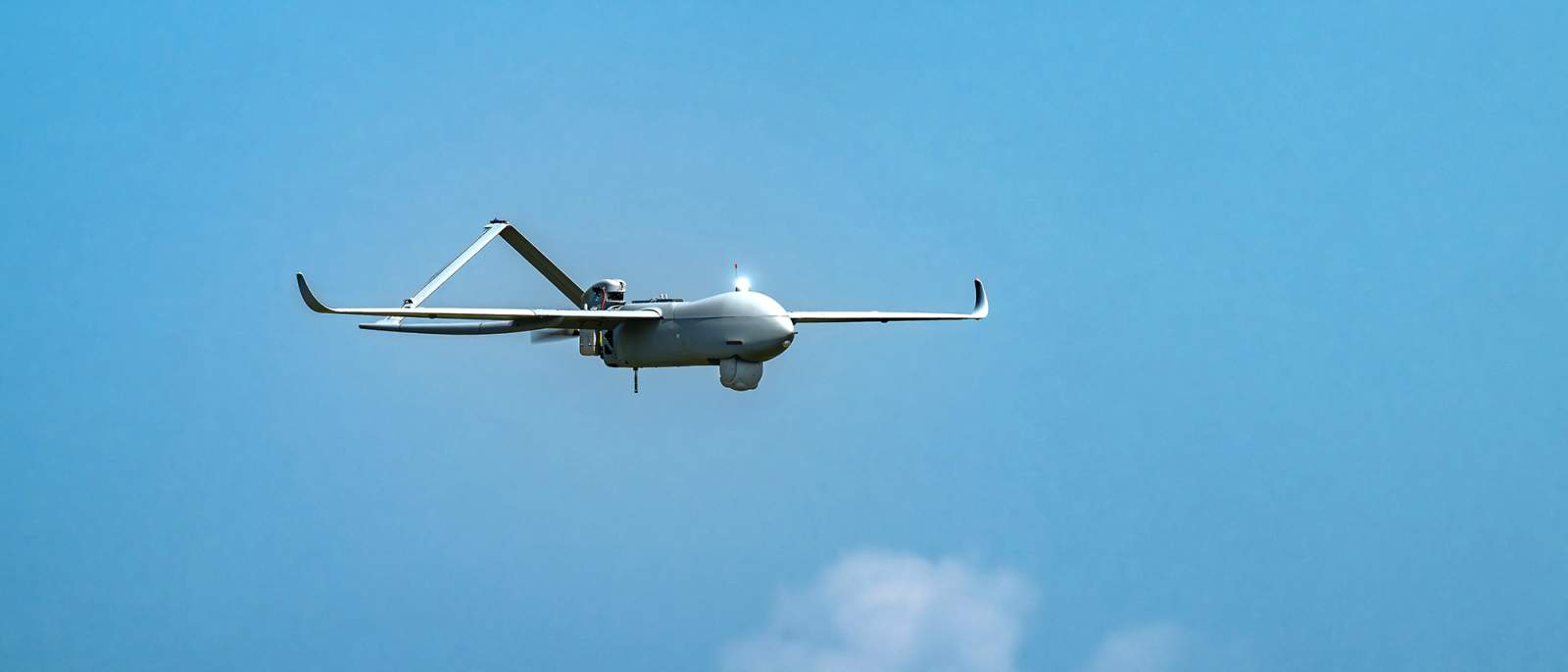
Textron Aerosonde UAS
Below are two news releases reporting contracts for Contractor-Owned/Contractor-Operated Aerosonde Uncrewed Air System operation support, first on the Littoral Combat Ships bound for the 5th Fleet (Central Command) and second for an unidentified ship deploying to 6th Fleet (European Command).
Aerosonde® UAS Increases Maritime Contractor-Owned/Contractor-Operated (COCO) Missions
Hunt Valley, Md., November 18, 2024 – Textron Systems Corporation, a Textron Inc. (NYSE:TXT) company, announced today that it has been awarded a task order valued at up to $47 million by the U.S. Navy’s Naval Air Systems Command (NAVAIR) to provide COCO UAS services to three Independence Class Littoral Combat Ships (LCS) deploying to 5th Fleet. This award follows a 2023 contract to provide UAS support to LCSs, bringing the total number of U.S. Navy ships supported by the Aerosonde® UAS to 10.
Textron Systems will deploy its Aerosonde and skilled personnel to provide mission overwatch and extended range intelligence, surveillance and reconnaissance (ISR) services with enhanced mission payloads as seen aboard the Expeditionary Sea Base (ESB)-4 and ESB-5, as well as two DDG-class ships and three LCSs. In December 2023, the Aerosonde UAS took its inaugural operational flight from its first LCS, the LCS-28 USS Savannah.
“Textron Systems has delivered COCO services with our Aerosonde UAS for over a decade, demonstrating the flexibility and value a model like this brings to the services,” said David Phillips, Senior Vice President Air, Land and Sea Systems. “Because we are managing the full life cycle of the system, including technology integration, human factors, spares and repairs, employing the Aerosonde UAS enables the Navy customer to focus solely on their mission. We extend the customer’s capabilities across the mission packages of each ship reliably and quickly.”
The Aerosonde UAS offers multi-mission capability built upon a family of systems which have amassed over 700,000 flight hours over more than 10 years. The system is equipped for multiple payload configurations with both vertical takeoff and landing (VTOL) and fixed-wing options.
NAVAIR Public Release SPR-2024-0803. Distribution Statement A – “Approved for public release; distribution is unlimited”
Aerosonde® UAS Increases Maritime Contractor-Owned/Contractor-Operated (COCO) Missions
Hunt Valley, Md., November 20, 2024 – Textron Systems Corporation, a Textron Inc. (NYSE:TXT) company, announced today that it has been awarded a task order valued at up to $17 million by the U.S. Navy’s Naval Air Systems Command (NAVAIR) to provide COCO UAS services to a U.S. Navy ship deploying to 6th Fleet. This award brings the total number of U.S. Navy ships supported by the Aerosonde® UAS to 11.
Textron Systems will deploy its Aerosonde and skilled personnel to provide mission overwatch and extended range intelligence, surveillance and reconnaissance (ISR) services with enhanced mission payloads. In September, Textron Systems was contracted to provide support to three additional Littoral Combat Ships (LCS).
“Textron Systems is committed to enhancing the Navy’s mission sets. The continued use of ISR support demonstrates the benefit of the COCO model and the services our Aerosonde UAS provides to the sailor,” said David Phillips, Senior Vice President Air, Land and Sea Systems. “The flexibility in a COCO mission allows the Navy to extend their capabilities while we as the contractor manage the full life cycle of the system, ultimately resulting in greater efficiency and reliability.”
The Aerosonde UAS offers multi-mission capability built upon a family of systems which have amassed over 700,000 flight hours over more than 10 years. The system is equipped for multiple payload configurations with both vertical takeoff and landing (VTOL) and fixed-wing options.
NAVAIR Public Release SPR-2024-0801. Distribution Statement A – “Approved for public release; distribution is unlimited”
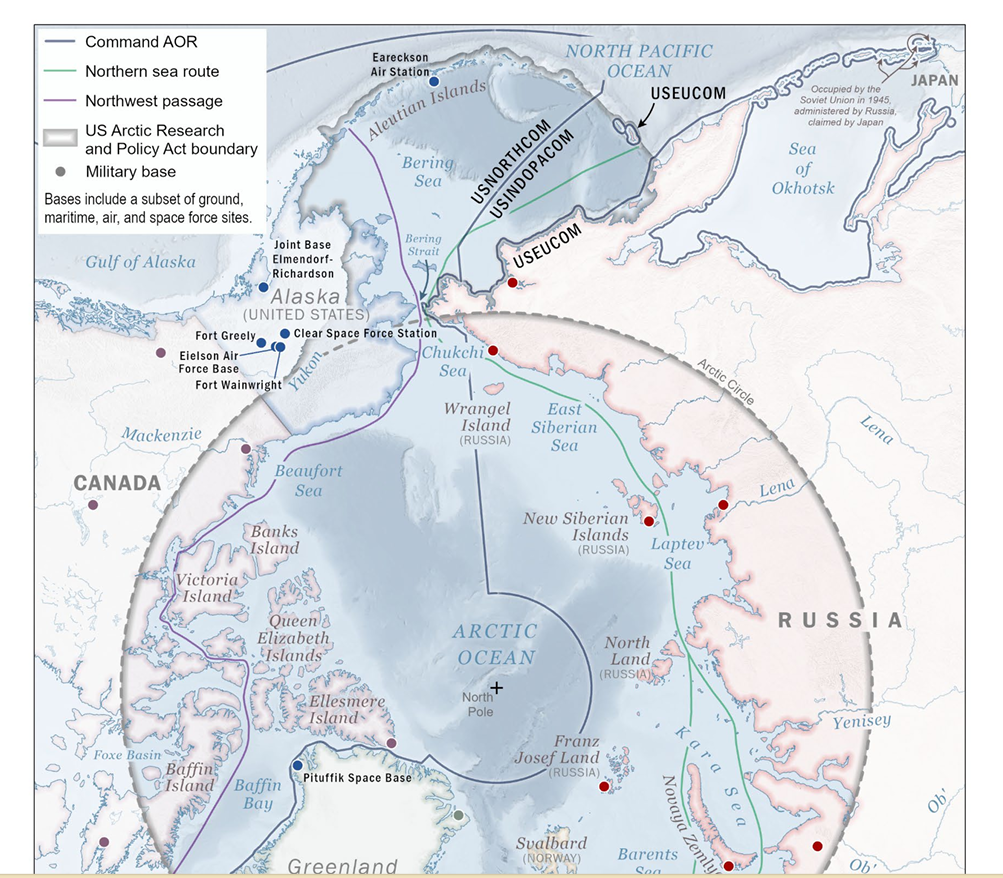
Screen grab from page 2 of the DOD Arctic Strategy, 2024
Here is a link to the new DOD Arctic Strategy here. I found it disappointing. There isn’t much strategy here. I would sum it up as–we are going to keep doing what we are doing, but we are going to do it better. (See critique below.)
“This strategy will strengthen the ability of the United States to build integrated deterrence and effectively manage risk to U.S. interests in the Arctic region by enhancing our domain awareness and Arctic capabilities; engaging with Allies, partners, and key stakeholders; and exercising tailored presence.”
About the US Coast Guard:
The US Coast Guard or USCG was mentioned in three places, once in a caption of a picture of USCGC Healy and these two paragraphs.
DoD will partner with the Department of Homeland Security (DHS), including through the U.S. Coast Guard (USCG), which plays a vital role in maintaining U.S. presence in the Arctic region and supporting domain awareness. The USCG is responsible for operating and maintaining the United States’ icebreaking capability, and DoD will continue to support the USCG’s long-term acquisition of at least eight polar icebreakers that will provide needed icebreaking capability for both military and civilian purposes, including PR/SAR. While disaster response is not a force sizing or shaping requirement, DoD remains ready to support DHS and the Federal Emergency Management Agency in the event of disaster, terrorist attack, or other mass-casualty incident in the Arctic when directed by the President or when requested by a lead Federal department or agency and approved by the Secretary of Defense.
Service-specific, Joint, Interagency, and Combined Exercises. Security and stability in the Arctic depend, in part, on the Joint Force’s ability to respond rapidly and effectively to threats in the region. Exercises increase interoperability with Allies and partners, validate plans, train our ability to rapidly deploy to all parts of the Arctic region, and provide an opportunity to test equipment in Arctic conditions. As such, the Joint Force will continue to exercise frequently in the Arctic through Service specific training, joint exercises —to include with USCG— and
combined exercises with our Allies and partners. DoD will
ensure CCMDs with Arctic equities work toward global integration through joint exercises and ensure key exercise lessons inform capability requirements and strategic planning.
That’s it.
About Icebreakers: Icebreakers are mentioned twice, it the paragraph above and here,
The PRC seeks to bolster its operational expertise in the Arctic, where its presence, while limited, is increasing. The PRC operates three icebreakers—the Xue Long, Xue Long 2, and Zhong Shan Da Xue Ji Di—which enable the PRC’s dual civil-military research efforts in the Arctic. Over the course of the PRC’s 13 Arctic research expeditions to date, the vessels have tested unmanned underwater vehicles and polar-capable fixed-wing aircraft, among other activities. People’s Liberation Army Navy (PLAN) vessels have also demonstrated the capability and intent to operate in and around the Arctic region through exercises alongside the Russian Navy over the past several years.
Critique:
“DoD will reach this end state through a monitor-and-respond approach.”
In other words, we will be reactive rather than proactive.
The threat to Europe in the Polar regions is just part of the long running NATO defense problem. No real change there, except the formal extension of NATO into Sweden and Finland.
The Air Threat over the Pole to North America is looked after by NORAD. Apparently, NORAD does not look after Greenland, but that does not seem to be a central problem.
Ground operations in the Arctic are always going to be difficult. There may be small unit operations but no need to worry about an invasion of North America coming over the pole. NORTHCOM is exercising both land and air assets that would be needed to deal with realistic threats.
The North Slope oil fields and the associated pipeline are probably a target if we become engaged in a long-term conflict that involves combat in or over the arctic. The oil fields are not mentioned in the strategy,
What has changed?
The opening of the Arctic Ocean to maritime commerce has made it a possible avenue for logistics between Russia and China with the potential for militarily valuable shipments moving both ways between the Russian Arctic coast on one end and the Russian Pacific Coast, North Korea, or China on the other. The weakness of Russian transcontinental land transportation systems makes the Northern Sea Route particularly important.
The door to be shut or left open is the Bering Strait.
Bering Strait. 44 Nautical miles (82km) wide, with the Diomede Islands in the center.
The “strategy” mentions the Bering Straits only as a choke point,
The Arctic includes multiple strategically significant maritime chokepoints. Reduction in sea ice
due to climate change means chokepoints such as the Bering Strait between Alaska and Russia and the Barents Sea north of Norway, are becoming more navigable and more economically and militarily significant.
We would certainly want to deny use of the Strait by our enemies and ensure that we and our allies have the option to transit through the Strait.
The planned deep-water port in Nome (currently on hold) will be essential to forces that might be used to control access to the Bering Strait. We would also want to make sure St Lawrence Island and Little Diomede remain in US hands. The US might also want to seize Big Diomede. None of these strategic locations are mentioned in the plan.
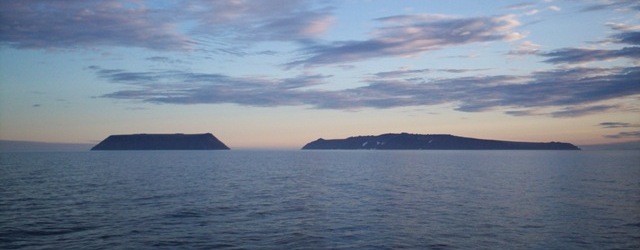
Diomede Islands: Little Diomede Island or Kruzenstern Island (left) and Big Diomede Island or Ratmanov Island in the Bering Sea. Photo is from the north. Photo by Dave Cohoe.
But who is in charge?
First look at the map at the head of this post. They have divided the Arctic so that operations there are under three different Unified Combatant Commands, USEUCOM, USINDOPACOM, and USNORTHCOM. In other words, no one below the President is in charge over the whole area.

These are the Unified Combatant Commander’s Areas of Responsibility. What is not made clear in this graphic is that all of Russia including the larger Asian part is under USEUCOM.
Perhaps most critically, the Pacific interface with the Arctic is under all three COCOMs.
This division of responsibility, placing Russian Asia under USEUCOM, also means that if the US should be at war with both China and Russia, then at least officially, conducting the war in the Pacific would be under two or perhaps three different COCOMs. I doubt this would actually work this way.
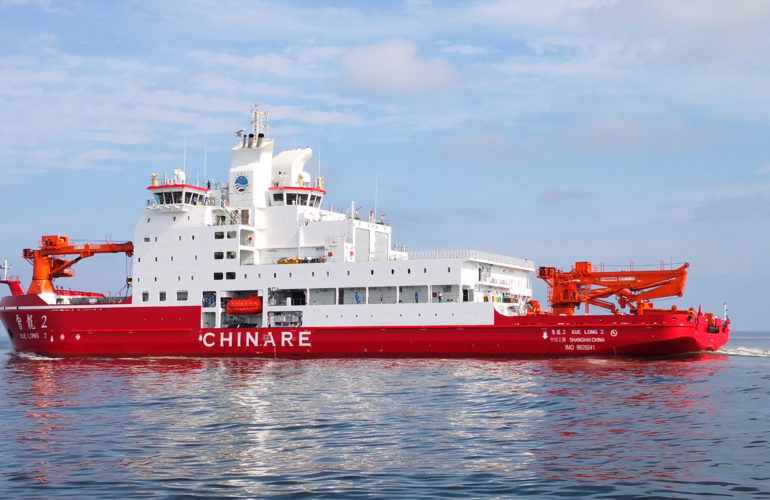
Xue Long 2 on sea trials. Photo by PRIC.
This is about a year old, but somehow, I apparently missed commenting on it when it first came out.
As the largest non-Arctic country, and one which has often referred to itself as a near-Arctic state, the People’s Republic of China (PRC) finds itself in a more precarious position in the region as compared to five years ago when it launched its ambitious white paper, which proclaimed Chinese interests in being a key stakeholder in the far north. Beijing’s plans for the Arctic assumed that the region would be open and amenable to the development of three main pillars of Chinese Arctic policy, namely scientific diplomacy, economic partnerships and participation in regional governance initiatives. All three of these pillars are now under pressure, which has underscored the PRC’s limitations in the Arctic and will inevitably force a rethinking and likely a retrenchment of the country’s far-northern interests.
The report notes,
Despite hopes in Beijing that the PRC’s Polar Silk Road initiative would emerge as an integral part of the overall Belt and Road framework, many centerpiece projects of the infrastructure initiative have either failed or are in doubt because of financial constraints, political opposition or some combination thereof.
The “no limits” partnership between China and Russia has always been one of opportunism. There is a natural antipathy between the two countries. China has never forgotten the unequal treaties imposed on them by European powers including Russia, that stripped away Chinese territory, including important parts of what is now Russia’s Asian holdings.
Facing frustration in the Arctic. Do not be surprised to see China double down on its efforts in Antarctica.
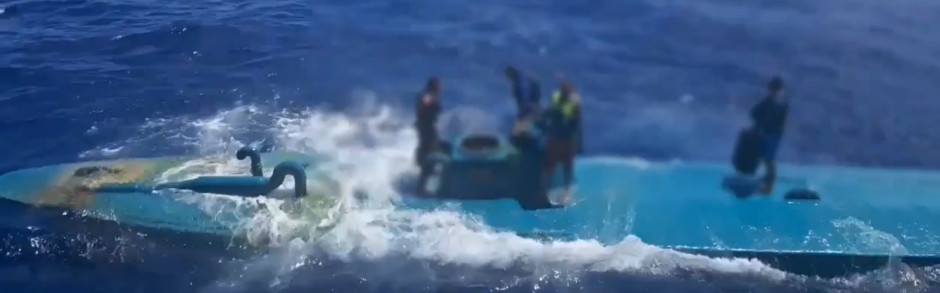
On June 26, 2024 Spanish police aboard SVA Fulmar interdicted a narco submarine 200 miles from the Canary Islands. The vessel was carrying 900kg of cocaine. The 4 crew scuttled the vessel before being rescued and arrested.–Covert Shores.
Covert Shores reports what appears to be a trend that self-propelled semi-submersibles are being used to transport cocaine directly from Latin America to Europe based on three interceptions beginning, one in March and two in June.
The use of internal diesel engines rather than outboards should not be surprising, considering they are much more fuel efficient that outboards, for the long distances involved.
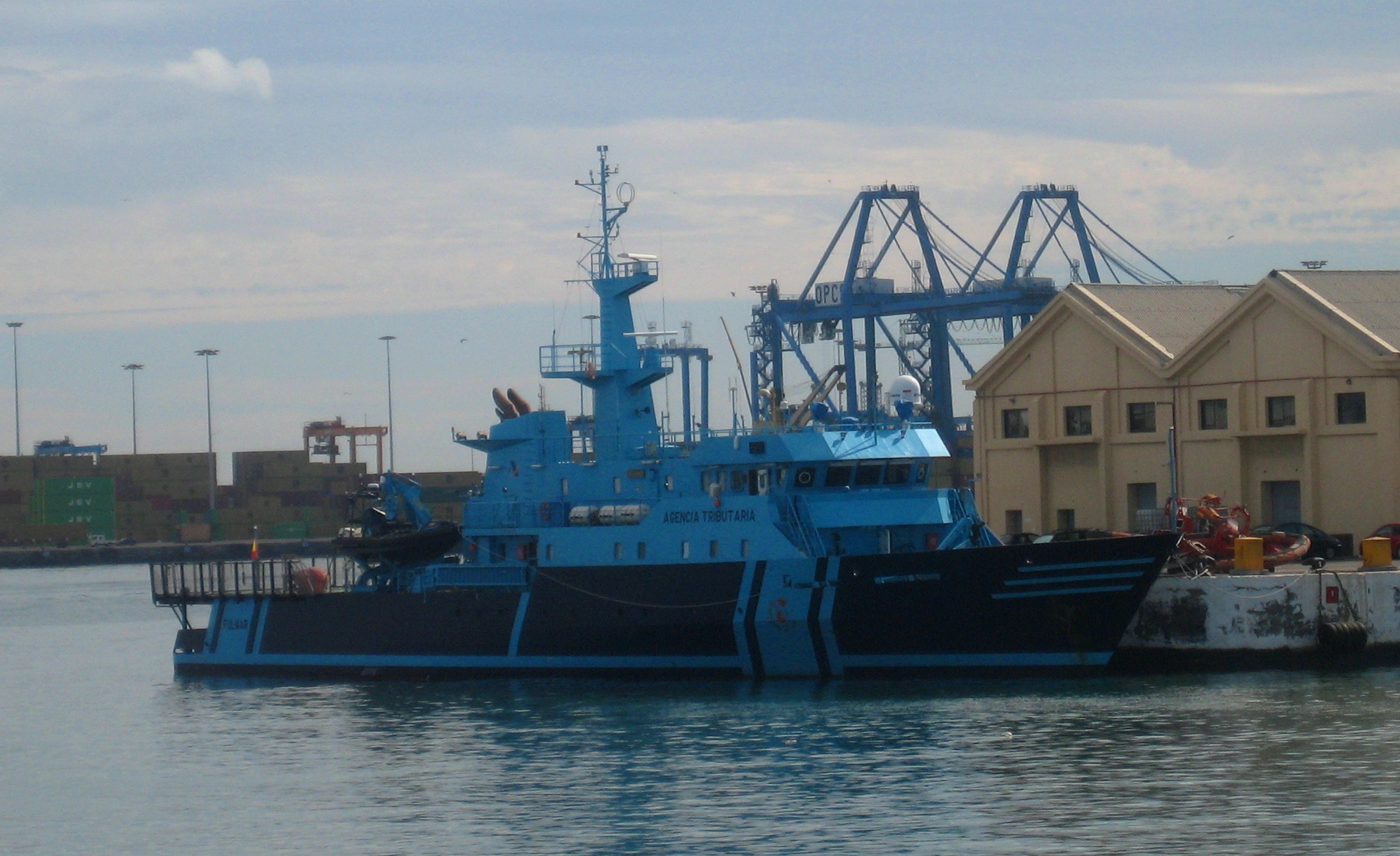
Spanish Tax Agency vessel SVA Fulmar. 20 Nov. 2007. Photo credit: Outisnn via Wikipedia

220822-A-KS490-1182 STRAIT OF HORMUZ (Aug. 22, 2022) From the left, U.S. Coast Guard fast response cutters USCGC Glen Harris (WPC 1144), USCGC John Scheuerman (WPC 1146), USCGC Emlen Tunnell (WPC 1145) and USCGC Clarence Sutphin Jr. (WPC 1147) transit the Strait of Hormuz, Aug. 22. The cutters are forward-deployed to U.S. 5th Fleet to help ensure maritime security and stability across the Middle East. (U.S. Army photo by Spc. Noah Martin)
“Hundreds of service members earned an award for seizing two million pounds of “explosive precursor material” in the Gulf of Oman last year, according to a citation obtained by Military.com. It is one of the U.S. military’s largest publicly revealed hauls as it works to stifle arms smuggling in the region.”
The award was made to “192 Marines and sailors with the 26th MEU, 342 sailors assigned to the USS Carter Hall” and unreported numbers of additional personnel “aboard the USS Stethem and Coast Guard Cutters Emlen Tunnell, Glen Harris and John Scheuerman…”
This is not the first time PATFORSWA cutters have stopped shipments of explosives.
I had never heard of the Meritorious Team Commendation (MTC). It is a Coast Guard unit award created in 1993 for groups or teams that are not identifiable by OPFAC as a United States Coast Guard unit.
 Chuck Hill's CG Blog