National Defense has a short post, “JUST IN: Gilday Calls for Massive International Exercise in Arctic.” It talks about doing an exercise comparable to RIMPAC in the Arctic. Chief of Naval Operations, Adm. Michael Gilday is almost certainly talking about an exercise on the Atlantic side of the Arctic, in the Norwegian Sea, above the Greenland-Iceland-UK gap. If the Exercise were held as far North as the Barents Sea, the Russians would probably get very excited.
The Arctic Circle runs just North of Iceland and North of the upper end of the Baltic Sea. Credit: CIA
The Coast Guard would almost certainly participate. The Canadians already host an Arctic Exercise, Nanook, but it is very small scale. It takes place west of Greenland and the US Navy has not generally participated.
(I have serious doubts that this RIMARCTIC is ever going to happen, at least not as something on the scale of RIMPAC. Everyone wants to go to Hawaii.)
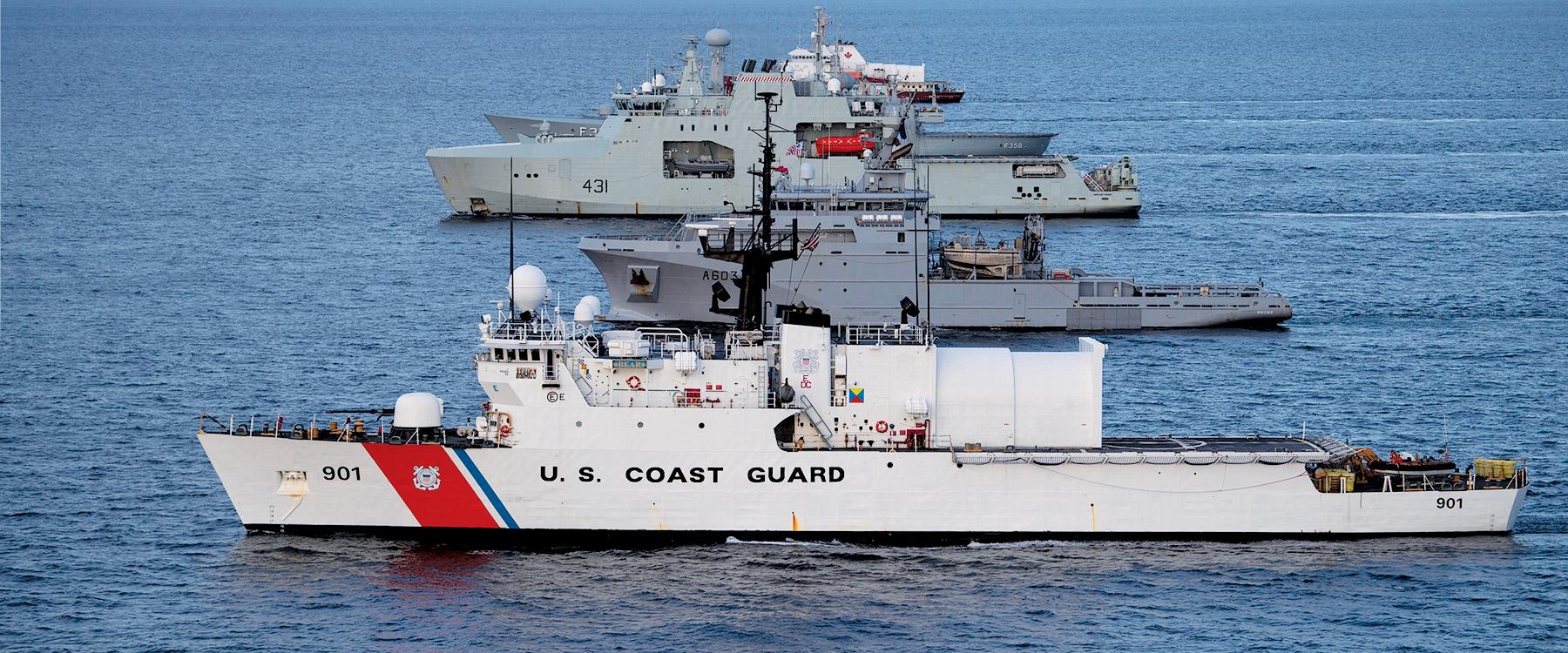
The USCGC Bear (WMEC-901) and allied ships from Canada, Norway, France, and Denmark steam in formation in the North Atlantic Ocean during Operation Nanook in August 2022.
The post also talks about China’s massive investment in Oceanography and there is an interesting footnote. We have heard 4th Fleet would be start experimenting with Unmanned systems soon, paralleling what has been done in 5th Fleet with Task Force 59. Apparently, it will begin with UNITAS.
The Navy plans to introduce unmanned vessels to their South American partners as a part of the UNITAS naval exercise in July. Uncrewed surface and subsurface boats can monitor sea lanes and search for nefarious activities such as drug smuggling and illegal fishing, he said.
These “potentially unmanned [capabilities] give us, along with allies and partners —which is really key here — the ability to keep an unblinking eye on that kind of activity and collect data,” he said.
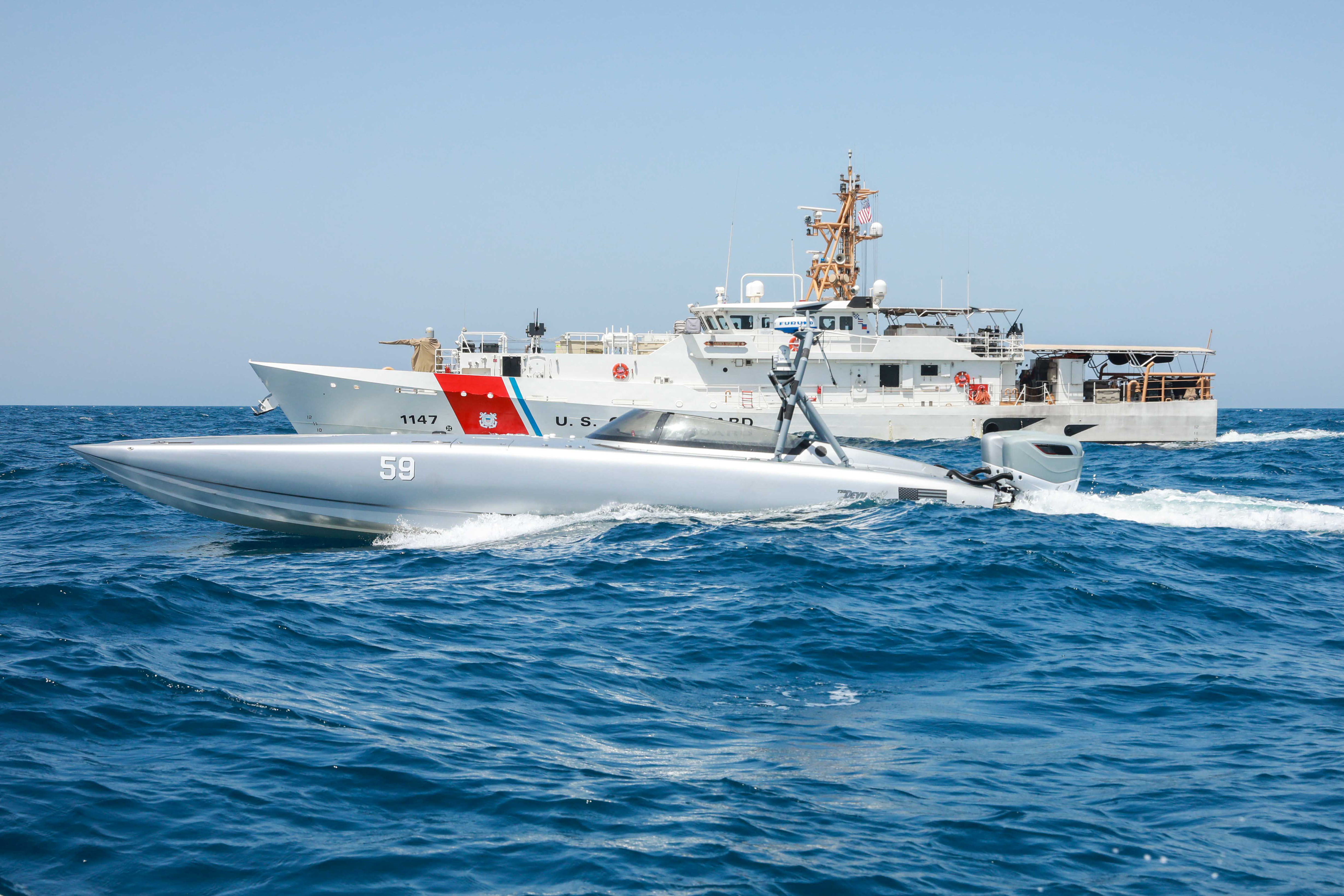
The Coast Guard fast response cutter Clarence Sutphin Jr. sails alongside an unmanned surface vessel in the Persian Gulf during exercise Eagle Resolve 23, June 1, 2023. Eagle Resolve is a combined joint all-domain exercise that improves interoperability with the U.S. military and partner nations, including Saudi Arabia.
But the post also discussed another program, a new class of smaller amphibious warships, expected to enter service from the early 2030s, that will also fill the role of Offshore Patrol Vessels.
Captain Van der Kamp also outlined the RNLN’s evolving thinking on a replacement amphibious shipping capability, dubbed LPX…these new ships are also expected to assume the patrol and surveillance tasks currently performed by the navy’s four Holland class patrol vessels…“We would combine these amphibious ships with the function of a patrol vessel to do Coastguard patrols in the Caribbean and counter-drugs operations in the Caribbean.”
The four Holland class OPVs were commissioned 2012 to 2013, so in the early 2030s they will be at the most 23 years old. These ships are similar in size, speed, capabilities, and mission to the OPCs. They have frequently conducted drug interaction missions in the Caribbean with US Coast Guard Law Enforcement Detachments embarked and at least on one occasion using a USCG helicopter.
The other two ships being replaced, HNLMS Rotterdam and HNLMS Johan de Witt. are older, commissioned in 1998 and 2007. They have a combined capability to land about 1200 Marines. I presume the cumulative capability of the new ships will be similar. Each of them can also carry up to 32 tanks, but the Netherlands Marine Corps does not have any tanks, nor do they have organic heavy artillery. Their only armored vehicles are much smaller, so perhaps the replacement ships will not need the capability to handle tanks.
Why is the Netherlands Navy choosing to do this?
Going from six ships to perhaps only four is likely to decrease the total crew requirements.
It may be that the landing ships are considered better able to meet the disaster response component that has been one of the OPVs’ missions.
The Netherlands Navy may not see any wartime role for the OPVs, or at least no role the new LPX could not also do.
Nevertheless, it seems the changes is rooted in changes in the Marine Corps concept of operation. “…leaner and smaller units that would unload further away from land.”
It may be significant that the new ships are referred to as LPX not LPDX. That may mean that they would not have a well deck. It might be thought they are paralleling US Marine Corp thinking that resulted in the Marines shedding their tanks and heavy artillery and the formation of a Littoral Regiment and a program to build relatively small Landing Ship, Mediums. On the other hand, given the way the Netherlands Marine Corps names their units, “Raiding Section,” “Raiding Troop,” and “Raiding Squadron,” they obviously see themselves as a raiding organization more akin to the British Royal Marine Commandos of WWII than to the US Marine Corps that seized and held islands in the Pacific. They do have a long and continuing association with the Royal Marines. In any case they are and probably will remain essentially light infantry.
If the new ships are to replace the four OPVs, then I would presume they would still need at least four ships. If they were following the USMC example, they may build a larger number of smaller ships, but I don’t think that will be the case. If they are to “…unload further away from land,” they are going to be very different from the beachable LSMs envisioned by the US Marines. The British developed LCVP Mk5c used by the Netherlands Marine Corps are big boats, 15.7 m (51 ft 6 in) in length and displacing 24 tons. If they are to be swung from davits, it will not be from a small ship.
I would not be surprised if the LPX program came out as four ships that look a lot like slightly larger Danish Absalon class (which can reportedly transport a company-sized landing force of some 200 soldiers with vehicles). Four ships that could each transport 300 Marines, each equipped with four LCVPs (or its replacement), a pair of “FRISC”(Fast Raiding, Interception and Special forces Craft) RHIB, with hangar space for a couple of helicopters, could replicate the transport capacity of the two LPDs in a more flexible, distributed, and perhaps more survivable force package. The resulting ships would effectively be modern high-speed transports (APD/LPR).
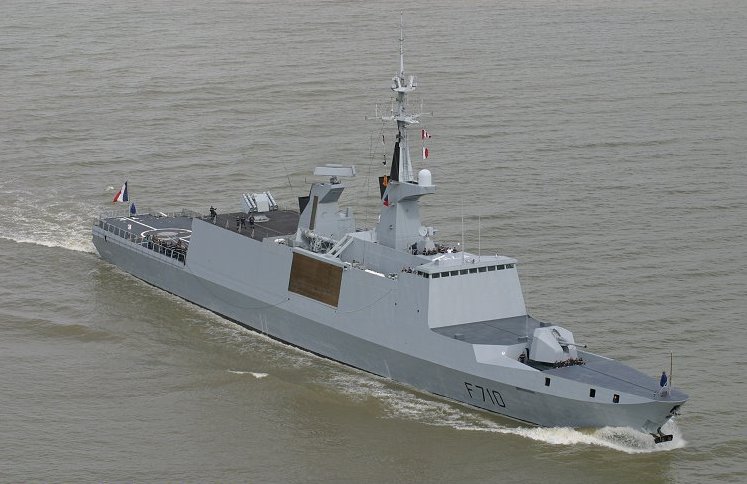
The frigate La Fayette going up the Seine river (2nd of July 2003, prior to its recent renovation). Photo credit: Guillaume Rueda
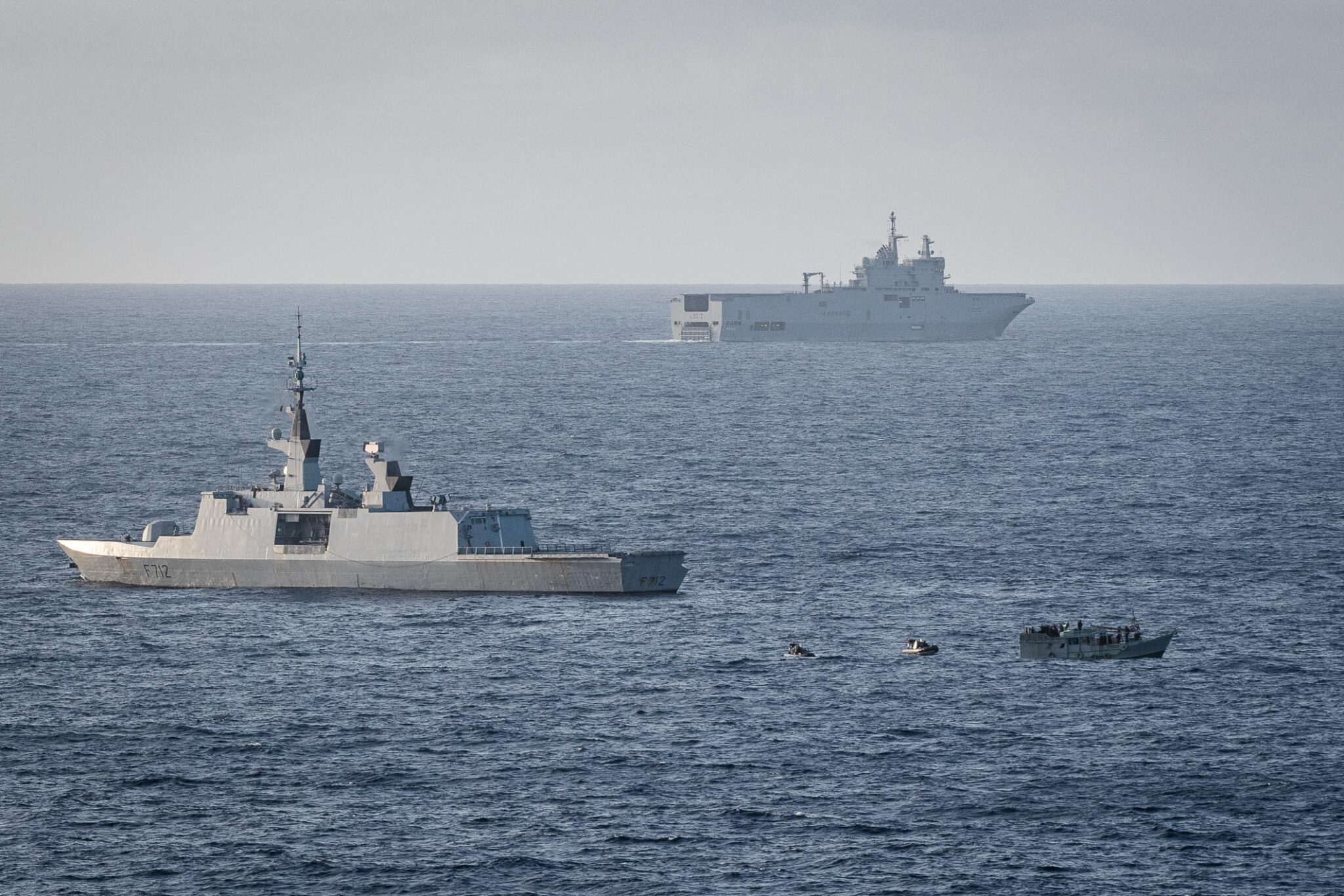
Below is a NAVCENT news release. I was a little surprised it did not include the name of the French ship. I have been unable to find the name of the ship, but it appears probable that this was done by the ships engaged in the French Navy’s annual training cruise, “MISSION JEANNE D’ARC 2023” including amphibious warship FS Dixmude (L9015) and frigate FS La Fayette (F710).
The French are not new at this, and their drug interdiction operations are frequently carried out by La Fayette class frigates. FS La Fayette probably made the interdictions, but FS Dixmude may have helped by flooding the area with search aircraft. Previous “MISSION JEANNE D’ARC” voyages have also resulted in drug interdictions. “MISSION JEANNE D’ARC 2021” resulted in a spate of five drug seizures by three French ships in six days in the same area. “MISSION JEANNE D’ARC 2022” resulted in at least one drug seizure in the Gulf of Guinea.
(US Coast Guard PATFORSWA cutters also frequently operate as part of Combined Task Force 150.)
May 24, 2023
French Warship Seizes $108 Million in Drugs during Indian Ocean Seizures
By U.S. Naval Forces Central Command Public Affairs
MANAMA, Bahrain – A French warship operating in support of Combined Task Force (CTF) 150 conducted four illegal drug seizures between April 19 and May 18 worth a total estimated U.S. street value of $108 million from fishing vessels transiting international waters in the Indian Ocean.
The warship seized 2,265 kilograms of heroin and 242 kilograms of methamphetamine from four different vessels while patrolling regional waters. CTF 150 is one of five task forces under Combined Maritime Forces, the largest multinational naval partnership in the world.
In 2023, maritime forces supporting CTF 150 have seized illegal drugs worth a combined estimated U.S. street value of $203 million, adding to record-breaking drug interdictions by U.S. and international naval units in 2021 and 2022 totaling more than $1 billion in value.
“It’s been a pleasure working with the French sailors to achieve our mission’s aims together,” said United Kingdom Royal Navy Lt. Francis Henry, a CTF 150 staff officer responsible for coordinating the task force’s counter-narcotics efforts.
CTF 150 conducts maritime security operations in the Gulf of Oman, Arabian Sea and Indian Ocean to disrupt destabilizing activity, promote international rules-based order and help ensure the free flow of commerce.
The task force is headquartered in Bahrain with Combined Maritime Forces, which is led by the commander of U.S. Naval Forces Central Command and U.S. 5th Fleet.
“Though there is no way to confirm the outcome of the attack — or even the legitimacy of either video — if the second boat triggered an explosion similar to the one seen in the first video, the Russian ship likely suffered serious damage.”
U.S. Seizes $80 Million Heroin Shipment in Gulf of Oman
By U.S. Naval Central Forces Command Public Affairs
MANAMA, Bahrain – A U.S. Coast Guard fast response cutter seized $80 million worth of heroin from a fishing vessel transiting the Gulf of Oman, May 10, during the ship’s second drug bust this week.
USCGC Glen Harris (WPC 1144) was operating in support of Combined Task Force (CTF) 150 when a boarding team discovered 1,964 kilograms of heroin on a vessel transiting international waters after departing Chah Bahar, Iran. Glen Harris also seized $30 million worth of methamphetamine and heroin two days ago from another fishing vessel that departed the same port.
“I’m very proud of my crew and all we’ve been able to accomplish as a team this week,” said Lt. Nick Jabs, Glen Harris’s commanding officer. “We’re out here to work with regional partners and disrupt any destabilizing maritime activity at sea. We will continue getting after it.”
Glen Harris’s previous seizure on May 8 included 580 kilograms of methamphetamine and 35 kilograms of heroin.
The ship arrived in the Middle East last year as part of a contingent of U.S. Coast Guard cutters that are forward-deployed to the region under Patrol Forces Southwest Asia.
CTF 150 is one of four task forces that form the world’s largest multinational naval partnership, Combined Maritime Forces. Naval forces supporting CTF 150 have now seized illegal drugs worth a combined estimated U.S. street value of more than $250 million in 2023. These efforts help ensure legitimate commercial shipping transits the region free from non-state threats.
NEWS | May 8, 2023
U.S. Coast Guard Seizes $30 Million in Drugs with International Task Force
By U.S. Naval Central Forces Command Public Affairs
MANAMA, Bahrain – A U.S. Coast Guard fast response cutter seized more than $30 million of heroin and methamphetamine from a fishing vessel transiting the Gulf of Oman, May 8.
Operating in support of Combined Task Force (CTF) 150, USCGC Glen Harris (WPC 1144) seized 580 kilograms of methamphetamine and 35 kilograms of heroin from a vessel transiting international waters after departing Chah Bahar, Iran.
CTF 150 is one of four task forces that form the world’s largest multinational naval partnership, Combined Maritime Forces. Naval forces supporting CTF 150 have seized illegal drugs worth a combined estimated U.S. street value of nearly $200 million in 2023.
Glen Harris arrived in the Middle East last year and operates from the U.S. Navy base in Bahrain where CMF is headquartered with U.S. Naval Forces Central Command and U.S. 5th Fleet.
The fast response cutter is part of a contingent of U.S. Coast Guard ships forward-deployed to the region under Patrol Forces Southwest Asia (PATFORSWA). PATFORSWA deploys Coast Guard personnel and ships alongside U.S. and regional naval forces throughout the Middle East.
“The dedication and expertise of Glen Harris’s leadership and crew embody our commitment to interdict and remove illicit narcotics from the sea, denying malign actors the ability to destabilize the region,” said Capt. Eric A. Helgen, PATFORSWA’s commander. “I could not be more proud of our fast response cutter crews.”
Currently led by the United Kingdom, CTF 150 conducts maritime security and counter-terrorism operations in the Gulf of Oman and Indian Ocean to disrupt criminal and terrorist organizations and their related illicit activities, including the movement of personnel, weapons, narcotics and charcoal. These efforts help ensure legitimate commercial shipping transits the region free from non-state threats.
U.S. and international naval units in the Middle East seized illegal drugs totaling $1 billion in value from 2021 to 2022.
Ukrainian Navy Island-class patrol boats, formerly of the U.S. Coast Guard, conduct maritime security operations in the Black Sea off the coast of Odesa, Ukraine. UKRAINIAN NAVY
The US Naval Institute’s May 2023 issue of “Proceedings” includes an article by Vice Admiral Oleksiy Neizhpapa, Ukrainian Navy discussing the Ukrainian Navy’s role in the war with Russia.
Because the Ukrainian Navy used all available assets, including unmanned vehicles, it has achieved a strategic effect. We forced the enemy fleet to move east of the meridian of Cape Tarkhankut (Crimean Peninsula) and denied Russian operational activity in the northwestern part of the Black Sea, even near Crimean harbors. These Ukrainian Navy efforts created a gray zone and enabled the Grain from Ukraine Initiative, which ensures the export of Ukrainian grain to countries in need. In 2022, more than 24 million tons of agricultural products were exported from initially blocked Ukrainian ports.
He is obviously very proud of the accomplishments of their small navy. It is a good article, but I would have had to reference if for no other reason than to post the accompanying photo above.
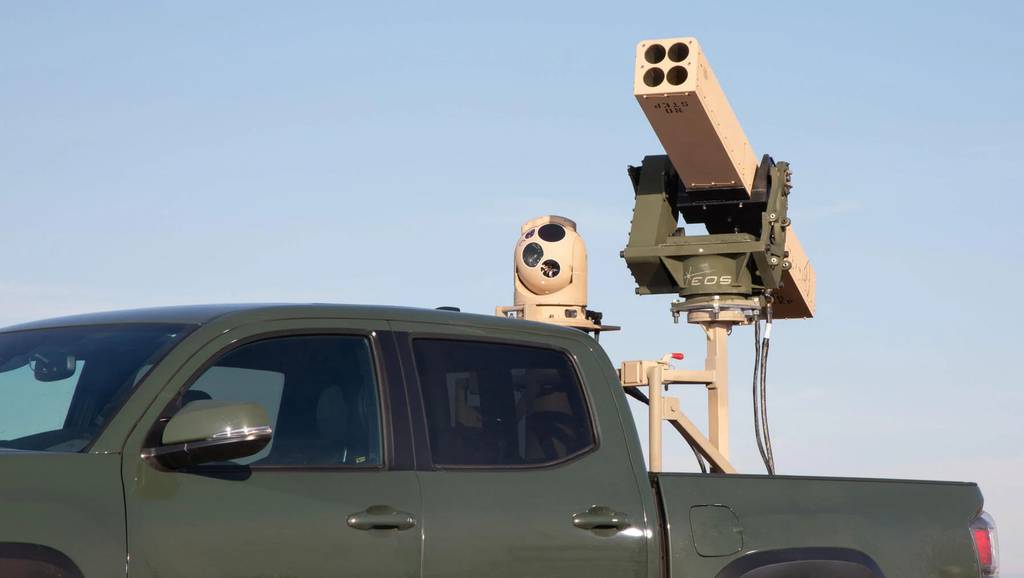
As you probably know, I am a fan of the APKWS (Advanced Precision Kill Weapon System) because I think it could provide a substantial upgrade for our cutters, particularly the smaller ones. The system is quick, accurate, effective, light weight, uncomplicated, inexpensive, requires little training, has minimum impact on the platform, and limits collateral damage.
The VAMPIRE system can fit in almost any pickup or vehicle with a cargo bed. (Courtesy of L3Harris)
Thanks to Walter for alerting me to this short video of the system in use.
Looks to me, like they are targeting observation posts along the river.
USS thundebolt (PC-12) Seen here in 1998 in both Coast Guard and Navy markings. U.S. Coast Guard photo by David Schuffholz
The US Naval Institute News Service reports the decommissioning and transfer of the last of the Cyclone class US Navy patrol craft. Seven of the class (PCs 1, 2,4, 8, 12, 13, and 14) were loaned to the Coast Guard at various times.
Their departure will leave the six Coast Guard Patrol Force SW Asia Webber class WPCs the only US patrol craft in the 5th Fleet.
Of the 14:
Two, Zephyr (PC-8) and Shamal (PC-13), are to be scrapped.
Five, Tempest (PC-2), Typhoon (PC-5), Squall (PC-7), Firebolt (PC-10), and Whirlwind (PC-11), have been transferred to the Royal Bahrain Naval Forces.
Three, Hurricane (PC-3), Sirocco (PC-6), and Thunderbolt (PC-12), have been transferred to the Egyptian Navy.
Two more, Monsoon (PC-4) and Chinook (PC-9), will join the former Cyclone (PC-1) in the Philippine Navy.
One, Tornado (PC-14) is expected to be sold, but is awaiting disposition.
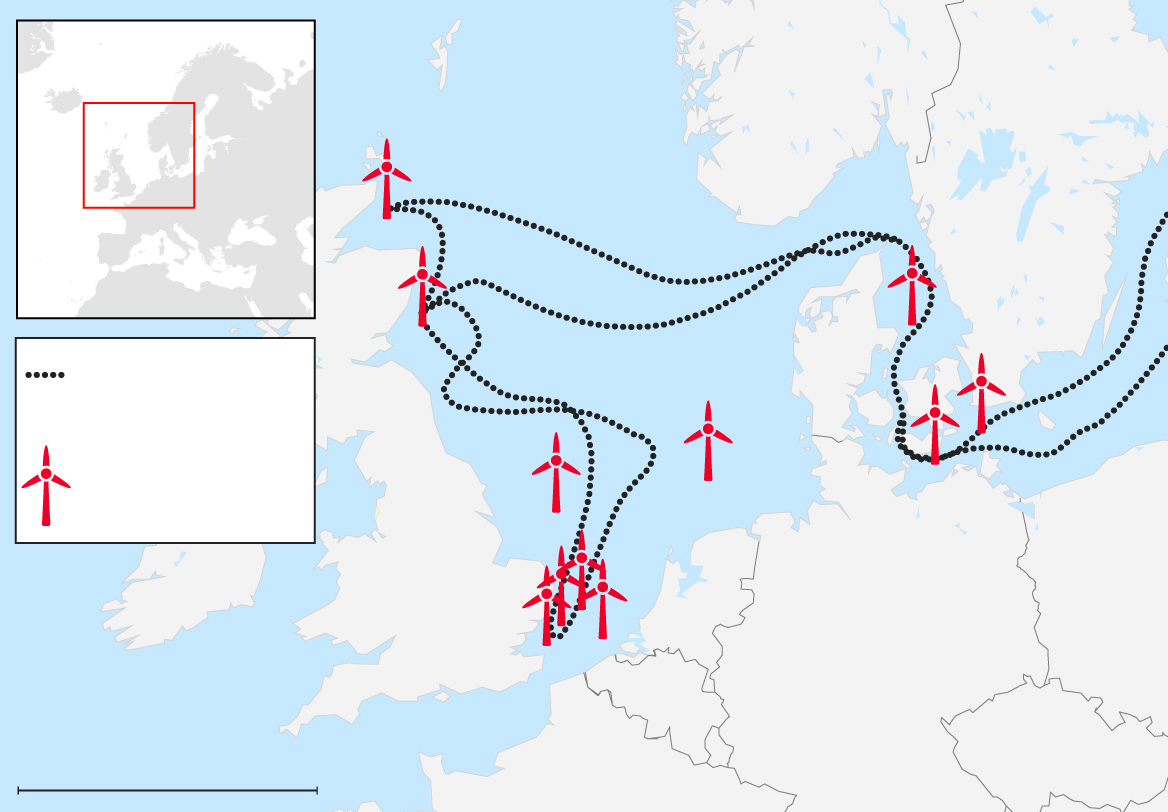
THE ADMIRAL VLADIMIRSKY PASSED SEVERAL OFFSHORE WIND FARMS. Source: Putin’s Shadow War
The Telegraph reports Russia is believed to be mapping NATO offshore energy industry and communications cables as possible targets should there be a wider war between Russia and NATO.
“A fleet of Russian boats, often disguised as fishing trawlers or research vessels but with armed guards, have been observed by European intelligence agencies conducting mass reconnaissance close to British coastal energy and communications networks.”
The same report notes a surge in hacker attacks on NATO infrastructure.
A U.S. Navy L3 Harris Arabian Fox MAST-13 drone boat and the U.S. Coast Guard cutters USCGC John Scheuerman and USCGC Charles Moulthrope transit the Strait of Hormuz on Wednesday, April 19, 2023. (Information Systems Technician 1st Class Vincent Aguirre/U.S. Coast Guard)
Below is a NAVCENT news release. It is quite apparent that the PATFORSWA Webber class WPCs have become the go-to resource for operation with the US Navy’s Task Force 59 unmanned surface vessels. Will we see something similar emerge when UAS start operating under 4th Fleet in the near future?
Unmanned Surface Vessel Transits Strait of Hormuz with U.S. Coast Guard
19 April 2023
From U.S. Naval Forces Central Command Public Affairs
MANAMA, Bahrain – An unmanned surface vessel from U.S. 5th Fleet transited the Strait of Hormuz with two U.S. Coast Guard cutters, April 19, demonstrating the continued operational integration of unmanned and artificial intelligence systems by U.S. maritime forces in the Middle East.
A U.S. Navy L3 Harris Arabian Fox MAST-13 drone boat and the U.S. Coast Guard cutter USCGC John Scheuerman transit the Strait of Hormuz on April 19, 2023. (Information Systems Technician 1st Class Vincent Aguirre/U.S. Coast Guard)
USCGC Charles Moulthrope (WPC 1141) and USCGC John Scheuerman (WPC 1146) transited one of the world’s most strategically important straits with an L3 Harris Arabian Fox MAST-13 unmanned surface vessel. The three vessels sailed south from the Arabian Gulf and through the narrow Strait of Hormuz before entering the Gulf of Oman.
“I am proud to be a part of this great partnership between the U.S. Coast Guard and Navy in the Middle East. We often work side-by-side as one team with a common mission to provide security and safeguard the seas,” said Lt. Trent Moon, John Scheuerman’s commanding officer.
U.S. 5th Fleet established a unit called Task Force 59 in September 2021 to integrate unmanned systems and artificial intelligence into regional maritime operations. Since its launch, the task force has deployed a suite of new unmanned systems from operational hubs in Jordan and Bahrain.
In December, Task Force 59 launched an Aerovel Flexrotor unmanned aerial vehicle from USCGC Emlen Tunnell (WPC 1145) while operating in the Arabian Gulf. The launch marked Task Force 59’s first from a U.S. Coast Guard vessel at the time.
“We are on the cutting-edge of integrating advanced unmanned technology into our maritime patrols. Our crews are excited to help lead these efforts with our Navy counterparts,” said Lt. Stephen Hills, Charles Moulthrope’s commanding officer.
U.S. 5th Fleet is leading regional efforts to increase vigilance in surrounding waters that include more than 5,000 miles of coastline from the Suez Canal, around the Arabian Peninsula, through the Strait of Hormuz and into the Arabian Gulf. The integration of unmanned platforms and sensors alongside crewed ships from the United States and regional partners enhances this capability.
The two Coast Guard cutters and Arabian Fox transited the Strait of Hormuz while operating in support of the International Maritime Security Construct, an 11-nation coalition led by the United States that focuses on maritime operations near key waterways in the Middle East.