U.S. Navy Decommissions Last Patrol Craft Stationed in Bahrain –NAVCENT

DAHLGREN, Va. (Nov. 6, 2004) Coast Guard Cutter Shamal (WPC-13) patrols the Potomac River near the Naval Surface Warfare Center in Dahlgren, VA. On Sept. 29, 2004, USS SHAMAL was transferred to the U.S. Coast Guard in Little Creek, VA and placed in Commission Special status. After a two-month dockside availability at Integrated Support Command Portsmouth, SHAMAL will make itstransit to her new homeport of Pascagoula, MS., where it will be officially commissioned on December 6, 2004. SHAMAL’s planned major missions will be alien migrant and drug interdiction operations within the D7 and D8 AORs. MS. USCG photo by Joseph P. Cirone,USCGAUX

Below is a NAVCENT news release. More a Navy story than a Coast Guard one, but a class of ships the Coast Guard not only worked closely with, but also operated. Their departure puts an even greater load on the six Patrol Forces SW Asia Webber class cutters.

U.S. Navy Decommissions Last Patrol Craft Stationed in Bahrain

By U.S. Naval Forces Central Command Public Affairs | March 28, 2023

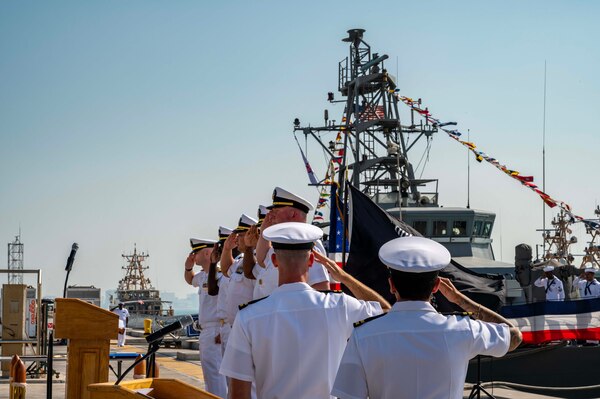
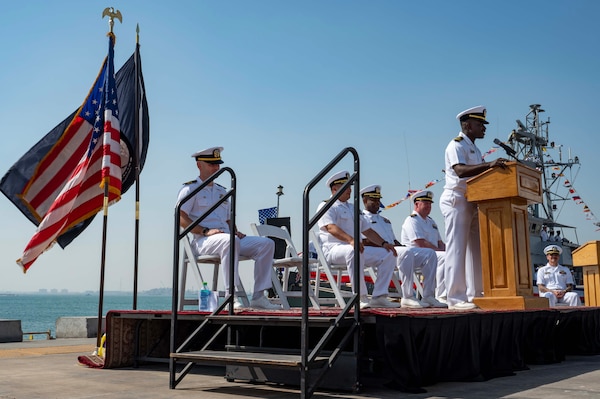
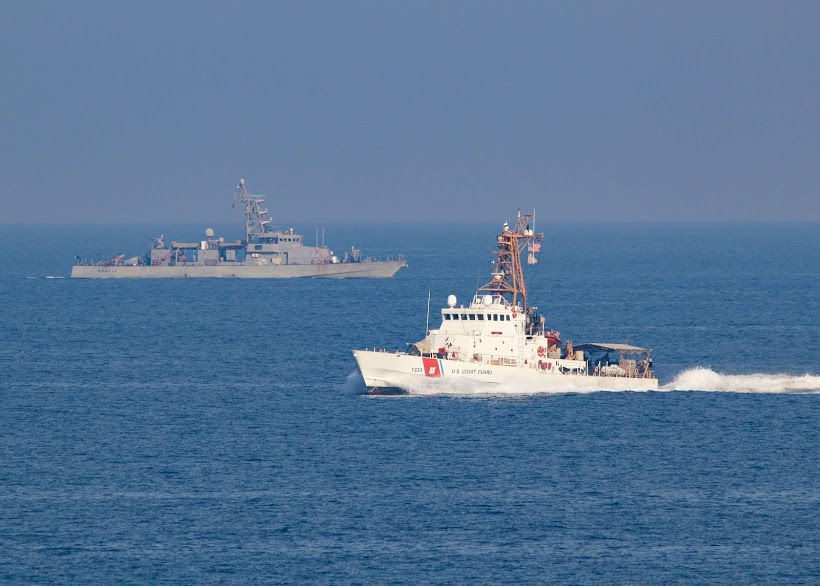
The U.S. Navy decommissioned the last two Cyclone-class patrol coastal ships stationed at Naval Support Activity Bahrain, March 28, during a pierside ceremony attended by U.S. 5th Fleet officials.

Leaders and crewmembers of USS Monsoon (PC 4) and USS Chinook (PC 9) marked the end of nearly three decades of U.S. naval service.

“I’m honored to be a part of the legacy on this waterfront,” said Lt. Cmdr. Dre Johnson, during the ceremony. “PC Sailors are a unique bunch, and only they can understand the amount of work they’ve done and the pride they have in what they’ve accomplished.”

Johnson is Monsoon’s last commanding officer. The U.S. Navy initially commissioned the ship in 1994 and then recommissioned it in 2008 after Monsoon served four years in the U.S. Coast Guard. Chinook was commissioned in 1995.

“With 28 years of crew covering multiple generations, each one was dedicated to the mission, adapting to rapidly changing mission sets, and working together as a team to accomplish whatever obstacle that came their way,” said Lt. Cmdr. David Hartmann, Chinook’s commanding officer.

Monsoon and Chinook are the last of a group of 10 ships designed for shallow-water operations that were stationed in Bahrain. The Middle East region includes 5,000 miles of coastline from the northern Arabian Gulf, around the Arabian Peninsula, through the Red Sea and Suez Canal.

Last year, the U.S. Navy decommissioned and transferred five patrol craft to the Royal Bahrain Naval Force: former ships USS Tempest (PC 2), USS Typhoon (PC 5), USS Squall (PC 7), USS Firebolt (PC 10) and USS Whirlwind (PC 11). Additionally, the U.S. Navy decommissioned and transferred former ships USS Hurricane (PC 3), USS Sirocco (PC 6) and USS Thunderbolt (PC 12) to the Egyptian Navy last week during a formal ceremony in Alexandria, Egypt.

Monsoon and Chinook are slated for transfer to the Philippine Navy. Officials from the Philippines attended the ceremony.

“I’m proud of our crews for reaching this milestone and representing our nation and Navy with utmost pride and professionalism,” said Capt. Anthony Webber, commander of Task Force 55, which oversees operations for U.S. 5th Fleet’s surface forces. “I’m also proud that we are turning over great ships to our Philippine partners.”

Bahrain, Egypt and the Philippines are members of the largest multinational naval partnership in the world called Combined Maritime Forces (CMF). Led by the United States, forces from the organization’s 38 nations operate across approximately 3.2 million square miles of international water space in the Middle East. The partnership ensures maritime security and stability in some of the world’s most important shipping lanes.
Coast Guard in the Iraq War

USCGC Adak Persian Gulf

MyCG has two posts about the Iraq war and the Coast Guard’s part in it.

Thought it odd we would have two so closely related posts, by the same author. Actually, the first was done some time ago but internet access was lost when the Coast Guard changed servers.

Both are now linked on my Heritage page.

“Iran Reveals World’s First Air Defense Small Boat” –Covert Shores

Camera drone’s-eye view of IRGC boats on display, March 2023. A) The air defense boat. B) Light missile boat with Bladerunner hull. C) light missile boats on Interceptor hull. D) light missile boats on Interceptor hull (alternative design). E) Missile boat, with type of missile unclear. F) RIB, possibly explosive boat or uncrewed. G) RIB with lightweight anti-ship torpedoes, can be carried aboard a Shahid Soleimani-class missile corvette. H) Interceptor boat. I) Interceptor boat with new type of missile.

Covert Shore has a post about a new Iranian Revolutionary Guard Corps (IRGC) Navy boat armed with vertical launch anti-aircraft missile, believed to be the first such craft in the world, but I found the photo above and the accompanying caption particularly interesting.

These are far different from the familiar, prototypical IRGC boats armed with a single machine gun and a few unguided rockets.

“Video: Interview With VADM Cooper On TF 59 Milestones, US 5th Fleet” –Naval News

Naval News provides a video of an interview with 5th Fleet/NAVCENT commander VAdm Charles Bradford (Brad) Cooper II. In addition to the video above, the Naval News post provides a transcript of the interview (always appreciated).

The video provides more than talking heads. There are snippets of video showing the operation of unmanned systems and the people mentioned.

PATFORSWA Webber class cutters show up in the video three times.

Task Force 59 is an exciting development. It appears likely this model will be replicated in other areas including with the 4th Fleet in the Drug Transit Zone. Hopefully the Coast Guard is taking the opportunity to learn as much as possible from these operations. If the Coast Guard does not have a Coast Guard R&D liaison to Task Force 59 we are missing a good bet.

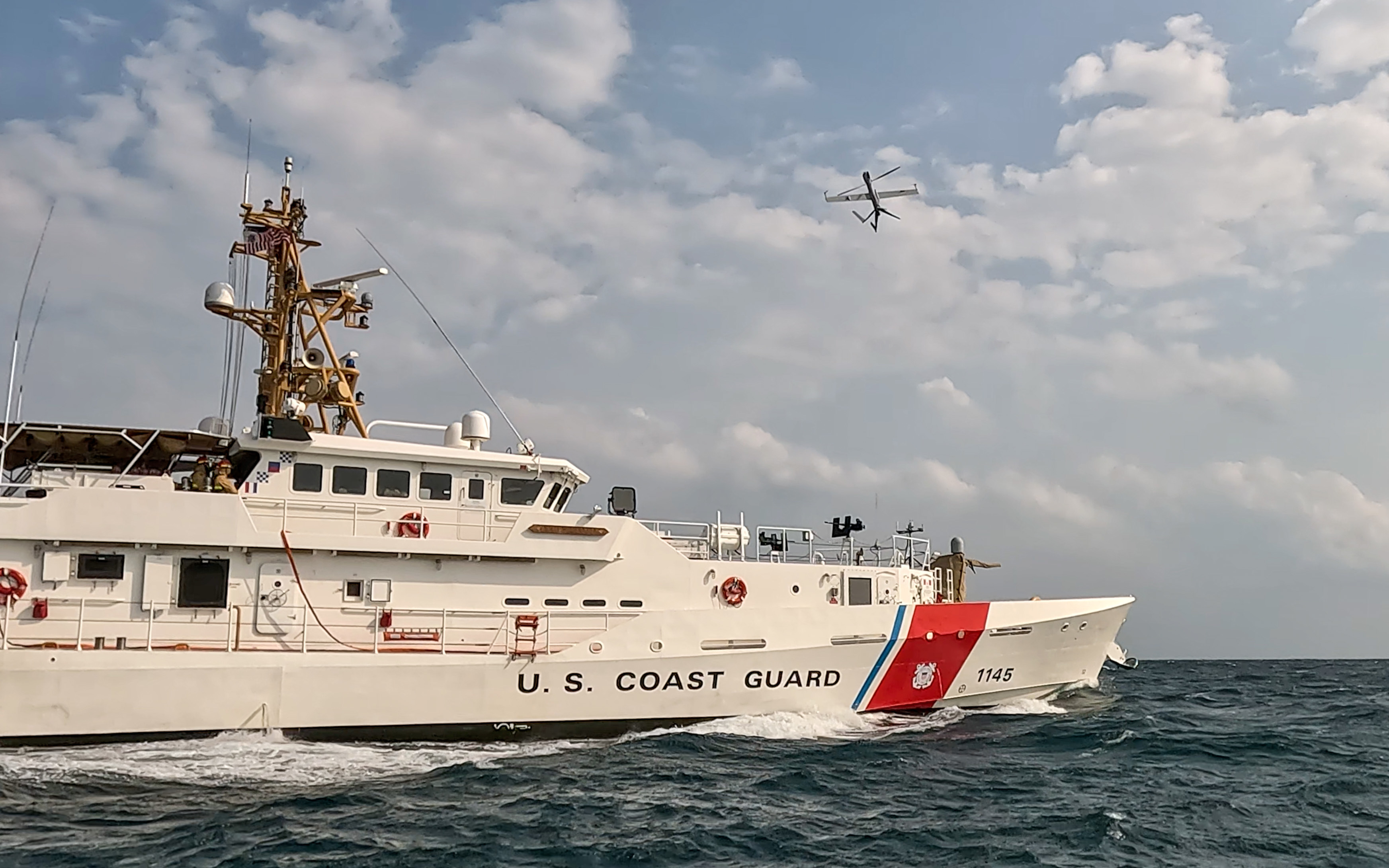
221207-N-NO146-1001 ARABIAN GULF (Dec. 7, 2022) An Aerovel Flexrotor unmanned aerial vehicle (UAV) takes off from U.S. Coast Guard fast response cutter USCGC Emlen Tunnell (WPC 1145) transiting the Arabian Gulf, Dec. 7. U.S. 5th Fleet’s Task Force 59 launched the UAV during Digital Horizon, a three-week event focused on integrating new unmanned and artificial intelligence platforms, including 10 that are in the region for the first time. (U.S. Navy photo)

Related:

“U.S. Forces Assist UK Seizure of Missiles Shipped from Iran” –NAVCENT

U.S. 5TH FLEET AREA OF OPERATIONS (Feb. 26, 2023) Anti-tank guided missiles and medium-range ballistic missile components seized by the United Kingdom Royal Navy sit pierside during inventory at a military facility in the U.S. 5th Fleet area of operations, Feb. 26, 2023.U.S. 5TH FLEET AREA OF OPERATIONS (Feb. 26, 2023) Anti-tank guided missiles and medium-range ballistic missile components seized by the United Kingdom Royal Navy sit pierside during inventory at a military facility in the U.S. 5th Fleet area of operations, Feb. 26, 2023. (Photo by Sgt. Brandon Murphy)

U.S. Forces Assist UK Seizure of Missiles Shipped from Iran

By U.S. Naval Forces Central Command Public Affairs | March 02, 2023

MANAMA, Bahrain —U.S. forces provided airborne intelligence, surveillance and reconnaissance support for an interdiction in the Gulf of Oman conducted by the United Kingdom Royal Navy, Feb. 23, that resulted in the discovery of an illegal weapons shipment from Iran.

Coordinated efforts among U.S. and UK maritime forces led to Royal Navy frigate HMS Lancaster (F229) confiscating anti-tank guided missiles and missile components from a small boat that originated from Iran. UK forces discovered packages that included Iranian versions of Russian 9M133 Kornet anti-tank guided missiles, known in Iran as “Dehlavieh,” and medium-range ballistic missile components.

“This is the seventh illegal weapon or drug interdiction in the last three months and yet another example of Iran’s increasing malign maritime activity across the region,” said Vice Adm. Brad Cooper, commander of U.S. Naval Forces Central Command, U.S. 5th Fleet and Combined Maritime Forces. “We will continue to work with our partners in pursuing any destabilizing activity that threatens regional maritime security and stability.”

The interdiction occurred along a route historically used to traffic weapons unlawfully to Yemen. The direct or indirect supply, sale or transfer of weapons to the Houthis in Yemen violates U.N. Security Council Resolution 2216 and international law.

U.S. and UK naval forces regularly conduct combined maritime security operations to disrupt the flow of illicit cargo in Middle East waters. Last year, U.S. Navy guided-missile destroyer USS Gridley (DDG 101), Royal Navy frigate HMS Montrose (F236) and combined air assets led to Royal Navy forces seizing surface-to-air missiles and land-attack cruise-missile engines.

In the past three months, seven major interdictions have resulted in U.S. and partner maritime forces seizing more than 5,000 weapons, 1.6 million rounds of ammunition, 7,000 proximity fuses for rockets, 2,100 kilograms of propellant used to launch rocket propelled grenades, 30 anti-tank guided missiles, medium-range ballistic missile components and $80 million worth of illegal drugs.

U.S. Naval Forces Central Command and United Kingdom Maritime Component Command are headquartered in Manama, Bahrain.

“U.S. Coast Guard Cutter Interdicts Illegal Drugs Shipment in Arabian Sea” –NAVCENT

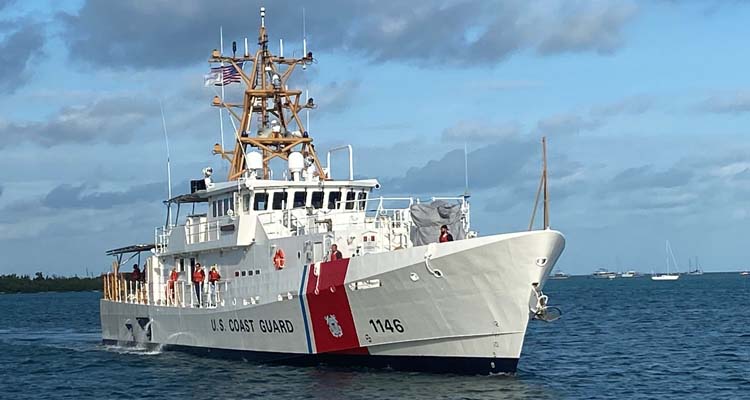
The 46th fast response cutter (FRC), John Scheuerman, was delivered to the Coast Guard Oct. 21, 2021, in Key West, Florida. One of six FRCs stationed in Manama, Bahrain. U.S. Coast Guard photo.

 Feb. 26, 2023

U.S. Coast Guard Cutter Interdicts Illegal Drugs Shipment in Arabian Sea

By U.S. Naval Forces Central Command Public Affairs

A U.S. Coast Guard ship seized illegal drugs worth $20 million in U.S. street value from a fishing vessel with four mariners transiting international waters in the Arabian Sea, Feb. 25.

Crewmembers from USCGC John Scheuerman (WPC 1146) discovered 1,350 kilograms of hashish, 276 kilograms of methamphetamine and 23 kilograms of amphetamine pills upon interdicting the vessel during a routine patrol.

“This is the result of excellent teamwork and multinational collaboration. It is important that we continue relentlessly pursuing any destabilizing maritime activity,” said U.S. Navy Capt. Anthony Webber, commander of Task Force 55, the staff responsible for U.S. 5th Fleet surface forces in the region. “The crew clearly demonstrated John Scheuerman’s motto of ‘selflessness and strength’ during this seizure and I couldn’t be more proud.”

John Scheuerman was operating in support of Combined Task Force (CTF) 150 at the time. Currently led by the United Kingdom Royal Navy, CTF 150 is one of four task forces organized under the Combined Maritime Forces (CMF).

CMF is the largest international naval partnership in the world, consisting of 38 member-nations and partners, and has interdicted over $1 billion worth of illicit narcotics during maritime patrols.

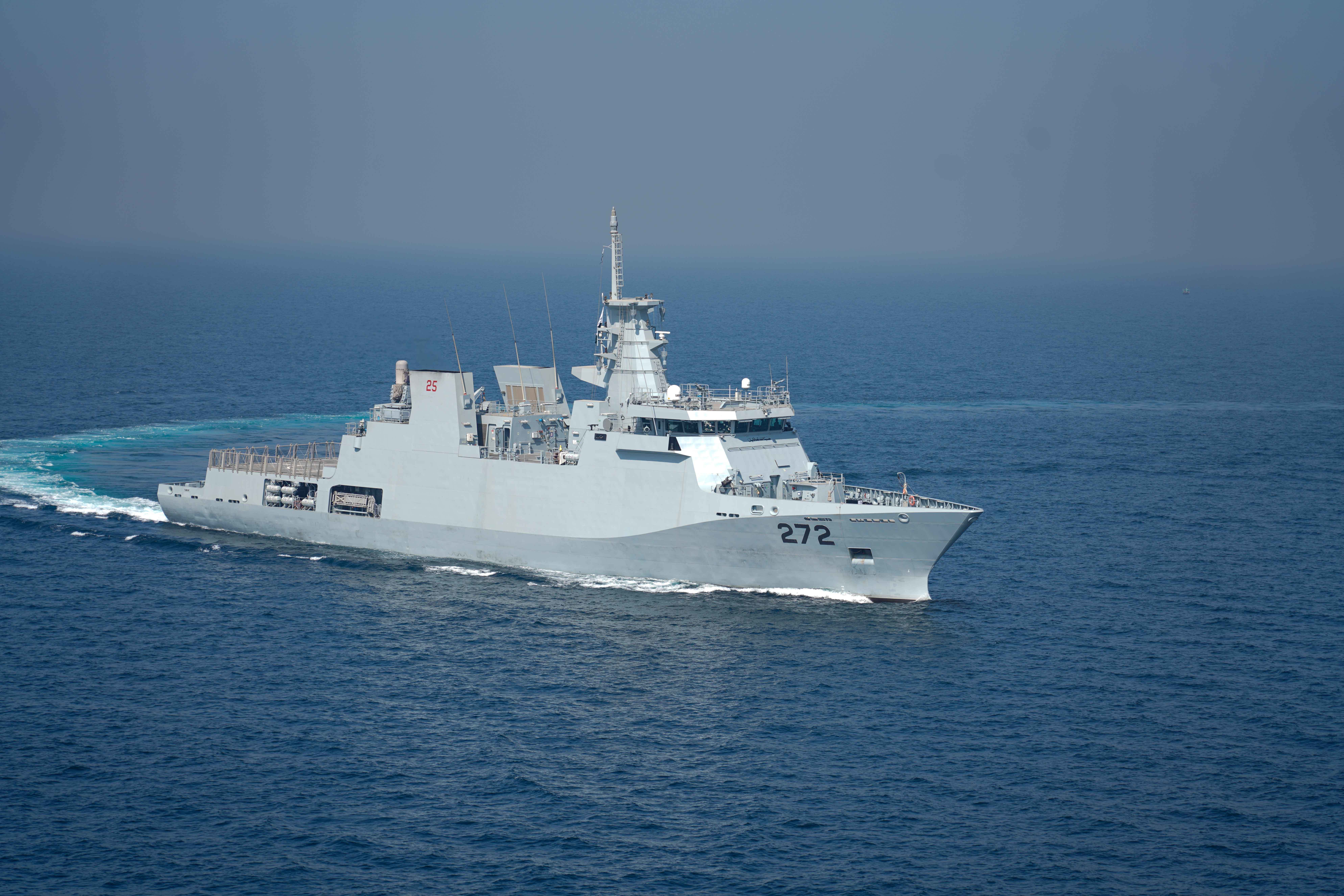
“Pakistan’s New OPV – PNS Yarmook – Is At NAVDEX 2023” –Naval News

Sister ship: GULF OF OMAN (Nov. 11, 2021) Pakistani corvette PNS Tabuk sails alongside amphibious dock landing ship USS Pearl Harbor (LSD 52) during a passing exercise in the Gulf of Oman, Nov. 11, 2021. (U.S. Navy photo by Mass Communication Specialist 3rd Class Sang Kim)

Naval News reports on a tour of a recently completed Damen designed Offshore Patrol Vessel. The vessel itself, PNS Yarmook (271), is a very typical modern OPV. What is not typical is the way it is being armed.

A medium caliber gun (57-76mm) and a pair of auto-cannon (20-30mm) seems to be the norm. Instead, it is to be a 30 mm Aselsan SMASH remote weapon station, two Aselsan STAMP remote weapon systems, (presumably with .50 cal. machine guns) and a Phalanx Block 1B close-in weapon system, and eight Harbah sub-sonic, anti-ship cruise missiles (ASCM) with land attack capability. This missile, at 1350 kg, is about twice as large as Harpoon (1523 lbs / 691 kg) and 50 kg or 110 pounds heavier than the Tomahawk. It is more than three times larger than Naval Strike Missile.

Pakistan is building another, slightly larger class of OPVs. Presumably, they will also be armed with ASCM. These, like the Yarmook class, are being built by the Damen yard in Galati, Romania.

USCGC Emlen Tunnell Seizes Illegal Drugs In Gulf Of Oman

230130-N-NO146-1001 GULF OF OMAN (Jan. 30, 2023) Illicit drugs interdicted by USCGC Emlen Tunnell (WPC 1145) sit on the deck of a fishing vessel for inventory as the U.S. Coast Guard cutter sails in the Gulf of Oman, Jan. 30. (U.S. Coast Guard photo) (Photo by U.S. Coast Guard)

Below is a U.S. Naval Forces Central Command news release. More information on Combined Maritime Forces, Task Force 150, Coast Guard PATFORSWA interdiction efforts, and why I think it is a great model for other areas here.

U.S., International Forces Seize Illegal Drugs in Gulf of Oman, By U.S. Naval Forces Central Command Public Affairs | January 31, 2023

MANAMA, Bahrain —

A U.S. Coast Guard vessel seized illegal drugs worth a total estimated U.S. street value of $33 million from a fishing vessel transiting international waters in the Gulf of Oman, Jan. 30.

U.S. Coast Guard cutter USCGC Emlen Tunnell (WPC 1145) was patrolling regional waters in support of Combined Task Force (CTF) 150 when it seized 4,000 kilograms of hashish and 512 kilograms of methamphetamine from the smuggling vessel.

Currently led by the United Kingdom Royal Navy, CTF 150 is one of four task forces organized under the Combined Maritime Forces (CMF). This was the first drug seizure in 2023 for CMF.

“This is just the beginning of our work in delivering maritime security operations in the region to stop illicit activities and drug smuggling,” said UK Royal Navy Capt. James Byron, the CTF 150 commander. “This comes as a result of a valued partnership between CTF 150 and all partner nations in Combined Maritime Forces.”

Byron assumed command of the multinational task force Jan. 18 after Royal Saudi Navy Rear Adm. Abdullah Al-Mutairi led the unit for six months.

Under Al-Mutairi’s leadership, CTF 150 ships logged more than 10,000 hours on regional patrols and intercepted six shipments of illegal drugs that included opium, heroin, hashish and amphetamines. The combined estimated value of the seized drugs totaled more than $250 million.

Since 2021, CMF has interdicted $1 billion worth of illicit narcotics during maritime patrols. CMF is the largest international naval partnership in the world consisting of 38 member-nations and partners.

“Navy Wants Independence LCS in Bahrain for Mine Countermeasure Mission” –USNI / “Navy considers non-LCS option for mine countermeasures in 5th Fleet” –Defense News

191227-N-PY805-1005
SOUTH CHINA SEA (Dec. 27, 2019) The Independence-variant littoral combat ship USS Gabrielle Giffords (LCS 10) receives fuel from the Henry J. Kaiser-class fleet replenishment oiler USNS Pecos (T-AO 197) during a replenishment-at-sea. Gabrielle Giffords is on a rotational deployment to INDOPACOM, conducting operations, exercises and port visits throughout the region and working hull-to-hull with allied and partner navies to provide maritime security and stability, key pillars of a free and open Indo-Pacific. (U.S. Navy photo by Nicholas J. Beihl/Released)

Two reports, one from US Naval Institute and one from Defense News. They appear to disagree, but they both were based on the same presentation. Really it is good news that both 5th and 7th Fleet want Independence class LCS. Trouble is, they don’t think they have enough to go around, if they are all based in San Diego, as they currently are. So, the Navy is looking at alternatives including forward basing or using other assets to provide the required Mine Counter Measures capability to 5th Fleet.

Their decision has potential consequences for Coast Guard forces’ efforts in the Eastern Pacific drug transit zone, Western Pacific IUU fisheries enforcement, and Southwest Asia.

The US Naval Institute report basically says the current plan is to supply 5th Fleet’s MCM requirement by using Independence class LCS operating from their base in San Diego, but they are looking at alternatives including forward basing or perhaps letting Freedom class LCS fill in.

The Defense News report tells us why the Navy wants an alternative solution.

The U.S. Navy is considering alternatives to deploying littoral combat ships to the Middle East for a mandatory mine countermeasures mission, hoping to instead maintain LCS deployments to the Western Pacific. (2)

—

“We’re trying to leverage that as much as we can and see how that fits into the mix,” he said. “There’s several different things going on, but right now I think the plan of record as it stands would be an Independence-variant MCM capability out there — but … we are working on several other options to see how we can fill that, and I personally think the answer is going to be something that is forward-deployed to Bahrain.” (Emphasis applied–Chuck)(2)

The Independence class (trimaran) LCSs in the Western Pacific are, or at least could be, helping to counter Illegal, Unreported, and Unregulated (IUU) fishing.

Once expected to go to the 5th Fleet/CENTCOM, the remaining Freedom class (mono-hull) LCSs are now expected to support 4th Fleet/SOUTHCOM including drug interdiction with embarked Coast Guard Law Enforcement Teams. If they are diverted to 5th Fleet to fill in, it could potentially hurt the drug interdiction effort.

An Alternative: As MCM can now be modularized, there appears to be less reason to have dedicated MCM ships or that all the elements have to be collocated on a single ship.

The service plans to buy 24 packages to equip 15 of the Independence-class LCS. That leaves nine mine countermeasure packages for potential use on “vessels of opportunity,” as Capt. Mike Egan, branch head for mine warfare in the Office of the Chief of Naval Operations, said last May at the 2022 International Mine Warfare Technology Symposium of the Mine Warfare Association. (3)

The aviation components and the Uncrewed Surface Vessel and its mine hunting sonar could be operated from shore or from an Expedition Base Ship. The Lionfish Unmanned Underwater Vehicle is the Remos 300. It is relatively small.

Part of the Navy’s planned family of systems, Lionfish’s main role will be intelligence gathering with the Navy’s expeditionary mine countermeasures company. As its name suggests, the SUUV is only 150 pounds and requires just a few sailors to deploy it. It will be based on HII’s Remus 300, a “man-portable UUV” that is “designed for modularity… [and] can be reconfigured with a range of sensors and payloads to meet mission requirements,” according to a statement the company published last year when announcing the government of New Zealand had ordered four UUVs. (4)

It could be operated from shore, from Expeditionary MCM Company RHIBs, or from Webber class WPBs.

More Reading: Good article on the state of US Navy Mine Warfare here.

Naval Strike Missile: Incidentally, there is affirmation that the Freedom class LCS, in addition to the Independence class LCS, will be equipped with Naval Strike Missile. From the USNI post,

“As of right now, the Navy still plans to put the Naval Strike Missile on the remaining Freedom-class hulls, Rear Adm. Fred Pyle, the director of surface warfare on the chief of naval operations’ staff (OPNAV N96), told reporters.” (1)

Sources: 

  1. Navy Wants Independence LCS in Bahrain for Mine Countermeasure Mission
  2. Navy considers non-LCS option for mine countermeasures in 5th Fleet
  3. Navy Mine Warfare Teeters Between Present, Future
  4. Navy moving ahead with HII for small UUV program

“Global Piracy Incidents Fall to Lowest Level in Decades” –gCaptain

USCGC Mohawk sails alongside a Nigerian navy ship in the Atlantic Ocean, Aug. 22, 2022. Mohawk was on deployment in the U.S. Naval Forces Africa area of operations. (Jessica Fontenette/U.S. Coast Guard)

gCaptain reports,

“Incidents of maritime piracy and armed robbery attacks last year fell to the lowest recorded level in almost three decades…”

While incidents are up in Southeast Asia, there has been a notable drop in incidents in the Gulf of Guinea, where the Coast Guard has been actively engaged in capacity building.

“The Gulf of Guinea saw a continued and much needed reduction is attributed to an overall decrease of pirate activity, with the number of incidents falling from 35 in 2021 to 19 in 2022.”

Off Somalia there has been both a sustained counterpiracy effort and allied patrols to interdict arms bound for rebels in Yemen.

“For a fourth year in row, there were no incidents of piracy or armed robbery by Somali-based pirates…”