“Coast Guard completes work on service life extension program prototype” –CG-9

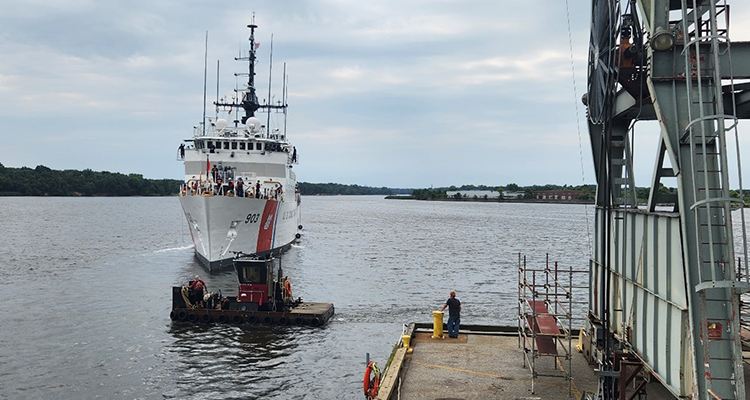
Coast Guard Cutter Harriet Lane departs Coast Guard Yard in Baltimore Aug. 3, 2023, after undergoing 15 months of In-Service Vessel Sustainment Program production work. The service life extension program for this cutter entailed 113 work items, worth $21 million, which included a new electrical system and an MK38 Mod 3 gun weapon system, a first for the medium endurance cutter class. Both Coast Guard Cutters Seneca and Harriet Lane served as medium endurance cutter prototypes for new electrical and structural work and Harriet Lane served as the gun weapons systems prototype.

For more information: In-Service Vessel Sustainment Program page


Above is an announcement by the Acquisitions Directorate (CG-9). As I noted in a July post about the WMEC270 Service Life Extension program, there are still some unknowns regarding the program. The photo above may answer some of those questions.

As expected, a Mk38 gun mount has replaced the 76mm Mk75. The CG-9 post indicates the installed mount is the 25mm Mk38 Mod3, and that there is one and only one mount. The Mk92 fire control system has apparently been removed and I see no apparent new radar that would replace its air search and approach control capability. It also appears the SLQ-32 has been removed.

It appears the Mk38 Mod3 is mounted on an elevated platform about four feet above the foc’sle deck. This should provide both a better field of fire and a degree of protection from green water coming over the bow, though I felt it should have been raised a full deck.

Harriet Lane was a prototype, but it wasn’t one of the six to get the complete SLEP. They are to be Spencer, Legare, Campbell, Forward, Escanaba and Tahoma.

Harriet Lane is expected to change homeports to the Pacific and be dedicated to operations in the Western Pacific.

I think it perhaps unfortunate, that the ship that may be placed in a position where it will need to face down China Coast Guard cutters armed with 76mm guns has lost hers. Perhaps it should not matter, but it may be more difficult to act boldly when your adversary can hurt you badly, from a distance, with impunity.
“USNI News Fleet and Marine Tracker: Aug. 14, 2023” –USNI

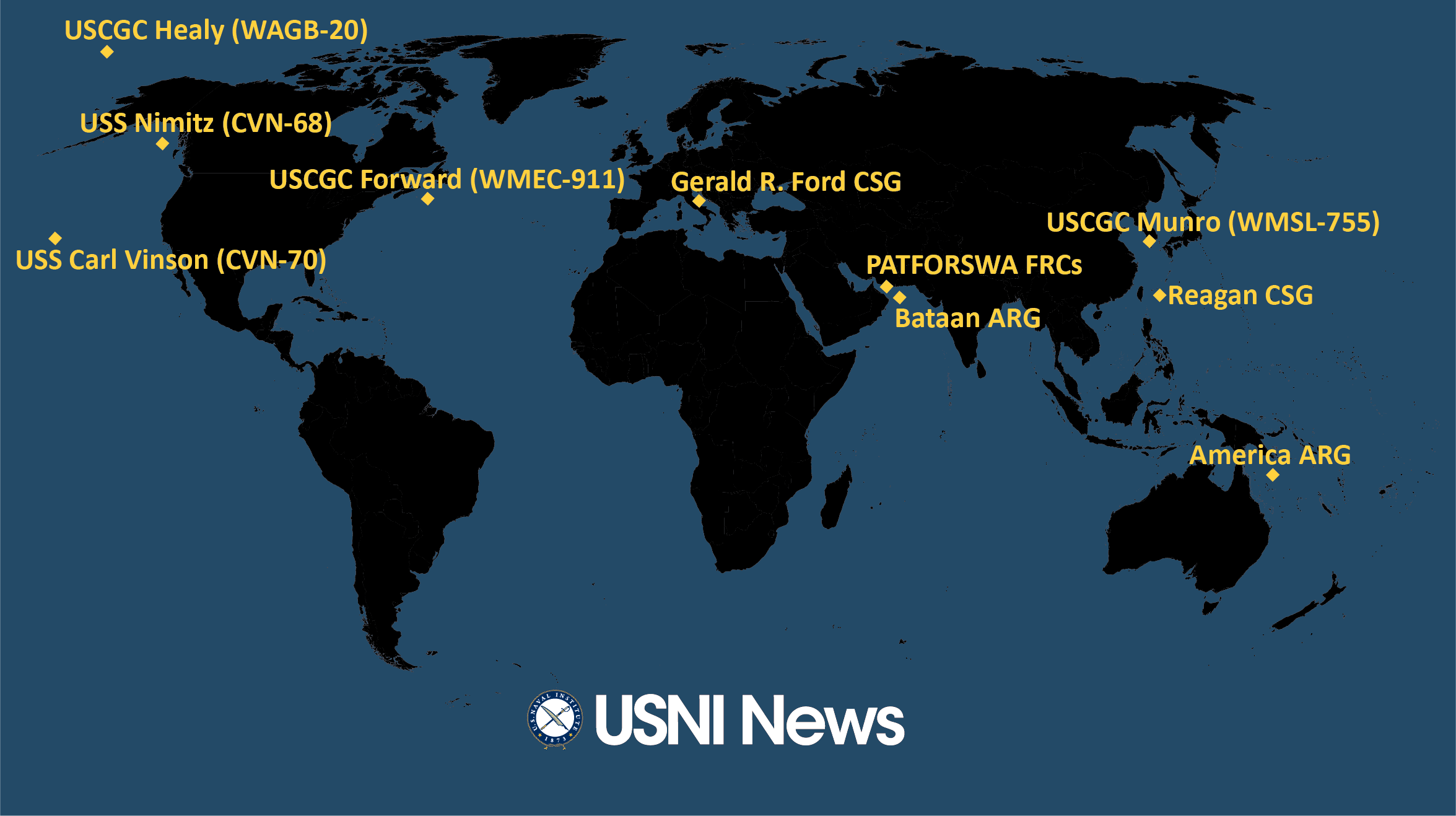
The US Naval Institute News Service “Fleet Marine Tracker” continues to report atypical Coast Guard activities. It continued to report on USCGC Healy’s Arctic deployment and mentioned PATFORSWA as they have since they have since they began including Coast Guard units in May.

This week, they included some activity I have not seen reported elsewhere.

“Legend-class National Security Cutter USCGC Munro (WMSL-755) departed Fleet Activities Yokosuka (CFAY) and is now in South Korea.”

“Coast Guard Cutter Forward (WMEC-911) is currently supporting Operation Nanook. Operation Nanook is an annual Canadian-led exercise that fosters international cooperation and shared responsibility in the Arctic and the northern Atlantic Regions.”

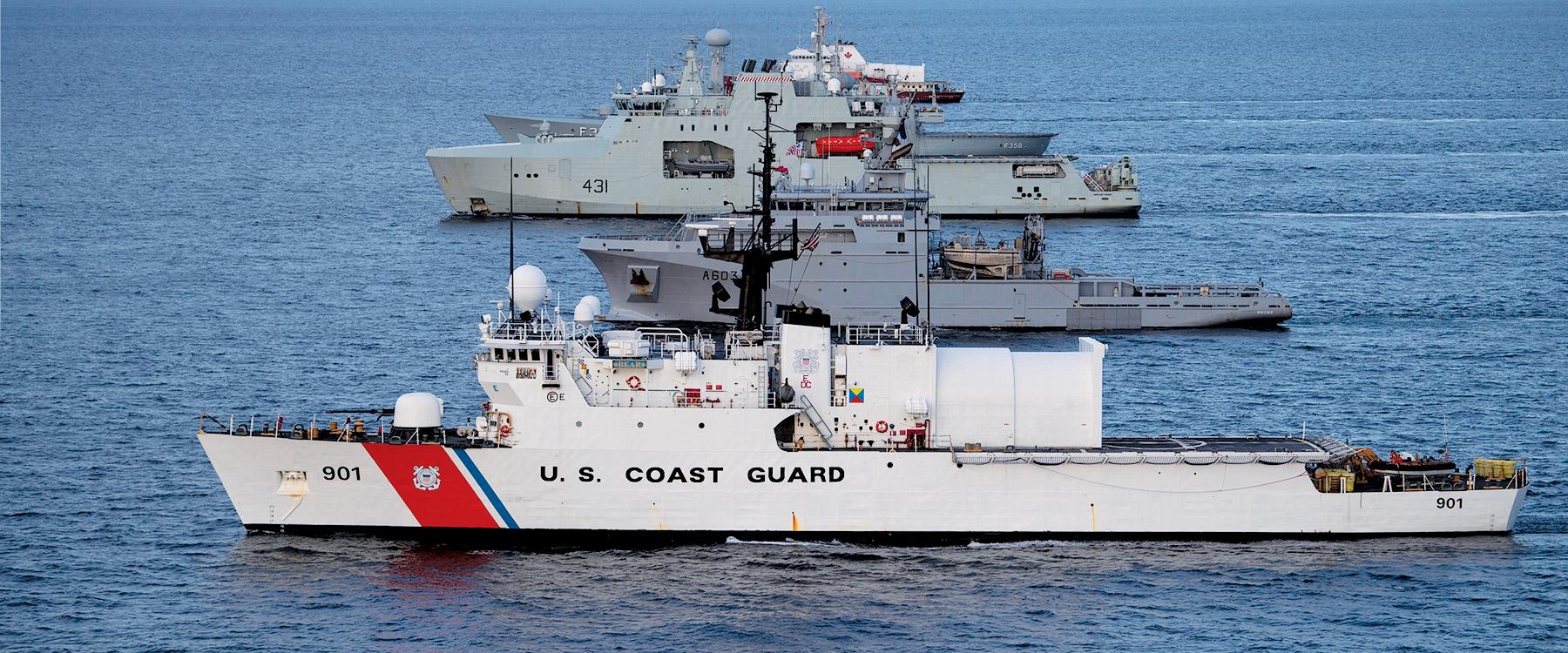
The USCGC Bear (WMEC-901) and allied ships from Canada, Norway, France, and Denmark steam in formation in the North Atlantic Ocean during last year’s Operation Nanook in August 2022. 

“U.S.-Philippine Coast Guard Patrols: Time To Provoke the Provocateur” –Real Clear Defense

Chinese fishing vessel fleet (Photo: The Maritime Executive)

Real Clear Defense has a post by the J. C. Wylie Chair of Maritime Strategy at the Naval War College, Dr. James R. Holmes, discussing the implications of the planned Philippine/US Coast Guard joint patrols in the South China Sea.

It is a thought-provoking article but I would argue for a change of emphasis. The Chinese consider what is happening war without gunsmoke, but if we engage on that basis we are already at war. Rather I would suggest we see this as purely law enforcement vigorously applied–which is of course the reason it is the US Coast Guard rather than the USN that will be conducting these joint patrols.

  • If foreign vessels fishing in the Philippine EEZ without a license is not already illegal, make it so. The Philippines should make sure the Chinese know that is how it will be viewed and act accordingly.
  • No foreign vessels should be allowed to impede Philippine vessels conducting legal activities.
  • No foreign vessels should be allowed to exploit the resources of the Philippine EEZ without a license.
  • No foreign vessels should be allowed to damage resources in the Philippine EEZ.

The Chinese maritime militia has been very useful, but they may also be viewed as China’s weakness, since they are officially civilians. As civilians violating Philippine law, they should be subject to vigorous law enforcement action.

CRASH AVERTED This photo taken on April 23, 2023 shows BRP Malapascua (right) maneuvering as a Chinese coast guard ship cuts its path at Second Thomas Shoal in the Spratly Islands. AFP PHOTO

If a vessel chooses to block a Coast Guard vessel and violates the Rules of the Road in the process, if a collision results and their engineroom floods, it was their violation of the Rules of the Road that caused the collision.

This is lawfare, not warfare, and the law is on the side of the Philippines. The Chinese are acting as a gang of thieves stealing from their weaker neighbors. Diplomatically the US and the Philippines need to work toward something similar to the Combined Maritime Forces organization in SW Asia and fielding a law enforcement alliance like my proposed Combined Maritime Security Task Force Pacific. (“Combined” used this way means multi-national.)

“US to Deploy Coastguard Ship to Papua New Guinea” –The Defense Post

The USCGC Oliver Henry (WPC 1140) crew arrives in Manus, Papua New Guinea, on Aug. 14, 2022, from Guam as part of a patrol headed south to assist partner nations in upholding and asserting their sovereignty while protecting U.S. national interests. The U.S. Coast Guard is participating with partners to support the Pacific Islands Forum Fisheries Agency-led Operation Island Chief and the larger Operation Blue Pacific through patrols in the Western Pacific in August and September 2022. (U.S. Coast Guard photo by SW3 Victor Villanueva, NMCB-FOUR)

(Sorry, this is a couple of weeks old.)

The Defense Post reports,

US Defense Secretary Lloyd Austin on Thursday announced the deployment of a US Coastguard ship to Papua New Guinea, as Washington seeks to boost its military footprint in the region amid fierce competition for influence with China…“A US Coastguard cutter will be here in August,” Austin said as he became the first Pentagon boss to visit Papua New Guinea.

Again, the Coast Guard is being used as an instrument of foreign policy. That is not a bad thing, but it is a fact.

It is not like the Coast Guard has not been there before. The photo is from 2022, but the US and Papua New Guinea are seeking closer, mutually beneficial ties.

For Papua New Guinea this means improvements to dual use (military and civilian) infrastructure (ports and airfields), increased economic activity, and help with preventing IUU fishing.

For the US, the diplomatic activity is prompted by Chinese attempts to obtain influence in Oceania that seemed to have been demonstrated when the Soloman Islands failed to respond to a request for a routine replenishment stop for USCGC Oliver Henry (pictured above).

Thanks to Paul for bringing this to my attention. 

“TEXTRON SYSTEMS AWARDED UNCREWED AIRCRAFT SYSTEM (UAS) CONTRACTOR-OWNED/CONTRACTOR-OPERATED CONTRACT FOR THREE LITTORAL COMBAT SHIPS (LCS) BY U.S. NAVY” –Textron Systems

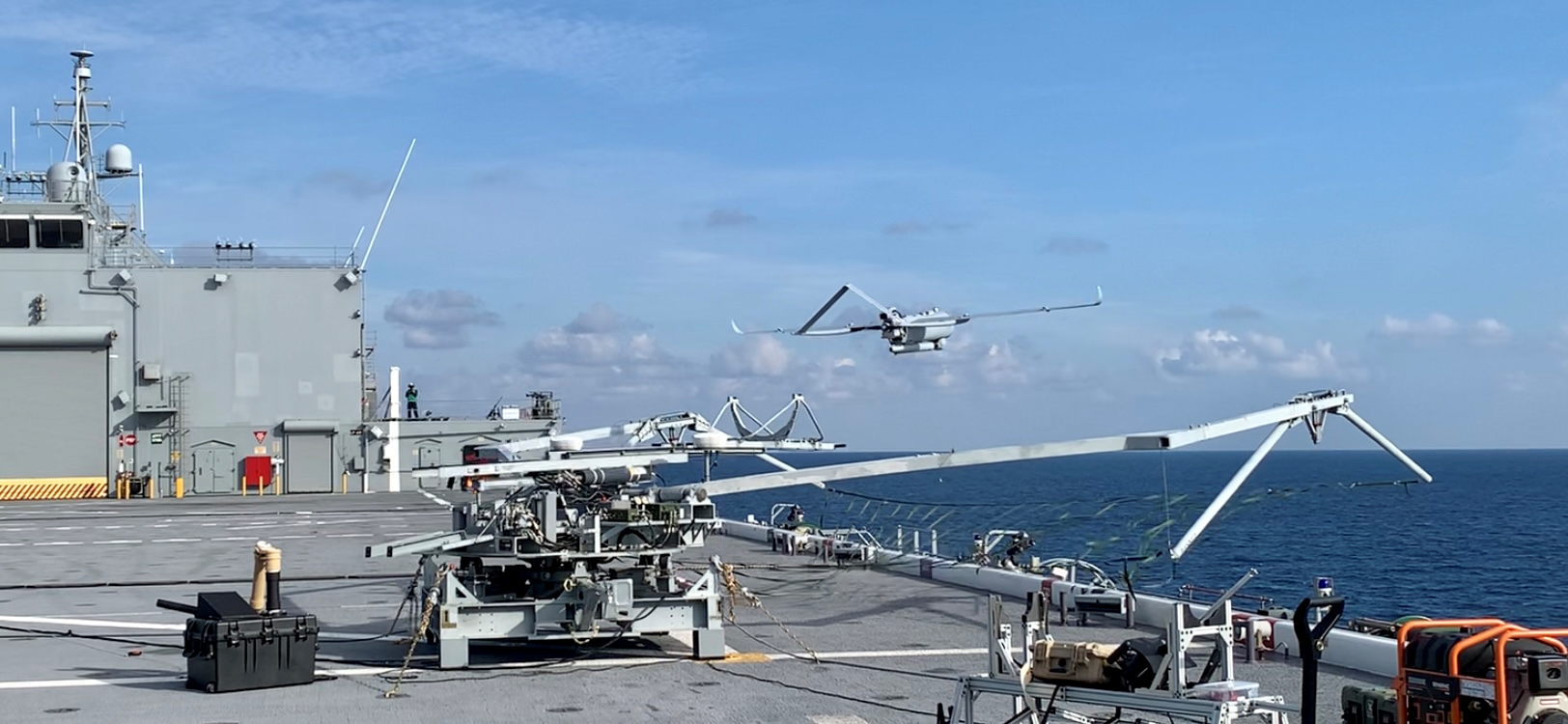
Aerosonde launch from USS Miguel Keith (ESB-5)

Below is a news release from Textron Systems.

It is not clear which version of Aerosonde is to be deployed on the LCSs. There are now hybrid quad versions that can take off and land vertically (see the video) without the supporting catapult and capture gear (top photo), but those with VTOL capability do sacrifice some endurance, speed, and payload as a result of greater weight and increased drag. It is likely the catapult launched version, which we know is on ESB-5, will also be used on the LCSs. Why did the Navy choose the Aerosonde over the Scan Eagle chosen by the Coast Guard? Let’s compare the two catapult launched UAS:

  • Type                                     Aerosonde Fixed Wing            Scan Eagle
  • Max Payload (pounds/kg):              20/9                                    11/5
  • Endurance (hours)                           14+                                     20+
  • Air Speed  (knots)                          45-65                                  60-80
  • Power (HP)                                        4                                        1.5

The Aerosonde’s only immediately apparent advantage is the greater payload. Perhaps the Navy has a sensor, or sensors that may be more capable but heavier that those included in the Coast Guard’s Scan Eagles, but if so, I can’t tell you what they are.

Incidentally, the payload capacity for the vertical takeoff and landing Hybrid Quad version of Aerosonde is 15 pounds, so it could presumably use the same sensor suite used on Coast Guard Scan Eagles.


AEROSONDE® UNCREWED AIRCRAFT SYSTEM (UAS) SUPPORTING SEVENTH U.S. NAVY SHIP WITH EXTENDED RANGE ISR SERVICES

Hunt Valley, Maryland, AUGUST 9, 2023 – Textron Systems Corporation, a Textron Inc. (NYSE:TXT) company, announced today that it has been awarded an initial contract valued at up to $19.5 million by the U.S. Navy’s Naval Air Systems Command (NAVAIR) to provide UAS operational support to two Independence Class LCS and one Freedom Class LCS variants. This award joins the Expeditionary Sea Base (ESB)-4 and ESB-5, as well as two DDG- class ships, bringing the total number of U.S. Navy ships supported by the Aerosonde® UAS system to seven.

Textron Systems will deploy its Aerosonde UAS to provide mission overwatch and extended intelligence, surveillance and reconnaissance (ISR) services with enhanced mission payloads as seen aboard the ESB-5.

“Contractor-owned/contractor-operated contracts like this support the Navy’s continued investments in uncrewed assets for their ships,” said Wayne Prender, Senior Vice President, Air Systems. “We’ve seen the benefits of our Aerosonde UAS for DDG and ESB- class ships already, and we’re honored to be expanding into this new ship class, allowing us to continue supporting maritime domain awareness and missions while delivering operational and logistical capabilities.”

The Aerosonde system continues to set the standard for mission readiness and ease of use, amassing more than 600,000 flight hours serving multiple U.S. customers and allies. It is designed for expeditionary land- and sea-based operations with both fixed-wing and vertical takeoff and landing (VTOL) options. Textron Systems has provided turnkey, UAS operations for customers around the world for more than 10 years.

NAVAIR Public Release 2023-538 Distribution Statement A – “Approved for public release; distribution is unlimited”

“Japan to supply 5 countries with free patrol boats to counter China” –Navy Recognition

Japanese Aso-class patrol vessel Dewa. (Picture source: Japanese government)

Navy Recognition reports,

For 2024, the OSA (Japan’s Official Security Assistance program–Chuck) has earmarked nations such as Vietnam, Indonesia, the Philippines, Papua New Guinea, Mongolia, and Djibouti. Notably, the first three have ongoing maritime disputes with China in the South China Sea…To strengthen its oversight of territorial waters and skies, Japan is considering equipping these nations with patrol boats, radar tech, drones, and communication tools.

While the US has transferred a lot of overage Coast Guard cutters, the Japanese generally supply new ships on very favorable financial terms. This helps maintain Japan’s shipbuilding capacity.

Japan has already supplied the Philippines with two large patrol cutters and ten smaller patrol craft. Japan has an agreement with Vietnam to build six cutters based on the Aso class pictured above. Japan has gifted at least one older cutter to Malaysia

It is not clear if the patrol boats mentioned in the title are actually free or if they refer to new or previously arranged programs.

Thanks to Lee for bringing this to my attention. 

“Philippine Armed Forces Resupply Mission Hit with Chinese Coast Guard Water Canons” –Video

Thought it worthwhile to pass this video along.

First thing, the Chinese are devoting a lot of resources to isolating this particular outpost, an ancient, badly corroded, grounded, but still commissioned former US LST.  There are three large modern China Coast Guard cutters visible in the video, 5201, 5305, and 4203. All three are about 100 meters in length or larger, all equipped with 76mm guns. We have seen 5201 before.

CRASH AVERTED This photo taken on April 23, 2023 shows BRP Malapascua (right) maneuvering as a Chinese coast guard ship cuts its path at Second Thomas Shoal in the Spratly Islands. AFP PHOTO

Second, the Philippines would have known what they were up against. Couldn’t they have used something faster and more maneuverable that could have gotten around these large cutters to make this supply run. I hope I am wrong, and I may not understand what it takes to reach this grounded LST, but it is almost as if they are failing on purpose.

The US has warned the Chinese against targeting the Philippine Coast Guard.

“Upgun Cutters to Meet Today’s Naval Threats” –USNI

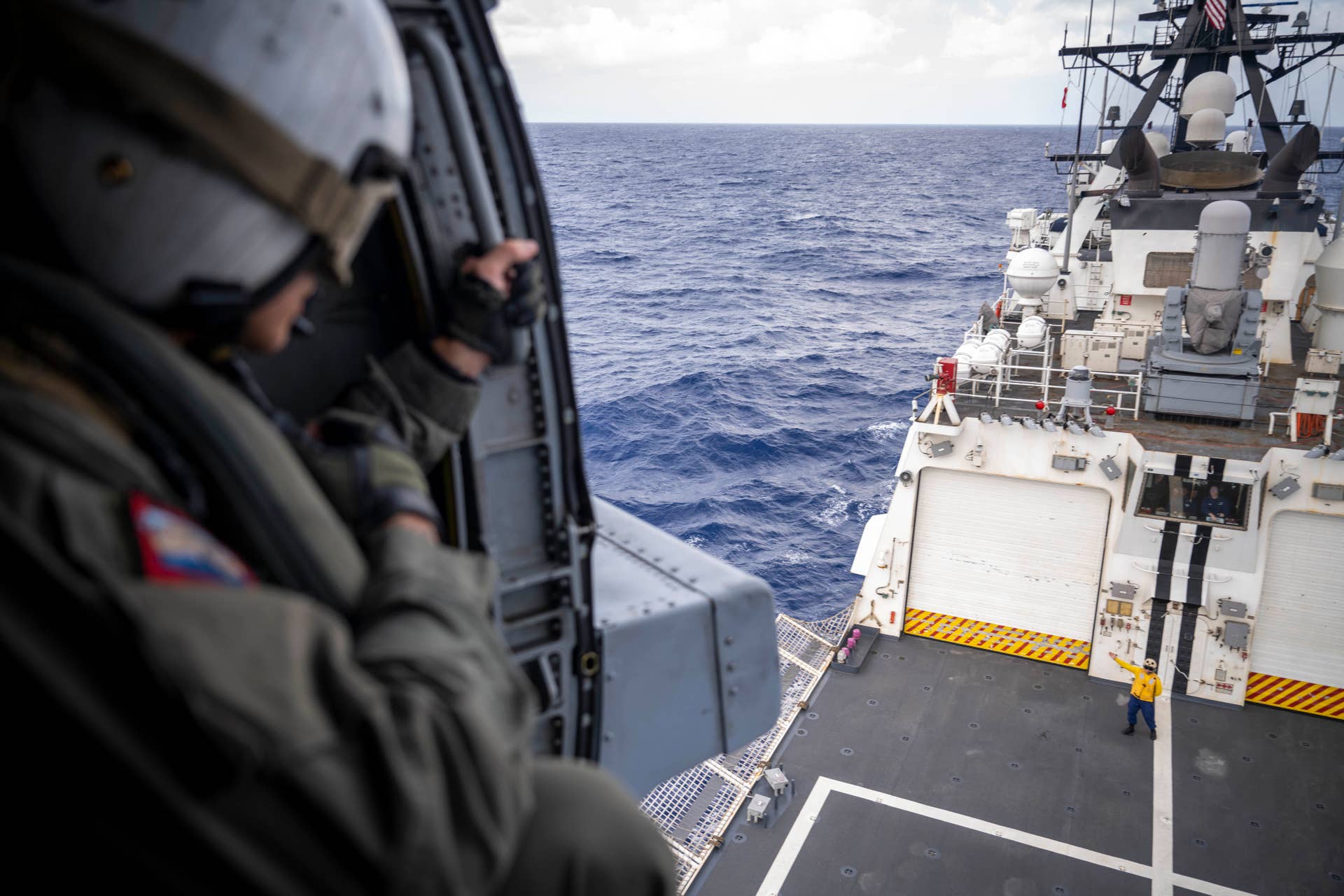
PACIFIC OCEAN (July 30, 2022) U.S. Navy Petty Officer 1st Class Humberto Alba, a naval aircrewman tactical-helicopter, attached to Helicopter Maritime Strike Squadron (HSM) 37, deployed on U.S. Coast Guard Legend-class cutter USCGC Midgett (WMSL 757), looks down at a USCGC crewmember after taking off during flight operations during Rim of the Pacific (RIMPAC) 2022. (U.S. Coast Guard photo by Petty Officer 3rd Class Taylor Bacon)

This essay from the July 2023 issue of Proceedings, is featured on the US Naval Institute Proceedings web site. It won Second Prize in the Midshipmen & Cadets Essay Contest—Sponsored by the U.S. Naval Institute.

This is just one of many such articles that have been published repeatedly over the years. The logic is clear,

If more heavily armed, Coast Guard cutters could better support the Navy and enhance defense readiness.

At small marginal cost, cutters could make a significant contribution to our nation’s naval strength, but it has not happened in the last 30+ years. Why not?

It seems the Leadership of both the Navy and Coast Guard have other priorities, and there is no sponsor in a position of power to push the program.

The Navy is in trouble. The Navy has been shrinking over most of the last 34 years, from down from 592 Sept. 30, 1989, to 299 as of this week. It began with the collapse of the Soviet Union. I’m sure it seemed like good idea at the time, but the “peace dividend” meant there was not much reason to build new ships. Teams that had developed a long string of successful ship designs ceased to exist. Shipyards closed. As a result, they have had difficulty fielding new classes of ships. Their new generation shipbuilding programs have been plagued with problems, while the Chinese navy has been building ships at a furious pace.

The Coast Guard has had its own troubled recapitalization program, beginning with “Deepwater” and while the NSC and FRC programs seem to have been successful, if long delayed, the Offshore Patrol Cutter and Icebreaker programs are still having significant difficulties. But perhaps more importantly, Coast Guard leadership sees the conventional model of a combat ready Coast Guard as counterproductive to other Coast Guard priorities.

Personally, I feel fears that a more heavily armed Coast Guard would not be welcome in many parts of the world is overblown, but the fear does exist and the conventional model of permanently installed weapon systems operated and maintained by Coastguardsmen would require a diversion of assets unless the budget is increased and more assets are provided. There is a cost to the Coast Guard in terms of training and maintenance time for both units and individuals, even if the Navy pays for the systems.

I think there is an alternative that would address the fears of the Coast Guard leadership and create a powerful sponsor in the Navy. 

The Navy Reserve could be that sponsor. It is a reservoir of trained talent, but where do they go upon mobilization? There are only so many ships. Their crews, while they may have some shortages, are essentially at war time manning levels. There are only so many helicopter landing spots on Navy ships. Many Navy Reservists have no really appropriate place to serve upon full mobilization.

Coast Guard units can provide a place where they can be used effectively. Navy helicopters and their crews can fly from Coast Guard cutters. Modularized versions of towed array sonar systems could be operated and maintained by Navy reservists on large cutters.

Initially at least, these reinforced cutters would be best used in the board reaches of the Pacific, beyond the effective range of enemy land based and air-launched anti-ship missiles, where the primary threat would be submarines, protecting the logistics ships that are essential for prosecuting a war in the Western Pacific.

In 2012, Admiral Jonathan W. Greenert, U.S. Navy, advocated,

“We need to move from ‘luxury-car’ platforms—with their built-in capabilities—toward dependable ‘trucks’ that can handle a changing payload selection.”

If the Navy can provide payloads, the Coast Guard can provide some trucks.

“US Coast Guard Seeks Bigger Role to Search, Board Vessels in Pacific” –gCaptain

The USCGC Oliver Henry (WPC 1140) crew arrives in Manus, Papua New Guinea, on Aug. 14, 2022, from Guam as part of a patrol headed south to assist partner nations in upholding and asserting their sovereignty while protecting U.S. national interests. The U.S. Coast Guard is participating with partners to support the Pacific Islands Forum Fisheries Agency-led Operation Island Chief and the larger Operation Blue Pacific through patrols in the Western Pacific in August and September 2022. (U.S. Coast Guard photo by SW3 Victor Villanueva, NMCB-FOUR)

gCaptain reports,

“The United States Coast Guard is in talks with Pacific Island countries to expand its maritime law enforcement role by allowing U.S. officers to board and search vessels suspected of illegal activity within their economic zones, officials said.”

This is about expanding and streamlining the shiprider program. In one case the Coast Guard already have permission to work with a national command center and act on behalf of another nation, Federated States of Micronesia, even if there is no shiprider physically aboard the cutter.

“More specifically, the agreement provides a coordinating mechanism and process for U.S. law enforcement personnel to work with the FSM National Police through command centers to receive approval from the FSM to act.”

Thanks to Lee for bringing this to my attention. 

“Probing Palau’s Waters: Chinese Ships Are Increasingly Active in the Pacific” –Real Clear Defense

The Republic of Palau on a map of the Pacific. Credit: Encyclopaedia Britannica/Universal Images Group via Getty Images

Real Clear Defense reports on Chinese incursions into Palau’s Exclusive Economic Zone.

None of the actions sighted appear to be illegal or that much different from what the US does in the South China Sea, but they are movements we want to watch. A more detailed understanding of what they are doing might reveal illegality such as tapping into undersea cables.

Seems like the Chinese are telling us we need to station some cutters in Palau, and maybe some land based UAS.

The nearest cutters are based in Guam. It is 700 nautical miles from Guam to Palau, further than the distance between Atlanta and New York City, 50 hours at 14 knots, so Guam really isn’t in the neighborhood.

The nearest Coast Guard fixed wing search aircraft are based in Hawai’i at Barbers Point, 4500 nautical miles away. Even the new C-130J would require two fuel stops just to get to Palau.