“MQ-9B SeaGuardian Showcased at RIMPAC 2024” –News Release

An MQ-9 Sea Guardian unmanned maritime surveillance aircraft system flies over the Pacific Ocean during U.S. Pacific Fleet’s Unmanned Systems Integrated Battle Problem (UxS IBP) 21, April 21. UxS IBP 21 integrates manned and unmanned capabilities into challenging operational scenarios to generate warfighting advantages. US Navy Photo

The Coast Guard has an unfilled requirement for a shore based Uncrewed Air System (UAS) to provide Maritime Domain Awareness.

Below is a news release from General Atomics Aeronautical Systems, Inc.

Reading the news release, I see the system incorporated an “integrated Minotaur Mission System.” Minotaur is a system currently being installed on all Coast Guard fixed wing search aircraft as well as US Navy and Marine Corps platforms. It went on to say “For RIMPAC, the MQ-9B effectively passed ISR&T (Intelligence, surveillance, reconnaissance, and targeting–Chuck) information to various surface and air units, such as the Nimitz-class carrier USS Carl Vinson, Guided Missile Destroyers (DDGs), Littoral Combat Ships (LCS), frigates, patrol boats, P-8s, P-3s, and numerous other U.S. and foreign units that took part in the exercise.” Could that have included Midgett and her task force? The use of the MQ-9B to drop sonobuoys for the task force and their embarked ASW helicopters would have been an interesting experiment.


GA-ASI’s MQ-9B SeaGuardian® Showcased at RIMPAC 2024

Sonobuoy Dispensing System and LRASM Among the New Capabilities Featured

SAN DIEGO – 14 August 2024 – With the completion of the U.S. Navy’s Rim of the Pacific (RIMPAC) flight operations on July 28, 2024, the MQ-9B SeaGuardian® Unmanned Aircraft System (UAS) supplied by General Atomics Aeronautical Systems, Inc., self-deployed back to its home base in El Mirage, Calif., but only after introducing an array of new capabilities. The flight home followed close to 100 flight hours supporting RIMPAC 2024 over the four-week exercise in and around the Hawaiian Islands.

RIMPAC is the world’s largest international maritime exercise. RIMPAC 2024 featured 29 nations, 40 surface ships, three submarines, 14 national land forces, more than 150 aircraft, and 25,000 personnel.

SeaGuardian provided real-time Intelligence, Surveillance, and Reconnaissance (ISR) data feeds to the U.S. Pacific Fleet Command Center using Signals Intelligence (SIGINT) parametrics and full-motion video to the watch floor and intelligence centers for real-time dynamic tasking — just as it did for the RIMPAC 2022 exercise. This year, SeaGuardian delivered some new features and capabilities, including Long Range Anti-Ship Missile (LRASM) targeting and a new Sonobuoy Dispensing System (SDS) to support its Anti-Submarine Warfare capability. SeaGuardian was configured with a prototype SDS pod capable of deploying 10 A-size sonobuoys per pod (SeaGuardian can carry up to four SDS pods or up to 40 sonobuoys) and the SeaVue Multi-role radar from Raytheon, an RTX business. Upon dispensing, the sonobuoys were successfully monitored and controlled by the SeaGuardian’s onboard Sonobuoy Monitoring and Control System (SMCS).

SeaGuardian is a maritime derivative of the MQ-9B SkyGuardian® and remains the first UAS that offers multi-domain Intelligence, Surveillance, Reconnaissance, and Targeting (ISR&T) as an internal payload that can search the ocean’s surface and depths in support of Fleet Operations. At RIMPAC 2024, SeaGuardian showcased all operational payloads, which includes the SeaVue, SNC’s Electronic Support Measures (ESM) solution, an Automatic Identification System (AIS), and a self-contained Anti-Submarine Warfare (ASW) system.

SeaGuardian’s multi-domain capabilities allow it to flex from mission to mission and pass real-time sensor data directly to the Fleet. For RIMPAC 2024, SeaGuardian added Link 16 Joint Range Extension Application Protocol (JREAP) “C” (internet protocol) and an integrated Minotaur Mission System to provide real-time sensor data for the various Maritime Operations Centers, ships, and aircraft with Minotaur nodes.

“For RIMPAC, the MQ-9B effectively passed ISR&T information to various surface and air units, such as the Nimitz-class carrier USS Carl Vinson, Guided Missile Destroyers (DDGs), Littoral Combat Ships (LCS), frigates, patrol boats, P-8s, P-3s, and numerous other U.S. and foreign units that took part in the exercise,” said GA-ASI President David R. Alexander.

On July 31, 2024, SeaGuardian self-deployed back to GA-ASI’s Desert Horizon Flight Operations Facility in El Mirage, Calif.

About GA-ASI

General Atomics Aeronautical Systems, Inc. (GA-ASI), an affiliate of General Atomics, is a leading designer and manufacturer of proven, reliable RPA systems, radars, and electro-optic and related mission systems, including the Predator® RPA series and the Lynx® Multi-mode Radar. With more than eight million flight hours, GA-ASI provides long-endurance, mission-capable aircraft with integrated sensor and data link systems required to deliver persistent situational awareness. The company also produces a variety of sensor control/image analysis software, offers pilot training and support services, and develops meta-material antennas.

For more information, visit www.ga-asi.com     

Avenger, Lynx, Predator, SeaGuardian, and SkyGuardian are registered trademarks of General Atomics Aeronautical Systems, Inc.
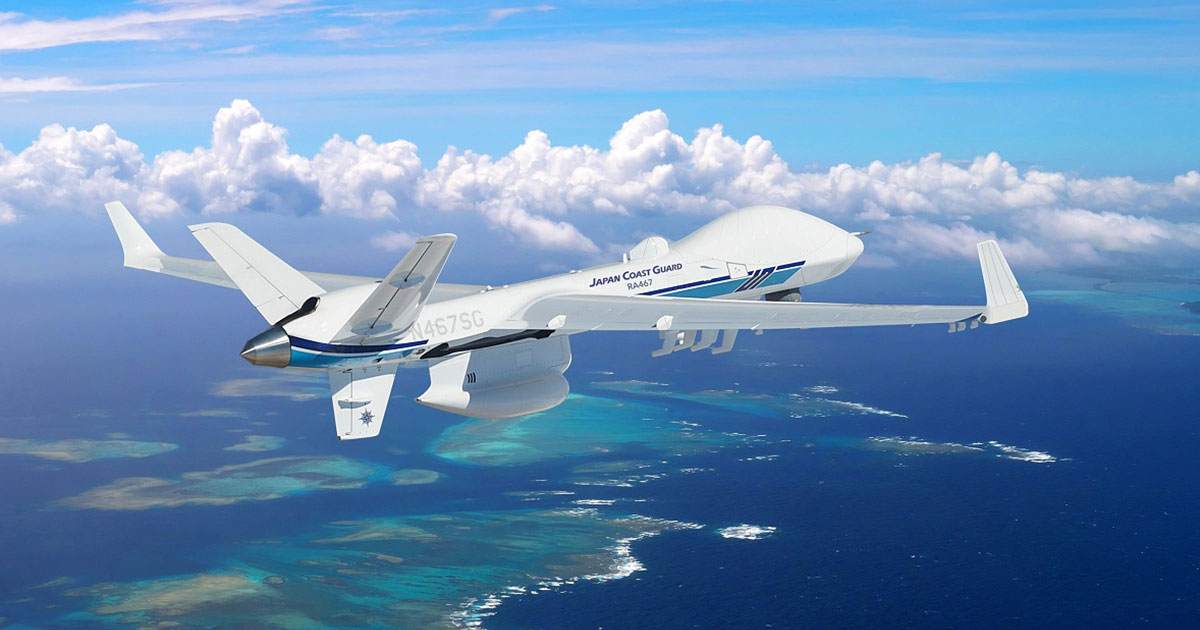
 

“Japan Buys Two SeaGuardians from GA-ASI” –News Release

Below is a news release from General Atomics Aeronautical Systems, Inc.
The SeaGuardian is a maritime variant of the MQ-9B that includes sense and avoid systems that allows it to operate safely in airspace with manned aircraft.

SeaGuardians are reportedly operated in a maritime role for Australia, Belgium, Canada, India, Italy, Japan, the Netherlands, and the UK.


Japan Buys Two SeaGuardians from GA-ASI

SAN DIEGO – 15 August 2024 – The Japan Coast Guard (JCG) has signed a contract for the purchase of two SeaGuardian® Remotely Piloted Aircraft (RPA) from General Atomics Aeronautical Systems, Inc. (GA-ASI), scheduled for delivery in 2025. This follows JCG’s ongoing Company-Owned, Contractor-Operated agreement with GA-ASI for operating SeaGuardian, which began in April 2022.
“Since JCG started operating SeaGuardians, they have been used for various JCG missions including supporting search and rescue and disaster response specifically during the 7.6 magnitude earthquake early this year near the Noto Peninsula of Ishikawa Prefecture and maritime surveillance during the 2023 G-7 Summit in Hiroshima, and the system has performed efficiently and effectively,” said GA-ASI CEO Linden Blue.

SeaGuardian is a medium-altitude, long-endurance RPA system that can fly for 24 hours or more, depending on the configuration.

GA-ASI has strengthened its Maritime Wide Area Surveillance (MWAS) for Japan with Optix+, which gathers information from the SeaGuardian sensors, as well as other data sources, displaying the full picture of surveillance information for its operator. This functionality makes it easy to task and direct its Intelligence, Surveillance and Reconnaissance (ISR) information in real time. GA-ASI’s Optix+ software suite rapidly correlates and exploits collected data into an easily shared common operational picture. Having multi-source correlated data enables automatic detection of anomalous behaviors over waters.

About GA-ASI

General Atomics Aeronautical Systems, Inc. (GA-ASI), an affiliate of General Atomics, is a leading designer and manufacturer of proven, reliable RPA systems, radars, and electro-optic and related mission systems, including the Predator® RPA series and the Lynx® Multi-mode Radar. With more than eight million flight hours, GA-ASI provides long-endurance, mission-capable aircraft with integrated sensor and data link systems required to deliver persistent situational awareness. The company also produces a variety of sensor control/image analysis software, offers pilot training and support services, and develops meta-material antennas.
“Q&A: Vice Admiral Andrew J. Tiongson, Commander, Pacific Area and Commander, Defense Force West, U.S. Coast Guard” –Seapower

Tiongson speaks at a press conference before the crew of the Coast Guard Cutter Waesche offloads 18,219 pounds of cocaine, worth more than $239 million, on Dec. 6, 2023. U.S. Coast Guard

The Navy League’s on-line magazine, Seapower, has an interview with the Pacific Area Commander. There is a lot of good information here.

HC-130Js (and C-27Js):

CGAS Sacramento will “transition” to HC-130Js. Pacific Area certainly needs the long range aircraft because, while 84% of the US EEZ is in Pacific Area they have only three fixed wing air stations (Kodiak, Barbers Point, and Sacramento) while Atlantic Area has five fixed wing air stations to cover only 16% of the US EEZ.

What will happen to the C-27Js? No mention was made of these. They might go to Guam. That would be helpful in providing fixed wing search aircraft in the Western Pacific. Recently there was a SAR case in the Western Pacific. A C-130 was dispatched from Barbers Point, but the flight was so long the crew needed a day’s rest before the aircraft could be used in the search. On the other hand, Guam might not be an optimal location since it is so far West. There are other options.

Fast Response Cutters:

As I read the statement, the intention is to have a total of six FRCs in Guam and add a fourth in Hawaii.

His discussion about these little ships clearly indicates that their nominal five-day endurance (same as the preceding 110 foot WPBs) is being exceeded regularly.

“The FRCs, first off, are game changers for the Coast Guard in general. Back in the day, we had patrol boats that were limited in terms of the sea states they could handle, the food that they could carry, the number of crew members and certainly their duration at sea. The FRCs have changed that.”

Six WPCs in the same port is not unusual. District 7 has three different ports, each homeport to six or seven Webber class, but this may be a move toward replicating a PATFORSWA type organization to support 7th Fleet in the Western Pacific.

Large Patrol Cutters:

There was a brief discussion of the Offshore Patrol Cutters, but no indication of when they are expected to arrive in PACAREA.

A second “Harriet Lane or Indo-Pacific support cutter” is on PACAREA’s unfunded priority list. For some reason, I think this may happen.

Commercial Icebreaker Procurement:

Plans for the commercial icebreaker (Aiviq) were discussed. It will be homeported in Juneau, as reported here in March, but still has not been purchased and it will take two years to complete changes to make it fully operational.

The admiral was asked, “Is the commercial icebreaker going to be crewed by Coast Guardsmen or by a contract crew?” and there was no definitive answer. Should the Coast Guard adopt a hybrid crew, as has been done by some Navy vessels it would be a major change in Coast Guard policy.

The Eastern Pacific Drug Transit Zone: 

Atlantic Area cutters are not assisting in Eastern Pacific drug transit zone interdiction efforts, as they normally would, because they are heavily engaged in migrant interdiction operations.

Trusted Partner:

The Area Commander talked a lot about what being a trusted partner meant, about partnerships with Asian coast guards, and the outsized effect of having a few good people in liaison positions.

U.S. Coast Guard Cutter Waesche returns home following a 120-day Indo-Pacific patrol

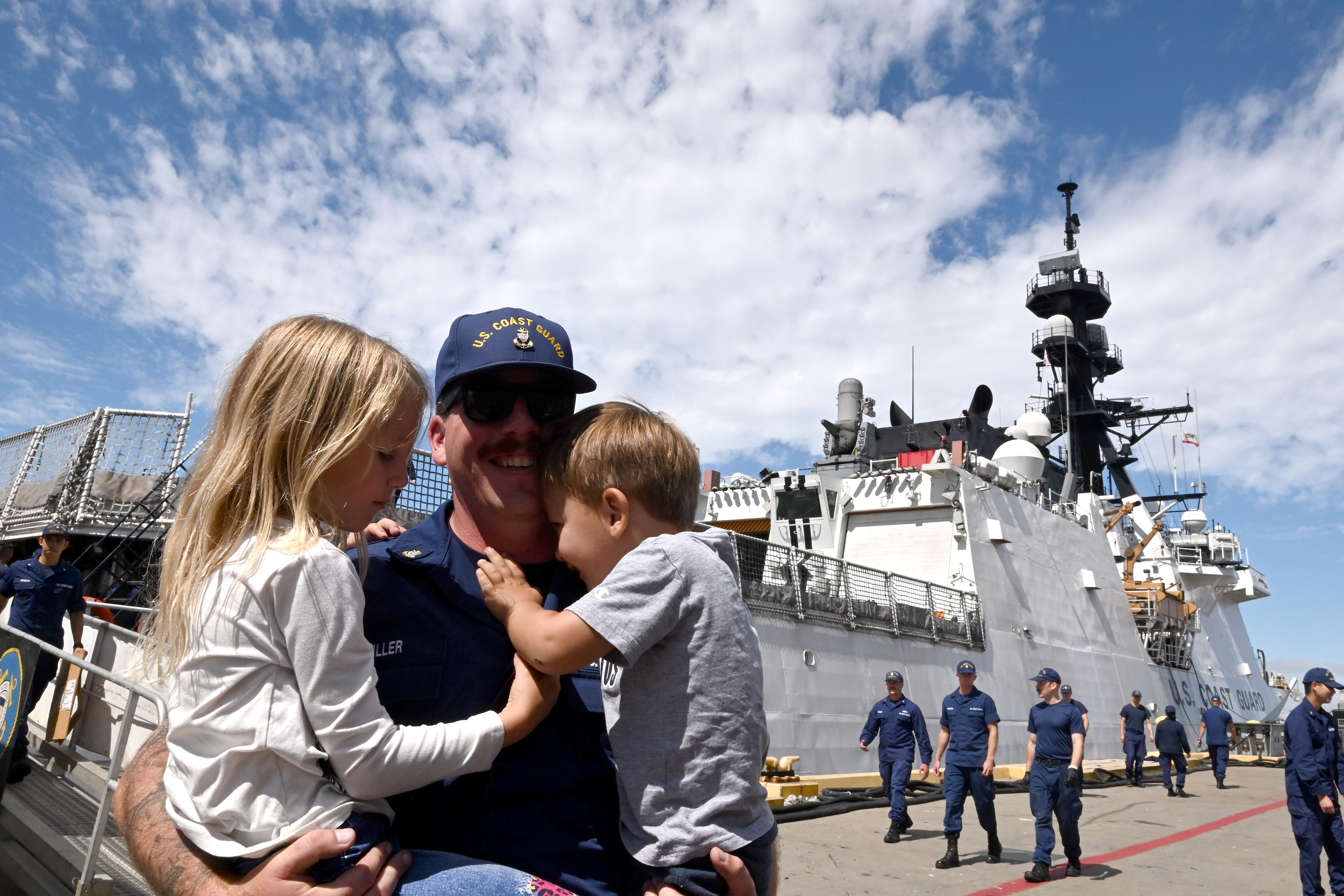
The U.S. Coast Guard Cutter Waesche (WSML 751) crew members reunite with family, friends and loved ones after returning to their Base Alameda, California, home port, Aug. 11, 2024, following a 120-day Indo-Pacific patrol. The Waesche participated in various engagements, exercises, and events throughout their deployment. U.S. Coast Guard photo by Chief Petty Officer Matthew Masaschi.

Below is a news release from Coast Guard News (more photos and a video there). Looks like the Coast Guard is aiming to keep at least one cutter in the Western Pacific at all times.

Those of my generation can’t help but see the irony of the friendly relations with the Socialist Republic of Vietnam as Waesche accompanied the 7th Fleet Flagship to Cam Ranh Bay.

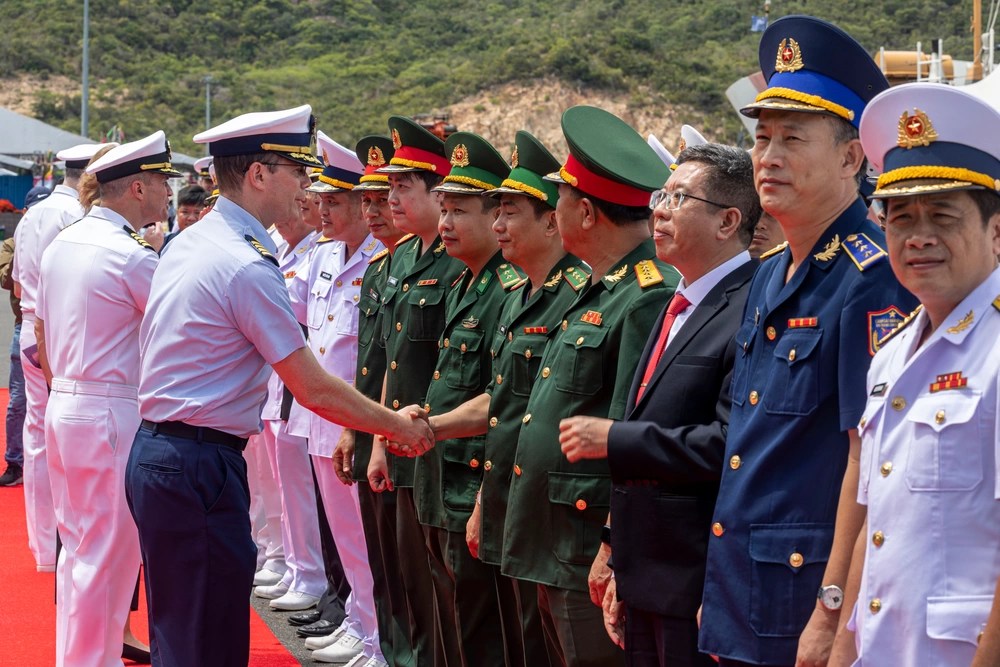
U.S. Coast Guard Capt. Tyson Scofield, commanding officer of the U.S. Coast Guard Cutter Waesche (WMSL 751), shakes hands with leadership from the Vietnamese People’s Army during a reception at the Cam Ranh International Port in Vietnam, July 8, 2024. Leadership from the Vietnam Coast Guard and Vietnam Peoples Navy welcomed U.S. Sailors and Coast Guardsmen upon their arrival. Waesche is deployed to the Indo-Pacific to advance relationships with ally and partner nations to build a more stable, free, open and resilient region with unrestricted, lawful access to the maritime commons. (U.S. Marine Corps photo by Cpl. Elijah Murphy)

Aug. 12, 2024

U.S. Coast Guard Cutter Waesche returns home following a 120-day Indo-Pacific patrol

ALAMEDA, Calif. — The U.S. Coast Guard Cutter Waesche (WSML 751) and crew returned to their Base Alameda home port Sunday, following a 120-day patrol throughout the Indo-Pacific.

Waesche participated in various engagements, exercises, and events throughout their deployment.

The cutter’s leadership and crew met with officials and military personnel during port calls in Japan, Republic of Korea, Singapore, and Vietnam.

Following Waesche’s visit to Maizuru, Japan, Waesche joined crews from the Japan Coast Guard vessel Wakasa (PL 93) and the Republic of Korea Coast Guard patrol vessel Taepyongyang (KCG 3016) for a joint search-and-rescue exercise at sea.

Waesche’s crew also conducted a bilateral U.S.-Philippine search-and-rescue exercise with the Philippine Coast Guard in the South China Sea.

“We are thankful to have traveled safely home to our loved ones and to have completed a successful and meaningful patrol,” said Capt. Tyson Scofield, Waesche’s command officer. “Waesche’s patrol strengthened U.S. relationships with our partner nations to foster a free and open Indo-Pacific. The opportunity to work alongside our allies and partners in the Indo-Pacific through impactful engagements was an honor and a rewarding experience that the crew will remember for the rest of their lives.”

Tyson assumed command of the Waesche during a change of command ceremony held in Honolulu as the cutter transited to the Indo-Pacific.

Waesche deployed with a San Francisco-based MH-65E Dolphin helicopter and an aircrew from Air Station Barbers Point, Hawaii.

Waesche was assigned to Destroyer Squadron (DESRON) 15, the Navy’s largest DESRON and the U.S. 7th Fleet’s principal surface force. DESRON 15 regularly assumes tactical control of surface units operating in the area.

Commissioned in 2010, Waesche is one of four Legend-class national security cutters homeported in Alameda. National security cutters are 418-feet long, 54-feet wide, has a top speed of over 28 knots, a range of 12,000 nautical miles, endurance of up to 90 days, and can hold a crew of up to 170. The advanced technologies of the national security cutter class ships are designed to support the operations and missions in the Indo-Pacific region.

What a Former WHEC is Doing Now

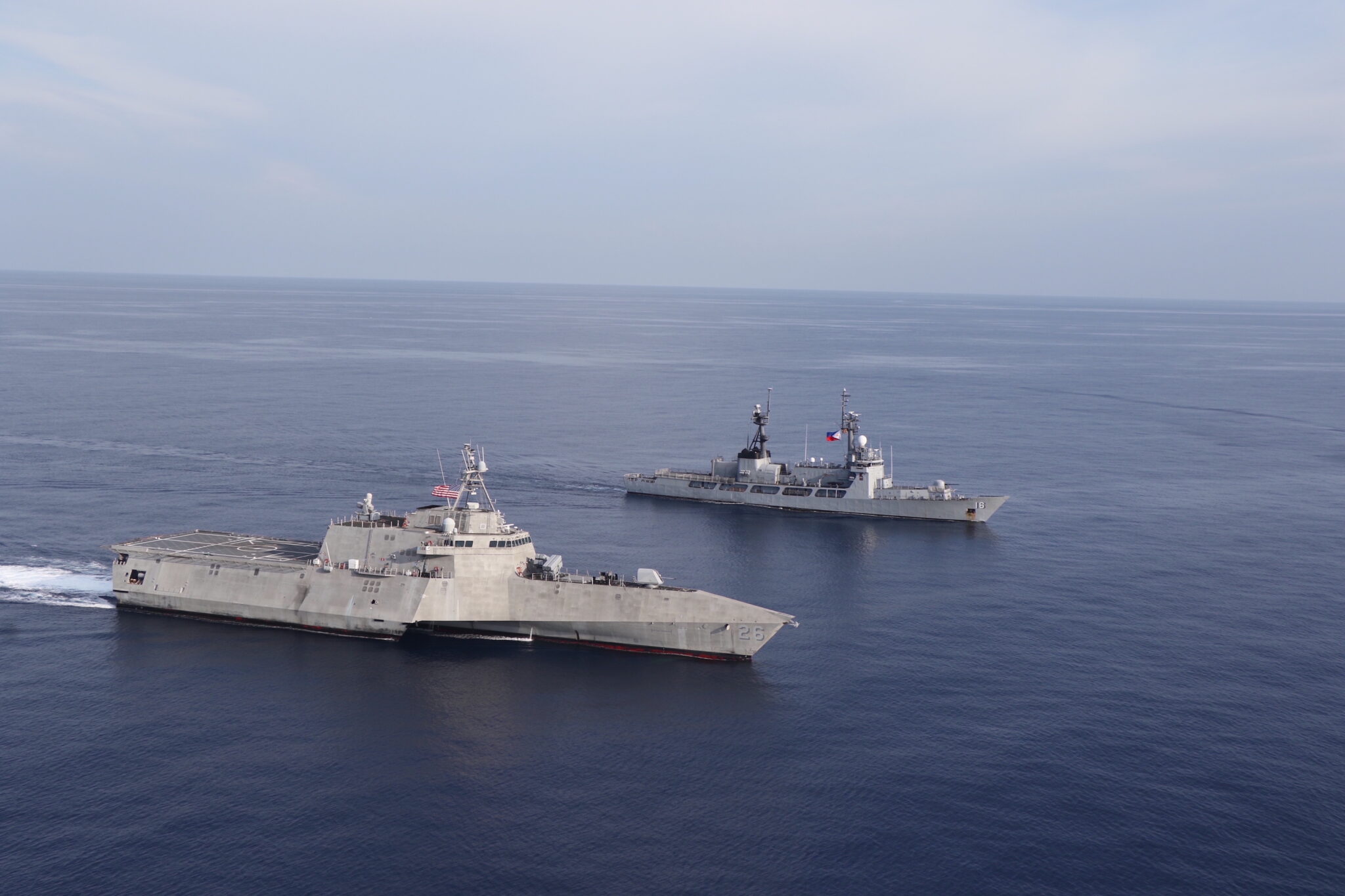
SOUTH CHINA SEA (July 31, 2024) – Independence-class littoral combat ship USS Mobile (LCS 26) conducts a Maritime Cooperative Activity with Philippine Navy’s Gregorio del Pilar-class patrol ship, BRP Ramon Alcaraz (PS 16), (former USCGC Dallas), in the South China Sea, July 31, 2024. Mobile, part of Destroyer Squadron 7, is on a rotational deployment operating in the U.S. 7th Fleet area of operations to enhance interoperability with allies and partners and serve as a ready-response force in support of a free and open Indo-Pacific region. (U.S. Navy photo by Naval Aircrewman Tactical Helicopter 2nd Class Diego Chavez)

US Naval Institute News reports,

U.S. and Philippine warships rendezvoused near a disputed South China Sea feature to conduct a joint maritime patrol on Wednesday.

USS Mobile (LCS-26) and BRP Ramon Alcaraz (PS-16) met off Leslie Bank, a maritime feature within Manila’s exclusive economic zone and Beijing’s 10-dash line claim. The littoral combat ship and ex-Coast Guard Hamilton-class cutter drilled in bilateral surface operations and communication, with a video released by the Armed Forces of the Philippines claiming that the two vessels took up a patrol formation.

Nice to see the LCS is apparently armed with Naval Strike Missiles.

“Iran’s ‘Zulfikar’ Submersible Torpedo Boat” –Covert Shore

Covert Shores reports on Iran’s version of an unusual asymmetric threat that originated in North Korea. Used by the Islamic Revolutionary Guard Corps, PATFORSWA may encounter these.

“I originally interpreted these to be Special Operations assets intended as a form of swimmer delivery vehicle. This would be consistent with related types in North Korean and Vietnamese service. In that role the torpedoes would be for self-defense. However, I now view them more as submersible torpedo boats intended to sink ships with torpedoes.”

The torpedoes are 12.75 inch (324mm) light weight anti-surface homing torpedoes. (243mm noted in the diagram above is apparently a typo.) We can’t take too much comfort in the fact that these are not heavy weight torpedoes. Heavy weight torpedoes frequently break ships in half, but because water is not compressible, the 100 pound warhead of a typical light weight torpedo still has about one half the impact of the 600 pound warhead of a typical heavy weight torpedo. These smaller torpedoes can seriously hurt even a large ship, possibly including immobilizing it, and making it an easier target for follow on attacks. Used against a vessel the size of PATFORSWA’s Fast Response Cutters, they would be fatal. Assuming these are wake homers, it might be wise to learn the maneuvers used to defeat wake homing torpedoes.

It is unlikely these little submersibles can go very deep or that they have much mobility while submerged. Even so, much of the Persian Gulf is shallow, so there are certainly places where they could rest on the bottom, lying in wait.

A Question of Proportionality / What to do about Philippine Outposts in the South China Sea?

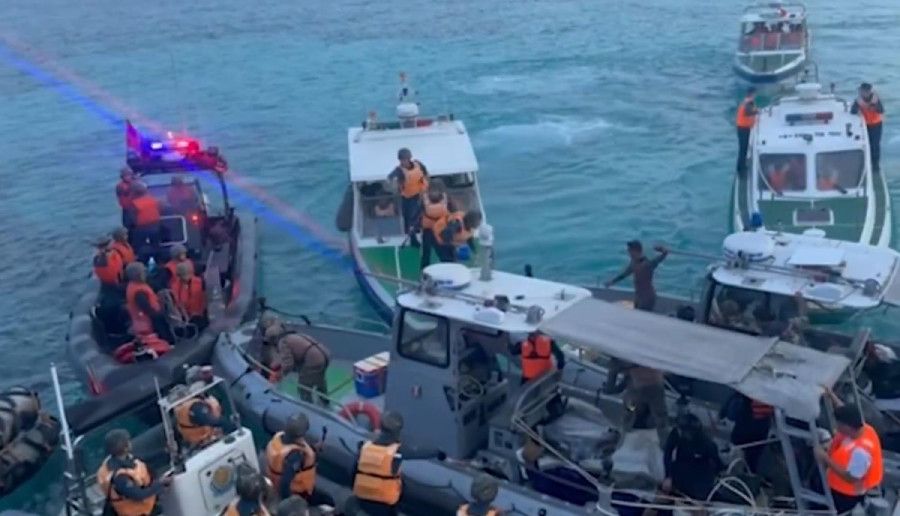
A still image taken from footage released by the Armed Forces of the Philippines showing China Coast Guard personnel confronting a resupply mission (Photo: Armed Forces of the Philippines)

Real Clear Defense reports,

Philippines Vows To Fight Back if Assaulted Again in South China Sea

At first, I was happy to see this, but I think they are making a mistake.

Philippine forces will defend themselves with “the same level of force …“If a knife is used, for example, our personnel will also use a knife, nothing more, under the concept of proportionality.”

If you are outnumbered in a knife fight you will lose. They will be outnumbered, and they will lose. That would be allowing the Chinese to write the rules of the game. Deadly force is deadly force. If someone is threatening you with a deadly weapon, you need to fire a warning shot, and if they keep coming shot the SOB.

Crews need to say, no one will take my vessel from me. As someone said, “Don’t Give Up the Ship.”

The Chinese are not going to start a war that might include the US until they are fully prepared to do so. Then and only then, they will want to open with a surprise attack.

The Philippines needs to raise the stakes for the Chinese to the point that they either back down or start a war with the US before they are really ready.

Right now, the Chinese are attempting to shape the battlefield to their advantage, building unsinkable missile cruisers surrounding Taiwan. The Philippines holds territory where they would like to place another missile launching platform. So does Japan. China should not be allowed to seize these positions.

Immediately the Philippines should make it clear to the Chinese, that they have no right to be in the Philippine EEZ, or any other country’s, behaving as they have. There is no reason to negotiate because they have no standing. That was decided in the international court of arbitration.

It might be possible to make a joint statement by the Philippines, Japan, Vietnam,  Indonesia, and maybe others.

When a move is made, it needs to be made with overwhelming strength on scene. That is possible if the Philippines employs surprise and has international support on scene. Philippine TA-50 jet aircraft should be overhead, ready to deter an attack on Philippine forces.

The result will be an incident, not a war. We have already seen lots of incidents, this will just add to the list, but this time we need the Chinese to back down.

Scarbough Shoal  and Second Thomas Shoal need to be reinforced and built up. The US and Japan could and should help the Philippines do it. Mirror what the Chinese have done. Make an artificial island, garrisoned with Marines, give it radars, effective AAW systems, and some of the Philippines’ BraMos missiles.

The Chinese are not going to like it, but unless they want to start a war with the US before they are ready, they will back down. Pulling a piece or two out of their plan to surround Taiwan with missile firing islands might actually prevent an attack on Taiwan.

Turkish Twin 35mm CIWS on South Korean Built Philippine Corvette (corrected text)

Gökdeniz twin 35mm CIWS (Aselsan image)

Naval News reports,

“On June 25, 2024, Türkiye’s leading defense company Aselsan announced that the Philippine Navy’s newly launched corvette, BRP Miguel Malvar, is equipped with the Gökdeniz close-in weapon system (CIWS).”

This is the first of a class of two 3,200 ton light frigates or corvettes. It is notably larger than the two previous 2,600 ton Jose Rizal class frigates also built by Hyundai Heavy Industries in S. Korea for the Philippine Navy which have yet to receive a CIWS they are expected to mount. I presume they will receive this system as well. Hyundai has also been contracted to build six 94.4 meter Offshore Patrol Vessels. They are well armed for OPVs including a 76mm gun, short range AAW missiles, and two 30mm guns presumably in this mount.


USCG perspective: All three ship classes are considerably smaller than either the NSCs or the OPCs. The 94.4 meter OPV is about a third larger than the Bear Class 270s.

This will be the first CIWS in the Philippine Navy, but it also notable because of its potential effectiveness in other roles. It should be more effective than Phalanx against threats other than cruise missiles, it might even be better against them. This CIWS is equipped with the same 35mm guns that equip the German made Gepard Flakpanzer that has proven so effective against kamikaze drones in Ukraine. An air burst round is available for the gun as well as Armor Piercing/High Explosive/Incendiary and High Explosive Incendiary rounds. 

At effective ranges, 4000 yards or less, these would also be devastating against above water systems on any surface vessel.

At some point, I believe the Philippine Coast Guard will choose to arm their cutters. The largest of these could easily accommodate a 76mm but this twin 35mm might be a good alternative. It or smaller mounts using single 35mms would probably fit on many of their smaller cutters, simplifying ammunition logistics. The Bushmaster III chain gun can use the same ammunition.

“USCGC Myrtle Hazard (WPC 1139) enters first drydock maintenance in Honolulu” –Forces Micronesia/Sector Guam

The USCGC Myrtle Hazard (WPC 1139) crew departs Guam for Honolulu on May 13, 2024, marking a significant milestone as the crew prepare for the first drydock maintenance period of approximately four and a half months. Commissioned in 2021, the Myrtle Hazard is the first of three Guam-based Fast Response Cutters to make the transit to Hawaii from Guam, traveling 3,743 miles to undergo this crucial maintenance phase. (U.S. Coast Guard photo by Chief Warrant Officer Sara Muir)

Below is a U.S. Coast Guard Forces Micronesia/Sector Guam news release (more photos there) that clarifies how Guam based Fast Response Cutters will be maintained. Just to provide a hint of how arduous this was, the distance from their base to Hawaii, 3743 nautical miles, would take 12 days at a 14 knot cruise speed, while the nominal range and endurance of ships of this class is 5 days and 2500 miles. Actually, she departed Guam on May 13 and arrived in Hawaii, May 28, 15 days later, presumably having stopped at least once to refuel and resupply. 

USCGC Myrtle Hazard arrived in Guam in September of 2020. This is her very first drydocking. Just getting to Hawaii required a transit equal to 16.3% of the miles she transited during the previous 42 months.

June 4, 2024

USCGC Myrtle Hazard (WPC 1139) enters first drydock maintenance in Honolulu

SANTA RITA, Guam — The USCGC Myrtle Hazard (WPC 1139) crew arrived in Honolulu on May 28, 2024, marking a significant milestone as it enters its first drydock maintenance period of approximately four and a half months. 

Commissioned in 2021, the Myrtle Hazard is the first of three Guam-based Fast Response Cutters (FRCs) to transit to Hawaii from Guam, traveling 3,743 miles to undergo this crucial maintenance phase.

In just the past two years, the Myrtle Hazard crew patrolled a vast 1.9 million square nautical mile area traveling as far south as Australia, accruing over 23,000 nautical miles steamed. The cutter crew enhanced regional maritime security and strengthened international cooperation by participating as the deputy commodore’s platform during a search and rescue exercise phase of Pacific Partnership 2022, the largest multinational humanitarian exercise in the Indo-Pacific. They also operationalized newly signed agreements by conducting historic bilateral boardings with Papua New Guinea, rescued mariners in dangerous sea conditions in the Northern Mariana Islands, and participated in critical operations escorting Department of Defense assets. The drydock maintenance is crucial for maintaining these high standards and ensuring the cutter’s continued ability to perform such missions.

“Throughout the transit east, as we leapfrogged through the Federated States of Micronesia and the Republic of the Marshall Islands to reach Hawaii, this crew demonstrated extraordinary resilience and skill. Despite several engineering challenges that tested our capabilities, their steadfast commitment and proficient handling of all casualties ensured our safe and timely arrival for drydock maintenance. I am immensely proud of their dedication and professionalism, which continue to ensure our readiness and effectiveness in fulfilling our missions,” said Lt. Emma Saunders, commanding officer of the USCGC Myrtle Hazard, on her first transit since assuming command.

Why Drydock is Essential

Drydock maintenance is vital for operational readiness, extending the cutter’s service life, and ensuring the safety of its crew. It involves a series of comprehensive inspections and repairs the crew cannot perform while the vessel is waterborne. These include hull preservation, mechanical overhauls, and technological upgrades, all of which are crucial for maintaining the cutter’s peak performance and safety standards.

Logistical Excellence and Risk Management

The logistical operation to transfer the cutter from Guam to Honolulu highlights the strategic planning and risk management necessary for this evolution. By proactively addressing maintenance needs, the team can meet operational commitments without compromising the safety or effectiveness of the fleet.

“Regular maintenance isn’t just about keeping our ships in shape; it’s about ensuring we’re always ready to meet the challenges we face at sea. Working closely with Coast Guard District 14 and our logistics teams, we schedule these critical maintenance periods to keep our missions running smoothly without missing a beat. This careful planning ensures we’re always there where we’re needed most, from safeguarding our shores to ensuring maritime safety and security across the Pacific. It’s a team effort, and every member of Team Guam plays a part in keeping our commitment strong and our presence steady in the waters we protect and the communities we serve.” said Capt. Robert Kistner, emphasizing the critical role of regular maintenance.

Next Steps for Guam-Based FRCs

Following the Myrtle Hazard, the other two Guam-based FRCs, USCGC Oliver Henry (WPC 1140) and USCGC Frederick Hatch (WPC 1143), will undergo their respective drydock periods. This systematic approach ensures that all vessels maintain their operational capabilities and readiness.

“We are committed to continuous improvement in maintenance practices, which is crucial for fulfilling our mission to protect and secure maritime interests in the Pacific,” said Kistner. “We look forward to Myrtle Hazard’s return this Fall.”

Future Outlook

As Base Guam continues to come online under the command of Cmdr. Dana Hiatt and operators employ the recently established Operational Logistics Command Expeditionary Team (LOG-X) more frequently; the U.S. Coast Guard is exploring enhancements in local maintenance capabilities and infrastructure in the Pacific. This includes potential investments in existing and new purpose-built facilities for Team Guam, which are crucial for minimizing downtime and ensuring a ready fleet capable of meeting future challenges.

Myrtle Hazard, the 39th 154-foot Sentinel-class FRC, is named in honor of the first enlisted woman in the U.S. Coast Guard who served as an electrician and radio operator. As part of the Guam-based cutters, it is a cornerstone for the U.S. Coast Guard’s ongoing commitment to the people of Oceania, focusing on maritime safety, security, and stewardship.

-USCG-

About U.S. Coast Guard Team Guam
Comprising over 350 members, this team is focused on maritime safety, security, and stewardship in Oceania. U.S. Coast Guard Forces Micronesia/Sector Guam, U.S. Coast Guard Base Guam, and their sub-units are staffed by dedicated active-duty, reserve, and civilian personnel. With a significant presence in Guam, Saipan, and the Micronesia sub-region, this integrated team focuses on operations and logistics to support maritime safety, security, and stewardship in Oceania and maintains close ties with local communities.

“U.S. Coast Guard Cutter Munro holds a change of command ceremony” –News Release

Royal Navy vessel HMS Spey (P234) (foreground) conducts coordinated ship maneuvers with U.S. Coast Guard Cutter Munro (WMSL 755) Sept. 17, 2023, in the South China Sea. Munro is deployed to the Indo-Pacific to advance relationships with ally and partner nations to build a more stable, free, open and resilient region with unrestricted, lawful access to the maritime commons. (U.S. Navy photo by Chief Petty Officer Brett Cote)

Below is a news release. Routine change of command, but the Munro’s recent activities are interesting for their variety, three very different activities in widely dispersed areas, Eastern Pacific, Western Pacific, and far Northern Pacific. More info in these earlier news releases:


 May 31, 2024

U.S. Coast Guard Cutter Munro holds a change of command ceremony

SAN DIEGO — The U.S. Coast Guard Cutter Munro (WMSL 755) held a change of command ceremony Thursday in San Diego.

Vice Adm. Andrew J. Tiongson, Commander, U.S. Coast Guard Pacific Area, presided over the ceremony in which Capt. James O’Mara IV relieved Capt. Rula Deisher as Munro’s commanding officer.

Deisher served as Munro’s commanding officer from May 2022 to May 2024, sailing over 73,000 nautical miles to 17 ports, including eight foreign countries during patrols in the Bering Sea, Western Pacific, and Eastern Pacific.

Most recently, Munro and the crew were responsible for the interdiction and seizure of illegal narcotics worth an estimated $460 million in wholesale value and over $2 billion in street value while patrolling the Eastern Pacific Ocean in support of the Joint Interagency Task Force-South. Munro’s crew also supported Operation Southern Shield during their recent patrol by conducting 16 fisheries boardings in the Southern Pacific Regional Fisheries Management Organization convention area, upholding the maritime rules-based order.

During Munro’s Western Pacific patrol, the cutter and crew hosted multiple engagements with foreign partners, including a discussion about the SAPPHIRE agreement with Japanese Coast Guard officers, a subject matter expert exchange, an at-sea engagement with the Korea Coast Guard, and participated in CARAT Brunei, where Munro worked alongside the Royal Brunei Navy in professional subject matter expert exchanges, leadership conferences, and an at-sea engagement.

While patrolling the Bering Sea, Munro conducted 24 fisheries boardings and two search-and-rescue cases, including the medical evacuation of a critical patient from Dutch Harbor, Alaska, to Anchorage, Alaska.

“To the crew of Munro, thank you,” said Deisher. “I am so proud of your endless dedication and care toward each other and our mission. This crew is phenomenal, and it has been an honor and privilege to sail with them and learn from them.”

Deisher’s next assignment is to serve as the Seventeenth District’s Response Division chief.

O’Mara, the incoming commanding officer, brings a wealth of experience to Munro.

Reporting from the Coast Guard’s Eleventh District as the Enforcement Branch chief, O’Mara oversaw assets across 1,000 miles of shoreline from the California-Oregon state line to the Mexico border and 73 federal waterways. He also worked closely with the Department of Defense Joint Interagency Task Forces and the Department of Homeland Security Joint Task Force West to conduct effective drug and law enforcement interdiction efforts across the Eastern Pacific.

Munro will be O’Mara’s seventh ship and fourth command, following previous commands aboard the Coast Guard Cutters Active (WMEC 618), Farallon (WPB 1301), Monomoy (WPB 1326), and Narwhal (WPB 87335).

The change of command ceremony, a time-honored tradition, is a significant event conducted before the assembled company of a command. It confirms to the unit’s men and women that the authority of command is maintained. The ceremony symbolizes a transfer of total responsibility, authority, and accountability from one individual to another, marking a new chapter in the command’s history.

Commissioned in 2017, Munro is one of four Coast Guard Legend-class national security cutters homeported in Alameda. National security cutters, measuring 418 feet long and 54 feet wide, boast a top speed of over 28 knots, a range of 12,000 nautical miles, endurance of up to 90 days, and can hold a crew of up to 170. The advanced technologies of the national security cutter class ships support the national objective of maintaining the security of America’s maritime boundaries and providing long-range search and rescue capabilities.