Polar Star to Depart for Antarctica Saturday, Nov. 13 –News Release

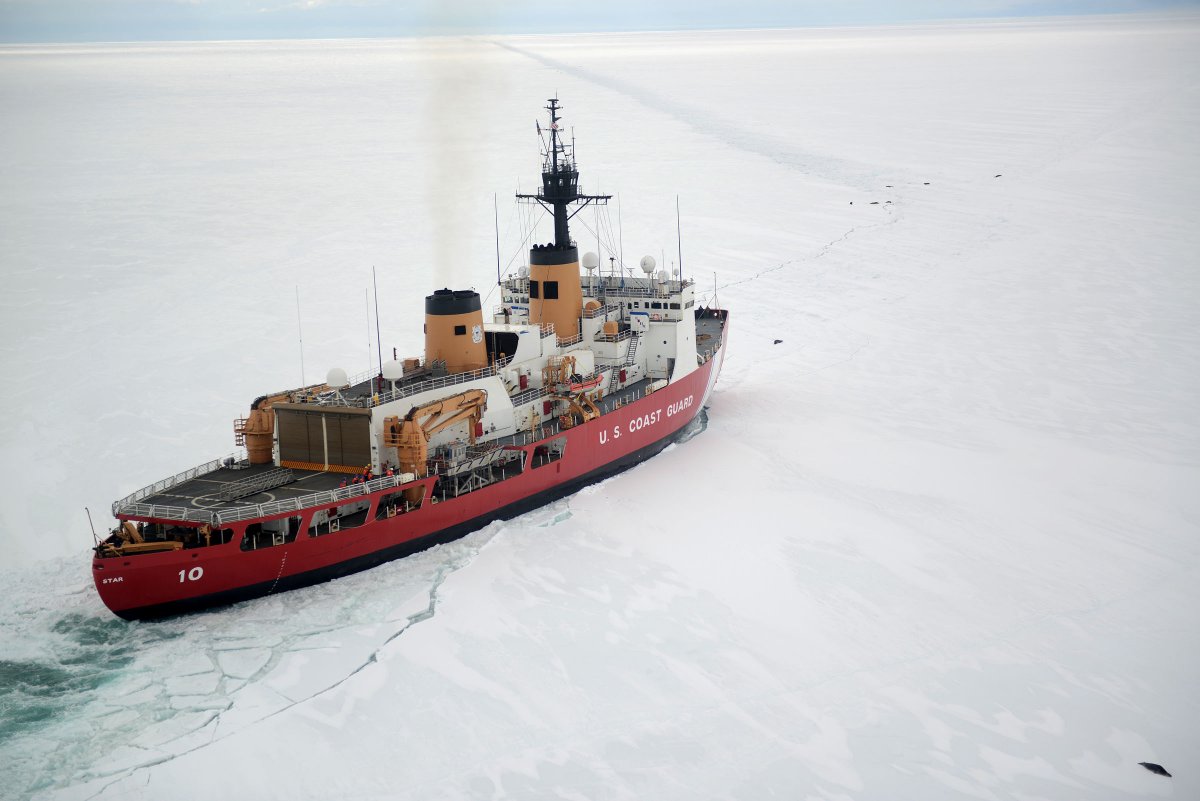
The Coast Guard Cutter Polar Star cuts through Antarctic ice in the Ross Sea near a large group of seals as the ship’s crew creates a navigation channel for supply ships, January 16, 2017. The resupply channel is an essential part of the yearly delivery of essential supplies to the National Science Foundation’s McMurdo Station.US Coast Guard photo by Chief Petty Officer David Mosley

united states coast guard

Media Advisory U.S. Coast Guard 13th District Pacific Northwest

MEDIA ADVISORY: America’s only heavy icebreaker departs Seattle homeport Saturday; bound for Antarctica

Nation's only heavy icebreaker reaches fast ice of Antarctica

Editors’ Note: Click on images to download high resolution version.

Who: U.S. Coast Guard Cutter Polar Star (WAGB-10) with crew and numerous scientists

What: Departing Seattle, en route to Antarctica in support of Operation Deep Freeze

When: Departing 1 p.m. Saturday, Nov. 13, 2021

Where: U.S. Coast Guard Base Seattle

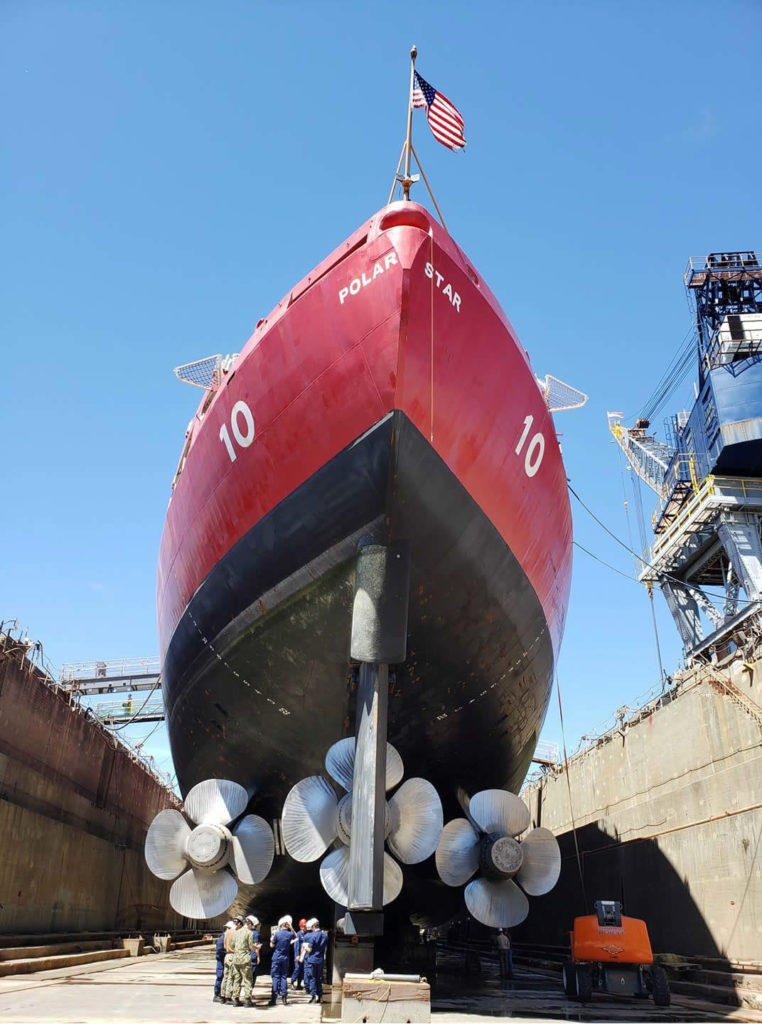
SEATTLE — The United States’ only heavy icebreaker, Coast Guard Cutter Polar Star (WAGB-10), is scheduled to depart its homeport in Seattle Saturday.

This annual journey to Antarctica is conducted in support of Operation Deep Freeze, a joint military service mission to resupply the United States Antarctic stations of the National Science Foundation, the lead agency for the United States Antarctic Program.

The women and men aboard the Polar Star conduct this essential mission to create a navigable path through ice as thick as 21 feet, to allow refuel and resupply ships to reach McMurdo Station, the largest Antarctic station and the logistics hub of the U.S. Antarctic Program.

The U.S. Coast Guard is recapitalizing its polar icebreaker fleet to ensure access to the Polar Regions, project U.S. sovereignty, and to protect the country’s economic, environmental and national security interests. To support this endeavor, the U.S. Coast Guard is exploring options to expand Base Seattle infrastructure to support the growing icebreaker fleet.

Media are encouraged to contact Coast Guard public affairs at 206-251-3237 to arrange an escort at Base Seattle to attend the ship’s departure. The commanding officer of the Polar Star, Capt. Willaim Woityra, may be available for virtual interview on Friday morning and in-person at 11 a.m. Saturday prior to the 1 p.m. departure.

“GA-ASI Flies MQ-9 in the Canadian Arctic” –Seapower

General Atomics Aeronautical Systems’ MQ-9A “Big Wing” UAS flew in the hostile climate of the Canadian Arctic. GA-ASI

The Navy League’s Seapower website reports,

 In a flight that originated from its Flight Test and Training Center (FTTC) near Grand Forks, North Dakota, General Atomics Aeronautical Systems, Inc. (GA-ASI) flew a company-owned MQ-9A “Big Wing” configured unmanned aircraft system north through Canadian airspace past the 78th parallel, the company said in a Sept. 10 release.

A traditional limitation of long-endurance UAS has been their inability to operate at extreme northern (and southern) latitudes, as many legacy SATCOM datalinks can become less reliable above the Arctic (or below the Antarctic) Circle – approximately 66 degrees north. At those latitudes, the low-look angle to geostationary Ku-band satellites begins to compromise the link. GA-ASI has demonstrated a new capability for effective ISR operations by performing a loiter at 78.31° North, using Inmarsat’s L-band Airborne ISR Service (LAISR).

The 78th parallel lies more than 1200 nautical miles North of Kodiak. Getting any kind of air recon that far north, other than perhaps icebreaker based helicopters, has always been difficult.

Even our icebreakers have difficulty communicating. Satellite coverage at these high latitudes is spotty at best.

The ability to operate UAS in this environment could substantially improve our Polar Domain Awareness and serve as a communications relay for multiunit operations in the Arctic or Antarctic.

The high altitude capability of these aircraft also provides a far larger view than would be possible from a helicopters. The horizon distance from 45,000 feet is about 250 nautical miles.

“SOLVING COMMUNICATIONS GAPS IN THE ARCTIC WITH BALLOONS” –CIMSEC

A NASA long duration balloon is prepared for launch on Antarctica’s Ross Ice Shelf near McMurdo Station in 2004. (NASA photo)

CIMSEC provides a discussion of the possibility of using high altitude balloons as communications links in the Arctic.

Even if balloons are not the answer, the article at least does an excellent job of outlining the difficulties of communicating in the Arctic (or Antarctic).

“SEA CONTROL 219 – USCG COMMANDANT ADMIRAL KARL SCHULTZ” –CIMSEC

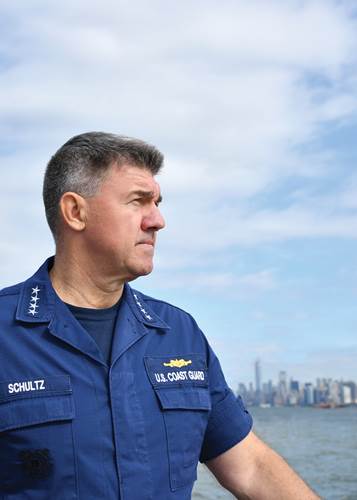
Coast Guard Commandant Adm. Karl Schultz visits with Coast Guard crews stationed in New York City. U.S. Coast Guard photo illustration by Petty Officer 1st Class Jetta Disco.

(I meant to cover this earlier, but perhaps still worth a listen)

CIMSEC’s Podcast “SEA Control,” had an interview with the Commandant, Dec. 27, 2020. You can find it here.

At first I thought I had heard it all before, but toward the end, there were some surprises.

He talked about  Arctic, Antarctic, and IUU. He talked about the Arctic Strategic Outlook and the IUU Strategic Outlook.

Illegal, Unreported, Unregulated fishing got a lot of attention. He related that it was gaining visibility and had become a national security issue since overfishing has created food security issues for many countries. He pointed to Coast Guard Cooperation with Ecuador in monitoring a fishing fleet off the Galapagos Islands. Internationally he sees a coordination role for the USCG.

Relative to the Arctic he mentioned the possibility of basing icebreakers in the Atlantic and the need for better communications.

He talked about the Tri-Service Strategy and the Coast Guards roles in it, particularly in less than lethal competition.

More novel topics started about minute 38 beginning with Unmanned systems. He talked about the recent CG experiments with unmanned systems and went on to note that the CG will also regulated Unmanned commercial vessel systems.

About minute 41 he talked about the Coast Guard’s role in countering UAS in the Arabian Gulf. He added that we have a lead role in DHS in counter UAS. “We are in the thick of that”

GA-ASI Concludes Successful Series of MQ-9 Demonstrations in Greece

He said the service was looking at MQ-9 maritime “Guardian” (minute 45)

When ask about reintroducing an ASW capability he said that while the Coast Guard was looking at it, the service would have to be cautious about biting off too much. (My suggestion of how the CG could have an ASW mission with minimal impact on its peacetime structure.)

He talked about balancing local and distant missions and concluded that the CG could do both (47), and that the Coast Guard was becoming truly globally deployable (48).

He noted that the first two FRCs for PATFORSWA would transit to Bahrain in Spring, followed by two more in the Fall, and two more in 2022. (49)

He noted technology is making SAR more efficient. “Hopefully we will put ourselves out of the Search and Rescue business.” 50

He talked about the benefits of “white hull diplomacy.” (52)

Asked about our funding for new missions he said it was sometime necessary to demonstrate the value of the mission first, then seek funding. (55)

He also talked about raising the bar on maintenance.

“Coast Guard Icebreaker Polar Star Bound for the Arctic in December” –USNI

The Coast Guard Cutter Polar Star cuts through Antarctic ice in the Ross Sea near a large group of seals as the ship’s crew creates a navigation channel for supply ships, January 16, 2017. The resupply channel is an essential part of the yearly delivery of essential supplies to the National Science Foundation’s McMurdo Station.US Coast Guard photo by Chief Petty Officer David Mosley

US Naval Institute News Service reports Polar Star will deploy to the Arctic in December. We knew this was coming, but we have been short of details of when and for how long. This at least indicates it will begin in December. (I will speculate, she will be gone about three months, returning in March to provide a little inport time before going into the yard.)

There seem to be a couple of errors in the story.

“For the first time in almost five decades, the Coast Guard’s heavy icebreaker won’t be supporting Antarctic scientific missions in coming months…”

Coast Guard heavy icebreaker support has not been continuous over that period, at least once, and I believe more than once, the McMurdo break-in was done by non-Coast Guard icebreakers, either contracted foreign icebreakers or the National Science Foundation’s own smaller icebreaker.

“This would be the first Coast Guard operation in the Arctic Ocean since August 1994 when a now-deactivated heavy icebreaker with a Canadian Coast Guard heavy icebreaker reached the North Pole.”

This seems to be missing a qualifier. The Coast Guard has certainly operated in the Arctic since August 1994. There is better information on Polar class operations in the Arctic here, in a Military.com report.

“It will be the first deployment of a U.S. Polar-class icebreaker to the Arctic on a non-science mission (emphasis applied–Chuck) since August 1994, when the heavy icebreaker Polar Sea, now inactive, became one of the first two American surface ships to reach the North Pole.

“In 1998, Polar Star spent three months in the region on a science mission. And in 2009, the Polar Sea conducted a three-month Arctic deployment, also dedicated solely to science.”

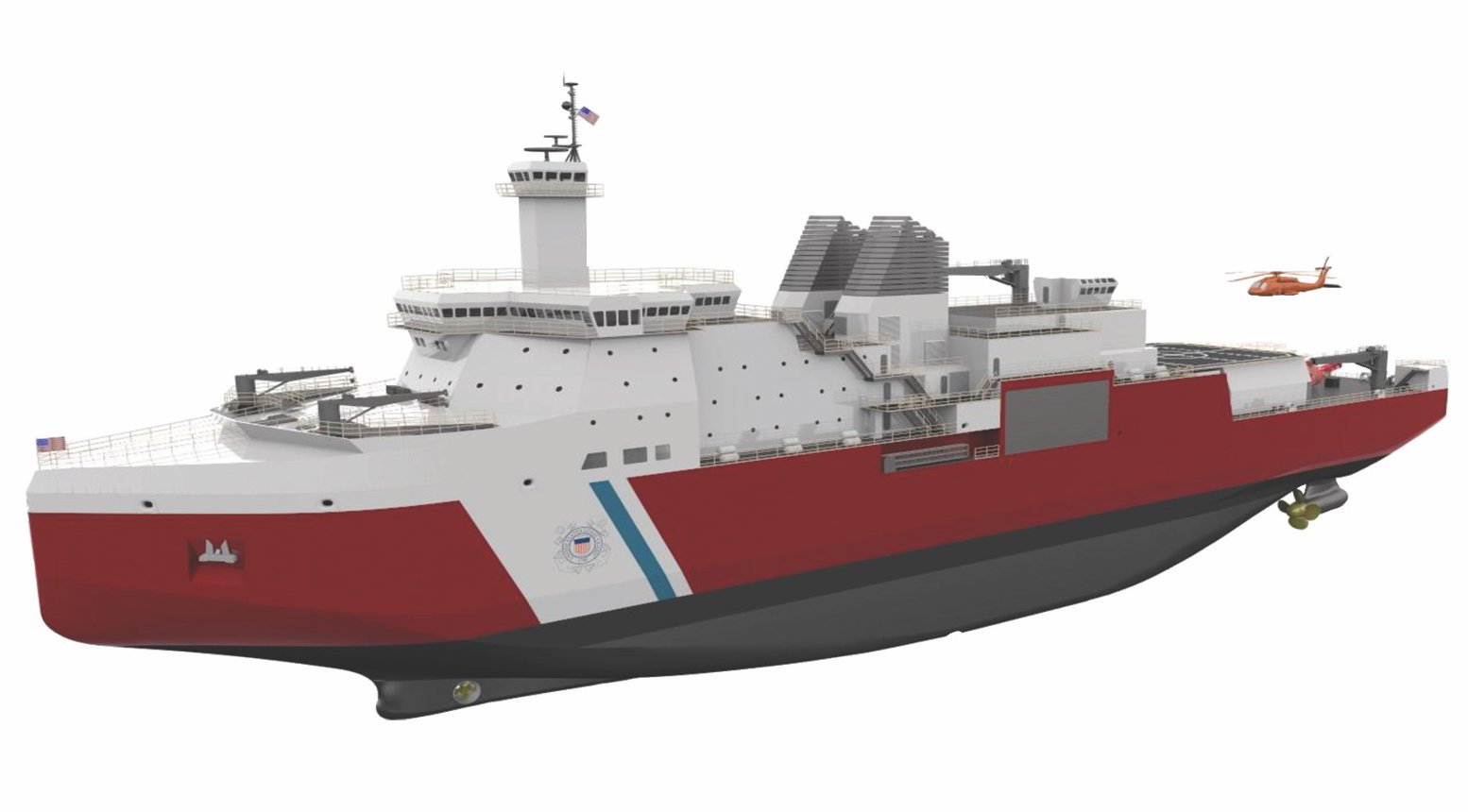
CRS, “Coast Guard Polar Security Cutter (Polar Icebreaker) Program: Background and Issues for Congress Updated November 11, 2020”

Since our last look at this report, there have been four updates. (See the latest version here.)

We now have the Senate Appropriations Committee’s (SAC) views on this part of the FY2021 DHS Appropriations Act. The Senate committee, like its counterpart in the House, has recommended approval of the Administration request for $555M that would fund the second Polar Security Cutter.

I have reproduced the section on Senate Activity (page 25/26) below. Note there is also mention of renovation of the Polar Star and acquisition of a future Great Lakes icebreaker as well:


Senate

The Senate Appropriations Committee, in the explanatory statement for S. XXXX that the committee released on November 10, 2020, recommended the funding level shown in the SAC column of Table 2.

The explanatory statement states (emphasis added):

Full-Funding Policy.—The Committee again directs an exception to the administration’s current acquisition policy that requires the Coast Guard to attain the total acquisition cost for a vessel, including long lead time materials [LLTM], production costs, and postproduction costs, before a production contract can be awarded. This policy has the potential to make shipbuilding less efficient, to force delayed obligation of production funds, and to require post-production funds far in advance of when they will be used. The Department should position itself to acquire vessels in the most efficient manner within the guidelines of strict governance measures. The Committee expects the administration to adopt a similar policy for the acquisition of the Offshore Patrol Cutter [OPC] and heavy polar icebreaker.

Domestic Content.—To the maximum extent practicable, the Coast Guard is directed to
utilize components that are manufactured in the United States when contracting for new
vessels. Such components include: auxiliary equipment, such as pumps for shipboard
services; propulsion equipment, including engines, reduction gears, and propellers;
shipboard cranes; and spreaders for shipboard cranes. (Pages 71-72)

The explanatory statement also states:

Great Lakes Icebreaking Capacity.—The recommendation includes $4,000,000 for preacquisition activities for the Great Lakes Icebreaker Program for a new Great Lakes
icebreaker that is as capable as USCGC MACKINAW. The Coast Guard shall seek
opportunities to accelerate the acquisition and request legislative remedies, if necessary. Further, any requirements analysis conducted by the Coast Guard regarding overall Great Lakes icebreaking requirements shall not assume any greater assistance rendered by Canadian icebreakers than was rendered during the past two ice seasons and shall include meeting the demands of United States commerce in all U.S. waters of the Great Lakes and their harbors and connecting channels. (Page 72)

The explanatory statement also states:

Polar Ice Breaking Vessel.—The Committee recognizes the value of heavy polar icebreakers in promoting the national security and economic interests of the United States in the Arctic and Antarctic regions and recommends $555,000,000, which is the requested amount. The total recommended for this program fully supports the Polar Security Cutter program of record and provides the resources that are required to continue this critical acquisition.
Polar Star.—The recommendation includes $15,000,000 to carry out a service life extension program for the POLAR STAR to extend its service life as the Coast Guard continues to modernize its icebreaking fleet. (Page 73)

“Breaking the Ice: High Stakes in the High North” –RealClearDefense

Real Clear Defense offers a suggestion of how US policy regarding the Arctic should be shaped.

While some decry an “icebreaker gap”…, the real problem is that U.S. policy in the Arctic lacks direction. The United States needs a better approach – a new cooperative arrangement with Russia to protect the environment, maintain peace in the region, and box-out China.

The Coast Guard does need more icebreakers. It does not need nearly as many as Russia. Our thinking needs to consider our access to Antarctica, which, however quiet it may be now, may not always be that way.

“Steer Clear of the Polar Regions” –USNI

 Photo: Official USCG Polar Star Facebook

The US Naval Institute Blog has a new post. Its bottom line,

For Semper Paratus to move beyond a mere slogan, the Coast Guard should steer clear of the Poles, decommission the two heavy icebreakers, and redirect resources toward coastal operations to better secure the homeland. As the smallest armed force, the Coast Guard must proactively roll back the nefarious reach of transnational human smuggling and narcoterrorism for the sake of national security. Leave the Poles to the Navy and to private sector research-and-development firms.

I am not going to comment, but I am sure someone will.