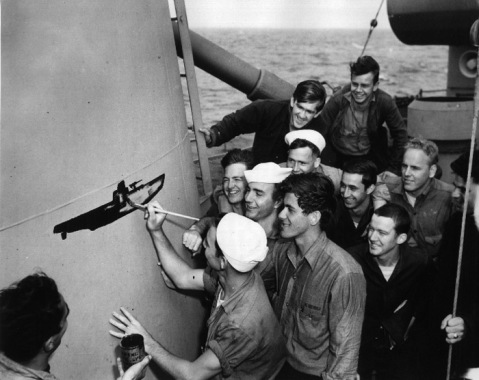
“US Coast Guard won’t ‘close the door’ on hunting submarines again in the future” –Business Insider

US Coast Guard crew of cutter Spencer watched as a depth charge exploded near U-175, North Atlantic, 500 nautical miles WSW of Ireland, 17 Apr 1943. Photo by Jack January

Business Insider reports on the Commandant’s response to a question posed at a Navy League event. It was hardly a ringing commitment, but the Commandant did say,

“If there was a requirement that was at the joint Coast Guard-Navy-[Department of Defense] level that said, ‘Hey, there’s an urgent need to bring that capability back in Coast Guard,’ I’m not saying we couldn’t revisit that,”

“I’m not so sure I see an immediate return to that mission space here, but again, I don’t close the door on anything since we live in an increasingly complicated world … and requirements change,” Schultz added

We have had an almost 30 year period when the Coast Guard’s Defense Readiness mission has been limited to low level requirements that had little impact on the majority of Coast Guard members. It happened because of the virtual disappearance of any significant naval threat after the collapse of the Soviet Union, but there has always been the possibility that a more active role might reemerge in the future.

If we have no defense readiness mission, there is no reason the Coast Guard should be military. There would be no reason for our ships to have sophisticated fire control systems, electronic warfare systems, or Phalanx CIWS. There would be no reason for defensive systems, because if we were irrelevant in a military conflict, why would an enemy bother wasting ammunition on us.

Many countries have no coast guard or their coast guards are limited to coastal SAR. In many nations their regular navies and air forces, that do have war time missions, also do fisheries protection, drug enforcement, migrant interdiction, coastal security, and SAR.

If our large cutters do not have a wartime defense readiness mission, it is illogical for us to build ships that are 80 to 90% of a frigate or corvette, with 80 to 90% of the crew of those types, when more numerous, much less capable ships could do the non-defense related missions much more economically.

Schultz and other officials have also said new Coast Guard ships will be able to adapt for future missions.

“We’re putting in what we call space, weight, and power to be able to plug and play for all kinds of mission support,” Shannon Jenkins, senior Arctic advisor at the Coast Guard’s Office of Arctic Policy, said at an event in August when asked about arming icebreakers. “It certainly will have the capacity and the abilities to add in whatever we need to execute our national missions, not just Coast Guard missions.”

( I think you mean Coast Guard non-defense related missions, because defense is a Coast Guard mission?)

If conditions are favorable and no conflict appears likely for a long period, then it may make sense to adopt a policy of “fitted for but not with” or a more open weight, space and power reservation approach, but at some point we are going to need leadership in the mold of Admiral Wasche to recognize the need for the Coast Guard to again step up and fill its military role.

Adding an ASW capability will take time. It has become more complex than it was in WWII and we no longer have a lot of ship building and repair facilities capable of quickly upgrading our ships. How good are we at predicting the future?

Even in WWII we began the war terribly unprepared. Cutters were assigned to escort convoys that had neither sonar nor radar. Some ships that got sonars had no trained operators. Although more U-boats were sunk by aircraft than by ships, our air assets failed to sink any submarines (although one sinking was credited, it turned out not to have been the case).

The Navy may be hesitant to ask that the Coast Guard start preparing for possible armed conflict. There are many in the US Navy who might see asking the Coast Guard to shoulder some of the responsibility for naval defense as a diversion of attention from the Navy’s needs. But the Navy has several communities that compete for dollars. If the Coast Guard can provide some surface escorts it may mean more Navy money available for submarines or aircraft, so we may also have support from within the Navy. We really need to talk about the Coast Guard’s role in a major conflict when our non-defense related missions will have a lower priority.

The international environment is starting to take on an ominous resemblance to the late 1930s. The US needs to deter aggressive action. The Coast Guard can play a part in providing a credible naval deterrent, but only if it is seen as capable in the near term. We really need to start thinking about this before the need becomes urgent.


How Spencer Became the Coast Guard’s Top U-Boat Killer, Thank You Royal Navy

US Coast Guard crew of cutter Spencer watched as a depth charge exploded near U-175, North Atlantic, 500 nautical miles WSW of Ireland, 17 Apr 1943. Photo by Jack January

Wanted to pass along a bit of Coast Guard history I found on Uboat.net. Below is their list of “Notable Events involving Spencer.”

It really looks like Spencer got a lot of her ASW training from the British Royal Navy, operating in company with British, Canadian, and USN escorts, against small World War I vintage British H class submarines.


23 Mar 1942
HMS H 50 (Lt. H.B. Turner, RN) conducted A/S exercises off Lough Foyle with USCGC Spencer and USS Gleaves. (1)

26 Aug 1942
HMS H 32 (Lt. J.R. Drummond, RN) conducted A/S exercises off Lough Foyle with HMS Yestor (Lt. R.C. Holt, RNVR), HMS Beverley (Lt. R.A. Price, RN), USS BabbittUSS SpencerHMCS Collingwood (T/A/Lt.Cdr. W. Woods, RCNR) and HMCS Trillium (T/Lt. P.C. Evans, RCNR). (2)

22 Dec 1942
HMS H 34 (Lt. G.M. Noll, RN) conducted A/S exercises off Lough Foyle with HMS Fowey (Cdr.(Retd.) L.B.A. Majendie, RN), HMS Carnation (Lt. A. Branson, RNR), HMS Black Swan (Cdr. T.A.C. Pakenham, RN), HMS Tango (T/Lt. J. Hunter, RNR), USS SpencerUSS Badger and HMCS Trillium (T/Lt. P.C. Evans, RCNR). (3)

23 Dec 1942
HMS H 34 (Lt. G.M. Noll, RN) conducted A/S exercises off Lough Foyle with USS SpencerHMCS Dauphin (T/Lt. R.A.S. MacNeil, RCNR) and HMS Tango (T/Lt. J. Hunter, RNR) plus ships from the 37th Escort Group. (3)

9 Feb 1943
HMS H 33 (Lt. M.H. Jupp, DSC, RN) conducted A/S exercises off Lough Foyle with HMS Poppy (Lt. N.K. Boyd, RNR), HMS Dianella (T/Lt. J.F. Tognola, RNR) and USS Spencer. (4)

10 Feb 1943
HMS H 28 (Lt. K.H. Martin, RN) conducted A/S exercises off Lough Foyle with USS Spencer. (5)

10 Feb 1943
HMS H 44 (Lt. I.S. McIntosh, RN) conducted A/S exercises off Lough Foyle with HMCS Dauphin (T/Lt. M.H. Wallace, RCNR), HMCS Trillium (T/Lt. P.C. Evans, RCNR), HMS Ness (Lt.Cdr. T.G.P. Crick, DSC, RN), HMS Philante (Capt. A.J. Baker-Cresswell, DSO, RN), HMS Folkestone (Cdr.(Retd.) J.G.C. Gibson, OBE, RN), USS SpencerUSS Campbell and HMCS Rosthern (T/Lt. R.J.G. Johnson, RCNVR). (6)

8 Mar 1943
German U-boat U-633 was sunk in the North Atlantic south-west of Iceland, in position 58.21N, 31.00W, by depth charges from the US Coast Guard cutter USCGC Spencer.

23 Mar 1943
HMS H 28 (Lt. K.H. Martin, RN) conducted A/S exercises off Lough Foyle with HMS Mallow (T/A/Lt.Cdr. H.T.S. Clouston, RNVR), HMS Myosotis (T/Lt. R. Lugg, RNR), HMS La Malouine (T/Lt. V.D.H. Bidwell, RNR), HMS Dianthus (T/A/Lt.Cdr. N.F. Israel, RNR) and USS Spencer. (7)

17 Apr 1943
German U-boat U-175 was sunk in the North Atlantic south-west of Ireland, in position 47.53N, 22.04W, by depth charges and gunfire from the US Coast Guard cutter USCGC Spencer.

Time to Revive Coast Guard’s ASW Capability?: “DOD MAP SHOWS RUSSIAN AND CHINESE SUBS ARE TOO CLOSE FOR COMFORT” –Sandboxx

russian subs

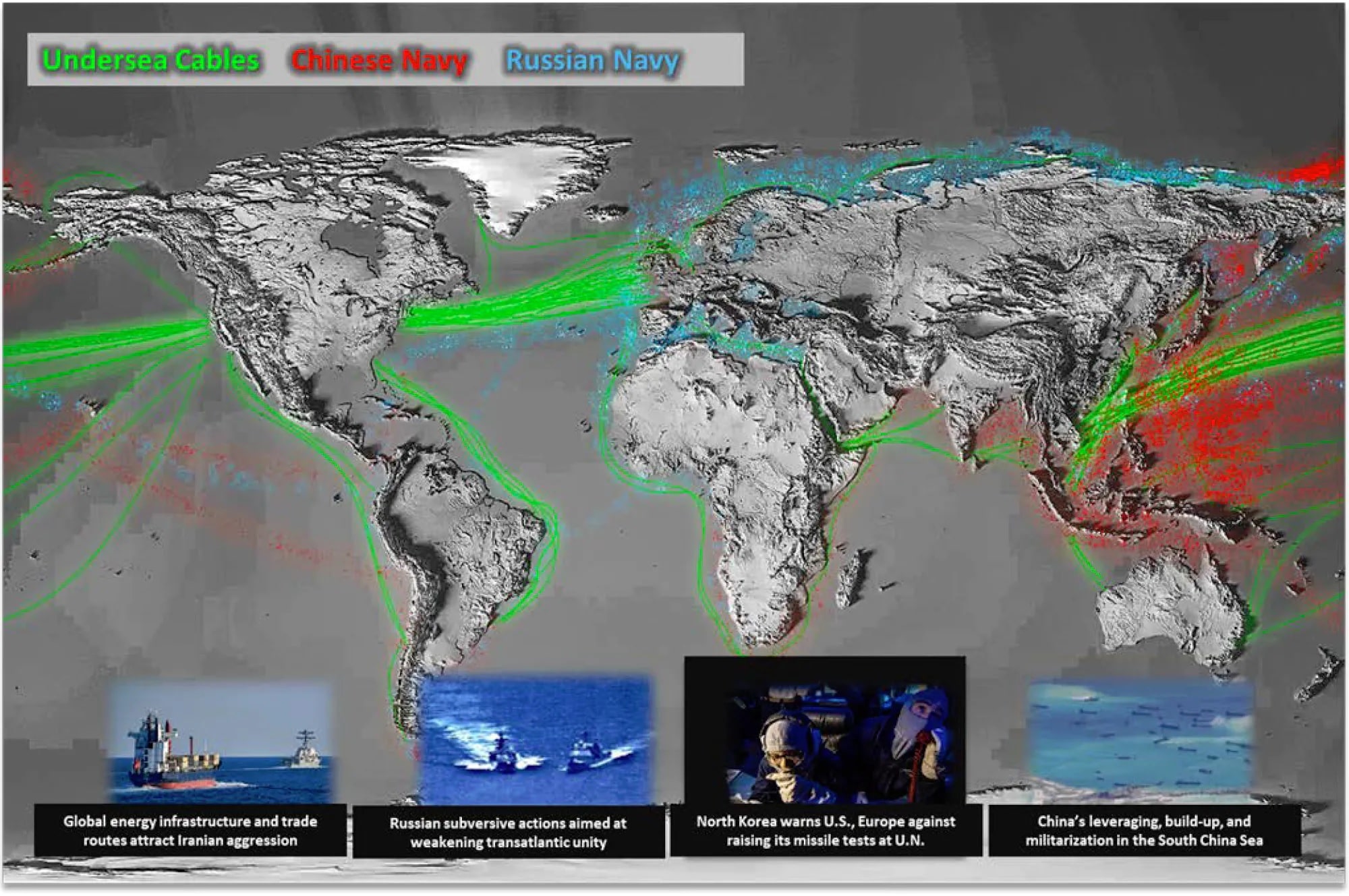
Sandboxxx reports the release of a map illustrating the operations of the Russian and Chinese naval forces.

The Pentagon recently released a map showing the travel paths of Russian and Chinese naval vessels, alongside important undersea cables, as a part of its 2021 National Defense Authorization Act request, commonly referred to as the DoD’s budget. The map clearly shows the heavy traffic in both The Atlantic and Pacific oceans, with Russian subs encroaching on America’s eastern seaboard and Chinese submarines creeping up in the west.

The Russian Navy operations, including those just outside US territorial waters on the East Coast, are discussed in the post.

What I also see in the map, is a great deal of Chinese activity around Guam, significant activity around Hawaii, some activity extending to the Americas, and a surprising amount of Chinese activity in the Arctic, North of Siberia, that presumably passed through the Bering Strait. There is also Chinese activity near the Aleutians.

The Philippines, India, and Australia must also find this map interesting.

The map looks looks like more reason to consider providing cutters with an Anti-Submarine Warfare capability.

If we ever do have a “near peer” conflict with Russia and/or China, there is a good possibility, when we go to rescue the crews of torpedoed ships, cutters may find, they themselves have become targets. An ASW capability may be necessary just to allow the cutters to operate in a threat environment that could reach up to the US coast line.

If cutters were given an ASW capability, I would think their wartime role would be to escort logistics shipping from outload ports in the lower 48 to rear staging areas and return. Air and Surface threat levels would not be non-existent, but they would be low.

“Euronaval 2020: Black Scorpion small-size torpedo from Leonardo” –Navy Recognition

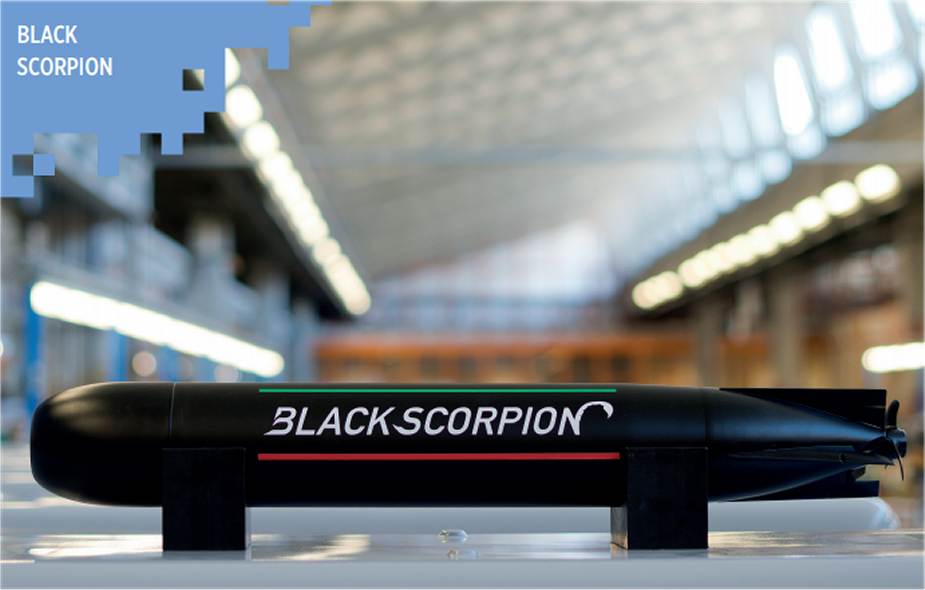
Black Scorpion small-size torpedo from Leonardo (Picture source Leonardo)

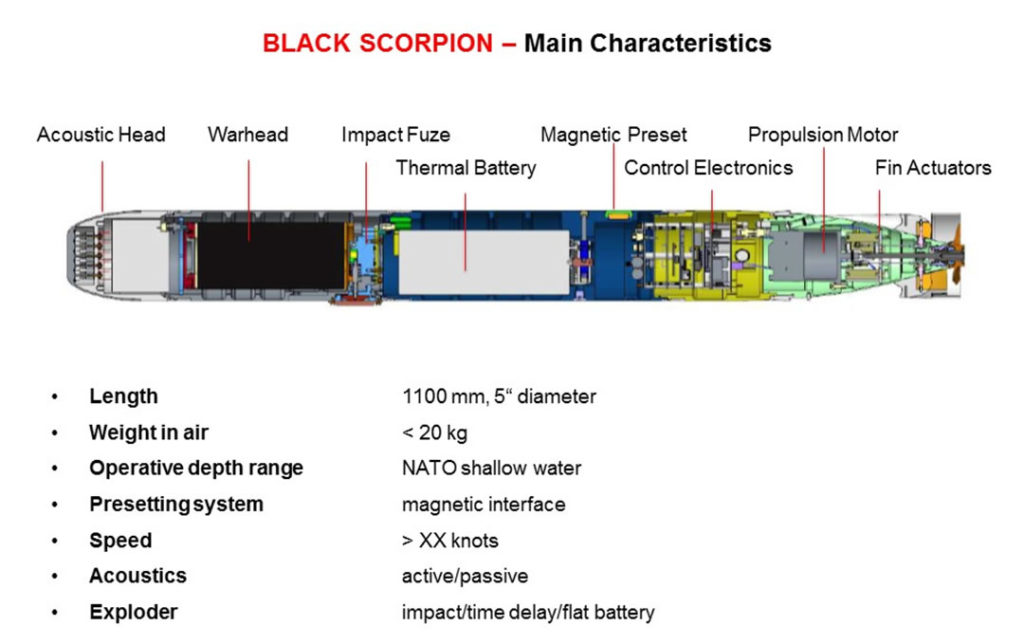
We saw this earlier but Navy recognition has another report on the Leonardo Black Scorpio, a truly very small torpedo, 127mm (5″) in diameter and 1.1 meters (43.3″) in length. The report provides a bit more insight into how it is expected to be used.

Much as I see the need for the Coast Guard to have a light weight torpedo, this may be too small to have anything more than very limited utility. A 21″ (533mm) heavy weight torpedo is 80-100 times heavier. A 12.75″ (324mm) light weight torpedo is 11 to 12 times larger. Even Grumman’s “Common Very Light Weight Torpedo” is five times as large.

But I am still curious. Range? Speed? Sensor range? Usable against surface ships? Midget submarines? Moored mines?

Graphic from Leonardo


“US, Guyana to Launch Joint Maritime Patrols Near Venezuela” –Marine Link

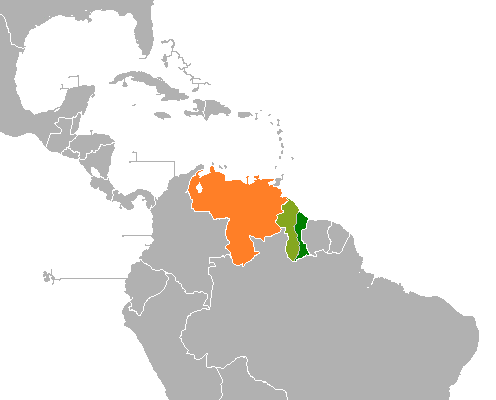
Disputed Guayana Esequiba in light green with the rest of Guyana in dark green; Venezuela shown in orange. Illustration by Aquintero82 from Wikipedia.

Marine Link reports,

“The United States and Guyana will begin joint maritime patrols aimed at drug interdiction near the South American country’s disputed border with crisis-stricken Venezuela, the U.S. secretary of state and Guyana’s new president said on Friday.”

I presume this is going to involve the US Coast Guard, given that it is about drug enforcement and cutters still comprise the majority of 4th Fleet ships.

Venezuela and Guyana have a long standing territorial dispute, with Venezuela claiming about two thirds of Guyana. This, of course, extends into the offshore waters in regard to EEZ.

Venezuela’s armed forces are about 50 times more powerful than those of Guyana. Guyana has no combat aircraft and no navy. They do have a very small coast guard. Venezuela has a respectable navy including two submarines, three frigates and six well armed OPVs.

Discovery of oil in the disputed offshore areas is also an issue. The USCG has had a hand in this dispute already. Venezuela may still be mad at us because of this apparent misunderstanding. When the President announced a surge in counter drug ops back in April, Venezuela was specifically mentioned. In June the Navy did a Freedom of Navigation operation off Venezuela because Venezuela is claiming a 15 mile territorial sea.

Hopefully things will not get too interesting down there.

“The Coast Guard Needs to Listen—Acoustically” –USNI

Source: WOODS HOLE OCEANOGRAPHIC INSTITUTION

The US Naval Institute Proceedings has an article recommending that the Coast Guard exploit acoustics to enhance its Maritime Domain Awareness.

The author provides some examples of how acoustics have proven this capability in the past.

Using SOSUS,

“In 1961, the Navy successfully tracked the USS George Washington (SSBN-598) during her transoceanic voyage from the United States to the United Kingdom, demonstrating the ability to acoustically track vessels over global distances.”

It has found a limited application within the Coast Guard,

The Coast Guard already is using passive acoustic monitoring to autonomously detect critically endangered North Atlantic right whales and notify nearby mariners. Despite the program’s success, it has not expanded beyond the single Coast Guard facility in Woods Hole, Massachusetts. Leveraging this remote-sensing ability would allow the Coast Guard to reduce its reliance on expensive aircraft patrol hours while providing the same level of service:

It apparently could have been used to monitor fishing activity.

 “A series of experiments supported by the Navy, Coast Guard, and National Marine Fisheries Service were conducted from 1992 to 1995 that explored the possibility of using SoSuS to track vessels fishing illegally. The experiment was a resounding success—results showed that SoSuS could be used to detect, identify, and monitor (this link is to a 468 page pdf — I did not see the article in question–Chuck) individual driftnet and trawling fishing vessels in the Bering Sea and northern Pacific Ocean. Despite promising results, the service failed to move to an acoustic-based enforcement approach.”

While I can find fault with the article, the author’s main thrust that the Coast Guard is not exploiting a part of the spectrum that could help maintain a picture of what is happening offshore is certainly true. Because we no longer have sonar or ASW expertise, we no longer have a window into what acoustic sensors have to offer.

While probably true that the Coast Guard might be able to establish acoustic surveillance over limited areas of special interest, if we are going to have a comprehensive system, we would likely have to ride the Navy’s coat tails.

A Navy system that listens for submarines could also listen for trawlers. It could detect vessels that have turned off their AIS. It might cue us that a terrorist controlled vessel is headed for a US Port; or that a merchant or fishing vessel is laying mines; or that a vessel is doing clandestine monitoring of our submarine operations.

This is also another way to track and identify vessels that may be illegally dumping.

This could even help with SAR. When I was an 8th District RCC controller in the early 70s, we had a tanker explode offshore, only we did not know that it had happened for several days. The day it happened we got a report of smoke. I sent an aircraft to investigate, but we found nothing but the smoke. Smoke was not uncommon, given all the offshore oil wells that flared gas. A few days later we got a report of a missing tanker. We searched and ultimately found its mast above water. It had been cleaning tanks closer to shore than it should have been, and had had a catastrophic explosion that ripped through 25 of its 27 cargo tanks. An acoustic monitoring system would almost certainly have picked that up. Anytime a ship sinks, the collapsing of bulkheads as air filled compartments are crushed should also be heard.

As the author points out, and as we have mentioned many times here, towed arrays on cutters could help us locate low profile drug smuggling vessels (drug subs).


Containerized Sonar

Naval News reports that the French Navy is testing a containerized Thales CAPTAS-1 active/passive variable depth sonar (VDS).

This not the only such sonar available. The Canadians offer a similar system.

Should it be necessary, such systems could conceivably allow sonar systems to be added to all Coast Guard cutters the size of the Webber class Fast Response Cutters and larger.

Swedish Patrol Boat ASW System

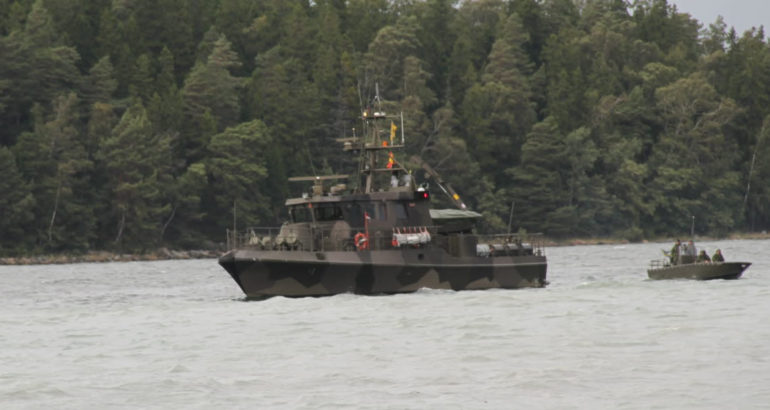
Photo: Tapper-class Fast Patrol Boat, displacement of 62 tons, 22 meters (72′) in length (Credits: Swedish Armed Forces)

Naval News reports that the first of six Trapper class fast patrol boats has completed an upgrade that will allow these small vessels to hunt submarines. At 62 tons full load, these vessels are about 2/3s the size of the Coast Guard’s 87 foot Marine Protector class WPBs (91 tons). 

Sweden has a history of suspected or known intrusions by submarines, midget submarines, and/or swimmer delivery vehicles, presumably from the Soviet Union/Russia.

What they seem to have done here is to use technology similar to the Sono-buoys used by airborne ASW units. While surface units do not have the speed of aircraft in getting to the scene, they are potentially more persistent, and because the buoys themselves do not have to fit within ejection tubes, they can be made larger with batteries that provide longer life. 

Photo: Tapper-class enhanced ASW capabilities mainly rely on new sonobuoy integration (Credits: Swedish Armed Forces)

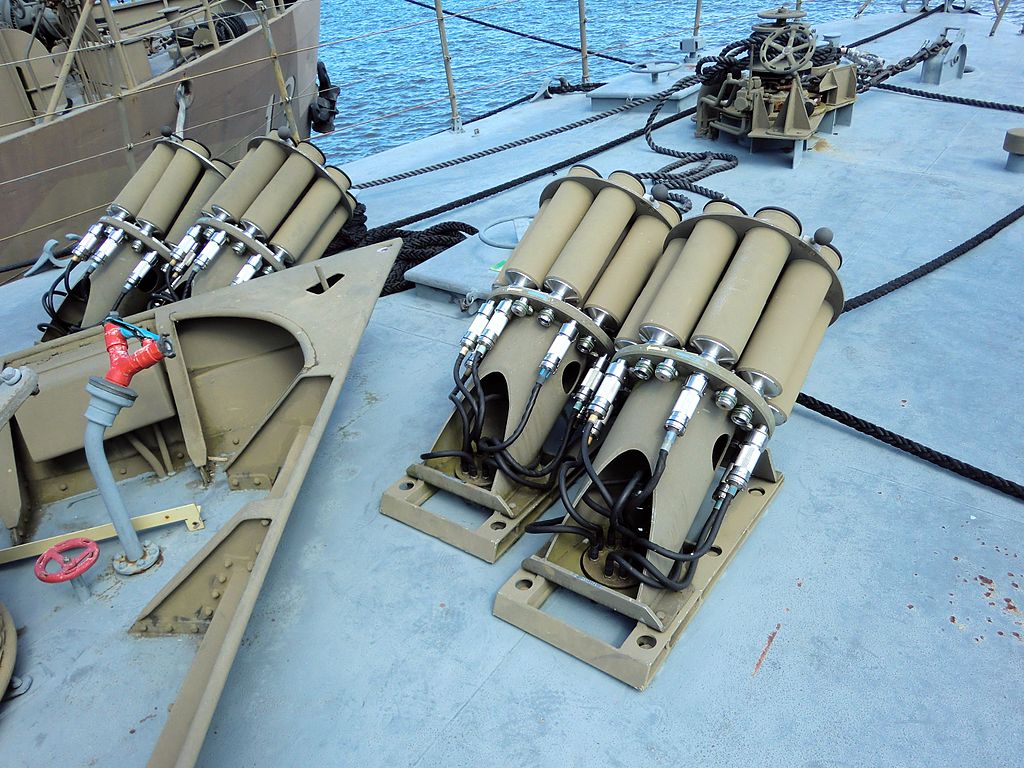
The post makes no mention of weapons or hull mounted sonars. When built in the 1990s, this class, originally of twelve vessels, based on a Swedish Coast Guard vessel design, had a searchlight sonar and small Anti-Submarine mortars that went by the designation RBS-12 or ASW600. The mortar projectiles were relatively small, only 100mm (3.95″) in diameter, weighing 4.2 kilograms (9 pounds 4 oz.), far smaller than the 65 pound (29.5 kilo) Hedgehog or Mousetrap weapons of WWII, but, unlike those systems, they did have a shaped charge. Apparently the weapon was removed at some point, but reportedly the weapon was reintroduced in 2018 on the Koster-class mine countermeasures vessels so it is possible it has been reintroduced here as well. 

Anti-submarine mortar system Elma LLS-920 (SAAB RBS12 ASW600) on the Swedish patrol boat HMS Hugin. Rearview with some mortars unattached. Photo by Dagjoh

While the post seems to emphasize passive detection, the last paragraph suggest there is an active component.

“The Kongsberg Maritime sonar selected for this upgrade is being used for Anti-Submarine Warfare (ASW), Mine and Obstacle detection and Navigation (emphasis applied–Chuck), and is designed for use in shallow water.”

Leslie B. Tollaksen, USCGC Chelan, USS Moberly, and the Last Battle in the Atlantic, May 5/6, 1945

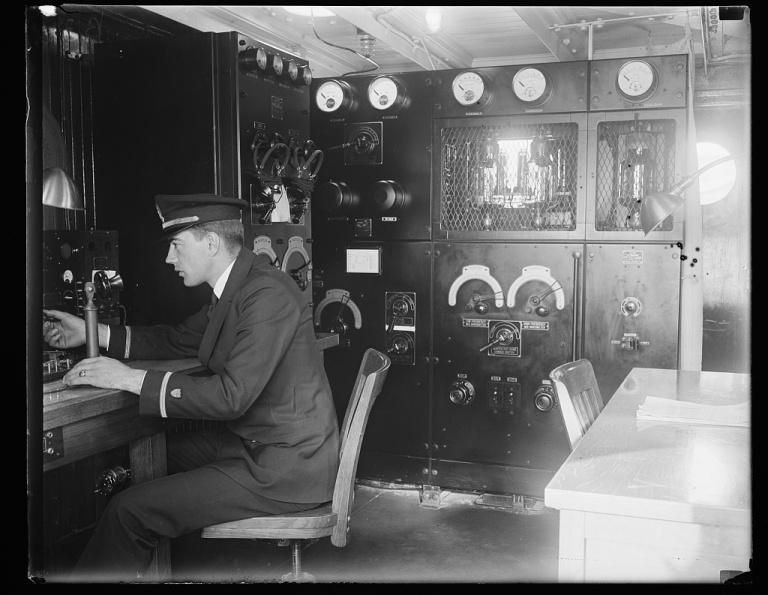
Caption: Biggest and costliest yet. This is the radio room on the U.S. Coast Guard Cutter Chelan, the newest cutter of the service now anchored at the Navy Yard, Washington D.C. This radio room houses three transmitters and three receiving sets. On the maiden trip, she picked up an SOS and towed schooner 1,500 miles, a record tow. Ensign Leslie B. Tollaksen, is shown in the photograph. Harris & Ewing, photographer. 1928 November 26. LOC LC-H2- B-3101 [P&P]

While looking into the sinking of U-853, the next to last U-boat sunk during World War II, I learned about the career of a largely unrecognized Coast Guard Officer, Leslie Bliss (Tolley) Tollaksen (1903-1973), Cdr., USCG. The story also links the next to last US warship sunk in the Battle of the Atlantic, USS Eagle 56, the last US merchant ship sunk in the Battle of the Atlantic, SS Black Point, and a cutter, USCGC Chelan, turned Royal Navy sloop that sank an Italian submarine in the Atlantic.

It also brought to mind a couple of possible names for future Offshore Patrol Cutters.

Commander Leslie B. Tollaksen:

We see Tollacksen in the photo above as a fresh caught ensign aboard USCGC Chelan. From a genealogy page:

Tollaksen “attended the University of Washington for two years before going and graduating from the US Coast Guard Academy in New London, Connecticut. He graduated from The USCG Academy in the Class of 1927, a year early to man the ships chasing down rum runners.

As a young Lieutenant, he was assigned to the US Coast Guard HQ in Washington, DC. He helped establish “Radio Washington” the telegraph station on Telegraph Road in Washington, DC, and also served as Aid to the Secretary of the Treasury, Henry Morgenthau, Jr. (At that time, his sister worked in the typing pool for President Franklin D. Roosevelt’s White House).

Leslie, about 1937 was the first US Coast Guard Officer selected for Post Graduate School at MIT.

Leslie, during WWII, and in command of the USS Moberly, sank the LAST German U-Boat U-853. U-8533 was a Type IXC/40 U-Boat, and lays on the bottom off Block Island…”

USCGC Chelan

USCGC Chelan was one of ten Lake Class cutters loaned to the British as part of the Lend Lease program.

USCGC Chelan as she looked in WWII in service with the Royal Navy as HMS Lulworth (Y60)

From Wikipedia:

On 14 July 1942, Lulworth was escorting Convoy SL 115 when she depth charged the Italian submarine Pietro Calvi and forced her to surface. She then open gunnery fire on Pietro Calvi, further damaging her, and Pietro Calvi’s crew scuttled her and abandoned ship; 35 members of Pietro Calvi’s crew survived.

The Italian submarine, Pietro Calvi, had previously sunk six Allied vessels, totaling 34,193 gross tons, including two American tankers.

U-853 

U-853 was a Type IXC/40 long range U-boat commissioned 25 June 1943. In July 1944 it had been fitted with a new device, a Dutch invention, a snorkel that allowed it to run its diesels and recharge its batteries while submerged, with only a small mast protruding above the water. U-853 had not been particularly successful. It had been attacked twice by Allied aircraft on 25 March 1944 and 17 June 1944. It had had two fruitless war patrol of 67 and 49 days, before the new commanding officer took over, 1 Sept. 1944.

Oberleutnant zur See Helmut Frömsdorf

It may be an indicator of the state of the German Navy that the new U-boat commander, Helmut Frömsdorf, was only 23 when he departed for his first and final patrol as CO on 23 Feb. 1945. He had served on U-853 for four years prior to being selected for command. From the time he had assumed command, including ten days moving from ports in Germany to Stavanger, Norway, the U-boat had been underway a total of only 83 days when U-853 and the crew of 55 was lost with all hands.

Hitler committed suicide on 30 April 1945. His successor was Admiral Donitz.

On 4 May, he issued orders that all Germans forces would surrender and, as part of the surrender process, U-Boat Headquarters sent the following message that same evening:

ALL U-BOATS. ATTENTION ALL U-BOATS. CEASE-FIRE AT ONCE. STOP ALL HOSTILE ACTION AGAINST ALLIED SHIPPING. DÖNITZ.

The order was to become effective at 0800 the following morning.  However, of the 49 boats then at sea, several were submerged and would not receive the message.  Among them was the U-853.

She is now a dive site:

This boat lies in 130 feet (42m) deep waters roughly 6 miles north east of Block Island and south of Newport, USA. The boat still contains remains of most of the 55 men who perished when she was sunk on May 6, 1945, in the last U-boat action as such in WWII.

USS Eagle 56 (PE-56), 430 tons, Commissioned 26 Oct. 1919. Sunk 23 Apr. 1945.  Automaker Henry Ford built 60 Eagle Boats for World War I, but none arrived before the Armistice and the Navy had discarded all but eight of them by WWII. (Navy)

Eagle 56:

Eagle 56 was nominally a subchaser, but an old and obsolete one. It was being used to tow targets when U-853 attacked and sank it.

At noon on 23 April 1945, Eagle 56 exploded amidships, and broke into two pieces 3 mi (4.8 km) off Cape Elizabeth, Maine. The destroyer Selfridge was operating near Eagle 56 and arrived 30 minutes after the explosion to rescue 13 survivors from the crew of 62. Selfridge obtained a sharp, well-defined sonar contact during the rescue and dropped nine Mark IX Mod 2 depth charges without obvious result.  According to a classified Navy report, U-853 had been operating in the waters off Maine.  At a Naval Board of Inquiry in Portland the following week, five of the 13 survivors claimed to have seen a submarine. Several spotted a red and yellow emblem on the submarine’s sail.

The Board of inquiry, however, concluded that the sinking had been the result of a boiler explosion. The record was not corrected until 2001.

In June 2001, Purple Heart medals were awarded to three survivors and the next of kin of those killed.

The wreck was located in June 2018, five miles (8.0 km) off the coast of Maine.

A commemorative plaque was erected on the grounds of Fort Williams Park near Portland Head Light.
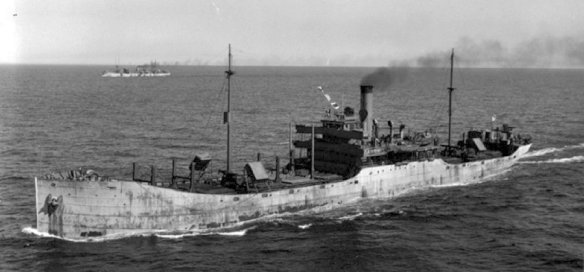
“Seen from an airship from ZP-11, SS Black Point steams off the east coast of the U.S., some 10 miles east of the entrance to the North River on 22 September 1944. A sailor on her foc’sle is probably watching the K-ship from which the picture was taken. The SS Silver Star Park steams in the background, both ships’ hulls reflecting hard service
National Archives photo 80-G-208086″

SS Black Point:

The SS Black Point was a 5,353 ton collier (coal carrying ship). She was 395′ (112.35 meters) long, with a beam of 66′ (16.82 meters) and a draft of 27′ (9.3 meters). She was the last US Flag vessel sunk during World War II. She was torpedoed 1740 May 5, 1945. She capsized and sank 25 minutes later, with the loss of 12 of her crew of 46. The torpedoing was observed by the crew of Judith Point Lighthouse and reported immediately.

“”COAST GUARD DEPTH CHARGES SCORE IN LAST U-BOAT KILLING: Off Point Judith, Rhode Island, crewmen of the Coast Guard-manned frigate watch the surface boil as a pattern of depth charges scores the final kill in the long, uphill battle against Nazi U-boats in the Atlantic. Working in teamwork with three Navy vessels, the Coast Guard ship destroyed the submarine on Sunday, May 6, 1945. The Moberly operates as a unit of the Atlantic Fleet.” Moberly has just fired a hedgehog pattern as the charges drop in a circular pattern ahead of the frigate.
U.S. Coast Guard photo 4557″
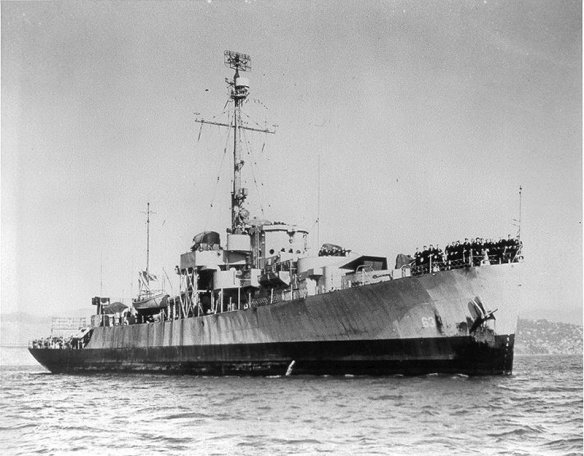
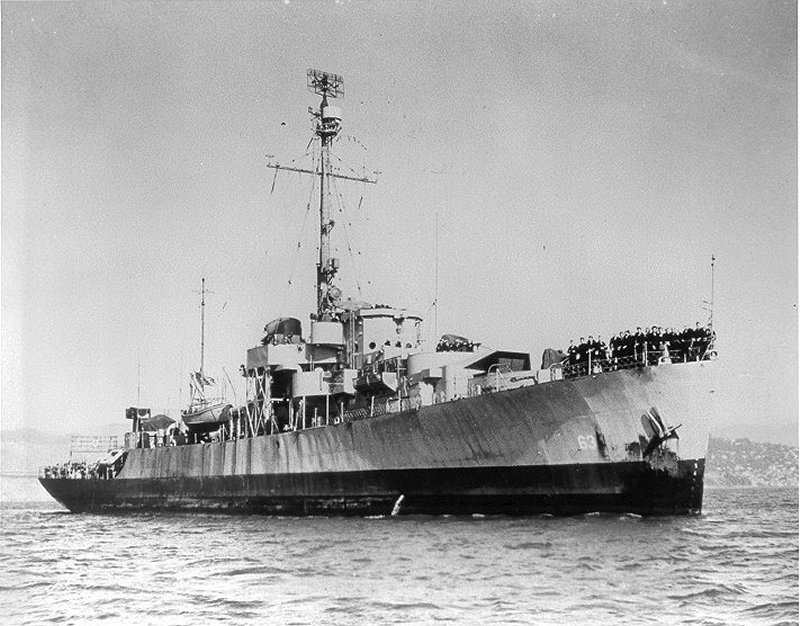
USS Moberly (PF-63) Off San Francisco, CA in early 1946.
Naval Historical Center photo NH 79077

USS Moberly was one of 75 Tacoma class patrol frigates manned by Coast Guard crews.

The only anti-submarine unit in the immediate vicinity was the remnants of a task group, TG 60.7 that had left New York at 1200 hours that day. It had arrived earlier after safely escorting the remaining vessels of GUS-8446, an 80-ship convoy that had originated in Oran and Casablanca. Several of the task group members were bound for the Charlestown Naval Base where the ships were scheduled to undergo extensive overhaul: destroyer Ericcson (DD-440), destroyer-escorts Amick (DE-168) and Atherton (DE-169), and the patrol frigate Moberly (PF-63). Accordingly, Eastern Sea Frontier headquarters issued dispatch 052223 diverting TG 60.7 to the sinking site and ordering various support activities to assist in discovering the intruder as needed.

Destroyer Ericcson, with the task group commander, Cdr. Francis C.B. McCune, aboard, was then under the control of a Coast Guard pilot in preparation for entering the Cape Cod Ship Canal and could not reach the scene for some time. Thus, Coast Guardsman Tollaksen found himself the Senior Officer Present and de facto commander of TG60.7.

A blow by blow of the search for, and attacks on, U-853 can be found here.

USS Moberly and USS Atherton share credit for the sinking.

For Consideration:

The Offshore Patrol Cutters are to be named after famous cutters. We have eleven names so far, but there are at least 14 to go. Perhaps we might name one for Moberly as representative of the 75 ships manned by Coast Guard crews.

We might also consider naming one for the Lowe (DE-325/WDE-425) to represent the 30 destroyer escorts the Coast Guard manned during WWII. 18 March 1945: Lowe, in company with Coast Guard manned destroyer escorts Menges (DE 320), Mosley (DE 321), and Pride (DE 323) sank the German submarine U-866, south of Nova Scotia. Lowe was primarily responsible for the sinking. Not only was she Coast Guard manned during WWII, but she also served as a Coast Guard cutter for almost three years, 20 July 1951 to 1 June 1954.


“GeoSpectrum Launches Low Frequency Active VDS Deployable by USVs”

Geospectrum’s new, compact version of the Towed Reelable Active Passive Sonar (TRAPS) suitable for Unmanned Surface Vessels (USVs)

NavyNews reports that Canadian Company GeoSpectrum has developed a version of their “Towed Reelable Active Passive Sonar” (TRAPS) that is scaled to fit vessels as small as 12 meter Unmanned Surface Vessels (USV).

We talked earlier about an earlier version of this system. If it fits on a 12 meter (39’4″) USV, then it should certainly be able to fit on anything WPB or larger. If we should ever have to go to war, this might be a capability we would want to protect our harbor approaches from submarines. We would probably also want to add an ASW torpedo launching capability.

It might be worth doing some experimentation to see how it works, and if desirable, draw up plans for adding this or a similar system for mobilization. First of course we should take a look at the results of Canada’s tests.

Might also be desirable to have something like this for the Webber class cutters going to PATFORSWA, since the Iranians have a large number of small conventionally powered submarines.

Maybe it could help us find semi-submersibles smuggling drugs as well.