11 Island Class WPBs have been transferred to foreign partner nations, 15 Continue USCG Service

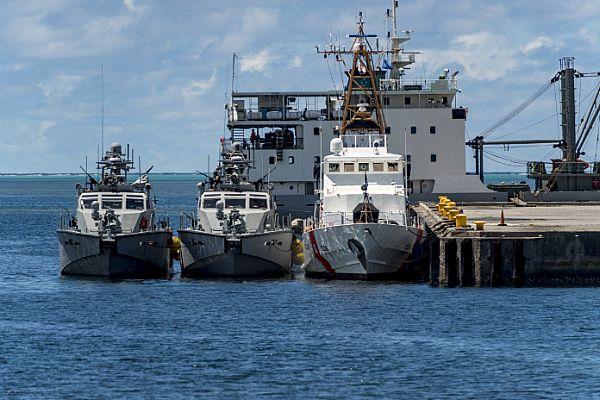
COLONIA, Yap (July 4, 2019) The U.S. Coast Guard Island-class patrol boat USCGC Kiska and Mark VI patrol boats assigned to Coastal Riverine Squadron (CRS) 2, Coastal Riverine Group 1, Detachment Guam, moored in the Micronesia port of Yap. CRG 1, Det. Guam’s visit to Yap, and engagement with the People of Federated States of Micronesia underscores the U.S. Navy’s commitment to partners in the region. The Mark VI patrol boat is an integral part of the expeditionary forces support to 7th Fleet, capability of supporting myriad of missions throughout the Indo-Pacific. (U.S. Navy photo by Mass Communication Specialist 2nd Class Jasen Moreno-Garcia/Released)

In the photo above we see the former USCGC Kiska in an earlier life. Foreign military sales and transfer of excess property seem to be a growing Coast Guard mission. This does to some extent justify earlier recapitalization than might otherwise be the case. It is part of our attempt to build capacity in like minded partners’ navies and coast guards.

Coast Guard celebrates completion of training as part of cutter transfer to Ukraine
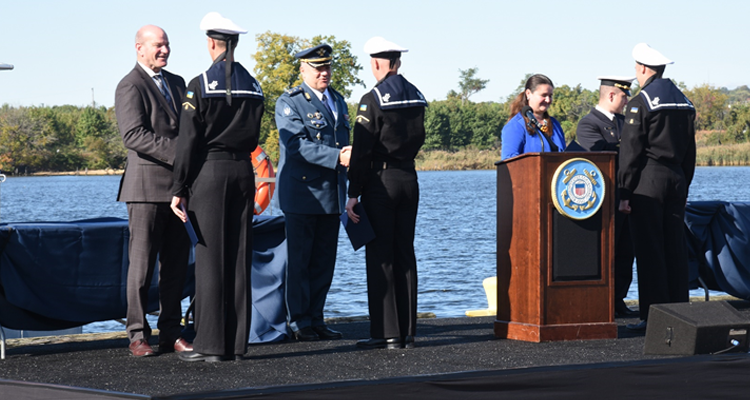
Members of the Ukrainian Navy receive congratulations following completion of Coast Guard training to operate and maintain a 110-foot Island Class patrol boat. These crewmembers will serve on Kubrak, the former Coast Guard Cutter Kiska, which will be delivered to Ukraine in early 2022. U.S. Coast Guard photo.


The Coast Guard Office of International Acquisition recognized 16 members of the Ukrainian Navy in a ceremony Oct. 22, 2021, at Coast Guard Yard in Baltimore. The Ukrainian crew just completed a rigorous six-week training program as part of the transfer of a 110-foot Island Class patrol boat to Ukraine.

The Coast Guard Cutter Transition Division Training Team helped the Ukrainian crew master the art of damage control, engineering maintenance, ship handling and watchstanding on Kubrak, which is the former Coast Guard Cutter Kiska. The Coast Guard officially transferred the title of the ex-Kiska Oct. 23, 2020. Since the title transfer, the cutter has been undergoing maintenance and upgrade work at Coast Guard Yard.

Kiska is the fifth patrol boat to be transferred to Ukraine under the Coast Guard Excess Defense Articles Program. Two cutters (ex-Drummond and ex-Cushing) were delivered to Ukraine in 2019, and two cutters (ex-Ocracoke and ex-Washington) will be transported to Ukraine later this month. Delivery of Kubrak to Ukraine is anticipated in early January 2022.

During its service as a Coast Guard cutter, the ex-Kiska was homeported in Hilo, Hawaii, and Apra Harbor, Guam, with primary missions of search and rescue, counter-drug activities and homeland security in addition to patrolling international and territorial waters as a humanitarian, law enforcement and Department of Homeland Security asset.

The ex-Kiska is the 11th 110-foot patrol boat transferred to a foreign partner nation; other patrol boats have been transferred to Pakistan, Georgia and Costa Rica. Congress has authorized transfer of two additional boats to Ukraine in fiscal year 2022. Recipients of former Coast Guard assets are determined by an interagency committee, led by the State Department.

Each 110-foot patrol boat transfer saves the Coast Guard money in remediation and disposal costs and helps build and sustain international maritime partnerships that foster greater global maritime security. One of the United States’ goals in this transfer is to help equip Ukraine with the means to project national sovereignty.

Coast Guard 110-foot patrol boats entered service in the mid-1980s; 15 of the 49 cutters originally in the class remain in service. The ships are being replaced with 64 154-foot fast response cutters, 45 of which are in service.

“Coast Guard cutter returns home following Western Pacific deployment” –News Release

Coast Guard Cutter Munro (WMSL 755) crewmember Petty Officer 2nd Class Kurt Chlebek, a boatswains mate, is greeted by his dog after Munro returned to their homeport in Alameda, California, Oct. 20, 2021, following a 102-day, 22,000 nautical mile multi-mission deployment. Munro’s crew departed Alameda in July for a Western Pacific patrol and operated in support of United States Indo-Pacific Command, which oversees military operations in the region. U.S. Coast Guard photo by Chief Petty Officer Matt Masaschi.

Wrap-up of USCGC Munro’s recent deployment to the Western Pacific.

united states coast guard

News Release

Oct. 20, 2021
U.S. Coast Guard Pacific Area

Coast Guard cutter returns home following Western Pacific deployment

Photo of U.S. and Japan Coast Guard vessels
Coast Guard Cutter Munro crew returns home following 102-day, 22,000 nautical mile multi-mission Western Pacific deployment Coast Guard Cutter Munro crew returns home following 102-day, 22,000 nautical mile multi-mission Western Pacific deployment

Editors’ Note: Click on images to download high resolution versions.

Alameda, Calif. – The U.S. Coast Guard Cutter Munro (WMSL 755) and crew returned to their Alameda homeport Wednesday following a 102-day, 22,000-nautical-mile deployment to the Western Pacific.

Munro departed Alameda in July to the Western Pacific to operate under the tactical control of U.S. Navy 7th Fleet to promote a free and open Indo-Pacific.

“Munro’s deployment demonstrated the Coast Guard’s unique authorities in support of the Indo-Pacific command,” said Vice Adm. Michael F. McAllister, commander Coast Guard Pacific Area. “Joint operations help strengthen our partnerships through search and rescue, law enforcement, marine environmental response and other areas of mutual interest which preserve a stable and secure global maritime environment.”

Munro’s crew executed numerous cooperative engagements, professional exchanges and capacity building efforts with naval allies and partners, including the Japan Coast Guard, Japan Maritime Self Defense Force, Philippine Coast Guard and Bureau of Fisheries and Aquatic ResourcesRoyal Australian Navy, and Indonesia Maritime Security Agency.

“Our relationships in the Western Pacific are stronger today, and our partners are unified in their commitment to security,” said Capt. Blake Novak, commanding officer of Munro. “It was an incredible opportunity for our crew to participate alongside allies, sharing search and rescue and law enforcement concepts to promote peace, prosperity, and the sovereign rights of all nations.”

As both a federal law enforcement agency and an armed force, the U.S. Coast Guard is uniquely positioned to conduct defense operations in support of combatant commanders on all seven continents. The service routinely provides forces in joint military operations worldwide, including the deployment of cutters, boats, aircraft, and deployable specialized forces.

Munro is one of four 418-foot national security cutters homeported in Alameda. National security cutters like Munro feature advanced command and control capabilities, aviation support facilities, stern cutter boat launch, and increased endurance for long-range patrols, enabling the crews to disrupt threats to national security further offshore.

Photos from the Munro’s deployment are available here.

“U.S. Coast Guard cutter trains with Indonesia’s Maritime Security Agency” –News Release

Members onboard U.S. Coast Guard Cutter Munro man the rails during a maritime engagement with the Indonesia Maritime Safety Agency in the Singapore Straight, Sept. 20, 2021. Coast Guard Cutter Munro is currently deployed to the Western Pacific to strengthen alliances and partnerships, and improve maritime governance and security in the region. (U.S. Coast Guard photo by Marine Corps Sgt. Kevin G. Rivas)

Below is a Pacific Area News release, more of USCGC Munro’s adventures in the Western Pacific. You can also see the four accompanying photos here.

Indonesia has a unique organization that includes two coast guard like institutions,

The relationship between the two agencies seems to have been in flux. The Indonesian Navy also has a number of patrol boats that would correspond to US Coast Guard patrol boats. The Indonesian Navy is also constructing Offshore Patrol Vessels comparable to large Coast Guard Cutters.

The Indonesian ship seen in the photographs is KN Dana (323), a 80 meter Offshore Patrol Vessel, one of a class of three Damen designed vessels of the Bakamla. There is also a larger 110 meter OPV, all are relatively new.

united states coast guard

News Release

U.S. Coast Guard Pacific Area
September 21, 2021
Contact: Coast Guard Pacific Area Public Affairs
Office: (510) 437-3375
D11-DG-M-PACAREA-PA@uscg.mil
Pacific Area online newsroom

U.S. Coast Guard cutter trains with Indonesia’s Maritime Security Agency

U.S. Coast Guard and Indonesian Coast Guard U.S. Coast Guard Captain Novak waves to Indonesian Coast Guard vessel U.S. Coast Guard and Indonesian Coast Guard

Editors’ Note: Click on images to download high resolution version.

ALAMEDA, Calif. — The U.S. Coast Guard Cutter Munro (WMSL 755) conducted operations and exercises with the Indonesian Maritime Security Agency and coast guard, the Badan Keamanan Laut (known as BAKAMLA), September 20, in the Singapore Strait.

 Together, the crews participated in ship-to-ship communications drills, multi-unit maneuvering and maritime domain awareness while at sea.

 “These maritime exercises with our Indonesian partners forge a stronger relationship, allowing our respective crews to work together and build on each others’ strengths,” said Munro’s Commanding Officer Capt. Blake Novak. “Strengthening our alliances and partnerships fosters our unified commitment to a free and open Indo-Pacific and promotes peace, security, prosperity and the sovereign rights of all nations.”

 The U.S. Coast Guard partnership with Indonesia continues to grow stronger. In 2019, the Coast Guard Cutter Stratton conducted engagements with BAKAMLA as part of the Western Pacific deployment, including a port call in Batam and an exercise in the Riau Islands Province. The Stratton also participated in Cooperation Afloat Readiness and Training with the Indonesian Navy in 2019.

Munro, a 418-foot national security cutter, departed its home port of Alameda, California, in July for a months-long deployment to the Western Pacific. Operating under the tactical control of the U.S. Navy’s 7th Fleet, the cutter and crew are engaging in professional exchanges and capacity-building exercises with partner nations and patrolling and conducting operations as directed. National security cutters like Munro feature advanced command and control capabilities, aviation support facilities, stern cutter boat launch, and increased endurance for long-range patrols, enabling the crews to disrupt threats to national security further offshore.

“The U.S. Coast Guard is proud to operate with the Indonesian Maritime Security Agency and coast guard to enhance capabilities, strengthen maritime governance, security and promote rules-based international order,” said Vice Adm. Michael F. McAllister, commander U.S. Coast Guard Pacific Area. “Strengthening partnerships contributes to the region’s maritime common good in search and rescue, law enforcement, marine environmental response and other areas of mutual interest.” 

As both a federal law enforcement agency and an armed force, the USCG is uniquely positioned to conduct defense operations in support of combatant commanders on all seven continents. The service routinely provides forces in joint military operations worldwide, including the deployment of cutters, boats, aircraft, and deployable specialized forces.

More photos from Munro’s Western Pacific deployment are available here. Subscribe here to receive notifications when new photos are added.


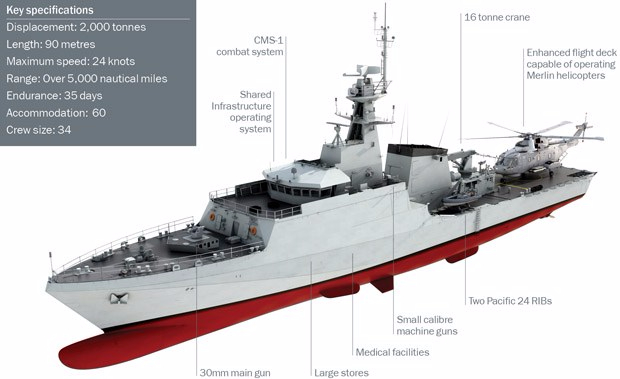
Royal Navy Deploys Two OPVs for Five Years to No Base in Particular

We have deployed cutters to the Western Pacific for months at a time, and PATFORSWA kept its 110s operating out of Bahrain for years, but the Royal Navy seems to be doing something different and I believe remarkable.

Naval News reports they are sending a pair of River Batch II class ships, HMS Tamar and HMS Spey, well beyond the Suez. It sounds all very 18th Century Star Trek, “Our Five Year Mission, Proceed into the Indian and Pacific Oceans and act in the Queen’s Interests.” (No, not a real quote.)

If these ships were in the US Coast Guard we would see them as MECs. They are slightly larger and faster than the 270s, but are not as well equipped in some respects. They are armed only with a 30mm gun and no helicopter hangar. I don’t believe they have any ESM/ECM. Their crew is also considerably smaller, smaller in fact than that of a 210. (I have seen various numbers for the crew size, 34 in the infographic above, 58 in Wikipedia, 46 as reported below, but all well below the 75 common on a 210 or the 100 typical of a 270.)

“Each ship is crewed by 46 sailors, with half the crew trading places with shipmates from the UK every few weeks.”

The Royal Navy actually has considerable experience keeping OPVs deployed for long periods with austere support.

We might even see one of these helping with drug interdiction in the Eastern Pacific, more likely they will be countering piracy and drug or arms trafficing in the Indian Ocean or capacity building in East Africa or SE Asia. Maybe we could make a multi-national Freedom of Navigation transit of the Taiwan Strait.


“U.S. Coast Guard Continues to Expand Presence in the Western Pacific” –USNI


August 26, JS OUMI conducted joint training with USCGC Munro in the East China Sea.

The US Naval Institute’s News Service reports on recent Coast Guard activity in the Western Pacific, apparently based primarily on a conversation with Vice Admiral Michael McAllister, Commander Pacific Area and Commander, Coast Guard Defense Force West.

They talk primarily about USCGC Munro’s operations with Japanese and Philippine forces. These included first time underway logistics support provided by the Japanese Maritime Self Defense Force, but there was more. They also discussed cooperation with the China Coast, but the Pacific Area Commander made one particular statement that may portend a new base in the Western Pacific,

“McAllister also provided an update on Coast Guard operations in the Pacific Islands since the July commissioning in Guam of Coast Guard Fast Response Cutters Myrtle Hazard (WPC 1139), Oliver Henry (WPC 1140) and Frederick Hatch (WPC 1143), and the re-designation of Coast Guard Sector Guam to Coast Guard Forces Micronesia Sector Guam.” (emphasis applied–Chuck)

There would not seem to be a reason to apply the designation “Coast Guard Forces Micronesia Sector Guam” unless there were Coast Guard forces in Micronesia somewhere beside Guam. Right now there are none that I am aware of.

I hope to publish something soon to discuss there those forces might be based.

“U.S. Coast Guard concludes training with Philippine maritime agencies” –Pacific Area

U.S. Coast Guard trains with Philippine maritime agencies

U.S. Coast Guard Cutter Munro (left) and Philippine Coast Guard Offshore Patrol Vessel Gabriela Silang (right) render honors to each other following bilateral operations and exercises Aug. 31, 2021, in the West Philippine Sea. The Munro and crew are currently deployed to the Western Pacific Ocean to strengthen alliances and partnerships and improve maritime governance and security in the region. (U.S. Coast Guard photo by Marine Corps Sgt. Kevin G. Rivas)

Passing along a Pacific Area news release. More photos here. Recently read USCGC Munro had completed an Underway Refueling from a Japanese Maritime Self Defense Force Vessel (Thanks to Paul). Of course this upset the Chinese. They seem to be perpetually upset.

united states coast guard

News Release

U.S. Coast Guard Pacific Area
Sept. 1, 2021

U.S. Coast Guard concludes training with Philippine maritime agencies

Photo of Coast Guard members on cutter Saluting on the cutter Cutters underway

Editors’ Note: Click on images to download high resolution version.

ALAMEDA, Calif. — The U.S. Coast Guard Cutter Munro (WMSL 755) arrived in Subic Bay, Philippines, Tuesday following operations and exercises in the West Philippine Sea with the Philippine Coast Guard and the Philippine Bureau of Fisheries and Aquatic Resources.

Munro’s crew participated in bilateral operations, professional exchanges, search-and-rescue and communications exercises, small boat operations, multi-vessel maneuvering, and maritime domain awareness drills while at sea.

“As the maritime security challenges in the Indo-Pacific region become increasingly complex, partnering with our Philippine Coast Guard and fisheries counterparts is vital to our shared interest in a free and open maritime environment,” said Munro’s Commanding Officer Capt. Blake Novak. “We thoroughly enjoyed our Philippine hosts’ professionalism and hospitality, and we look forward to future bilateral operations to further our longstanding relationship.”

The search-and-rescue exercise simulated the agencies’ bilateral response to a vessel in distress. During the exercise, the Munro, PCG, and BFAR practiced searching for the distressed vessel, shipboard firefighting techniques, and recovering and treating persons in the water. As part of the exercise, members of the PCG joined USCG members aboard Munro as they launched the cutter’s Small Unmanned Aircraft System to aid in the search-and-rescue response. The day’s exercises and operations provided opportunities for each involved agency to learn from each other.

“The success of the joint maritime exercise between the PCG and USCG will not only strengthen international partnerships for immediate response to calamities and disasters but will also ensure that our personnel could effectively perform their mandated functions in countering terrorism and other acts of lawlessness in our country’s waters,” said Admiral George V. Ursabia JR., PCG commandant.

The USCG has a long history of cooperation with the PCG. In 2019, the Coast Guard Cutter Bertholf conducted engagements with the PCG as part of its Western Pacific deployment, focusing on search and rescue, maritime security, and law enforcement capabilities.

Munro, a 418-foot national security cutter, departed its homeport of Alameda, California, in July for a months-long deployment to the Western Pacific. Operating under the tactical control of U.S. 7th Fleet, the cutter and crew are engaging in professional exchanges and capacity-building exercises with partner nations and are patrolling and conducting operations as directed. National security cutters like Munro feature advanced command and control capabilities, aviation support facilities, stern cutter boat launch, and increased endurance for long-range patrols, enabling the crews to disrupt threats to national security further offshore.

“The Coast Guard shares deep and abiding interests with our allies and partners, who, like us, have long endorsed a rules-based international order,” said Vice Adm. Michael F. McAllister, commander, U.S. Coast Guard Pacific Area. “Partnering with the Philippines to enhance maritime governance, including important missions such as search and rescue and enforcement of fisheries laws and treaties, is essential to the security, stability and prosperity of all nations.”

As both a federal law enforcement agency and an armed force, the USCG is uniquely positioned to conduct defense operations in support of combatant commanders on all seven continents. The service routinely provides forces in joint military operations worldwide, including the deployment of cutters, boats, aircraft, and deployable specialized forces.

More photos from Munro’s Western Pacific deployment are available here. Subscribe here to receive notifications when new photos are added.


White Hull Diplomacy, “The Coast Guard and Stability Operations” –Small Wars Journal

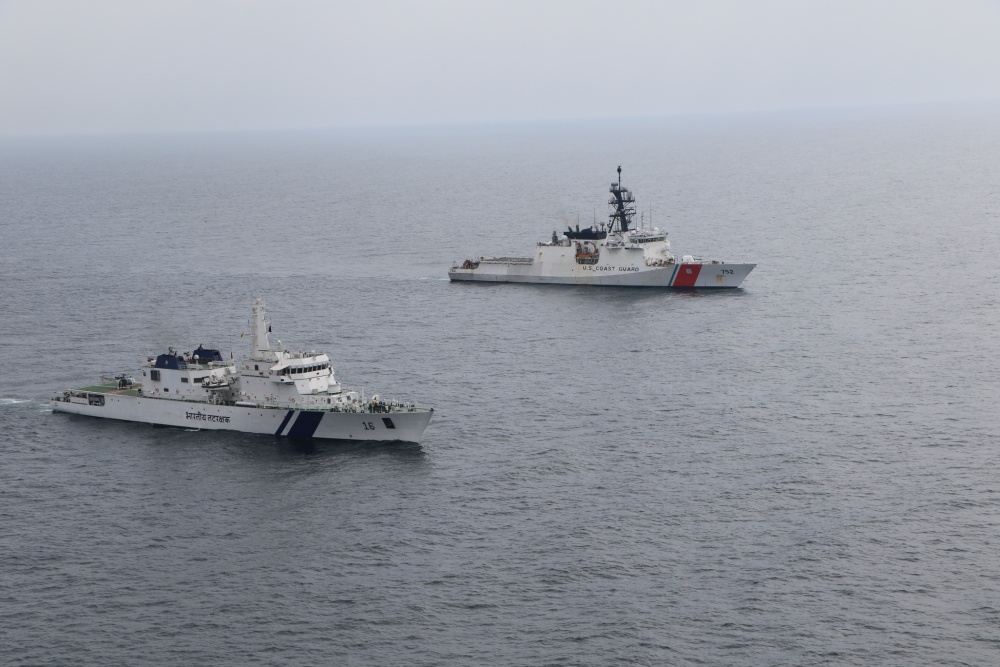
Coast Guard Cutter Stratton (WMSL 752) sales alongside the Indian coast guard ships Abheed and Shaurya (16) Aug. 23, 2019, while transiting in the Bay of Bengal off the coast of Chennai, India. The Stratton is participating in a professional exchange with the Indian coast guard that includes operational exercises at sea and on shore. (U.S. Coast Guard photo by Petty Officer 3rd Class Stephen Esterly)

Small Wars Journal makes the case for designating the Coast Guard to maintain expertise in and conduct maritime stability operations.

Historically, the United States military is regularly involved in some sort of stability operation despite the military preference for high intensity conflict. … The United States risks losing some of the lessons learned if it does not develop a holistic and complementary Joint Force that can both dominate a peer enemy and conduct stability operations at and below the level of armed conflict. Competition means that forces will be employed across the spectrum of operations with equal emphasis. Designating specific services to conduct stability as a primary mission is one means of ensuring a Joint Force that is equally capable across the spectrum. The Coast Guard is uniquely suited to a lead role in maritime focused stability operations. As a military force that is resident within the inter-agency, the Coast Guard provides a presence that is “instantly acceptable because of their worldwide humanitarian reputation.” This forward presence dovetails with the Department of Homeland Security mission of “safeguarding the American people” by pushing the boundaries of U.S. law enforcement into regions and countries where it can mentor and develop partner capabilities in the areas it is needed most.

It quotes the Coast Guard Strategic Plan 2018-2022.

“The Coast Guard plays a critical role in strengthening governance in areas of strategic importance. We mature other nations’ inherent capabilities to police their own waters and support cooperative enforcement of international law through dozens of robust bilateral agreements. Our leadership on global maritime governing bodies and our collaborative approach to operationalize international agreements drives stability, legitimacy and order. As global strategic competition surges, adversaries become more sophisticated and the maritime environment becomes more complex. The Coast Guard provides a full spectrum of solutions, from cooperation to armed conflict.”

The post states,

“At its heart the primary stability tasks fall into seven military missions and activities:  protecting civilians, security sector reform, support to security cooperation, peace operations, foreign humanitarian assistance, counterinsurgency, and foreign internal defense.”

It then goes on to describe how the Coast Guard has done each of these tasks in the past.

What we may be seeing here is a preview of the roles the Coast Guard may be expected to perform when the expected Tri-Service Strategy is published.

Thanks to Geoff for the “White Hull Diplomacy” portion of the title. 

“The Long Blue Line: Operation “Relevant Ursa”–Bear training in West Africa” –Coast Guard Compass

Coast Guard’s 270-foot medium endurance cutter Bear underway in Africa. (Ensign Connor Brown, U.S. Coast Guard)

Coast Guard Compass reports on an unusual 95 day deployment by USCGC Bear to the West Coast of Africa, primarily with the island nation of Cabo Verde but sailing as far north as Morocco.


“It’s Time for a ‘Quad’ of Coast Guards” –Real Clear Defense

A Japan Coast Guard helicopter approaches an Indian Coast Guard patrol vessel during a joint exercise off Chennai, India, January 2018 (Photo: The Asahi Shimbun via Getty)

Real Clear Defense has an article which first appeared in the Australian think tank Lowy Institute‘s publication “The Interpreter,” advocating greater cooperation between the Coast Guards of Australia, India, Japan, and the US.

“The so-called Quad group of Indo-Pacific maritime democracies – Australia, India, Japan, and the United States – is a valuable grouping, although it is still under utilized in many ways. One of the most effective ways that these countries could work together to enhance maritime security in the Indo-Pacific would be through coordinating the work of their coast guard agencies.”

While India in particular, is adverse to committing to a military alliance, these nations share a commitment to a rules based international system.

Quadrilateral cooperation through the countries’ coast guards could provide an answer to this political problem. As principally law-enforcement agencies, coast guards can provide many practical benefits in building a stable and secure maritime domain, without the overtones of a military alliance.

Using ship-riders, this sort of cooperation could go beyond capacity building and uphold the norms of international behavior. It might lead to the kind of standing maritime security task force I advocated earlier. When coast guards are in conflict, having multiple coast guards on scene could insure that instead of a “he said, she said” situation, we could have a “he said, we say” situation that would show a united front against bullying.

Given Bertholf and Stratton‘s stay in the Western Pacific and Walnut and Joseph Gerczak‘s support of Samoa, which was coordinated with Australia and New Zealand, it appears we may already be moving in this direction.


The Other Prize Winning USNI Coast Guard Essays

At least for a little while, the three prize winning US Naval Institute Coast Guard Essays are available on line, and they are available whether you are a member or not. 

I did a separate post on the First prize winner earlier. The other two are linked below.

    “Rethink Coast Guard Priorities”—2nd Prize, By Lt Noah Miller, USCG
    “Guard the African Coast”—3rd Prize, By LCdr Stuart J. Ambrose, USCGR
Both are thoughtful efforts, well worth the read.
Lt Miller makes the case for devoting more assets to fisheries enforcement even at the expense of decreased drug enforcement. I think he has a point, particularly in regard to the Central and Western Pacific.
“The Western and Central Pacific region is extremely remote, so it is difficult to detect potential incursions and even more difficult to respond in a timely manner. However, tuna fisheries are present in these waters, and they are among the most valuable pelagic fisheries in the world.”
LCdr Ambrose tells us why the Coast Guard should be engaged in Africa.