Marine Air-Ground Tablet (MAGTAB)

A moving map on a MAGTAB. (Image credit: USMC/Cpl. Lisa Collins)

Having recently read a couple of posts about a test of a new missile system launched from a Marine Attack helicopter, discovered that the Marines have what is effectively a secure handheld tactical data link, and it has been in the field since at least 2019.

That it is also capable of being used as a fire control system for missiles in the maritime environment appears promising, but more importantly, the Coast Guard could use something like this for coordinating with small units like helicopters, patrol boats, cutter boats, and response boats. This appears to provide much of the capabilities of a Combat Information Center.

Maybe the R&D center should look into it.

Screengrab of a Nov. 27, 2019 video by the US Marine Corps on the MAGTAB, showing the mission status of various tactical actions and asset movements. (Image credit: USMC/Cpl. Lisa Collins)

“HII AWARDED $244 MILLION CONTRACT TO INTEGRATE MINOTAUR SOFTWARE PRODUCTS INTO MARITIME PLATFORMS” –HII News Release

New Minotaur operator workstations are being installed on all HC-144Bs. Minotaur provides dramatically improved data fusion and integrates installed sensors and radar. U.S. Coast Guard photo by Aviation Engineering Warrant Officer 3 Randy Jopp.

Below is a news release from HII (Huntington Ingalls). Minotaur is being installed on all USCG fixed wing search aircraft (C-130J, C-27J, and C-144). This seems to say cutters, as well as Navy floating units and Marine units, are also being fitted with elements of the system. 


HII AWARDED $244 MILLION CONTRACT TO INTEGRATE MINOTAUR SOFTWARE PRODUCTS INTO MARITIME PLATFORMS

Contract Extends HII’s ISR Mission Support Across Domains

MCLEAN, Va., (Oct. 17, 2023) — HII (NYSE: HII) announced today that its Mission Technologies division was awarded a $244 million task order to integrate Minotaur software products into maritime platforms for the U.S. Navy, U.S. Marine Corps and U.S. Coast Guard.

HII was awarded this contract under the Department of Defense (DoD) Information Analysis Center’s (IAC) multiple-award contract (MAC) vehicle.  IAC MAC task orders are awarded by the U.S. Air Force’s 774th Enterprise Sourcing Squadron to develop and create new knowledge for the enhancement of the Defense Technical Information Center repository and the research and development and science and technology community.

Under the Naval Air Systems Command task order, HII will perform research, development, test and evaluation to facilitate the integration of Minotaur Family of Services products into the services’ maritime platforms to meet intelligence, surveillance and reconnaissance warfighting requirements.

Minotaur products support the warfighter by enhancing sensor performance and presenting data from multiple types of sensors, including radar and C5ISR equipment, into a single common operating picture and transmitting that data to other platforms and units during operations.

HII has been the first and only industry prime developer of Minotaur since the program was first awarded to industry in 2020.

The contract has a five-year period of performance, with work conducted at contractor facilities in various U.S. locations.

“HII has been at the forefront of Minotaur software development for nearly a decade,” said Andy Green, executive vice president of HII and president of Mission Technologies. “It’s a privilege to continue this mission-critical work and to concurrently deliver the advantage to three branches of the Armed Forces.”

“We are pleased that the Navy has selected this proven technology to meet the combined requirements of next-generation Navy, Marine Corps and Coast Guard ISR platforms,” said Todd Gentry, president of Mission Technologies’ C5ISR business group. “We have assembled an outstanding team and look forward to expanding our longstanding partnership with the Navy and supporting the tri-service maritime strategy.”

C5ISR
Find more information about HII’s C5ISR capabilities.

NOTE

The DoD IAC, sponsored by the Defense Technical Information Center, provides technical data management and research support for DoD and federal government users. Established in 1946, the IAC program serves the DoD science and technology and acquisition communities to drive innovation and technological developments by enhancing collaboration through integrated scientific and technical information development and dissemination for the DoD and broader science and technology community.

This material is based upon work supported by the DoD Information Analysis Center Program (DoD IAC), sponsored by the DTIC under Contract No. FA807523F0049.

Approved for Public Release, Distribution Unlimited. Any opinions, findings and conclusions or recommendations expressed in this material are those of the author(s) and do not necessarily reflect the views of the DoD.

About HII

HII is a global, all-domain defense provider. HII’s mission is to deliver the world’s most powerful ships and all-domain solutions in service of the nation, creating the advantage for our customers to protect peace and freedom around the world.

As the nation’s largest military shipbuilder, and with a more than 135-year history of advancing U.S. national security, HII delivers critical capabilities extending from ships to unmanned systems, cyber, ISR, AI/ML and synthetic training. Headquartered in Virginia, HII’s workforce is 44,000 strong. For more information, visit:

Navy Integrated Combat System Includes Coast Guard

Defense News services has a post, “Lockheed wins $1.1B contract to design Navy’s Integrated Combat System,” that reports,

“The U.S. Navy awarded Lockheed Martin $23 million to begin creating the Integrated Combat System that may one day connect the Navy’s and U.S. Coast Guard’s surface fleets.”

There is a good background article from US Naval institute that came out in 2020.

This is an essential element of the Navy’s planned distributed operations. It should also facilitate interoperability with current and future users of the Aegis system including Australia, Canada, Japan, Norway, Spain, and South Korea.

The National Security Cutters already have the Aegis combat system which will evolve into the integrated systems.

I have seen no indication the OPC will share this system, but it certainly should. It is to be used on unmanned craft as well, so it could probably be scaled down to work on the Webber class FRC as well.

“The Coast Guard is investing in underway connectivity…and it’s paying off!” –MyCG

Below is news from MyCG. I am publishing it in full for convenience. It is a great advertisement for Starlink which has played a significant role in Ukraine’s Maritime Drone offensive against Russia, but the most surprising thing for me was this,

“…soon all users will have Dial-In Phone System (DIPS), a new capability that assigns a unique telephone number to every member of the workforce to last for the duration of their career. With it, you will be able to make and receive phone calls, and have voicemail, within DoD365 Teams….even underway! (Watch out for another MyCG article next week for more information about DIPS!)”

WOW!!


Aug. 16, 2023

The Coast Guard is investing in underway connectivity…and it’s paying off!

By AJ Pulkkinen, MyCG staff writer

The Coast Guard is aggressively adding Starlink commercial satellite communications on most cutters. This next-generation upgrade provides a twenty-fold increase in the speed of shipboard networks.

The C5I team already installed Starlink on 17 cutters and targets all major cutters (WMSL, WMEC, Polars) for completion by the end of this calendar year (CY) WLB (225s) and FRC (154s) are targeted during CY24, along with the 17 WPBs (87s) that have installed legacy commercial satellite communications.

Starlink technology provides the bandwidth and latency for shipboard users that is on par with those working at a desk in an office ashore.

Bandwidth and latency are two different aspects of network performance. Bandwidth is the amount of data that can be transferred over a network for a definite period of time. Latency is the amount of time it takes for a bits of data to travel from one point on a network to another.

Underway users already equipped with Starlink are experiencing drastic increases in connection capability, such as connectivity to CG applications including Direct Access, FSMS, SharePoint, OneDrive and the full suite of DOD365 apps, and the ability to seamlessly upload and download large media files.

Starlink’s performance more easily allows underway users to access personal email, banking and social media. And soon all users will have Dial-In Phone System (DIPS), a new capability that assigns a unique telephone number to every member of the workforce to last for the duration of their career. With it, you will be able to make and receive phone calls, and have voicemail, within DoD365 Teams….even underway! (Watch out for another MyCG article next week for more information about DIPS!)

Starlink also provides global coverage, notably in the high latitudes. The cutter Eagle experienced minimal to no loss in coverage while crossing the North Atlantic to the Azores. Capt. Jessica Rozzi-Ochs says, “Starlink has seamless transition from satellite to satellite, unlike the legacy system, which drops service while it looks for and tracks a new satellite. This was particularly impressive when we experienced heavy weather (20+ foot seas, hard rain, 40-50 knots of wind) and Starlink didn’t go down once.”

Gone will be the days of having to come back to port only to spend hours or days at the computer because you lacked connectivity while underway.

The Eagle’s crew reported great success with their Starlink. By having consistent access to the Financial System Management Solution (FSMS), Eagle’s supply office reduced the number of offline requisitions, which minimized human error in tracking commitments and expenditures underway. They were able to better communicate with vendors and partners, streamlining the acquisition processes and coordinating port services for their port calls. With this enhance communication, they procured parts essential for maintaining the cutter fully mission capable even when short turnaround times were necessary.

The Eagle’s crew was able to frequently upload pictures and video to social media accounts in near-real time while underway. These timely posts reached a wide audience, with several posts reaching over 45,000 views.

Starlink will help alleviate one of the greatest burdens on our cutter community: intermittent connectivity. This capability will transform shipboard life, and serve as an invaluable tool for recruitment, retention, and the sea duty attractiveness.

“Video: Interview With VADM Cooper On TF 59 Milestones, US 5th Fleet” –Naval News

Naval News provides a video of an interview with 5th Fleet/NAVCENT commander VAdm Charles Bradford (Brad) Cooper II. In addition to the video above, the Naval News post provides a transcript of the interview (always appreciated).

The video provides more than talking heads. There are snippets of video showing the operation of unmanned systems and the people mentioned.

PATFORSWA Webber class cutters show up in the video three times.

Task Force 59 is an exciting development. It appears likely this model will be replicated in other areas including with the 4th Fleet in the Drug Transit Zone. Hopefully the Coast Guard is taking the opportunity to learn as much as possible from these operations. If the Coast Guard does not have a Coast Guard R&D liaison to Task Force 59 we are missing a good bet.

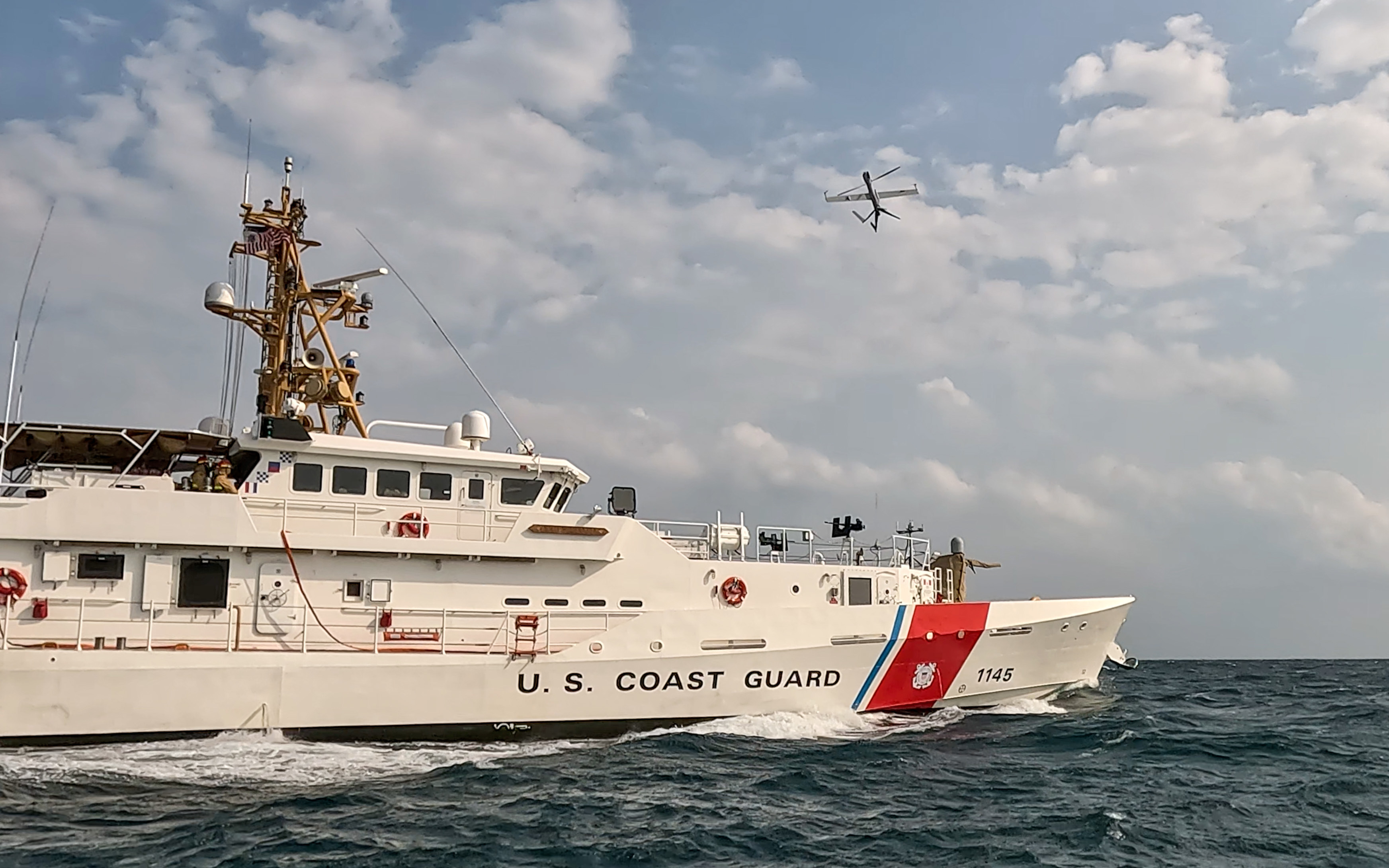
221207-N-NO146-1001 ARABIAN GULF (Dec. 7, 2022) An Aerovel Flexrotor unmanned aerial vehicle (UAV) takes off from U.S. Coast Guard fast response cutter USCGC Emlen Tunnell (WPC 1145) transiting the Arabian Gulf, Dec. 7. U.S. 5th Fleet’s Task Force 59 launched the UAV during Digital Horizon, a three-week event focused on integrating new unmanned and artificial intelligence platforms, including 10 that are in the region for the first time. (U.S. Navy photo)

Related:

“Coast Guard to Triple Western-Pacific Deployments, Policy Chief Says” –Defense One

Defense One has an interview with Rear Adm. Michael Ryan, the Coast Guard’s deputy commandant for operations policy and capabilities.

The reference to tripling Western-Pacific Deployments seems to reflect the planned deployment of three National Security Cutters to the Western Pacific in 2023, but that is not explicitly stated and there is also reference to homeporting a WMEC in the Western Pacific, topics we discussed here.

Most of the interview is really about connectivity, data collection, and analysis. Hopefully we will see some data used for a new Fleet Mix Study, that will determine our needs and be able to justify them to Congress.

It was interesting to me that the interview was a result of Admiral Ryan’s attendance at the National Defense Industrial Association’s Expeditionary Warfare conference in Arlington, Va.

“Sea Machines and USCG partner on computer vision domain awareness” –Marine Link

Photo from Sea Machines website, https://sea-machines.com/ai-ris/

Marine Link reports that a 270 foot WMEC has been fitted with an artificial intelligence recognition and identification system (AI-ris) computer vision product by Sea Machines.

AI-ris uses artificial intelligence to identify and track visual targets of interest. Installation on the cutter was made possible under an ongoing Cooperative Research and Development Agreement (CRADA) between Sea Machines Robotics and the USCG Research and Development Center in an effort to evaluate how computer vision systems can be utilized for autonomous navigation, collision avoidance, and target detection. The deployment of AI-ris provides the USCG a new tool for maritime domain awareness and allows Sea Machines to refine its computer vision technology with feedback from the USCG across a range of environmental conditions and operational scenarios.”

No idea why the report did not name the cutter that got the system. Even the photo that accompanied the report has no hull number.

Sea Machines and the Coast Guard Research and Development Center (RDC) do have some history, having used their SM300 Autonomous Command & Control system.

“USCG selects KVH for new 5-year small cutter satcom connectivity contract” –Marine Log

“Coast Guard Cutter John F. McCormick (WPC 1121) crew transits through the San Francisco Bay, Saturday, March 4, 2017, during their voyage to homeport in Ketchikan, Alaska. The cutter was named after McCormick who received the Gold Lifesaving Medal in 1938 for his exceptional skill in maintaining control of the 52-foot motor lifeboat Triumph while responding to a vessel in need near the Columbia River Bar under treacherous conditions, allowing the crew to recover a crewmember that had been washed overseas. Coast Guard photo by Petty Officer 2nd Class Loumania Stewart”

Marine Log reports,

Middletown, R.I., KVH Industries, Inc., (Nasdaq: KVHI), has been awarded a U.S. Coast Guard contract worth a potential $69 million that will see it supply the next-generation satellite communications solution for the service’s small cutter fleet of more than 140 vessels/platforms. Chosen in a full and open competitive procurement process, KVH’s TracPhone V7-HTS Ku-band satellite communications system and mini-VSAT broadband service will be the U.S. Coast Guard’s Small Cutter Connectivity (SCC) Ku-band System and Airtime Support Services solution. The USCG also anticipates that approximately 20 new cutters will join the small cutter fleet over the next five years, requiring the same level of support that KVH will provide to the already deployed vessels.

I presume the additional “approximately 20 new cutters” are the remaining Webber class Fast Response Cutters.

“Coordinating combat exercise operations from the inside of the cutter” –MyCG

MyCG has a story about the experience of personnel manning USCGC Bear’s CIC during Operation Nanook. There were some statements that surprised me.

“There were a lot of ways we were pushed as a team within the operations department,” he explained. “For me, I think it was getting acclimated with being on a cutter after being an ‘OS’ at a sector for most of my career. Being underway was really uncharted territory for me, no pun intended. Communications, especially the use of tactical signals to pass important information from ship-to-ship, was completely new to me with nearly 17 years of experience. But I would gladly do it again if I had the chance.”

How is it that we have an OS1, 17 years in the service, and he has never been afloat before?

Learning tactical signals, or TACSIGS, Gordon refers to was no small feat either. TACSIGS are a lost form of communication the Coast Guard no longer teaches. Only as a result of CIC’s collective brain power was Bear able to engage in close-quarter maneuvering with other ships in the convoy— often times, only at moment’s notice.

I know cutters seldom work with other warships, but it is a basic skill required of a CIC. Screwing up tactical signal will at least embarrass the ship, at worse the ship may be run over by an aircraft carrier–it has happened more than once.

And then there was this,

The unreliable internet capabilities to carry out critical tasking also challenged the crew.

You are depending on internet to coordinate operations? You can’t expect that to work when you need it most, and where is EMCON?

Sounds like the OS rating has proven so useful, and so many of the OS billets are now ashore, that the rating’s skill set has drifted away from those required afloat. Sounds like we have a problem. Maybe we need to split the rating? Create an OS like rating for those that serve exclusively ashore? Or else a special school to bring OSs going afloat up to speed?

“Coast Guard modifies offshore patrol cutter contract to complete installation of the combat and radar systems” -CG-9

OPC “Placemat”

Below is a post from the  Acquisitions Directorate (CG-9). I had never heard of the “Athena combat weapons system” so “Googled” it. The most common thing that came up was an Army laser weapons program. I don’t really think that is what they talking about, but I could be wrong. The post does call it a “weapons system.” I think it may be the Leonardo ATHENA® (Architecture & Technologies Handling Electronic Naval Applications) Combat Management System (CMS). Leonardo’s web page on the system indicates it is the CMS used on the FREMM frigate which is the parent craft for new USN FFG. Maybe the Navy liked the CMS as much as they liked the ship.

The CMS on the Bertholf class cutters is an Aegis based system. I have not heard anything about its application to the offshore patrol cutter (OPC).

Late Addition: Got this, thanks to Timothy H,

AEGIS Athena Baseline 9G
May be an image of text
That is good news, since it means there will be commonality between the systems on the NSCs and the OPCs.

The Coast Guard modified its current contract with Eastern Shipbuilding Group (ESG) May 20 so installation of the Athena combat weapons system and multi-mode radar system will be completed during the production phase of the offshore patrol cutter (OPC). The Athena system, radar and armament of the OPC are provided to the Coast Guard as Navy type-Navy owned government furnished equipment.

Prior to this modification, installation of both systems was to occur after contract delivery while each cutter was in its homeport. The Navy has completed development, integration and testing of the Athena and radar systems, enabling the Coast Guard to shift to production-phase installation. Performing this work prior to delivery reduces the technical risks associated with post-delivery installation and delivers mission-ready OPCs to the fleet as soon as possible.

The first four OPCs are currently in production at ESG’’s shipyard in Panama City, Florida.

The OPC meets the service’s need for cutters capable of deploying independently or as part of a larger task force and is essential to stopping smugglers at sea, rescuing mariners, enforcing fisheries laws, responding to disasters, interdicting undocumented individuals and protecting the nation. The acquisition of 25 OPCs will complement the capabilities of the service’s national security cutters and fast response cutters as an essential element of the Department of Homeland Security’s layered maritime security strategy.

For more information: Offshore Patrol Cutter Program page