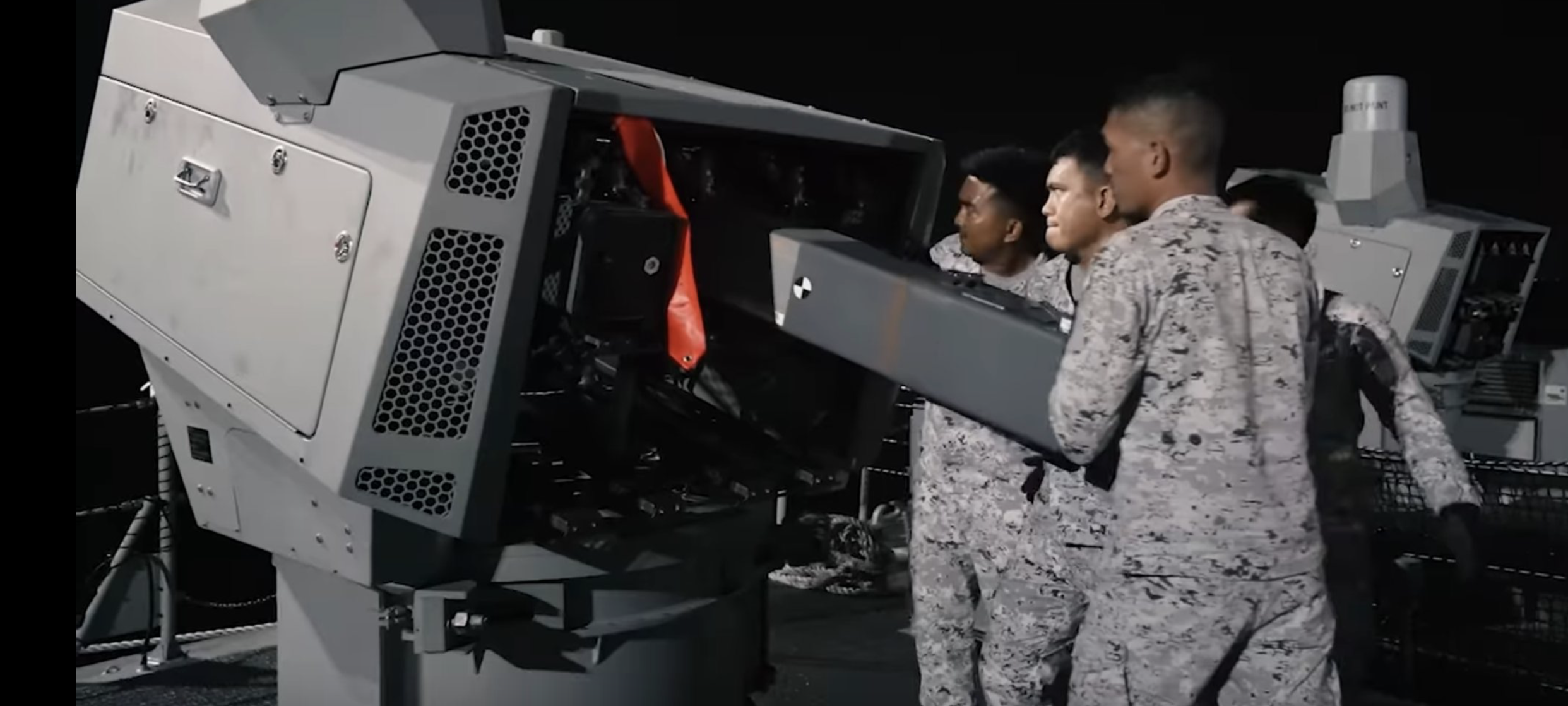
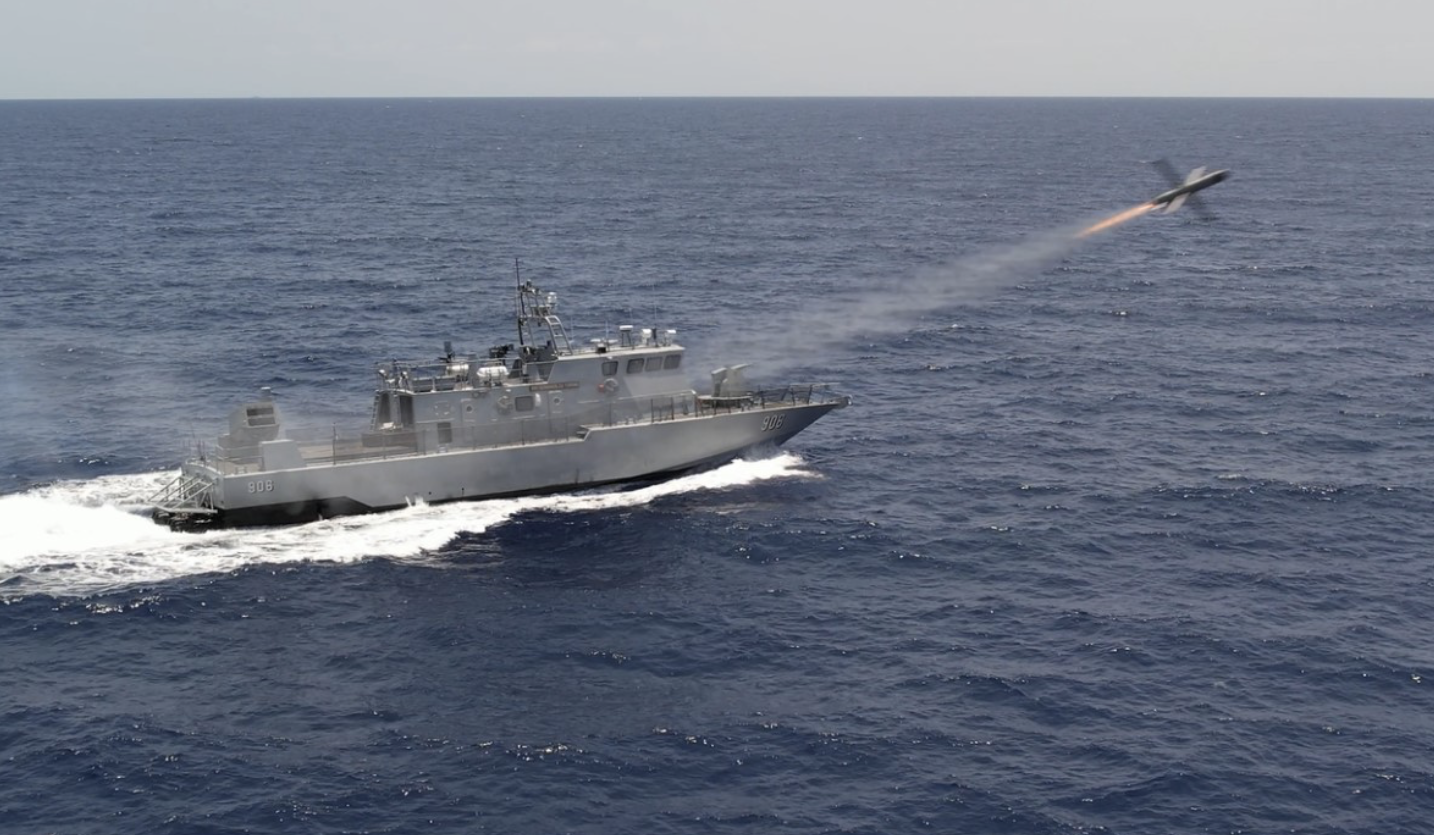
A FaceBook friend alerted me to photos and the video above of an exercise launch of Spike NLOS missiles from a Philippine Acero class Fast Attack Craft (FAC), a version of the Israeli Shaldag V.
There was a discussion of Spike NLOS in earlier post. That post showed two smaller four round launchers fitted to an 11.9 meter craft.
The missile never leaves its shipping container until it is launched.
“Spike NLOS is delivered as a ‘wooden roound’ enabling long shelf life, low maintenance, and low life-cycle cost.”
TYPHOON MLS NLOS has an eight cell Spike NLOS missile launcher and integrated Toplite stabilized observation and target acquisition system (same as on the Mk38 mod2 and mod3). Photo: RAFAEL via defense-update.com
Philippine Navy Acero class patrol boat launches Rafael Spike NLOS. The vessel features a Rafael Typhoon MLS-NLOS missile launcher capable of carrying 8 Spike-NLOS surface-to-surface missiles (limited to 4 ships only). Additionally, it is armed with one Mk.44 Bushmaster II autocannon mounted on a Rafael Typhoon Mk 30-C remote-controlled weapon station, two M2HB Browning 12.7 mm/50-cal. heavy machine guns mounted on Rafael Mini Typhoon remote-controlled weapon stations, and two M60 7.62 mm/30-cal. GP machine guns.
It is too early to say where these changes will take the Coast Guard, but both the acting Commandant and the Senior Advisor to the Secretary for the Coast Guard (SASCG) Mr. Sean Plankey, are Coast Guard Academy graduates (class of 1987 and 2003). Both seem to be firmly grounded in the military nature of the Coast Guard. Both have spent a lot of time in close contact with DOD.
“Force Design 2028 is the way we will become a more agile, capable, and responsive fighting force(emphasis applied–Chuck) to best serve the American people,” ADM Lunday said.
Some of the steps outlined in Force Design 2028 appear specifically intended to move the Coast Guard closer to DOD.
–Align with the DoD’s “Rapid Force-Wide Review of Military Standards” for physical fitness, body composition, and grooming standards. We’ll follow DoD standards to the maximum extent possible and build processes that are necessary to ensure total force readiness.
–Increase Coast Guard engagement with the Defense Innovation Unit (DIU) to accelerate technology and capability acquisition and adoption by leveraging leading edge disruptive technology development in the private sector. This includes increasing our footprint at DIU and maximizing the number of training allowance billets available at the DIU Immersive Commercial Acquisition Program.
I certainly see a need for more attention to the Coast Guard’s Defense Readiness Mission and to Ports, Waterways, and Coastal Security.
My impression is that the Coast Guard will be increasingly focused on protecting the Maritime Transportation System, particularly in cyberspace.
April 3, 2025
Coast Guard Force Design 2028
By MyCG Staff
Acting Commandant Kevin E. Lunday recently announced Force Design 2028 (FD 2028). Directed by Department of Homeland Security Secretary Kristi Noem and led by the Senior Advisor to the Secretary for the Coast Guard (SASCG) Mr. Sean Plankey, FD 2028 is creating a blueprint to ensure the Service is ready for the future and the Nation’s demands.
“Force Design 2028 is the way we will become a more agile, capable, and responsive fighting force to best serve the American people,” ADM Lunday said.
FD 2028 is focused on four campaigns:
People
Organization
Acquisition and Contracting
Technology
Here are some details about each campaign, including some of the first steps already underway. Additional details can be found in ALCOAST 155/25.
People
We are building the Coast Guard’s future force, starting today. Increased national demand for our Coast Guard requires a larger, more capable military workforce. This campaign will improve training systems, boost access to medical care, and modernize both the Coast Guard Reserve and the civilian management system.
Early actions:
Align with the DoD’s “Rapid Force-Wide Review of Military Standards” for physical fitness, body composition, and grooming standards. We’ll follow DoD standards to the maximum extent possible and build processes that are necessary to ensure total force readiness.
Starting in Promotion Year 2026, best qualified selection boards will be required to employ in-zone reordering to the maximum authorized by law to reorder those officers of particular merit for promotion.
Remove administrative burdens on our members by reducing reporting and other requirements that are redundant and of little value. (See ALCOAST 145/25 for details.)
Restore maximum Commander and Officer-in-Charge discretion and flexibility in their use of non-judicial punishment (NJP) under Article 15 of the Uniform Code of Military Justice (UCMJ). This change is consistent with the ultimate responsibility entrusted to commanders to maintain good order and discipline at their units.
Organization
As global security threats, technological advancements, and operational demands continue to evolve, the Coast Guard must adapt its organizational construct and internal decision making and governance processes to remain relevant, effective, and responsive.
Early actions:
Delegate operational authorities to the appropriate level of command to increase mission effectiveness and reduce risk to Coast Guard personnel. The recent delegation of non-compliant vessel use of force authorities to pursuit coxswains and cutter commanding officers is one example that empowers those at the tactical edge with the authorities, capabilities, and effective command and control needed to deliver operational results.
Establish a USCG HQ Director of Staff, reporting to the Vice Commandant, who is responsible for streamlining executive decision-making, enhancing agility and integration, aligning strategic messaging, and optimizing HQ processes.
Restructure the Deputy for Personnel Readiness (DPR) enterprise to optimize support for our most valuable resource-our people. This transformation establishes a comprehensive, people-centric approach across four business lines: accessions and training, total workforce management, workforce and family services, and healthcare delivery. We will separate policy/program management from service delivery to best meet the needs of our people.
Restructure the Deputy for Materiel Readiness (DMR) enterprise to focus on a systems approach to assets, ensuring the Coast Guard has the right capabilities, in the right place, at the right time. This transformation includes creating new business lines to oversee the total lifecycle management of our surface, air, C5I, and shore infrastructure, and integrating acquisition and sustainment functions for greater efficiency and effectiveness.
Establish the Assistant Commandant for Operational Integration and Response Policy (CG-3/5R) to align operational integration and planning at the Service level to increase decision-making speed and resource allocation to our operational commanders and advance national level planning and preparedness while increasing situational awareness for the Secretary, Department, Joint Staff, and Interagency partners.
Acquisitions and Contracting
Develop a high velocity acquisition and contracting system to rapidly deliver the assets the Service needs to fulfill its commitment to the American people.
Early actions:
Eliminate or minimize bureaucratic delays to delivering the assets the Service needs. An example is the recent elevation the Simplified Acquisition Procedures and micro- purchase limits to the maximum extent allowed by law and regulation, ensuring rapid distribution of goods and services to the field units charged with carrying out our front-line missions.
Increase Coast Guard engagement with the Defense Innovation Unit (DIU) to accelerate technology and capability acquisition and adoption by leveraging leading edge disruptive technology development in the private sector. This includes increasing our footprint at DIU and maximizing the number of training allowance billets available at the DIU Immersive Commercial Acquisition Program.
Improve the speed of contracting and procurement by empowering our contracting professionals in the field, reducing redundant and sequential approval and review process that add unwarranted mission risk.
Provide improved transparency and accountability in the contracting process through development of a quick-to-field contract tracking system and establish clear metrics and targets that consider mission impact.
Technology
The Coast Guard will accelerate the adoption of secure, state-of-the-market technologies to enhance data sharing, situational awareness, and operational effectiveness.
Early actions:
Leverage efficient industry solutions to dramatically accelerate the Authority To Operate (ATO) process for Information Technology systems and achieve the goal of ATOs in 30 days. This will begin with the Software Factory and minimize bureaucratic delays to deliver essential capabilities required for Coast Guard mission success.
Establish data teams in each mission domain to make sure we’re fully leveraging data to improve operations.
Establish a Rapid Response Rapid Prototype Team to transform how we deliver mission-critical technology solutions. This effort will span operations, engineering, acquisitions, finance, information technology, logistics, data science, and change management/integration – delivering proven innovation where it matters most.
How we will stay on course
An FD 2028 implementation team comprised of permanently assigned military and civilian personnel is being established and will report to the new Director of Staff. The team will coordinate a Coast Guard wide effort to implement the Secretary’s intent on FD28 as well as continue the actions already started.
“We are executing transformational change to renew the Coast Guard,” said ADM Lunday. “Force Design 2028 will ensure the Coast Guard remains Semper Paratus, Always Ready, to serve the American people.”
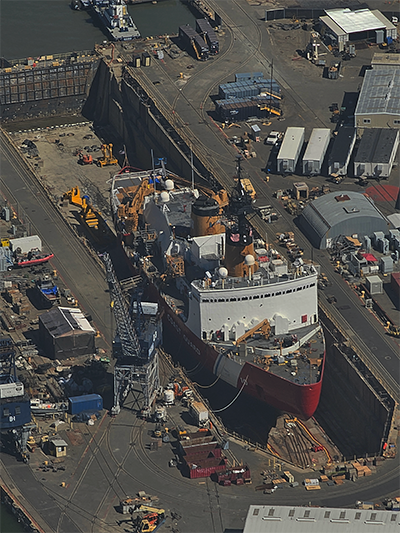
Polar Star at Mare Island Dry Dock LLC undergoing the fourth phase of its five-year Service Life Extension Project. U.S. Coast Guard photo by Cmdr. Jeremy Courtade.
“A multi-billion shortfall in operation and maintenance coffers is hampering US Coast Guard operations with a steep cliff looming on the horizon, according to Commandant Adm. Linda Fagan…The four-star admiral estimated that her service funding really needs to grow from $13 billion up towards the $20 billion range, and that right now it could “ingest” $3 billion for operation and maintenance accounts to keep helicopters in the air and vessels mission ready. That additional $3 billion, Fagan added, could be used to shore up infrastructure, buy additional parts, maintenance, and for command, control, communication, computer, cyber and intelligence (C5I) initiatives.”
The Commandant says dry dockings are being deferred and parts and equipment has to be passed from cutter to cutter to allow them to deploy with full capability.
Swapping equipment puts an additional load on the crews. Being Semper Paratus cost money.
Good to see the Commandant being forthright about the problems, rather than trying to pretend the Coast Guard does not need additional funding to meet the ever-increasing demands.
Being a credible, essential part of the defense establishment by having clearly defined roles in a potential future conflict with China and/or Russia would help to justify additional cost and heightened readiness.
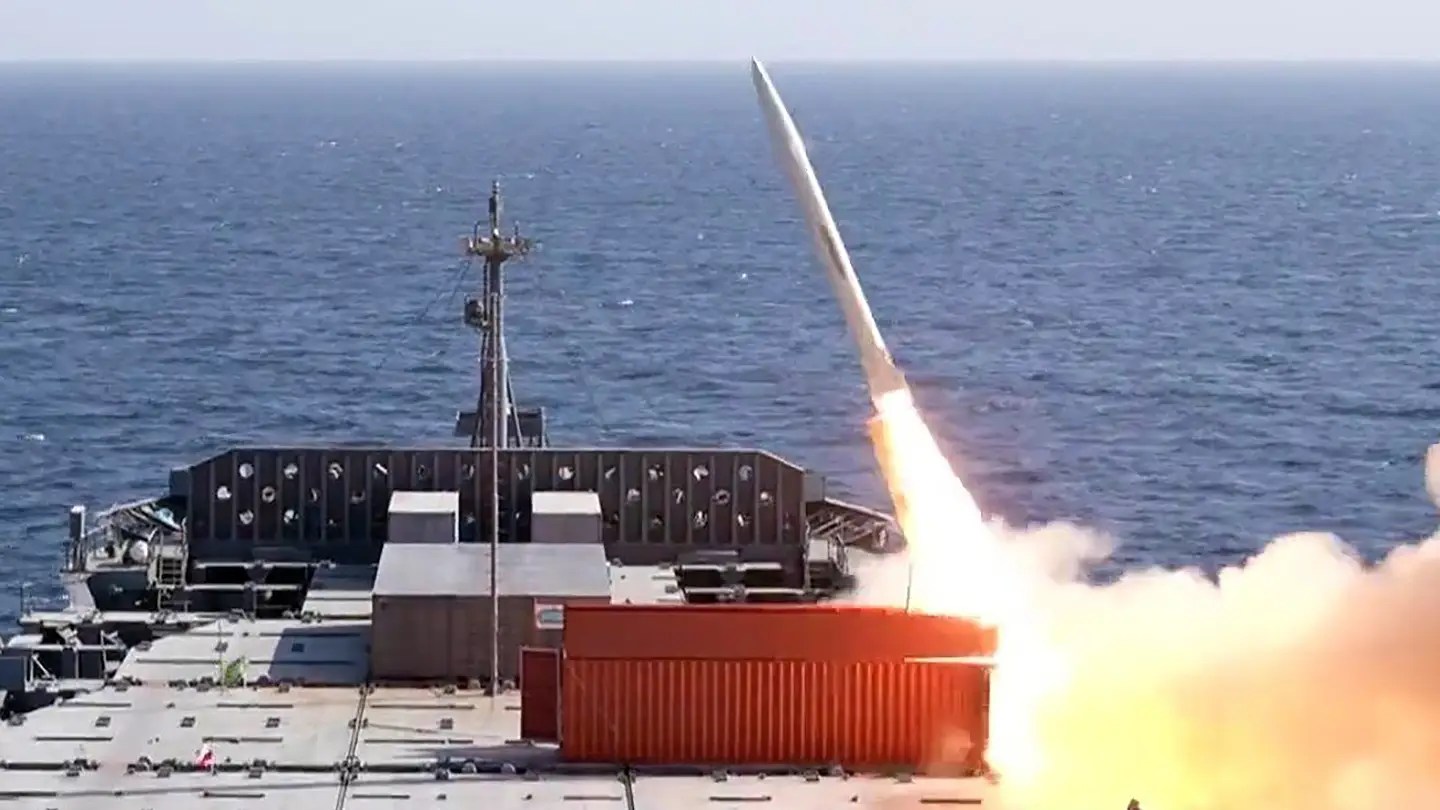
The country’s IRGC-linked Tasnim News Agency reports that two “Fateh class” ballistic missiles were recently launched from Shahid Mahdavi, which the Iranian Navy took delivery of in March 2023 after it was converted from a state-owned and operated container ship known as the Sarvin. Iranian State Media
Iran’s Islamic Revolution Guards Corps (IRGC) has fired two ballistic missiles from launchers disguised as standard shipping containers that were hosted aboard one of its sea base-like vessels. This particular combination, which has not been seen to date, greatly expands the reach with which those weapons could be used to strike potential targets by surprise, especially given that shipping containers can be embarked on any vessel that has the space to accommodate them.
Iran’s liberal transfer of technology to proxies and the inherent deniability of containerized missile systems aboard nondescript vessels opens a number of unpleasant possibilities.
Launching from the sea complicates defenses because it means new potential threat axes.
This potentially threatens the US as well as our allies. Defenses designed to intercept ICBMs don’t necessarily work against shorter ranged ballistic missiles or cruise missiles. Those destroyers intercepting ballistic missiles over the Red Sea are not patrolling off the US coast ready to intercept missiles aimed at US cities.
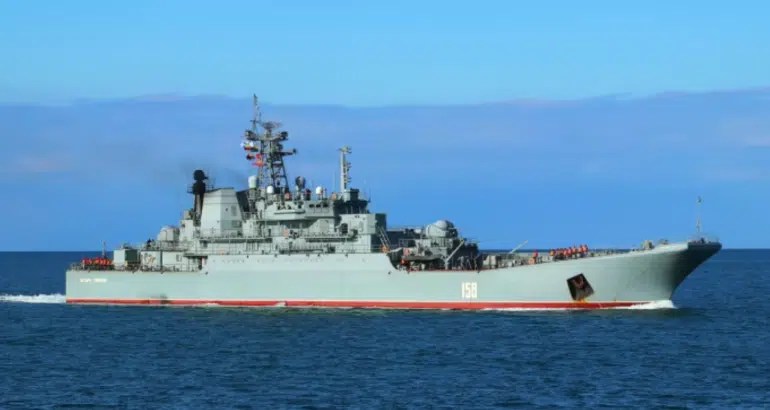
“Ukraine has claimed the destruction of another warship of the Russian Black Sea Fleet, the Ropucha class landing ship Cesar Kunikov (also written as Tsezar Kunikov) being the latest victim of explosives-laden naval drones off the coast of Crimea. Ukrainian officials claim that the landing ship was sunk in the overnight attack and available imagery shows the vessel capsized.”
I applaud what the Ukrainians are doing, but the Coast Guard needs to anticipate that we might someday be on the receiving end of this sort of attack. What are the Russians doing and could we do better?
So far, the Russian Black Sea Fleet has reportedly lost 24 surface units and a submarine to various forms of attack. But let’s look specifically at landing ships in the Black Sea which the Russians are using to transport supplies and reinforcements to Crimea.
Ropucha-I class landing ship Caesar Kunikov (Russian MoD photo)
Russia has been able to add some small combatants to the Black Sea Fleet using its River systems, but they are unable to add large ships, including landing ships because Turkey has closed access to the Black Sea by warships from the Mediterranean, so Russia cannot expect reinforcements. Apparently anticipating closure of the Dardanelles, the Russian Navy moved six additional landing ships into the Black Sea. Wikipedia reports,
In February 2022, prior to the full-scale Russian invasion of Ukraine, the landing ships Korolev, Minsk, Kaliningrad, Pyotr Morgunov, Georgy Pobedonosets, and Olenegorsky Gornyak from the Baltic Fleet and Northern fleets departed their bases and passed through the Dardanelles Strait for claimed Military exercise in the Black Sea.
In addition, a Ukrainian ship of this type was added to the Russian Black Sea Fleet when Russia occupied Crimea, but that ship is reportedly inactive. The Russians are apparently having difficulty maintaining these approximately 40 year old ships.
“According to Ukrainian Navy spokesperson Dmytro Pletenchuk, the Black Sea Fleet now has only fiveRopucha class ships remaining in service out of a previous total of 13 (additional units were transferred from the Baltic and Northern Fleets ahead of the full-scale invasion of Ukraine).” –This may refer to all types of LSTs, not just Rapucha class. They also lost a Tapir class LST.–Chuck
Ship Self-Defense:
Looking at this video, I could not help but think that the Ukrainians would have had a harder time if the Russian ship had enforced darken ship. At the very least the attackers might have had less time to coordinate their attack. The attacks are clearly made at night using electro optics, and a lighted target helps them. All that lighting also degrades the night vision of lookouts that might otherwise recognize that an attack is underway.
The Russian LST was well armed. The Rapucha class ship reported sunk, had two twin 57mm guns with a 200 round per minute rate of fire, so, theoretically, about four times the firepower provided by an NSC or OPC’s 57mm Mk110. You might think these would be effective against unmanned surface vessels, but I have yet to see any evidence in any of the videos of main gun systems being used against such attacks. They always seem to be pointed on the centerline.
It seems that in successful attacks, the target is late in recognizing it is under attack. I have to wonder if their weapons and sensors were manned and ready? Were lookouts posted? Were lookouts equipped with night vision devices?
Apparently, the attack occurred near the end of its voyage from Novorossiysk to Sevastopol. The ship was close enough to Sevastopol that smoke from wreck was visible on shore.
If you are intending to intercept a ship that may use evasive courses. The most logical place to intercept it would be near the known starting and ending points and in this case the ending point would have been an easier place to stage an ambush. It would also be the easiest place to provide protective units.
In an earlier attack, we saw the attacking USVs engaged by a helicopter. In this case, there seems to have been no overwatch.
Small boat escorts might help, even if all they did was provide eyes and ears away from the light and noise of the target vessel that could recognize the threat.
It would of course be critical that they escorting vessels not be fired upon by the targeted vessel, so recognition signal lights would probably be appropriate.
Pairs of boats ahead and on either side of the escorted vessel could alternately sprint and drift so as to minimize noise.
I would estimate escorting boats would want to patrol about 4,000 yards from the escorted vessel, but this is something that could be tested using watercraft with similar characteristics to the kamikaze USVs.
If armed with machine guns, escorting boats could attempt to engage the threats. If using tracer ammunition, even if unable to destroy the threat, they would be pointing out the threat to the target ship.
In many of these videos, it appears that the first hit which immobilizes the target occurs with USV in a pursuit curve coming up the stern of the vessel. An escorting boat in the wake of target vessel would be in a good position to prevent that first immobilizing hit.
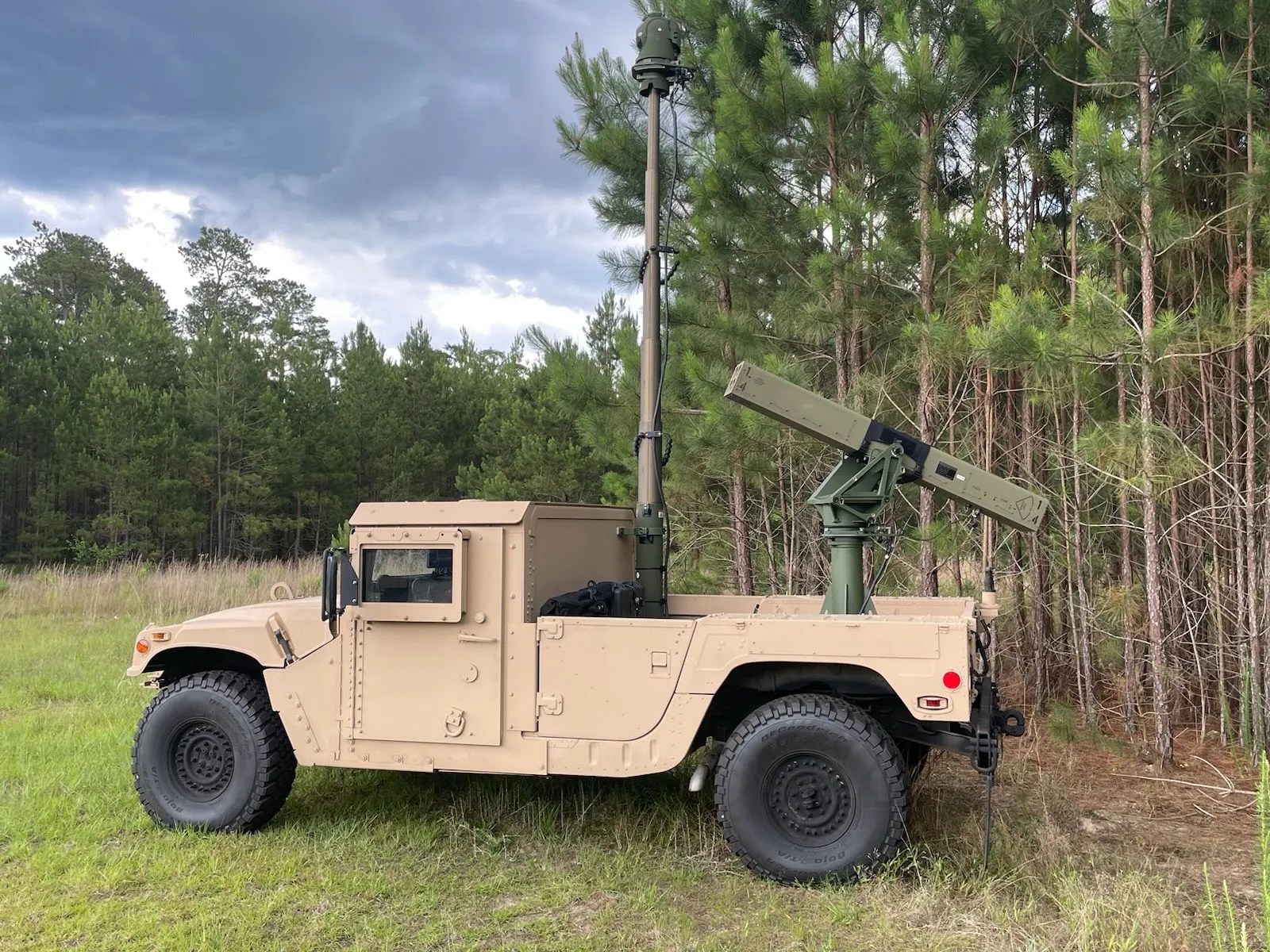
The Ukrainian Navy’s press service recently released footage showcasing the combat effectiveness of their air defense units, marking the confirmed debut of a new Counter-Unmanned Air System (UAS) weapon system developed by L3Harris for Ukraine.
The video captured the moment when a Russian kamikaze drone, identified as the Shahed-136, was successfully shot down by an Advanced Precision Kill Weapon System (APKWS) laser-guided rocket launched from the Vampire weapon system.
It is probably less maintenance intensive than a .50 caliber machine gun.
It has a very small footprint and light weight.
Because it is a precision weapon, it minimizes the probability of collateral damage.
It is a proven counter Unmanned Air System.
It can employ a variety of warheads for different purposes including air burst with the M429 proximity fuse. It has even been tested successfully against cruise missiles.
It is effective against small, fast, highly maneuverable surface threats.
It has an effective range greater than that of our M38 gun mounts and a similar effective range to that of the 57mm and 76m guns.
While I would not count on its ability to stop medium to large ships, it can inflict damage at effective ranges beyond that of most weapons a terrorist organization might equip a vessel with. It is likely to be a lot more effective against small ships than the Mk38.
And it is cheap.
Without much additional effort, it could make Coast Guard assets much more capable in the Ports, Waterways & Coastal Security and Defense Readiness missions.
The U.S. Coast Guard Cutter Forward (WMEC 911) steams near an iceberg in the Atlantic Ocean, Aug. 22, 2023. Forward deployed in support of Op Nanook, an annual Canadian-led exercise that offers an opportunity to work with partners to advance shared maritime objectives. (U.S. Coast Guard photo by Petty Officer 3rd Class Mikaela McGee)
The US Naval Institute’s Fleet and Marine Tracker again reports three Navy ships are operating under 4th Fleet. This has been the case since the end of the UNITAS exercise. We will have to wait to see if this higher level of activity becomes a new norm.
As for Coast Guard activity, they note PATFORSWA in the Mid East, USCGC Healy (WAGB-20) in the Beaufort Sea, USCGC Forward (WMEC-911) participation in Operation Nanook, and, “Legend-class National Security Cutter USCGC Munro (WMSL-755) is in the South China Sea and is conducting joint training with the Malaysian Maritime Enforcement Agency (MMEA).”
There is good coverage of Coast Guard out of area operations. USNI is publishing what information they get from the Coast Guard, but apparently the Coast Guard does not provide anything comparable to the statistical information the Navy provides (as in the example below), so there is no information about routine Coast Guard operational tempo.
Ships Underway
Total Battle Force
Deployed
Underway
297
(USS 238, USNS 59)
100
(USS 67, USNS 33)
67
(39 Deployed, 28 Local)
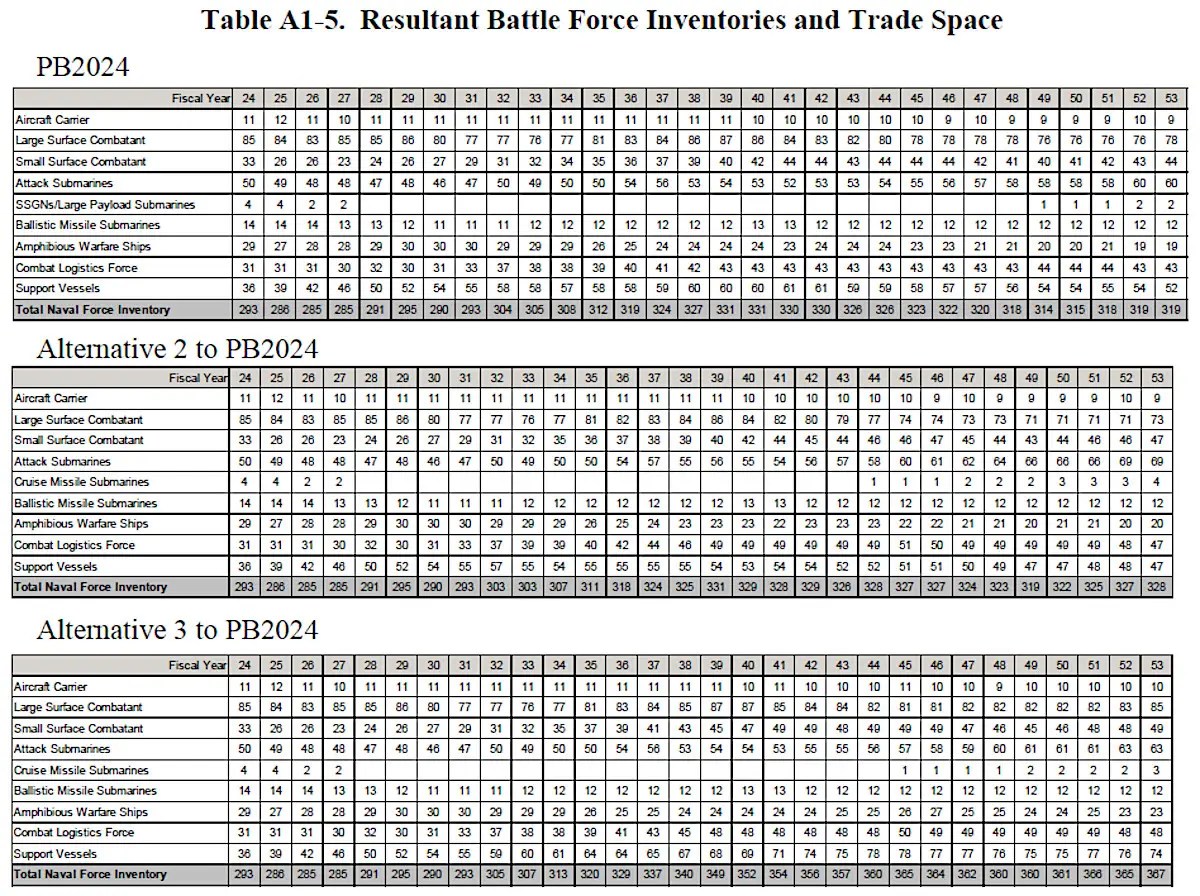
Unfortunately, the Coast Guard frequently lacks visibility (particularly the larger cutters and fixed wing aircraft) because despite being an important component of the “National Fleet,” it is not included in the “Total Battle Force.” It could be argued that the battle force number is not very instructive because it includes everything from aircraft carriers to fleet tugs and research ships, but people, including people in Congress take the number seriously. They talk about it a lot.
The investment in high quality platforms that make the Coast Guard so effective in its peacetime missions is only fully justified by the fact that the Coast Guard serves as a naval auxiliary in wartime.
We cannot allow people to forget that the Coast Guard has wartime roles that justify additional investment in capabilities that might not be otherwise justified.
A revision to the statistical presentation, like the example above, that included Coast Guard major units, would demonstrate that Coast Guard units are underway at a relatively high rate. It would show that the government is getting what it paid for.
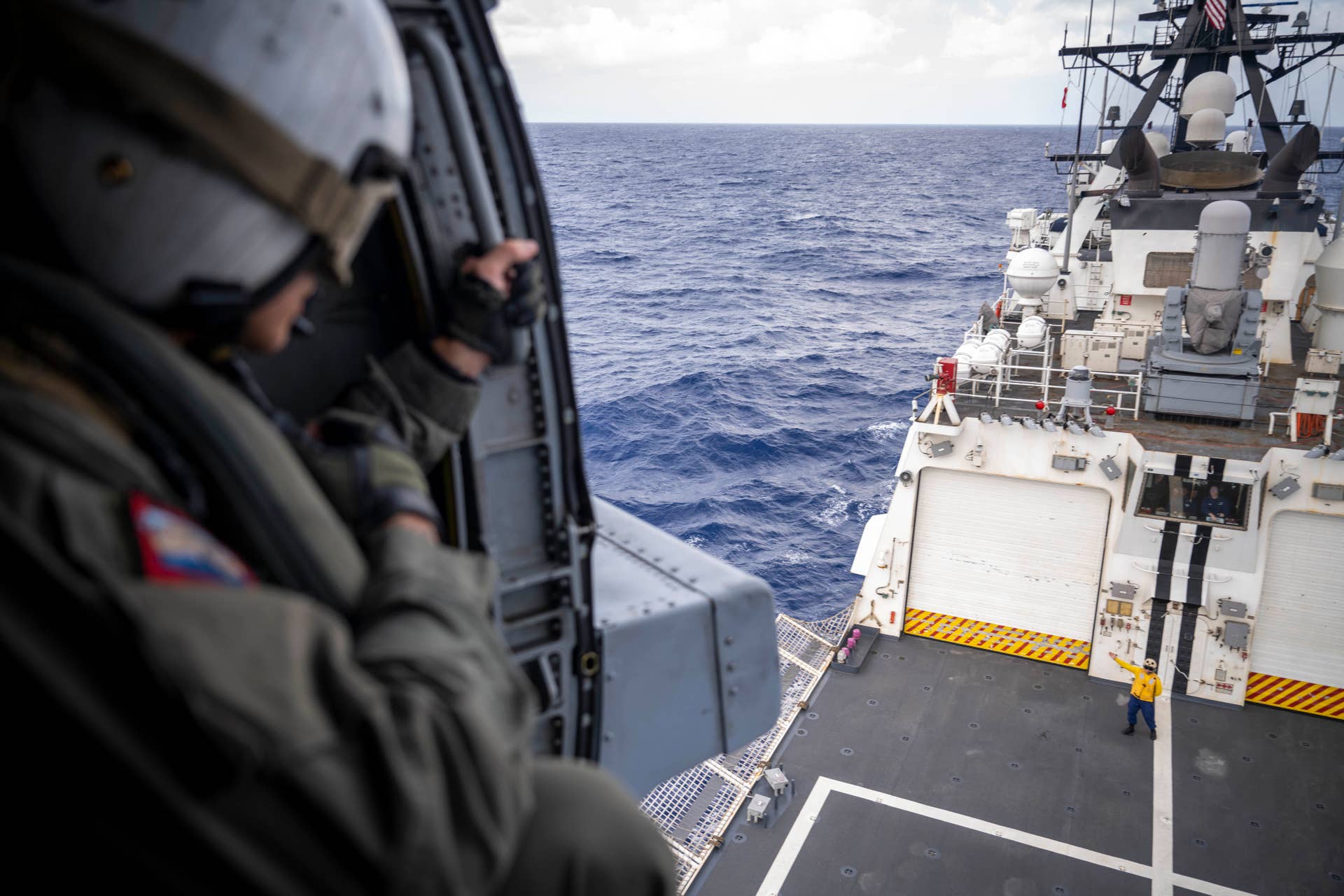
PACIFIC OCEAN (July 30, 2022) U.S. Navy Petty Officer 1st Class Humberto Alba, a naval aircrewman tactical-helicopter, attached to Helicopter Maritime Strike Squadron (HSM) 37, deployed on U.S. Coast Guard Legend-class cutter USCGC Midgett (WMSL 757), looks down at a USCGC crewmember after taking off during flight operations during Rim of the Pacific (RIMPAC) 2022. (U.S. Coast Guard photo by Petty Officer 3rd Class Taylor Bacon)
This essay from the July 2023 issue of Proceedings, is featured on the US Naval Institute Proceedings web site. It won Second Prize in the Midshipmen & Cadets Essay Contest—Sponsored by the U.S. Naval Institute.
This is just one of many such articles that have been published repeatedly over the years. The logic is clear,
If more heavily armed, Coast Guard cutters could better support the Navy and enhance defense readiness.
At small marginal cost, cutters could make a significant contribution to our nation’s naval strength, but it has not happened in the last 30+ years. Why not?
It seems the Leadership of both the Navy and Coast Guard have other priorities, and there is no sponsor in a position of power to push the program.
The Navy is in trouble. The Navy has been shrinking over most of the last 34 years, from down from 592 Sept. 30, 1989, to 299 as of this week. It began with the collapse of the Soviet Union. I’m sure it seemed like good idea at the time, but the “peace dividend” meant there was not much reason to build new ships. Teams that had developed a long string of successful ship designs ceased to exist. Shipyards closed. As a result, they have had difficulty fielding new classes of ships. Their new generation shipbuilding programs have been plagued with problems, while the Chinese navy has been building ships at a furious pace.
The Coast Guard has had its own troubled recapitalization program, beginning with “Deepwater” and while the NSC and FRC programs seem to have been successful, if long delayed, the Offshore Patrol Cutter and Icebreaker programs are still having significant difficulties. But perhaps more importantly, Coast Guard leadership sees the conventional model of a combat ready Coast Guard as counterproductive to other Coast Guard priorities.
Personally, I feel fears that a more heavily armed Coast Guard would not be welcome in many parts of the world is overblown, but the fear does exist and the conventional model of permanently installed weapon systems operated and maintained by Coastguardsmen would require a diversion of assets unless the budget is increased and more assets are provided. There is a cost to the Coast Guard in terms of training and maintenance time for both units and individuals, even if the Navy pays for the systems.
I think there is an alternative that would address the fears of the Coast Guard leadership and create a powerful sponsor in the Navy.
The Navy Reserve could be that sponsor. It is a reservoir of trained talent, but where do they go upon mobilization? There are only so many ships. Their crews, while they may have some shortages, are essentially at war time manning levels. There are only so many helicopter landing spots on Navy ships. Many Navy Reservists have no really appropriate place to serve upon full mobilization.
Coast Guard units can provide a place where they can be used effectively. Navy helicopters and their crews can fly from Coast Guard cutters. Modularized versions of towed array sonar systems could be operated and maintained by Navy reservists on large cutters.
Initially at least, these reinforced cutters would be best used in the board reaches of the Pacific, beyond the effective range of enemy land based and air-launched anti-ship missiles, where the primary threat would be submarines, protecting the logistics ships that are essential for prosecuting a war in the Western Pacific.
“We need to move from ‘luxury-car’ platforms—with their built-in capabilities—toward dependable ‘trucks’ that can handle a changing payload selection.”
If the Navy can provide payloads, the Coast Guard can provide some trucks.
Five white 311-foot cutters of Coast Guard Squadron Three, assigned to support Operation MARKET TIME tied up alongside Navy repair ship USS Jason (AR-8) at Naval Station Subic Bay in the Philippines, 4 August 1967. From inboard to outboard: USCGC Half Moon (WHEC-378); USCGC Yakutat (WHEC-380); USCGC Gresham (WHEC-387); USCGC Barataria (WHEC-381) and USCGC Bering Strait (WHEC-382) U.S. Coast Guard Historian’s Office. Photo by CDR Richard Morse, USCG, Commanding Officer USCGC Barataria (WHEC-381)
First that he Coast Guard has no similar long-term plans, and second,
Coast Guard assets are not considered in as part of the “Battle Force.”
A good part of the reason our ships soldier on long after they should have been replaced may be because we have not been informing the executive branch and congress about our long-term needs.
I can imagine an adverse reaction to my suggestion that cutters should be part of the “Battle Force”, but you need to understand what the Navy includes in that category. These are not all high-powered warships. Currently the US Navy “Battle Force” is 299 ships. Of those, 59 are USNS ships that are almost completely unarmed, have civilian crews, and no electronic countermeasures. They include oilers, logistics ships, expeditionary fast transports, towing salvage and rescue ships, and ocean surveillance ships. In addition, it includes some commissioned ships that are not really warships, like command ships and expeditionary base ships. The relatively small future Landing Ship Medium is expected to be included as well.
If we have a naval conflict with a major power (e.g., China) the Navy is going to need the Coast Guard’s help. Cutters will help enforce blockades, round up hostile merchant shipping and fishing vessels, rescue crews from sunken ships, play host to unmanned systems, provide harbor defense and force protection, and probably ultimately be equipped as second line warships.
Cutters count, so they should be counted.
Vessels I would include in the count would include at least all the Icebreakers, National Security Cutters, Offshore Patrol Cutters, and Medium Endurance Cutters and possibly ocean-going buoy tenders and Webber class WPCs.
Major conflict with China “is coming,” U.S. Strategic Command’s chief warns outright…Navy Admiral Charles A. Richard, has warned that the U.S. should anticipate, and prepare for, a protracted conflict with China in the near future – which could be triggered by further hostile actions toward Taiwan by Chinese forces.
I will admit, that military commanders always tend to look at the worst case scenarios. That seems to go along with the job, but Admiral Richard may know things we do not.
There are significant oportunities for development of modular weapons and sensors (and here) that could be brought aboard Cutters and operated by Navy Reserve personnel. The Coast Guard could do a lot to protect the logistics train from Chinese submarines.
In terms of nation defense, the Coast Guard is a bargain. For small marginal cost, preexisting Coast Guard platforms can be upgraded to provide significant capablity. The problem is that the upgrades may be needed early in the conflict. We may not have months or years to make changes.
And of course, the future option of upgrades has no deterrent effect.





 Chuck Hill's CG Blog