The Coast Guard Cutter Healy breaks ice around the Russian-flagged tanker Renda 250 miles south of Nome Jan. 6, 2012. The Healy is the Coast Guard’s only currently operating polar icebreaker. The vessels are transiting through ice up to five-feet thick in this area. The 370-foot tanker Renda will have to go through more than 300 miles of sea ice to get to Nome, a city of about 3,500 people on the western Alaska coastline that did not get its last pre-winter fuel delivery because of a massive storm. If the delivery of diesel fuel and unleaded gasoline is not made, the city likely will run short of fuel supplies before another barge delivery can be made in spring. (AP Photo/US Coast Guard – Petty Officer 1st Class Sara Francis) NY112
The US Naval Institute has a report on the impact of the government shutdown on the Coast Guard and other government agencies, with a close look at what it probably means for the Polar Security Cutter (icebreaker) program.
Business Insider brings us an interesting report that the Coast Guard had declined to undertake a suggested “Freedom of Navigation” transit of the Northern Sea Route because of fear the Polar Star would break down while in the ice near Russia and require Russian icebreaker assistance.
The fact that using the Polar Star in the Arctic would have probably made, making the McMurdo breakout problematic, probably also made such an exercise almost impossible. As we have seen in the last year, between dry docking and the trip South the crew spent very little time in homeport
Congress is back in session. It is likely the current Congress will attempt to complete the Department of Homeland Security (DHS) Budget before the new Congress is seated in January.
On October 11, 2018, the Senate Subcommittee on Oceans, Atmosphere, Fisheries, and Coast Guard held a public hearing entitled, “The Future of the Fleets: Coast Guard and NOAA Ship Recapitalization.” I feel I have been remiss in not talking about this earlier, but the topics are still in question and it appears all the major players in the sub-committee will be returning next year, although committee assignments may change. Despite the name of the hearing, the NOAA representative was unable to attend, so the entire hearing was about Coast Guard programs.
Unfortunately the hearing video was not posted on YouTube so I was unable to post it here. The Commerce Committee website with the video of the hearing, list of witnesses, and links to the prepared statements is here.
I’d like to call attention to the Congressional Research Service’s evaluation of the Coast Guard’s shipbuilding programs in the form of Mr. Ronald O’Rourke’s prepared testimony for the hearing. It is relatively short at 21 pages, and covers the Waterways Commerce Cutter (Inland tenders) and Polar Security Cutter (Heavy Polar Icebreaker) as well as the National Security Cutter (NSC), Offshore Patrol Cutter (OPC), and Fast Response Cutter (FRC) programs.
As he has done frequently in the past, he makes the case for procuring cutters using Block Buy or Multi-Year Procurement as the Navy has done in some of its most successful Program. I have a hard time understanding why the Coast Guard has not taken advantage of this option. We had an opportunity to do it with the NSC, another with the FRC. Now we have the option of using Block Buy for the Polar Security Cutter (heavy polar icebreaker) and Offshore Patrol Cutter (OPC). The recent Coast Guard Authorization Bill includes authorization to use Block Buy.
26:00 GAO Ms. Marie Mak Director, Contracting and National Security Acquisitions, Government Accountability Office began her prepared statement.
Mrs Mak of GAO is again saying we have not made a good business case for the new icebreaker and that our planning is short term. Pointed to the Navy 30 year shipbuilding plan as a good example of long term planning.
29:30 Mr. Ronald O’Rourke Specialist in Naval Affairs, Congressional Research Service began his prepared statement
An illustration of how useful long term planning can be is found in this quote from Mr. O’Rourke’s written submission, p.3:
“As one example of how…Congress has exercised its constitutional power to set funding levels and determine the composition of federal spending, during the period FY2008-FY2015, when the Navy’s shipbuilding account averaged about $14.7 billion per year in then-year dollars, there was recurring discussion about the challenge of increasing the account to the substantially higher annual funding levels that would soon be needed to begin implementing the Navy’s 30-year shipbuilding plan. Projections were prepared by CBO showing the decline in the size of the Navy that would occur over time if funding levels in the shipbuilding account did not increase substantially from the average level of about $14.7 billion per year. Congress, after assessing the situation, increased the shipbuilding account to $18.7 billion in FY2016, $21.2 billion in FY2017, $23.8 billion in FY2018, and $24.2 billion in FY2019. These increasing funding levels occurred even though the Budget Control Act, as amended, remained in operation during those years. At the most recent figure of $24.2 billion, the Navy’s shipbuilding account is now 74% greater in then-year dollars than it was as recently as FY2010.”
Mr. O’Rourke pointed out that using Multi-Year contracting to procure the Offshore Patrol Cutters could save us $1B, enough to pay for the Polar Security Cutter (PSC or Polar Icebreaker) or the entire Waterways Commerce Cutter program.
He discussed increasing rate of OPC procurement.
He noted that there had been a reduction in the estimated cost of the Polar Icebreaker from an initial estimate of $1B to a projected cost of $2.1B for three ships. From pages three and four of his prepared statement.
Coast Guard’s Non-Use of Multiyear Contracting
In connection with my work on ship acquisition, I maintain the CRS report on multiyear procurement (MYP) and block buy contracting. In both that report and in testimony I have given to other committees in recent years on Coast Guard ship acquisition, I have noted the stark contrast between the Navy— which uses multiyear contracting (in the form of MYP or block buy contracting) extensively to reduce its ship- and aircraft-procurement costs by billions of dollars—and the Coast Guard, which to date has never used multiyear contracting in one of its ship or aircraft acquisition programs.
The Navy in recent years, with congressional approval, has used multiyear contracting for, among other things, all three of its year-to-year shipbuilding programs—the Virginia-class attack submarine program, the DDG-51 destroyer program, and the Littoral Combat Ship (LCS) program. The Navy has been using multiyear contracting for the Virginia-class and DDG-51 programs more or less continuously since the 1990s. Savings from the use of MYP recently have, among other things, helped Congress and the Navy to convert a nine-ship buy of DDG-51 class destroyers in FY2013-FY2017 into a 10-ship buy, and a nine ship buy of Virginia-class attack submarines in FY2014-FY2018 into a 10-ship buy. The Navy is also now using block buy contracting in the John Lewis (TAO-205) class oiler program, and is considering or anticipating using them for procuring LPD-17 Flight II amphibious ships, FFG(X) frigates, and Columbia-class ballistic missile submarines. The Navy’s use or prospective use of multiyear contracting for its year-to-year shipbuilding programs is arguably now almost more of a rule than an exception in Navy shipbuilding. For Congress, granting approval for using multiyear contracting involves certain tradeoffs, particularly in connection with retaining year-to-year control of funding. In the case of Navy shipbuilding, Congress has repeatedly accepted these tradeoffs.
In contrast with Navy practice, the Coast Guard often uses contracts with options in its ship-procurement programs. Contracts with options can be referred to as multiple-year contracts, but they are not multiyear contracts. Instead, contracts with options operate more like annual contracts, and they cannot achieve the kinds of savings that are possible with multiyear contracts. Like the other military services, the Coast Guard has statutory authority to use MYP contracting and can be granted authority by Congress to use block buy contracting.
Questioning began time 33:00 I will try to summarize some of the discussion, but this is in no way complete.
Senator Sullivan
33:30 questioned how the CG could meet increasing challenges with nearly 14,000 fewer major cutter OP Hours.
RAdm Haycock says new assets are more capable. (He might have noted that FRCs are more capable than Island class and can conduct some missions previously conducted only by major cutters.) He did favorably compare FRCs with existing 110s in Alaska, but perhaps missed an opportunity to push for more assets and/or higher rate of construction.
37:30 Senator Sullivan push to use shipyard in Ketchikan.
Senator Baldwin
42:30 Why are we using predominately foreign made outboards rather than Mercury or Evinrude which are made Wisconsin?
Ans. We want to use American made products, but we also employ competition. We could create a demand signal that is not sustainable. Builders choose components, but must comply with Buy American requirements.
49:30 Senator Sullivan:
Suggestion that perhaps we could lease.
Ans. Design time has decreased as has price due to Navy assistance and use of parent design. Ship and power plant can be smaller than previously thought without loss of capability. Icebreaker will be based on Parent design. Cooperation with the Canadians. This has shortened time line and cost has come down. There are still some risks.
59:30 We have looked exhaustively at foreign designs. Our missions are very different. Our design will be based on yet unbuilt Canadian design (CCGS Diefenbaker).
1:01:30 Baldwin:
Great Lakes Icebreaker–not enough resources, push to build a Great Lakes Icebreaker at least as capable as Mackinaw, some funding provided for design of a Great Lakes icebreaker, what are we doing?
We are looking at requirements. 140s are going through service life extension.
1:04:40 More on made in American requirements.
Ans. Sometime foreign made components can be problematic over lifecycle.
1:07:00 Senator Wicker
The Senator pushing for 12th NSCs.
NSCs are having a profound impact as we push border south
1:09:00 Polar Security Cutter, what about the fact funding is not included in House budget?
Ans. Will impact scheduling and the interest of the industrial base.
1:12:00 Senator Blumenthal
Concern about opioids, what additional assets do we need?
Talked about Unmanned Air Systems but really did not specifically address opioids intel which I would assume has more to do with importation by merchant ships through our ports.
1:15:00 CG museum. Committed to location at New London.
1:16:30 Admissions at the CG Academy–concern about possible discrimination
1:17:30 Senator Baldwin
1:18:00 More on “Made in America” components
1:20:00 Specifically referenced need to buy propulsion pods for Polar Security Cutter from Scandinavia.
1:21:30 Timeline for Inland tenders? Possibility of using parent craft?
Our needs are different. Have to have more people because of our missions, we need more range, mixed gender birthing. Probably nine months to complete analysis and a year before we start to contract. In service 2023. We are moving as fast as we can.
(Was pleased to note that RAdm Haycock made a strong witness and appeared both competent and cooperative.)
I am passing this along from the Navy League. The Senate has completed their mark up of the Coast Guard Authorization, and it looks like they have indeed left off funding for the new Polar Icebreaker (Polar Security Cutter). We really should have funded these a decade ago, so any delay is at the very least unwise if not irresponsible.
Charles–
This is the week to make an impact. Our staff here at Navy League headquarters is busy asking members of Congress to support a vital mission in the Arctic, but we won’t succeed without you. Congressional staff are negotiating the details of a bill to fund the Coast Guard for Fiscal Year 2019 as we write this. The administration requested $750 million for icebreaker procurement in FY19, and the Senate included the money in its funding bill, but the House stripped it out.
Increased activity in the Arctic means we need a strong American presence. Our only operational heavy icebreaker, the Polar Star, is 42 years old, operating 12 years beyond its expected lifespan. The Polar Star reaches the end of its operational life in 2023, just as there is expected to be an increase in activity, including the opening of new shipping lanes, the presence of cruise ships, and an increase in exploring Arctic oil and gas reserves.
Our competitors, including Russia and China, are investing heavily in their own Arctic presence: Russia has over 40 icebreakers, some of which are armed. We must ensure the new Polar Security Cutter heavy icebreaker is delivered by 2023 or we risk being excluded from this important region. A Department of Homeland Security mission needs statement and Coast Guard studies have shown that the right number for secure American presence is three heavy and three medium icebreakers. We must begin building the fleet with this sensible funding request from Congress that provides enough funding for the first Polar Security Cutter and long-lead materials for the second.
Beyond America’s national security needs demanding an Arctic presence, no fewer than seven government agencies depend on the capability of American icebreakers.
The Coast Guard needs your help to secure these funds. There is significant competition within the Department of Homeland Security budget for other projects, and we need to ensure these funds are protected and fully appropriated — or risk falling even further behind our competitors!
One Team – Mission Focused
Alan Kaplan
National President
Navy League of the United States
2300 Wilson Blvd, Suite 200
Arlington, VA 22201
703-312-1571
The Coast Guard Cutter Healy breaks ice around the Russian-flagged tanker Renda 250 miles south of Nome Jan. 6, 2012. The Healy is the Coast Guard’s only currently operating polar icebreaker. The vessels are transiting through ice up to five-feet thick in this area. The 370-foot tanker Renda will have to go through more than 300 miles of sea ice to get to Nome, a city of about 3,500 people on the western Alaska coastline that did not get its last pre-winter fuel delivery because of a massive storm. If the delivery of diesel fuel and unleaded gasoline is not made, the city likely will run short of fuel supplies before another barge delivery can be made in spring. (AP Photo/US Coast Guard – Petty Officer 1st Class Sara Francis) NY112
Oct. 26, 2018 The Congressional Research Service issued an update of their research into the Coast Guard’s “Polar Security Cutter” (Polar Icebreaker) program. Summarizing the major relatively recent developments:
The likely price of three cutters is expected to be $2.1B meaning the price of the icebreaker is very close to that of the National Security Cutter.
Building a single class of more than three ships, rather than a mix of Heavy and Medium capability ships is being seriously considered. This is now more likely as it appears a ship, smaller cheaper than previously envisioned, can provide the “Heavy Icebreaker” capability.
I have provided the Summary below.
The Coast Guard Polar Security Cutter (PSC) program, previously known as the polar icebreaker (PIB) program, is a program to acquire three new heavy polar icebreakers, to be followed years from now by the acquisition of up to three new medium polar icebreakers. The Coast Guard wants to begin construction of the first new heavy polar icebreaker in FY2019 and have it enter service in 2023. The PSC program has received about $359.6 million in acquisition funding through FY2018, including $300 million provided through the Navy’s shipbuilding account and $59.6 million provided through the Coast Guard’s acquisition account. The Coast Guard’s proposed FY2019 budget requests $750 million in Coast Guard acquisition funding for the program.
The acquisition cost of a new heavy polar icebreaker had earlier been estimated informally at roughly $1 billion, but the Coast Guard and Navy now believe that three heavy polar icebreakers could be acquired for a total cost of about $2.1 billion, or an average of about $700 million per ship. The first ship will cost more than the other two because it will incorporate design costs for the class and be at the start of the production learning curve for the class. When combined with the program’s $359.6 million in prior-year funding, the $750 million requested for FY2019 would fully fund the procurement of the first new heavy polar icebreaker and partially fund the procurement of the second.
The operational U.S. polar icebreaking fleet currently consists of one heavy polar icebreaker, Polar Star, and one medium polar icebreaker, Healy. In addition to Polar Star, the Coast Guard has a second heavy polar icebreaker, Polar Sea. Polar Sea, however, suffered an engine casualty in June 2010 and has been nonoperational since then. Polar Star and Polar Sea entered service in 1976 and 1978, respectively, and are now well beyond their originally intended 30-year service lives. The Coast Guard has used Polar Sea as a source of spare parts for keeping Polar Star operational.
A Department of Homeland Security (DHS) Mission Need Statement (MNS) approved in June 2013 states that “current requirements and future projections … indicate the Coast Guard will need to expand its icebreaking capacity, potentially requiring a fleet of up to six icebreakers (3 heavy and 3 medium) to adequately meet mission demands in the high latitudes….”
The current condition of the U.S. polar icebreaker fleet, the DHS MNS, and concerns among some observers about whether the United States is adequately investing in capabilities to carry out its responsibilities and defend its interests in the Arctic, have focused policymaker attention on the question of whether and when to acquire one or more new heavy polar icebreakers as replacements for Polar Star and Polar Sea.
On March 2, 2018, the U.S. Navy, in collaboration with the U.S. Coast Guard under the polar icebreaker integrated program office, released a request for proposal (RFP) for the advance procurement and detail design for the Coast Guard’s heavy polar icebreaker, with options for detail design and construction for up to three heavy polar icebreakers.
Issues for Congress for FY2019 for the polar icebreaker program include, inter alia, whether to approve, reject, or modify the Coast Guard’s FY2019 acquisition funding request; whether to use a contract with options or a block buy contract to acquire the ships; whether to continue providing at least some of the acquisition funding for the PSC program through the Navy’s shipbuilding account; and whether to procure heavy and medium polar icebreakers to a common basic design.
120 MW (160,923 HP) (More than twice that of the Polar Star)
Power will be provided by four props on conventional shafts.
They are planning to build three. It is claimed they will be able to break ice 4.3 meters thick and be able to continuously break two meter ice while making 11 knots. They are expected to cost 70B rubles, or about $1.04B US.
The Coast Guard Cutter Healy breaks ice around the Russian-flagged tanker Renda 250 miles south of Nome Jan. 6, 2012. The Healy is the Coast Guard’s only currently operating polar icebreaker. The vessels are transiting through ice up to five-feet thick in this area. The 370-foot tanker Renda will have to go through more than 300 miles of sea ice to get to Nome, a city of about 3,500 people on the western Alaska coastline that did not get its last pre-winter fuel delivery because of a massive storm. If the delivery of diesel fuel and unleaded gasoline is not made, the city likely will run short of fuel supplies before another barge delivery can be made in spring. (AP Photo/US Coast Guard – Petty Officer 1st Class Sara Francis) NY112 (Obviously not directly south of Nome, maybe SW–Chuck)
CIMSEC provides an overview of our current Icebreaker replacement program and why it is necessary. It does seem to look only at the Arctic requirements, only mentioning the Antarctic in passing.
This is not going to flow well, I apologized for the mishmash. The video above is of a House Sub-Committee hearing that occurred on July 24. I think it is still worth a look. The video does not actually begin until just before time 19:55
Before watching the video, I would suggest a look at the “Summary of Subject Matter.” This is what the Congressional Representatives are looking at.
End of Service Lives for Medium Endurance Cutters (MEC) with Planned Offshore Patrol Cutter (OPC) Delivery Dates:
Check out the charts on page 2. The second chart shows “End of Service Lives for Medium Endurance Cutters (MEC) with Planned Offshore Patrol Cutter (OPC) Delivery Dates.” It illustrates the risks and loss of capacity that appears likely, if OPCs are funded at the planned rate of no more than two ships a year. It is unclear why the WMECs are to be retired in the order intended since it is not the order of their completion. Presumably it is based on an assessment of the condition of the ships, but it is very clear that they will all be well over aged. The 210s will retire first. The youngest retirement would be at age 53 and some would qualify for Social Security before replacement. (Diligence, 66)
How they arrived at the expected service life shown is hard to understand, because every 210 is going to be 53 years old or older at the end of projected service life plus 15 year life extension. The 210s were, of course, substantially reworked during a “Major Maintenance Availability” 1986 to 1990, but no further life extension work is apparently planned based on the testimony in the video.
It may appear we are in much better shape with respect to the 270s, but these more complex ships may actually be harder to keep operational. We saw this in the number of breakdown experienced after the Haitian Earthquake eight years ago. They were commissioned between 1983 and 1991 and are expected to be replaced between 2130 and 2135. Legare, second to newest, is planned to be the first replaced, and would be “only” 40 years old. Harriet Lane one of the earliest completed is expected to be one of the last replaced and would be 50 years old. The rest fall within that range. SLEP for 270s beginning 2021, but it is not certain it will be applied to all 13 ships.
Because ships are not being replaced as quickly as they were originally built, we see a growing gap between the end of the ship’s projected service life, even with a 15 year service life extension, and the projected date of replacement.
Cutter Capability (by operating hour):
See also Appendix A, which illustrates the current shortfall in cutter hours available compared to the “Legacy Fleet” the recapitalization program was intended to replace. The “Legacy Fleet” is based on 12 WHECs, 29 WMECs, and 49 island class WPBs. (Not sure why they used 29 WMECs, since we had 32 as recently as 2001.)
There are two charts, the first includes WPBs and Webber class WPCs as well as WHECs, WMECs, NSCs, and OPCs. The second considers on the only the larger vessels, excluding WPCs and WPBs.
The first chart shows that we are currently down 20,450 hours (8.6%) relative to the legacy fleet, but that when the recapitalization is complete the total will be 31,970 hours (13.4%) greater than the legacy fleet. This increase is all due to the greater number Webber class and the greater number of hours each is expected to operate annually compared to 110s.
The second chart looks only at the larger ships, leaving aside the Webber and Island class WPCs and WPBs. It shows we are currently down 13,950 op hours (10%) and further, that when the program is completed, we will be down 15,030 hours (10.7%)reflecting the smaller number of large patrol cutters. If we could view this as a chart of actual cutter available on a yearly basis, it suggest that we will never be down by more than the 10.7% that shows upon completion of the program. Actually that is unlikely to be the case. The aging fleet means a higher probability of unplanned maintenance and even catastrophic failure that may result in WMECs being decommissioned prematurely and becoming parts donors like the Polar Sea.
At some point Coast Guard leadership is going to have to tell Congress the ugly truth that we have started the OPC/WMEC replacement program much too late, and we need to double down on the production rate. As soon as the first ship is completed and tested we need to issue a Multi-Year Procurement contract and it should include building up to four ships a year, at least until all sixteen 210s are replaced and at least three ships a year until all the WMECs are replaced.
We need to tell the Congress this as soon as possible, because bad news does not get better with age. Unfortunately it did not happen in this hearing. In fact when asked about the possibility of accelerating OPC production, time 1:10:00, VAdm McAllister seemed to dismiss the possibility saying we had other higher priorities. This was the wrong answer. You don’t always get to decide how money is spent. If we should get the opportunity to accelerate OPC construction, as has happened with the FRCs, we should welcome it.
Mission Needs Statement:
You can see the “Mission Needs Statement” referred to here. It is 70 pages plus about 45 pages of Appendices, but as noted, “… it does not identify asset gaps or a material solution to meet Coast Guard’s mission needs.”
GAO findings, failure to plan long term:
The GAO has taken the Coast Guard to task because their acquisition portfolio planning has been limited to apparently short term planning using the annual budget and five year Capital Investment Plan (CIP). That this has resulted a bow wave of unfunded requirements being pushed progressively further into the future.
“When you are up to your ass in alligators, it is difficult to remember that your initial objective was to drain the swamp.”
I have to think GAO has a point here.
We still have not provided a 20 year acquisition plan that the Coast Guard said they would provide in 2014, much less the 30 year plan I have suggested that would parallel the Navy’s planning process.
We have only done one fleet mix study. It was completed in 2007 and included the apparent assumption of applying the now rejected Crew Rotation Concept to both the NSCs and OPCs. Even so, it is still being used as a basis for critiquing the program of record that was last re-baselined in 2005. Things change, we now have better information about how our assets actually function. It is long past time for updated planning.
The Video:
Witnesses were:
Vice Admiral Daniel Abel, Deputy Commandant for Operations, United States Coast Guard | Written Testimony
Vice Admiral Michael McAllister, Deputy Commandant for Mission Support, United States Coast Guard | Written Testimony
Ms. Marie A. Mak, Director of Acquisition and Sourcing Management, Government Accountability Office | Written Testimony
Here is a brief outline of the topic discussed. Video actually begins 19:55.
23:00 Administration and CG leadership priorities do not demonstrate a commitment to rebuild infrastructure.
42:00 Appropriation deleted $1.4B including $750M for the Heavy Polar Icebreaker and the rest from an account to repair of replace hurricane damaged infrastructure.
46:00 Icebreaker schedule is overly optimistic.
47:00 WMEC gap.
49:00 No service life extension program for 210s. Some, but not all 270s, will have 10 year life extension.
51:00 Capabilities vs hours.
55:30 WMECs are operating at higher than anticipated tempo. Anticipate catastrophic failures within in the WMEC fleet. 5 out or 14 WMEC 210s are at high risk.
59:30 Maintenance backlog.
1:08:00 Still no 20 year plan has been provided since it was requested in 2014.
1:10:00 accelerate OPC procurement?
1:12:30 OPC homeports, of the first four, two will go to Kodiak and two to LA
1:14:00 Great Lakes icebreaking, Mackinaw replacement? SLEP of 140′
1:15:45 Will be doing a fleet mix study for the Great Lakes.
1:20:00 Homeport for icebreakers has not been decided. Working on homeport decisions for the entire fleet.
1:23:00 UAS
1:24:00 Counter UAS capability. The six WPBs in CENTCOM have some capability.
1:25:00 Manpower analysis
—-
Opening Statement of the Sub-Committee Chair:
The Subcommittee is meeting today to review how the Coast Guard is integrating their acquisition, manpower, and maintenance plans to align to their mission needs and assure the Service has the assets, personnel, and expertise needed to carry out its missions.
On June 1, 2018, Admiral Karl Schultz became the 26th Commandant of the Coast Guard. His guiding principles for the Service are: Ready, Relevant, and Responsive. He said, “These guiding principles frame my direction and will support the Department of Homeland Security, the Secretary of Defense and Combatant Commanders, and other national and global maritime interests.” Admiral Schultz and his senior leadership team are in the midst of reviewing the status of the Coast Guard and making changes to align the Service with those guiding principles. Today, we will hear from two members of that team, and look forward to better understanding their perspectives on the status of the Coast Guard.
The ongoing recapitalization of the Service’s cutters was planned two decades ago to address mission demands at that time. The world and the demands on the Coast Guard have since changed and it is critical that the Service be ready to respond to the demands of today, as well as those that will exist in decades to come. It is also important that the Coast Guard is prepared to manage capability gaps that are occurring and likely to continue to occur as recapitalization continues.
The decisions being made today will shape the Coast Guard of the future. The cutters being built today have a planned 30-year service life and will probably serve longer, and the final OPC is projected to be patrolling the seas until 2064. Like Admiral Schultz, Congress wants to ensure the Coast Guard is Ready, Relevant, and Responsive for years to come. In order to do so, we need accurate information from the Service to determine whether current plans will provide the capabilities to meet future demands.
Even more important than Coast Guard ships and aircraft are the people who operate them. The Coast Guard’s active duty workforce is only slightly larger than that of the New York City police department and less than ¼ the size of the next smallest U.S. Armed Force. Congress has encouraged the Coast Guard to better understand and articulate its workforce needs to meet current and emerging needs. Looking forward, it is likely that the Service will need to make tough, strategic decisions regarding how Coast Guard personnel are allocated. Even before the advent of a new cybersecurity operating domain, the Coast Guard was struggling to meet mission demands; creating a cybersecurity workforce while also conducting legacy operations poses an additional challenge that must be addressed immediately.
In addition to our focus on Coast Guard assets and personnel, this Subcommittee has continually pushed the Service to improve its shore infrastructure made up of approximately 43,400 assets nationwide. Unfortunately, even after several years of us stressing the need for action, much of that property is in dire need of rebuilding or repair. While Coast Guard leaders consistently stress the importance of investing in shore infrastructure, the budgetary trade-offs being made within the Coast Guard and the Administration do not reflect a genuine commitment to address this need. For example, despite a shore infrastructure backlog of more than $1.5 billion, the Coast Guard’s Fiscal Year 2019 budget request only includes $30 million to address those projects.
Shore infrastructure is critical to every Coast Guard mission – cutters need piers, aircraft need runways, inspectors need buildings, etc. – and if the Service truly desires to remain Ready, Relevant, and Responsive, it needs to find ways to address these critical needs.
The Government Accountability Office (GAO) has issued a number of reports since 2012 reviewing Coast Guard acquisition programs and providing recommendations to improve those programs. Over the years, the Coast Guard has agreed with many of those recommendations and agreed to take action on them. However, the new GAO report released today notes that the Coast Guard has not fully implemented those prior recommendations. Hopefully, today’s hearing will help us understand why that is.
A new senior leadership team brings new perspectives, new ideas, and new priorities. I look forward to hearing from our witnesses today on how they see the Coast Guard and how we can best position the Service for success going forward.
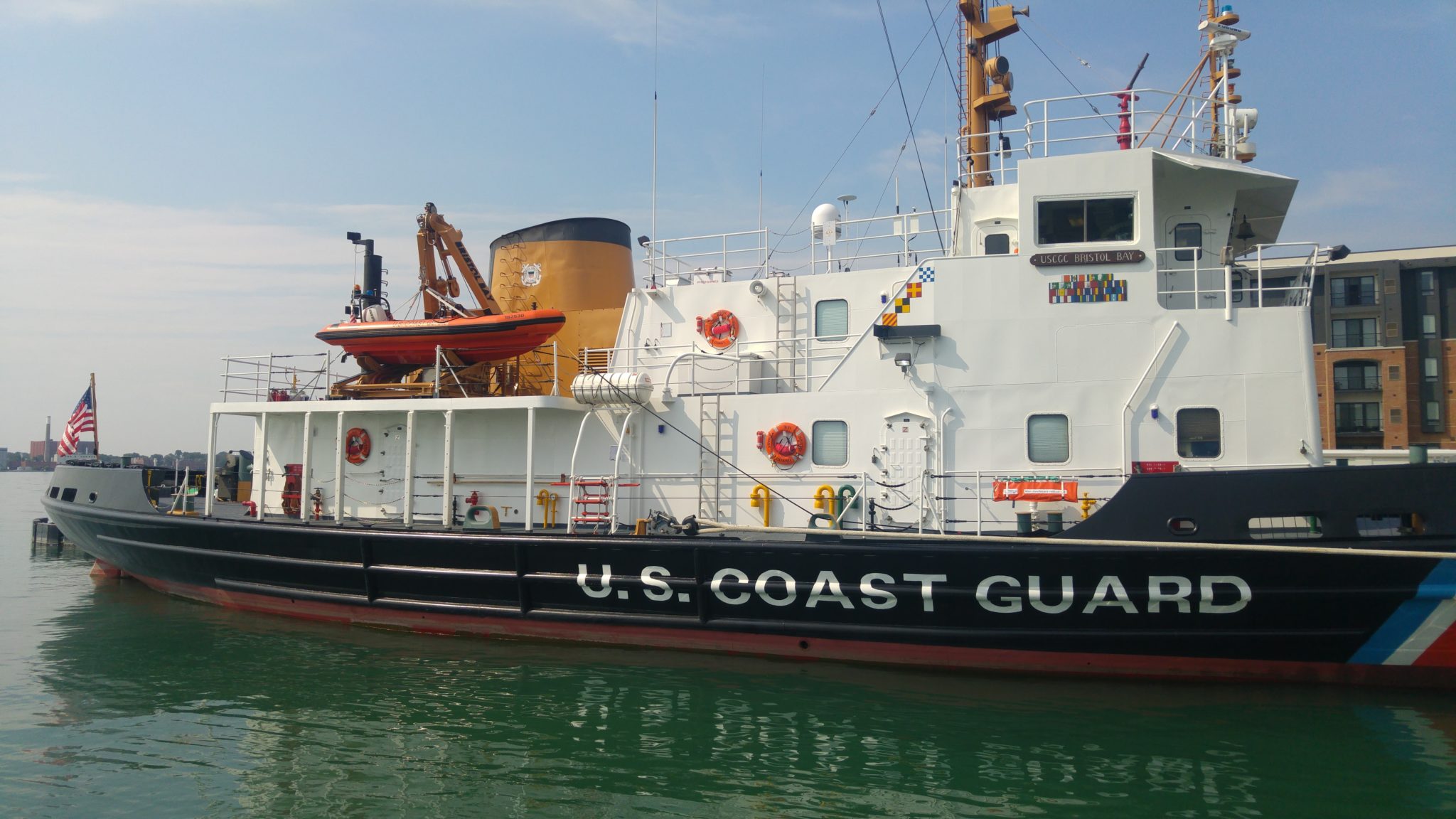
The In-service Vessel Sustainment Program modifications for the 140 foot domestic icebreaking tugs include a new davit that should make boat launching much quicker and easier. Compare the photo above with the earlier photo below. You can see that the O-1 deck has been extended out to the side of the hull and the new davit replaced a kingpost style derrick. Here is the vendor’s press release that provided the more recent photo.
Katmai Bay (WTGB 101) is tied to the pier at Group Sault Saint Marie, Michigan, Sept. 2001. USCG photo by PA1 Harry C. Craft III







 Chuck Hill's CG Blog