China to Build Nuclear Icebreaker, Ready in 2018

512px-Antarctica_CIA_svg

Maritime Executive is reporting China will build a nuclear powered Polar Icebreaker.

“The vessel will feature higher ice capabilities, better research capabilities and be more comfortable and environmentally friendly than Xue Long. It is expected to be 122.5 meters (400 feet) long and will be able to break ice of up to 1.5 meters (five feet) thick at a speed of around two knots. It will be able to operate bow or stern first using two ABB Azipod units with combined power of 15MW.”

This is what the Coast Guard would call at best a medium icebreaker. 15MW or about 20,000 HP is far less than even the Healy’s 22.4 MW, but while we don’t expect a new icebreaker for a decade, they expect theirs will be finished in two years.

Polar Icebreaker Operational Requirements Document, Industry Version

ice-breakers-540688_1280

If you would like to take a look at the Operational Requirements Document (ORD) for the proposed polar icebreaker (PIB in the document), you can find it here (pdf). (Sorry I did not publish this earlier.)

The bad news is that it does not look like it will be fully operational until 2028.

I”1.3.1 Initial Operational Capability Date: The Initial Operational Capability (IOC) date is anticipated to occur during or before FY-2026. IOC is defined as the delivery of the vessel. ”

1.3.2 Coast Guard Support Date The Coast Guard Support Date (CGSD) is the formal transition from CG-932 to Surface Forces Logistics Center Product Line (SFLC PL) and is anticipated to occur during or before FY-2028.”

1.4 Full Operational Capability Date: The Full Operational Capability (FOC) date occurs upon the successful completion of operational testing and evaluation and is anticipated to occur during or before FY-2028.

Here are the basics. I have cherry picked the list. There are many more requirements, but I think these are the most significant:

  • “The PIB will operate worldwide and will be exposed to extreme environmental conditions found in the Polar, Tropical, and Temperate regions. The PIB will experience ice up to large concentrations of multiyear consolidated pack ice with ridging, air temperatures ranging from -72 degrees Fahrenheit (°F) to 114°F, sea water temperatures ranging from 28.8°F to 87°F, wind speeds that can exceed 100 miles per hour (mph) (87 knots (kts)) and sea conditions up to sea state 8. …
  • “The PIB shall be capable of independently breaking through ice with a thickness > 6 ft (threshold) / > 8 ft (objective) at a continuous speed > 3 kts.
  • “The PIB shall be capable of independently breaking through ridged ice with a thickness of 21 ft.
  • “The PIB shall have a fully mission capable (in accordance with Table 20) cutter endurance per deployment without replenishment (subsistence and fuel) > 80 days underway (threshold) / > 90 days underway (objective).
  • “The PIB shall have the capability to exchange information (voice and data) with: USCG, DoD, DHS, NATO, DoS, NSF and NOAA.
  • “The PIB shall be capable of breaking a single-pass channel to a width of at least 83 ft.
  • “The PIB shall have a sustained speed of 15 kts.
  • “The PIB shall have a minimum range of 21,500 nautical miles at 12 kts in ice free waters
  • “The PIB shall have the capability of performing 3,300 Operational Hours (threshold) / 4,050 Operational Hours (objective) per year. (The USCG is currently transitioning from the use of DAFHP to Operational Hours as the metric for operational tempo. The threshold and objective figures contained in this requirement represent 185 and 225 DAFHP respectively.)
  • “The PIB shall be capable of delivering aviation fuels, diesel fuels, and potable water while underway from storage and service tanks to United States Navy (USN)/USCG/North Atlantic Treaty Organization (NATO) vessels 240 feet or less in length in either astern tow or alongside
  • “The PIB shall be capable of receiving underway replenishment of fuel and water from USN/NATO/Allied Navy vessels, Military Sealift Command or other designated vessels.
  • “The PIB shall be able to pump aviation fuels, diesel fuels, and water to shore facilities, including U.S. Scientific Research Stations.
  • “The PIB shall have a designated topside cargo area capable of transporting (not simultaneously): 3.1.9.7.1 Three 9 ft x 35 ft buoys including associated buoy mooring equipment (or) 3.1.9.7.2 Six twenty foot equivalent units (TEU) with a maximum weight of 20 tons each.
  • AVIATION: “The PIB shall be able to hangar a total of two of any combination of the following aircraft: 3.1.10.2.1 USCG H-65 with blade-folding capability. 3.1.10.2.2 USCG/USN H-60 with blade-folding capability. 3.1.10.2.3 UAS (not to exceed the footprint of an USCG H-60 with blade folding capability). (plus  meet certification criteria for Level I, Class 1 aviation operations for those aircraft–Chuck) The PIB shall have the capability for an H-65 to be mechanically secured to the flight deck immediately after landing without the use of tie-down personnel. The PIB shall have the capability to support mobile mechanical traversing of the USCG/USN H-60. The PIB shall have the aviation fuel capacity to operate an H-60 for 250 flight hours with 24 flight hours of fuel capacity in service tanks. (also TACAN equipped–Chuck)
  • BOATS: The PIB shall have the capability to independently launch, recover, fuel, maintain and operate two assigned boats with over-the-horizon (OTH) capability. The PIB shall have the capability to launch, recover, fuel, maintain, and operate at least one assigned cargo landing boat capable of landing a minimum capacity of 4,500 pounds (e.g., people, cargo, and equipment). The PIB shall have the capability to launch and recover on both port and starboard sides.
  • The PIB shall have the capability to deliver, support, and recover one 8-person boarding team and their gear, trained and outfitted in accordance with the Maritime Law Enforcement Manual, COMDTINST M16247.1 (Series) via cutter boat operated by a boat crew in accordance with USCG policy.
  • The PIB shall have the capacity to tow astern a vessel not exceeding an equivalent displacement to that of the PIB. (Shouldn’t this say the ability to tow a vessel of equivalent tonnage to the PIB or perhaps some minimum?–Chuck)
  • The PIB shall have the capability to support a DIVEDET of 7 personnel and their equipment, in accordance with the USCG Diving Policies and Procedures Manual, COMDTINST M3150.1 (Series) and the USN Diving Manual, SS521-AG-PRO-010 (Series).
  • The PIB shall provide dedicated location(s) and reserved space, weight, power, hotel services, data network and phones to accommodate six 10 ft x 20 ft science vans that do not interfere with flight deck operations. (Shouldn’t this be 8x8x20 foot vans?–Chuck)
  • WEAPONS: The PIB shall have the capability to employ removable weaponry. The PIB shall have the ability to conduct disabling fire against surface targets.
  • The PIB shall have a heavy lift capability with a minimum capacity of 20 tons extending to at least one lift point 25 feet past the widest point of the ship’s beam on both the port and starboard side of the  ship.
  • The PIB shall provide messing, berthing, sanitary facilities, and workspaces for all permanently attached crewmembers and 50 embarked personnel. Includes DIVEDET and LEDET deployed with 20 person AVDET (if LEDET is embarked, SCIDET (Science) will remain ashore).
  • The PIB shall be capable of wintering over for a minimum of 210 days.
  • The PIB shall be designed to provide airspace management for organic aircraft operating in controlled and uncontrolled airspace by providing installed organic systems.

Additionally it should be able to conduct boat and helo operations to Sea State Four (8.2 feet/2.5 meters)

COMMENTS: I would like to offer some comments on the document.

CONTAINERS:

Inclusion of “dedicated location(s) and reserved space, weight, power, hotel services, data network and phones to accommodate six 10 ft x 20 ft science vans that do not interfere with flight deck operations.” (3.1.16.6 page 29) is promising. It offers an avenue to address emerging requirement or the need for capabilities that might might have been unrecognized. In addition to scientific support they might be used for humanitarian assistance/disaster relief, as holding cells, as class room space, for upgraded communications, accommodations, or medical facilities.

AVIATION:

If we are going to be able to operate, hangar, and service Navy H-60s, we also need to be able to store their associated weapons and equipment including sonobuoys and torpedoes. I suspect this means we will need more space (and perhaps specialized space) than required to support CG H-60s (which I doubt will ever deploy on the PIB anyway). The containerized mission modules might be one way to address this if the need arises.

WEAPONS:

Polar Icebreakers will undoubtedly go to Antarctica so the Antarctic Treaty will apply.  Contrary to what you may have heard, the treaty does not require that ships entering the area be unarmed, only that they be open to inspection. Article VII para. 3. “All areas of Antarctica, including all stations, installations and equipment within those areas, and all ships and aircraft at points of discharging or embarking cargoes or personnel in Antarctica, shall be open at all times to inspection by any observers designated in accordance with paragraph 1 of this Article.”

Obviously we do not want to send the PIB down there mounting classified weapons. The document addresses this by saying, “The PIB shall have the capability to employ removable weaponry.” This might mean only .50 caliber machine guns like the Polar Class, but there is also an operational requirements in table 6 (PIB Activities, page 11) is “Stop/neutralize a vessel through the use of force continuum.” Notably this is in the group “Boarding Operations” rather than Defensive/Offensive Operations.

If  we are going to enforce US sovereignty and ” the ability to conduct disabling fire against surface targets” is not limited to surface targets powered by outboard motors, the ship will need something more. There is also a strong possibility that the target could outrun a 15 knot PIB so we either need to be able to do this at a distance, or using the ship’s boats or helicopters.

Ultimately all weapons are removable. In some cases, like missiles or torpedoes the launchers themselves may be unclassified as long as the weapon itself is not installed.

The LCS classes have incorporated removable weapons in their design with reconfigurable weapon stations. We might consider something similar for the PIB,

In wartime, if fighting is in the Arctic or Antarctic, the polar Icebreakers will be unique high value naval auxiliaries that may become critical to naval operations. They will need to be adequately protected. We might consider fitting them “for but not with” defensive weapons. A minimum of two Mk38 25 mm and two SeaRAM CIWS appears to be appropriate, while requiring a minimum impact on command and control and manning requirements.

Photos: A removable weapon system. The Mk46 Gun Weapons System. This is used in the LCS anti-surface mission module. The armor piercing, fin stabilized discrding sabot round would probably be effective as a disabling round against even large diesel engines. 

CONCLUDING OBSERVATIONS

It is a pretty large document, running 89 pages total. The last 17 pages are appendices. Reportedly it was the product of a “46-member, 11-Agency Integrated Product Team (IPT)” There is a lot of detail, but there are also a lot of statements that are so nebulous as to be meaningless and as far as I can see do not contribute to an understanding of the requirements. This applies to most of the capabilities listed in Table 5 on page 9 and virtually all of the following,

  • “6 CRITICAL OPERATIONAL ISSUES Critical Operational Issues (COIs) are the operational effectiveness and operational suitability issues (not characteristics, parameters, or thresholds) that shall be examined during Operational Test and Evaluation (OT&E) to evaluate/assess the system’s capability to safely perform its mission.6.1 Operational Effectiveness COIs 6.1.1 Protection Response (PR) 6.1.1.1 Can the PIB perform USCG Emergent Response for Search and Rescue (SAR) and National Emergency Response Operations (NERO)?
  • 6.1.2 Law Enforcement Response (LER) 6.1.2.1 Can the PIB perform USCG Enforcement Response for Law Enforcement and Homeland Security?
  • 6.1.3 Surveillance and Reconnaissance (SR) 6.1.3.1 Can the PIB contribute to Maritime Domain Awareness?
  • 6.1.4 Defense Readiness (DR) 6.1.4.1 Can the PIB provide Defense Readiness to Combatant Commanders?
  • 6.1.5 Maintain Mobility (MM) 6.1.5.1 Can the PIB provide USCG services to maintain movement of vessels and equipment in civil and military maritime environments
  • 6.1.6 Transport (TRAN) 6.1.6.1 Can the PIB provide USCG organic transportation of people and equipment?
  • 6.1.7 Force Movement (FM) 6.1.7.1 Can the PIB be prepared for operational employment and move from ready locations to the intended area of operations?
  • 6.1.8 Information Management (IM) 6.1.8.1 Can the PIB perform Information Management in support of USCG Missions?
  • 6.1.9 Force Protection (FP) 6.1.9.1 Can the PIB provide Force Protection?”

Perhaps I have missed something or these will be clarified in the future.

Will the Navy Be Funding and Managing Our Next Icebreaker Procurement?

PolarisAzipodsLookingAft

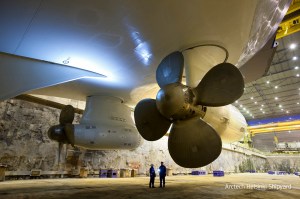
Azipods, state of the art propulsion technology for icebreakers. 

The Senate Appropriations defense subcommittee has proposed that $1B be added to the Navy’s shipbuilding budget for the construction of an icebreaker for the Coast Guard.

This sounds like good news, and there is precedence for this, in the form of USCGC Healy. Still, there are reasons, this may not be the best approach for the project, for the Coast Guard, or for the Navy, particularly since this should not be a one time procurement, it should be the first of a series.

The Navy contracted for the Healy and it did not turn out so badly, but there were difficulties as discussed here.

There are really two issues.

  • Who gets the money?
  • Who should manage the project?

Who gets the money?

The Coast Guard has been trying to get the government to recognize that it needs an AC&I budget of $2-2.5B/year. It needs to be a new norm. Funding icebreakers is part of that. Putting the money in the Navy budget is deceptive, and it does nothing to address the true needs of the Coast Guard..

Because of sequestration it is easier to add money to a DOD budget than to the Coast Guard budget, but if they can make exceptions for one military service, you would think they could make an exception for the Coast Guard as well.

Who would be the best project manager?

The Coast Guard got a black eye for the Deepwater project, but that was largely the result of a misguided Reagan era directive that project management be outsourced to the private sector that was followed by a gutting of in-house expertise in DOD as well as the Coast Guard. NAVSEA also lost much of its in house expertise. Since then, the Coast Guard’s Acquisitions Directorate has been rebuilt into an award winning organization. In fact, while I don’t necessarily think it is true, the GAO has suggested that the Coast Guard’s procedures may be superior to those of the Navy.

The Coast Guard has been preparing for this acquisition for years. If the Navy is to manage it, the Coast Guard will have to spend time bringing them up to speed.

There is also the question of who will procure the follow-on icebreakers. We have been saying we need three heavy and three medium icebreakers. the Coast Guard needs to continue to increase its icebreaker procurement expertise to build these vessels as well.

If the project is given to NAVSEA, it may be low on their priority list. NAVSEA is currently building or planning:

If NAVSEA were to divert their personnel from these projects to the procurement of an icebreaker, it would hurt supervision of these projects.

All of these projects are far larger than construction of one icebreaker. So, if they are given the icebreaker project, will they put their best people on it? Do they have any icebreaker expertise? Will they have to hire new people who will need to go through a time consuming clearance process and take the time to be brought up to speed?

NAVSEA may want to do their own lengthy and costly study & review process. They may impose requirements that the Coast Guard would not. These would add to the cost and these costs would likely be added on to any future icebreakers that would probably be built to the same design.

A troubling “encouragement”:

There was a particularly troubling requirement quoted on page 31 of the  Congressional Research Service’s report, “Coast Guard Polar Icebreaker Modernization: Background and Issues for Congress.” from the FY2017 DOD Appropriations Act (S. 3000) apparently from pages 98-99.

“While the effort to speed polar icebreaker acquisition by 2 years is commendable, the Committee believes more must be done now to expand our capabilities and to defend interests in the Polar Regions. In addition to concerns about our current fleet, the Committee notes that Russia has roughly 40 operational icebreakers and 11 icebreakers either planned or under construction. Therefore, to further accelerate production, the Committee recommends $1,000,000,000 in the “Shipbuilding and Conversion, Navy” account to construct domestically the first U.S. Coast Guard operated ship for the Polar Icebreaker Recapitalization Project. In order to achieve an earlier start on this project and to reduce cost and schedule risk, the Committee encourages the selection of an in-service U.S. hull design and the setting of limitations on overall ship specifications and requirements. The Committee directs the Secretary of Defense in coordination with the Secretary of Homeland Security to submit a report to the appropriate congressional committees not later than September 30, 2016 which provides polar icebreaker requirements, preferred design, overall acquisition strategy, and a breakout of funds necessary to support the acquisition.”

I find the direction to forego an opportunity to improve on the designs we have, in favor of decades old hull designs that no longer represent the best in current icebreaker design troubling, particularly since this may be the first of three heavy icebreakers, not just a single stop-gap design.

USCGC Polar Sea

USCGC Polar Sea

There are of course only two large, in service, US hull designs.

ice-breakers-540688_1280

USCGC Healy (foreground)

Our most modern, but frequently forgotten Great Lakes Icebreaker, USCGC Mackinaw (WLBB-30), is a few years younger but still designed about two decades ago, was built by Marinette Marine, which is at least still an operational shipyard, producing Freedom Class LCS for the Navy.

Would it be enough to simply say we are going to scale up the Mackinaw hull (say double all the dimensions) so that we could have a ship that at least uses azipods like most modern icebreakers?
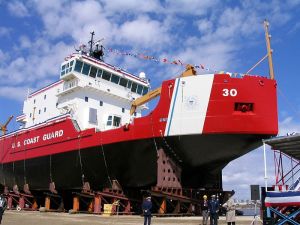
Launch of USCGC Mackinaw (WLBB-30) on April 2, 2005. Photo by Peter J. Markham.

Launch of USCGC Mackinaw (WLBB-30) on April 2, 2005. Photo by Peter J. Markham.

Do we need the Navy?:

I would note that the Coast Guard’s intention had been to fund the Icebreaker in FY2018 not 2022, but somehow we had an unannounced delay of four years which was reduced by a much publicized decision to accelerate construction to 2020. Not only does this strike me as dishonest, but it also seems to suggest that the Coast Guard, given supporting funding, could be ready to contract for the Icebreaker on its own prior to 2020.
If the money were given to the Coast Guard instead of the Navy, I believe the icebreaker would be ready earlier, be delivered cheaper, and will be more in line with our true needs.
If we have to live with this:
As much as I dislike the prospect, we may have to live with this, because of the Congress’ self imposed “sequestration” silliness. If so, how the Navy/Coast Guard team that manages the procurement will be important. The Coast Guard needs to continue to grow its icebreaker expertise.

Perhaps NAVSEA could sub-contract the Coast Guard Acquisitions Directorate (CG-9) to procure the icebreaker.

Thanks to Tups for bringing the encouragement to select an in-service U.S. hull design to my attention.


Commandant’s Strategic Intent, Mid-Term Report

Coast Guard Capt. Douglas Nash, commanding officer of Coast Guard Air Sation Sacramento, salutes a Coast Guard C-27J pilot during a change of watch ceremony at Air Station Sacramento's hanger in McClellan Park, Thursday, July 1, 2016. The ceremony marked the final day that an HC-130 Hercules crew stood the watch at Air Station Sacramento and introduced the newest aircraft. Coast Guard photo by Petty Officer 3rd Class Loumania Stewart

Procurement of 14 C-27J aircraft was one of the achievements sited. C-27Js replace C-130s at CGAS Sacramento. 

The Commandant has issued a mid-term update on his earlier published “Strategic Intent, 2015-2019” (pdf). The new document is available in pdf format. You can find it here: “United States Coast Guard Commandant’s Strategic Intent, 2015-2019, Mid-Term Report.”

It is relatively short and readable at 21 pages. The recurring themes of the Commandant’s administration are all there, starting with TOC (transnational organized crime) and its deleterious effect on Western Hemisphere governance and prosperity. It does read a little like an Officer Evaluation Report input.

There is nothing particularly surprising here, but even for me, the enumeration of the scope the Coast Guard’s authorities, responsibilities, and international contacts is still mind boggling.

I am not going to try to summarize the report, but there were a few things that struck me.

The Commandant mentions service life extension programs for the seagoing buoy tenders (already begun), the 47 foot MLBs, and the 87 foot WPBs (in the future), but there is no mention of what we will do about the inland tender fleet. There will also be a life extension program for helicopters before they are finally replaced.

“Extend the service life of our rotary wing assets and align with DOD’s Future Vertical Lift initiative.”

There is mention of a program I was not aware of, the “Defense Threat Reduction Agency National Coast Watch System project.” The Defense Threat Reduction Agency attempts to track and reduce the WMD threat. It is not really clear what our role is here. We know about the container inspection programs in foreign ports. Is that it, or is there more to this? (that can be discussed at an unclassified level.)

Russia’s New Nuclear Icebreaker, Largest, Most Powerful

NPR has some photos of the launching of Russia’s as yet uncompleted, 568 foot long nuclear powered icebreaker. which will be the largest and most powerful icebreaker in the world. The NPR story provided a link to a Sputniknews story.

According to sputniknews.com,

“The Project 22220 vessel is 189.5 yards long (568.5 ft–Chuck) and 37.1 yards wide (111.3 ft). The ship displaces 33,540 metric tons.”

That is almost three times as large as the Polar Star.

A second ship of the class is also expected to be completed before 2020.

Interestingly, while Russian navy projects are frequently subject to delays, this icebreaker is being launched more than a year earlier than originally planned.

Thanks to David for bringing this to my attention. 


Senate Homeland Security Appropriations–Plus Up

MarineLog is reporting:

The homeland security measure provides $10.4 billion for the d Coast Guard, an increase of $292 million above the FY2017 requested level.

“This level supports a robust USCG operating expenses budget, including a grant program for commercial fishing safety, purchase of additional response boats, and funds for the National Coast Guard Museum,” says the Committee. “This bill also provides necessary increases for acquisitions, including funding long lead time materials for a tenth National Security Cutter, continuing activities associated with the Offshore Patrol Cutter, two additional Fast Response Cutters (for six total), and support for multiple sustainment efforts and program offices such as the C-130J, C-27J, and HH-65. The measure also includes program management and personnel costs associated with the Polar Icebreaker Recapitalization Project in addition to funding in the Senate FY2017 Department of Defense Appropriations Bill.”

The Defense Appropriations Bill includes $1B for the Navy to build a new Icebreaker for the Coast Guard. We will have more to say about this later.

Finland Builds an LNG Powered Icebreaker.

FinnishLNGicebreaker

For more photos see http://gcaptain.com/photos-worlds-first-lng-powered-icebreaker-polaris/

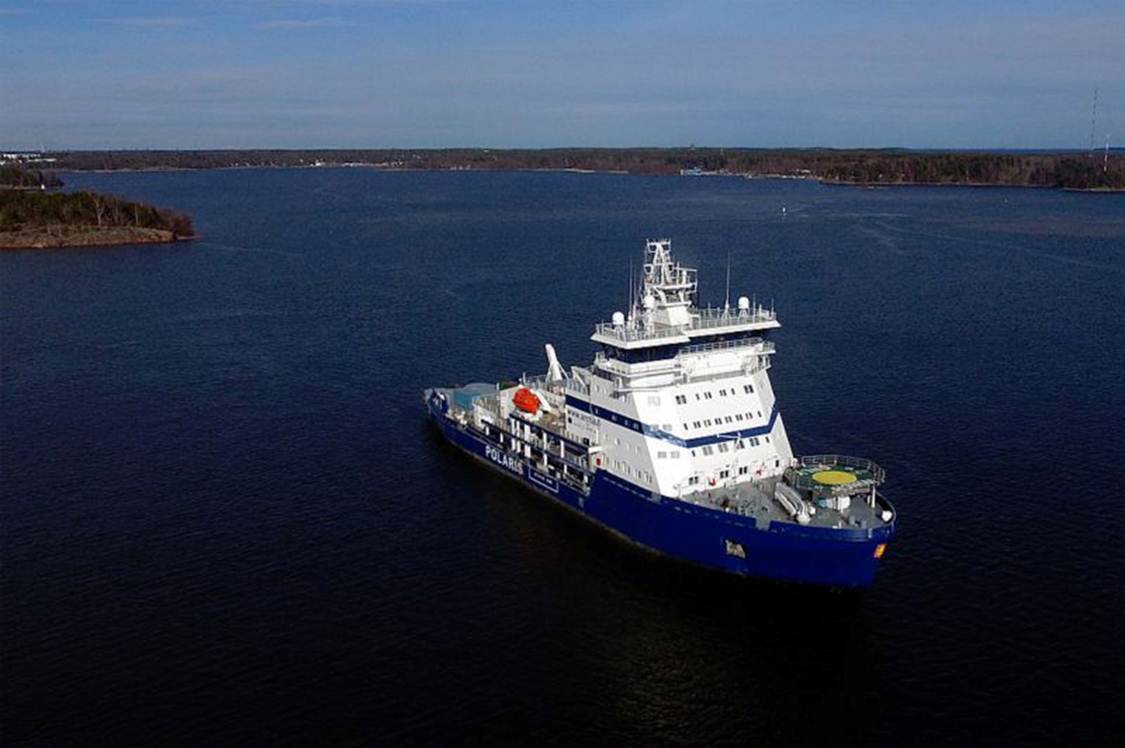
ARCTECH has completed the World’s first LNG powered (dual fuel capable, low sulfur diesel or LNG) icebreaker, NB501 Polaris, for the Finnish Transport Agency, and it is currently in sea trials.

The vessel will be able to move continuously through about 1.6 meter thick level ice, to break a 25 meter wide channel in 1.2 meter thick ice at speed of 6 knots, as well as to reach 9…11 knots of average assistance speed in the demanding icebreaking conditions in the Baltic Sea. In open water the service speed will be 16 knots.

Reportedly “It will also be able to perform oil spill response operations, emergency towing and rescue operations.”

Its dimensions are 110x24x8 meters or 361x79x26 feet. Its propulsion comes from three azimuthing propulsors totaling 19kW or about 25,500 HP. Specs here (pdf).

Crew requirements are tiny at 16.

With a 30 day endurance, it does not have the range the Coast Guard needs for Polar Operations, but with 180% more horsepower than the Mackinaw, it would make a great Great Lakes icebreaker. The US certainly has a lot of LNG. Would be good for the environment too. (Of course it would have to be built in the US, but using a foreign design is not a problem for the Coast Guard.)

Thanks to Lee for bringing this to my attention. 

Russians Building Missile Armed Arctic Patrol Vessel

Project23550IceClassPatrolVessel

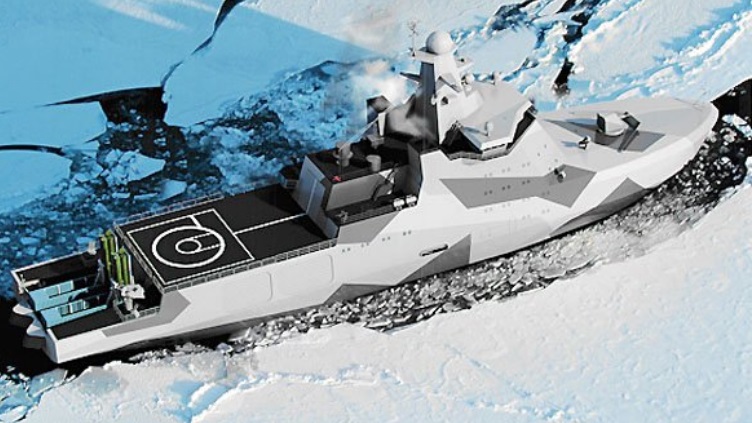
Concept image issued by the Russian Ministry of Defence of the Project 23550 ice-class patrol ships for the Russian Navy. Source: Russian MoD

Janes360 is reporting that the Russian Ministry of Defense has awarded contracts for two new ice class patrol vessels that are reportedly capable of operating in ice up to 1.5 meters thick (approx. 5 feet).

The class is described (in Russian) by the MoD as being “without analogues in the world”, and combining “the qualities of tug, ice-breaker, and patrol boat”.

To me it looks an awful lot like the Norwegian Coast Guard vessel Svalbard or Canada’s Arctic Offshore Patrol Ship that is based on the Svalbard’s design.

Jane’s notes, “A concept image released by the MoD showed the vessel armed with a medium-calibre main gun on the foredeck (likely an A-190 100 mm naval gun), a helicopter deck and hangar, and two aft payload bays each fitted with a containerised missile launch system (akin to the Club-K system offered for export) armed with four erectable launch tubes – presumably for either Club anti-ship or Kalibr-NK land-attack missiles. Although billed as patrol boats, this level of armament makes them better armed than many corvettes.”

If these are in fact containerized missile systems, then they may simply be optional equipment, added to the conceptual image to give the ship a bit more swagger, and we may never actually see this. If you are breaking ice for a vessel following close behind, you may not want missiles with their warheads and high energy fuel located near the stern where a collision with a vessel following too close might rupture a missile and start a fire.

It does suggest that a few spaces for containers could turn almost any ship into a potential missile platform.

9th NSC as D17 Flagship–CIMSEC

The Coast Guard Cutter Stratton from Alameda, Calif., steams near an ice floe in the Arctic Ocean during Operation Arctic Shield 2014 Sept. 14, 2014. (Coast Guard photo courtesy of Cutter Statton)

CIMSEC has a post, “DESIGNATE THE 9TH NATIONAL SECURITY CUTTER AN ARCTIC FLAGSHIP,” which suggest essentially two related actions regarding the recently funded ninth Bertholf class National Security Cutter (NSC).

  • Homeport it in Kodiak, and
  • Ice-strengthen the hull.

As usual, the benefits of cutting transit time by basing ships in Kodiak are overstated because the need to transit south for training and yard period is neglected. Individual training is also easier and less expensive if the ship is located near training facilities.

I find the case for ice strengthening a bit more interesting, but do we really want to redesign a ship that now benefits from the maturity of its design?

The author also touts the advantages of light icebreaking done by an ice-strengthened NSC, perhaps not realizing that icebreaking is already done by 225 foot buoy tenders, four of which are homeported in Alaska, including one in Kodiak.

It really looks like the OPC would be a better choice for homeporting in Alaska, being simpler and already planned to be ice-strengthened, but it is also true that the ninth NSC will be finished at least a couple of years before the first OPC and probably several years before an OPC will be homeported in Kodiak.

Document Alert: Changes in the Arctic: Background and Issues for Congress

ice-breakers-540688_1280

The Congressional Research Service has issued another study, this one on the Arctic (pdf). It was authored by their Naval Expert Ronald O’Rourke, who has authored several reports on the Coast Guard, so you can be sure he has an understanding of the Coast Guard’s situation.

It is pretty long, but here is the summary.

“The diminishment of Arctic sea ice has led to increased human activities in the Arctic, and has heightened interest in, and concerns about, the region’s future. The United States, by virtue of Alaska, is an Arctic country and has substantial interests in the region. On January 21, 2015, President Obama issued an executive order for enhancing coordination of national efforts in the Arctic. The United States assumed the chairmanship of the Arctic Council on April 24, 2015, and will serve in that capacity for two years.

“Record low extents of Arctic sea ice over the past decade have focused scientific and policy attention on links to global climate change and projected ice-free seasons in the Arctic within decades. These changes have potential consequences for weather in the United States, access to mineral and biological resources in the Arctic, the economies and cultures of peoples in the region, and national security.

“The five Arctic coastal states—the United States, Canada, Russia, Norway, and Denmark (of which Greenland is a territory)—have made or are in the process of preparing submissions to the Commission on the Limits of the Continental Shelf regarding the outer limits of their extended continental shelves. The Russian submission includes the underwater Lomonosov Ridge, a feature that spans a considerable distance across the Arctic Ocean.

“The diminishment of Arctic ice could lead in coming years to increased commercial shipping on two trans-Arctic sea routes—the Northern Sea Route and the Northwest Passage. Current international guidelines for ships operating in Arctic waters are being updated.

“Changes to the Arctic brought about by warming temperatures will likely allow more exploration for oil, gas, and minerals. Warming that causes permafrost to melt could pose challenges to onshore exploration activities. Increased oil and gas exploration and tourism (cruise ships) in the Arctic increase the risk of pollution in the region. Cleaning up oil spills in ice-covered waters will be more difficult than in other areas, primarily because effective strategies have yet to be developed.

“Large commercial fisheries exist in the Arctic. The United States is currently meeting with other countries regarding the management of Arctic fish stocks. Changes in the Arctic could affect threatened and endangered species. Under the Endangered Species Act, the polar bear was listed as threatened on May 15, 2008. Arctic climate change is also expected to affect the economies, health, and cultures of Arctic indigenous peoples.

“Two of the Coast Guard’s three polar icebreakers—Polar Star and Polar Sea—have exceeded their intended 30-year service lives, and Polar Sea is not operational. On May 12, 2011, representatives from the member states of the Arctic Council signed an agreement on cooperation on search and rescue in the Arctic.

“Although there is significant international cooperation on Arctic issues, the Arctic is increasingly being viewed by some observers as a potential emerging security issue. Some of the Arctic coastal states, particularly Russia, have announced an intention or taken actions to enhance their military presences in the high north. U.S. military forces, particularly the Navy and Coast Guard, have begun to pay more attention to the region in their planning and operations.”