A New Kind of Shiprider Agreement–Virtual / “U.S., Federated States of Micronesia sign expanded shiprider agreement”

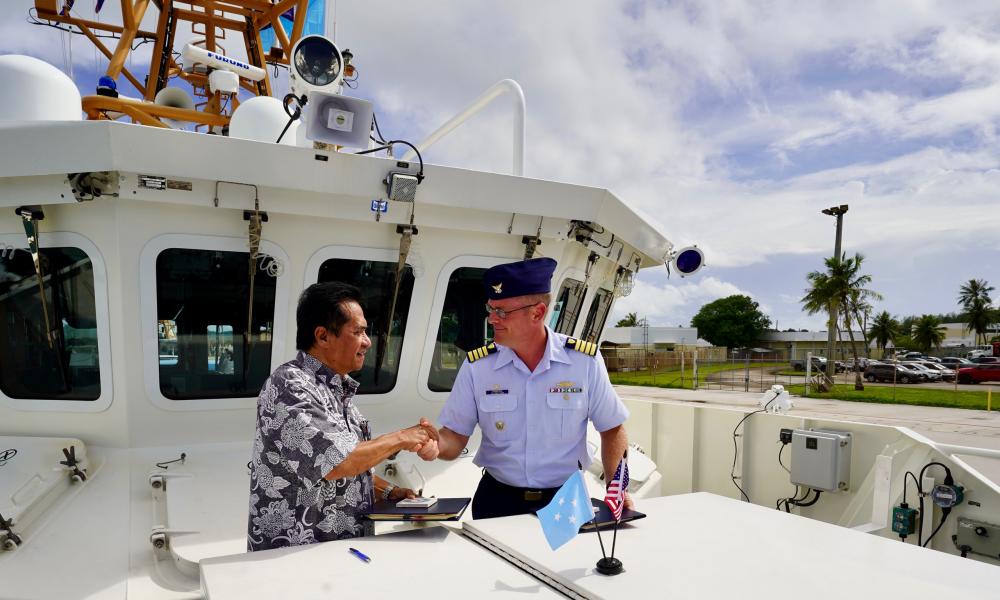
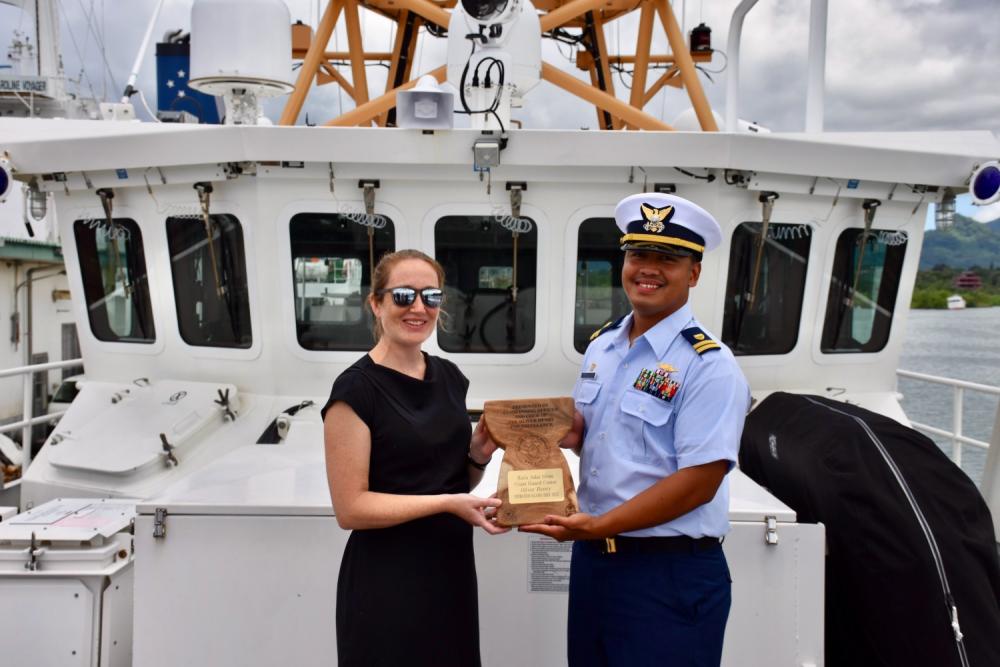
U.S. Coast Guard Forces Micronesia Sector Guam Commander Capt. Nicholas R. Simmons and the Honorable Joses R. Gallen, Secretary of Justice, Federated States of Micronesia, signed an expanded shiprider agreement allowing remote coordination of authorities, the first of its kind aboard the USCGC Myrtle Hazard (WPC 1139) in Guam, on Oct. 13, 2022. The agreement will enable to U.S to act on behalf of the FSM to combat illicit maritime activity and to strengthen international security operations. (U.S. Coast Guard photo by Chief Warrant Officer Sara Muir)

This is a lot more of a leap than it might seem from the news release. It is a huge vote of confidence from the Federated States of Micronesia.

More specifically, the agreement provides a coordinating mechanism and process for U.S. law enforcement personnel to work with the FSM National Police through command centers to receive approval from the FSM to act.

In all previous shiprider agreements, the Coast Guard team enforced the laws of the assisted nation under the authority of an agent of that nation, that accompanied the ship. What we have here is a virtual shiprider (my choice of words). Not only is it easier logistically, it means the decision by the nation assisted is probably being made at a higher level than would have been the case with a dedicated on-scene shiprider.

It also means that a cutter can begin acting on behalf of the Federated States of Micronesia as soon as the cutter enters their EEZ, rather than having to wait until the shiprider comes aboard. The cutter will also not have to drop the shiprider off before departing the area, or arrange other transportation that might delay the agent’s return to duty. It is a win-win.


News Release

U.S. Coast Guard Forces Micronesia / Sector Guam

U.S., Federated States of Micronesia sign expanded shiprider agreement

U.S., Federated States of Micronesia sign expanded shiprider agreement U.S., Federated States of Micronesia sign expanded shiprider agreement

Editor’s Note: Click on the images above to view or download more.

SANTA RITA, Guam — To overcome complex challenges to maritime enforcement in the Federated States of Micronesia (FSM), a nation with over six hundred islands, representatives of the United States and the FSM signed a remote shiprider agreement on Oct. 13, 2022, during a Joint Committee Meeting hosted by Joint Region Marianas.

Through remote coordination, this agreement, the first of its kind, will enable the U.S. to act on behalf of the country to combat illicit maritime activity when an FSM law enforcement officer is not present. More specifically, the agreement provides a coordinating mechanism and process for U.S. law enforcement personnel to work with the FSM National Police through command centers to receive approval from the FSM to act.

Shiprider agreements allow maritime law enforcement officers to observe, board, and search vessels suspected of violating laws or regulations within a designated exclusive economic zone (EEZ) or on the high seas. These law enforcement activities bolster maritime law enforcement operations and maritime domain awareness and provide a mechanism to conduct integrated operations within the Pacific.

“We’re thrilled to cooperate with our Federated States of Micronesia partners on this initiative that will reap benefits for FSM’s economic, environmental, and national security in the maritime domain,” said Alissa Bibb, Chargé d’affaires at the U.S. Embassy in Kolonia.

The dynamic nature of detecting, deterring, and suppressing illegal activity in the Pacific, like fisheries offenses and illicit maritime drug trafficking, requires creative and collaborative solutions. This agreement builds on the enduring partnership and long-standing shiprider agreement between the two nations by providing a new framework to conduct maritime operations and relies on the professionalism and expertise of U.S. and FSM maritime law enforcement officers.

The U.S. Coast Guard regularly exercises 13 bilateral fisheries law enforcement agreements with countries throughout the Pacific islands. These agreements enable U.S. Coast Guard personnel and U. S. Navy vessels with embarked U.S. Coast Guard law enforcement personnel to work with host nations to protect critical regional resources. Shiprider efforts greatly enhance host-nation sovereignty by enabling Pacific Island Nation partners to enforce their laws and regulations using U.S. assets.

The U.S. Coast Guard maintains strong partnerships with the maritime forces in the region through extensive training and subject matter expert exchanges. FSM, also known as the Big Ocean State, has one of the world’s largest EEZs, with waters rich in sea life. FSM consists of four states — Pohnpei, Chuuk, Yap, and Kosrae — each with a mix of unique peoples, languages, and cultures. FSM is a signatory to a Compact of Free Association with the United States. They are also a Pacific Islands Forum Fisheries Association member and a party to the South Pacific Tuna Treaty.

“This historic agreement significantly strengthens presence and enforcement options to counter illicit maritime activity in the region. It is only made possible by the deep and abiding relationships and respect between the Coast Guard and our FSM partners, “Capt. Nick Simmons, Commander of U.S. Coast Guard Forces Micronesia. “FSM has the 14th largest EEZ in the world and only two patrol boats. Our crews spend ample time within the region but getting a shiprider aboard our vessels can be a real logistical challenge. This agreement dramatically increases the capacity of available resources to act on FSM’s behalf to protect their living marine resources and sovereignty. We appreciate their continued trust and confidence as we work together.”

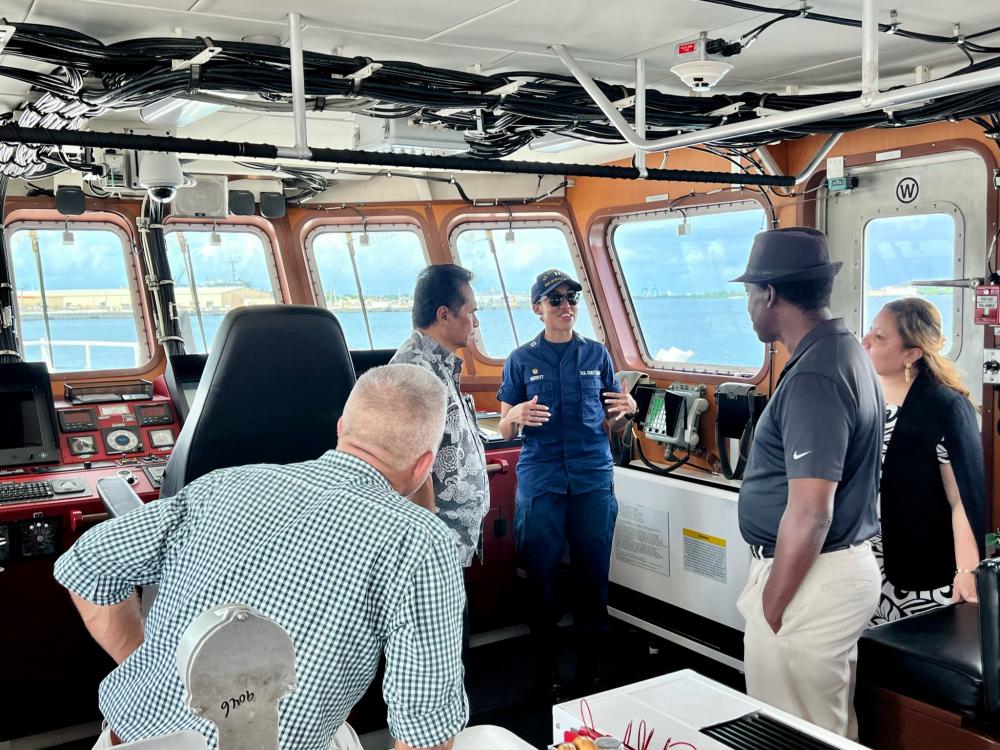
The USCGC Oliver Henry (WPC 1140) hosted Chargé d’affaires Bibb and her team aboard in Pohnpei in September. They met with several key officials, and members of the cutter’s engineering team conducted a subject matter exchange with the crew of FSS Palikir, the last active Pacific-class patrol boat, on shipboard repairs and assisting with preventative maintenance.

In May, USCGC Myrtle Hazard (WPC 1139) made a contactless crew rest and re-fueling stop in FSM during their expeditionary patrol across Oceania. In December 2021, USCGC Sequoia (WLB 215), working alongside the Navy’s Underwater Construction Team Two (UCT-2), conducted operations to widen the channel at Kapingamarangi Atoll. U.S. Coast Guard Forces Micronesia/Sector Guam also provides search and rescue support to FSM, with several successful cases in the last year, resulting in ten lives saved.

The shiprider program supports regional coordination and aligns with the National Security Strategy, U.S. Indo-Pacific Command efforts, and the U.S. Coast Guard’s Operation Blue Pacific. The bilateral agreements enacted in the Pacific are the bedrock of regional maritime law enforcement partnership. They convey the United States’ ongoing investment in protecting shared resources and interest in maritime safety and security, including fair and reciprocal trade, while standing against a current of aggressive and coercive influence in the region.

The U.S. is devoted to ensuring greater unity and a free and open Indo-Pacific for all nations who observe the rule of law. The U.S. Coast Guard continues to demonstrate our enduring presence in the Pacific and help facilitate increased regional stability, security, and resilience for U.S. partners.

For more U.S. Coast Guard Forces Micronesia/Sector Guam news, visit us on DVIDS or subscribe! You can also visit us on Facebook or Instagram at @USCGForcesMicronesia.

Visiting Fiji and other Pacific Islands

Naval News points out the apparent strong interest of many nations in West Pacific island nations, “Pacific Port Visits Show Regions Growing Importance: Expert.”

Certainly the Coast Guard has been calling on a these small island nations with significant regularity.

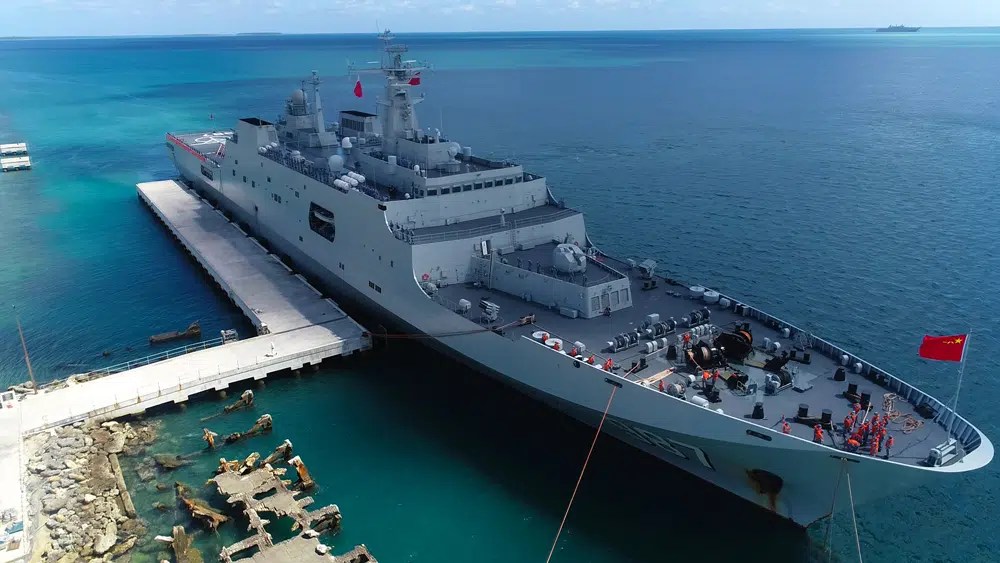
We are not the only ones visiting.

Type 071 LSD Wuzhishan of the People’s Liberation Army Navy (PLAN) alongside in Nuku’alofa, Tonga with an Australian Canberra class LHD visible in the background. (Xinhua)

The post points to visits by USS Jackson (LCS-6), the UK’s HMS Spey (P-234), Japan’s JS Kirisame (DD-104) and India’s INS Satpura (F-48).

Somehow, I suspect of all these, the Webber class WPCs, like USCGC Oliver Henry’s recent deployment, are the most welcome, non-threatening, the right scale, not showing off, just trying to help.

“U.S. Coast Guard conducts port visit in Federated States of Micronesia” –CG Forces Micronesia

USCGC Oliver Henry hosts U.S. Embassy team in Pohnpei

The crew of USCGC Oliver Henry (WPC 1140) host Chargé d’affaires Alissa Bibb and her team aboard upon arrival in Pohnpei, Federated States of Micronesia, on Sept. 14, 2022. Following stops in Australia and Papua New Guinea, we’ve been patrolling to deter illicit maritime activity — most recently, to counter illegal, unregulated, and unreported fishing in the territorial waters of the Federated States of Micronesia to assist in ensuring FSM’s sovereignty, resource security, and the rule of law. (U.S. Coast Guard photo by USCGC Oliver Henry)

Passing along this news release from Forces Micronesia/Sector Guam. It includes some history of previous operations in the area and illustrates connections made through the Academy.

News Release

U.S. Coast Guard Forces Micronesia / Sector Guam

U.S. Coast Guard conducts port visit in Federated States of Micronesia

USCGC Oliver Henry arrives to Pohnpei USCGC Oliver Henry hosts Charge d'Affairs FSM USCGC Oliver Henry hosts FSM National Oceanic Resource Management Authority – Fisheries Compliance Division Assistant Director

Editor’s Note: Click on the images above to view or download more.

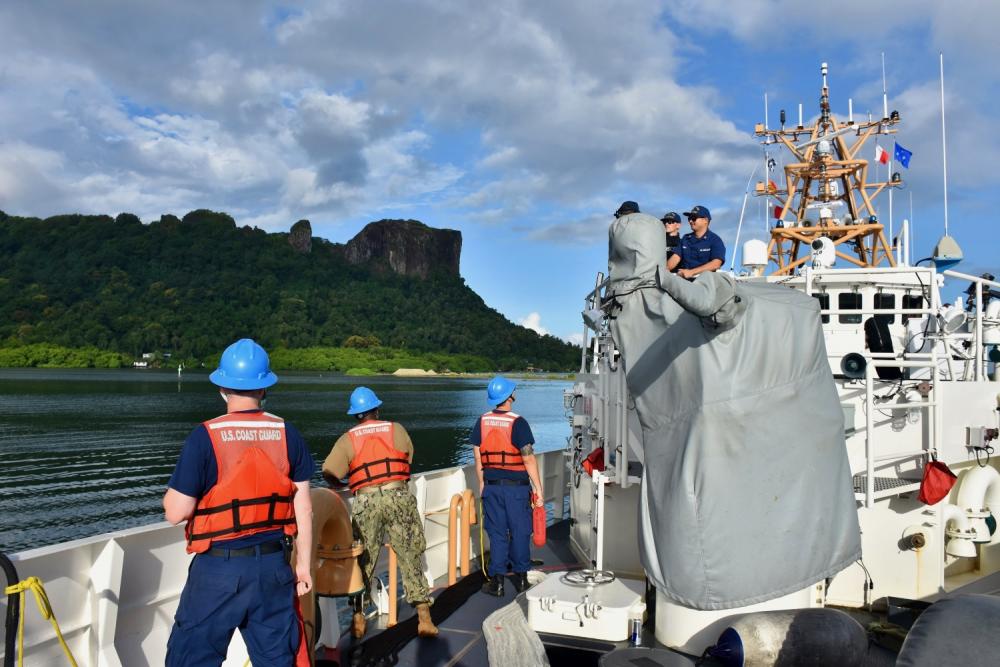
POHNPEI, Federated States of Micronesia — The Sentinel-class fast response cutter USCGC Oliver Henry (WPC 1140) crew conducted a port visit in Kolonia on Sept. 14 – 16, following a patrol across Oceania encompassing the Coral Sea and the exclusive economic zones of Papua New Guinea and Federated States of Micronesia.

This port visit marks the sixth stop while conducting operations in the Indo-Pacific theater, following several stops across Papua New Guinea and one in Australia, part of Operation Blue Pacific.

During their stop in Pohnpei, Oliver Henry’s crew hosted Chargé d’Affairs Alissa Bibb and her team and Assistant Director Youky Susaia Jr. of the FSM National Oceanic Resource Management Authority – Fisheries Compliance Division. Thye covered patrol highlights and discussed future opportunities. Susaia Jr. is also a 2020 graduate of the U.S. Coast Guard Academy and a classmate of Oliver Henry’s executive officer.

The Oliver Henry commanding officer visited the FSM National Police Maritime Wing headquarters for an office call with Cmdr. Steward Peter to discuss multilateral efforts. Finally, members of the cutter’s engineering team conducted a subject matter expert exchange with the crew of FSS Palikir, the last active Guardian-class patrol boat, on shipboard repairs and preventative maintenance.

“We appreciate the time and support from our Federated States of Micronesia partners and look forward to furthering our shared commitment towards living marine stewardship and maritime security,” said Lt. Freddy Hofschneider, Oliver Henry’s commanding officer. “As a proud Micronesian, it was an honor and privilege to revisit Pohnpei, especially knowing that the crew truly enjoyed their time around the island to immerse themselves in the deeply rooted culture and experience such a beautiful place.”

The U.S. Coast Guard maintains strong partnerships with the maritime forces in the region through extensive training and subject matter expert exchanges. FSM, also known as the Big Ocean State, has one of the world’s largest exclusive economic zones, with waters rich in sea life. FSM consists of four states —Pohnpei, Chuuk, Yap, and Kosrae—each has a mix of unique peoples, languages, and cultures and a total of more than 600 islands. FSM is a signatory to a Compact of Free Association with the United States. They are also a Pacific Islands Forum Fisheries Association member and a party to the South Pacific Tuna Treaty.

The U.S. Coast Guard’s cutter fleet was last in the FSM in May, when the USCGC Myrtle Hazard (WPC 1139) made a contactless crew rest and re-fueling stop during their expeditionary patrol across Oceania. In December 2021, USCGC Sequoia (WLB 215), working alongside the Navy’s Underwater Construction Team Two (UCT-2), conducted operations to widen the channel at Kapingamarangi Atoll, which narrowed due to marine overgrowth. U.S. Coast Guard Forces Micronesia/Sector Guam also provides search and rescue support to FSM.

The U.S. Coast Guard is conducting a routine deployment in Oceania as part of Operation Blue Pacific, working alongside Allies, building maritime domain awareness, and sharing best practices with partner nation navies and coast guards. Op Blue Pacific seeks to strengthen partnerships and execute a mission to support maritime governance and the rule of law in the region. To this, we must understand, measure, and articulate regional influences and relationships and provide our crews with the best operational assets and support to get the mission done safely and return.

The 154-foot Oliver Henry is the 40th Sentinel-class fast response cutter. The ship was commissioned along with its sister ships, Myrtle Hazard and Frederick Hatch, in Guam in July 2021. In the time since, the crew has participated in several search and rescue cases, completed a counternarcotics patrol off Guam with the Japan Coast Guard patrol vessel Mizuho, and conducted sovereignty and fisheries patrols in the Forces Micronesia/Sector Guam area of responsibility.

For more U.S. Coast Guard Forces Micronesia/Sector Guam news, visit us on DVIDS or subscribe! You can also visit us on Facebook at @USCGForcesMicronesia.

“The Pacific Islands” –Congressional Research Service (CRS) Report

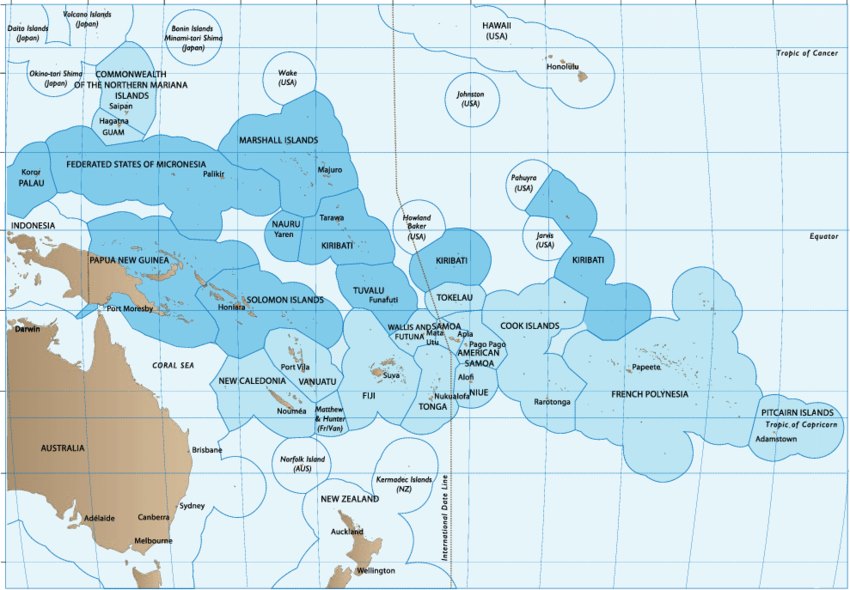
Estimated exclusive economic zones (EEZs) of Pacific Island countries and territories (PICTs). The EEZs of countries that are the Parties to the Nauru Agreement are shown in darker blue. Note that not all EEZs of PICTs have been officially delineated under the United Nations Convention on the Law of the Sea. Source: Patrick Lehodey

The Congressional Research Service (CRS) has published a two page “IN FOCUS” brief on “The Pacific Islands” of Micronesia, Melanesia, and Polynesia. Like all my links to CRS reports, this link will always take you to the latest version. It has already been updated at least once, 17 August, 2022.

Given the increased Coast Guard activity in the region, the report may provide useful background. The topics discussed are:

  • Overview
  • Geopolitical Context
  • The United States and the Region
  • The Freely Associated States
  • International Assistance
  • China’s Influence
  • Security Challenges
  • Self Determination

“U.S. Coast Guard participating in Operation Island Chief, Operation Blue Pacific 2022” –News Release

The USCGC Oliver Henry (WPC 1140) crew arrives in Manus, Papua New Guinea, on Aug. 14, 2022, from Guam as part of a patrol headed south to assist partner nations in upholding and asserting their sovereignty while protecting U.S. national interests. The U.S. Coast Guard is participating with partners to support the Pacific Islands Forum Fisheries Agency-led Operation Island Chief and the larger Operation Blue Pacific through patrols in the Western Pacific in August and September 2022. The other two patrol boats are Australian built Guardian class. (U.S. Coast Guard photo by USCGC Oliver Henry)

Just passing along this news release from U. S. Coast Guard Forces Micronesia/Sector Guam.


U.S. Coast Guard participating in Operation Island Chief, Operation Blue Pacific 2022

 The USCGC Oliver Henry (WPC 1140) gets underway on Aug. 8, 2022, from Guam for a patrol headed south to assist partner nations in upholding and asserting their sovereignty while protecting U.S. national interests.  The USCGC Oliver Henry (WPC 1140) crew, including ship riders from Papua New Guinea, the U.S. Marine Corps, and the U.S. Navy, take a moment for a photo aboard the ship off Manus, Papua New Guinea, Aug. 14, 2022.

Editor’s Note: Click on the images above to view more images and b-roll video
or download high-resolution versions.

MANUS, Papua New Guinea — The U.S. Coast Guard is participating with partners to support the Pacific Islands Forum Fisheries Agency-led Operation Island Chief and the larger Operation Blue Pacific through patrols in the Western Pacific in August and September 2022.

“Employing our unique authorities, capabilities, and access within Oceania is a privilege. We are eager to further integrate with our Allies and regional partners to protect national interests and combat illicit maritime activity such as illegal, unreported, and unregulated fishing,” said Capt. Nick Simmons, U.S. Coast Guard Forces Micronesia/Sector Guam commander. “Strengthening governance and modeling professional maritime behavior on the high seas and the surrounding waters is one way to counter predatory activity and reinforce the Pacific as a positive center of gravity and sustainable economy.”

The operation covers a substantial area of the Pacific on the high seas and the exclusive economic zones of the Federated States of Micronesia, Papua New Guinea, Australia, and the Solomon Islands, while renewing relationships bolstered by local knowledge and expertise.

The USCGC Oliver Henry (WPC 1140), a 154-foot Sentinel-class fast response cutter, and crew deployed from Guam are making their first port call of the patrol in Manus, Papua New Guinea. During the patrol, the cutter will also have aerial support from a forward deployed HC-130 Hercules airplane crew from U.S. Coast Guard Air Station Barbers Point and New Zealand Defence Force P3 Orion airplane crew. Where possible, the crew will also conduct subject matter expert exchanges and engagements.

Operation Island Chief is one of four operations conducted annually under FFA. It includes the Pacific waters of 11 participating FFA member nations – Fiji, Federated States of Micronesia, Kiribati, Palau, Papua New Guinea, Nauru, the Marshall Islands, Samoa, the Solomon Islands, Tuvalu, and Vanuatu.

“The Oliver Henry crew are committed to regional collaboration and sharing best practices to strengthen our relationships and information sharing,” said Lt. Freddy Hofschneider, commanding officer of Oliver Henry. “The U.S. Coast Guard has been a dedicated partner in the region for decades. We appreciate the support of our colleagues as we take this ship across vast distances in this region, making some transits and port calls for the first time.”

A significant emphasis of the operation for the U.S. Coast Guard is the ongoing emphasis on fisheries and resource protection.

“The Pacific Ocean is home to some of the world’s most abundant fisheries,” said Simmons. “These fisheries are living marine resources, part of the global food chain, representing food security and an economic engine for many of the Pacific Island Nations. By leveraging our cutters, aircraft, and intelligence professionals, the U.S. Coast Guard continues our strong partnership with the Pacific Islands Forum Fisheries Agency and its members to protect this vital marine ecosystem and ensure continued economic prosperity and a thriving ocean for future generations.”

According to FFA, partners are seeing increasing success through multilateral operations in the Pacific to tackle IUUF. These operations evolved from a focus on protecting against illegal boats entering the fisheries to policing the operations of licensed vessels that haven’t followed the rules and regulations governing their activities. The Pacific region is a vast expanse, and collaboration across the many partners, providing personnel and assets, is crucial to ongoing success.

The Oliver Henry is the 40th Sentinel-class fast response cutter. The ship arrived in Guam and was commissioned along with its sister ships, Myrtle Hazard and Frederick Hatch, in July 2021. In the time since, the crew has participated in several search and rescues cases, completed a counternarcotics patrol off Guam with the Japan Coast Guard patrol vessel Mizuho, and conducted sovereignty and fisheries patrols in the Forces Micronesia/Sector Guam area of responsibility.

For more U.S. Coast Guard Forces Micronesia/Sector Guam news, visit us on DVIDS or subscribe! You can also visit us on Facebook at @USCGSectorGuam.

-USCG-

Late Addition:The Sentinel-class fast response cutter USCGC Oliver Henry (WPC 1140) crew arrives in Port Moresby for a port visit on Aug. 23, 2022, following a patrol in parts of the Coral Sea, and the Solomon Islands and PNG Exclusive Economic Zones. The U.S. Coast Guard is conducting a routine deployment in Oceania as part of Operation Blue Pacific, working alongside Allies, building maritime domain awareness, and sharing best practices with partner nation navies and coast guards. (U.S. Coast Guard photo by USCGC Oliver Henry)

“Coast Guard Cutter Kimball conducts patrol to increase maritime presence and support in Pacific” –D14

USCGC Kimball (WMSL 756) U.S. Coast Guard photo by Chief Petty Officer Sara Muir

Below is a press release from District 14. This is a demonstration of the Coast Guard’s growing commitment to countering Illegal, Unregulated, and Unreported (IUU) fishing in the Western Pacific

News Release

U.S. Coast Guard 14th District Hawaii and the Pacific
Contact: 14th District Public Affairs
Office: (808) 535-3230
After Hours: HawaiiPacific@uscg.mil
14th District online newsroom

Coast Guard Cutter Kimball conducts patrol to increase maritime presence and support in Pacific

Editors’ Note: Click on images to download a high-resolution version.

HONOLULU — The Coast Guard Cutter Kimball (WMSL-756) concluded a successful two week expeditionary patrol in support of counter-illegal, unreported and unregulated fisheries enforcement, furthering the United States’ commitment to regional security and partnerships.

As part of Operation Blue Pacific, the crew of the Kimball deployed in support of national security goals of stability and security throughout the Indo-Pacific; the crew of the Kimball remains prepared to utilize training in targeted and intelligence-driven enforcement actions as well as counter predatory irresponsible maritime behavior.

While patrolling approximately 3,600 miles in the Philippine Sea, the Kimball’s law enforcement team conducted its first ever at-sea boarding and expanded on the multilateral fisheries enforcement cooperations such as the Western and Central Pacific Fisheries Commission.

The WCPFC is an international body made up of 43 nations and international organizations. Members agree to allow the 13 countries in the pact to board and record any potential violations on their nationally flagged vessels. The findings go to the WCPFC, who notifies the vessel’s flag state of the suspected infraction for further investigation.

“Our presence in the area shows our partners the Coast Guard’s enduring efforts to provide search and rescue response and oversight of important economic resources,” said Lt. Cmdr. Drew Cavanagh, operations officer for the Kimball. “The ongoing presence of a Coast Guard cutter in this part of the Pacific to assist in determining compliance with conservation management measures established by the WCPFC demonstrates the U.S. commitment to the region and our partners.”

The Coast Guard combats illegal fishing and other maritime threats across the Pacific to protect the United States and Pacific Island Countries resource security and sovereignty. Combating illegal fishing is part of promoting maritime governance and a rules-based international order that is essential to a free and open Oceania.

While on patrol, the Kimball was briefly diverted to assist in a search and rescue case in the Federated States of Micronesia where they utilized a small unmanned aircraft system, or sUAS. Use of sUAS expands maritime domain awareness and provides persistent airborne surveillance on maritime hazards, threats, and rescue operations.

“Training is also an important component of underway time and affects our readiness,” Lt. j. G. Joseph Fox, assistant combat systems officer for the Kimball. “The team conducted law enforcement training as well as disabled vessel towing training for our newest crewmembers.”

The Kimball is one of the newest national security cutters to be homeported in Honolulu. These technologically-advanced ships are 418 feet long, 54 feet wide and have a 4,600 long-ton displacement. They have a top speed in excess of 28 knots, a range of 12,000 nautical miles, endurance of up to 90 days and can accommodate a crew of up to 150.

Advanced command-and-control capabilities and an unmatched combination of range, speed and ability to operate in extreme weather enable these ships to confront national security threats, strengthen maritime governance, support economic prosperity, and promote individual sovereignty.