“Coast Guard Force Design 2028” –News Release

The U.S. Coast Guard’s headquarters campus in Washington, D.C.

Below is a Coast Guard News Release.

It is too early to say where these changes will take the Coast Guard, but both the acting Commandant and the Senior Advisor to the Secretary for the Coast Guard (SASCG) Mr. Sean Plankey, are Coast Guard Academy graduates (class of 1987 and 2003). Both seem to be firmly grounded in the military nature of the Coast Guard. Both have spent a lot of time in close contact with DOD.

“Force Design 2028 is the way we will become a more agile, capable, and responsive fighting force (emphasis applied–Chuck) to best serve the American people,” ADM Lunday said.

Some of the steps outlined in Force Design 2028 appear specifically intended to move the Coast Guard closer to DOD.

–Align with the DoD’s “Rapid Force-Wide Review of Military Standards” for physical fitness, body composition, and grooming standards. We’ll follow DoD standards to the maximum extent possible and build processes that are necessary to ensure total force readiness.

–Increase Coast Guard engagement with the Defense Innovation Unit (DIU) to accelerate technology and capability acquisition and adoption by leveraging leading edge disruptive technology development in the private sector. This includes increasing our footprint at DIU and maximizing the number of training allowance billets available at the DIU Immersive Commercial Acquisition Program.

I certainly see a need for more attention to the Coast Guard’s Defense Readiness Mission and to Ports, Waterways, and Coastal Security.

My impression is that the Coast Guard will be increasingly focused on protecting the Maritime Transportation System, particularly in cyberspace.


April 3, 2025

Coast Guard Force Design 2028

By MyCG Staff

Acting Commandant Kevin E. Lunday recently announced Force Design 2028 (FD 2028). Directed by Department of Homeland Security Secretary Kristi Noem and led by the Senior Advisor to the Secretary for the Coast Guard (SASCG) Mr. Sean Plankey, FD 2028 is creating a blueprint to ensure the Service is ready for the future and the Nation’s demands.

“Force Design 2028 is the way we will become a more agile, capable, and responsive fighting force to best serve the American people,” ADM Lunday said.

FD 2028 is focused on four campaigns:

  • People
  • Organization
  • Acquisition and Contracting
  • Technology

Here are some details about each campaign, including some of the first steps already underway. Additional details can be found in ALCOAST 155/25.

People
We are building the Coast Guard’s future force, starting today. Increased national demand for our Coast Guard requires a larger, more capable military workforce. This campaign will improve training systems, boost access to medical care, and modernize both the Coast Guard Reserve and the civilian management system.

Early actions:

  • Align with the DoD’s “Rapid Force-Wide Review of Military Standards” for physical fitness, body composition, and grooming standards. We’ll follow DoD standards to the maximum extent possible and build processes that are necessary to ensure total force readiness.
  • Starting in Promotion Year 2026, best qualified selection boards will be required to employ in-zone reordering to the maximum authorized by law to reorder those officers of particular merit for promotion.
  • Remove administrative burdens on our members by reducing reporting and other requirements that are redundant and of little value. (See ALCOAST 145/25 for details.)
  • Restore maximum Commander and Officer-in-Charge discretion and flexibility in their use of non-judicial punishment (NJP) under Article 15 of the Uniform Code of Military Justice (UCMJ).  This change is consistent with the ultimate responsibility entrusted to commanders to maintain good order and discipline at their units.

Organization
As global security threats, technological advancements, and operational demands continue to evolve, the Coast Guard must adapt its organizational construct and internal decision making and governance processes to remain relevant, effective, and responsive.

Early actions:

  • Delegate operational authorities to the appropriate level of command to increase mission effectiveness and reduce risk to Coast Guard personnel. The recent delegation of non-compliant vessel use of force authorities to pursuit coxswains and cutter commanding officers is one example that empowers those at the tactical edge with the authorities, capabilities, and effective command and control needed to deliver operational results.
  • Establish a USCG HQ Director of Staff, reporting to the Vice Commandant, who is responsible for streamlining executive decision-making, enhancing agility and integration, aligning strategic messaging, and optimizing HQ processes.
  • Restructure the Deputy for Personnel Readiness (DPR) enterprise to optimize support for our most valuable resource-our people. This transformation establishes a comprehensive, people-centric approach across four business lines: accessions and training, total workforce management, workforce and family services, and healthcare delivery. We will separate policy/program management from service delivery to best meet the needs of our people.
  • Restructure the Deputy for Materiel Readiness (DMR) enterprise to focus on a systems approach to assets, ensuring the Coast Guard has the right capabilities, in the right place, at the right time. This transformation includes creating new business lines to oversee the total lifecycle management of our surface, air, C5I, and shore infrastructure, and integrating acquisition and sustainment functions for greater efficiency and effectiveness.
  • Establish the Assistant Commandant for Operational Integration and Response Policy (CG-3/5R) to align operational integration and planning at the Service level to increase decision-making speed and resource allocation to our operational commanders and advance national level planning and preparedness while increasing situational awareness for the Secretary, Department, Joint Staff, and Interagency partners.

Acquisitions and Contracting
Develop a high velocity acquisition and contracting system to rapidly deliver the assets the Service needs to fulfill its commitment to the American people.

Early actions:

  • Eliminate or minimize bureaucratic delays to delivering the assets the Service needs. An example is the recent elevation the Simplified Acquisition Procedures and micro- purchase limits to the maximum extent allowed by law and regulation, ensuring rapid distribution of goods and services to the field units charged with carrying out our front-line missions.
  • Increase Coast Guard engagement with the Defense Innovation Unit (DIU) to accelerate technology and capability acquisition and adoption by leveraging leading edge disruptive technology development in the private sector. This includes increasing our footprint at DIU and maximizing the number of training allowance billets available at the DIU Immersive Commercial Acquisition Program.
  • Improve the speed of contracting and procurement by empowering our contracting professionals in the field, reducing redundant and sequential approval and review process that add unwarranted mission risk.
  • Provide improved transparency and accountability in the contracting process through development of a quick-to-field contract tracking system and establish clear metrics and targets that consider mission impact.

Technology
The Coast Guard will accelerate the adoption of secure, state-of-the-market technologies to enhance data sharing, situational awareness, and operational effectiveness.

Early actions:

  • Leverage efficient industry solutions to dramatically accelerate the Authority To Operate (ATO) process for Information Technology systems and achieve the goal of ATOs in 30 days. This will begin with the Software Factory and minimize bureaucratic delays to deliver essential capabilities required for Coast Guard mission success.
  • Establish data teams in each mission domain to make sure we’re fully leveraging data to improve operations.
  • Establish a Rapid Response Rapid Prototype Team to transform how we deliver mission-critical technology solutions. This effort will span operations, engineering, acquisitions, finance, information technology, logistics, data science, and change management/integration – delivering proven innovation where it matters most.

How we will stay on course

An FD 2028 implementation team comprised of permanently assigned military and civilian personnel is being established and will report to the new Director of Staff.  The team will coordinate a Coast Guard wide effort to implement the Secretary’s intent on FD28 as well as continue the actions already started.

“We are executing transformational change to renew the Coast Guard,” said ADM Lunday.  “Force Design 2028 will ensure the Coast Guard remains Semper Paratus, Always Ready, to serve the American people.”
“Maritime Coastal Border Security and the Role of USCG R&D” –Marine Link

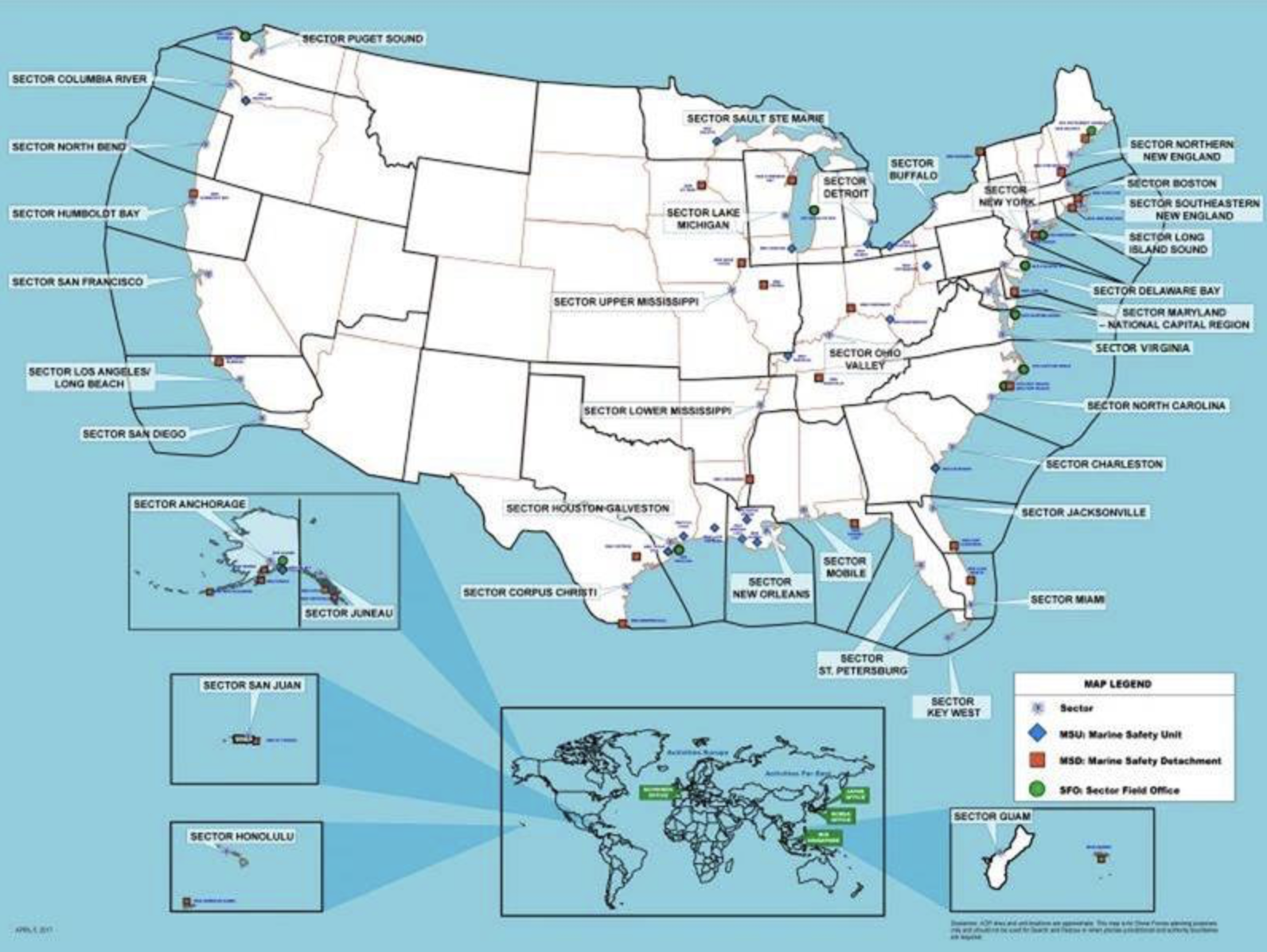
Map shows the locations of 37 Coast Guard Sectors. Source: https://homeport.uscg.mil/Pages/Sector-Map.aspx

Marine Link provides a post by Bert Macesker, Executive Director, USCG Research and Development Center and Dr. Joe DiRenzo, the Center’s Partnership Director, that discusses what the Coast Guard R&D Center is doing to enhance maritime border security in all its forms.

Where is Our Air Cover?

I am not really suggesting this, but having some Air National Guard on call would be comforting.

There is a hole in US defenses and the Coast Guard is likely to be the first to see the threat, “Who yah gone call?”

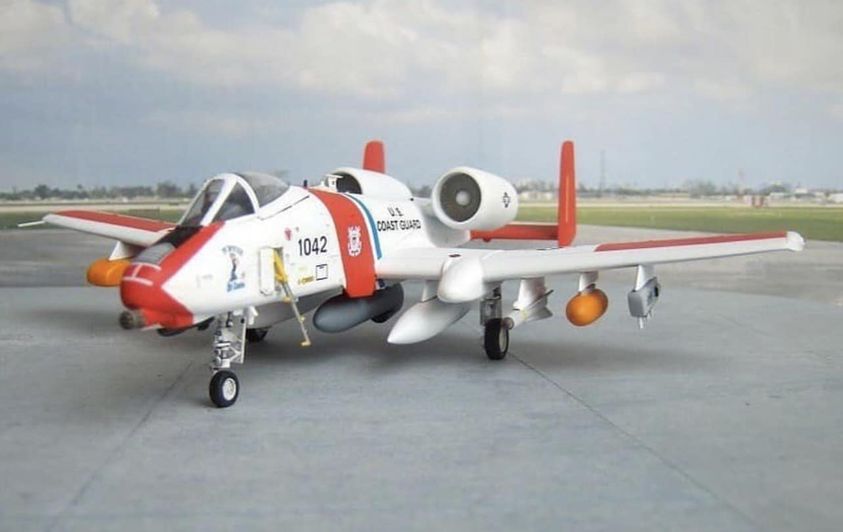
  • MSN reports on the growing maritime role of Air Force A-10s.
  • A bit more on how A-10s have been used in a maritime role here and here
  • I also seem to remember seeing that A-10s based in S. Korea have also trained to counter N. Korean small boats. A-10s can be a powerful anti-shipping weapon system.

If a threat, in the form of a merchant ship with containers that may be filled with missiles, mines, terrorists, a dirty bomb, a nuclear bomb, or whatever horror the mind of man can imagine, should be headed for the US, the Coast Guard is the most likely agency to detect the threat. But then what?

Can your local sector commander or even district commander call for air support from a DOD unit poised to strike a target at sea in a timely manner? I don’t think so.

NORAD, the North American Aerospace Defense Command, does have a modest number of aircraft on standby, prepared to intercept air threats, mostly air national guard, but they are not trained, equipped, or prepared to take out maritime targets.

I have (several times) suggested that the Coast Guard needed at least the ability to forcibly stop any vessel, regardless of size. That would presumably allow DOD forces sufficient time to organize a response because we don’t have one pre-packaged.

I would feel a lot more comfortable if DOD units, assigned an anti-shipping role, were on standby, practiced and exercised, ready to respond to a Coast Guard call for help.

They might be Marine cruise missiles, Army attack helicopters, or Navy maritime patrol aircraft, but Air Guard A-10s look promising. This could also prepare these units for an anti-shipping role in wartime.

Target designation is always a problem in multiunit operations. Every Coast Guard unit should have at least a hand held laser target designator to allow them to mark a target for DOD units.

I know an attack using a merchant ship seems unlikely, at least in peacetime, but 9/11 was unlikely and look at the fallout from our failure to respond appropriately to the hijackings in progress, not just those killed on the ground on that day, but also two fruitless wars.

“Preserving Alaska’s living marine resources” –D17

USCGC Bertolf class National Security Cutter off Unimak Island, Aleutians, Alaska

Below is a summary of District 17’s Living Marine Resources conservation and management efforts. There is also information about the Magnuson-Stevens Fishery Conservation and Management Act (MSFCMA), 1976, that resulted in the expulsion of foreign fishing vessels from a 200 mile Exclusive Economic Zone even before the United Nations Convention on Law of the Sea and about the North Pacific Regional Fisheries Training Center (NPRFTC) (one of five such centers) that “teaches the enforcement of Conservation and Management Measures on behalf of four international fisheries commissions and 62 signatory nations across North and South America, Asia, Oceania, Europe, and Africa, covering over 80 percent of the Pacific Ocean​.”


April 20, 2023

Preserving Alaska’s living marine resources

ANCHORAGE, Alaska — Alaska supports some of the most abundant and diverse marine ecosystems in the world. With more than 46,000 miles of shoreline – more than all of the lower 48 U.S. states combined – the ocean is an integral part of Alaska’s ecosystems, economy, history and culture. According to National Marine Fisheries Service’s (NMFS) Fisheries of the United States 2020 report, U.S. commercial fisheries landed 8.4 billion pounds of seafood valued at 4.7 billion dollars, 199-million saltwater recreational fishing trips were taken, and recreational anglers caught one billion fish with 65 percent released alive. According to the 2019 report, commercial and recreational saltwater fishing supported 1.8 million. Alaska produces more than half the fish caught in waters off the U.S. coast, provides jobs and a stable food supply for the nation, and supports a traditional way of life for Alaska Natives and local fishing communities. Protection of the state’s 5.7-billion-dollar domestic fishery has never been more crucial.  

The living marine resources (LMR) mission is one of two missions focused on protecting fisheries in and outside U.S. waters. The Coast Guard is responsible for enforcing LMR regulations on domestic, commercial, recreational, and charter fishing vessels. Tasked with enforcing applicable fisheries laws in partnership with the NMFS, the Coast Guard’s goal is to provide the at-sea law enforcement presence necessary to reach national goals for LMR conservation and management. Vessel boardings are a critical component to accomplishing this mission providing an opportunity for teams to inspect a vessel’s catch, gear, and other items to ensure regulatory compliance as well as safety.

“The 17th Coast Guard District’s LMR mission is to promote a level playing field in Alaska’s extremely valuable commercial fisheries, protect resources, and ensure safety of life at sea,” said Lt. Cmdr. Jedediah Raskie, D17’s domestic fisheries enforcement chief. “The LMR enforcement mission is a complex operation requiring in-depth planning, multilateral partnerships and inter-agency collaboration. A continued at-sea presence is crucial, and this is only accomplished through dedication and teamwork with our enforcement partners.”

Those partners include:

Coast Guard – Coast Guard Cutters from Alaska, Washington, Hawaii, and California, Sector Anchorage, Sector Juneau, North Pacific Regional Fisheries Training Center, Maritime Safety and Security Teams (MSSTs)

State – Alaska State Troopers, Alaska Department of Fish and Game (ADF&G), local law enforcement

Other Federal – NOAA’s Office of Law Enforcement (OLE), Department of State, U. S. Drug Enforcement Administration, Customs and Border Protection (CBP)

Collectively in 2022, D17 patrolled 10,723 NMs, conducted 654 federal LMR enforcement boardings (11 on foreign-flagged vessels), detecting 30 violations on 26 vessels, and seizing catch on three fishing vessels. The top five fisheries violations include logbook discrepancies, no Individual Fishing Quota (IFQ) permit onboard, expired or no federal fisheries permit (FFP) onboard, sea-bird avoidance gear not onboard or improperly constructed, and improperly marked buoys on fishing gear.

“Right now, our teams are heavily involved with enforcement surrounding the opening of Pacific halibut and sablefish season,” said Lt. Cmdr. Jedediah Raskie. “The Pacific halibut and sablefish Individual Fishing Quota (IFQ) program is the largest catch share program in the U.S. and comprises 90 percent of D17’s total fisheries boardings.”

With the IFQ program, each fisherman has a catch quota that can be used during the open season from March to November. The North Pacific Fishery Management Council developed this program to address issues associated with the race-for-fish that had resulted from the open-access and effort control management of the halibut and sablefish fisheries. Top IFQ violations include: not having an official logbook onboard, no IFQ permit and/or FFP onboard, illegally retaining and/or mutilating halibut, and failure to retain and/or log retaining Pacific cod and rockfish.

Background

The Magnuson-Stevens Fishery Conservation and Management Act (MSFCMA) is the primary law governing mariner fisheries management in U.S. federal waters. The act’s keys objectives are to prevent overfishing, rebuild overfished stocks, increase long-term social and economic benefits, and ensure a safe and sustainable supply of seafood. Prior to the MSFCMA, waters beyond 12 NM were international waters and fished by fleets from other countries.

This 1976 law created eight regional fishery management councils responsible for the fisheries that require conservation and management in their region. The councils are charged with conserving and managing fishery resources from 3 to 200 miles off the coast while the State of Alaska manages fisheries that occur within 3 NM from shore. To learn more, visit  About the MSA — U.S. Regional Fishery Management Councils (fisherycouncils.org)).

The North Pacific Fishery Management Council (NPFMC) is one of the regional councils established to oversee fisheries in the 200-mile Exclusive Economic Zone (EEZ). With a jurisdiction of approximately 1,025,000 NM, the council manages more than 140 species within 47 stocks and stock complexes, primarily groundfish in the Gulf of Alaska, Bering Sea, and Aleutian Islands, targeting cod, pollock, flatfish, mackerel, sablefish, and rockfish species harvested by trawl, longline, jig, and pot gear. The council also makes allocation decisions for halibut in concert with the International Pacific Halibut Commission that biologically manages the resource for U.S.-Canada waters. Other large Alaska fisheries for salmon, crab, and scallops are managed jointly with the State of Alaska. More at North Pacific Fishery Management Council – Managing Our Nation’s Fisheries Off The Coast Of Alaska (menlosecurity.com).

To better enforce the fishery council’s management plans, the Coast Guard determined that region specific training was necessary to ensure boarding officers received adequate instruction in enforcing the increasingly complex laws that govern our nation’s living marine resources. The Coast Guard’s five fisheries training centers are dedicated to providing training in LMR and protected marine species law enforcement to eliminate natural resource degradation associated with recreational boating, recreational fishing, commercial fishing, and illegal incursions by foreign fishing vessels into our EEZ.

The North Pacific Regional Fisheries Training Center (NPRFTC) in Kodiak trains students operating across the vast and harsh environments of the Seventeenth Coast Guard District, to include the Arctic Ocean, Bering Sea, Aleutian Islands archipelago, Gulf of Alaska, and the Inside Passage, an area that encompasses 3,853,500 SQ NM of sea and more than 47,300 miles of coastline. NPRFTC also teaches the enforcement of Conservation and Management Measures on behalf of four international fisheries commissions and 62 signatory nations across North and South America, Asia, Oceania, Europe, and Africa, covering over 80 percent of the Pacific Ocean​. NPRFTC personnel provide instruction to surface and aviation law enforcement crews, command personnel and supporting staff, and deployable specialized forces units. Upon completion of the training, boarding officers are then charged with carrying out the LMR by performing at-sea boardings to ensure compliance.

The nation’s waterways and their ecosystems are vital to the country’s economy and health. The Coast Guard’s LMR mission is to assist in preventing the decline of marine proteced species populations, promote the recovery of marine protective species and their habitats, partner with other agencies and organizations to enhance stewardship of marine ecosystems and ensure internal compliance with appropriate legislation, regulations, and management practices.

“‘Protect. Defend. Save’: Coast Guard Launches New Recruiting Initiatives to Attract Members” –Military.Com

(U.S. Coast Guard illustration)

Military.com has a post about the Coast Guard’s new recruiting initiative including the new logo above.

I really like the closing paragraphs,

To continue to provide a high level of operations, Fagan said, the service will need a 3% to 5% budget increase each year, which means, by 2033, the Coast Guard would be a “$20 billion a year organization.”

“I’m certain you will not find a better return on investment for the American people,” Fagan said.

Choice of words is important. Defend and perhaps protect, suggest to me, more emphasis on the Defense Readiness mission. Wonder if that was really the intention?

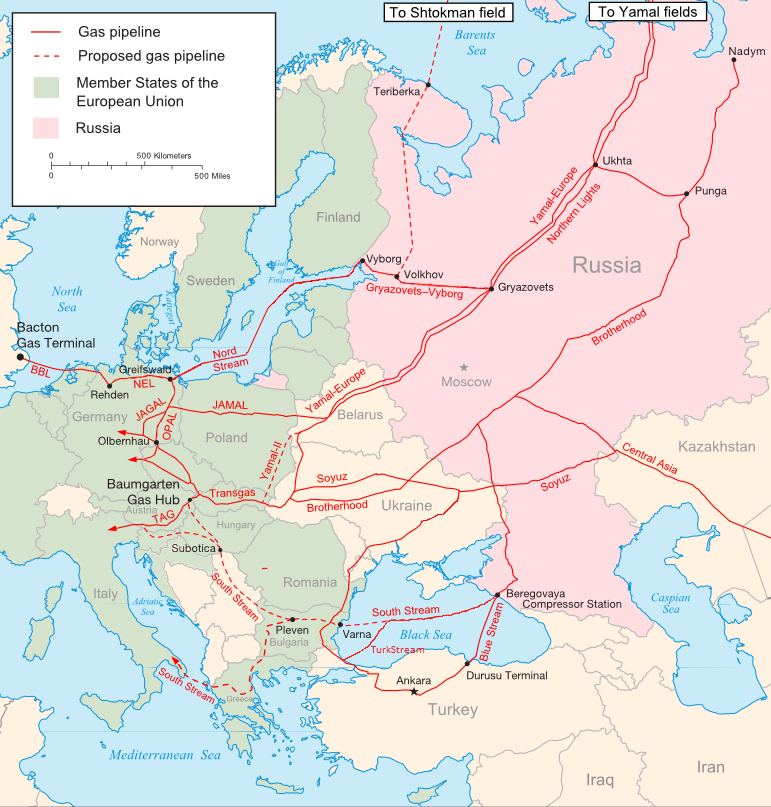
“Nordic Countries’ Response To Nord Stream Sabotage” –Naval News

File:Major russian gas pipelines to europe.png Created: 15 November 2009 Prepared by Samuel Bailey (sam.bailus@gmail.com)

Naval News reports on the Nordic response to the apparent sabotage of the Nord Stream pipeline. Coast guards are involved.

This raises the question of who protects undersea infrastructure? I don’t think there has been a lot of interest in or discussion of this question in the US. Certainly the USCG has a role.

The Air Force’s New Ship Killer (QuickSink) with Torpedo Like Effects

The first Air Force Research Lab video above talks about a new weapon, but it is also recognition of a new threat.

Let’s talk about what is wrong with the scenario in the video, how the Coast Guard could use this new weapon, along with the “Rapid Dragon” delivery system, and why the Coast Guard not only could, but should be the agency to use this weapon against this particular threat.

The Scenario:

NORTHCOM is worried about the cruise missile threat to the continental US, including the possibility of large numbers of missiles launched against priority targets.

“Conventional cruise missiles or hypersonic cruise missiles, low-radar cross-section cruise missiles, cruise missiles from Russia, cruise missiles from China, potentially other countries. Cruise missiles that can be launched from undersea, from 100 miles-plus off the coast. Cruise missiles from on the sea. … Cruise missiles from the air. Cruise missiles from commercial vehicles launched out of a container that can be masked as part of the commercial ship. (emphasis applied–Chuck)

The video shows a ballistic missile being preped for launch from a container. That is possible, but cruise missiles are more likely. In any case, potential actions to stop the launch would be the same.

In the video we see a Navy P-8 Maritime Patrol Aircraft monitoring the activities of a suspicious container ship. Presumably the war has not started since they don’t call for an Air Force fighter to bring in the weapon until the P-8 sees a launcher being elevated for missile launch. This is really too late to call the Air Force. Before the Air Force can get a fighter on scene, the missiles will have been launched. The aircraft monitoring the ship’s activity should be able to immediately initiate countermeasure. The P-8 Poseidon is capable of carrying Anti-Ship Cruise missiles of 725 kg (1,598 lb). It might be able to deploy the QUICKSINK weapon seen in the video which is based on a 2,000 pound bomb. It could certainly deploy a similar weapon based on the 1000 pound bomb. The problem is that, at this stage in the run-up to war, P-8s should be looking for submarines that might also launch cruise missiles, and fighter aircraft don’t have the endurance to loiter on scene waiting for something to happen. They would also be needed to intercept any cruise missiles that are launched.

The Weapon:

In the actual sinking, this was a big bomb used against a small ship, but the key to its effectiveness what where it exploded.

The weapon is discussed here, “Air Force destroys target vessel with ship-killing JDAM.” It clearly is intended to exploit the non-compressibility of water to allow a weapon that would not normally immediately sink a ship, if it hit above the waterline, to break the ship in half.

“In a September 2021 interview with Military.com, Meeks said one of the bomb’s modifications was a redesigned nose plug. This is intended to keep the bomb from veering off in an unintended direction if it hits the water before the target, which Meeks likened to skipping a stone across the surface of a pond.”

There is additional information about the seeker here, including how it works (GPS to get to the general area, then radar, and imaging IR), expected cost (substantially less than $1M for the all up rounds bought in quantity), and range (15 miles, potentially more with range extending wing kits).

As I have pointed out numerous times, no other non-nuclear weapon equals a modern torpedo’s ability to sink a ship. Apparently the Air Force agreed and decided to develop a weapon that would kill a ship in the same way a modern torpedo does, by detonating under water, preferably below the keel, rather than by directly hitting the target above the waterline. Looking at the videos, it appears the bomb enters the water, almost vertically, close to the port side. We see the familiar lift of the center section as we have seen many times when a Mk48 torpedo is used against a surface target, after which the ship breaks in half. For comparison, here is a destroyer hit by a Mk48, and a Mk48 torpedo’s warhead contains far less explosive than a 2000 pound bomb.

The Launch Platforms:

The weapon can be used on a wide variety combat aircraft. The video shows and F-35 and the actual test was done with an F-15, but there is no reason this could not In fact be dropped from a Coast Guard fixed wing using the “Rapid Dragon” concept.

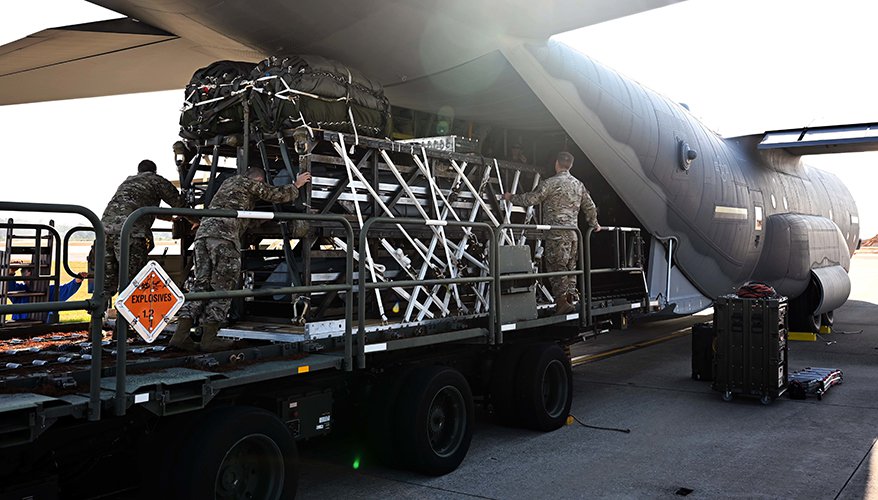
Rapid Dragon hardware being loaded on a C-130. USAF photo.

Why Coast Guard?:

It is not that the Coast Guard will necessarily be the only ones doing this mission, but the Coast Guard does seem to be particularly well suited for the purpose.

If we are to keep watch on vessels off the US coast in the run up to war, you want aircraft with long endurance. You want excellent communications. You want good electro optics so that you can watch what is happening on a ship from outside the range of shoulder launched air defense systems (MANPAD). You get all that with Coast Guard fixed wing aircraft equipped with the Minotaur system. Using Air Force’s QUICKSINK modified JDAM from the Rapid Dragon launcher means we can have a single unit that can remain on station for an extended period, observe the actions of target of interest, communicate effectively, and if necessary promptly eliminate a threat while freeing other assets like the P-8 and fighters to do jobs only they can do.

It would not be necessary for the Coast Guard to store the weapons or arm the aircraft if a agreement could be reached allowing DOD facilities to load the Rapid Dragon and weapons. Actually targeting would be done by DOD assets anyway. It appears this mission could be performed, even to our smallest fixed wing, the HC-144.

Is it doable?:

A recent report suggests that it is. Lt. Gen. James Slife, who leads Air Force Special Operations Command said, “It doesn’t require any aircraft modifications, it doesn’t require any special aircrew training.”

Might be of interest to compare the amount of ordanance used in this SINKEX. It should be recognized that this retired USN frigate was probably a larger, more resilient target than the one used in the “QUICKSINK” demonstration, but I suspect, if QUICKSINK had been used agains the frigate, the results would have been the same, though it probably would have taken the two halves of the ship longer to sink.

What is an Ideal Coast Guard Military Readiness Mission? We Provide the Truck and Driver, Navy Provides the Load

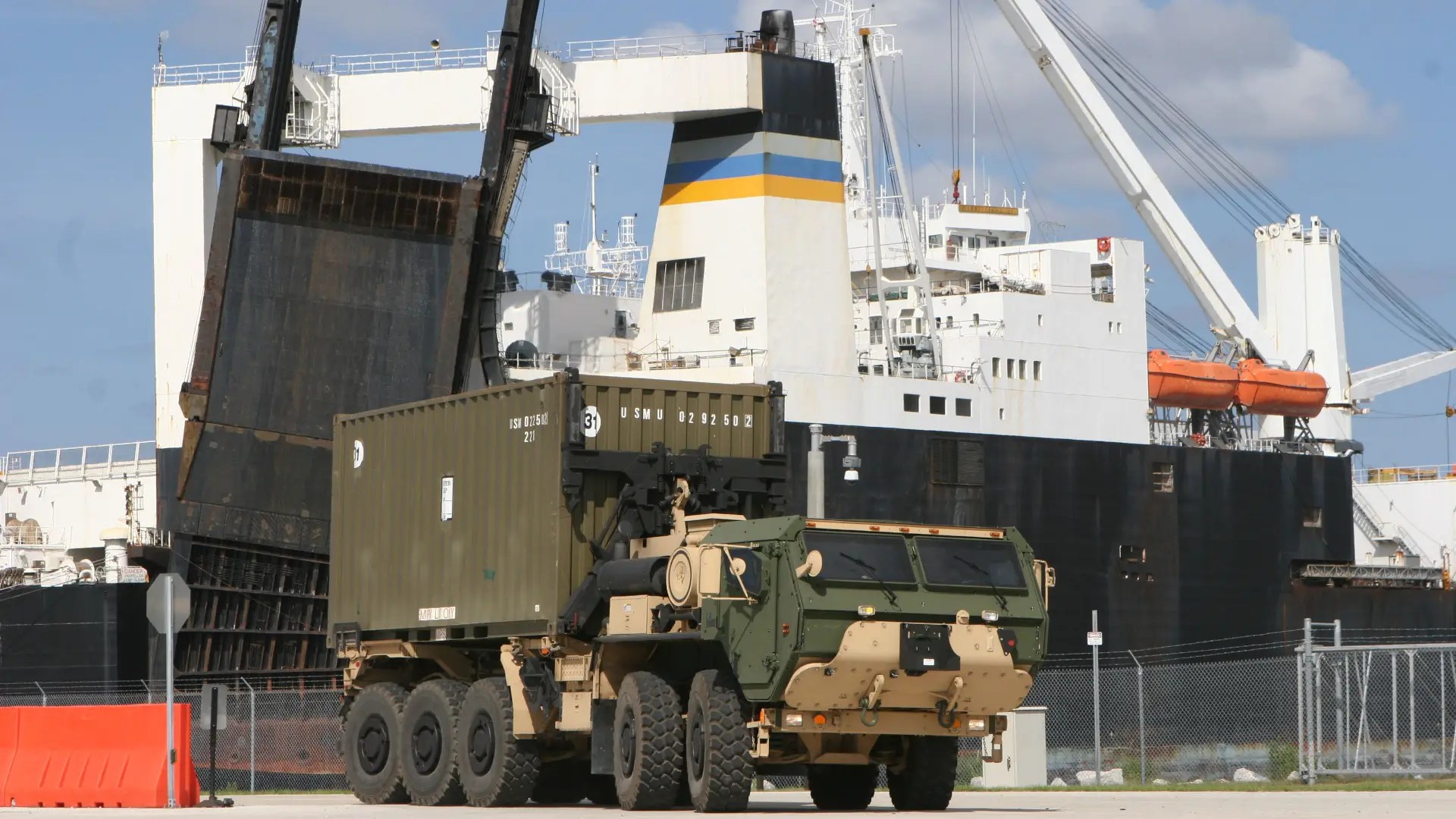
A US Marine Corps Logistics Vehicle System Replacement truck carrying a standard shipping container with a Navy logistics vessel in the background. The Navy is now working on a project to develop a containerized electronic warfare and electronic intelligence system that will work on various naval, air, and ground platforms. USMC / Lance Cpl. Shawn Valosin

The US Coast Guard has had a long history of participation in almost every armed conflict the US Navy has engaged in. But there has always been a tension between peacetime economy and effectiveness and readiness for war.

Some military systems are essential for our peacetime missions, like minimal deck guns or muti-mode radars, we would probably have them, even if we had no wartime missions.

Some military equipment we would be unlikely to have, if we had no military missions, can enhance performance of peacetime missions, like data links and electronic warfare systems. These systems are welcome.

Then there are systems that would enhance our wartime effectiveness that have little or no utility in peacetime. If they require significant training and maintenance time, they can adversely effective peacetime economy and effectiveness. There is an argument to be made that these still offer good return on investment compared with making a similar investment in DOD assets, but diverting DHS assets to support DOD missions can be a hard sell.

Ideally, we would want Coast Guard assets to do their peacetime missions without having to think about wartime missions until mobilization, but when needed, DOD would quickly and easily add capabilities and trained operating personnel.

That is not always possible, but in some cases we might be able to come close to that.

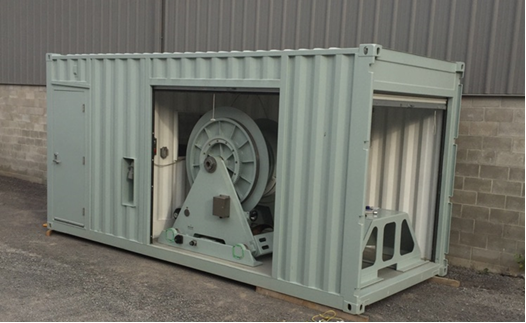
The Danes showed how to make modular naval weapon and sensor systems with their SanFlex system. Now we regularly see announcement of some new modular system. Here, here, here, here, here, here, here, here, and  here.

TRAPS containerized active/passive towed array from GeoSpectrum Technologies.

Towed sonars can be containerized, here, here, and here.

I even proposed a containerized weapon system.

What I think we need, after determining the most appropriate mission set for Coast Guard units is a determination of what:

  • must be permanently installed and operated by Coast Guard personnel at all times,
  • what can be quickly installed and operated in the event of a crisis, and
  • what can be added in the form of modular equipment maintained by the Navy and to be operated by Navy Reserve personnel upon mobilization.

A primary example of the latter would be an ASW helicopter. Unmanned systems also look like likely candidates for systems that could be quickly added to Coast Guard vessels.

Unmanned mine hunting and destruction equipment might be based on Coast Guard buoy tenders to allow them to look for mines in US waters, including those around Alaska, Hawaii, Guam and Saipan. In fact the Navy is making some extra LCS Mine CounterMeasures (MCM) for ships of opportunity.

If the Navy wanted Coast Guard cutters to augment Navy ASW forces, a likely mission if we have a war with China, they could become useful units by the addition of a modular version of the Navy’s towed array sonar systems and assignment of experienced ASW personnel and an MH-60R aviation detachment. We would need to have identified where we would store torpedoes, sonobuoys, and other support equipment, but those spaces could have other uses in peacetime.

The Coast Guard’s Air Policing Job Over DC and Armed Overwatch

Back in 2014, I published a post, Random Thoughts on CG Aircraft Missions,
that among other things, talked about the Coast Guard’s air policing/intercept duties over the National Capital, now being done by MH-65s, and use of fixed wing aircraft to provide air borne use of force support for Webber class cutters, which is a capability we currently do not have. 
We may have a unique opportunity to address the problems discussed, using excess USAF assets at little or no cost. In the case of the Air Policing operation it might even reduce operating costs.
To outline the problems, as I see them, I will simply repeat the arguments from the earlier post.
The DC intercept: The problems with the current use of H-65s for intercepting general aviation aircraft that violate the standing airspace restrictions over the capital is that: (1) Many general aviation aircraft have a higher maximum air speed than the helicopter. (2) Even if the target is slower, the relatively slow speed of the helicopter may make achieving an intercept problematic. (3) If the aircraft is in fact hostile, the helicopter has to hand over the task of destroying it to an interceptor aircraft or missile battery introducing the possibilities of delays and misdirection.
Airborne use of force for law enforcement: In the Webber class cutters, the Coast Guard has an asset that can perform many of the missions normally expected of a medium endurance cutter, including drug and migrant interdiction, but they do not enjoy the advantage of organic aviation assets. There is no helicopter to augment their search, to chase down high speed contacts, or to use force to compel them to stop. When boardings are performed, they have neither a second boat nor an armed helicopter to provide over-watch as their boarding team approaches a suspected trafficer.
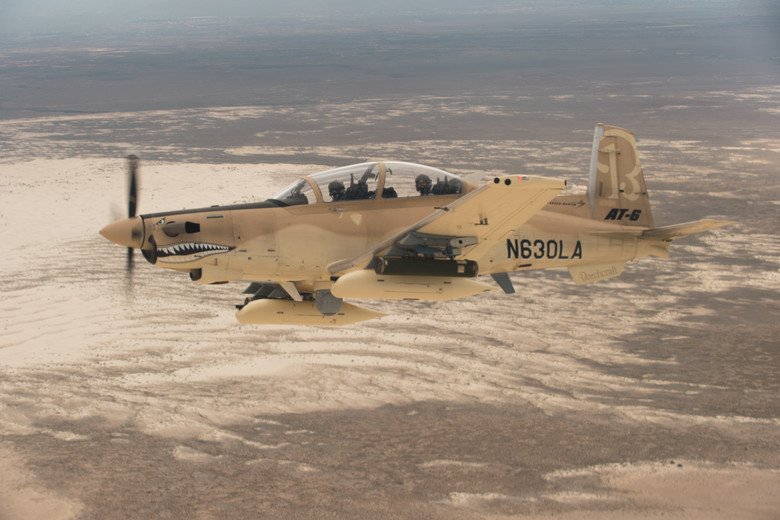
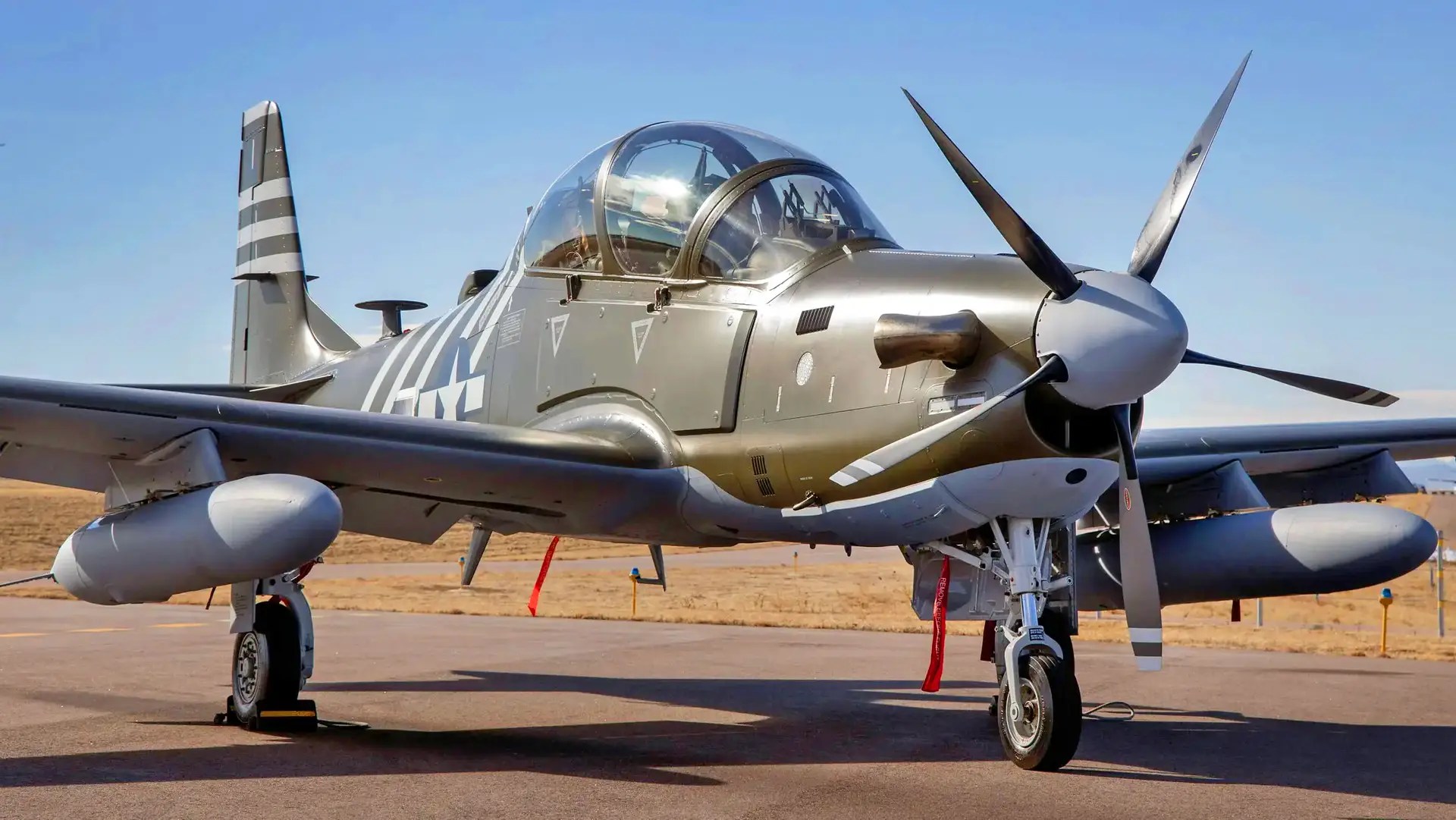
A couple of the aircraft I suggested might be appropriate for these roles were the A-29 Super Tucano and the AT-6 Wolverine.

The second A-29 Super Tucano for Air Force Special Operations Command, which received this one-off heritage scheme honoring the 1st Air Commando Group of World War II. Sierra Nevada Corporation

It just so happens, the Air Force has three A-29s and two AT-6s that are excess, now less than two years old, and they plan to dispose of them.
Compared to our helicopters, these aircraft have greater speed, range, and endurance and are, I believe, less expensive to operate. They are certainly less expensive to operate than our twin engine fixed wing aircraft.
In addition, these aircraft have excellent electro-optics and both air-to-air and air-to-surface capability, should it be necessary.
Replacing the H-65s providing air policing over DC, with the three A-29s, would not only provide a more capable interceptor, one still capable of operating at low air speeds, it would also reduce wear and tear on the H-65 fleet, whose maintenance has become problematic. As Air Force Special Operations Force aircraft, these planes may be better equipped to interface with the Capital Area Air Defenses, including F-16s and Army Surface to Air missile batteries than the MH-65s.

Basing the two AT-6s out of Puerto Rico would allow them to provide armed overwatch to Webber class WPCs in an area of intense activity. They could also be used as search assets given their excellent capabilities. The AT-6s are based on the T-6 Texan II trainer that is used to train all military aviators including Coast Guard. I understand there are now over 1000 T-6s and the two aircraft have 85% parts commonality.

If we chose to arm these, beyond their organic .50 cal. machine guns, we could probably make an arrangement with a nearby DOD air base to arm the aircraft.

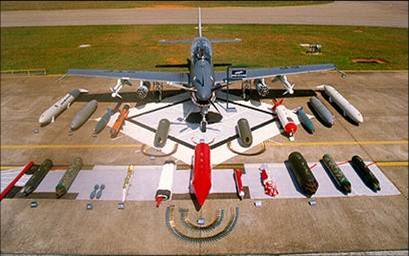
An A-29 Super Tucano with potential external stores. 

30mm as Replacement for the 25mm?

From Back Left: 40mm grenade casing, 30x173mm (A-10/M44), 30x113mm (M230), 25x137mm (M242/Mk38 gun mount), 20x103mm (Phalanx), 50 BMG
foreground: 300Blackout (typical rifle round), 9mmx19 (typical pistol round)

We have known for a long time, the 30mm was much more effective than the 25mm even against relatively small vessels. We really did not need the test to show that, physics is very much on the side of the larger round, but the revalation was how ineffective the 25mm using HEI rounds, really was.

More recently, two options that are not available for the 25mm, have made the case for the 30mm even more compelling, an airburst round that can be used against UAVs and a swimmer round that is much more likely to penetrate the hull if if it hits the water short of the target, subjecting the target to flooding.

Then we saw reports that the Navy was procuring a new, very different Mk38, the 30mm mod4.

Recently, one of our readers, Secundius, in an in comments discussion of the status of the ALaMO guided 57mm projectile program, pointed to a document that reports the funding of Navy Department ammunition purchases. (Incidentally the ALaMO round is in service now. MAD-FIRES is in a 27 month, third stage of development, that should end, January 2023.)

Using the document, I took a look at “other ship gun ammunition,” specifically looking at 25 and 30mm ammunition, in hopes of seeing evidence of fielding of the 30mm Mk38 Mod4.

If I am reading Vol. 1-127 correctly, the Navy bought only target practice rounds for the 25mm in FY2020 and 2021, and no 25 mm rounds in FY2022. On the other hand, in regard to 30mm ammunition, in addition to 120,010 training rounds purchased FY2020-2022, they bought 14,177 Armor Piercing Fin Stabilized Discarding Sabot Tracer (APFSDS-T) rounds in FY2021 and 8,245 in FY2022. 3,000 Counter UAS rounds were purchased in FY2021.

We know the Polar Security Cutter will get the Mk38 Mod4 and that, reportedly, existing installations of the Mk38 Mod2/3 are not expected to be replaced by the new mount.

I feel strongly that if the US ever experiences a terrorist attack, using a medium to large ship, the key asset, that will oppose them, will be a Webber class WPC.

Other US armed forces are not prepared to respond to this threat. There are no Navy ships near most of our ports. Our larger cutter will be either on distant patrol or unable to get underway in time. The Webber class will likely be the most heavily armed cutter available.

To be able to avoid being disabled by improvised armaments such a threat might bring along, e.g. ATGM, heavy machine guns, or anti-tank and anti-aircraft guns, we need to be able to engage from at least 4,000 yards.

Reportedly the 30mm MK258 MOD 1 APFSDS-T Swimmer round, “provides a short time of flight, high impact energy and maximum penetration capability out to more than 4 000 m,” so it should meet the range requirement. The effective range of the 25mm is only 2,700 yards (2,457 m) using HEI projectiles. It is probably over 3,200 yards using the APDS projectile.

The Coast Guard can make a strong case, that ships armed with nothing larger than the 25mm Mk38, specifically the Webber class, should either, be given the more capable 30mm Mk38 Mod4, or have short range missiles like APKWS or Hellfire mounted on the existing mounts (which might be the simplest and best solution). Similar missiles have already been mounted on the Israeli mount that is the Mk38 Mod2/3 and on the MSI mount that is the Mk38 Mod4. (My thoughts on countering such a terrorist threat and what we can do with what we have now are here.

To validate the capability of the 30mm with the APFSDS-T round, we really ought to do a SINKEX, using only this weapon from a range of 4000 yards or more. While a larger target might be more appropriate, the Coast Guard could offer up one or two of its decommissioned Island class 110 foot WPBs as targets for the 2024 RIMPAC. The 30mm used for the SINKEX might not be on a Coast Guard vessel, but perhaps if the first OPCs emerge with the 30mm Mk38 Mod4, they could have the honors. Using an OPC in a Coast Guard SINKEX would be a great debut for the new class, and if the 30mm proves ineffective, after expending the equivilent of an FRC’s ammo allowance, the OPC could then use the 57mm Mk110, perhaps with ALaMO ammunition.

We need to see how effective our weapons and their ammunition really are.

We have already had sort of a SINKEX using the 25mm, and it did not turn out well.