No country has been given greater impetus to maintain Maritime Domain Awareness than India. CIMSEC has a short report on their progress.
Maritime Domain Awareness–in India
1

No country has been given greater impetus to maintain Maritime Domain Awareness than India. CIMSEC has a short report on their progress.
The MarineLog has reported that Canada has issued a Request for Proposal (RFP) for seven 19 meter motor lifeboats, with an option for three more.

Photo credit: NavyRecognition, Model of the P18N OPV on the CSOC stand during AAD 2014. Click to enlarge.
NavyRecognition reports delivery of another cutter similar in concept to Cutter X. This time it is first of two being built in China for Nigeria.
P18N Offshore Patrol Vessels have a displacement of 1,700 tons, a length of 95 m, width of 12.2 m and beam of 3.5 m. It is powered by two MTU 20V 4000M diesel engines (I believe this is essentially the same engine as in the Webber class WPCs–Chuck). The maximum speed is 21 knots. The endurance of the vessel is 20 days at sea (range 3000 nautical miles at 14 knots) for a crew of 70 sailors.
The range and speed are certainly adequate for their purposes, but “nothing to write home about,” and the hangar is only suitable for UAVs, but it is actually better equipped in some ways than the proposed Cutter X with a 76mm gun and two 30mm. This probably contributes to the size of its 70 member crew.
Nigeria is modernizing their forces. The Nigerian Navy took over the former USCGC Chase in 2011, and they expect to get the Gallatin in 2015. Nigeria is the source of much of our imported oil, and they have an ongoing insurgency and a serious piracy problem.
If the helicopter on the model pictured above looks familiar, it is a Z-9, a Chinese license built version of the French helicopter that was the basis for the H-65. Chinese variants include both ASW and attack helicopter versions.

There is an update on the architectural features of the planned National Coast Guard Museum accessible here.
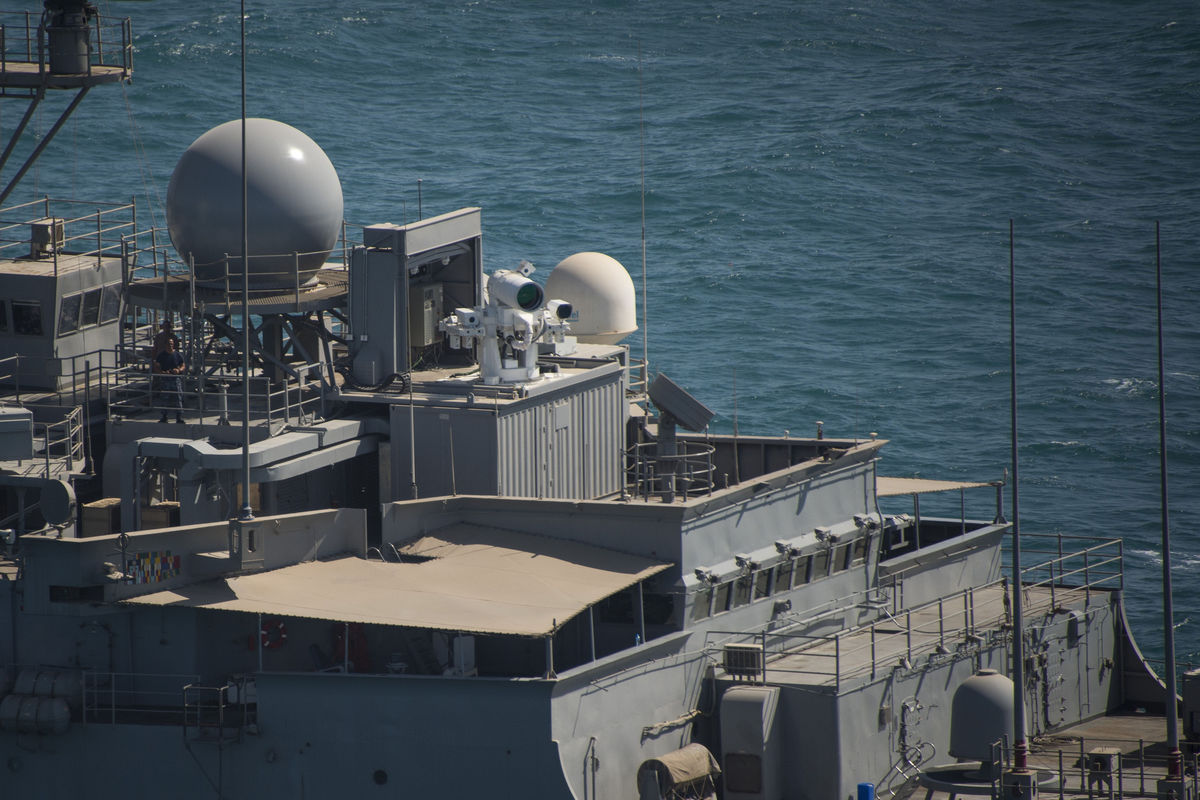
Source: U.S. Navy, Mass Communication Specialist 2nd Class Daniel M. Young via Bloomberg Click on the photo to enlarge.
Bloomberg.com is reporting the deployment of a laser weapon on the interim Afloat Forward Staging Base, Ponce, formerly LSD-15.
One of the more interesting aspects of the device from a Coast Guard perspective is that it can also be used in a non-lethal mode.
The device can emit progressively stronger beams, first to warn an adversary, and then destroy it if necessary, Chief of Naval Research Rear Admiral Matthew Klunder said at a Bloomberg Government session this year.
The laser can be adjusted to fire a non-lethal dazzling flash at an incoming vessel so they know it’s there “all the way to lethal,” Klunder said. The laser’s range is classified.
FierceHomelandSecurity is reporting that the DHS Inspector General has found reduced funding CG funding for C4ISR upgrades has had an adverse effect on operations.
The Homeland Security Department’s inspector general said these aircraft and ships will continue to rely on obsolete technology that will also cost more to operate and maintain. And the Coast Guard hasn’t addressed how and when it will implement these upgrades in revised plans…For example, some older cutters use surface search radar systems that contain almost two-decade old technology, which should’ve been replaced 10 years ago, the report said. In another example, the Coast Guard was planning to upgrade aircraft that use 1990s video and sensor technology to provide surveillance and other functions…”For example, Coast Guard personnel aboard one legacy cutter reported experiencing problems with a malfunctioning surface search radar system, including the need to reboot the system several times a day and system breakdowns while at sea,” the report said…The IG also said that certain aircraft system’s video and mission processor overloads and must be restarted, which could take 30 minutes, if operators try to update a common operating picture with large amounts of data.
Pakistan’s “TheNews” is reporting, “The State Department has made a determination approving a possible Foreign Military Sale to Pakistan for GRC43M Cutters and associated equipment parts training and logistical support for an estimated cost of 350 million.”
They are to be built by Westport Shipyard, Inc. (Westport, WA), a company best known as America’s largest yacht builder. We have seen an example of this 43 meter (143 foot) class before. They were demonstrated for the Coast Guard in 2011.
This composite construction vessel is closer to the original concept of the FRC than the Webber Class, and it appears that the cost is about three quarters that of the Webber class. Claims are also made of lower maintenance and longer hull life. They are also faster. Now that the initial contract for the Webbers has run its course, perhaps it would be a good time to reevaluate these as an alternative.
Thanks to Lee for bringing this to my attention.
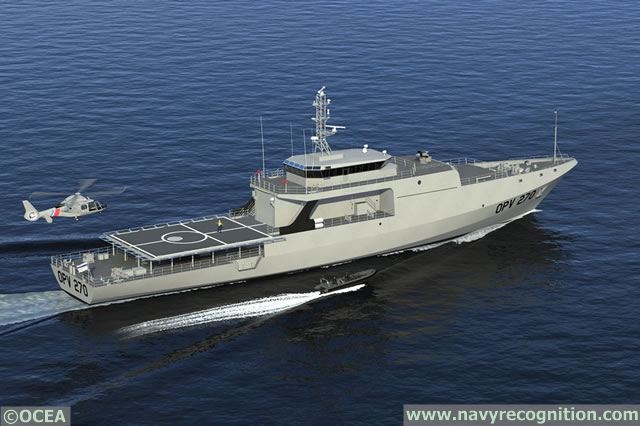
Janes360 is reporting that the Philippine Coast Guard has inked a 90M Euro ($113M) deal for the purchase of five vessels. One is to be an 82/83 meter (270 foot) aluminum hulled patrol vessel and the other four are 24 meter (79 foot) patrol boats.
NavyRecognition, reporting on OCEA participatin in the EuroNaval trade show, has some details on the OPV 270.
“OPV 270 is a 83 m (270 ft) long marine aluminum made ship. It carries 44 crew members and can take 3 to 6 VIP passengers on board, in addition to 20 ordinary passengers. 35 survivors can also be taken on board. It can travel over 4.500 to 8.000 km at 15 knots and its maximum speed, which depends of the load, can reach 26 knots. its endurance is from 30 to 45 days.”
This earlier report by DefenseStudies includes some photographs of the 24 meter patrol boat in service with the Nigerian Navy, and a short discussion of how they are expected to be used. (Incidentally the “West Philippine Sea” is the Philippine name for the South China Sea.)
gCaptain is reporting, “The United Nations Security Council authorized naval inspections of ships off Somalia’s coast and beyond suspected of carrying illegal weapons and charcoal, a commodity that generates millions of dollars a month in revenue for militants linked to al-Qaeda.”
Possibly there will be some Coast Guard involvement in the form of detachments on US Navy ships and conceivably with the 110 foot WPBs operating out of Bahrain.
Unfortunately, it appears, that if inspections are done, it will be in a haphazard fashion. The expectation is that the ships already in the Indian Ocean doing counter piracy will also do this. But really, the places the ships need to be to do these inspections is different from where they need to be to respond to piracy attacks, because innocent ships avoid the Somali coast. The place to intercept smugglers is close to the Somali coast.
This is the kind of operation the Coast Guard specializes in. It is essentially no different from drug or migrant interdiction. It is what the Coast Guard did in Vietnam as part of Markettime.
If the Coast Guard had some built in excess capacity to respond to contingencies, they could take on this sort of operation.
The entire US Navy is excess capacity to respond to contingencies. It is not built for routine peacetime operations. It would not be a bad thing for those that decide the budgets to see building a capable Coast Guard as the same sort of insurance.
| ShipSpotting.com |
 |
| © Antonio Alcaraz Arbelo |
The OldSalt Blog brings news of a 14 November fundraiser for the restoration of the former USCGC Lilac, now a museum ship in New York. They have been enjoying record attendance and now hope to put her steam plant back in operation. More here.
 Chuck Hill's CG Blog