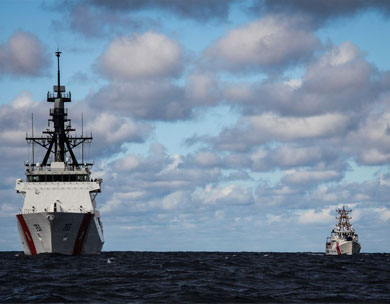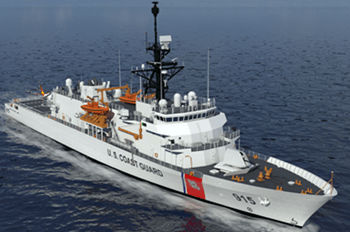
White Hulls Must Prepare for Gray Zone Challenges–USNI

The US Naval Institute’s 2016 Coast Guard Essay Contest winner, “White Hulls Must Prepare for Gray Zone Challenges,” by LCdr.Craig Allen, Jr., USCG is worth the read.

Much of the focus is on the PATFORSWA and LCdr Allen seems to know where of he speaks.

“Lieutenant Commander Allen is a cutterman assigned to the Office of Defense Operations at Coast Guard Headquarters. He previously commanded the Sentinel-class cutter USCGC William Flores (WPC-1103) and the USCGC Baranof (WPB-1318), an Island-class cutter forward deployed to Manama, Bahrain. He also served as the executive officer of the USCGC Tornado (WPC-14), a Cyclone-class patrol craft. Commander Allen is a 2014 graduate of the U.S. Marine Corps Command and Staff College.”

But as he points out. These “Gray Zones” are not limited to SW Asia. We see them in South East Asia, East Africa, West Africa, and even in Central and South America.

While the post concentrates on crew preparation, I think its appropriate to point out an observation by Vice Adm. Joseph Mulloy, deputy chief of naval operations for integration of capabilities and resources, that attacks like those on the USS Mason, where a non-state actor employed cruise missiles are likely to become more common.

Maybe adding a CIWS (preferably the SeaRAM) to the OPC might not be a bad idea.

What Might a Wartime OPC Weapons Fit Look Like?

opc-eastern

Four years ago I wrote a post suggesting that the Offshore Patrol Cutter might be designed from the start for a wartime weapons fit, but then fit them out with only those systems required for their peacetime missions, which might have included only its helicopter, UAS, and 25 mm Mk38 Mod2 gun(s).

I started with the assumption that the OPC should be able to mount a weight of weapons at least equal to those mounted on the 255 foot Owasco class cutters as built during World War II (140-150 tons). This figure did not include ammunition other than depth charges, consequently, nearly all the weight was above the main deck. This now appears very conservative in that the Eastern OPC design is about twice the size of the Owasco Class. (For another data point, when built, the USS Fletcher, first of a class of 175 destroyers with a design displacement of 2,700 tons, had 161.8 tons of armaments and 190.8 tons of ammunition.)

In the earlier post, a possible wartime outfit that I believed might be used for designing the ship (and the weights I used) included:

Total 124.4 tons

Since we now have a notional design for the cutter and my own views have changed somewhat, I thought it might be worthwhile to revisit how this class might be armed in wartime. The design may have ruled out some of the systems above, but the surprisingly large size suggest it should be fairly adaptable.

In fact it looks like the OPC could be turned into a credible warship adding only deck mounted systems that require only minimal deck penetration for cabling and the like.

What’s already there?:

Based on earlier information, as built, the design will includes provision for

For a total of 28.55 tons

Anti-Ship Cruise Missile:

 LRASM_TSL_Concept_Lockheed_Martin
LRASM topside launcher concept. The size and weight are comparable to launchers for Harpoon. Photo: Lockheed Martin.
Currently there are three potential anti-ship cruise missiles that might be used, Harpoon, LRASM, and Naval Strike Missile. Harpoon weighs 1,523 lb (691 kg) with a 488 pounds (221 kg) a warhead. Naval Strike missile is smaller, longer ranged, and more intelligence with a weight of 900 lbs (410 kg) with a 276 (125 kg) warhead. LRASM is the newest and supposedly the most “intelligent.”
As I posted earlier, I think the Coast Guard could use a couple of LRASM on each of their NSCs and OPCs even in peacetime as a means of addressing the threat of a terrorist attack using a medium or large ship. It is the missile’s range (about twice the others) and purported ability to target specific parts of a specific target rather than its larger warhead, that made the LRASM the system of choice for this role.
Reportedly the LRASM deck mount is comparable in size and weight to the Mk141, which is the standard quad deck launcher for Harpoon. The only source I could find, indicated that the weight of a quad Mk141 with missiles is 27,126 lbs or 13.6 tons, or 27.2 tons for an eight missile battery. Still I can’t believe the LRSM will not weigh a bit more than Harpoon, seeing its warhead is twice as large. I will assume a quad deck mount weighs about 15 tons, or 30 tons for an eight missile outfit. In any case, if other types of missiles were used, they would weigh less.
These might be positioned either on the fantail or on the platforms aft of the 57mm and below the bridge, one deck above the foc’sle where it appears they plan to mount .50 caliber machineguns possibly in Mk49 ROSAM.

RGM-84 Harpoon SSM was fired from a Mk-141 missile launcher aboard USS Shiloh (CG 67). The Shiloh’s beam is only one foot more than that of the Offshore Patrol Cutter. Looking at the photo, you can see that the launchers take up well under half the width of the fantail.

opcplacemat

Photo: Click to enlarge

 Evolved Sea Sparrow Missile:
It appears it may be possible to equip the OPCs with ESSM (Evolved Sea Sparrow Missile). A new version of the missile, the ESSM block II, will obviate the need for illuminators that have been required for earlier versions. These would allow the cutter to provide limited local area AAW protection for ships that the cutter might be escorting out up to 25 miles. Additionally they can be used against surface targets.
Using the Mk56 VLS a loaded 12 missile module weighs 11.5 tons. Physically it is not very large. 3.66 m (12 ft) x 2.71 m (9 ft) x 4.65 m (15’3″) high. We could locate one or perhaps two of these on top of the superstructure where they apparently intend to store the third boat.  This may seem relative high in the ship, but it is the same position where the Oliver Hazard Perry (FFG-7) Class frigates mounted their 76mm gun and the OPC is considerably beamier (54 vis 45 foot).
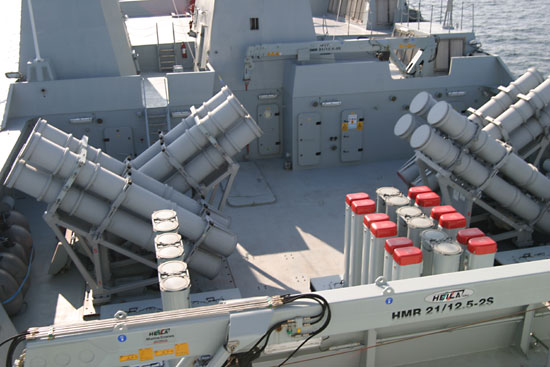
harpoonmk56

Photo: Click to enlarge. The relatively small foot print of the Mk56 VLS system (pdf) can be seen here on a Danish Absalon-class command and support ship (beam 64 feet, by comparison the Offshore Patrol Cutters’ beam is 54 feet–same as that of the Bertholf class National Security Cutters).  Two sets are visible in the foreground, one set of twelve with missile canisters with red tops in place to the right, on the ship’s centerline, and a second set of twelve without canisters to the left. The Absalon class has three twelve missile sets, with the third set off camera to the right. 

VLSLauncher_korvet
 
Photo: 12 earlier Mk48 mod3 VLS for ESSM seen here mounted on the stern of a 450 ton 177 foot Danish StanFlex300 Flyvefisken class patrol boat.  The Mk56 launchers replace the Mk48s with an approximate 20% weight savings. 
SeaRAM: 
searam_lead_img
This could really be any of three systems, Phalanx, SeaRAM (a modified Phalanx with eleven rolling airframe missiles instead of the 20 mm gun) or the 21 round Mk 49 RAM launcher. Loaded, all three are about 8.5 tons or less.
An operations research study done for Australia “Limitations of Guns as a Defence against Manoeuvring Air Weapons,” (pdf) by Christian Wachsberger, Michael Lucas and Alexander Krstic, Weapons Systems Division, Systems Sciences Laboratory, DSTO-TN-0565 has convinced me that gun systems are unlikely to effective in the future, so for the OPC I would choose two SeaRAM. This has also been chosen for the frigate follow on to the Navy’s LCS.
Two LCS systems could provide automated 360 degree protection against the sudden attack of a coordinated anti-ship missile attack. One system could replace the Mk38 mod2 system currently planned for placement on top of the hangar. A second system could be sited on the superstructure forward and below the bridge, behind and above the 57mm. This might require a small extension of the superstructure to provide a platform sufficiently large enough to both support the system and allow access for maintenance.
AN/SQR-20 Multi-Function Array (Thales CAPTAS 4):
 captas-4_vds_fremm_sna_2016_surface_navy_news_2
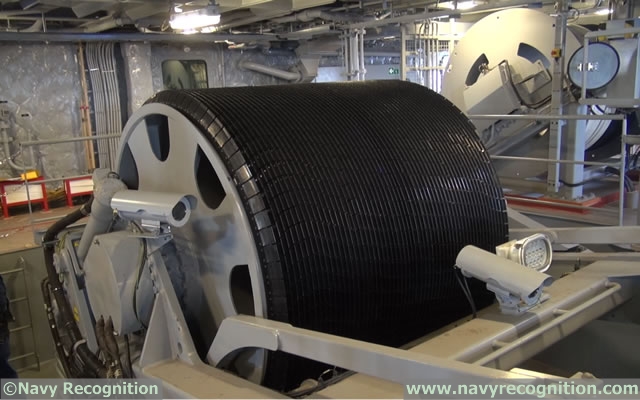
Photo: NavyRecognitionReeling system for the CAPTAS-4 Variable Depth Sonar tether aboard a French Navy FREMM Frigate (Aquitaine class).
If there is a submarine threat, we will need a sonar. Additionally passive towed arrays may be used as a targetting system for anti-ship cruise missiles. In peacetime, a towed array might also be to locate semi-submersibles.
The Thales CAPTAS-4 is one of the systems being considered for the LCS and its frigate derivative. The current version weighs 20.6 tons. The US version will probably be lighter since the Navy is looking for a lighter version for the LCS. Additionally there are lighter options made by Thales and others, so what ever might be chosen is going to be this weight or less. It would of course be mounted on the fantail.

Mk38 mod2/3 and Mk49 ROSAM: 

I will assume that the two Mk49 RO

SAM will be retained and the Mk38 mod2 (or mod3) will be relocated and a second Mk38 (1.15 tons) will be added.

Summary: 

The resulting additions would be:

  • Multi-Function Array (CAPTAS-4) (20.6 tons)
  • MH-60 (11.75 tons)
  • 8 x LRASM (30 tons)
  • 24 x ESSM (23 tons)
  • 2 x SeaRAM (22 missiles) (17 tons)
  • 57mm Mk110 gun w/1000 rounds (15.4 tons)
  • 2 x Mk38 mod2/3 (2.3 tons)
  • 2 x .50 cal. in Mk49 ROSAM (0.25 tons)

This totals 120.3 tons or 91.75 tons more than the planned outfit as built.

We don’t really know if the ship can take this much weight. Assuming it displaces 4,000 tons, which seems likely, this is about a 2.3% increase in displacement and much of the weight is relatively high.

Is it feasible?

There are things that can be done to counterbalance the effects of this additional weight. Some fuel tanks might have to be left permanently full or be converted to ballast tanks. Given the extreme range of the cutter, even half of the design range would be more range than most Navy combatants.

We know the ship is supposed to have some weight moment reservation for additional weapons but we don’t know how much. There is also the requirement that the ship be able to take on, feed and shelter 500 migrants on the foc’sle or flight deck. Those 500 people alone would amount to almost 40 tons of additional top weight.

There are alternatives that could provide a simlar outfit while moving the weight lower. A more extreme change would be to replace both the Mk56 VLS (23 tons) and the 57mm Mk110 (15.4 tons) with Mk41 VLS (33.6 tons) in place of the 57mm. We would loose the gun, but this would provide the additional capability of launching Anti-Submarine Rockets (ASROC) as well. That might be a good trade, but it would require more radical reconstruction.

In short, adding less weight in weapons than carried by the 255 foot Owasco Class cutters of WWII, the Offshore Patrol Cutter could be turned into an effect surface combatant comparable to many frigates. The same sort of alterations could also be appied to the National Security Cutters.

OPC–Eastern Wins the Contract


opc-eastern

The Coast Guard’s Acquisitions Directorate (CG-9) is reporting Eastern Shipbuilding Group has been awarded the contract for detail design and construction of the first of 25 Offshore Patrol Cutters (OPC) expected to replace the Coast Guard’s overage Medium Endurance Cutter Fleet.

“The Coast Guard today selected Eastern Shipbuilding Group Inc. of Panama City, Florida, to continue to the detail design and construction phase (Phase II) of the offshore patrol cutter acquisition program. The award is worth $110.29 million.

“The full Phase II award covers detail design and production of up to nine OPCs and has a potential value of $2.38 billion if all options are exercised.

Eastern Shipbuilding Group’s notional design is 360 feet long, with a beam of 54 feet and a draft of 17 feet. The OPCs will have a sustained speed of 22.5 knots, a range of 10,200 nautical miles (at 14 knots), and an endurance of 60-days. It is expected to “conduct missions including law enforcement, drug and migrant interdiction search and rescue, and other homeland security and defense operations. Each OPC will feature a flight deck and advanced command, control, communications, computers, intelligence, surveillance and reconnaissance equipment.” It’s hangar will accommodate one MH-60 or an MH-65 and a Unmanned Air System (UAS).

WJHG.com reports, “At a cost of around $484 million per ship, it’s the largest contract the Coast Guard has ever awarded in its 226-year history.”

I’m not sure how that works out because “production of up to nine OPCs and has a potential value of $2.38 billion if all options are exercised” equals $264.4M/ship. If that is the actual shipyard building costs and the remaining $220M is Government Furnished Equipment (GFE) and other costs the ships may be a real bargain.

Hopefully additional details of the design will surface in the near future.

Thanks to Luke for bring this to my attention. 

opcplacemat

Navy Rethinks the LCS–Manning, Crew Rotation, Homeporting

800px-USS-Freedom-rear-130222-N-DR144-367

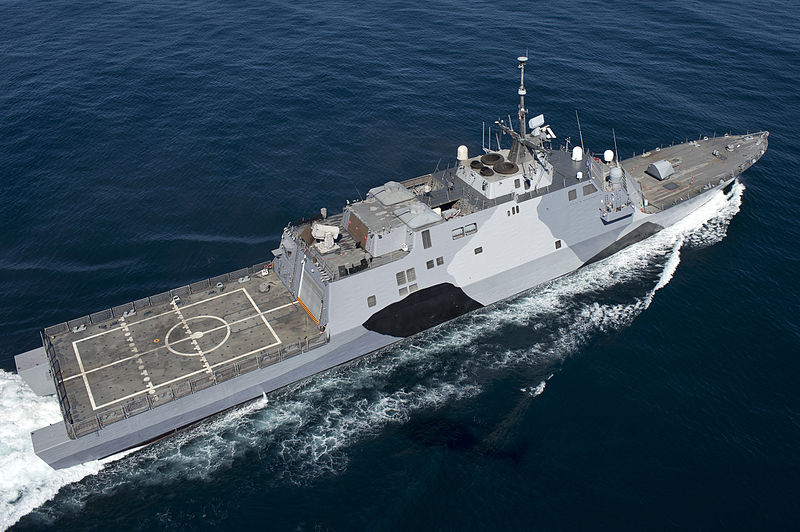
Photo: USS Freedom (LCS-1)

The US Naval Institute news service reports “Results of New LCS Review is Departure from Original Vision.”

Why should we care?:

For one thing the LCS were planned to be multi-crewed. Their plan was a bit different from our Crew Rotation Concept, but the idea was the same, multiple crews rotating among multiple ships to provide more deployed time. The Coast Guard had planned to apply the Crew Rotation Concept to the National Security Cutters, but I have also seen it referred to with regard to the Offshore Patrol Cutters.

Earlier I called the Offshore Patrol Cutter, the other LCS, and it does look like they will continue to share some systems and training. If the OPCs emerge with space for modular systems, we may see even more cross talk between the programs. The two types (LCS and OPCs) are similar in size, so comparisons are inevitable.

Hopefully we can learn from their experience.

The results: 

The Navy is abandoning their planned rotation of three crews among two ships in favor of a plan that would assign two crews to a single ship, much like the way SSBNs are manned by blue and gold crews. The significant difference is that the crews “own” the ships, they don’t expect to walk away to a different hull and never see it again.

The size of the crews is to be increased. Originally there was to have been a core crew of 40. That was increased to 50, and it is now planned to increase the core crew to 70 plus a 23 person air detachment. Maximum berthing is reportedly 98. Adding a CG LE team should max out the berthing. This pushes the crew much closer to what the Coast Guard was planning for the OPC, (pdf) a crew of 104. That means a full crew for each LCS is really 163, two core crews of 70 and 23 in the air detachment.

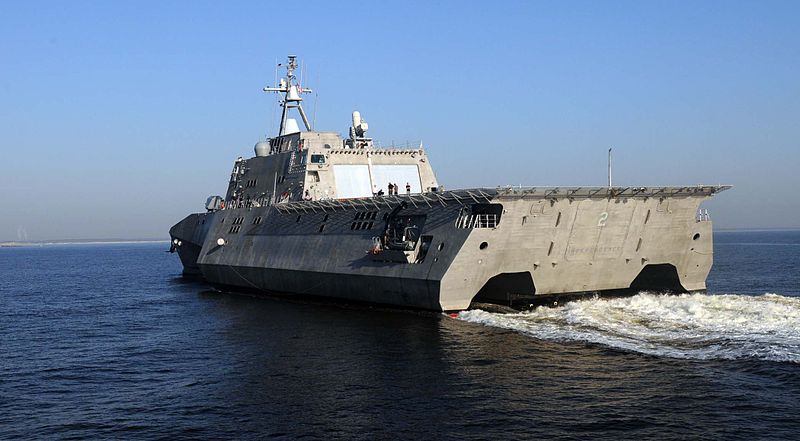
Instead of basing a mix of both types of LCS on each coast, the new plan would put the trimaran Independence class, with its longer range, on the West Coast (San Diego) while the shorter legged, monohull Freedom class will be based on the East Coast (Mayport, FL). That makes a lot of sense.

The ships will be organized into six four ship divisions with each division assigned a single mission (mine countermeasures, anti-surface, or antisubmarine). The four oldest ships will be single crewed, will not be assigned to a division and will instead be used for training and testing. Again this makes sense since subsequent ships are somewhat different, having incorporated lessons learned on the first ships.

That doesn’t necessarily mean there will be one division of each class assigned each of the three missions although that may the result. To me the Independence class appears better suited for ASW and the Freedom class by default better used as minecountermeasures ship.

uss_independence_lcs_2

Photo: USS Independence (LCS-2), U.S. Navy photo by Mass Communication Specialist 2nd Class Justan Williams 

Lessons: 

When the Coast Guard finally decides to abandon the Crew Rotation Concept, as currently envisioned–four crews for three ships. They can point to the LCS experience as justification.

As a means to allow increased time underway, permanently augmenting the NSCs’ crews to allow generous leave and TAD assignments is probably a better solution. After all, if we have a crew of 160 or so assigned to each NSC or OPC, we could probably keep them underway at least as much as the LCS are.

Applying a division staff organization to the NSCs and perhaps the OPCs is probably a good idea. In addition to a post command captain, that could, among other things, provide initial advice to newly arrived COs and possibly a relief CO function; it could provide personnel augmentation for those specialists positions that have little or no redundancy in the typical ship’s organization, allowing them some leave and/or TAD while the ship is underway, with the objective of keeping the crew members underway time at 185 days or less, while the ship is away from homeport for a considerably longer time.

Commandant’s Strategic Intent, Mid-Term Report

Coast Guard Capt. Douglas Nash, commanding officer of Coast Guard Air Sation Sacramento, salutes a Coast Guard C-27J pilot during a change of watch ceremony at Air Station Sacramento's hanger in McClellan Park, Thursday, July 1, 2016. The ceremony marked the final day that an HC-130 Hercules crew stood the watch at Air Station Sacramento and introduced the newest aircraft. Coast Guard photo by Petty Officer 3rd Class Loumania Stewart

Procurement of 14 C-27J aircraft was one of the achievements sited. C-27Js replace C-130s at CGAS Sacramento. 

The Commandant has issued a mid-term update on his earlier published “Strategic Intent, 2015-2019” (pdf). The new document is available in pdf format. You can find it here: “United States Coast Guard Commandant’s Strategic Intent, 2015-2019, Mid-Term Report.”

It is relatively short and readable at 21 pages. The recurring themes of the Commandant’s administration are all there, starting with TOC (transnational organized crime) and its deleterious effect on Western Hemisphere governance and prosperity. It does read a little like an Officer Evaluation Report input.

There is nothing particularly surprising here, but even for me, the enumeration of the scope the Coast Guard’s authorities, responsibilities, and international contacts is still mind boggling.

I am not going to try to summarize the report, but there were a few things that struck me.

The Commandant mentions service life extension programs for the seagoing buoy tenders (already begun), the 47 foot MLBs, and the 87 foot WPBs (in the future), but there is no mention of what we will do about the inland tender fleet. There will also be a life extension program for helicopters before they are finally replaced.

“Extend the service life of our rotary wing assets and align with DOD’s Future Vertical Lift initiative.”

There is mention of a program I was not aware of, the “Defense Threat Reduction Agency National Coast Watch System project.” The Defense Threat Reduction Agency attempts to track and reduce the WMD threat. It is not really clear what our role is here. We know about the container inspection programs in foreign ports. Is that it, or is there more to this? (that can be discussed at an unclassified level.)

WHY THE COAST GUARD NEEDS LRASM IN PEACETIME–CIMSEC

This is an expanded version of an earlier piece that was posted here. I rewrote it for the CIMSEC blog in hopes it would find a larger audience. Hopefully it is a clearer than the original. 

The Coast Guard has a problem. It is not currently equipped to perform one of its missions, and it appears no other agency is prepared to cover the deficiency. The Long Range Anti-Ship Missile (LRASM) may be a possible solution.

The Mission

One of the Coast Guard’s peacetime missions is Ports, Waterways and Coastal Security (PWCS).

“The PWCS mission entails the protection of the U.S. Maritime Domain and the U.S. Marine Transportation System (MTS)…prevention and disruption of terrorist attacks… Conducting PWCS deters terrorists from using or exploiting the MTS as a means for attacks on U.S. territory, population centers, vessels, critical infrastructure, and key resources.”

The Shortfall

Implicit in this mission is that the service should have the capability to forcibly stop a non-compliant ship, any ship, of any size. If a crew is motivated by simple greed, a .50 caliber machine gun is probably enough to convince them to take their chances in court rather than resist, but if the crew is motivated by a fanatical, or even suicidal belief in a cause, they become much harder to stop.

Terrorist targets are limited only by their imagination. They might include something like the Mumbai attack, an assault on a bridge, an LNG tanker or facility, a nuclear power plant, a passenger ship, an SSBN departing on patrol, or they might use a vessel to bring in a nuclear weapon.

The Coast Guard is an armed force at all times, but it is certainly not heavily armed. In fact, in terms of stopping a recalcitrant merchant ship, the Coast Guard seems relatively less capable now than they were eighty years ago.

This is because of the rapid growth in the size of merchant ships. Even the largest cutters with their 57 mm and 76 mm guns are far less capable of stopping today’s over 100,000 ton merchant vessels than the cutters of the 1930s, with their 5″ guns were against ships that were typically well under 10,000 tons.

Worse yet, the units that would actually be on scene to attempt to stop and board a ship suspected of being under the control of terrorists is unlikely to include any of the larger cutters because they seldom remain near harbor entrance. Rather, they are frequently sent well off shore.

The Coast Guard simply does not have the capability to deal with a terrorist attack using a medium to large sized merchant ship, and it currently appears that there is no other organization capable of answering this threat in the 30 or more port complexes terrorists might find worthwhile targets.

Our Friends

Navy surface forces, in U.S. waters, are too geographically concentrated. Navy ships tend to be either in homeport, working up in specific geographic areas, deployed, or in transit to deploy. There are no Navy surface warships homeported in the Gulf of Mexico, on the East Coast north of the New Port News/Norfolk complex, in Alaska, or on the West coast between San Diego and Puget Sound with weapons equal to or better than those on cutters. For many ports, the nearest Navy surface vessel is hundreds of miles away.

Air Force, Navy, Marine, and Army Air are not on standby around the U.S. armed with anti-ship weapons. Of the Air Force, only some strategic aircraft are training for the anti-shipping mission. Fighters and attack aircraft do not. The author suspects the U.S. would not get a timely response from the Air Force to a no notice requirement to stop a maritime target. Units that are not trained for an anti-shipping role cannot be easily pressed into that mission.

A Possible Solution

LRASM, with an over 200 nautical mile range and the ability to strike selected locations on a target ship, could possibly provide an answer. If the U.S. fielded LRASM on all nine National Security Cutters (NSC) and 25 Offshore Patrol Cutters (OPC) currently planned, its over 200 mile range could cover virtually all of these ports, and likely have a weapon on target within 20 minutes of launch.

How It Might Work

The Coast Guard is developing a Maritime Domain Awareness system. Most likely, it will tap into the Navy’s system and over the horizon radars.

When the maritime domain awareness system detects the approach of a suspicious vessel, a small patrol vessel (WPB or WPC) is assigned to intercept it and conduct a boarding to determine the vessel’s nature and intent.

When the patrol vessel is assigned the intercept, a larger cutter that may be at some distance, but within range, would be directed to provide support in the form of a LRASM launch if necessary.

The patrol craft will transmit video, position, course, and speed during its approach which will allow the start of mission planning for an LRASM launch should it become necessary. The results of the patrol craft’s attempt to board will allow determination of hostile intent.

Once a determination of hostile intent has been made, and deadly force authorized, the supporting cutter can launch its weapon. The patrol craft will continually update the supporting cutter before and during the flight of the LRASM. Navy, Joint, and/or Allied procedures would be used to call for a strike, and should also work with other service’s assets if they are available.

LRASM_TSL_Concept_Lockheed_Martin
LRASM topside launcher concept. The size and weight are comparable to launchers for Harpoon. Photo: Lockheed Martin.

Is It Affordable?

It is likely cutters could be equipped to carry eight missiles, but for peacetime purposes, two per ship would almost certainly meet the Coast Guard’s needs. Since some ships will always be in maintenance with ammunition removed, and others may be deployed where carrying the weapons would be counterproductive. The Coast Guard is unlikely to ever require more than about 50 missiles to meet its peacetime needs. A very rough estimate of LRASM unit cost would be something on the order of $2M to $5M each. That means the total cost of the missiles is likely between $100M and $250M. Adding launchers, control systems, and installations to cost would almost certainly be less than $500M. These costs would be spread over several years. This gives only an order of magnitude estimate, but it is several orders of magnitude less than the cost of other systems being deployed to protect the U.S. from attack.

Since the missiles, their launchers, and control systems are Navy type/Navy Owned equipment, the Navy would be responsible for paying for them. The cost of adding another four missiles per year for the Coast Guard to the Navy’s buy for LRASM could be lost in the rounding errors in the Navy budget.

For the Coast Guard, the program would probably require no more than 150 additional billets ashore and afloat. Not insignificant, but doable.

Conclusion

If the LRASM performs as advertised, its combination of range, warhead, and intelligent targeting may allow the Coast Guard’s small, but widely distributed force to effectively cover virtually the entire U.S. coast.

LRASM_Surface_Launch_72617-300x233

Late addition, LRASM deck mount launcher successful test. 

Alaska, FY2017 Budget, Homeports

Bertholf-and-Vorovsky

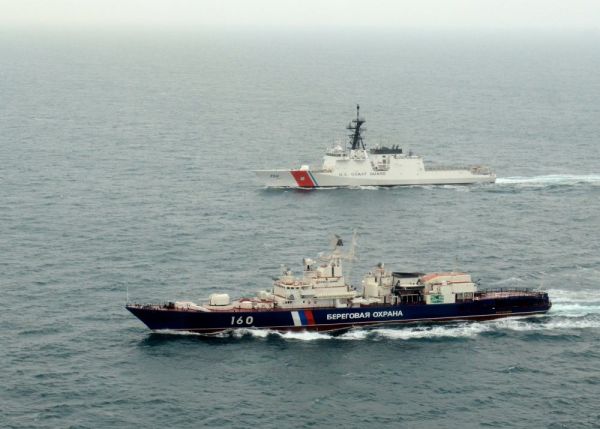
Some interesting little notes from Alaska Dispatch News here and http://politicalnews.me/ here.

From the first:

“…in the appropriations bill passed out of committee Thursday, Murkowski secured language directing the Coast Guard to consider basing a national security cutter near the Arctic. The bill also directs the Coast Guard to station two offshore patrol cutters in Kodiak and appropriated $325 million for fast-response cutters, two of which are scheduled to be stationed in Ketchikan in 2017.”

From the second:

  • CG Base Kodiak: Murkowski secured $22 million for upgrades to CG Base Kodiak to support future OPC homeporting and current NSC operations.

  • Search and Rescue: Murkowski secured language directing the Secretary of Homeland Security to report on the plans of the Coast Guard to ensure long-term search and rescue capabilities in the Arctic.

  • Response Capabilities: Murkowski inserted an amendment directing the Secretary of Homeland Security to report on the Coast Guard’s plans to ensure it is capable of conducting its response missions throughout the Bering Sea and Arctic Ocean.

I think we could make a good case for homeporting two or even three OPCs in Kodiak, but don’t think we will see any NSCs homeported in Alaska.

Replacing the 110s in Alaska with the more seaworthy Webber class as quickly as possible also makes a lot of sense. We might want to put a couple at Dutch Harbor as well.

Thanks to Daniel for bringing this to my attention. 


FY2017 Budget

NSC&FRC

It is still a long way from being a law, but you can see the bill as it currently stands here.

I would like to note that while the FY2017 budget bill includes $95M for  long lead time materials for the tenth National Security Cutter, most of the cost will fall in FY2018 when we will also be funding the OPC and FRC programs, and maybe an icebreaker.

Are they really thinking ahead? If they are going to fund a 10th NSC, they need to do it this year.

Senate Homeland Security Appropriations–Plus Up

MarineLog is reporting:

The homeland security measure provides $10.4 billion for the d Coast Guard, an increase of $292 million above the FY2017 requested level.

“This level supports a robust USCG operating expenses budget, including a grant program for commercial fishing safety, purchase of additional response boats, and funds for the National Coast Guard Museum,” says the Committee. “This bill also provides necessary increases for acquisitions, including funding long lead time materials for a tenth National Security Cutter, continuing activities associated with the Offshore Patrol Cutter, two additional Fast Response Cutters (for six total), and support for multiple sustainment efforts and program offices such as the C-130J, C-27J, and HH-65. The measure also includes program management and personnel costs associated with the Polar Icebreaker Recapitalization Project in addition to funding in the Senate FY2017 Department of Defense Appropriations Bill.”

The Defense Appropriations Bill includes $1B for the Navy to build a new Icebreaker for the Coast Guard. We will have more to say about this later.