“Navy makes sure helicopters cannot land on new Offshore Patrol Vessels” –The Australian

Australia Considering Modular C-Dome For Arafura OPVs
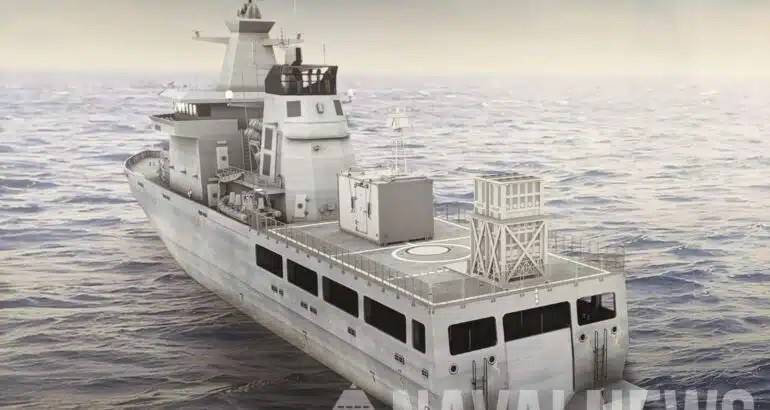
Illustration of Arafura-class OPV fitted with C-DOME

The Australian reports,

“Normally when a navy acquires a new ship, they want it to be as capable as possible. Not so the Royal Australian Navy, which has down-designed the Arafura class Offshore Patrol Vessels (OPVs) so that they can no longer support the weight of a helicopter on the large rear deck.”

The article goes on to criticize this and other decisions regarding the ship, but there may be method to this madness.

I would assume the Australian Navy is putting some thought into these decisions and it may be related to my observations in a post only two days ago, “When is a Flight Deck Not a Flight Deck?”

The intention may be to save topside weight so that an additional load or loads, heavier than an 11 ton helicopter, can be placed high on the ship.

A helicopter deck must be very strong everywhere, because it may be required to take high dynamic loads concentrated on just a few square inches, that may occur unpredictably, almost anywhere on the deck. By contrast even a large load like SURTASS-E, that spreads the load over a much larger area, requires less deck strength.

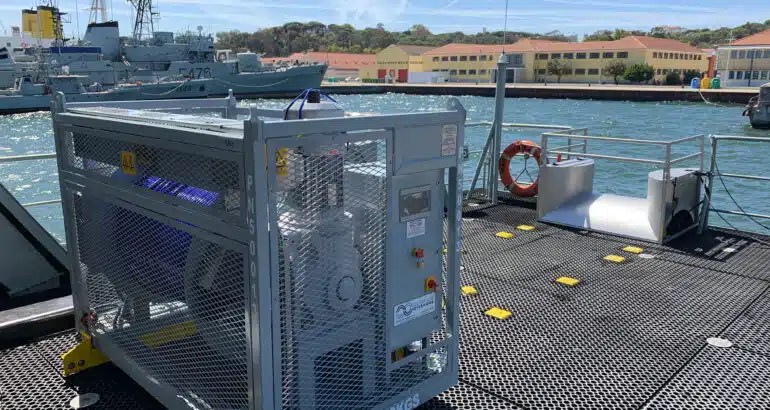
SURTASS-E. (U.S Department of Defense)

It may be that the Australian Navy has decided to use the “flight deck” as a mission load area where they anticipate placing heavy loads. The weight savings from weakening the flight deck may also permit additional topside weight for other systems, like weapons, if it is not required for loads on the flight deck.

When is a Flight Deck Not a Flight Deck?

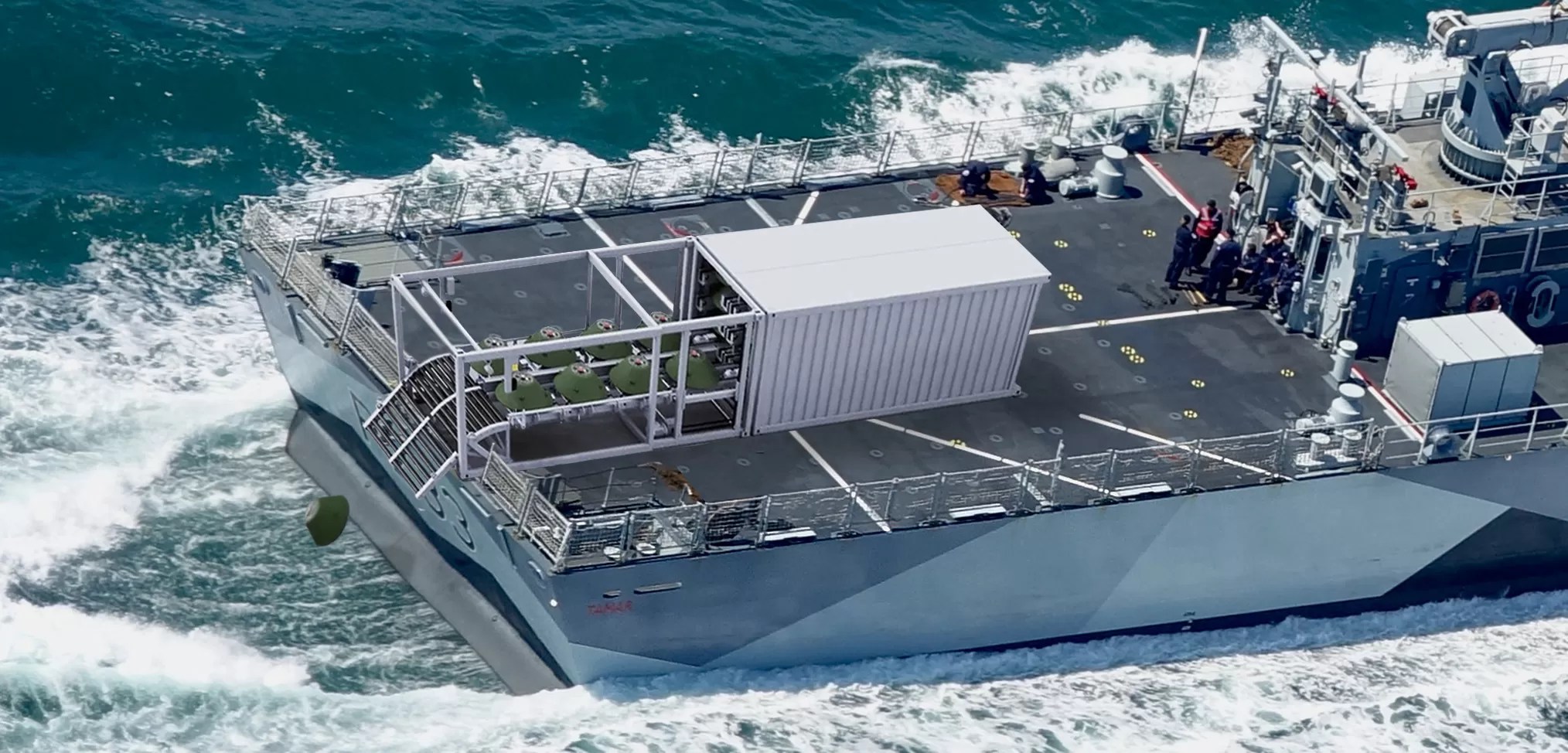
Containerized minelaying system on a River Batch 2 Offshore Patrol Vessel

It has been said that aircraft carriers are the ultimate modular warships because their primary weapons (aircraft) are interchangeable.

A flight deck on an Offshore Patrol Vessel (OPV) certainly offers a degree of aviation options. General purpose, cargo, ASW, and ASuW helicopters and a range of Unmanned Air Systems, but it appears our allies, the UK and particularly Australia may be looking at other ways to use this large open space.

Royal Navy:

Navy Lookout had a post that talked about restoring a naval mining capability in the Royal Navy. There was no specific reference to using flight decks or to Offshore Patrol Vessels.

The RN does not need dedicated minelaying vessels. The SSNs have a theoretical minelaying capability but XLUUVs are a much lower risk and stealthier solution for covert and sensitive missions. Where stealth is less important, containerised minelaying solutions are being developed that can be secured to the deck and dispense mines over the stern. (emphasis applied–Chuck)

But the photo, above, definitely got my attention. There we see an SH Defence “CUBE” containerized mine laying system developed by RWM Italia S.p,A. (Rheinmetall). on the flight deck of a River Batch 2 Offshore Patrol Vessel (HMS TAMAR).

Australian Navy:

Australia is planning to produce up to 14 flight deck equipped Arafura class OPVs including two intended specifically for Mine Counter Measures (MCM). These ships were always intended to accept containerized mission loads. It appears they are now planning what these ships will do in wartime.

Missile Launcher:

We already saw “Australia Considering Modular C-Dome For Arafura OPVs” –Naval News

Australia Considering Modular C-Dome For Arafura OPVs
Illustration of Arafura-class OPV fitted with C-DOME

Mine Layer:

As noted in the Navy Lookout, Australia is planning to buy and produce large numbers of mines. Naval News reports,

“Australia is set to accelerate the procurement of sea mines as part of Project SEA 2000…The decision to rapidly procure the capability, reportedly from a European supplier, will deliver a ‘significant’ deterrent effect according to Defence…it’s understood that the government has budgeted approximately $500 million to 1 billion Australian dollars for the acquisition…the weapons being brought are smart mines, able to disseminate between civilian vessels and a variety of military targets, allowing a strategic anchorage to be denied to hostile forces, all the while preserving access for aligned vessels(emphasis applied–Chuck)

This all points to large numbers of mines being used in defensive fields. Such minefields will almost certainly be laid by surface vessels. Australia does have some civilian crewed support ships that might be used for mine laying, but as the Arafura class comes online, they will be the most likely surface minelayers.

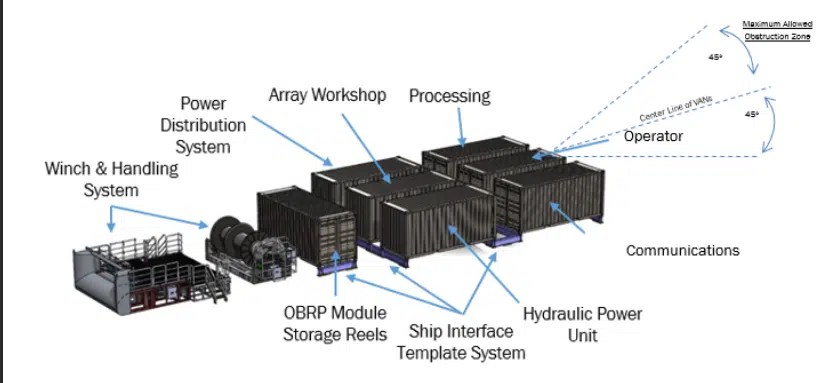
SURTASS-E:

SURTASS-E. (U.S Department of Defense)

Then there is these reports from Naval News and The Drive that Australia is getting SURTASS-E systems.

SURTASS-E is expected to provide long range detection and cuing for tactical weapons, against both diesel- and nuclear-powered submarines. Again, the Arafura class seems a likely host, because the system is intended for military crew manning and, unlike the civilian manned National Support Squadron ships, these ships are armed and have communication systems that include tactical data link.

Now About the Coast Guard:

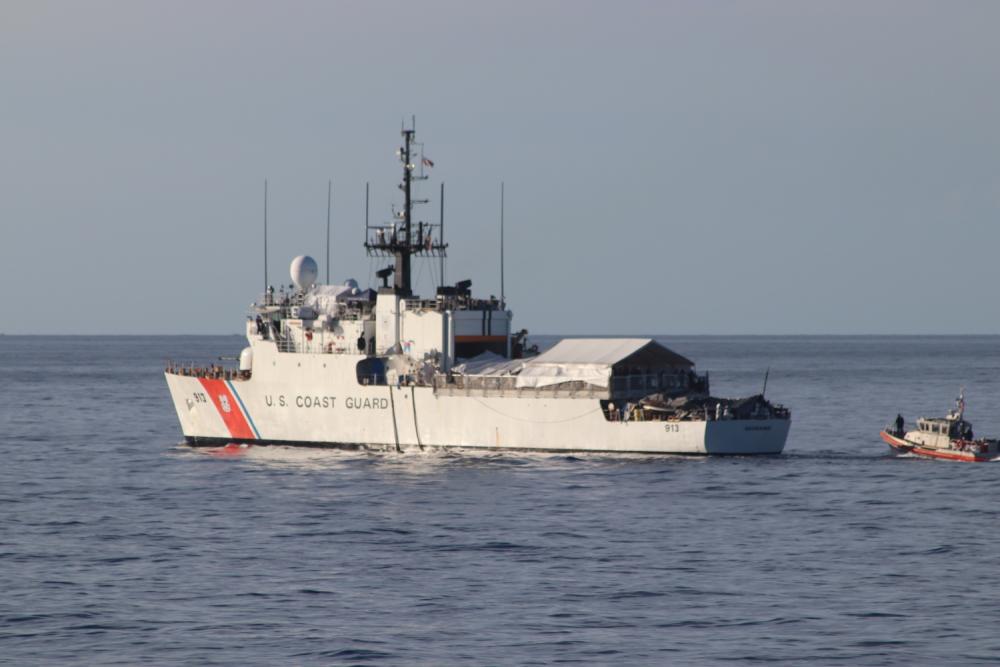
Using a flight deck for non-aviation purposes is not a foreign idea to the Coast Guard. They do it all the time to provide a holding area for migrants. 

USCGC Mohawk’s (WMEC 913) crew patrols the South Florida Straits during Operation Vigilant Sentry, Jan. 5, 2023. Mohawk’s crew patrolled the Florida Straits and Caribbean Sea in support of Homeland Security Task Force—Southeast and Operation Vigilant Sentry in the Coast Guard Seventh District’s area of operations for a 46-day patrol. (U.S. Coast Guard photo by USCGC Legare (WMEC 912)

“SEA To Provide KRAITSENSE ASW System For A South-Asian Navy’s OPV Program” –Naval News

KRAITSENSE ASW System. Photo credit: SEA

Naval News reports,

“UK-based anti-submarine warfare (ASW) solutions provider SEA has been awarded a contract to supply two of its innovative ASW systems, KraitSense, to a South-East Asian Navy for a new offshore patrol vessel (OPV) programme.”

I found another photo, below, in an earlier report.

KraitSense low profile passive sonar system. SEA picture.

It these systems perform reasonably well; they would be an attractive mobilization option for giving OPVs an ASW role. Even if not equipped with ASW weapons, adding sensors that can be coordinated with other surface and air weapons carriers would be helpful.

The SE Asian Customer?

Artist impression of the future Philippine Navy OPV to be constructed by HHI. HHI image.

Who is the SE Asian country with, “With a vast coastline and high number of islands within their jurisdiction…” Think the Philippines may be most likely.

Hyundai Heavy Industries (HHI) is building six offshore patrol vessels (OPV) for the Philippine Navy (not their Coast Guard). At about 2400 tons, 94.4 meters (309 ft 9 in) in length, with a speed of 22 knots, they are pretty typical medium sized OPVs, except for one thing, Wikipedia reports that their armament, in addition to 76 and 30 mm guns, includes two sets of triple lightweight anti-submarine torpedo tubes. There is no indication of an ASW sensors. It is reported to have spaces for Multi-Mission Containerized Modules. The flight deck and hangar are sufficient for support of an ASW helicopter and/or UAS.

Netherlands Navy Talks about Replacing OPVs with Light Amphibious Warfare Ships

A Naval News report, “RNLN Looks At Low-Manned Platform To Augment Frigate Fire Power” talks about the possibility of adding weapons and sensors to lightly manned small vessels to act as extensions of a large warship’s weapons and sensors. Cooperative Engagement Capability probably makes this possible. (Incidentally the vessel shown in the leading illustration is a Damen design 50 meter in length with a beam of 9 meters. More here.)

But the post also discussed another program, a new class of smaller amphibious warships, expected to enter service from the early 2030s, that will also fill the role of Offshore Patrol Vessels.

Captain Van der Kamp also outlined the RNLN’s evolving thinking on a replacement amphibious shipping capability, dubbed LPX…these new ships are also expected to assume the patrol and surveillance tasks currently performed by the navy’s four Holland class patrol vessels…“We would combine these amphibious ships with the function of a patrol vessel to do Coastguard patrols in the Caribbean and counter-drugs operations in the Caribbean.”

The four Holland class OPVs were commissioned 2012 to 2013, so in the early 2030s they will be at the most 23 years old. These ships are similar in size, speed, capabilities, and mission to the OPCs. They have frequently conducted drug interaction missions in the Caribbean with US Coast Guard Law Enforcement Detachments embarked and at least on one occasion using a USCG helicopter.

The other two ships being replaced, HNLMS Rotterdam and HNLMS Johan de Witt. are older, commissioned in 1998 and 2007. They have a combined capability to land about 1200 Marines. I presume the cumulative capability of the new ships will be similar. Each of them can also carry up to 32 tanks, but the Netherlands Marine Corps does not have any tanks, nor do they have organic heavy artillery. Their only armored vehicles are much smaller, so perhaps the replacement ships will not need the capability to handle tanks.

Why is the Netherlands Navy choosing to do this?

Going from six ships to perhaps only four is likely to decrease the total crew requirements.

It may be that the landing ships are considered better able to meet the disaster response component that has been one of the OPVs’ missions.

The Netherlands Navy may not see any wartime role for the OPVs, or at least no role the new LPX could not also do.

Nevertheless, it seems the changes is rooted in changes in the Marine Corps concept of operation.  “…leaner and smaller units that would unload further away from land.”

It may be significant that the new ships are referred to as LPX not LPDX. That may mean that they would not have a well deck. It might be thought they are paralleling US Marine Corp thinking that resulted in the Marines shedding their tanks and heavy artillery and the formation of a Littoral Regiment and a program to build relatively small Landing Ship, Mediums. On the other hand, given the way the Netherlands Marine Corps names their units, “Raiding Section,” “Raiding Troop,” and “Raiding Squadron,” they obviously see themselves as a raiding organization more akin to the British Royal Marine Commandos of WWII than to the US Marine Corps that seized and held islands in the Pacific. They do have a long and continuing association with the Royal Marines. In any case they are and probably will remain essentially light infantry.

If the new ships are to replace the four OPVs, then I would presume they would still need at least four ships. If they were following the USMC example, they may build a larger number of smaller ships, but I don’t think that will be the case. If they are to “…unload further away from land,” they are going to be very different from the beachable LSMs envisioned by the US Marines. The British developed LCVP Mk5c used by the Netherlands Marine Corps are big boats, 15.7 m (51 ft 6 in) in length and displacing 24 tons. If they are to be swung from davits, it will not be from a small ship.

I would not be surprised if the LPX program came out as four ships that look a lot like slightly larger Danish Absalon class (which can reportedly transport a company-sized landing force of some 200 soldiers with vehicles). Four ships that could each transport 300 Marines, each equipped with four LCVPs (or its replacement), a pair of FRISC” (Fast Raiding, Interception and Special forces Craft) RHIB, with hangar space for a couple of helicopters, could replicate the transport capacity of the two LPDs in a more flexible, distributed, and perhaps more survivable force package. The resulting ships would effectively be modern high-speed transports (APD/LPR).

“Vard Unveils New ‘Vigilance’ OPV Design” for Canada –Naval News

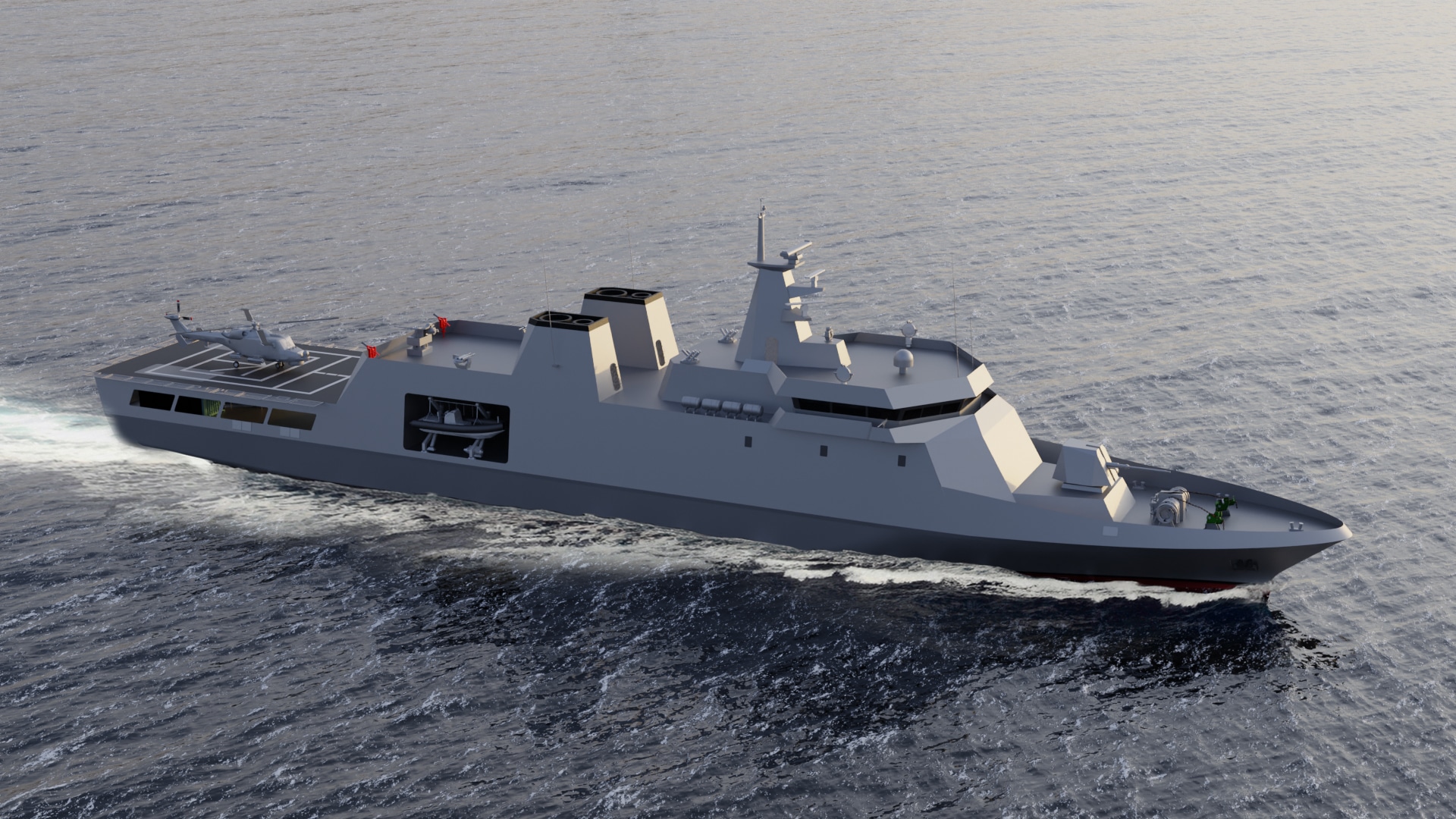
Vigilance OPV design for Canada by VARD

Naval News reports,

Tailored to the needs of the Royal Canadian Navy’s future fleet, Vigilance strikes the balance between flexibility, adaptability, and size, while maintaining the life-cycle cost advantages VARD’s naval designs are known for.  The vessel has been conceived for high-tempo sovereignty missions and engineered for global deployment and forward basing abroad.

There is not really a lot of information here.

They are to replace the Kingston Class Maritime Coastal Defence Vessels, which have been used to do drug interdiction in the Caribbean with USCG Law Enforcement teams doing the boardings. It is a class of twelve ships so there may be that many replacements, but also possibly fewer.

USCGC Escanaba (WMEC 907) and USCGC Richard Snyder (WPC 1127) practice maneuvering with the Royal Canadian Navy’s Kingston Class Maritime Coastal Defence Vessel HMCS Goose Bay (MM 707) in the Davis Strait on Aug. 13, 2021.  (Photo courtesy Royal Canadian Navy)

There is no indication of size but there is a clue in the identification of the rendering that accompanied the post, “VARD-7-075-Vigilance-Offshore-Patrol-Vessel-770×410.jpg”. Using VARD’s naming convention this is a “7 series” ship meaning “Naval and Security” that is about 75 meters (246 feet) long. Given the intention to employ them “forward basing abroad,” particularly as a Pacific nation, limiting the size to only 75 meters may be unwisely parsimonious. A larger ship would be both more capable in adverse weather conditions and more adaptable to future requirements. The Kingston class are only 55.31 m (181 ft 6 in) overall, so 75 meters would be an upgrade, but it is still a very small OPV, particularly if it is to operate helicopters. It would be similar in size to Malta’s P71 or the Danish Knud Rasmussen class.

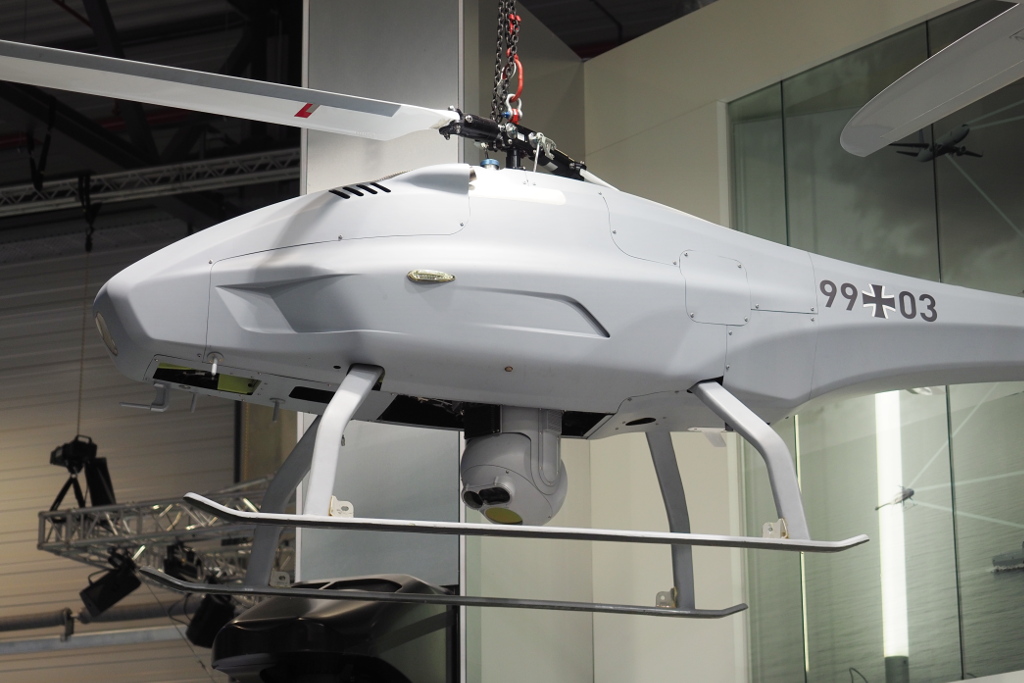
If the ship is in fact 75 meters in length, then the flight deck seen in the fendering does appear relatively short for landing a helicopter, especially since Canada’s Navy and Air Force do not operate any small helicopters that might be operated from the ships. The logo that accompanies the post may suggest that the flight deck is for unmanned air systems rather than helicopters. The UAS in the logo appears to be the Swedish built UMS Skeldar V-200known as CU-176 Gargoyle in Canadian Service. This UAS is also in service with the Belgian, German, Netherlands, and Spanish Navies.

UAV SKELDAR V-200 in German service, tail marking 99+03, at ILA Berlin Airshow 2022. Photo credit: Boevaya mashina.

The gun seen in the rendering suggest a 30mm Mk38 Mod4. In view of the fact the Arctic Offshore Patrol Ship is armed only with a 25mm Mk38 Mod2/3 that would to conform to past policies. The same gun is expected to be on the new Canadian frigate.

Looking at VARD’s design catalog, I see some resemblance to their 72 meter and 85 meter designs.


Video below added as late addition, thanks to Dave. 

“Australia Considering Modular C-Dome For Arafura OPVs” –Naval News

Australia Considering Modular C-Dome For Arafura OPVs
Illustration of Arafura-class OPV fitted with C-DOME

Naval News reports,

“The Royal Australian Navy (RAN) is in talks to procure a containerised variant of Rafael’s C-Dome in an effort to increase the firepower of its future Offshore Patrol Vessels (OPV).”

Arafura class OPVs:

The Arafura-class is based on the Lürssen-designed Darussalam-class, operated by the Royal Brunei Navy. This is expected to be a class of 14, 12 off shore patrol vessels and two dedicated to mine counter-measures. They are expected to displace 1640 tons, be 80 meters (262 ft) long and 13 meters  (43 ft) of beam with a draft of four meters (13 ft) with a speed of 22 knots.

C-DOME Missile System:

C-Dome is the naval version of the Israeli Iron Dome missile system which was developed with considerable US support. There has been considerable US interest in the Iron Dome system (here, here, and here). Systems are coproduced by Rafael and Raytheon. Complete systems are built in the US.

The new Israeli Sa’ar 6 corvettes are expected to have forty vertical launch cells for C-Dome in addition to 40 Barrak 8.

From Wikipedia specifications for the Iron Dome interceptor:

  • Weight: 90 kg (200 lb)
  • Length: 3 m (9.8 ft)
  • Diameter: 160 mm (6.3 in)
  • Proximity fuse

By comparison, the Evolved Sea Sparrow Missile weighs 620 pounds, is 12 feet in length, and has a diameter of 10 inches. It can be quad packed in the Mk41 vertical launch cells.

The RIM-116, Rolling Airframe Missile (RAM), weighs 162 pounds, is 9’2″ long, and has a diameter of 5″ so smaller than the Israeli system, but it has yet to be deployed in a vertical launcher so it apparently needs two launch systems to provide 360 degree coverage.

“HMS Tamar Makes Rare Port Call to Diego Garcia” –SeaWaves Magazine

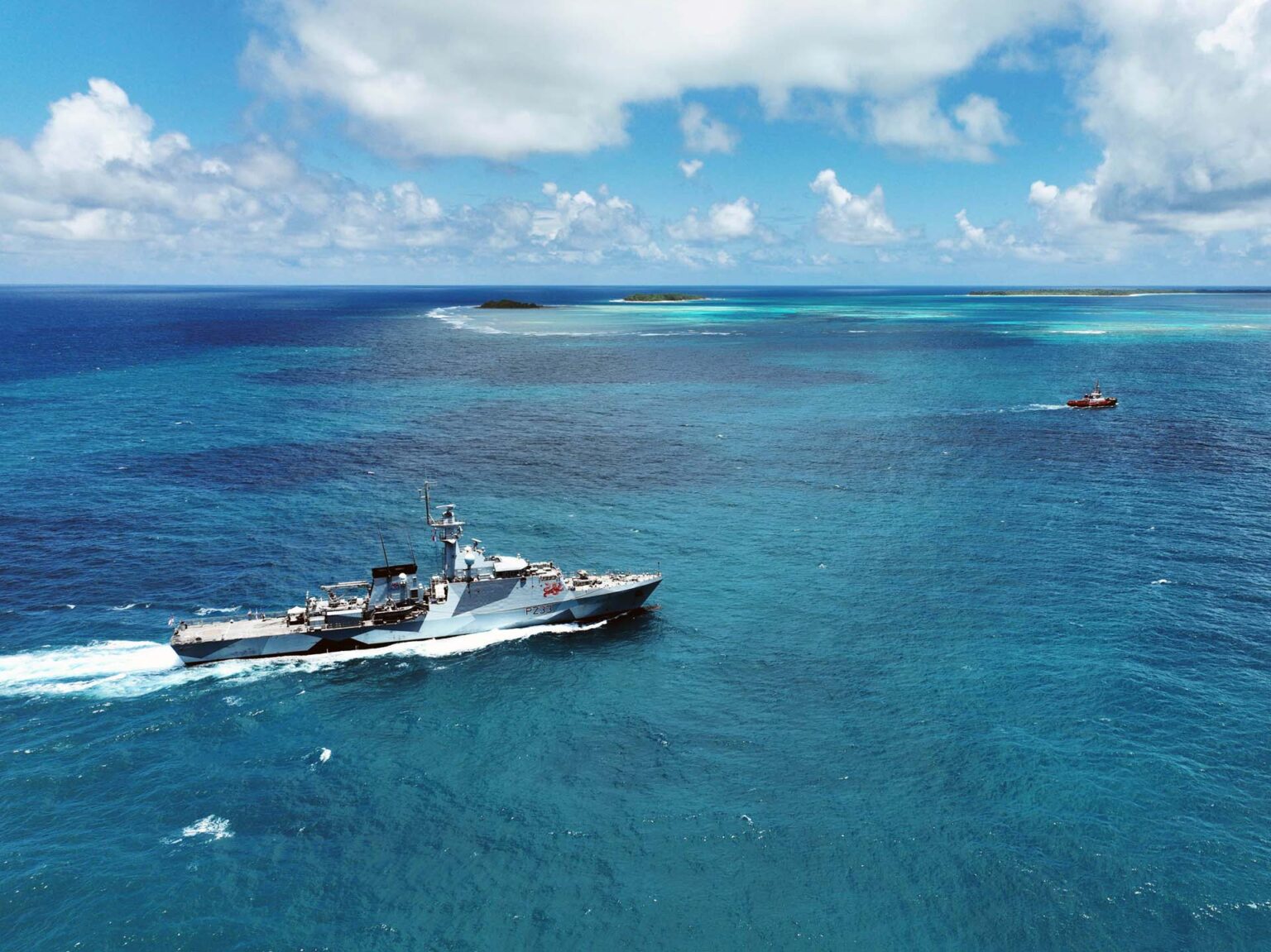
HMS Tamar arriving into Diego Garcia

SeaWaves Magazine reports on a visit by Royal Navy Offshore Patrol Vessel Tamar to the Island of Diego Garcia, an important US and Allied base in the Indian Ocean.

“Crew of the patrol ship concentrated on safeguarding the environment in the British Indian Ocean Territory, ensuring the remote island chain’s rare wildlife was not disturbed by the illegal actions of humanity.

“They found its shores littered with tonnes of rubbish and fishermen flouting international law, trawling the territory’s expansive, protected waters – roughly the size of Texas – for its rich stocks of rare fish.”

I would note two things, first this visit is much too rare and second that while HMS Tamar has a flight deck, it virtually never has an embarked helicopter or capable UAS.

The UK has a vast overseas EEZ. They have never had a large number of OPVs. Generally, they have kept one ship in the Western North Atlantic/Bermuda/Caribbean and one ship in the South Atlantic/Falklands/New Georgia regions, not always an OPV. Their overseas territories in the Indian, Pacific, and Mid Atlantic Oceans seldom, if ever, see a patrol vessel. It does seem the British are starting to recognize the utility of these little ships, but I don’t expect them to build any more.

When operating in these overseas EEZs, patrol vessels are generally not supported by land based maritime patrol aircraft.

The River class Batch 2 are large enough to support a helicopter but have no hangar. A helicopter can help search over the horizon, but they are not as helpful as might be thought, because it is difficult to get more than four hours a day search time (two, two hour sorites). While on WHEC-726 I once calculated the embarked helicopter was increasing our effective area searched by about 40%.

Though it would lack some of the operational flexibility of an embarked helicopter, a robust UAS detachment could provide an even better search capability at a relatively low cost.

How Long Should an OPV be? Is There a Minimum?

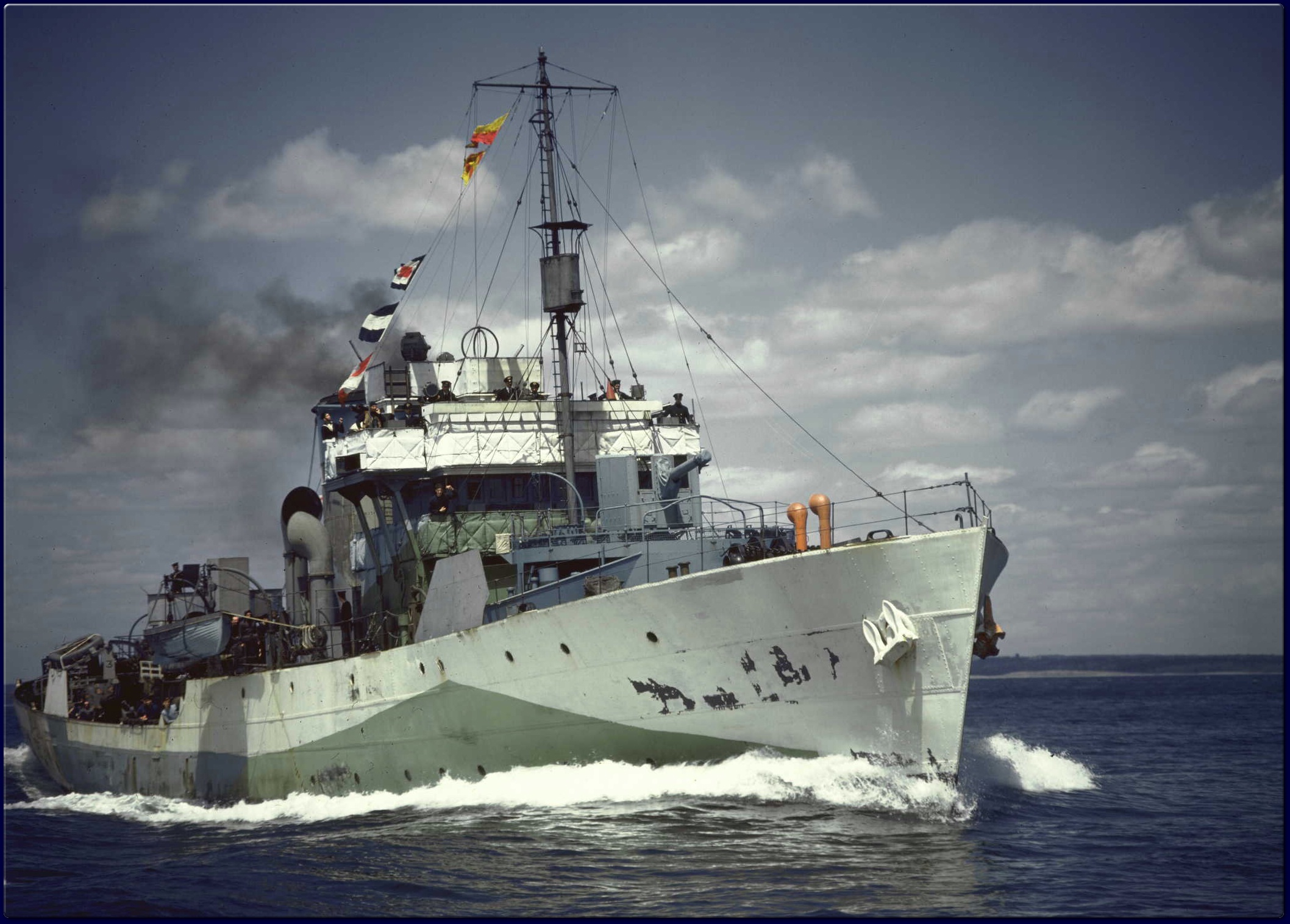
Flower class corvette HMCS REGINA (K234) circa 1942 – 1943
Source:Canadian Navy Heritage website. Image Negative Number CT-252

Decades ago, I read a Royal Navy research paper that asked essentially, “What is the proper length for a corvette?” A balance of adequate seakeeping and minimum cost? The report had originated shortly after World War II when the British had operated hundreds of 205 foot (62.5 meter) long Flower class and 252 ft (77 m) Castle class corvettes. Their answer was 270 feet (82.3 meters, probably they were talking waterline length. In this post, I will be using length overall (loa) and full load displacement (fl)), but there was a caution, that while that was appropriate for the Atlantic, operation in the Pacific would require a larger ship because of the longer swells prevalent in the Pacific.

This introduced me to the idea that there might be a step function in effectiveness based on length, and that it might vary with the environment.

A very pleasant experience with the 327 foot (100 meter) cutter Duane also seemed to suggest there might be a sweet spot where ships become much more seaworthy.

Is there a minimum length for a vessel to function effectively as an Offshore Patrol Vessel? There is room for some scholarly research into the question.

Lacking a naval engineering background, I approach the question in a different way. On the assumption that given experience, OPV users move toward an optimum balance of capability and cost, let’s look at the experience of navies and/or coast guards of five nations that have created more than one class of OPV over the last 30 or so years, the US Coast Guard, French Navy, UK Royal Navy, Japan CG, and Indian Navy and Coast Guard. We will look at the ships created about 30 years ago and the ships they have chosen to build most recently.

FRANCE

France has the largest EEZ of any nation, 11,691,000 km2, about 103% that of the US, most of it in the Pacific and Indian Oceans.

The Old
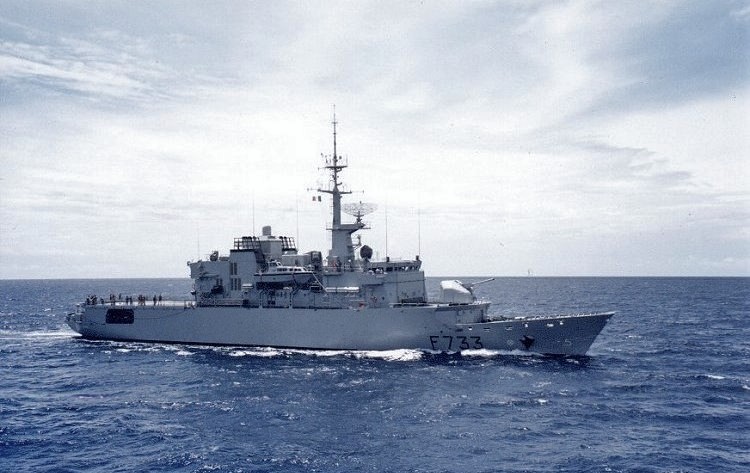
Floreal class. Six ships (plus two for Morocco) commissioned 1992-1994: 93.5 meter, 307 feet, 3000 ton, 20 knots. FS Ventose pictured. 

The New

Artist drawing of the future Modular and Multirole Patrol Corvette MMPC. (Picture source: Navy Recognition)

European Patrol Corvette. First Delivery expected 2030: 110 meters. 361 feet. 3,000 tons, 24+ knots.

France has their open ocean coast guard functions performed by their navy. In 1992 the French Navy commissioned the first of six Floréal class “surveillance frigates” pictured above. These are expected to be replaced by a version of the 110 meter, approx. 3,000 ton, 24 knot European Patrol Corvette.

The Old
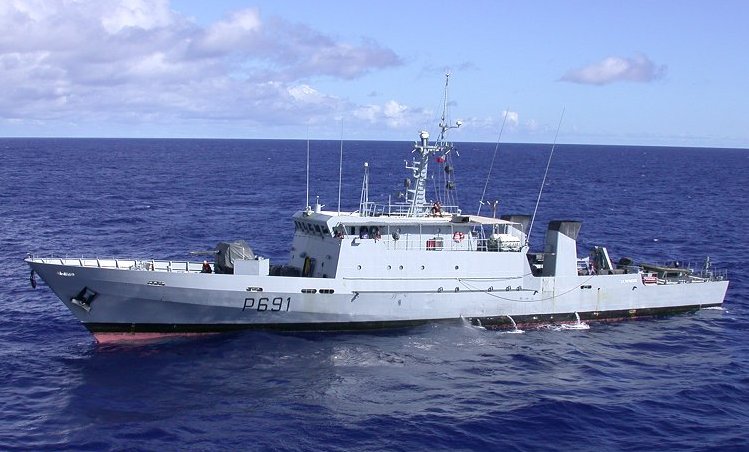
Patrol ship Tapageuse at sea near Tahiti (18 June 2003). Photographer: Jean-Michel Roche

P400 class of ten vessels. Commissioned 1986-88, 54.8 m (179 ft 9 in). 480 tons fl. 24 knots. 

The New
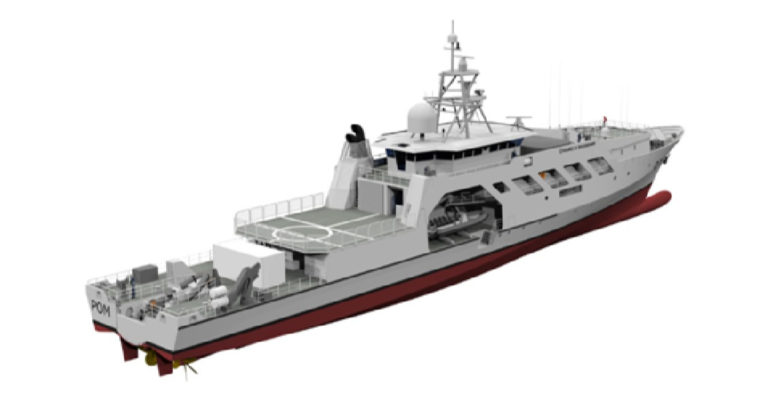
Rendering of the future “POM” OPV of the French Navy

Patrouilleurs Outre-mer (POM), or Félix Éboué class: Six ships to be commissioned 2023-25, 80 m (262’6″), 1300 tons fl.

Their latest acquisitions are six 80 meter Offshore Patrol Vessels (Patrouilleur d’Outre-Mer – POM).

They replace the P400 class. Like the Floreals, these ships and their replacements are of simple design intended to operate for long periods from austere bases in French overseas territories. Most of the P400s were operating in the Western Pacific in the same environment where we currently operate the smaller Webber class FRCs. Significantly, “Since late 2008, ships of the D’Estienne d’Orves class, with their heavy armament removed, were planned to replace the P400 in the high sea patrol role, a task for which the P400 class have proved to be underweight.” This was 20 years after the the vessels were commissioned but clearly the French thought they were “going to need a bigger boat.” The replacement POM class turned out to be very similar to the D’Estienne d’Orves class in length and displacement, 80 m and 1,300 tons.
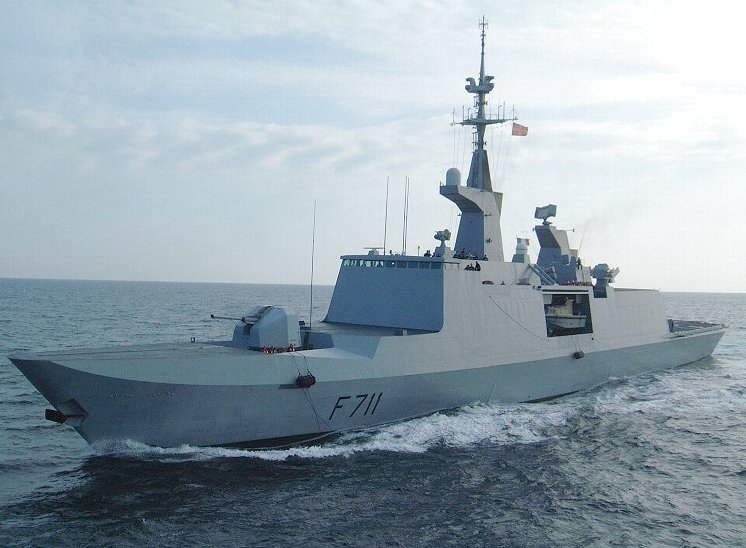
File:FS Surcouf.jpg

La Fayette class Frigate Surcouf 

In 1996 France commissioned the first of five nominally general purpose 125 m (410 ft 1 in), 3,800 ton, 25 knot La Fayette class frigates, but as built, they had no ASW capabilities, so they were more high performance OPVs not unlike the USCG Hamilton class WHECs. France’s EEZ is widely distributed and varied. The French seem to have a wide array of solutions to their patrol requirements. They seem to produce designs for specific outposts. In addition to those discussed above they have built these relatively unusual OPVs: here and here.

The former French Ship L’Adroit, now the Argentinian OPV, ARA Bouchard (P-51)

Perhaps it is telling that, when French shipbuilder Naval Group built an OPV on speculation for a world market, the result was the 87 meter L’Adroit, which after service with the French Navy was sold to Argentina along with three new construction near sisters. Recently France contracted for ten Offshore Patrol vessels that have been reported to be 90 meters in length. I suspect these will be similar to L’Adroit

US Coast Guard:

The US EEZ, the second largest, is very nearly as large as that of France at 11,351,000  km2.

The Old
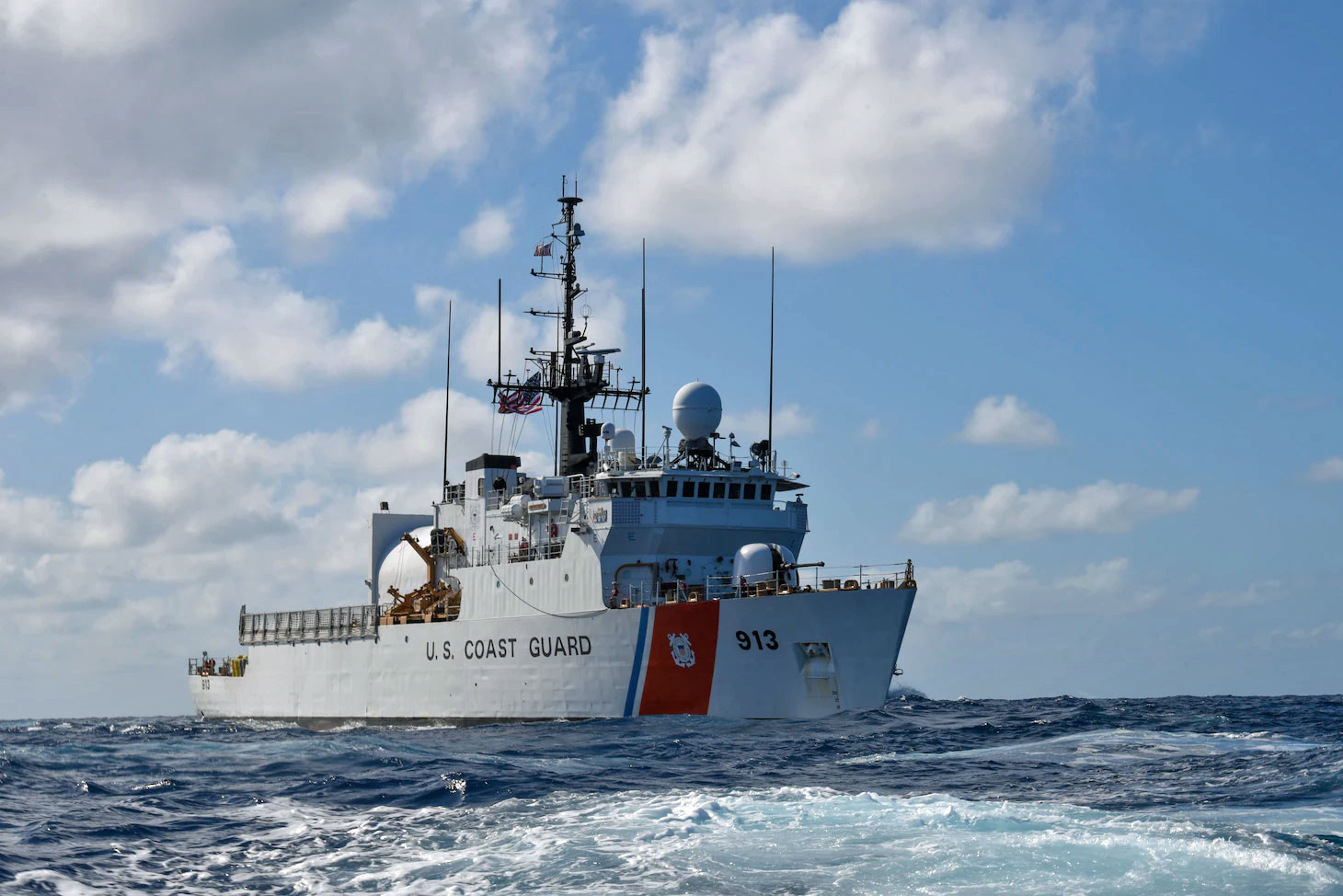
Bear class Medium Endurance Cutters, class of 13, commissioned 1984-1991, 82 m (270′), 1800 tons, 19.5 knots.

The New
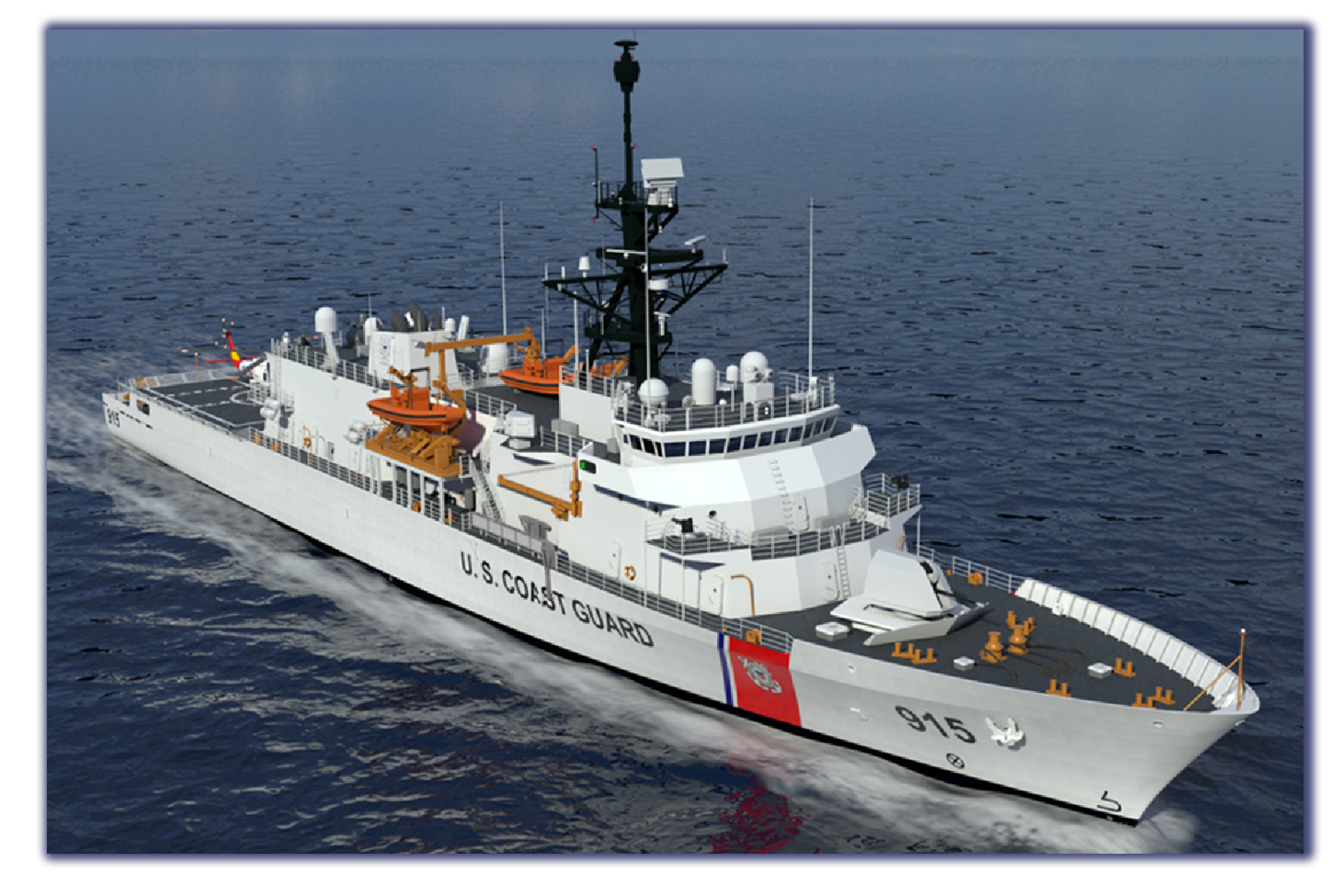
Offshore Patrol Cutter, Artist’s Rendering, Credit Eastern Shipbuilding

Offshore Patrol Cutter, projected class of 25, projected delivery 2025-2038, 110 m (360′), 4,500 tons, 22+ knots

Thirty years ago, the US Coast Guard had just completed the 82 meter, 270 foot, 1,800 ton, 19.5 knot Bear class, the first of which was commissioned in 1984, the newest, Mohawk in 1991. They replaced 143-, 205-, 213-, 311-, and 327-foot cutters built during and before the Second World War.

The US Coast Guard would not build any additional Offshore Patrol vessels until the 127 meter, 4,500 ton Bertholf class National Security Cutters (NSCs), the first of which was commissioned in 2008. Despite the age difference, the NSCs were not replacements for the WMEC270s, but rather the twelve 115 meter (378-foot) Hamilton class commissioned 1967 to 1972.

The direct replacement for the Bear class WMEC270s (as well as the 64 meter, 210 foot Reliance class) is the 110 meter Argus class Offshore Patrol Cutter, (OPC).

The relatively large size of both the NSC and the OPC, displacing at least 4,500 tons full load, reflect demanding requirements for launch and recovery of boats and helicopters in heavy weather.

These requirements seem to reflect experience on Alaska Patrol. While the Bear class seem to have served well in the Atlantic and the equatorial Eastern Pacific they were found to be inadequate for operations in Alaskan waters.

The 64 meter Reliance class were never really designed to be offshore patrol cutters in the modern sense. Designed before the United Nations Convention on the Law of the Sea, when the territorial sea was still three miles, and before the advent of the 200 mile Exclusive Economic Zone, they were only expected to go out 50 miles offshore.

Meanwhile, the relatively small 47 meter Webber class have proven remarkably capable but are operated with an eye on their endurance and weather limitations.

Looking at the large cutters that were in the fleet when I entered the service in the ’60s, we had three classes of ships that stood weather station patrol, demanding long open ocean patrols. Of these, the 100 meter Secretary class 327s were considered the most successful. The 95 meter Casco class “311s” were also successful and their huge fuel capacity allowed great operational flexibility. The 77.7 meter Owasco class “255s” operated at significant disadvantage, in that they were rough riding and their limited fuel capacity forced them to drift when being able to maintain a favorable heading would have been desirable.

United Kingdom’s Royal Navy: 

The UK’s EEZ is the fifth largest in the world at 6,805,586 km2 (60% that of the US).

The Old
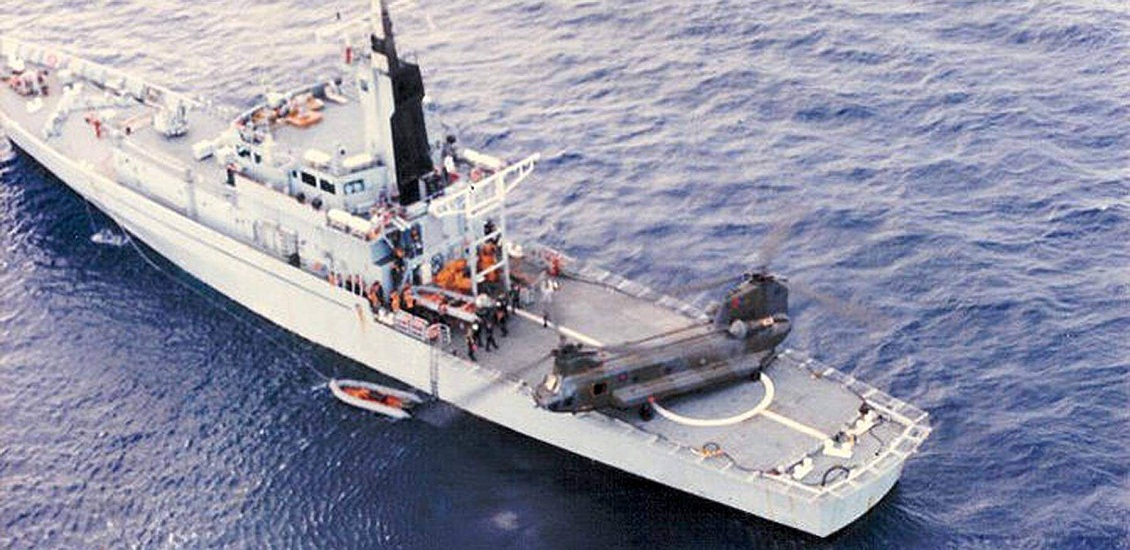
HMS Leeds Castle during the Falklands War.

Castle Class, two ships, commissioned 1981 and 1982, 81 m (266′), 1,550 ton fl, 20 knot 

The New
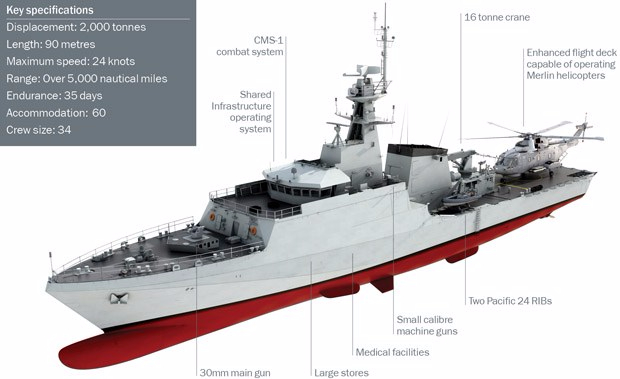
River Class (Batch II), 5 ships, commissioned 2017 to 2021, 90.5 m (297′), 2,000 tons fl, 25 knots

The Royal Navy has never had a great many OPVs. They currently have eight in commission. They have tended to use frigates and MCM vessels to perform coast guard duties.

The Castle class were designed to replace the 61.1 m (200′), 1,280 ton, 16 knot Island class OPVs commissioned 1977 to 1979, that were criticized as unseaworthy, too slow, and lacking a flight deck. Originally it was to have been a class of six, but only two were completed and the Island class soldiered on into the 21st century. The two Castle class served the Royal Navy for 28 and 29 years before being sold to Bangladesh in 2010 where they still serve.

The Castle class was followed by three 79.5 m (261′), 1,700 ton, 20 knot River class (Batch I) and a forth modified, slightly longer River class the 81.5 m (267 ft 5 in) HMS Clyde that unlike the earlier ships included a flight deck. Initially the River class Batch 1 ships were leased, but the first three were subsequently purchased and continue to serve as fisheries protection vessels. HMS Clyde has been sold to Bahrain.

These were followed by five 90 m River class Batch II ships. Despite the similar nomenclature, these are an entirely different class.

Japan Coast Guard: 

Japan’s EEZ is 4,479,388  km2 (39.5% that of the US) and is the eighth largest in the world. Their entire EEZ is in the North Pacific, which can be a challenging environment.

The Old
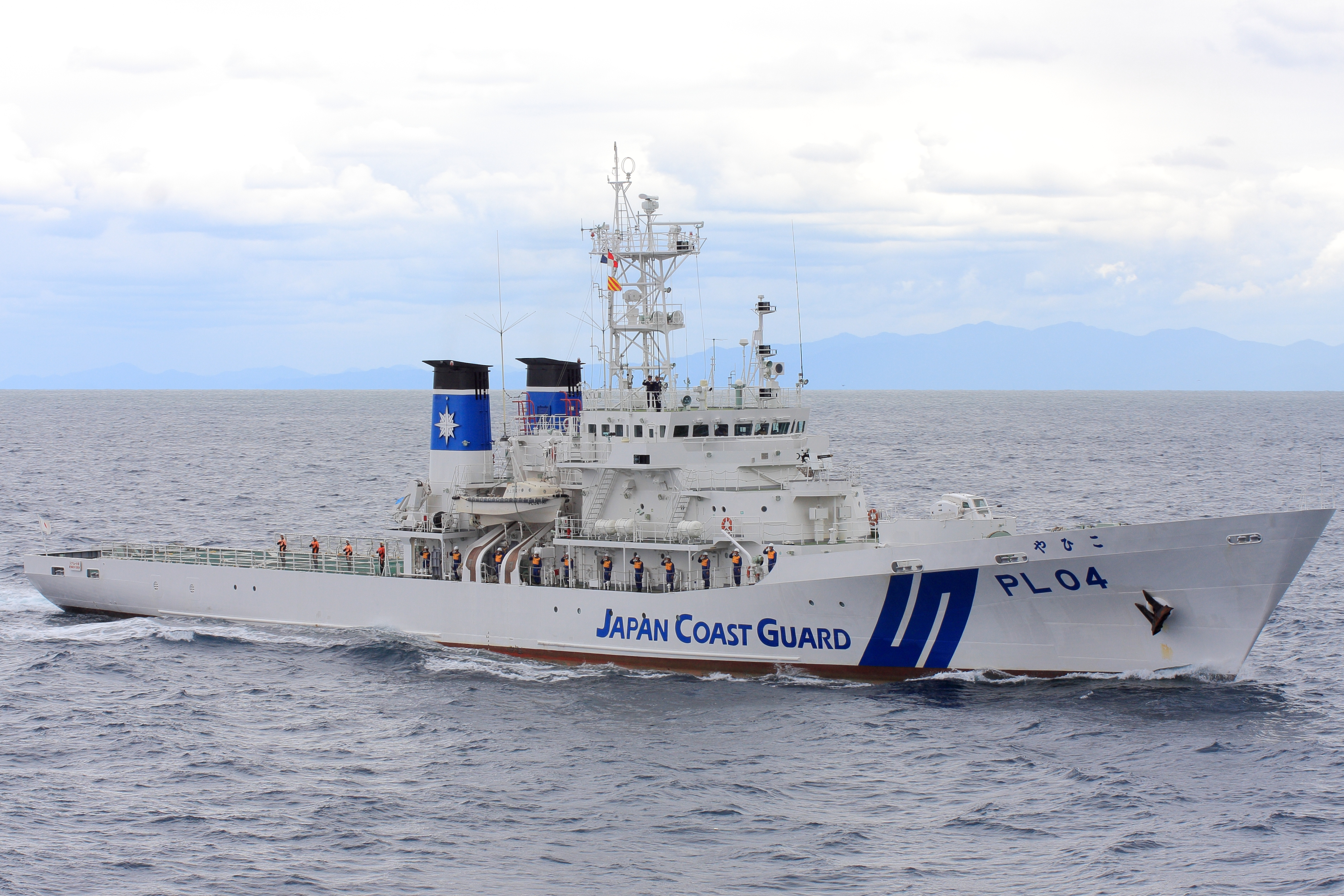
Ojika-class patrol vessel Yahiko (PL-04). First of clasPhoto credit: Cp9asngf though Wikipedia

Ojika class, seven ships, commissioned 1991 to 2000, 91.5 m (300′), 2,006 tons fl, 20 knots

The New
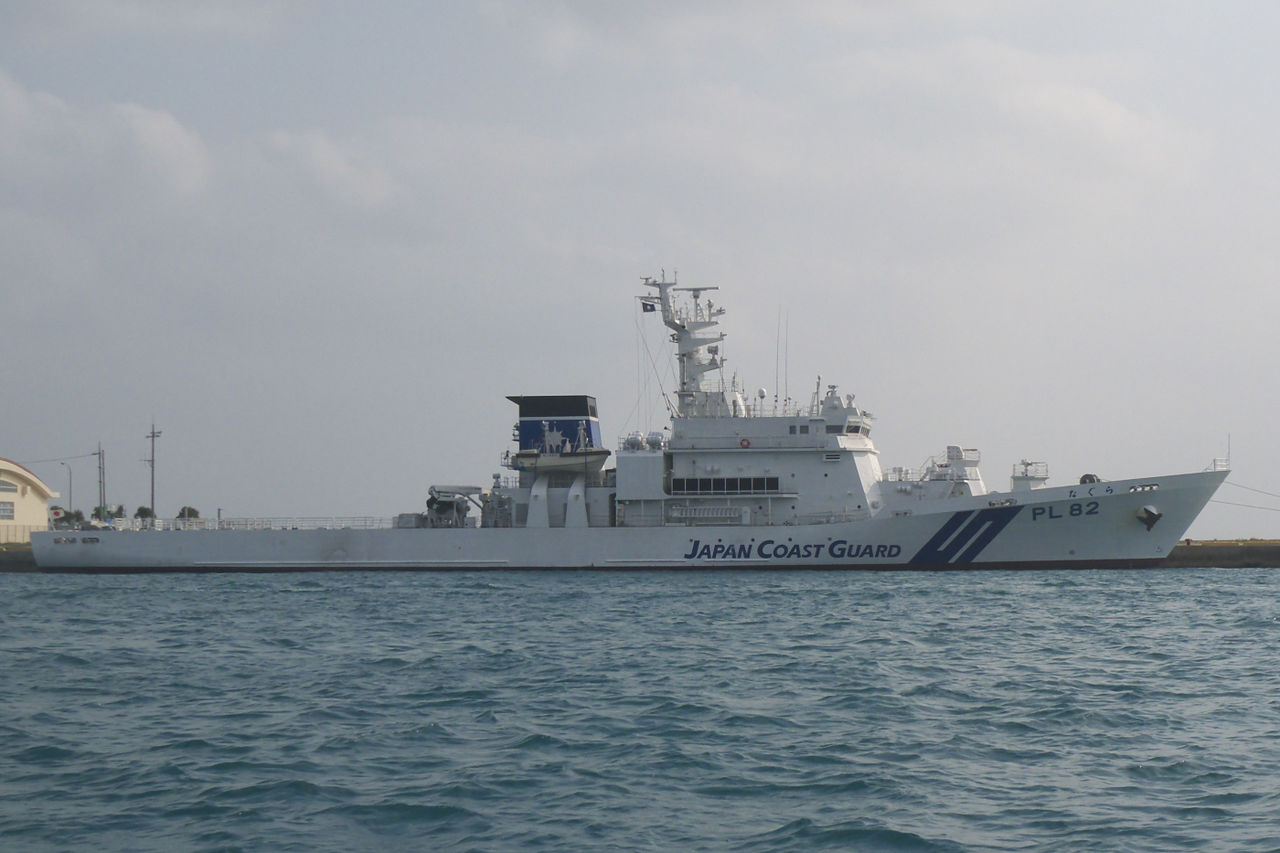
JCG Kunigami class cutter PL82 Nagura. Photo from Wikipedia Commons, by Yasu

Kunigami-class, 20 ships+1 building (+ 2 for the Philippine CG, commissioned 2012 to 2020, 96.6 m (317′}, 2260 tons, 25 knots

Unlike the US Coast Guard, the Japan Coast Guard produced “High Endurance Cutters” (PL and PLH) continuously over the last 30 years, 62 ship in 13 classes, including some very large cutters, some up to 150 meters and approaching 10,000 tons.

Thirty years ago, the Japan Coast Guard was building the Ojika class, seven ships commissioned 1991 to 2000. Six of the seven are still in service, they are 91.5 meters (300 feet) in length, with a full load displacement of 2,006 tons, a max speed of 20 knots, and a crew of 34.

The most recent, general-purpose “High Endurance Cutters” built by the Japan Coast Guard have been the 96.6 m (317 ft) Kunigami-class. There are currently 20 of these cutters in service with three more on the way. In addition, Japan has built two modified versions of this class for the Philippine Coast Guard. With no end in sight for their construction, these may become the most produced OPVs of the 21st century.

These are relatively simple ships, not much different from the Ojika class.
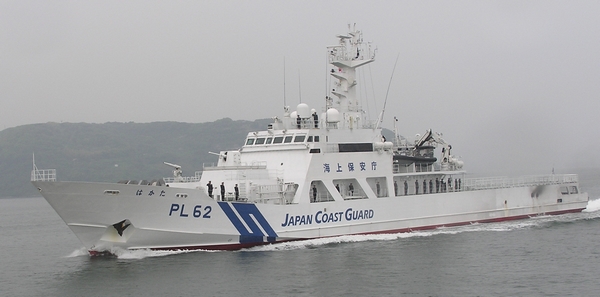
JCG Hateruma class cutter Plhakata. One of a class of nine commissioned 2008-2010. 89.0 m (292.0 ft) loa. 1350 tons fl. 30 knots max speed. Crew of 30. Photo by Takaaki.

Frequently cutters of different classes have been built concurrently rather than consecutively.  Aside from three 79 meter Aso class, commissioned 2005/2006, designed as high-speed interceptors of North Korean spy ships, the smallest “high endurance cutters” built in the last 30 years are the nine ship, 89 meter Hateruma class pictured above, commissioned 2008 to 2010.

The JCG cutters discussed here, unlike their larger PLH cutters, have no hangar, only basic weapon and sensor suites. Their size is not determined by features incorporated in the design. It appears their size is a reflection of the environment where they operate, the North Pacific.

India:

India’s EEZ is 2,305,143 km2, 20.3% that of the US, but still more than the entire EEZ under the Atlantic Area.

In 1986 the Indian Coast Guard had 80 officers and 400 men. They have come a long way. The Indian Coast Guard got a big boost after the 2008 Mumbai Terrorist Attack, which came by sea. The Indian Coast Guard operates 27 Offshore Patrol Vessels, all commissioned within the last 28 years, 18 since 2015.

The Old
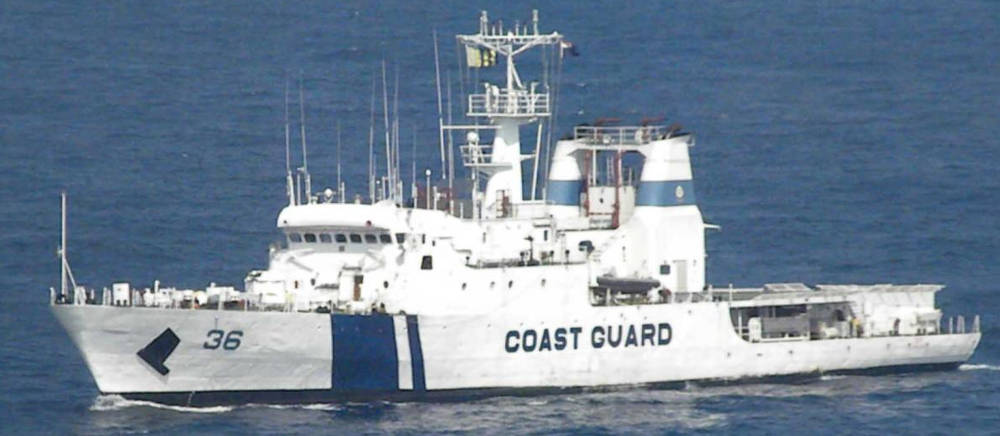
Indian Coast Guard Ship Varuna. Indian Government photo.

Vikram-class offshore patrol vessels, nine ships commissioned 1983-92, 74 m (243′), 1,224 tons, 22 knots.

The New
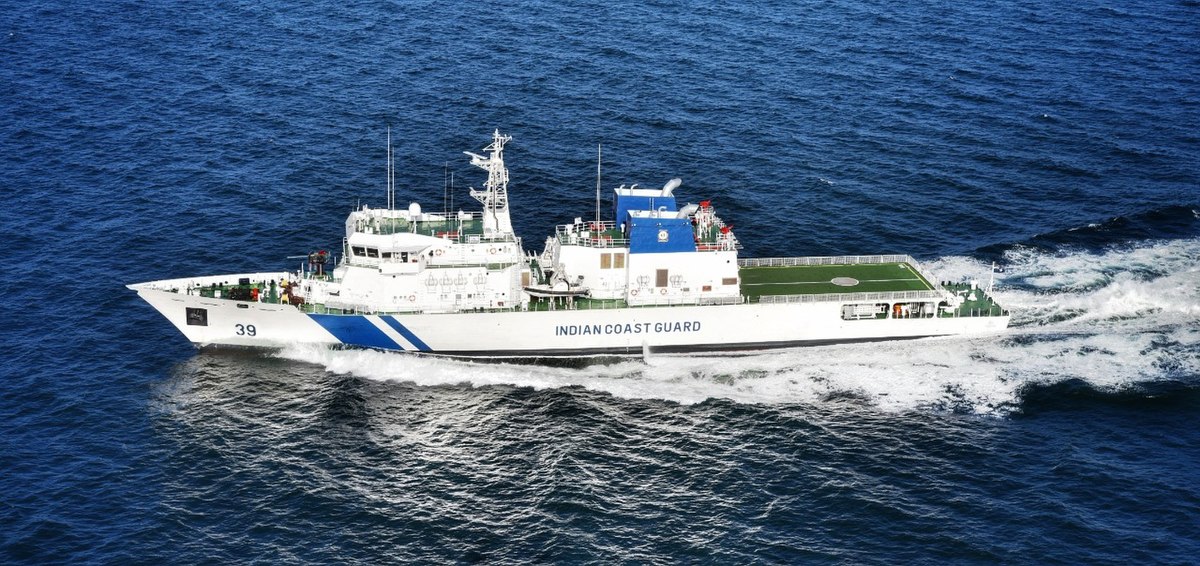
ICGS Vigraha (39) during sea trials, 28 August 2021, Indian Coast Guard photo.

Vikram-class (different Vikram class) offshore patrol vessels, Class of seven ships commissioned 2018-2021, 97 m (318’3″), 2140 tons, speed 26 knots.

And
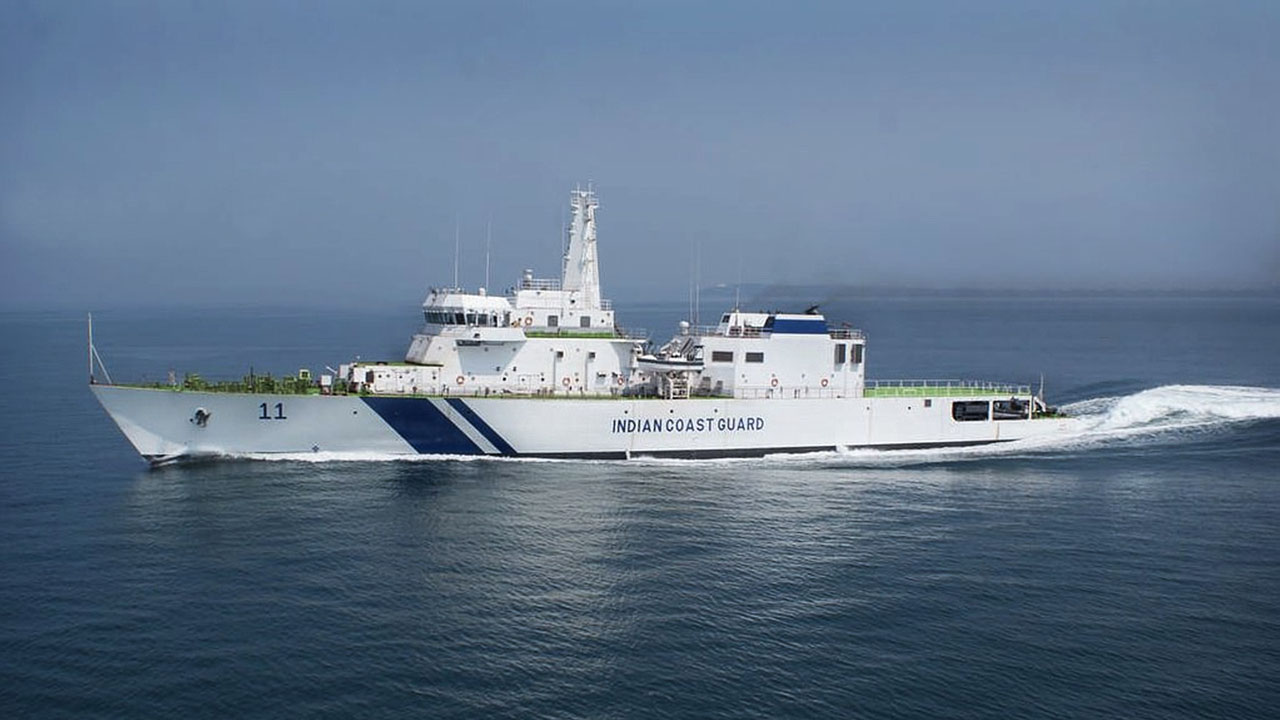
105 meter, Off Shore Patrol Vessel (OPV) ICGS Samarth, 10 November 2015, photo Indian Coast Guard

Samarth-class, 11 ships, commissioned 2015 to 2022, 105 m (344.5′), 2450 tons fl, 23 knots

The first Vikram class was not considered entirely successful because they could not operate helicopters in heavy weather because of the ships’ roll characteristics. The class is no longer in service with the Indian Coast Guard, but two ships were transferred to Sri Lanka.

Since 1990 the Indian CG has not commissioned an OPV of less than 93 meters. Their largest are 105 meters. None of their smaller patrol craft (WPCs) exceed 51.1 meters so there is a clear distinction between OPVs and Inshore Patrol Vessels.

INDIAN NAVY

The Indian Navy operates 12 Offshore Patrol Vessels, six of each of the two class below.

The Old
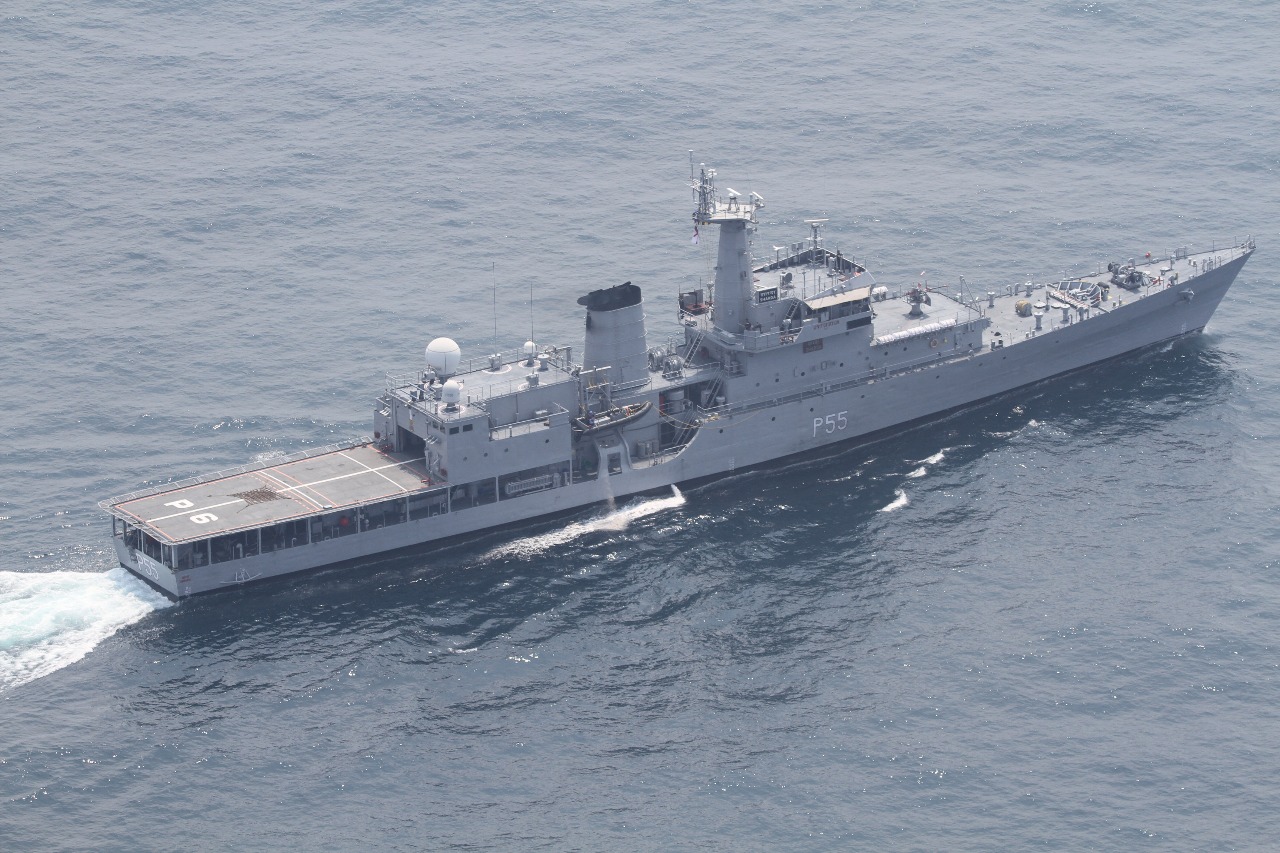
Sukanya class OPV INS Sharda (P55). Indian government photo.

Sukanya-class, seven ships, commissioned 1989 to ’93, 101 m (332′), 1,890 tons fl, 21 knots

The New
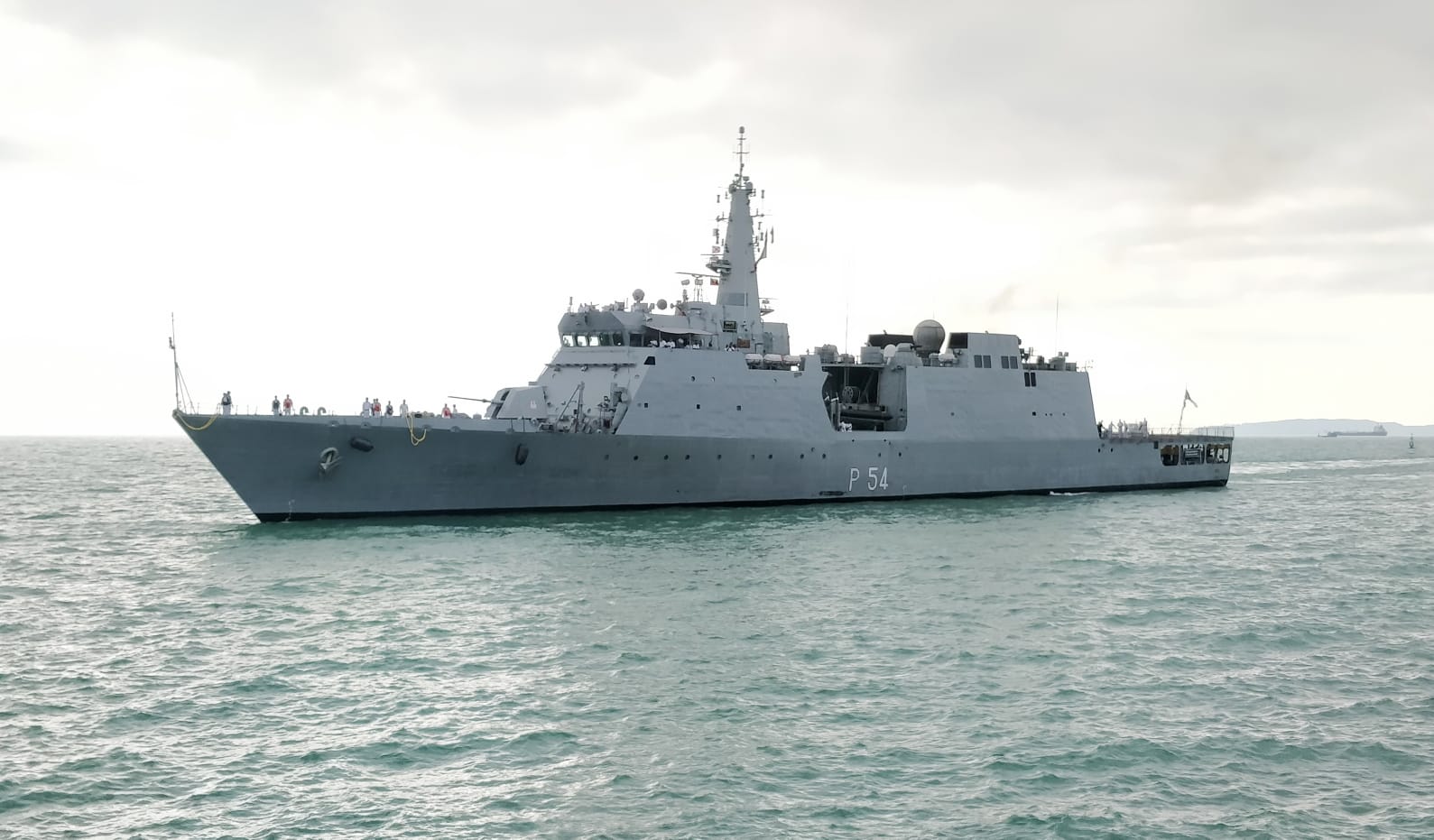
INS Saryu. Indian Government phot

Saryu class, six ships, commissioned 2013-2018, 105 m (344′), 2,230 tons, 25 knots

OBSERVATIONS

Speed: Speed has typically increased by about four knots. The trend seems to be to a maximum speed of 24-26 knots. Increasing speed is made easier by increasing waterline length. It may not be an accident that a waterline length of 97.8 m (320.8′) provides a hull speed of 24 knots, typical max speed for a modern OPV, while 20 knots, the typical speed for an OPV 30 years ago, only required a waterline length of 67.9 m (222.8′).

There is now little or no difference between the speeds of OPVs and corvettes or light frigates. For warships, except those that have to be able to keep up with nuclear powered carriers, the value of absolute top speed has diminished while the value of high sustained cruising speed has increased. This is apparent if you compare the Oliver hazard class FFGs with the new Constellation Class. Top speed is down 3-4 knots to 26 knots, but range is up with a powerplant designed for economical cruising.

Aircraft: Flight decks are now ubiquitous. Hangars are common but are not included in every new design. Designs that support two embarked helicopters are still the exception. The French POM, which seems to be a minimalist approach, bucks the trend and includes aviation facilities for only unmanned air systems.

Length: Of the current generation OPVs, none of those discussed is less than 80 meters (262,4) and only the minimalist French POM was that small.

The Royal Navy study I mentioned seems to have gotten it right, that 270 feet (82.3 m) is a reasonable minimum and in some environments, length should be greater. Desire for greater capabilities (e.g., greater speed, better aviation facilities, more weapons and sensors} may to be driving designs of greater length than would be required simply for seakeeping, but the choices made by the Royal Navy and Japan and Indian Coast Guards tend to confirm that about 90 meters or more and at least 2,000 tons is the new norm.

“Discover the French Navy’s New OPV for the Indo-Pacific” –Naval News

The video above is from Naval News via YouTube. Below is the information provided on the YouTube page.

Presentation of the first POM (Patrouilleur Outre-Mer or Offshore Patrol Vessel – OPV – for the overseas territories), the “Auguste Bénébig”, by its commander. This new French Navy (Marine Nationale) vessel will be based in Noumea, New Caledonia, in the Southern Pacific Ocean.

This new class of modern OPVs marks the renewal of the assets of the French Navy based overseas to protect French interests in the Indo-Pacific.

The increased autonomy (endurance–Chuck) of the patrol boat and its state-of-the-art equipment give it the capacity to operate far and for a long time in the wide French maritime zones in the Indo-Pacific.

This class of ships was designed by SOCARENAM. It can implement the SMDM drone. The POM vessel are 79.9 meters long and 11.8 meters wide, with a draft of 3.5 meters for a displacement of 1,300 tons at full load.

We have looked at the UAS these ships will deploy with here, “First Three SMDM Fixed-Wing UAS Delivered To The French Navy” –Naval News.

We talked about these ships in regard to how similar their missions are to those of Coast Guard cutters here, “SOCARENAM Shipyard Selected to Deliver 6 French Navy OPVs for Overseas Territories” –Naval News.

And about how close these were to my concept of Cutter X here, “France confirms order for six new POM Offshore Patrol Vessels” –Naval News, Another Cutter X

Like an FRC:

I always thought these looked like oversized Webber class, the proportions are similar and the much larger POM is not much more complicated than the Webber class. The crew of the POM is 30, only six more than that of the FRC. Both have a bridge with a 360-degree view positioned well aft, minimizing vertical acceleration. Both have an 8 meter boat in a stern ramp. The armament is similar with four .50 cal. machine guns and a single medium caliber gun in the bow, a 20mm on the POM and a 25mm on the FRC. The POM has a diesel electric and diesel powerplant but despite its much greater displacement, I doubt it has any more horsepower than the FRC (I have not been able to find a figure for the POM). With similar crew and systems, they should not cost much more than the FRCs to operate.

Unlike an FRC:

It appears the thinking was that they wanted a ship to do the same sorts of missions the Webber class Fast Response cutters (FRC) are doing out of Guam, but they also recognized that these ships would be far from any major naval base and that they would need to travel great distances and would be exposed to extreme weather conditions, so they needed to be larger (1300 tons vs 353 tons) and have greater endurance (30 days vs 5 days). Their range is 5500 nmi compared to 2500 for the FRC.

Having chosen a larger hull, they took advantage of the greater volume and deck space to add a second RHIB, a multimode radar, space for 29 passengers (roughly a platoon of Marines), a sickbay, a dive locker, space for a 20 foot containerized mission module, a flight deck and hangar for a 700-kilogram-class rotor-blade drone (not yet deployed), and a holding area for up to six prisoners.

Portugal to Build a New Type of Ship–UxS Carrier

The “plataforma naval multifuncional” (multifunctional naval platform). Portuguese Navy image.

It is not often an entirely new category of ship emerges, but this seems to be the case. Perhaps it was inevitable, but it looks like the Portuguese may be the first to make it happen–a specialized, built for purpose, unmanned systems mothership.

Wish the specs in the lower right above were readable. 

First heard about this ship from Cdr. Salamander. He has some interesting ideas about how such a ship could be used. It is part research ship, part disaster response vessel, and, significantly for the Coast Guard, part Offshore Patrol Vessel. There is more about the ship from Naval News. It is not particularly large, with a crew of about 90 and accommodations for another 100. The cost is reportedly about $100M US, much less than the cost of the Offshore Patrol Cutter. Judging by the size of the helicopter (reportedly an NH-90) on the model, it appears to be 100 to 110 meters (328-360 feet) in length, about the length of the OPC, maybe less. It must be pretty broad if that is an MQ-1C Gray Eagle on the deck. The Span of the Gray Eagle is 56 ft (17 m), but it just does not look like it is in scale. Maybe they have a European sourced UAS in mind. Beam looks to be about 20 to 22 meters based on my presumptions about the length, that is 66 to 72 feet. Those proportions are similar to those of the 6,615 ton Canadian Harry DeWolf class Arctic Offfshore Patrol Ship, 103.6 m (339 ft 11 in) long and a beam of 19 m (62 ft 4 in). By comparison, the beam of both the NSC and OPC is 16m or 54 feet.

The thing that makes this ship totally unique is the runway and ski-jump designed expressly for fixed wing unmanned air systems.

Artist rendering of MQ-9B STOL landing on a big-deck amphibious assault vessel. Photo: Courtesy of General Atomics Aeronautical.

What might make this very useful is the newly developed STOL version of the MQ-9B with shorter span, high lift, folding wings.

Not sure I like this particular design. It is not clear how many UAS and helicopters can be carrier or if there is hangar space. The island is unnecessarily thick and looks too far forward. No indication of speed or endurance. The speed in unlikely to exceed 20 knots, between 16 and 18 knots seems likely, but the concept is novel. Look forward to seeing the ship in final form.

Late Addition: 

After posting this on Facebook, I got some additional information. This is a Google translate from Portuguese. Thanks to Pedro Mateus.

MULTI-PURPOSE PLATFORM SHIP Lisbon, Portugal June 20, 2022 On June 20, 2022, the Portuguese Navy launched a tender limited by simplified prior qualification, via procedure no. of a Multipurpose Vessel/Platform (N-PM), with an execution period of up to 3 years (with delivery until December 2025), for a base price of 94.5 million Euros.

This Multipurpose Ship/Platform (N-PM) will have a total length, between perpendiculars, of 100 meters, a maximum beam (at flight deck level) of 20 meters and a maximum draft of 7.5 meters. It will follow STANAG 4154 (Ed 3) standards and will be able to maintain the operation of lowering and hoisting vessels in sea state 5 on the Douglas Scale. Its garrison will be composed of 1 commander, 7 officers, 8 sergeants and 29 soldiers, in a total of 45 elements. It has accommodation sized up to 28 officers, 30 sergeants and 32 enlisted men, for a total of 90 elements (in addition to the commander). It will be dimensioned for a range of 45 days at a cruising speed of 10 knots.

The N-PM shall comprise a set of aviation facilities including, among others, a flight deck (a ski-jump runway, a spot for helicopter operation, with lighting system, GPI, etc.), hangar for a helicopter (with support for hydraulic maintenance stations, overhead crane, technical lighting, etc.) and a hangar for unmanned aircraft. In terms of organic helicopter, it should support the Lynx MK95A and NH90 aircraft (either in “spot” or in hangar) and EH101 (“spot”). The flight deck must allow the operation of different types of unmanned aircraft, commonly known as “drones” (Ogassa OGS42, Tekever AR3, etc.), as well as all the support required for vertical refueling operations (VERTREP).

Within the scope of semi-rigid vessels, the N-PM will have 3 vessels: a vessel with
SOLAS (“Safety of Life at Sea”) certification for operation as “Fast
Rescue Boat”, with a power of not less than 250 hp; and two non-cooperative approach vessels, with capacity for 8 equipped soldiers, with a maximum speed of 35 knots or higher and a minimum autonomy of 60 nautical miles, for inspection missions , policing, combating drug trafficking, assault and support for a small embarked force.

Following the good practices and installation and operation recommendations of the “Alliance of European Research Fleets” (EUROFLEET), in terms of support systems for scientific research, the N-PM will be designed to be able to operate subsurface Unmanned Vehicles (VENTs) and remotely operated vehicles – “Remotely Operated Vehicle” (ROV). It will have a sensor pavilion (“drop keel”) for the installation of scientific and acoustic sensors; a large volume “Rosette” CTD system (for deep water sampling, with probe capable of operating up to 6,000 m); an MVP system, “Moving Vessel Profiler”, capable of operating up to 700 meters deep with the ship sailing at 8 knots; an “Acoustic Doppler Current Profiler” (ADCP); a “Global Acoustic Positioning System” (GAPS), capable of operating up to 4,000 meters deep. In addition to these organic systems, the N-PM will have the capacity and integration for several other non-organic systems (Piston Corer – Calypso, Vibrocorer, Box Corer, Multi Corer, etc.) as well as all operating and support winches.

Under an integrated architecture of command and control, platform management, and digital information processing and management systems, this N-PM will have a set of navigation systems (IBS, DDU, TACAN, Secure GPS, etc.), with navigation radar surveillance systems, combined warning radar (ARPA capability, “Automatic Radar Plotting Aid” and IMO certification; ECM and Anti-Jamming) and IFF/W-AIS identification systems, as well as underwater surveillance systems (bathythermograph; support for XBT/XSV probe used in the Navy (XBT4, XBT5, XBT7 and MK-8 XBT/XSV) or CTD type probes). In terms of external communications, it will have, among others, satellite communication systems SATCOM and MILSATCOM, GMDSS, submarine telephone, SART, EPIRB and ICCS.

In terms of armament, the N-PM will be equipped, at least, with 4 “softmounts” for a Browning M2 .50 heavy machine gun, with a firing range limiter and respective accessories, and a base, with ballistic protection for the Browning part and respective operator; and with 2 pieces of Hotchkiss salvo. The N-PM will be equipped with magazines and armories capable of storing various portable weapons, ammunition, pyrotechnic material and demolition material and respective detonators.

Technical drawing and 3D model via the Portuguese Navy Ships Directorate
Editing and composition by “Espada & Escudo”