Iran’s Shahid Soleimani Catamaran Missile Corvette and Torpedo Armed RHIB

Iranian torpedo armed RHIB carried by Shahid Soleimani class catamaran corvette.

Covert Shores reported on new Iranian missile armed catamaran corvettes, but the report also included the photo above. What we are seeing is a boat suspended from the stern of the corvette. The boat is equipped with what appears to be a torpedo tube for a lightweight torpedo. Presumably there is a second tube on the other side. Diameter is likely to be the same as the NATO standard, 324mm or 12.75″. Unlike most lightweight torpedoes, this is unlikely to be intended for use against submarines. Almost certainly, it is intended for use against surface ships.

There is not a lot of public source information about Iranian torpedoes but their partners in crime, Russia and China, are both believed to have cloned the US made Mk46 torpedo and both passive and active acoustic and wake homing technology is readily available. Passive acoustic homing in the search phase, and wake homing in the terminal phase, seems likely. Range is probably at least 8,000 yards.

This means, these torpedoes can be launched from well outside the effective range of typical Close In Weapon Systems (CIWS) of 20 to 40mm. 

We can’t take much comfort in the fact that the warhead of these torpedoes would be about 100 pounds. That is way less than the approximately 600 pounds of a heavy weight 21″ torpedo like the Mk48, but the effects of an underwater explosion are not linear. The effect of a 100-pound warhead is about half that of heavy weight torpedoes that we have repeatedly seen break ships in half. So, a lightweight torpedo, exploding under the keel, might not break a ship in half, but it is going to hurt.

I have long felt an anti-surface light weight torpedo like this would provide Coast Guard cutters a relatively low-cost way to forcible stop a medium to large vessel, regardless of size, a capability they do not currently have. Apparently, the Iranians think it will work.

Shahid Soleimani Catamaran Missile Corvette:

This is a significant departure for the Islamic Revolutionary Guard Corps. Apparently, they have recognized that their naval swarm forces are vulnerable to attack from the air, and, I believe, particularly helicopters.

hIran Shahid Solemani class corvette top view

With its array of VLS AAW weapons, these corvettes constitute a serious threat to USN and allied helicopters that might be used to counter Iranian swarm tactics.

When engaged in force protection, if the force protection package includes aircraft, and one of this class shows up, a PATFORSWA Webber cutter class might be doing useful service, if they take station a couple hundred yards behind the corvette and maintain a fire control solution on that probably highly flammable and explosive collection of weapons in the center of the superstructure, behind the bridge–without pointing the gun, of course.

“US Navy seizes massive shipment of ammo, explosive material in Gulf of Oman” –Task and Purpose

The U.S. Navy released photos of a fishing trawler it says carried more than 50 tons of ammunition rounds, fuses and propellants for rockets when it was boarded Dec. 1., 2022 in the Gulf of Oman. (U.S. Navy 5th Fleet via Stars and Stripes)

Task and Purpose reports,

“For the second time in less than a month, the U.S. Navy intercepted a ship passing through the Gulf of Oman and seized a large shipment of illicit weapons bound for Yemen..The Navy made the interception on Thursday, Dec. 1. Sailors with the Navy’s 5th Fleet stopped a fishing trawler in the gulf. During a flag verification boarding, they found a large cargo of munitions and chemical propellant. The sailors seized 1.1 million rounds of 7.62mm ammo, as well as an additional 25,000 12.7mm rounds. The trawler also was carrying almost 7,000 rocket fuses and more than 2,000 kilograms of a propellant used in rocket propelled grenades. The cargo totaled more than 50 tonnes.”

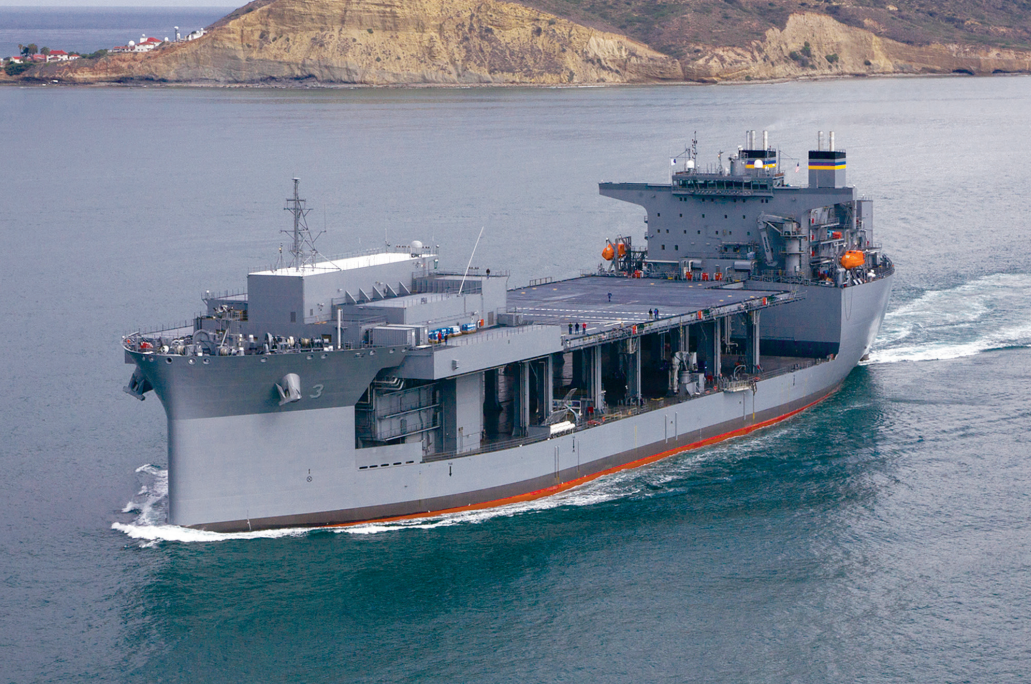
The boarding party came from the expeditionary sea base USS Lewis B. Puller, but I think it is a safe bet Coast Guard personnel were involved in the boarding.

USS Lewis B. Puller (ESB-3)


Fast Response Cutter / Navy MkVI Patrol Boat –Peter Ong

Today we have a guest author, Peter Ong. This is Peter’s sixth post on this blog, and he is now a regular contributor to Naval News. In this post, he reports a conversation with Coast Guard Cutter Forces about why the success of the Coast Guard’s Fast Response Cutter program has allowed  the Navy to cancel their MkVI patrol boat program that at one time was expected to produce 48 patrol boats.

The MkVI had only very austere galley and messing facilities, a Microwave and MREs. They were not expected to be underway more than 24 hours. The FRCs endurance, allowing days, rather than hours, on station to intercept drug and arms smugglers and their abilitiy to support counter UAS systems may be providing capabilities the MkVI simply could not have.

220822-A-KS490-1182 STRAIT OF HORMUZ (Aug. 22, 2022) From the left, U.S. Coast Guard fast response cutters USCGC Glen Harris (WPC 1144), USCGC John Scheuerman (WPC 1146), USCGC Emlen Tunnell (WPC 1145) and USCGC Clarence Sutphin Jr. (WPC 1147) transit the Strait of Hormuz, Aug. 22. The cutters are forward-deployed to U.S. 5th Fleet to help ensure maritime security and stability across the Middle East. (U.S. Army photo by Spc. Noah Martin)

When is a ship a boat and when is a boat a ship? When is an apple an orange and when is an orange an apple? Answer: they are not as these are two different and distinct things when it comes to comparing the warships of the U.S. Coast Guard to the MkVI patrol boats of the U.S. Navy.

A U.S. Navy Mark VI patrol boat with Maritime Expeditionary Security Squadron TWO moves through the water prior to a live fire exercise in the Philippine Sea, Feb. 27, 2021. (U.S. Marine Corps photo by 1st Lt. Stephanie Murphy).

The U.S. Navy is divesting of their 12 in-service Mark VI Patrol Boats, which at the Surface Navy Association 2021, Major General Tracy King, USMC, Director, Expeditionary Warfare (N95) stated that the twelve Mark VIs “Were very expensive to maintain.” However, many critics and pundits of the Mark VIs’ early retirement cite that the Mark VIs still have a lot of life left in them and that their high speeds and heavy armament makes them an asset to special forces, Marines, and Navy SEALs. Mark VIs also perform capital ship escort screenings and contribute to Distributed Lethality and Distributed Maritime Operations by having a smaller vessel signature that might help U.S. Marines move around and slip ashore undetected.

In a phone interview on September 29, 2022 with United States Coast Guard (USCG) Captain John J. Driscoll, Office of Cutter Forces (CG-751), the U.S. Coast Guard captain made a comment about the Sentinel-class Fast Response Cutters (FRC) substituting for the U.S. Navy’s Mark VI Patrol Boats in the Patrol Forces Southwest Asia (PATFORSWA) region and other parts of the globe.

The U.S. Navy plans to replace the Mark VIs and the aging Patrol Coastal boats in the PATFORSWA region with USCG FRCs. When asked how the cutter fleet is integrated with the U.S. Navy and the Department of Defense, the captain replied that the cutter fleet is built into different operational security plans within the U.S. Department of Defense, but these plans are not discussable.

Captain Driscoll said that the Coast Guard’s Fast Response Cutters and the Mark VI are different assets and have different capabilities. The 65 planned FRCs have much greater range and greater endurance (5 days, 2,500 nautical miles (4,600 km; 2,900 mi) and are designed to be on patrol 2,500 hours per year) than the U.S. Navy’s Mark VI Patrol Boats (750 nautical miles (860 mi; 1,390 km) at 25 knots; 690 nautical miles (790 mi; 1,280 km) at 30 knots).

The captain mentioned that the FRC is tremendously capable and different in how it integrates with the Department of Defense and one can’t make comparisons between the Navy’s Mark VI and the USCG’s Fast Response Cutters because the FRC is a commissioned warship of the United States with an assigned crew whereas the Mark VI is just a patrol boat—a ship versus a boat—the ship is larger. The FRC is 154-feet long (46.9 m) with a beam of 25-feet (7.6 m) whereas the Mark VI Patrol Boat is 84.8-feet (25.8 m) long with a beam of 20.5-feet (6.2 m).

Armament is about the same between the two vessels (a Mark 38 MOD 2 25mm autocannon forward with crew-served 12.7mm heavy machine guns and grenade launcher(s) aft) with the Mark VI sporting more armament (another potential Mark 38 25mm autocannon aft and potential crew-served 40mm automatic grenade launchers or 12.7mm heavy machine guns. Some PATFORSWA FRCs will receive the Mark 38 MOD 3 with a 7.62mm coaxial chaingun to the bow 25mm autocannon and a 40mm automatic grenade launcher).

Nonetheless, one can see the huge difference in operational range. Furthermore, the success of the 65 planned Coast Guard FRCs eclipses the 12 Mark VI U.S. Navy Patrol Boats in terms of production numbers. Furthermore, the Mark VI is propelled by waterjets to 45 knots (52 mph; 83 km/h) whereas the FRC has propellers that drive it at 28+ knots. Repeated requests to the U.S. Navy asking for explanation on “[The Mark VIs are] very expensive to maintain” were not answered, but one can assume that it takes a lot of time, labor, and money to clean out the Mark VI’s waterjet intakes and impellers compared to the more easily accessible external shaft and propellers on the Fast Response Cutters when operating in littoral waters potentially teeming with flotsam and seaweed.

FRC range and endurance are important. Captain Driscoll stated that the FRCs are working in the Papua New Guinea and Indonesian region to combat Illegal, Unreported and Unregulated (IUU) fishing and are working with partner nations to address the competition for maritime resources.

As for possible up-arming of the FRCs with the Mark 38 MOD 4 30mm autocannon, that is a retrofit possibility, noted the captain, although the upcoming Polar Security Cutter (PSC) heavy icebreakers will receive the 30mm autocannons first, two on each PSC. Captain Driscoll mentioned that the 30mm autocannon is in the U.S. Navy acquisition system and that the USCG and U.S. Navy both decide on future cutter armament. Programmable and airbursting 30mm ammunition options are not discussable although if the U.S. Navy has the specialized and advanced 30mm ammunition in its inventory, the USCG can also use it depending on the cutter’s mission parameters.

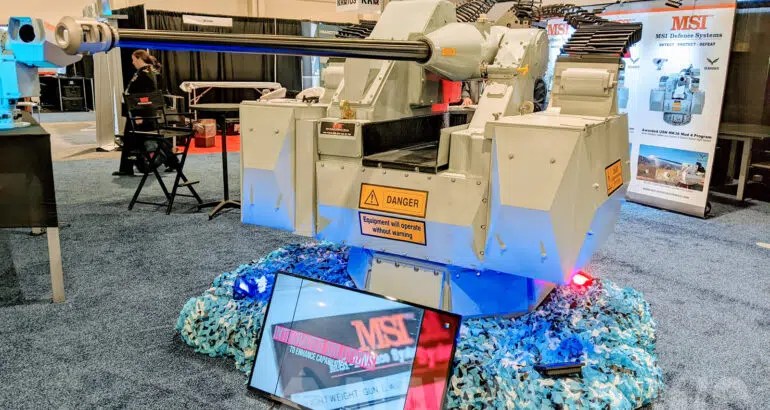
The new Mark 38 Mod 4 30mm naval gun system on display on MSI Defence stand at Sea Air Space 2022. It can, in theory and with funding, be retrofitted aboard existing USCG cutters if agreed upon between the U.S. Navy and the U.S. Coast Guard. Photo: NavalNews

“U.S., UK and Saudi Arabia Complete Naval Exercise in Arabian Gulf” CENTCOM

210524-G-N0146-0073 ARABIAN GULF (May 24, 2021) – Patrol boat USCGC Maui (WPB 1304, foreground) and fast response cutter USCGC Robert Goldman (WPC 1142) transit the Arabian Gulf en route to Bahrain, May 24. Robert Goldman and USCGC Charles Moulthrope (WPC 1141) are the newest additions to Patrol Forces Southwest Asia (PATFORSWA), which is comprised of six 110′ cutters, the Maritime Engagement Team, shore side support personnel, and is the Coast Guard’s largest unit outside of the U.S. playing a key role in supporting Navy security cooperation, maritime security, and maritime infrastructure protection operations in the U.S. 5th Fleet area of operations. (U.S. Coast Guard photo by Seaman Logan Kaczmarek)

Below is a CENTCOM news release. Photos are available here. Wish they had listed the Saudi and Royal Navy participating units as well. 

NEWS | Nov. 8, 2022

U.S., UK and Saudi Arabia Complete Naval Exercise in Arabian Gulf

By U.S. Naval Forces Central Command Public Affairs

Naval forces from the United States, United Kingdom and the Kingdom of Saudi Arabia completed a weeklong maritime exercise called Nautical Defender in the Arabian Gulf, Nov. 7.

The multilateral training event involved U.S. Naval Forces Central Command (NAVCENT), Royal Saudi Navy’s Eastern Fleet, UK’s Royal Navy, and observers from regional nations. Partners focused on maritime security, vessel boarding procedures, explosive ordinance disposal and other training drills ashore in Saudi Arabia and at sea.

In addition to personnel from the U.S. Navy, Marine Corps, Army and Coast Guard, participating U.S. ships included USS Delbert D. Black (DDG 119), USS Devastator (MCM 6), USCGC Charles Moulthrope (WPC 1141) and USCGC Robert Goldman (WPB 1142).

NAVCENT is headquartered in Manama, Bahrain and includes maritime forces operating in the Arabian Gulf, Gulf of Oman, Red Sea, parts of the Indian Ocean and three critical choke points at the Strait of Hormuz, Suez Canal and Bab al-Mandeb.

“U.S. Naval Forces in Middle East Interdict $29 Million in Illegal Drugs” –Seapower

USCGC Charles Moulthrope arrives at Naval Station Rota, Spain. After a two-week transit across the Atlantic Ocean, the cutter arrived in-port to resupply.

The Navy League’s on-line magazine, Seapower, reports,

A U.S. Coast Guard fast response cutter seized an estimated $29 million worth of illicit narcotics from a fishing vessel while patrolling the Gulf of Oman, Oct. 12, two weeks after another sizable interdiction, U.S. Naval Forces Central Command Public Affairs said in an Oct. 13 release.

This is getting to be routine. The same ship seized a fishing vessel on Sept 27 with $85M in illegal drugs, presumably the “sizable interdiction” referred to above, and USCGC Glen Harris (WPC 1144) , an another PATFORSWA cutter, has already made three drug interdictions.

“Hellfire Missile With Roughly Three Times More Range Tested…” –The Drive

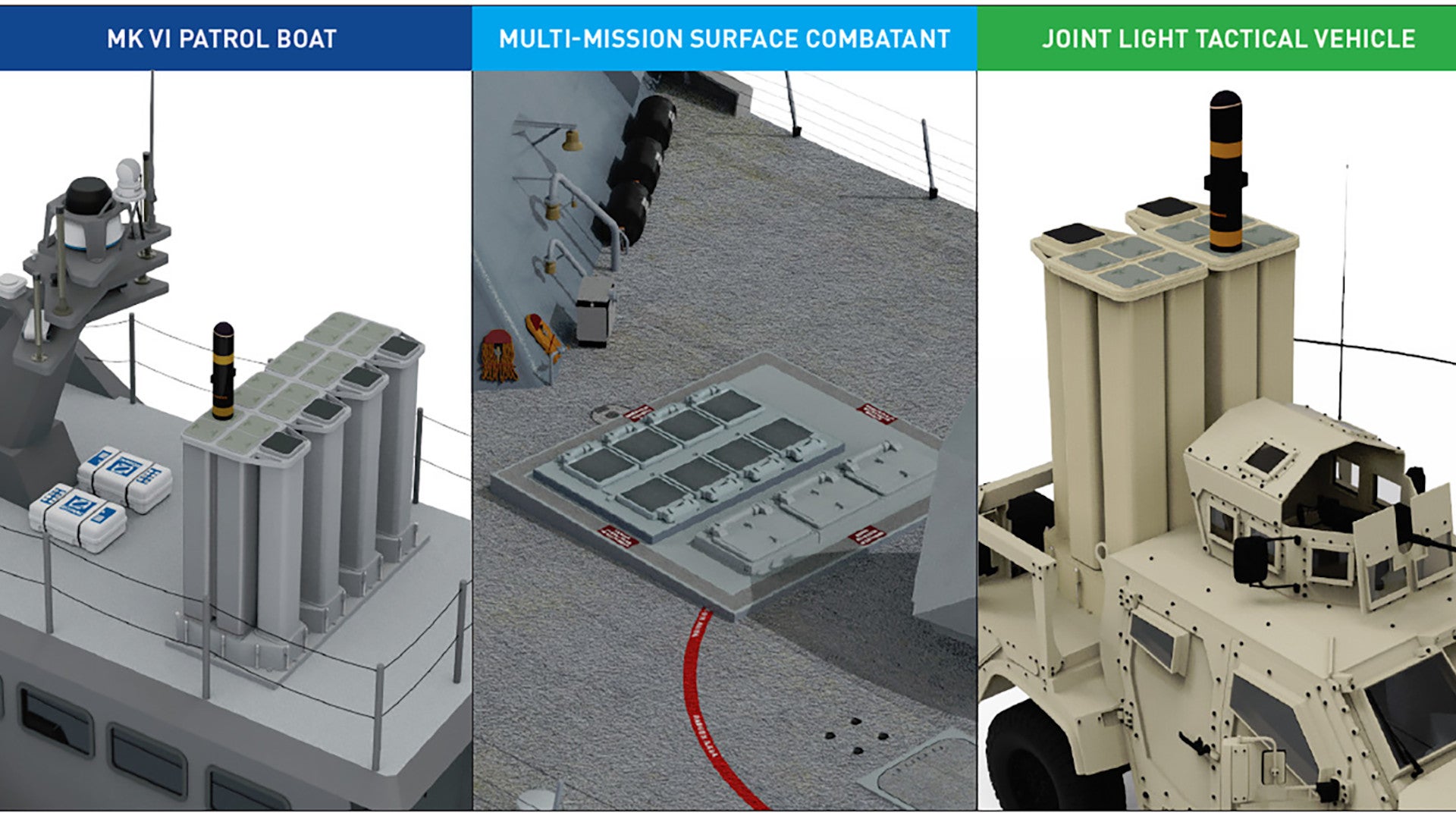
New Lockheed Hellfire/JASM launcher discussed earlier

The Drive reports an exercise that claimed to employ an enhanced version of Hellfire with a range about three times as great as that of the previous versions. Hellfire’s replacement, JASM, perhaps more accurately an upgraded Hellfire, has now been approved for full rate production and there have been reports that a longer range version was in the works.

Beyond the air-launched advantages, this missile would be hugely beneficial for sea-launched applications, such as the LCS. Beyond that, it could be extremely beneficial in servicing Hellfire’s growing surface-to-air role, as well.

Since the typically reported surface to surface range of the Hellfire is 8 km, three times that would be 24 km or over 26,000 yards (equal to the longest ranged battleship hit in WWII). In most cases, that means it can reach anything within the visual horizon. It would also mean, it would out range our 57 and 76mm guns. If this longer ranged Hellfire/JASM is mounted on the new 30 mm Mk38 Mod4, it could mean even Polar Security Cutters will have a potentially more potent weapon than the 57mm Mk110, with a much smaller footprint and lower maintenance requirements.

The weapon would certainly be a welcomed addition to the Webber class patrol craft of PATFORSWA because it would give them greatly enhanced capability against swarming small inshore attack craft, helicopters, and UAS, threats common in their operating area.

As I noted earlier, JASM could provide Coast Guard vessels as small as patrol boats, with a much more accurate, more powerful, and longer ranged response to the need to be able to forcibly stop vessels both small and large, while also providing counter UAS, a degree of anti-aircraft protection, and should it ever be required, a naval fire support ashore capability.

“U.S., U.K. Navies Conduct Unmanned Exercise in Arabian Gulf” –Seapower / and the Coast Guard is There

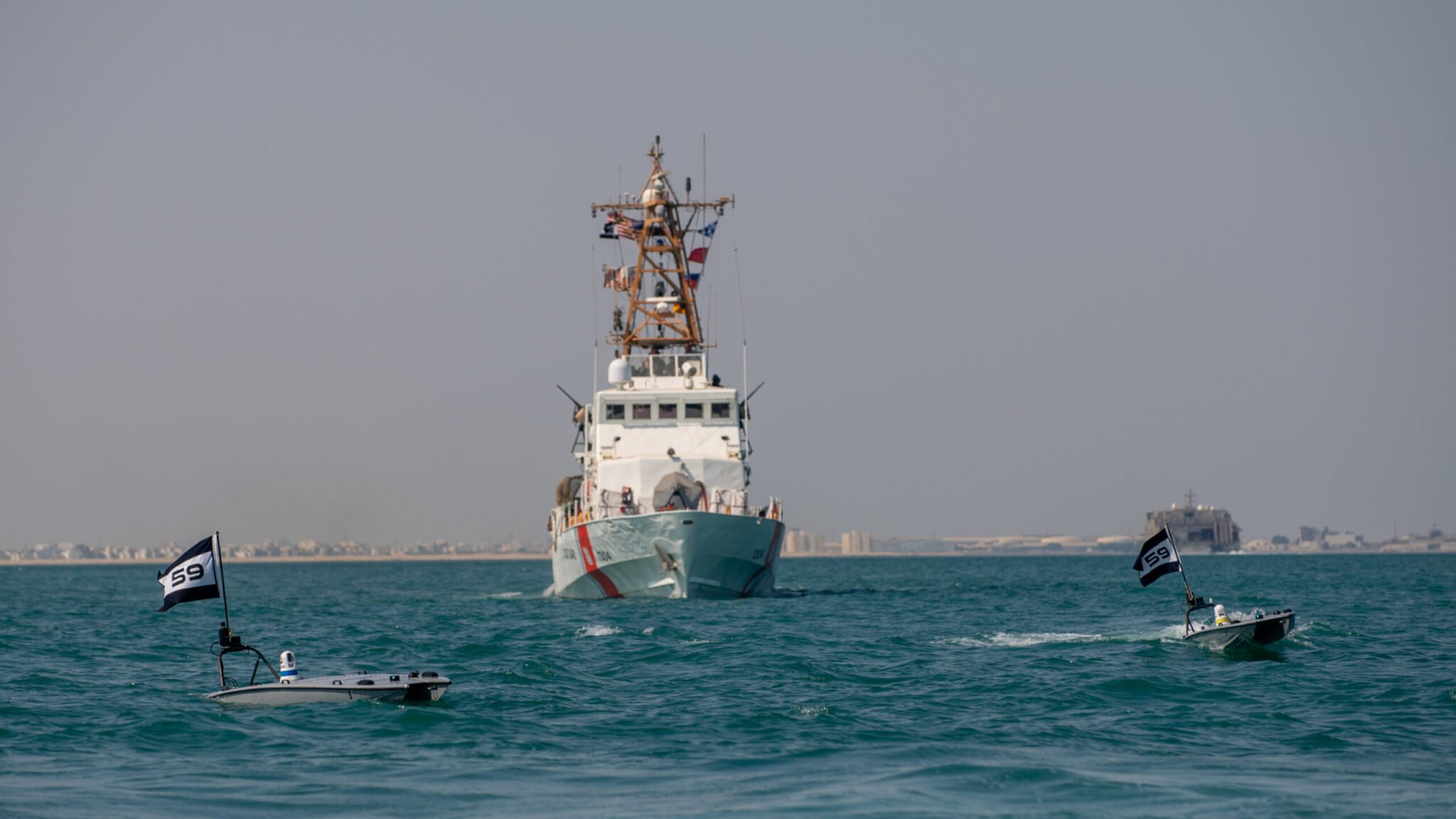
Naval forces from the United States and United Kingdom conducted a bilateral exercise in the Arabian Gulf, Oct. 7. U.S. NAVY (That is USCGC Robert Goldman (WPC 1142) at the end of the column.)

The Navy League’s on-line magazine, Seapower, reports,

Naval forces from the United States and United Kingdom conducted a bilateral exercise in the Arabian Gulf, Oct. 7, which featured the use of unmanned systems and artificial intelligence to enhance maritime monitoring by crewed ships and operators ashore, U.S. Naval Forces Central Command Public Affairs said in an Oct. 7 release.

The one-day exercise, called Phantom Scope, occurred in international waters off the coast of Bahrain with forces from U.S. 5th Fleet and the UK Royal Navy. Three Saildrone Explorer unmanned surface vessels (USVs) participated alongside guided-missile destroyer USS Delbert D. Black (DDG 119), fast response cutter USCGC Robert Goldman (WPC 1142) and Royal Navy mine countermeasures vessels HMS Chiddingfold (M37) and HMS Bangor (M109).

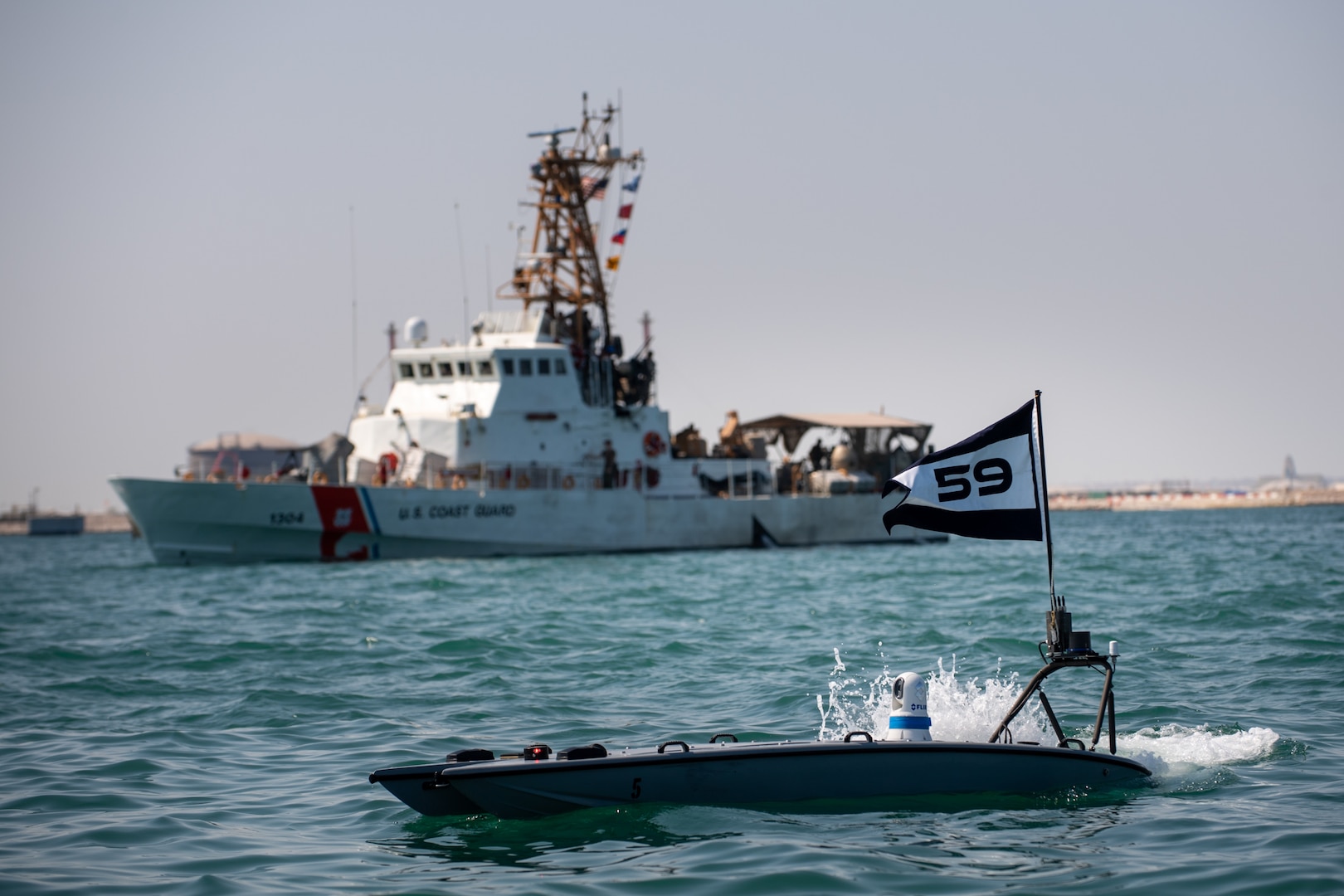
US Naval Forces, Central Command, has been very actively pushing and experimenting with unmanned systems and the Coast Guard’s PATFORSWA has been actively involved in these experiments. Hopefully some of the experience will help the Coast Guard with its own exploitation of unmanned systems.

Two MANTAS T-12 unmanned surface vessels operate alongside a U.S. Coast Guard patrol boat during exercise New Horizon in the Arabian Gulf. (U.S. Navy photo by Mass Communication Specialist 2nd Class Dawson Roth)

“The Long Blue Line: LANTAREA’s PATFORSWA Managers—over 15 years of leadership!”

MyCG has a new post that reports on the history of an element of Atlantic Area staff that has been manned by reservists, but it is more than that. It charts the history of Coast Guard efforts in support of Central Command over more than 16 years. It also reports that the Reservists are being releaved by an Active Duty/Civilian staff.

It is an interesting read.

“U.S. Coast Guard decommissions Bahrain-based USCGC Baranof” –LANTAREA

220926-A-EQ028-1234 MANAMA, Bahrain Seaman Alexander Moyes lowers the Union Jack aboard USCGC Baranof (WPB 1318) during the ship’s decommissioning ceremony in Manama, Bahrain, Sept. 26, 2022. Baranof decommissioned after 34 years of service. (U.S. Army photo by Spc. Frederick Poirier)

A bitter sweet day. End of an era. The last of six Island class cutters assigned to PATFORSWA is now decommissioned. The force has now been reequipped with six Webber class Fast Response Cutters.

News Release

U.S. Coast Guard Atlantic Area

U.S. Coast Guard decommissions Bahrain-based USCGC Baranof

U.S. Coast Guardsmen conduct a decommissioning ceremony for USCGC Baranof (WPB 1318) in Manama, Bahrain, Sept. 26, 2022.

ice Adm. Kevin E. Lunday, commander of Coast Guard Atlantic Area, arrives at the decommissioning ceremony for USCGC Baranof (WPB 1318) in Manama, Bahrain, Sept. 26, 2022. USCGC Baranof (WPB 1318) is moored pierside in Manama, Bahrain, Sept. 26, 2022, prior to its decommissioning.

Editors’ Note: To view more or download high-resolution imagery, click on the photos above.

MANAMA, Bahrain — The USCGC Baranof (WPB 1318) was decommissioned during a ceremony aboard Naval Support Activity Bahrain, Monday.

Vice Adm. Kevin Lunday, commander of U.S. Coast Guard Atlantic Area, presided over the ceremony.

“USCGC Baranof’s exemplary service to our nation is a testament to both the Island-class platform and the crews that have manned Baranof over the past 34 years,” said Lunday. “Whether it was conducting law enforcement and search and rescue in the Caribbean, or deploying to the present-day homeport of Bahrain to support U.S. Central Command, those that have manned Baranof have continually met the needs of America.”

Baranof was commissioned into service on May 20, 1988 at Coast Guard Base Miami Beach in Miami. The 18th of 49 Island-class patrol boats, Baranof received orders to the U.S. Fifth Fleet area of operations in support of Operation Iraqi Freedom in 2002. Shortly after their arrival in Bahrain, Baranof’s crew was underway conducting maritime interdiction operations in the North Arabian Gulf.

Baranof was replaced by the USCGC Clarence Sutphin Jr. (WPC 1147), which arrived at NSA Bahrain on Aug. 23, 2022. As part of the Coast Guard’s fast response cutter program, the service is acquiring 65 Sentinel-class fast response cutters, with six of those assigned to U.S. Coast Guard Patrol Forces Southwest Asia.

PATFORSWA, the Coast Guard’s largest unit outside of the United States, oversees the cutters in Bahrain. The ships are forward deployed to U.S. Fifth Fleet to help ensure maritime security and stability across the Middle East. The 154-foot long vessels feature advanced communications systems, and improved surveillance and reconnaissance equipment.

PATFORSWA, which is operationally attached to Fifth Fleet’s Commander Task Force 55, is composed of six FRCs, shoreside mission support personnel and a maritime engagement team. The unit plays a crucial role in maritime security, maritime infrastructure protection, and regional theater security cooperation. The unit also supports other U.S. Coast Guard deployable specialized forces operating throughout the Middle Eastern region.

USCGC MOHAWK’s Trans-Atlantic, Europe and West Africa Deployment–Wrap Up

I love the T-shirt, great morale builder. U.S. Coast Guard Petty Officer 3rd Class Andrea Daring, an operations specialist temporarily assigned to the U.S. Coast Guard Cutter Mohawk, cleans the bulk heads during a fresh water wash down of the ship while underway in the Atlantic Ocean, Aug. 10, 2022.  (U.S. Coast Guard photo by Petty Officer 3rd Class Jessica Fontenette) 

Below is a media advisory concerning the expected return of USCGC Mohawk from a 92 day deployment that included escorting two PATFORSWA bound Webber class patrol craft accross the Atlantic and port visits and capacity building in Europe and West Africa.

Maybe we need a new slogan, “Join the Coast Guard and see the World.”

It was an unusually very well documented cruise, at least photographically, check it out.

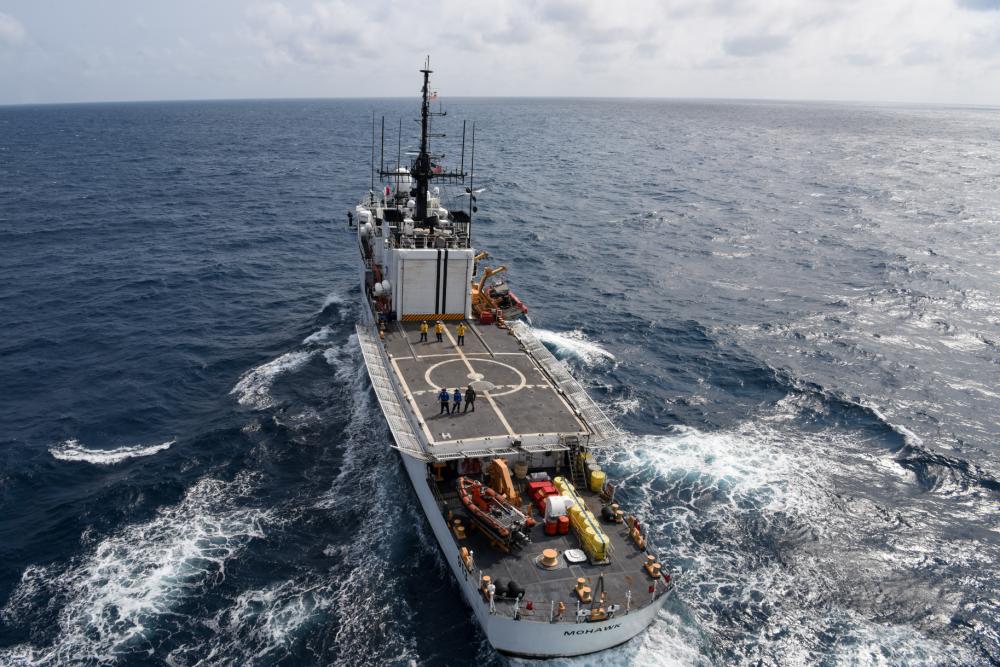
USCGC Mohawk (WMEC-913), Clarence Sutphin Jr. (WPC-1147), and John Scheuerman (WPC-1146)

USCGC Mohawk sails alongside a Nigerian navy ship in the Atlantic Ocean, Aug. 22, 2022. (Jessica Fontenette/U.S. Coast Guard)

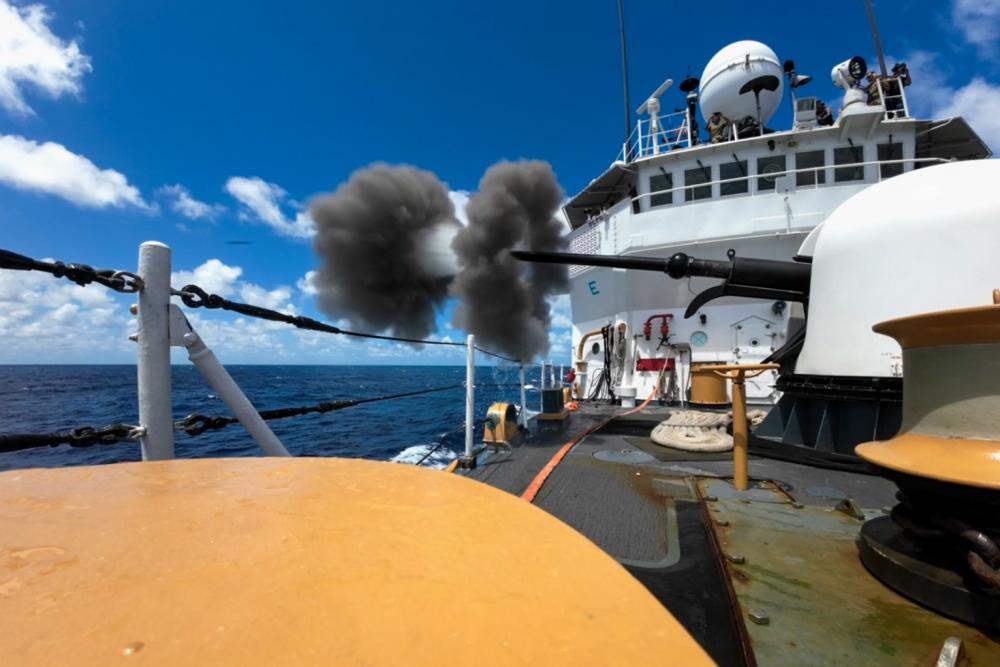
USCGC Mohawk (WMEC 913) conducts a MK-75 gun exercise while underway in the Atlantic Ocean, Sept. 2, 2022.  (U.S. Coast Guard photo by Petty Officer 3rd Class Jessica Fontenette)

Crew members onboard the USCGC Mohawk (WMEC 913) prepare for helicopter hoist training on the flight deck while underway in the Atlantic Ocean, Aug. 27, 2022. (U.S. Coast Guard photo by Petty Officer 3rd Class Jessica Fontenette)


Media Advisory

U.S. Coast Guard Atlantic Are

Coast Guard Cutter Mohawk to return from 92-Day AFRICOM deployment

KEY WEST, Fla. — USCGC Mohawk (WMEC 913) and crew are scheduled to return to their homeport Monday following a 92-day, United States Africa Command deployment.

WHO: Cmdr. Andrew Pate, Mohawk’s commanding officer, and Mohawk crew

WHAT: Mohawk crew returns to Key West homeport after 92-day, AFRICOM deployment

WHERE: Coast Guard Sector Key West, 201 Mustin St., Key West, Florida 33040, Delta 2 Pier

WHEN: 1 p.m. Monday, Sept. 12

Editor’s Note: Media are asked to RSVP by 4 p.m. Sunday to Atlantic Area Public Affairs at 757-452-8336. Media are requested to arrive no later than 12 p.m., Monday, with a driver’s license and proof of insurance in order to be processed through security.

Mohawk’s crew departed Key West, Florida in June and forward-deployed to the U.S. Naval Forces Europe –Africa area of operations, where they were employed by U.S. Sixth Fleet to defend U.S., allied and partner interests.

Mohawk began its deployment as surface action group commander, leading the transatlantic escort of two newly commissioned 154-foot fast response cutters, USCGC Clarence Sutphin Jr. (WPC 1147) and USCGC John Scheuerman (WPC 1146) from Key West, Florida to the U.S. Sixth Fleet area of operations. Clarence Sutphin Jr. and John Scheuerman continued on to their new homeport in Manama, Bahrain, where they will be employed by U.S. Fifth Fleet.

While on deployment, Mohawk made significant advances in combating piracy and illegal, unregulated, and unreported fishing conducting multinational law enforcement operations at sea in the Atlantic basin. Their efforts served to strengthen existing relationships with  African nations, and prioritized opportunities for new partnerships with allies who share common interests in the region. Mohawk’s crew worked closely with eight partner nation navies, sailing nearly 19,000 nautical miles in support of American interests abroad. Leading training exercises at-sea and in port, Mohawk also hosted diplomatic engagements and participated in community relations events during port visits to Côte d’Ivoire, Ghana, Nigeria, Portugal, Senegal, Sierra Leone and The Gambia. Mohawk was the first United States warship to moor in The Gambia since 1994.

Commissioned in March 1991, Mohawk is the 13th and last of the Famous-class Coast Guard cutters. It is named for the Algonquin tribe of Iroquoian Indians who lived in the Mohawk Valley of New York, and is the third cutter to bear the name. Mohawk is homeported in Key West, Florida.

 Photos from Mohawk’s deployment are available here.