“Naval shipyard Tandanor to build new icebreaker for Argentina” –Navy Recognition

Artist rendering of the future icebreaker for Argentinian Navy (Picture source: Argentinian MoD)

Navy Recognition reports, state owned “Tandanor Naval Shipyard will proceed to the construction of a polar ship for the Argentinian Navy.”

“The new polar ship will have a length of 131,5 m, a beam of 23,6 m, and could reach a top speed of 16 knots.”

That is 431’4″ long and 77’5″ of beam.

Argentina is moving to strengthen their claim on territory in Antarctica.

In 2015 they completed repairs on their only icebreaker which had suffered a serious fire in 2007.

In 2019 Argentina contracted for four Offshore Patrol Vessels, three of which were to be ice-strengthened. Two of the ice-strengthened OPVs have already been delivered and the third should be delivered this year.

Argentina’s claim on Antarctica overlaps those of the UK and Chile.


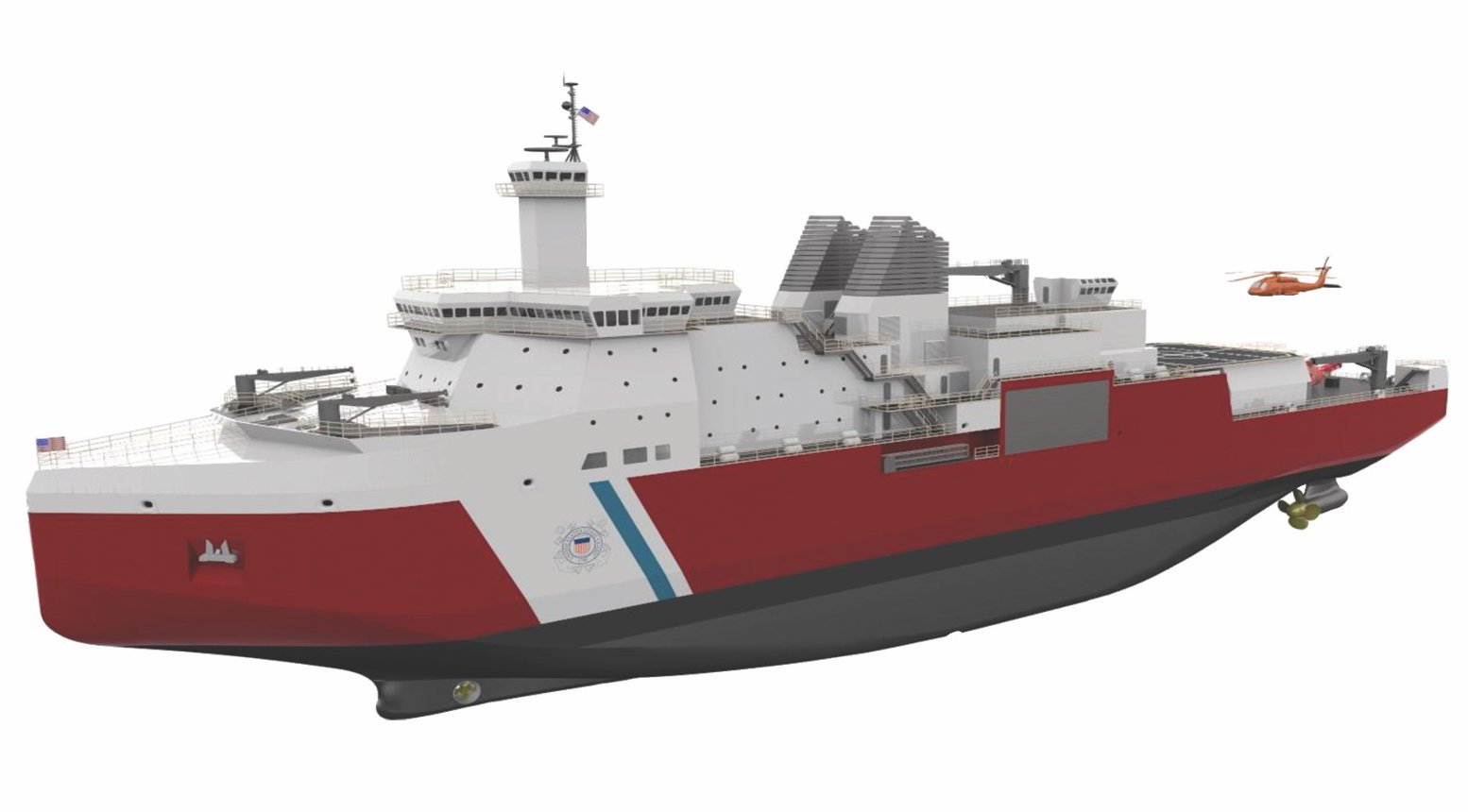
Contract Option for Second Polar Security Exercised

DOD reports a contract option for design and construction of the Second Polar Security Cutter has been exercised. Notably this is a Navy contract. Completion expected Sept. 2026.

VT Halter Marine Inc., Pascagoula, Mississippi, is awarded a $552,654,757 fixed-price incentive modification to previously awarded contract N00024-16-C-2210 to exercise an option for the detail design and construction of the second Coast Guard Polar Security Cutter. Work will be performed in Pascagoula, Mississippi (61%); Metairie, Louisiana (12%); New Orleans, Louisiana (12%); San Diego, California (4%); Mossville, Illinois (4%); Mobile, Alabama (2%); Boca Raton, Florida (2%); and other locations (3%), and is expected to be completed by September 2026. Fiscal 2021 procurement, construction, and improvement (Coast Guard) funds in the amount of 485,129,919 (80%); fiscal 2020 procurement, construction, and improvement (Coast Guard) funds in the amount of $100,000,000 (17%); and fiscal 2019 procurement, construction, and improvement (Coast Guard) funds in the amount of $20,000,000 (3%) will be obligated at time of award and will not expire at the end of the current fiscal year. The Naval Sea Systems Command, Washington, D.C., is the contracting activity.

Thanks to Paul for bringing this to my attention.

“First Images Of New Inlay Class Warship For Myanmar Navy” –Covert Shores

Myanmar UMS Inlay (54), 12 March 2018, Indian Navy Photo

Covert Shores reports sighting of a second Inlay class, a locally built offshore patrol vessel. This prompted a look at this class and the Myanmar Navy, which turns out to be surprisingly strong, with an apparently capable domestic shipbuilding capability.

Myanmar seems to have been in the news a lot lately, and it has not been “good news.” Like many other nations in Asia, particularly SE Asia, they have been building Offshore Patrol Vessels. Reportedly the Myanmar Coast Guard was established only months ago, in Oct. 2021, but it appears these OPVs will serve with their Navy. Myanmar Coast Guard floating units appear to be limited to four very old patrol boats.

Reportedly these Inlay class Offshore Patrol Vessels displace 1500 tons, but I suspect that is not their full load displacement. They are similar in size to the 1.800 ton 270 foot WMECs, slightly shorter, 265’9′ (81 meters vs 82.3) and a bit broader of beam (41′ vs 38’/12.5 vs 11.6 meters). Speed is essentially the same at 20 knots. The bridge does seem surprisingly large.

Reportedly the Myanmar vessels can hangar a Eurocopter AS365 Dauphin, that is essential the same as an H-65. Also, reportedly there is a launch ramp for a RIB in the stern. There might be a boat davit on the starboard side, but I have not seen a good photo of the starboard side. There is a large opening on the starboard side superstructure aft, that mirrors the one visible on the port side.

Apparently, the weapon forward of the bridge is a Soviet era twin 57mm. The weapon might be ancient, but it is probably still very effective at short ranges.

The Myanmar Navy is more impressive than I would have expected, and many of their ships are built locally. As noted in the headline post, they just got their second submarine, one Russian built via India and now one from China. They have a 12,400 ton S. Korean built LPD. They are building their fourth domestically built frigate, to add to two overage Chinese built frigates. They have three domestically built 1,100 ton corvettes. They have twenty vessels similar in size to the Webber class but much more heavily armed, including five armed with Anti-Ship Cruise Missiles, and two slightly larger, 500 ton Fast Attack Craft also armed with ASCMs. These are in addition to six older Chinese built Houxin class missile boats.

All total, they appear to have 21 surface combatants armed with Anti-Ship Cruise Missiles, primarily the Chinese made C-802, which is roughly equivalent to the US made Harpoon.

Myanmar has also begun to build 600 ton, 63 meter, high speed “sub chasers” to replace eight, now overage, Chinese built Hainan class. The new ships are equipped with the same twin 57mm mount that also equips the new OPVs.


Old Fleet vs New Fleet, by the Ton, Revisited

USCGC Gallatin WHEC -721 (378), USCGC Rockaway WHEC-377 (311), and USCGC Spencer WHEC-36 (327) moored at Governor’s Island, New York

Back in 2012, I did a little comparison between the Cutter Acquisition Program of Record and the Fleet it would nominally replace. Full replacement is still many years away (about 2038), but we do know a lot more now, than we did at that time, so here is an update.

The Benchmark Fleet: The fleet of 2000/2001 looked like this (displacement in tons full load, comparing only the larger patrol vessels):

Class       Displacement x Number = Total Displacement
378s          3050 tons      x      12    =     36,600 tons
270s          1780 tons      x      13     =    23,140 tons
210s          1050 tons       x      16    =    16,800 tons
Alex Haley 2929 tons     x         1     =      2,929 tons
Storis         1916 tons     x         1     =      1,916 tons
Acushnet   1746 tons     x         1     =      1,746 tons
110s            155 tons     x        49     =      7,595 tons

Total                                     93 vessels, 90,726 tons

(Three 180 foot WLBs of about 1,000 tons each, that had been converted to WMECs were also decommissioned about this time.)

The Fleet Today: Threre are perhaps as many as 27 Island class WPBs still in commission. At least 22 of the original 49 are no longer in USCG service. There are probably considerably fewer than 27 active USCG Island class. I would guess about 19 remain.

Looking only at the Webber class and larger cutters:

Class       Displacement x Number = Total Displacement
NSC          4500 tons       x        8      =  36,000 tons
270s          1780 tons       x      13      =  23,140 tons
210s          1050 tons       x      14      =  14,700 tons
Alex Haley 2929 tons       x       1       =    2,929 tons
FRC             353 tons       x      45      =  15,885 tons

Total                                     81 vessels, 92,654 tons

To this we might add however many 110s are still available, reportedly 15 vessels totaling 2,325 tons, so 96 vessels, 94,979 tons.

We are down to 36 large patrol cutters (=>1,000 tons full load), the same number expected to make up the future fleet, but they are individually less capable, and fewer than the 40 plus the Coast Guard has historically generally employed since WWII.

Looking back at my old Janes Fighting Ships and Combat Fleets of the World, the number of large patrol cutters were: 44 (82/83), 48 (86/87), 48 (90/91), 44 (2000/01), 39 (2013).

Fortunately, the Webber class have proven capable of performing some missions that previously would have been performed by larger cutters.

The Future Fleet (2038): 

Class       Displacement x Number = Total Displacement

NSC        4500 tons      x    11       =       49,500 tons
OPC        4500 tons      x    25       =     112,500 tons
FRC           353 tons      x   64       =       22,592 tons

Total                                  100 vessels, 184,592 tons

Implications: 

We will end up with more ships if the current plan is completed. In 2012 I expected the total displacement of the replacement fleet would exceed the displacement of the benchmark fleet by 34.44%, instead it is up an additional 65,618 tons, more than doubling displacement of the fleet in 2000. Only 15,618 tons of the increase was due to the three additional NSCs and six additional FRCs. Most of the increase was due to the surprisingly high displacement of the OPCs.

The large cutters (NSCs and OPCs) will be much more capable than those they replace, particularly compared to the 210s. They will handle rough weather better. Crews will be more comfortable and better rested, which can translate into better performance. In most respects, not only the NSCs, but also the OPCs, are more capable than the 378s.

The larger, more capable cutters will require larger, more expensive support facilities, more dock space, deeper berths, and larger dry docks for maintenance.

We have seen a tendency to base groups of the same class ships together. We will see fewer instances of ports with only one cutter homeported there. Fewer ports will be home to large cutters.

The fleet will still be much smaller than the last Fleet Mix analysis indicated it needed to be, to meet all the Coast Guard’s statutory obligations. Those obligations still seem to be growing.

36 ships, no matter how capable, are still only 36 ships. I still see a need for Cutter X, a simple but seaworthy ship of 1,500 to 2,500 tons that can be procured in quantity.

“New Royal Canadian Navy Offshore Patrol Vessel Visits Norfolk After Circumnavigating North America” –USNI

HMCS Harry DeWolf in ice (6-8 second exposure)

We have talked about the Canadian Navy’s Arctic Offshore Patrol Ship (AOPS) before (more here). It is, in many ways an Offshore Patrol Vessel, that would seem right at home in the US Coast Guard. In fact, in addition to the six being built for the Royal Canadian Navy, two are being built for the Canadian Coast Guard.

I would not be surprised if the US Coast Guard opts to build something similar. This US Naval Institute News Service story provides a bit more insight into its operations and how it is being used.

The AOPS, like the Offshore Patrol Cutter (OPC), is a VARD design. It is based on the Norwegian Coast Guard Cutter Svalbard, that was capable enough to reach the North Pole on 21 August 2019. Svalbard also completed a scientific mission for the US in the Beuford Sea in 2020, when CGC Healy had a fire in one of its main propulsion motors and was unable to recover data contained in buoys she had deployed earlier.

Most surprising for me were the comments the ship’s use of containers,

At the briefing to press in Norfolk, which was broadcast online, he noted that sea-shipping containers aboard Harry DeWolf, not usually carried on warships, can be used as laboratories for science and researchers studying changes in the Arctic.

Gleason added that at all times the ship will have two containers loaded for humanitarian assistance and disaster relief to respond to emergencies when called upon.

Gleason said early on there was a key training scenario of responding in a mass casualty scenario. In it Harry De Wolf  worked with the U.S. and Canadian coast guards and naval vessels in treating and evacuating the injured aboard and taking them ashore.

On this mission to the North, Gleason said the containers had a real-time military mission. They “were used as underwater listening devices” for submarines. “Fortunately, we didn’t find any.”

I suspect the “underwater listening devices” for submarines was the Towed Reelable Active Passive Sonar, TRAPS system, (more here).

“Coast Guard Polar Security Cutter (Polar Icebreaker) Program: Background and Issues for Congress” –CRS, December 7, 2021


The Congressional Research Service has once again updated their look at the Polar Security Cutter (heavy icebreaker) program. (See the latest version here.) My last look at this evolving document was in regard to the October 19, 2021 revision.

The one-page summary, which has not changed, is reproduced below, but first I will point out what appears to have changed since the October 19 edition.


From page 13 re program delays (This is based on the report discussed here)

An October 19, 2021, press report stated

Delivery of the first new Coast Guard heavy polar icebreaker has slipped a year to 2025 due to the fact that it’s been 45 years since the last heavy icebreaker was built in the U.S. and impacts from the COVID-19 pandemic, Adm. Karl Schultz, the service’s commandant, said on Tuesday [October 19].

The first Polar Security Cutter (PSC) is expected to be delivered in the third quarter of fiscal year 2025, Schultz told a Senate Commerce Committee panel that oversees the Coast Guard. The PSC was originally expected to be delivered in March of 2024, which is in the second quarter of FY ’24. That timeline was later revised to May 2024, which is the third quarter….

Schultz said that COVID “complications” have hampered “international collaboration” on PSC ship construction, noting that the program is ambitious and “on a compressed timeline.”

A Coast Guard spokesman told Defense Daily in an email reply to questions that infection rates and travel restrictions due to COVID “significantly affected Halter Marine’s ship design efforts and subcontractor integration, resulting in unavoidable delays. COVID-19 was particularly impactful to HMI’s efforts to hire and maintain staffing levels across multiple occupation categories (labor, management, and engineering) and hindered collaboration with its ship design subcontractors, many of whom are based internationally and were significantly affected by early COVID-19 restrictions.”

The spokesman added that “The Coast Guard and Navy Integrated Program Office recently negotiated a consolidated contract action that definitizes COVID-19 delays and rebaselines the delivery schedule by 12 months.” Still, the program remains on track to begin operations in 2027 with Operation Deep Freeze, he said.

From pages 29 and 30, re a Great Lakes Icebreaker and a Forth PSC

Build Back Better Act (H.R. 5376)
House
Section 110023 of H.R. 5376 as passed by the House on November 19, 2021, states
SEC. 110023. GREAT LAKES ICEBREAKER ACQUISITION.

In addition to amounts otherwise available, there is appropriated for fiscal year 2022, out of funds in the Treasury not otherwise appropriated, $350,000,000, to remain available until September, 30, 2031, to the Coast Guard, for acquisition, design, and construction of a Great Lakes heavy icebreaker, as authorized under section 8107 of the William M. (Mac) Thornberry National Defense Authorization Act for Fiscal Year 2021 (P.L. 116-283).50 The Coast Guard shall return to the Treasury any funds appropriated under this section that have not been expended by September 30, 2031.

Section 10024 of H.R. 5376 as passed by the House states
SEC. 110024. POLAR SECURITY CUTTERS AND CLIMATE SCIENCE.

In addition to amounts otherwise available, there is appropriated for fiscal year 2022, out of any money in the Treasury not otherwise appropriated, $788,000,000, to remain available until September 30, 2031, to the Coast Guard, for the acquisition of the fourth heavy Polar Security Cutter, including scientific laboratory and berthing facilities, to expand access for scientists to the polar regions, to improve climate and weather research, for other polar missions, and for other purposes, as authorized under section 561 of title 14, United States Code.


Summary (Note no change from previous edition-Chuck)

The Coast Guard Polar Security Cutter (PSC) program is a program to acquire three new PSCs (i.e., heavy polar icebreakers), to be followed years from now by the acquisition of up to three new Arctic Security Cutters (ASCs) (i.e., medium polar icebreakers). The PSC program has received a total of $1,754.6 million (i.e., about $1.8 billion) in procurement funding through FY2021, including $300 million that was provided through the Navy’s shipbuilding account in FY2017 and FY2018. With the funding the program has received through FY2021, the first two PSCs are now fully funded.

The Coast Guard’s proposed FY2022 budget requests $170.0 million in procurement funding for the PSC program, which would be used for, among other things, procuring long leadtime materials (LLTM) for the third PSC.

The Navy and Coast Guard in 2020 estimated the total procurement costs of the PSCs in then year dollars as $1,038 million (i.e., about $1.0 billion) for the first ship, $794 million for the second ship, and $841 million for the third ship, for a combined estimated cost of $2,673 million (i.e., about $2.7 billion). Within those figures, the shipbuilder’s portion of the total procurement cost is $746 million for the first ship, $544 million for the second ship, and $535 million for the third ship, for a combined estimated shipbuilder’s cost of $1,825 million (i.e., about $1.8 billion).

On April 23, 2019, the Coast Guard-Navy Integrated Program Office for the PSC program awarded a $745.9 million fixed-price, incentive-firm contract for the detail design and construction (DD&C) of the first PSC to VT Halter Marine of Pascagoula, MS, a shipyard owned by Singapore Technologies (ST) Engineering. VT Halter was the leader of one of three industry teams that competed for the DD&C contract. The first PSC is scheduled to begin construction in 2021 and be delivered in 2024, though the DD&C contract includes financial incentives for earlier delivery.

The DD&C contract includes options for building the second and third PSCs. If these options are exercised, the total value of the contract would increase to $1,942.8 million (i.e., about $1.9 billion). The figures of $745.9 million and $1,942.8 million cover only the shipbuilder’s costs; they do not include the cost of government-furnished equipment (GFE), which is equipment for the ships that the government purchases and then provides to the shipbuilder for incorporation into the ship, post-delivery costs, costs for Navy-specific equipment, or government program-management costs.

The operational U.S. polar icebreaking fleet currently consists of one heavy polar icebreaker, Polar Star, and one medium polar icebreaker, Healy. In addition to Polar Star, the Coast Guard has a second heavy polar icebreaker, Polar Sea. Polar Sea, however, suffered an engine casualty in June 2010 and has been nonoperational since then. Polar Star and Polar Sea entered service in 1976 and 1978, respectively, and are now well beyond their originally intended 30-year service lives. The Coast Guard plans to extend the service life of Polar Star until the delivery of at least the second PSC. The Coast Guard is using Polar Sea as a source of spare parts for keeping Polar Star operational

“Delivery Of The U.S. Coast Guard’s New Heavy Icebreaker Has Been Delayed Yet Again” –The Drive

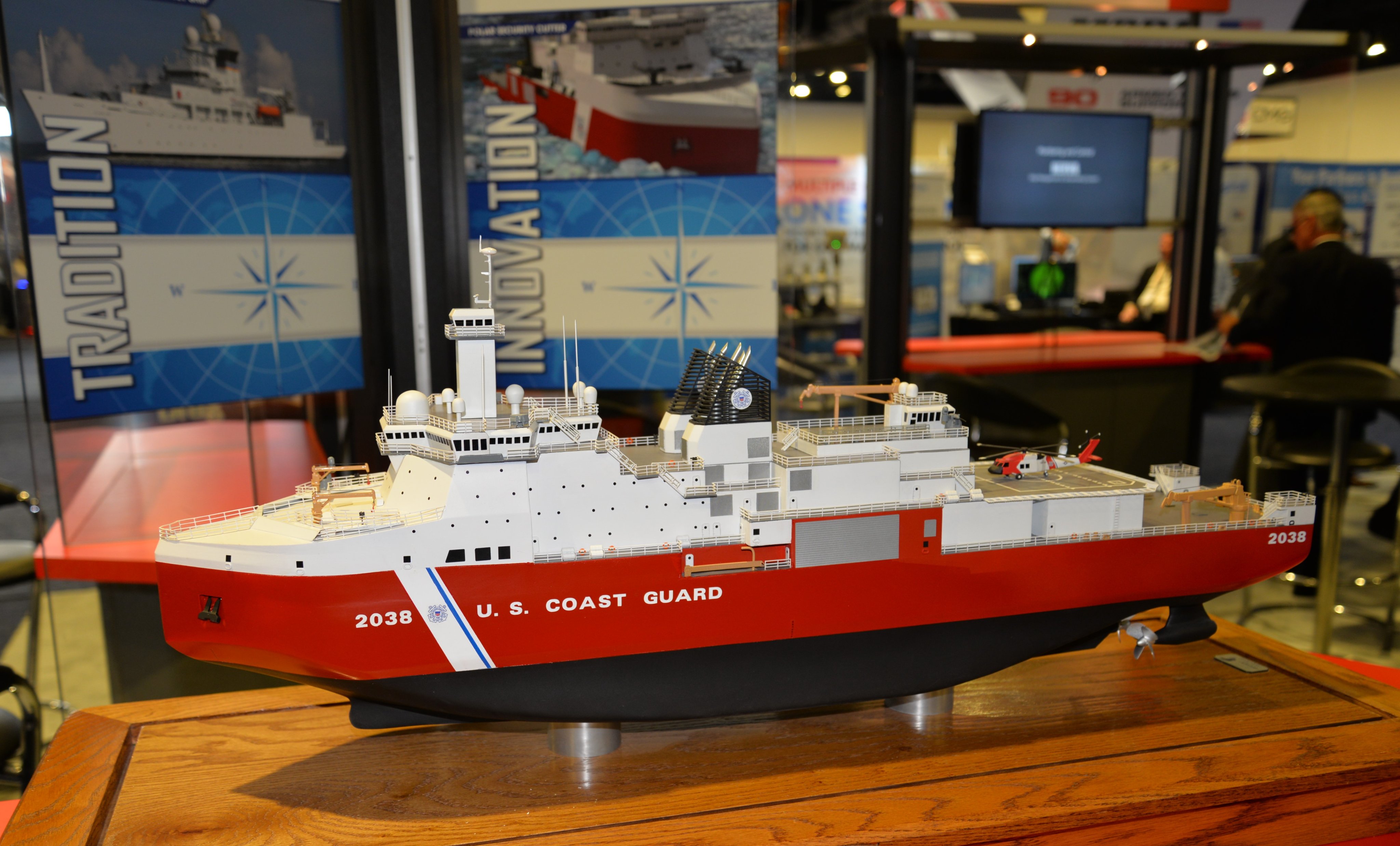
Photo of a model of Halter Marine’s Polar Security Cutter seen at Navy League’s Sea-Air-Space Exhibition have surfaced. Photo credit Chris Cavas.

The Drive/The Warzone reports that the delivery of the first Polar Security Cutter (PSC) has been pushed back to 2025. As recently as October, delivery was expected in 2024. This raises questions about why this is happening, and will Polar Star be able to continue to meet at least our minimum icebreaker requirements? In fact, the plan was to retain Polar Star until the second PSC was completed.

The article points to the decision to use the proposed Polarstern II as a basis for the design, when that ship was in fact never completed and the maturity of its design remains unclear.

More to the point, for whatever reason, the Coast Guard once more, waited too long to start a complex replacement program, and as a result, has risked creation of a capability gap.

The OPC program, poster child for this tendency, was repeatedly delayed. From the CRS report on cutter procurement,

“The posting for the RFP for the Stage 2 industry studies included an attached notional timeline for building the 25 OPCs. Under the timeline, OPCs 1 through 7 (i.e., OPCs 1-4, to be built by ESG, plus OPCs 5-7, which are the first three OPCs to be built by the winner of the Stage 2 competition) are to be built at a rate of one per year, with OPC-1 completing construction in FY2022 and OPC-7 completing construction in FY2028. The remaining 18 OPCs (i.e., OPCs 8 through 25) are to be built at a rate of two per year, with OPC-8 completing construction in FY2029 and OPC-25 completing construction in FY2038.
“Using these dates—which are generally 10 months to about two years later than they would have been under the Coast Guard’s previous (i.e., pre-October 11, 2019) timeline for the OPC program—the Coast Guard’s 14 Reliance-class 210-foot medium-endurance cutters would be replaced when they would be (if still in service) about 54 to 67 years old, and the Coast Guard’s 13 Famous-class 270-foot medium-endurance cutters would be replaced when they would be (if still in service) about 42 to 52 years old.

We know, from recent experience, that our ships may be able to continue functioning effectively, if perhaps not economically or reliably, when over 40 years old, but to base plans on an assumption that replacement can be delayed until they well passed 40 years old is irresponsible–and we are still doing it, by not advocating acceleration of the OPC build rate.

To Lee and Walter who pestered me about this after I initially failed to recognize the significance of the post, Thanks.

“Fincantieri To Design And Build New Multirole OPV For Italian Coast Guard” –Naval News

The future multirole offshore patrol vessel (unità d’altura multiruolo) of the Italian Coast Guard.

Naval News reports the award of a contract for a new Italian CG cutter.

The order, which concludes the tender procedure and has a value of approximately 80 million euros, provides for the construction of a multirole OPV and the related temporary support services for a duration of 5 years. There is also an option for the construction of a further 2 vessels.

The Italian Coast Guard is a quarter the size of the US Coast Guard and is part of the Italian Navy. Historically, offshore Coast Guard functions were frequently performed by the Italian Navy. Their Coast Guard only began building larger specialized coast guard Offshore Patrol Vessels a little over a decade ago.

The new ship(s) appears generally similar to the two earlier Dattilo class OPVs commissioned in 2013 and 2014. At a reported 85 meters in length it will be about ten meters shorter. USCGC Hamilton exercised with a Dattilo class cutter during its European deployment back in April.

This and previous Italian OPVs appear to be derived from Offshore Support Vessel (OSV) practice. There is no indication of speed, but I would expect about 18 knots, this being the speed of previous Italian OPVs. All previous Italian OPVs had provision for taking containers aboard, so that also appears likely. There is no provision for a hangar. No mention is made of armament, but judging from the artist’s renderings and current Italian Coast Guard/Navy practice, it is likely to be an Leonardo Oto Melara/Oerlikon KBA 25 mm/80 remote weapon system which fires the same 25x137mm round as the Mk38 but at up to more than 550 rounds per minute supplemented by 7.62mm machine guns. Following previous practice, the new ship(s) is probably fitted for but not with the OTO Melara 76mm.

A Cutter X for Nigeria Built in Turkey

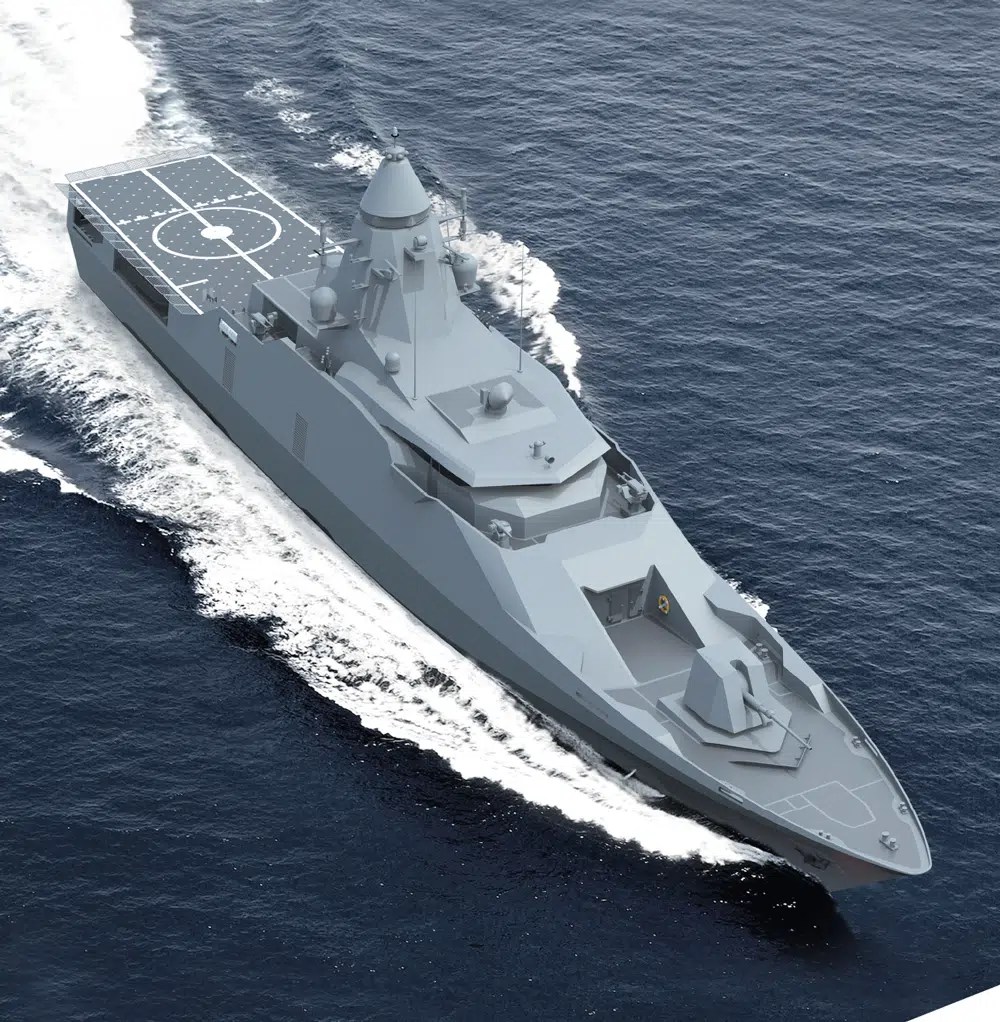
Dearsan OPV 76 design

Naval News reports a contract has been reached for Turkish shipbuilder Dearsan to construct two offshore patrol vessels for the Nigerian Navy.

The OPV 76 is 78.6 meters long and 11 meters wide. The draft of the ship is 2.9 meters and the displacement is about 1200 tons. It can reach a top speed of 26 knots, and has a range of 3000 nautical miles with economical speed. The ship can be operated by a crew of 46.

These are pretty close to what I envisioned as Cutter X, but with more weapons.

They are attractive little ships, and better armed than most. You can see the 76mm gun on the bow. The 40mm gun is sited on the aft end of the superstructure. MBDA Simbad RC launch systems for Mistral short range surface to air missiles are positioned on the starboard aft and port forward corners of the superstructure. .50 caliber machine guns mounted in remote operating stations occupy the other two corners.

If my research is correct, the four diesel engines will provide at least 16,000 HP (12,000 kW).

I don’t see davits, so I presume it will have a stern ramp for launching boats. The flight deck appears to be raised enough to allow “garage” space for boats and perhaps other systems.

None of the photos provide a good view from aft looking forward, but it appears unlikely to include a hangar for an embarked helo. There might be room for a UAS hangar.

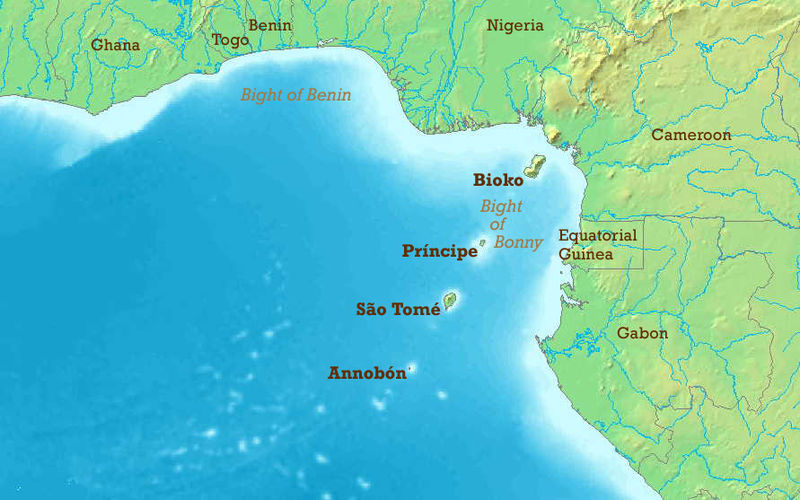
Within the context of Nigeria’s neighborhood, the Gulf of Guinea, these will be seen as relatively powerful warships. They will join two former USCG 378s and two Chinese built corvettes as the principle combatants of the Nigerian Navy. The area has had a history of piracy and maritime robbery, but Nigeria has been making progress in curbing the problem. Nigeria is the most populous nation in Africa, a nation with huge potential, and it has demonstrated regional leadership in participating in UN peacekeeping missions. The US Coast Guard has been making an effort to help, and it appears to paying off.

I see that the Nigerian Navy also operates four former USCG 180 foot buoy tenders.

a Gulf of Guinea, from Wikipedia

“Eastern Shipbuilding looks to win Coast Guard cutter contract — again” –Defense News

Defense News has a report of Eastern Shipbuilding’s hopes and efforts regarding phase two of the Offshore Patrol Cutter program.

“the Coast Guard expects to award the OPC second stage detail design and construction contract in spring 2022.”

I am a little surprised, it is taking as long as it is, to make a decision, two years after award of contracts to nine ship builder for industry studies (March 20, 2020), and about a year after the deadline for submission of proposals (May 28, 2021), but it certainly is an important choice.

Start of the OPC program contract was too long delayed in the first place. Then a hurricane delayed Eastern’s efforts about a year, and raised the cost. The decision to recompete the contract resulted in more delays, in that previous plans to move to funding two OPCs a year were pushed even further into the future. Instead of delivering the first three OPCs, one per year 2021-2023 and delivering two per year beginning 2024 through 2034; the current notional deliver schedule is one per year 2022-2028 and then two per year 2029-2037.

One potential benefit, if Eastern should be chosen for Phase II, is that they might be able to transition more quickly to building two ships per year. To some extent, that may be true of other yards as well, but Eastern’s product will presumably remain the same and a decision about its suitability to proceed to full rate production can be made years before the same is true of OPCs produced by other yards that will not be built to the same detail plans.