“Eastern Shipbuilding looks to win Coast Guard cutter contract — again” –Defense News

Defense News has a report of Eastern Shipbuilding’s hopes and efforts regarding phase two of the Offshore Patrol Cutter program.

“the Coast Guard expects to award the OPC second stage detail design and construction contract in spring 2022.”

I am a little surprised, it is taking as long as it is, to make a decision, two years after award of contracts to nine ship builder for industry studies (March 20, 2020), and about a year after the deadline for submission of proposals (May 28, 2021), but it certainly is an important choice.

Start of the OPC program contract was too long delayed in the first place. Then a hurricane delayed Eastern’s efforts about a year, and raised the cost. The decision to recompete the contract resulted in more delays, in that previous plans to move to funding two OPCs a year were pushed even further into the future. Instead of delivering the first three OPCs, one per year 2021-2023 and delivering two per year beginning 2024 through 2034; the current notional deliver schedule is one per year 2022-2028 and then two per year 2029-2037.

One potential benefit, if Eastern should be chosen for Phase II, is that they might be able to transition more quickly to building two ships per year. To some extent, that may be true of other yards as well, but Eastern’s product will presumably remain the same and a decision about its suitability to proceed to full rate production can be made years before the same is true of OPCs produced by other yards that will not be built to the same detail plans.

European Patrol Corvette

European Patrol Corvette

Defense News reports on the status of the European Patrol Corvette program.

We did talk about this program earlier. France, Italy, and Spain are already committed for a total of 20 ships and Greece is also expected to participate. It seems likely other will join the program.

These ships will perform many of the functions we associate with Coast Guard cutters, particularly in the case of the French Navy. The ships are close in size and general characteristics to the Offshore Patrol Cutters but will be better armed and slightly faster.

If the program continues to grow, this will be a relative large class and will all most certainly will be exported.

“Between 2009 and 2018, China produced 136 military ships, of which 11 were exported, he said, while two U.S. shipbuilders built 78 ships, of which six were exported. Twelve European yards produced 80 ships, of which 49 were for the export market…”

This is part of a movement to “rationalize” the European shipbuilding industry. Recently we have seen a move by Fincantieri and Navantia to increase cooperation. Ultimately this may effect US shipbuilding. Fincantieri owns Marinette Marine that builds the Freedom class LCS and that built USCGC Mackinaw, the 16 Juniper class WLBs, and the 14 Keeper class WLMs. Navantia has partnered with Bath Iron Works, to among other things offer a candidate for the Offshore Patrol Cutter.

“Report to Congress on Coast Guard Cutter Procurement” –CRS, Updated October 19, 2021″ –CRS

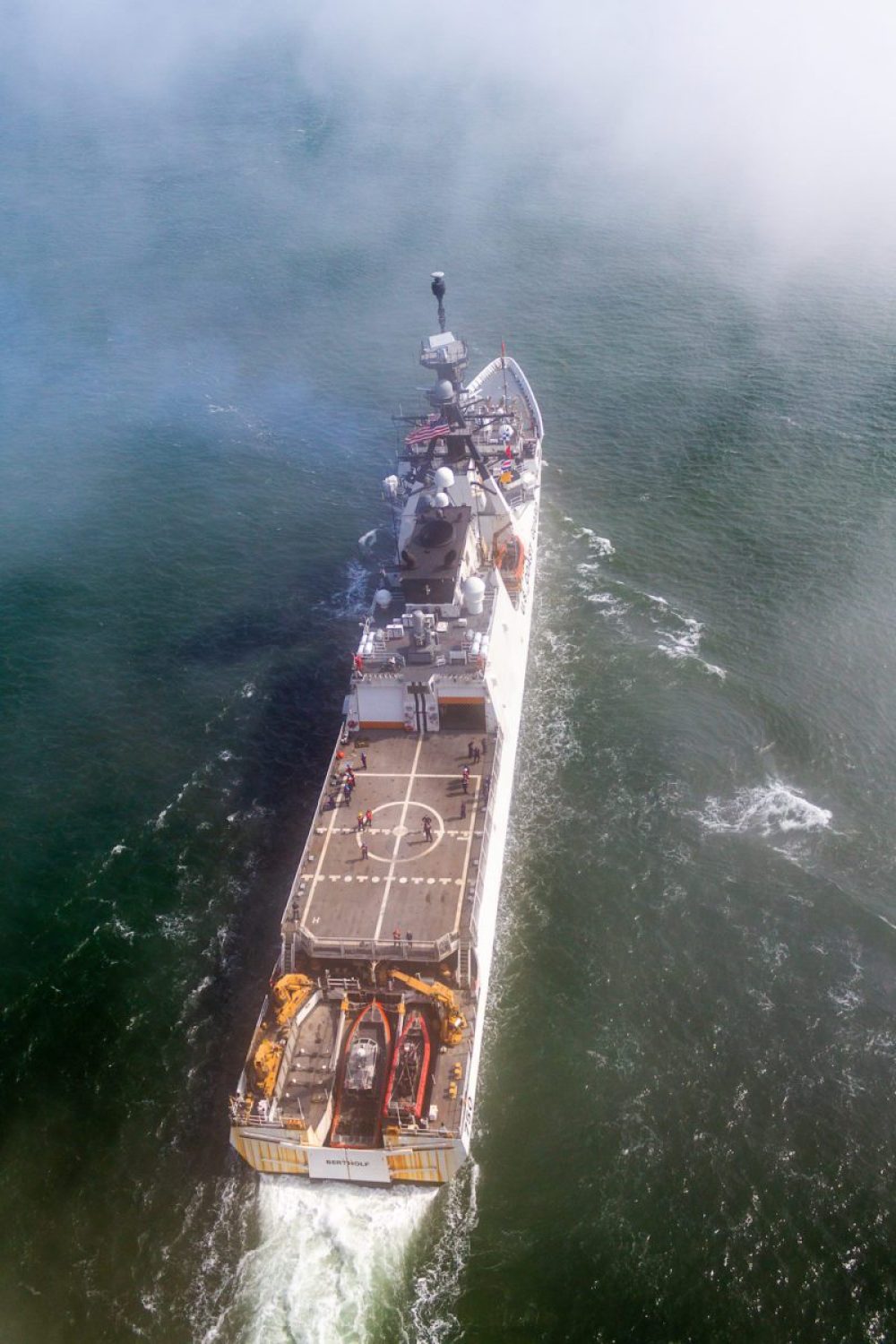
The Coast Guard Cutter Bertholf enters the San Francisco Bay en route to their Alameda, California homeport following a three-month multi-mission patrol, Oct. 3, 2020. Bertholf is one of four Legend-class national security cutters homeported in Alameda. (Photo by Pablo Fernicola)

The Congressional Research Service has again updated their “Report to Congress on Coast Guard Cutter Procurement”. (This link will always take you to the most recent edition of the report.) My last post on this evolving document was in reference to a 15 September, 2021 update. The questions raised in that report remain largely unanswered. I have reproduced the one page summary in full below. The summary does not appear to have changed, except to reflect the commissioning of the 45th FRC. But first I will highlight what I believe to be the changes since the last update. The significant changes reflect the Senate’s actions reported on pages 27 and 28.

Senate

The Senate Appropriations Committee, in the explanatory statement it released on October 18, 2021, for the FY2022 DHS Appropriations Act (S. XXXX), recommends the funding levels shown in the SAC column of Table 2. (PDF page 144 of 160) The explanatory statement states:

Offshore Patrol Cutter [OPC].—The Committee provides the requested amount of $597,000,000 for the construction of the fourth OPC and LLTM for the fifth OPC. While the Committee supports OPC procurements, the Committee remains concerned about costs for the program and continues the requirement for the Coast Guard to brief the Committee within one week prior to taking any procurement actions impacting estimated costs for the OPC program.

Fast Response Cutter [FRC] Program.—In accordance with the Coast Guard’s recapitalization plan, the Committee has completed funding for the replacement of legacy 110-foot Island Class patrol boats with FRCs that will operate similarly in the coastal zone. The Coast Guard is encouraged to notify the Committee if additional FRCs are necessary to support the Department of Defense in Patrol Forces Southwest Asia. (PDF page 69 of 160)

The explanatory statement also states:

Fleet Mix Analysis.—The Committee recognizes ongoing acquisition programs for various cutter classes that are responsible for many of, but not all, Coast Guard missions. While programs have correctly been prioritized around recapitalizing the oldest vessels in the fleet, several cutter classes are rapidly approaching the end of their service lives, while others have long surpassed their service lives. In order to best understand future capital investment needs, the Coast Guard shall provide to the Committee within 180 days of the date of enactment of this act, a comprehensive analysis that provides a fleet mix sufficient to carry out the assigned missions of the Coast Guard and other emerging mission requirements. The Coast Guard shall brief the Committee within 60 days of the date of enactment of this act on its plans to carry out this requirement.

Full-Funding Policy.—The Committee again directs an exception to the administration’s current acquisition policy that requires the Coast Guard to attain the total acquisition cost for a vessel, including long lead time materials [LLTM], production costs, and postproduction costs, before a production contract can be awarded. This policy has the potential to make shipbuilding less efficient, to force delayed obligation of production funds, and to require post-production funds far in advance of when they will be used. The Department should position itself to acquire vessels in the most efficient manner within the guidelines of strict governance measures.

Domestic Content.—To the maximum extent practicable, the Coast Guard shall utilize components that are manufactured in the United States when contracting for new vessels. Such components include: auxiliary equipment, such as pumps for shipboard services; propulsion equipment, including engines, reduction gears, and propellers; shipboard cranes; and spreaders for shipboard cranes. (PDF page 68 of 160)


Summary

The Coast Guard’s program of record (POR), which dates to 2004, calls for procuring 8 National Security Cutters (NSCs), 25 Offshore Patrol Cutters (OPCs), and 58 Fast Response Cutters (FRCs) as replacements for 90 aging Coast Guard high-endurance cutters, medium-endurance cutters, and patrol craft. The Coast Guard’s proposed FY2022 budget requests a total of $695.0 million in procurement funding for the NSC, OPC, and FRC programs, including $597 million for the OPC program.

NSCs are the Coast Guard’s largest and most capable general-purpose cutters; they are replacing the Coast Guard’s 12 Hamilton-class high-endurance cutters. NSCs have an estimated average procurement cost of about $670 million per ship. Although the Coast Guard’s POR calls for procuring 8 NSCs to replace the 12 Hamilton-class cutters, Congress through FY2021 has fully funded 11 NSCs, including the 10th and 11th in FY2018. In FY2020, Congress provided $100.5 million for procurement of long lead time materials (LLTM) for a 12th NSC, so as to preserve the option of procuring a 12th NSC while the Coast Guard evaluates its future needs. The Coast Guard’s proposed FY2022 budget requests $78.0million in procurement funding for activities within the NSC program; this request does not include further funding for a 12th NSC. The Coast
Guard’s proposed FY2022 budget also proposes rescinding $65.0 million of the $100.5 million in FY2020 funding for LLTM for a 12th NSC, “allowing the Coast Guard to focus investments on building, homeporting, and crewing Polar Security Cutters and Offshore Patrol Cutters.” The remaining $35.5 million appropriated in FY2020 for LLTM would be used to pay NSC program costs other than procuring LLTM for a 12th NSC. Nine NSCs have entered service; the ninth was commissioned into service on March 19, 2021.

OPCs are to be less expensive and in some respects less capable than NSCs; they are intended to replace the Coast Guard’s 29 aged medium-endurance cutters. Coast Guard officials describe the OPC and PSC programs as the service’s highest acquisition priorities. OPCs have an estimated average procurement cost of about $411 million per ship. The first OPC was funded in FY2018. The Coast Guard’s proposed FY2022 budget requests $597.0 million in procurement funding for the fourth OPC, LLTM for the fifth, and other program costs. On October 11, 2019, the Department of Homeland Security (DHS), of which the Coast Guard is a part, announced that DHS had granted extraordinary contractual relief to Eastern Shipbuilding Group (ESG) of
Panama City, FL, the builder of the first four OPCs, under P.L. 85-804 as amended (50 U.S.C. 1431-1435), a law that authorizes certain federal agencies to provide certain types of extraordinary relief to contractors who are encountering difficulties in the performance of federal contracts or subcontracts relating to national defense. The Coast Guard is holding a full and open competition for a new contract to build OPCs 5 through 15. On January 29, 2021, the Coast Guard released a Request for Proposals (RFP) for this Stage 2 contract, as it is called. Responses to the RFP were due by May 28, 2021. The Coast Guard plans to award the Stage 2 contract in the second quarter of FY2022.

FRCs are considerably smaller and less expensive than OPCs; they are intended to replace the Coast Guard’s 49 aging Island-class patrol boats. FRCs have an estimated average procurement cost of about $65 million per boat. A total of 64 have been funded through FY2021, including four in FY2021. Six of the 64 are to be used by the Coast Guard in the Persian Gulf and are not counted against the 58-ship POR quantity for the program, which relates to domestic operations. As of October 19, 2021, 45 of the 64 have been commissioned into service. The Coast Guard’s proposed FY2022 budget requests $20.0 million in procurement funding for the FRC program; this request does not include funding for any additional FRCs

Cat 4 Hurricane, No Problem, Bollinger Delivers USCGC John Scheuerman Ahead of Schedule

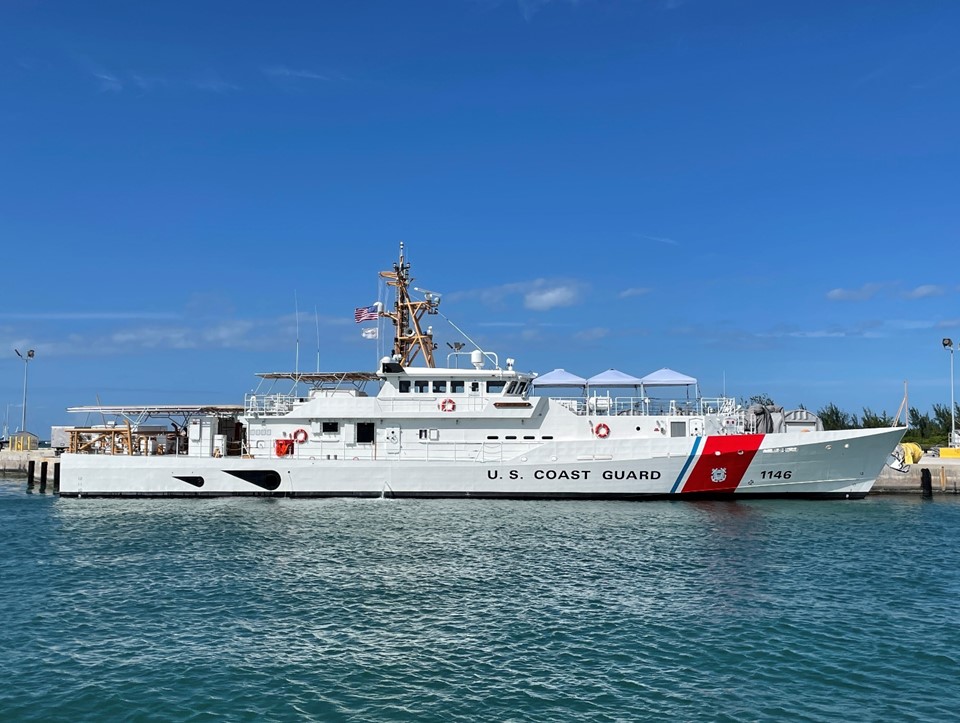
USCGC John Scheuerman in Key West, Florida.

Below is a lightly edited Bollinger news release. The battle in which John Scheuerman lost his life, was the Invasion of Solerno. If you read the link I provided, you can see that the Luftwaffe response was so intense, it caused the naval task force commander shift his flag to a less conspicuous ship, USS Biscayne, a ship that would later serve as USCGC Dexter.


BOLLINGER SHIPYARDS DELIVERS 46th FAST RESPONSE CUTTER AHEAD OF SCHEDULE DESPITE DIRECT HIT FROM HURRICANE IDA 

LOCKPORT, La., – (October 21, 2021) – Bollinger Shipyards LLC (“Bollinger”) has delivered the newest Sentinel-class Fast Response Cutter (“FRC”), the USCGC John Scheuerman, to the U.S. Coast Guard in Key West, Florida nearly one week ahead of schedule despite a three week shutdown due to the significant damage sustained to Bollinger’s facilities during Hurricane Ida. The storm made landfall in late August near Port Fourchon, Louisiana as a powerful Category 4 storm. Bollinger’s facilities in Port Fourchon, Lockport, Houma and Larose suffered significant damage as a result of Hurricane Ida, which tied with last year’s Hurricane Laura and the Last Island Hurricane of 1856 as the strongest on record in Louisiana.

“While every delivery is meaningful, being able to deliver this vessel nearly a week early despite everything our crew has faced over the past month is nothing short of remarkable,” said Bollinger President & CEO Ben Bordelon. “We had folks who lost everything in that storm. Our yard where we build the FRCs took a beating and was shuttered for three weeks while we rebuilt. This vessel and this delivery is a win our folks really needed and it reflects the resilience, commitment and tenacity of the 650 skilled men and women that built it.”

On September 24th, following an extensive multi‐week recovery and rebuilding effort, Bollinger welcomed employees back to all 11 of its facilities across Louisiana. Bollinger’s Lockport facility is home to the FRC program, which directly supports 650 jobs. The USCGC John Scheuerman departed Lockport on Monday, October 11th for Bollinger’s Fourchon facility where it performed a shakedown excercise prior to dry docking for final inspection in preparation of its delivery. The Cutter departed Fourchon for Key West, FL on Sunday, October 17th. The USCGC John Scheuerman is the 169th vessel Bollinger has delivered to the U.S. Coast Guard over a 35-year period and the 46th FRC delivered under the current program. The USCGC John Scheuerman is the fifth of six FRCs to be home-ported in Manama, Bahrain, which will replace the aging 110’ Island Class Patrol Boats, built by Bollinger Shipyards 30 years ago, supporting the Patrol Forces Southwest Asia (PATFORSWA), the U.S. Coast Guard’s largest overseas presence outside the United States.

U.S. Coast Guard Commandant Adm. Karl Schultz has previously lauded the “enhanced seakeeping capabilities” of the PATFORSWA-bound FRCs, saying the ships are going to be “game changing” in their new theater of operations. Last week, at the commissioning ceremony for the USCGC Emlen Tunnell—another Bahrain-based FRC—Adm. Schultz noted that these ships will “conduct maritime security operations, theater cooperation efforts, and strengthen partner nations’ maritime capabilities to promote security and stability in the region, as well as thwart the increasingly aggressive and dangerous maritime activities of the Iranian Revolutionary Guard Corps.” He went on to say that these FRCs are “a perfect complement to the capabilities of both the Navy and Marine Corps. United, we bring a range of maritime capabilities to employ across the cooperation-competition-lethality continuum.”

PATFORSWA is composed of six cutters, shoreside support personnel, and the Maritime Engagement Team. The unit’s mission is to train, organize, equip, support and deploy combat-ready Coast Guard Forces in support of U.S. Central Command and national security objectives. PATFORSWA works with Naval Forces Central Command in furthering their goals to conduct persistent maritime operations to forward U.S. interests, deter and counter disruptive countries, defeat violent extremism and strengthen partner nations’ maritime capabilities in order to promote a secure maritime environment.

Each FRC is named for an enlisted Coast Guard hero who distinguished themselves in the line of duty. John Scheuerman, Seaman First Class, United States Coast Guard Reserve was posthumously presented the Silver Star Medal for service as set forth in the following citation:  “For conspicuous gallantry and intrepidity in action while serving on board the U.S.S. LCI (L) 319 during the amphibious invasion of Italy, September 9, 1943.  Observing an enemy fighter plane diving in for a strafing attack as his vessel approached the assault beaches in the Gulf of Salerno, SCHEUERMAN unhesitatingly manned his battle station at an exposed antiaircraft gun and, with cool courage and aggressive determination, exerted every effort to direct accurate gunfire against the hostile aircraft.  Although mortally wounded before he could deliver effective fire, he remained steadfast at his post in the face of imminent death, thereby contributing materially to the protection of his ship against further attack.  SCHEUERMAN’s fearless action, great personal valor and selfless devotion to duty under extremely perilous conditions were in keeping with the highest traditions of the United States Naval Service.” Scheuerman also posthumously received the Purple Heart Medal.

“Eastern Shipbuilding opens new C5I integration facility for offshore patrol cutter” –Defense News

Eastern Shipbuilding Group is on contract to build the first four offshore patrol cutters for the U.S. Coast Guard and is competing for the contract for the rest of the class. The first ship, Argus, is in construction and expected to deliver by the end of 2022. (Eastern Shipbuilding Group photo)

Defense News reports,

PANAMA CITY, Fla. — Eastern Shipbuilding Group, Northrop Grumman and their industry partners formally opened a test and integration center this week for the C5I systems at the heart of the U.S. Coast Guard’s new offshore patrol cutter program.

This OPC production facility is meant to reduce risk on what the Coast Guard calls its top acquisition priority. Within mockups of the bridge, the operations center and other key rooms, every piece of internal and external sensing and communications equipment will be networked together in this facility at Eastern’s Allanton yard first, tested for any integration hiccups and then sent up the road to the company’s Nelson Street yard where the OPC hulls are being constructed.

Northrop Grumman Vice President for Maritime Systems and Integration Todd Leavitt told Defense News this C5I system — command, control, communications, computers, cyber, intelligence, surveillance and reconnaissance — is more complex than even the Consolidated Afloat Networks and Enterprise Services (CANES) program the company worked on for the U.S. Navy.

That is only a small part of the report which includes information about the ship’s internal communications system. A shoreside facility is a great idea. It will likely eliminate post delivery teething problems that can be expensive and delay deployment.

We really need these ships to work right out of the box.

Coast Guard Commissions USCGC Emlen Tunnell (WPC-1145)

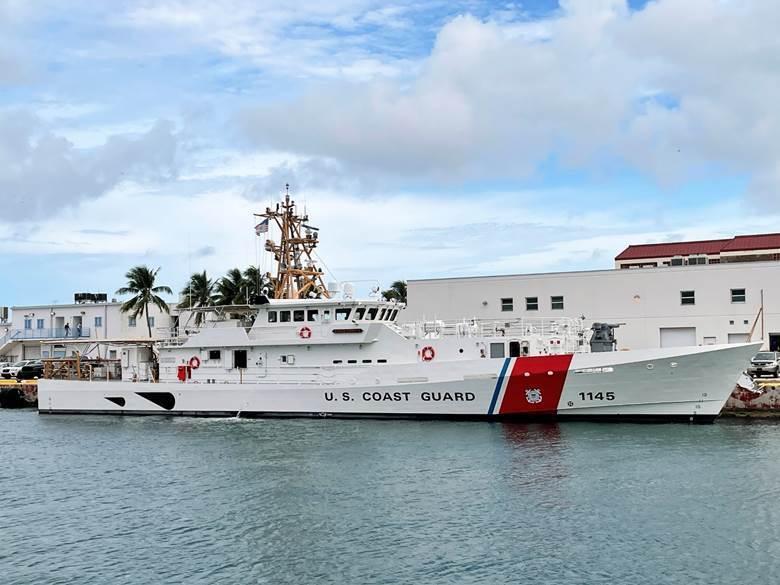
USCGC Emlen Tunnell in Key West, Florida.

Port News reports the commissioning of the 45th Webber class WPC. The commissioning was widely reported, but I found it interesting that a Russian news outlet would take note, including reporting on Tunnell’s football career. Other report here, here, and here.

Later this year, USCGC Emlen Tunnell will join her sister-ship USCGC Glen Harris (WPC 1144) and voyage to Bahrain as the second of three pairs of FRCs to replace the Island class cutter of Patrol Force South West Asia (PATFOSWA). Like the previous transit, the pair are likely to take the opportunity to conduct some training and joint operations along the way. Presumably there will also be a National Security Cutter along to provide support and also show the flag, conduct exercises, and build capacity.

“Coast Guard to Recapitalize Aids-to-Navigation Boats” –Seapower

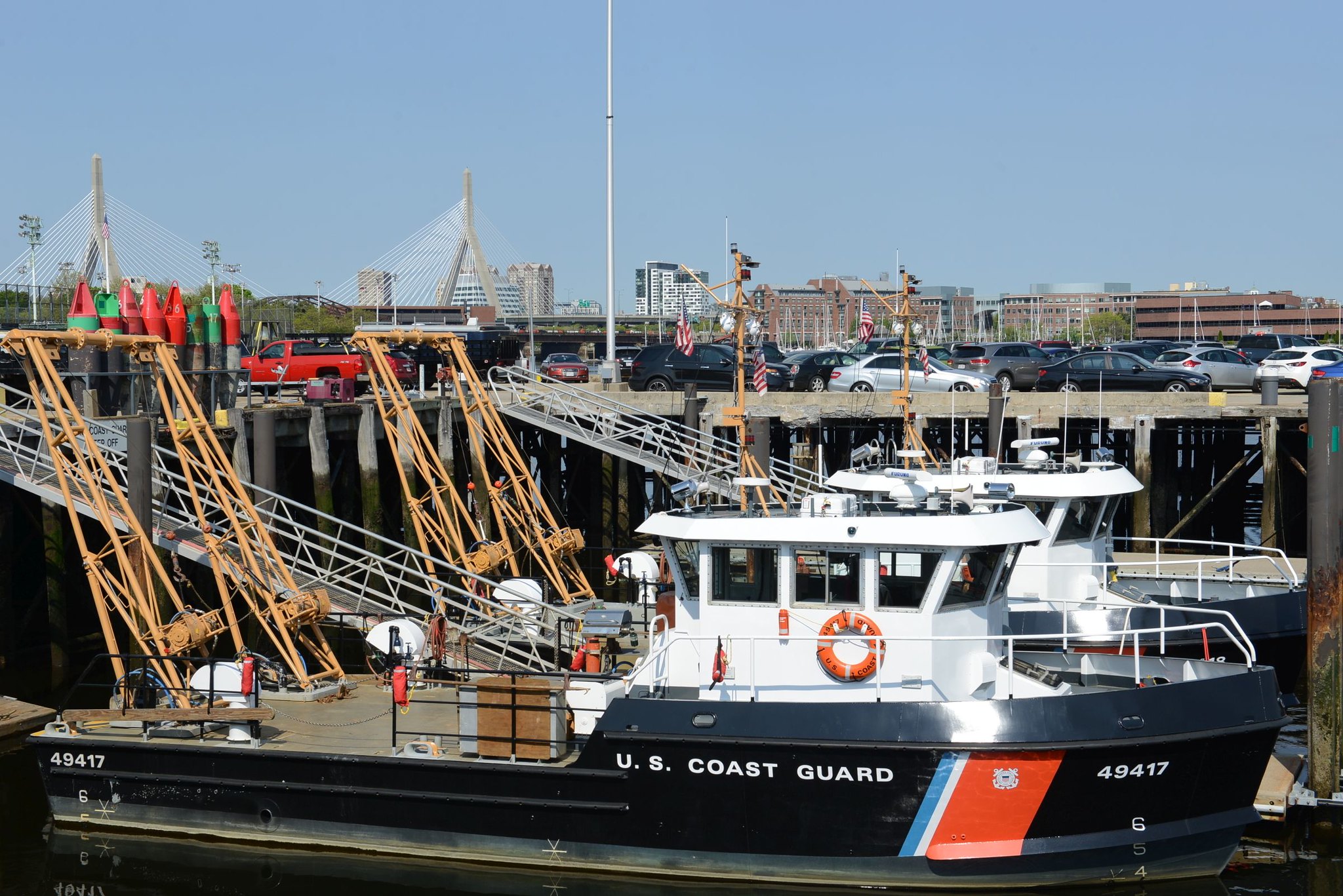
49 foot ANB, Boston

The Navy League’s magazine “Seapower” reports,

“We’re going to do a detailed design and construction award in the spring of 2022 to replace our half-centurion working aids-to-navigation boats,” said Adm. Karl Schultz, the Coast Guard commandant, speaking 28 Sept. at a webinar of the Heritage Foundation.

Shultz said the service plans to procure about 35 new ANBs, “but I believe we will be able to shrink down to about 30 really capable boats,” although he did not specify the type or types of ANBs to be replaced.

We currently have seven types of aid to navigation boats, as described in the link:

  • The 18-foot aids to navigation-medium cutter boat is used by the Keeper Class Coastal Buoy Tenders to transport equipment to a construction site and also used at small boat stations for emergency response to floods or areas where a shallow water response is necessary.
  • The 20-foot aids to navigation boat-small and 16-foot aids to navigation boat-skiff primarily aid to navigation servicing, construction, repair and discrepancy response.
  • The 26-foot trailerable aids to navigation boat serves as the workhorse for aids to navigation teams.
  • The 49-foot stern loading buoy boat supports the short-range aids to navigation missions.
  • The 55-foot aluminum hull can operate in moderately rough weather in coastal and inland waters.
  • The 64-foot self-propelled barge primarily operates on the protected rivers and protected waters

My Combat Fleets of the World, still the latest edition, copyright 2013, lists three 64 foot WYGL, 17 55ft, 26 49ft BUSL (Boat, Utility, Stern Load), 90 26ft tailerable WYGL, 48 (+47 additional planned) 20ft ANB,S (aids to navigation, small), and 30 (+30 additional planned)16ft aids to navigation skiffs (WYTL). The numbers quoted in the article are only different with regard to the 55ft boats.

As of last year, the Coast Guard operated a fleet of ANBs that included three 64-foot and four 55-foot ANB, 26 49-foot stern-loading buoy-servicing boats, 90 26-foot and five 17-to-23-foot transportable ANBs, as well as numerous smaller skiffs.

Apparently we have already ditched 13 of the 55ft boats. Presumably the older ones.

Sounds like the intention is to replace all the 49, 55, and 64 foot boats.

  • The 64ft self propelled barges entered service 1996-97.
  • The 55ft boats, built by the Coast Guard Yard, entered service 1977-1988.
  • The 49ft boats, built by the Coast Guard Yard, entered service 1997-2000.

Not quite as old as the Commandant seems to indicate, but definitely time to start replacement. It appears all the smaller AtoN boats entered service in the last 15 years.

Thanks to Lee for bringing this to my attention. 

Despite Hurricane Ida, Bollinger Says On Track to Deliver the Next FRC Ahead of Schedule

This is just a couple of select paragraphs from a longer Bollinger press release. Good news, apparently no delays expected in delivery of Webber class WPCs.


“Bollinger Shipyards Resumes Operations at All Facilities Following Hurricane Ida

“LOCKPORT, La., ‐‐ (September 24, 2021) – Bollinger Shipyards LLC (“Bollinger”) today announced that all 11 of its facilities are now open and operational following Hurricane Ida’s landfall last month near Port Fourchon, Louisiana as a powerful Category 4 storm. Bollinger’s facilities in Port Fourchon, Larose, Lockport and Houma suffered significant damage as a result of the storm, which tied with last year’s Hurricane Laura and the Last Island Hurricane of 1856 as the strongest on record in Louisiana.

“In advance of the storm, Bollinger took steps to mitigate potential damages to its facilities and any resulting delays to its production schedules. Despite damages sustained to Bollinger’s Lockport facility, the 650‐man production line for the U.S. Coast Guard Fast Response Cutter program has resumed operations and Bollinger is on track to deliver the next vessel ahead of schedule.”

“Report to Congress on Coast Guard Cutter Procurement” –CRS, Updated September 15, 2021″ –CRS

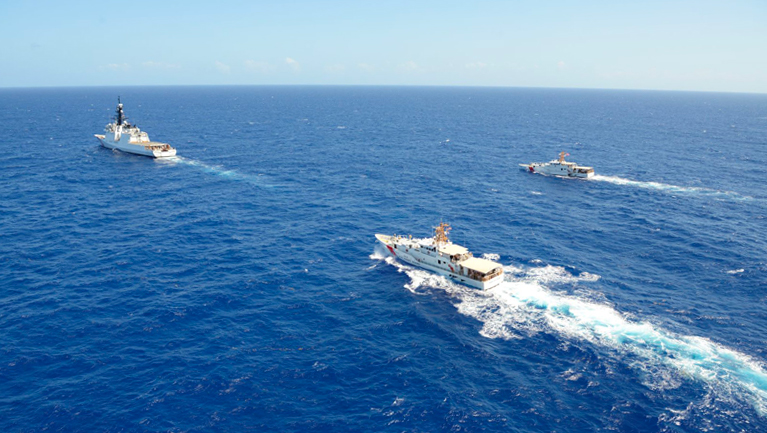
“Coast Guard Cutter Hamilton leads the way for cutters Robert Goldman and Charles Moulthrope as they depart Puerto Rico April 1. National security cutter Hamilton is escorting the two fast response cutters (FRCs) across the Atlantic to Rota, Spain. From there, the FRCs will continue to their homeport of Manama, Bahrain.” U.S. Coast Guard photo by Petty Officer 3rd Class Sydney Phoenix.

The Congressional Research Service has again updated their “Report to Congress on Coast Guard Cutter Procurement”. (This link will always take you to the most recent edition of the report.) My last post on this evolving document was in reference to a 17 August, 2021 update. I have reproduced the one page summary in full below. But first,

I missed this addition in my last look at the report. From page 22/23:

August 2021 House Committee Request for GAO Review

In a letter dated August 16, 2021, the House Transportation and Infrastructure Committee requested GAO to review the management of the OPC program and the Coast Guard’s efforts for managing its existing medium endurance cutters. The letter stated:

Initially projected to cost about $12 billion over its 30-year life cycle, the [OPC] program recently experienced significant cost and schedule delays….

In addition to construction of the OPC, the Committee continues to remain concerned about the operational gap between the end of service life for the aging Medium Endurance Cutters and the delayed delivery of the OPCs….

Given the significant budgetary commitment that the Congress, DHS, and Coast Guard have made for the OPC program to date, continued oversight is necessary to ensure the OPC program does not continue to experience cost growth or additional schedule delays. As such, the Committee requests that the Government Accountability Office (GAO) review the management of the OPC and Medium Endurance Cutters acquisition programs including, but not limited to:

  • The status of the Phase 1 (the first four hulls) and Phase 2 (hulls 5 through 25) OPC acquisition programs, including what steps are being taken to manage the program within the revised cost and schedule commitments; and
  • The status of the Medium Endurance Cutters and level of maintenance needed to keep the fleet operating to minimize the operational gap until the OPCs are incrementally delivered.

This is new. From page 27:

FY2022 National Defense Authorization Act (H.R. 4350) House
The House Armed Services Committee’s report (H.Rept. 117-118 of September 10, 2021) on H.R. 4350 states:

Sentinel-class Fast Response Cutter

The committee looks forward to reviewing the Navy’s updated force structure assessment and shipbuilding plan. The committee understands the Navy intends to change the fleet architecture reflected in the 355-ship force-level goal to reflect a more distributed fleet mix with a smaller proportion of larger ships and a larger proportion of smaller manned ships as well as unmanned vessels. The committee supports incorporating a mix of smaller manned ships into the fleet and encourages the Navy to consider the capabilities the U.S. Coast Guard’s Sentinel-class Fast Response Cutter could provide to the fleet and the concept of operations and associated requirements that would support acquisition of these vessels.

Further, the committee is aware the U.S. Coast Guard has contract options for 12 additional Sentinel-class Fast Response Cutters with firm fixed pricing in place until May of 2023. Exercising these contract options in advance of their expiration would lock in favorable pricing on Sentinel-class Fast Response Cutters should the Navy determine that they add value to the fleet.

Given the successes of the U.S. Coast Guard’s Sentinel-class Fast Response Cutter in support of the Navy’s Fifth Fleet as a part of Patrol Forces Southwest Asia, the committee believes there are similar roles for Sentinel-class Fast Response Cutters in other areas of responsibility. Therefore, the committee directs the Secretary of the Navy to submit a report to the congressional defense committees not later than February 1, 2022, that details the current mission sets and operating requirements for the Sentinel-class Fast Response Cutter and expands on how successes in the U.S. Central Command area of responsibility would translate to other regions, including the U.S. Indo-Pacific Command. Further, the committee directs the Secretary of the Navy to assess the requisite upgrades to the Sentinel class Fast Response Cutter required to meet Navy standards and evaluate the concept of operations for employing these vessels in Southeast Asia. This report should be unclassified but may include a classified annex. (Page 21)

The Summary page is reproduced below:


Summary

The Coast Guard’s program of record (POR), which dates to 2004, calls for procuring 8 National Security Cutters (NSCs), 25 Offshore Patrol Cutters (OPCs), and 58 Fast Response Cutters (FRCs) as replacements for 90 aging Coast Guard high-endurance cutters, medium-endurance cutters, and patrol craft. The Coast Guard’s proposed FY2022 budget requests a total of $695.0 million in procurement funding for the NSC, OPC, and FRC programs, including $597 million for the OPC program.

NSCs are the Coast Guard’s largest and most capable general-purpose cutters; they are replacing the Coast Guard’s 12 Hamilton-class high-endurance cutters. NSCs have an estimated average procurement cost of about $670 million per ship. Although the Coast Guard’s POR calls for procuring 8 NSCs to replace the 12 Hamilton-class cutters, Congress through FY2021 has fully funded 11 NSCs, including the 10th and 11th in FY2018. In FY2020, Congress provided $100.5 million for procurement of long lead time materials (LLTM) for a 12th NSC, so as to preserve the option of procuring a 12th NSC while the Coast Guard evaluates its future needs. The Coast Guard’s proposed FY2022 budget requests $78.0million in procurement funding for activities within the NSC program; this request does not include further funding for a 12th NSC. The Coast
Guard’s proposed FY2022 budget also proposes rescinding $65.0 million of the $100.5 million in FY2020 funding for LLTM for a 12th NSC, “allowing the Coast Guard to focus investments on building, homeporting, and crewing Polar Security Cutters and Offshore Patrol Cutters.” The remaining $35.5 million appropriated in FY2020 for LLTM would be used to pay NSC program costs other than procuring LLTM for a 12th NSC. Nine NSCs have entered service; the ninth was commissioned into service on March 19, 2021.

OPCs are to be less expensive and in some respects less capable than NSCs; they are intended to replace the Coast Guard’s 29 aged medium-endurance cutters. Coast Guard officials describe the OPC and PSC programs as the service’s highest acquisition priorities. OPCs have an estimated average procurement cost of about $411 million per ship. The first OPC was funded in FY2018. The Coast Guard’s proposed FY2022 budget requests $597.0 million in procurement funding for the fourth OPC, LLTM for the fifth, and other program costs. On October 11, 2019, the Department of Homeland Security (DHS), of which the Coast Guard is a part, announced that DHS had granted extraordinary contractual relief to Eastern Shipbuilding Group (ESG) of
Panama City, FL, the builder of the first four OPCs, under P.L. 85-804 as amended (50 U.S.C. 1431-1435), a law that authorizes certain federal agencies to provide certain types of extraordinary relief to contractors who are encountering difficulties in the performance of federal contracts or subcontracts relating to national defense. The Coast Guard is holding a full and open competition for a new contract to build OPCs 5 through 15. On January 29, 2021, the Coast Guard released a Request for Proposals (RFP) for this Stage 2 contract, as it is called. Responses to the RFP were due by May 28, 2021. The Coast Guard plans to award the Stage 2 contract in the second quarter of FY2022.

FRCs are considerably smaller and less expensive than OPCs; they are intended to replace the Coast Guard’s 49 aging Island-class patrol boats. FRCs have an estimated average procurement cost of about $65 million per boat. A total of 64 have been funded through FY2021, including four in FY2021. Six of the 64 are to be used by the Coast Guard in the Persian Gulf and are not counted against the 58-ship POR quantity for the program, which relates to domestic operations. Forty-four of the 64 have been commissioned into service. The Coast Guard’s proposed FY2022 budget requests $20.0 million in procurement funding for the FRC program; this request does not include funding for any additional FRCs