“Coast Guard Polar Security Cutter (Polar Icebreaker) Program: Background and Issues for Congress” –CRS, Updated August 31, 2021

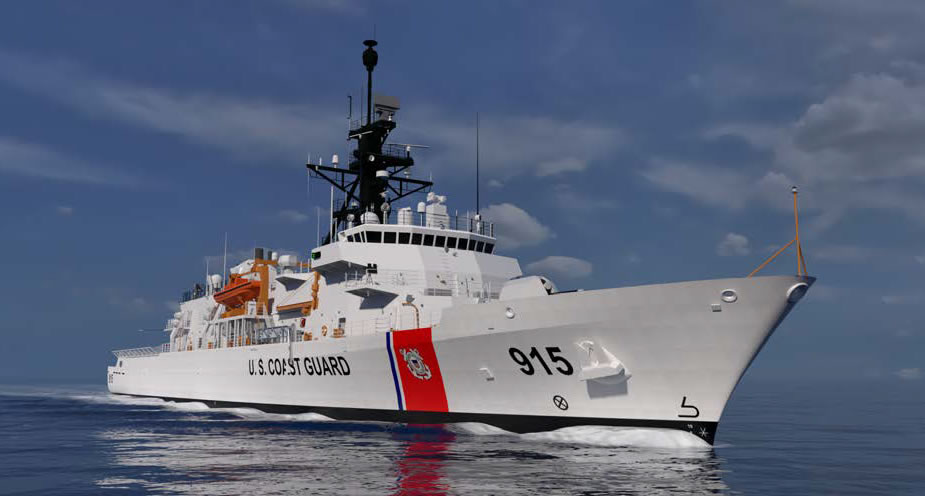
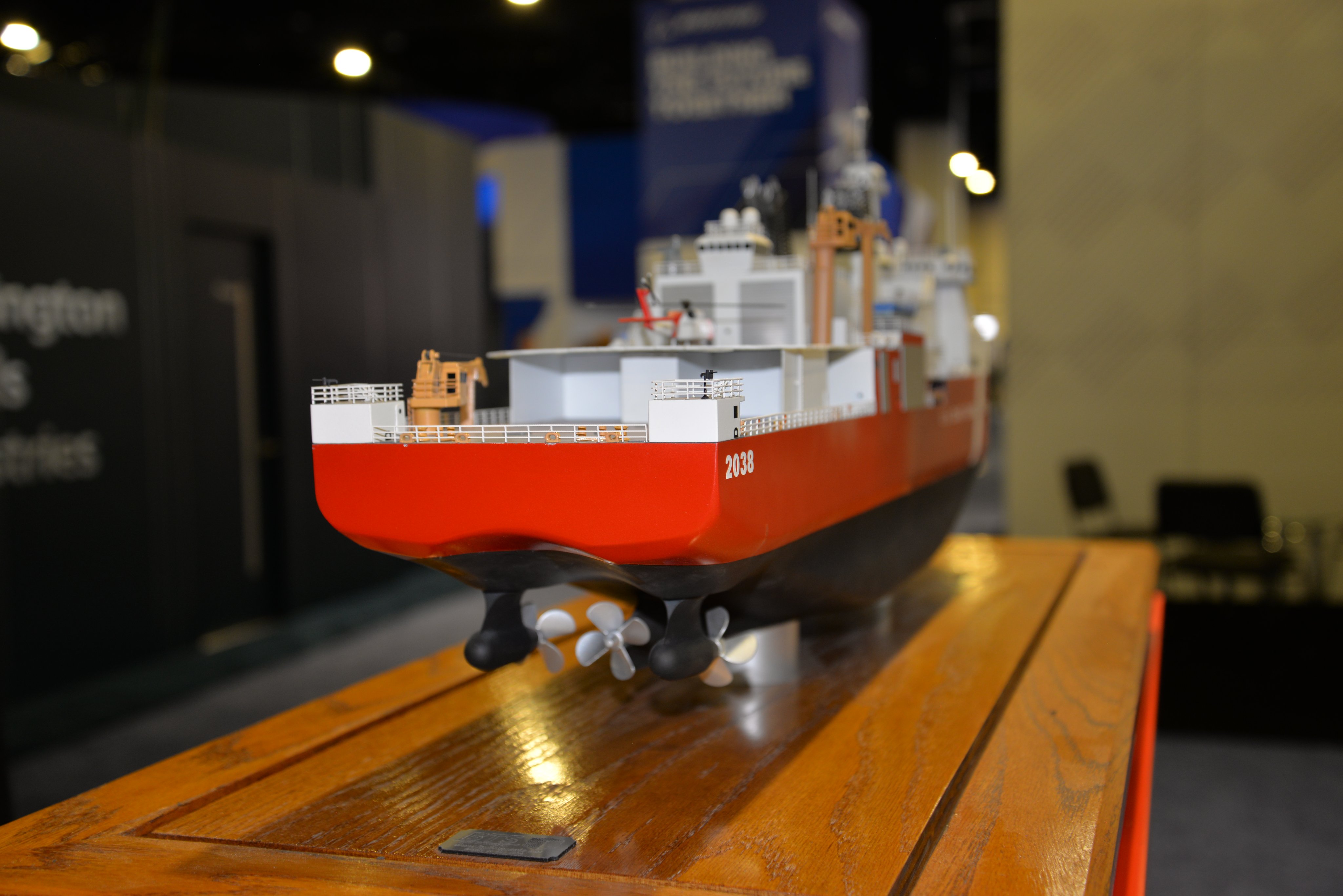
Photo of a model of Halter Marine’s Polar Security Cutter seen at Navy League’s Sea-Air-Space Exhibition have surfaced. Photo credit Chris Cavas.

The Congressional Research Service has once again updated their look at the Polar Security Cutter (heavy icebreaker) program. (See the latest version here.) My last look at this evolving document was in regard to the August 17, 2021 revision.

It appears this new edition was prompted by an update to the projected cost for the program. The following is a note attached to Table 1 (page 6), which I have also reproduced below.

Source: U.S. Navy information paper on PSC program, August 18, 2021, received from Navy Office of Legislative Affairs, August 31, 2021, which states that costs shown are from the PSC program 2020 Life Cycle Cost Estimate.

Table 1. Estimated PSC Procurement Costs
(In millions of then-year dollars)

Cost element                             1st PSC       2nd PSC      3rd PSC      Total
Target contract price                    746               544              535          1,825
Program costs (including GFE)   218               175              228             621
Post-delivery costs                        46                 47                49             142
Costs for Navy-Type, Navy-          28                 28                29               85                          Owned (NTNO) equipment

TOTAL                                       1,038               794               841        2,673

There was also this additional note attached to Table 1.

Notes: Target contract price includes detail design, construction, and long lead-time materials (LLTM), and does not reflect potential costs rising to the contract ceiling price. GFE is government-furnished equipment— equipment that the government procures and then provides to the shipbuilder for installation on the ship. NTNO equipment is GFE that the Navy provides—such as combat weapons systems, sensors and communications equipment and supplies—for meeting Coast Guard/Navy naval operational capabilities wartime readiness requirements. (For additional discussion, see Coast Guard Commandant Instruction (COMDTINST) 7100.2G, May 16, 2013, accessed August 31, 2021, at https://media.defense.gov/2017/Mar/15/2001716816/-1/-1/0/ CI_7100_2G.PDF.)

Below is the one page summary:

Summary

The Coast Guard Polar Security Cutter (PSC) program is a program to acquire three new PSCs (i.e., heavy polar icebreakers), to be followed years from now by the acquisition of up to three new Arctic Security Cutters (ASCs) (i.e., medium polar icebreakers). The PSC program has received a total of $1,754.6 million (i.e., about $1.8 billion) in procurement funding through FY2021, including $300 million that was provided through the Navy’s shipbuilding account in FY2017 and FY2018. With the funding the program has received through FY2021, the first two PSCs are now fully funded.

The Coast Guard’s proposed FY2022 budget requests $170.0 million in procurement funding for the PSC program, which would be used for, among other things, procuring long leadtime materials (LLTM) for the third PSC.

The Navy and Coast Guard in 2020 estimated the total procurement costs of the PSCs in then year dollars as $1,038 million (i.e., about $1.0 billion) for the first ship, $794 million for the second ship, and $841 million for the third ship, for a combined estimated cost of $2,673 million (i.e., about $2.7 billion). Within those figures, the shipbuilder’s portion of the total procurement cost is $746 million for the first ship, $544 million for the second ship, and $535 million for the third ship, for a combined estimated shipbuilder’s cost of $1,825 million (i.e., about $1.8 billion).

On April 23, 2019, the Coast Guard-Navy Integrated Program Office for the PSC program awarded a $745.9 million fixed-price, incentive-firm contract for the detail design and construction (DD&C) of the first PSC to VT Halter Marine of Pascagoula, MS, a shipyard owned by Singapore Technologies (ST) Engineering. VT Halter was the leader of one of three industry teams that competed for the DD&C contract. The first PSC is scheduled to begin construction in 2021 and be delivered in 2024, though the DD&C contract includes financial incentives for earlier delivery.

The DD&C contract includes options for building the second and third PSCs. If these options are exercised, the total value of the contract would increase to $1,942.8 million (i.e., about $1.9 billion). The figures of $745.9 million and $1,942.8 million cover only the shipbuilder’s costs; they do not include the cost of government-furnished equipment (GFE), which is equipment for the ships that the government purchases and then provides to the shipbuilder for incorporation into the ship, post-delivery costs, costs for Navy-specific equipment, or government program management costs.

The operational U.S. polar icebreaking fleet currently consists of one heavy polar icebreaker, Polar Star, and one medium polar icebreaker, Healy. In addition to Polar Star, the Coast Guard has a second heavy polar icebreaker, Polar Sea. Polar Sea, however, suffered an engine casualty in June 2010 and has been nonoperational since then. Polar Star and Polar Sea entered service in 1976 and 1978, respectively, and are now well beyond their originally intended 30-year service lives. The Coast Guard plans to extend the service life of Polar Star until the delivery of at least the second PSC. The Coast Guard is using Polar Sea as a source of spare parts for keeping Polar Star operational.

On August 18, 2020, an electrical fire occurred in one of Healy’s main propulsion motors as the ship was 60 miles off Seward, AK, en route to the Arctic. As a result of the fire, the ship’s starboard propulsion motor and shaft became nonoperational. The ship canceled its deployment to the Arctic and returned to its homeport in Seattle for inspection and repairs.
“Report to Congress on Coast Guard Cutter Procurement” –CRS, Updated August 17, 2021

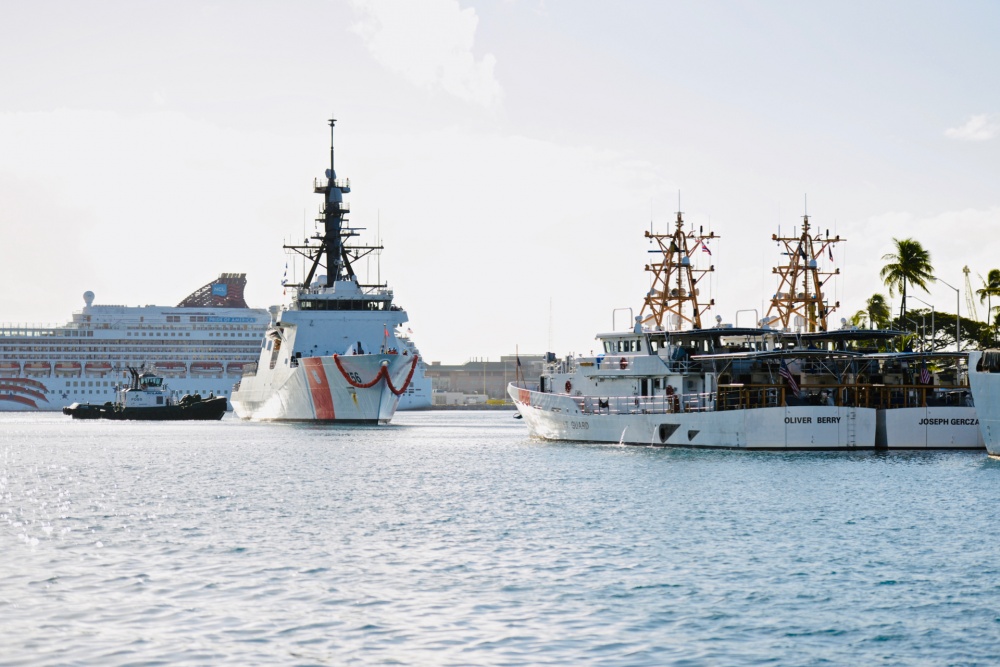
The crew of USCGC Kimball (WMSL 756) arrive in Honolulu for the first time Dec. 22, 2018. Known as the Legend-class, NSCs are designed to be the flagships of the Coast Guard’s fleet, capable of executing the most challenging national security missions, including support to U.S. combatant commanders. (U.S. Coast Guard photo by Chief Petty Officer Sara Muir/Released)

The Congressional Research Service has again updated their “Report to Congress on Coast Guard Cutter Procurement”. (This link will always take you to the most recent edition of the report.) My last post on this evolving document was in reference to an 8 June 2021 update. I have reproduced the one page summary in full below. But first,

Comments:

It appears this report is little changed from the previous edition. The significant change is a reflection of the actions of the House Appropriations Committee and this change is relatively small. The Administration’s FY2022 Procurement Funding Request was:

  • NSC (Bertholf Class) program   $78.0M
  • OPC (Argus Class) program    $597.0M
  • FRC (Webber Class) program   $20.0M
  • TOTAL                                      $695.0M

The House Appropriations Committee mark up increased the total to $716M adding $21M to the NSC program.

An explanation included in House Report 117-87 of July 15, 2021 states

“National Security Cutter (NSC).—The Committee provides $99,000,000, which is $21,000,000 above the request, for the NSC program. This funding will support Post Delivery Activities to missionize and operationalize NSCs 10 and 11. The shortfall for these activities is currently over $200,000,000. The $21,000,000 is funded in the bill as a rescission and re-appropriation of prior-year funds to extend their availability.” (Page 57)

So while construction of the eleven National Security Cutters have be funded, we can expect to see future funding requests totaling over $100M to make #10 and #11 fully operational.

The rescission referred to is from funds earmarked for long lead time items for a possible future NSC#12. This seems to put an end to any possibility of a NSC.

The House Appropriations Committee action leaves in place the Administration’s plan to fund OPC#4 and procure long lead time items for OPC#5, but adds no additional NSCs or FRCs.

Summary (Below is the one page summary contained in the report–Chuck)

The Coast Guard’s program of record (POR), which dates to 2004, calls for procuring 8 National Security Cutters (NSCs), 25 Offshore Patrol Cutters (OPCs), and 58 Fast Response Cutters (FRCs) as replacements for 90 aging Coast Guard high-endurance cutters, medium-endurance cutters, and patrol craft. The Coast Guard’s proposed FY2022 budget requests a total of $695.0 million in procurement funding for the NSC, OPC, and FRC programs, including $597 million for the OPC program.

NSCs are the Coast Guard’s largest and most capable general-purpose cutters; they are replacing the Coast Guard’s 12 Hamilton-class high-endurance cutters. NSCs have an estimated average procurement cost of about $670 million per ship. Although the Coast Guard’s POR calls for procuring 8 NSCs to replace the 12 Hamilton-class cutters, Congress through FY2021 has fully funded 11 NSCs, including the 10th and 11th in FY2018. In FY2020, Congress provided $100.5 million for procurement of long lead time materials (LLTM) for a 12th NSC, so as to preserve the option of procuring a 12th NSC while the Coast Guard evaluates its future needs. The Coast Guard’s proposed FY2022 budget requests $78.0million in procurement funding for activities within the NSC program; this request does not include further funding for a 12th NSC. The Coast
Guard’s proposed FY2022 budget also proposes rescinding $65.0 million of the $100.5 million in FY2020 funding for LLTM for a 12th NSC, “allowing the Coast Guard to focus investments on building, homeporting, and crewing Polar Security Cutters and Offshore Patrol Cutters.” The remaining $35.5 million appropriated in FY2020 for LLTM would be used to pay NSC program costs other than procuring LLTM for a 12th NSC. Nine NSCs have entered service; the ninth was commissioned into service on March 19, 2021.

OPCs are to be less expensive and in some respects less capable than NSCs; they are intended to replace the Coast Guard’s 29 aged medium-endurance cutters. Coast Guard officials describe the OPC and PSC programs as the service’s highest acquisition priorities. OPCs have an estimated average procurement cost of about $411 million per ship. The first OPC was funded in FY2018. The Coast Guard’s proposed FY2022 budget requests $597.0 million in procurement funding for the fourth OPC, LLTM for the fifth, and other program costs. On October 11, 2019, the Department of Homeland Security (DHS), of which the Coast Guard is a part, announced that DHS had granted extraordinary contractual relief to Eastern Shipbuilding Group (ESG) of Panama City, FL, the builder of the first four OPCs, under P.L. 85-804 as amended (50 U.S.C. 1431-1435), a law that authorizes certain federal agencies to provide certain types of extraordinary relief to contractors who are encountering difficulties in the performance of federal contracts or subcontracts relating to national defense. The Coast Guard is holding a full and open competition for a new contract to build OPCs 5 through 15. On January 29, 2021, the Coast Guard released a Request for Proposals (RFP) for this Stage 2 contract, as it is called. Responses to the RFP were due by May 28, 2021. The Coast Guard plans to award the Stage 2 contract in the second quarter of FY2022.

FRCs are considerably smaller and less expensive than OPCs; they are intended to replace the Coast Guard’s 49 aging Island-class patrol boats. FRCs have an estimated average procurement cost of about $65 million per boat. A total of 64 have been funded through FY2021, including four in FY2021. Six of the 64 are to be used by the Coast Guard in the Persian Gulf and are not counted against the 58-ship POR quantity for the program, which relates to domestic operations. Forty-four of the 64 have been commissioned into service. The Coast Guard’s proposed FY2022 budget requests $20.0 million in procurement funding for the FRC program; this request does not include funding for any additional FRCs.

“Coast Guard to Build Digital Twin for Polar Star” –National Defense

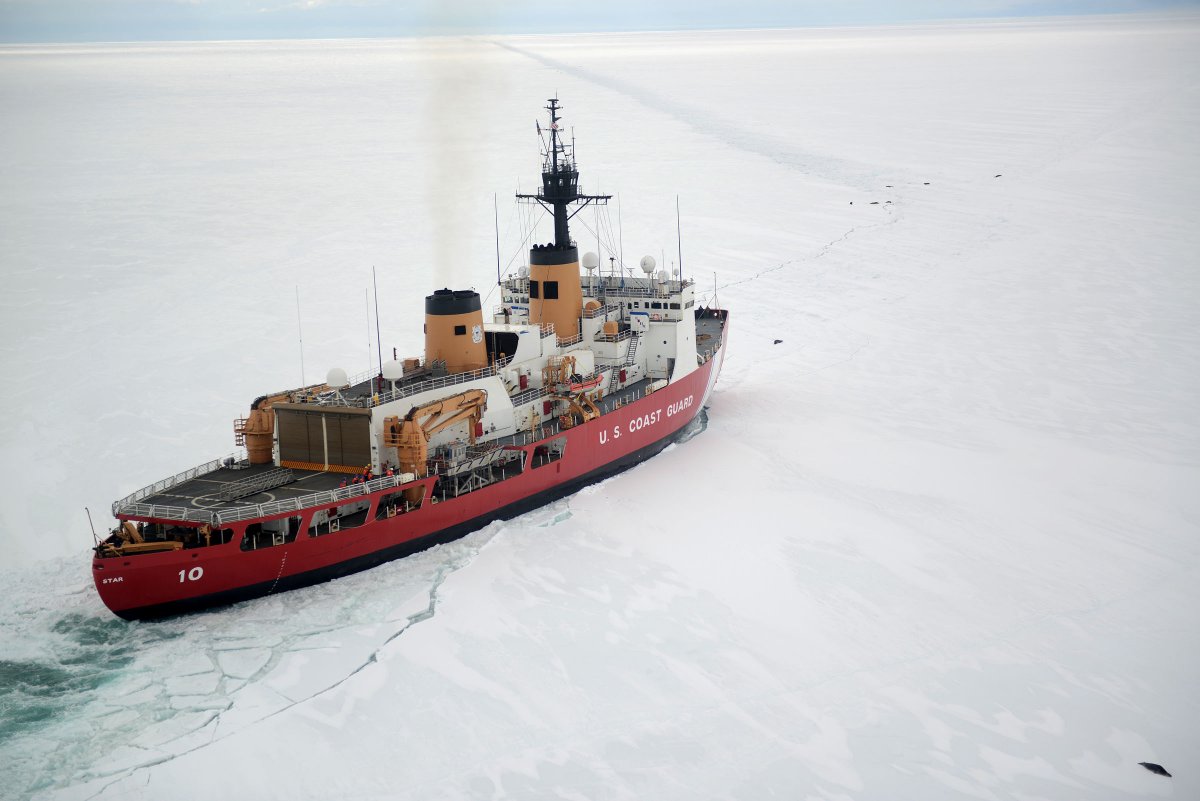
The Coast Guard Cutter Polar Star cuts through Antarctic ice in the Ross Sea near a large group of seals as the ship’s crew creates a navigation channel for supply ships, January 16, 2017. The resupply channel is an essential part of the yearly delivery of essential supplies to the National Science Foundation’s McMurdo Station.US Coast Guard photo by Chief Petty Officer David Mosley

National Defense reports,

“Canada-based manufacturer Gastops will collect data on the USCGC Polar Star — a ship built in the 1970s — to create a computer model that can undergo risk assessments at a relatively low cost, said Shaun Horning, president and CEO of the company.”

Results will feed into the planned service life extension intended to allow Polar Star to continue operating, at least until the second Polar Security Cutter is commissioned.

“…replacing the Polar Star’s 30-year-old analog control system with a digital control system will be one aspect of the refurbishment that will need to be tested extensively, Horning noted.”

This is the first time I have heard of the Coast Guard developing a “digital twin,” but this is becoming increasingly common. We can probably expect to hear of this being applied to other Coast Guard systems.

“Coast Guard exercises contract option for FRCs 61-64” –CG-9

The last of 64 planned Webber class Fast Response Cutters have been funded and contracted. The Acquisitions Directorate (CG-9) reports

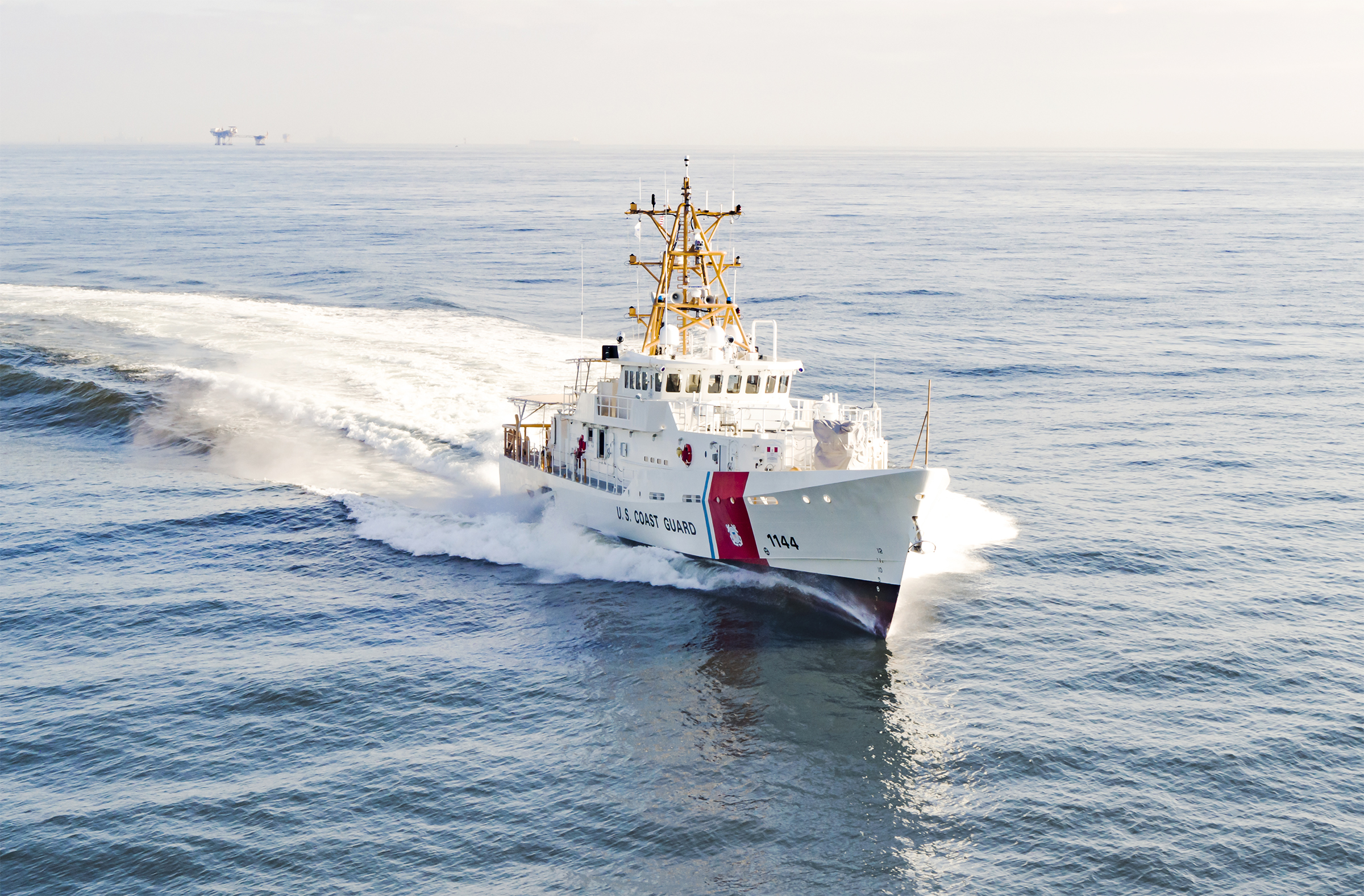
The Coast Guard exercised a contract option Aug. 4 for production of four more Sentinel-class fast response cutters (FRCs) and associated deliverables worth about $212.9 million with Bollinger Shipyards of Lockport, Louisiana.

This option brings the total number of FRCs under contract with Bollinger to 64 and the total value of the Phase 2 contract to approximately $1.7 billion. The FRCs built under this option will be delivered between October 2024 and June 2025.

To date, there are 43 FRCs in operational service.

FRCs have a maximum speed of over 28 knots, a range of 2,500 nautical miles and an endurance of five days. The ships are designed for multiple missions, including drug and migrant interdiction; ports, waterways and coastal security; fishery patrols; search and rescue; and national defense. They feature advanced command, control, communications, computers, intelligence, surveillance and reconnaissance equipment; over-the-horizon cutter boat deployment to reach vessels of interest; and improved habitability and seakeeping.

For more information: Fast Response Cutter Program page

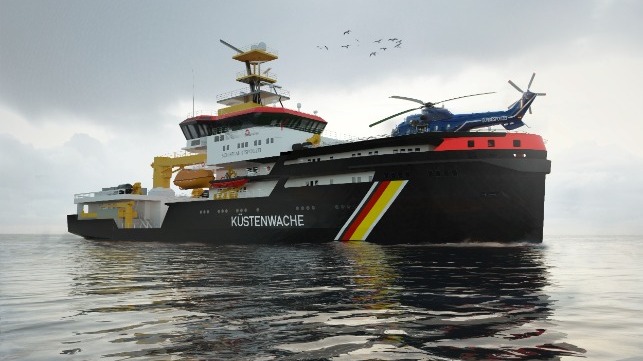
Is this a German Buoy Tender? Icebreaker?

SCHOTTEL Mehrzweckschiffe

It is always interesting to find that others deal with missions you perform in a very different way.

A Marine Link report on the new ship above piqued my curiosity about the parent agency. The German Federal Waterways and Shipping Administration (WSV),

“… is responsible for ensuring a safe, smoothly flowing and thus economically efficient shipping traffic. The tasks comprise the maintenance, operation as well as the upgrading and construction of the federal waterways including the locks, weirs, bridges and shiplifts.

The responsibility of the Federal Waterways and Shipping Administration extends to a total of 23,000 km² of maritime waterways and approximately 7,300 km of inland waterways. In addition, we maintain Vessel Traffic Service Centres at waterways in the coastal area and traffic control centres at inland waterways and we use special vessels for different specialist tasks (buoy laying, emergency missions, direction-finding etc.).

Around the clock, our experts on the water and ashore ensure safe traffic flows.

Our leitmotif is: “Facilitate mobility and protect the environment!”

Sounds like it has some of the Coast Guard’s missions and some Corps of Engineers missions.

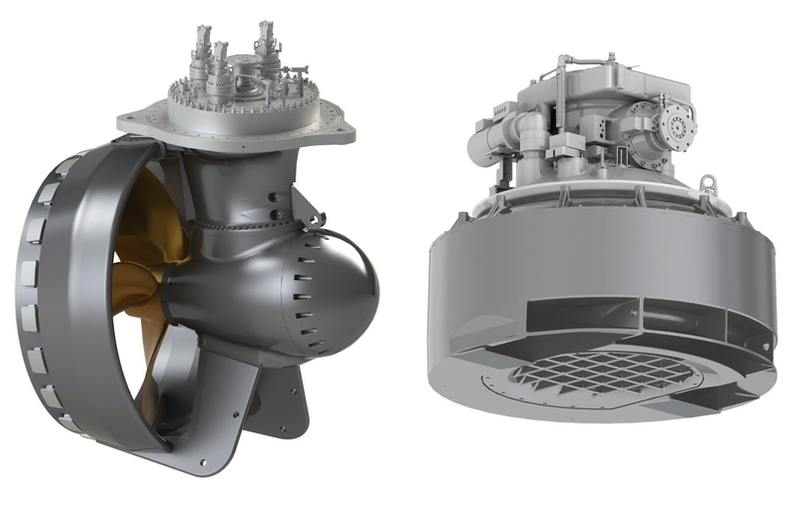
The ship itself is described as multi-purpose. Presumably it tends buoys, but it is far bigger and more powerful than any USCG buoy tender, at over 90 meters (290′) in length driven by two steerable propulsion units of 4,500 KW each (over 12,000 HP total). It also has a 2,990 kW (over 4,000 HP) pumpjet.  Our most similar ship seems to be USCGC Mackinaw. (240′ in length and 9,119 shp/6.8 MW).

Mackinaw is of course a domestic icebreaker, in addition to being able to tend buoys.  The new German ship looks like it might also be capable of light icebreaking. (Maybe Tups who comments here frequently would be able to tell us.)

SCHOTTEL RudderPropellers type SRP 750 (each 4,500 kW at 750 rpm) on the left. SCHOTTEL PumpJet type SPJ 520 (2,990 kW) on the right. Image: SCHOTTEL

The German ship also has a gas-tight “citadel” structure with a protective air supply, in order to carry out operations in hazardous atmospheres. In the Coast Guard only the National Security Cutters have this feature.

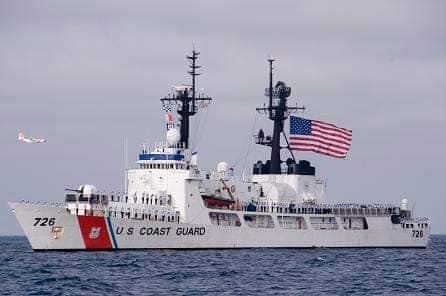
The Hamilton Class 378 foot WHECs, an Appreciation

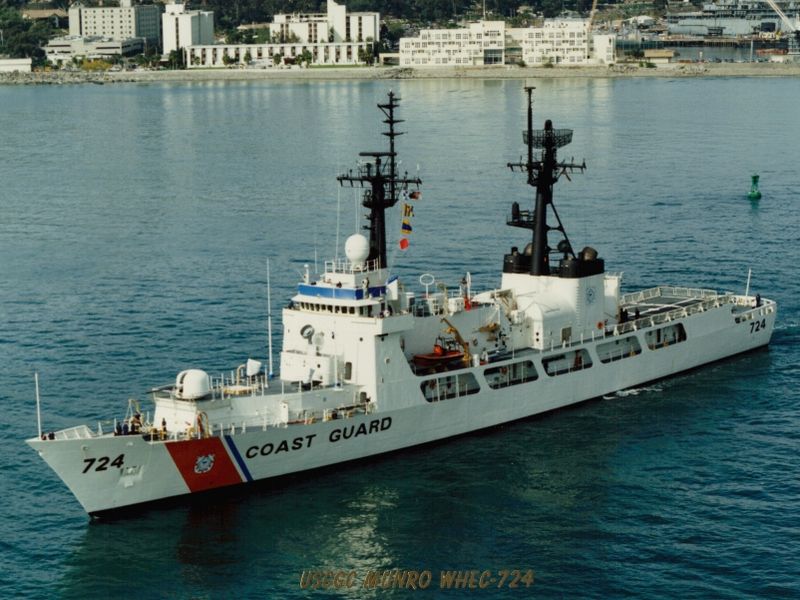
USCGC Douglas Munro (WHEC-724)

The Navy League’s magazine, Seapower, reports that the last of the US Coast Guard’s Hamilton class 378 foot WHECs, Douglas Munro, will be decommissioned at the end of the month.

The designers of these ships certainly made them aesthetically pleasing, and the preliminary design work was done in house by Coast Guard engineers.

The 378s were the crowning achievement of a recapitalization program begun in the late 1950s that resulted in the 82 foot Point class patrol boats, the 210 foot Reliance class WMECs, and ultimately the 378 foot Hamilton class WHECs, all built to preliminary designs developed in house.

Between October 1960 and August 1970 the Coast Guard commissioned 79 Point class WPBs. The Point class followed closely on the heals of the 95 foot WPB, the last of which had been commissioned in July 1959.

Between June 1964 and July 1969 we commissioned 16 Reliance class WMECs. Between February 1967 and March 1972 we commissioned 12 Hamilton class WHECs.

So between Oct. 1960 and March 1972 the Coast Guard commissioned 107 new patrol cutters. In 1967 alone we commissioned 17 Point class WPB. 1968 was the peak year for the larger cutters. In that year the Coast Guard commissioned four 378s and seven 210s. (Makes it clear we should be able to complete more than two Offshore Patrol Cutters per year, doesn’t it?)

USCGC Gallatin WHEC -721 (378), USCGC Rockaway WHEC-377 (311), and USCGC Spencer WHEC-36 (327)

When the 378s were built, the WHEC designation had just recently been coined. 36 ships were classed as WHECs, six 327 foot 2,656 ton full load Secretary class cutters, 18 Casco class 311 foot 2,529 ton cutters, and 12 Owasco class 255 foot 1,978 ton cutters. The plan was to build 36 of Hamilton class to replace all of them, but the termination of the Ocean Station program resulted in only twelve being built. The 378s were 15 to 54% larger than the ships they replaced at 3,050 tons full load, and they were a much more advanced design.

CODOG Propulsion:

The COmbined Diesel or Gas turbine (CODOG) propulsion was a bold choice in the early 1960s. The Royal Navy had commissioned their first combatants with gas turbines (combined with steam) in 1961  The US Navy would not complete their first gas turbine powered Perry class frigate until 1977. (I think you can see the influence of the Hamilton class in the design of the Perry class frigates.) A pair of Danish Frigates, the Peder Skram class, would also use the same FT-4 turbines, but the first of that class was laid down only four months before Hamilton, so it was more contemporary than predecessor. 49 months after Hamilton was laid down, the Canadian laid down the first of the Iroquois class destroyers that used more powerful versions of the FT-4 in a COGOG arrangement with smaller 7500 HP Allison gas turbines. We would see the FT-4 gas turbine again in the Polar class icebreakers beginning in 1976.

The Coast Guard had done some experimentation with gas turbines. As built, USCGC Point Thatcher (WPB-82314), commissioned in Sept. 1961, was equipped with controllable pitch props and two 1000 HP gas turbines (later replaced by two 800 HP diesels that would became standard in the class). The first five 210 foot cutters of the Reliance class, commissioned June 1964 to February 1966, had two 1,000 HP gas turbines in addition to two 1,500 HP diesels, that they retained until they received major renovations 1985-1990.

The Hamilton Class’s Navy contemporaries were the 3,371 ton full load Garcia and 4,066 ton Knox class frigates (classified as Destroyer Escorts until 1975). Those ships were larger and used high temperature and pressure steam propulsion to produce 35,000 HP (compared to 36,000 for the 378s on their turbines). The frigates used only a single shaft for a speed 27 knots. The Hamiltons’ turbines gave them a two knot speed advantage, while their diesels gave them more than double the range. Two shafts gave them a greater degree of redundancy.

ASW Capability: 

While the contemporary Garcia and Knox class were much better equipped for ASW, the newly commissioned 378s, with their AN/SQS-38 sonar and helicopter deck were not only larger and faster, but also compared favorably as ASW ships to all but the newest Navy Destroyer Escorts (those completed 1963 and later).

CGC DALLAS (WHEC-716)… Vietnam… During seven combat patrols off the coast of Vietnam, Dallas undertook 161 gunfire support missions involving 7,665 rounds of her 5-inch ammunition. This resulted in 58 sampans destroyed and 29 Viet Cong supply routes, bases, camps, or rest areas damaged or destroyed. Her 5-inch (127 mm) guns made her very valuable to the naval missions in the area. Original 35mm Slide shared by Capt W.F. Guy, USCG… Circa May 1970.

Electronic Warfare, Gun and Fire Control: 

The 378s introduced the post WWII Coast Guard to electronic warfare with the WLR-1.

Unlike the earlier WHECs, the 378s were completed with the Mk56 gun firecontrol system which was much more capable than the short to medium range Mk52 used by the older cutters. Their 5″/38s proved useful when deployed to Vietnam. Below is quoted from Wikipedia’s description of USCGC Morgenthau‘s Vietnam deployment.

From records compiled by then-Lieutenant Eugene N. Tulich, Commander, US Coast Guard (Ret), Morgenthaus Vietnam numbers included: Miles cruised – 38,029 nautical miles (70,430 km; 43,763 mi); Percentage time underway – 72.8%; Junks/sampans detected/inspected/boarded – 2383/627/63; Enemy confirmed killed in action (KIA) 14; Structures destroyed/damaged – 32/37; Bunkers destroyed/damaged – 12/3; Waterborne craft destroyed/damaged – 7/3; Naval Gunfire Support Missions (NGFS) – 19; MEDCAPS (Medical Civic Action Program) – 25; Patients treated – 2676.

The FRAM:

During the late 1980s the Reagan administration was pushing for a 600 ship Navy. The FRAM of the Hamilton class was one of the small ways the Coast Guard played a part in the competition that may have driven the Soviet Union into dissolution.

While the 378s would still might not have been first class fighting units, electronic warfare was brought up to date, a newer air search radar, a modern gun, and firecontrol was installed. Harpoon anti-ship cruise missiles were add along with a Close in Weapon System (CIWS), a hangar was added and the ships were equipped to operate with a LAMPs I ASW helicopters.

Ultimately, following the collapse of the threat from the Soviet Union, the ASW equipment and anti-ship cruise missile were removed, but benefits of modernization, remained.

The After Life: 

These ships are now 49 to 54 years old and, thanks to the hard work of their crews over a half century, they are still doing good work, no longer for the US Coast Guard, but for Navies and Coast Guards around the world. Virtually all of their contemporaries have gone to the ship breakers, as have many younger ships.

BRP Andrés Bonifacio (FF-17), the former USCGC Boutwell.

  • Hamilton (715), Dallas (716), and Boutwell (719) serve in the Philippine Navy.
  • Mellon (717) serves in the Bahrain Naval Force
  • Chase (718) and Gallatin (721) serve in the Nigerian Navy
  • Sherman (720) serves in the Sri Lanka Navy
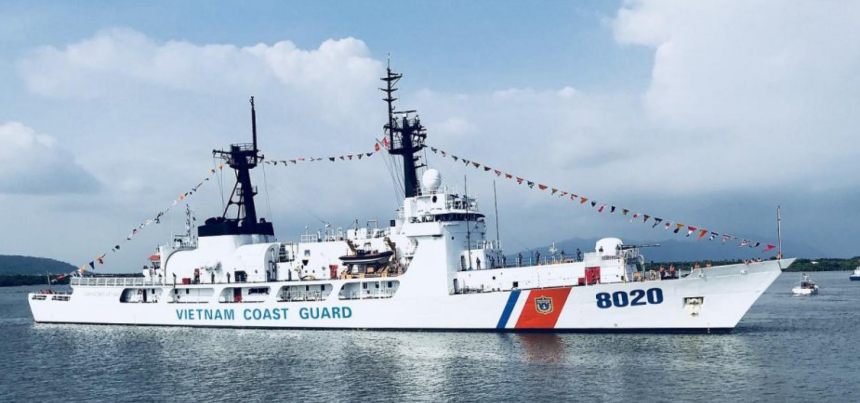
  • Morgenthau (722), Midgett (726), and Munro (724) serve or will serve in the Vietnam Coast Guard
  • Rush (723) and Jarvis (725) are in the Bangladeshi Navy

The Vietnam Coast Guard patrol vessel CSB-8020, formerly the US Coast Guard cutter Morgenthau (Photo: Vietnam Coast Guard)

Canada’s HMCS Harry DeWolf Class AOPS

HMCS Harry DeWolf in ice (6-8 second exposure)

The Harry DeWolf class is an almost unique type of ship. Canada is building eight, six for their Navy and two for their Coast Guard. It is derived from the similar and perhaps slightly more capable Norwegian Coast Guard vessel Svalbard, which has made it to the North Pole and recently undertook a mission the Healy was unable to complete due to a machinery casualty.

They are classified as “Artic and Offshore Patrol Ships” or AOPS, rather than icebreakers, but they are clearly designed to operate in ice and are rated Polar Class 5 (Year-round operation in medium first-year ice, which may include old ice inclusions). In many ways they approximate the similarly sized and powered old Wind Class icebreakers. (2012 post on the class with updates in the comments here.)

Below are another photo and a couple of videos, but first the specs.

  • Displacement: 6,615 t (6,511 long tons)
  • Length: 103.6 m (339 ft 11 in)
  • Beam: 19 m (62 ft 4 in)
  • Draft: 6.5 m (21 ft 4 in) (estimate based on that of Svalbard)
  • Propulsion Generators: Four 3.6 MW (4,800 hp)
  • Propulsion Motors: 2 × 4.5 MW (6,000 hp)
  • Speed: 17 knots
  • Endurance: 6,800 nautical miles
  • Crew: 65 (accomodations for 85)
  • Armament: one 25mm Mk38 remote weapon system modified for Arctic Conditions and two .50 cal. machine guns (I do feel this is inadequate.)

HMCS Harry DeWolf looking forward, bow and 25mm Mk38 remote weapon system.


Looking at Replacing the 52 Foot MLBs

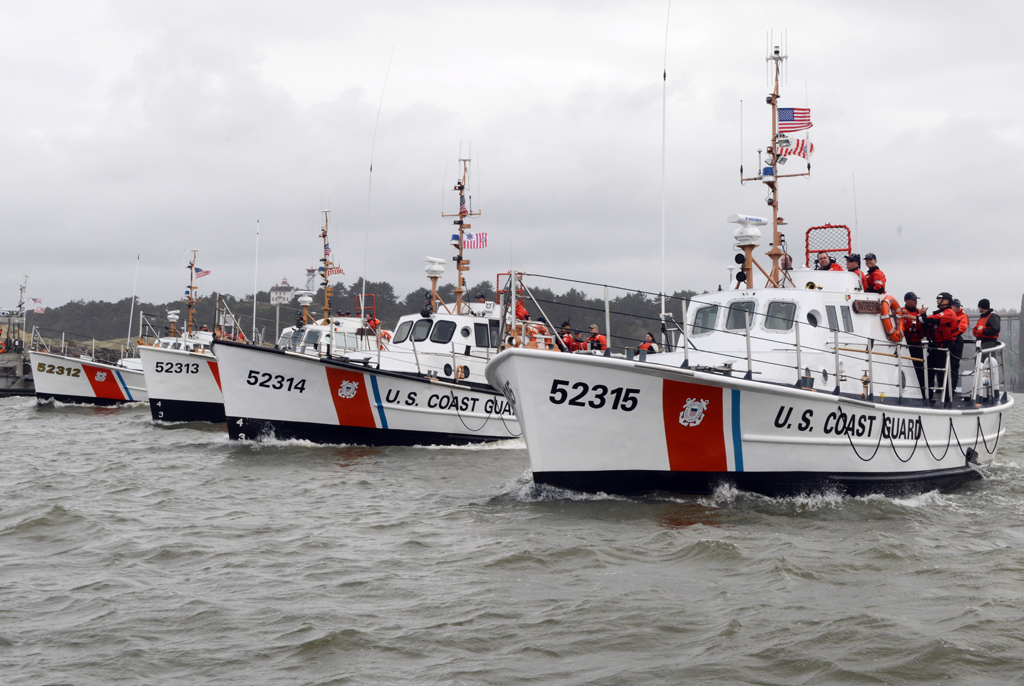
Coast Guard crew members aboard four 52-foot Motor Life Boats and one 47-foot Motor Life Boat transit in formation outbound of Yaquina Bay, Ore., April 9, 2019. The four 52-foot MLBs are the only active vessels of their kind and the crews are assigned to different units across the Pacific Northwest, which is why having all four together for the roundup was a rare occurrence.
(U.S. Coast Guard photo by Petty Officer 3rd Class Trevor Lilburn)

It looks like the Coast Guard may be finally looking at replacing the 52 foot Motor lifeboats.

“The U. S. Coast Guard (USCG) is conducting market research in preparation for the replacement of four Special Purpose Craft – Heavy Weather (SPC-HWX).  The primary purpose of the SPC-HWX is to conduct Search and Rescue (SAR) missions in extreme weather conditions to include surf and extreme seas and be able to tow larger fishing vessels.  Other missions will include Ports, Waterways, and Coastal Security (PWCS) and law enforcement.  These boats will replace 52-foot SPC-HWX boats that were built in the 1950s and are increasingly difficult to maintain.  The SPC-HWX boats will be deployed to four USCG stations in the Pacific Northwest.  A preliminary table of requirements that outlines the features desired in a new SPC-HWX is attached…”

We could see this coming. One has already been taken out of service. They are approaching 60 years old, and, while they have warranted affection from those that have served on them, we can certainly do better. We have been discussing possible replacements for over seven years, here, here, here, here, and here

There are two specifications that I saw as unnecessarily limiting, first the dimensions, length, 64′, beam, 22′ max with fendering, draft 7′, and secondly the maximum speed, 25 knots. Are the maximum dimensions based on infrastructure limits, or are we unnecessarily limiting our choices? Limits on length in particular might preclude use of innovations like the Axe Bow. We really should not have to specify a maximum length, unless there are limits on supporting facilities. Competition will inevitably favor smaller craft as long as they can meet the other specifications. Higher speed is desirable and attainable, so why not add 30 knots as an objective speed and provide an incentive in the contract for reaching speeds over 25 knots. On the other hand the RFI include nothing about noise of G-force limits.

This RFI only refers to replacing the four 52 footers, but in many places, a larger, relatively fast motor lifeboat could be a suitable replacement for the 87 foot WPBs, after all you can expect heavy weather from time to time, anywhere the Coast Guard operates. If the Coast Guard does see the advantage of replacing WPBs with these larger MLBs, it is also possible to make this type of vessel ice-capable for operation in Alaska and and other Northern ports.

There should be no problem finding a builder with the appropriate experience. I expect  Vigor now owner of the former Kvichak Marine Industries, Seattle, WA will be a bidder.

I do hope someone will look at the RAFNAR hull form.

Thanks to Lee for bringing this to my attention. 

Perhaps the Most Well Armed Cutter Sized Corvette in the World

Click on the illustration above for better view

More on the Israeli’s new Sa’ar 6 Corvette from Navy Recognition, particularly in regard to the C-Dome missile system (reporting a range of 250 km). It has been over six years since I did my first post on this class. At the time, I thought the Offshore Patrol Cutters might be close in size, but they are more than twice as large as the Israeli ships. Did a second post in Aug. 2015. and I have posted comments as additional details became available, but it is time for another look.

These will be the largest combatants in the Israeli Navy, but their dimensions are still quite modest:

  • displacement: 1900 tons
  • Length: 90 m (295.2′)
  • Beam: 13.5 m (44.3′)
  • Draft: 3.5 m (11.5)
  • Speed: 27 knots
  • Crew: 70

First of the class of four, INS Magen, has completed sea trials and the German shipbuilder has delivered it to the Israelis, who will install the Israel sourced weapon systems. The remaining ships are expected to follow at six month intervals.

Note, contrary to the labeling on the illustration, the 16 missiles amidships, shown in green, will be Gabriel V anti-ship missiles rather than Harpoons. (Gabriel V will also arm the new Finnish ice-capable corvette.)

Aviation facilities are also surprising. The ships are expected to support and hangar an H-60 ASW helicopter and may also support a vertical take-off Unmanned air system.

These ships are remarkable, for their size and crew strength (only 70), in being capable in all three primary warfare areas, ASW, ASuW, and AAW. Their capabilities exceed those of many frigates and approach those of DDGs four times their size.

With a total of eighty-eight missile launch tubes, assuming they are all filled, it seems these will be the most heavily armed ships of their size in the world.

“Coast Guard releases request for proposal for offshore patrol cutter follow-on detail design and production” –CG-9

Artists rendering of the future USCGC Argus, from Eastern Shipbuilding Group

The following is reproduced from the Acquisitions Directorate announcement: Interesting to look though some of the linked documents. Shows how complex contracting has become. 


The Coast Guard released a request for proposal (RFP) Jan. 29 for detail design and production of up to 11 offshore patrol cutters (OPCs). The RFP is available here. The competition is open to all interested offerors.

Establishing a new, full and open competitive environment for the OPC program is a key component of the Coast Guard’s strategy to recapitalize its offshore surface capabilities. The RFP was informed by extensive industry engagement, including contracted industry studies with eight U.S. shipyards, an invitation to review and respond to a draft RFP and the establishment of an OPC technical library. The OPC technical library provides updated design information that reflects the current state of OPC acquisition activities to potential offerors.

The deadline to submit responses to the RFP is May 28, 2021. Contract award is scheduled to occur in the second quarter of fiscal year 2022.

The OPC acquisition program meets the service’s long-term need for cutters capable of deploying independently or as part of task groups, and is essential to stopping smugglers at sea, interdicting undocumented migrants, rescuing mariners, enforcing fisheries laws, responding to disasters and protecting ports and waterways. The acquisition of up to 25 OPCs will complement the capabilities of the service’s national security cutters, fast response cutters, and polar security cutters as an essential element of the Department of Homeland Security’s layered maritime security strategy.

For more information: Offshore Patrol Cutter program page