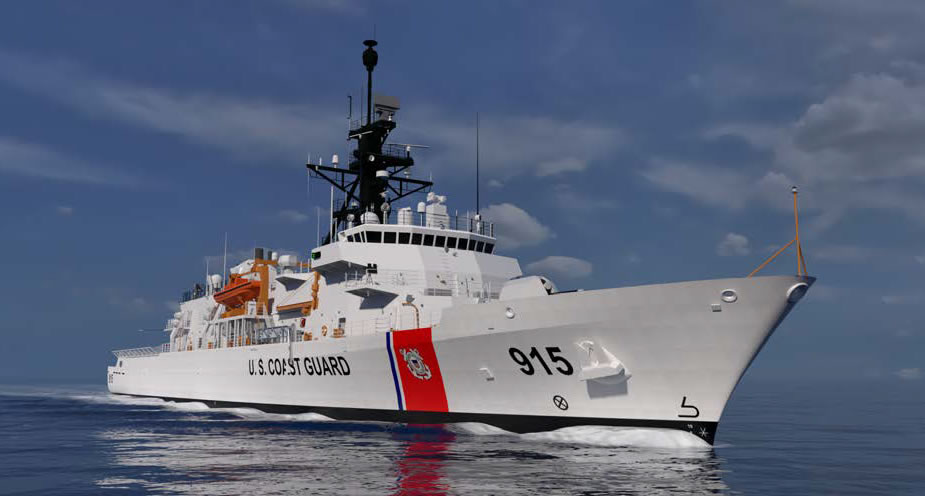
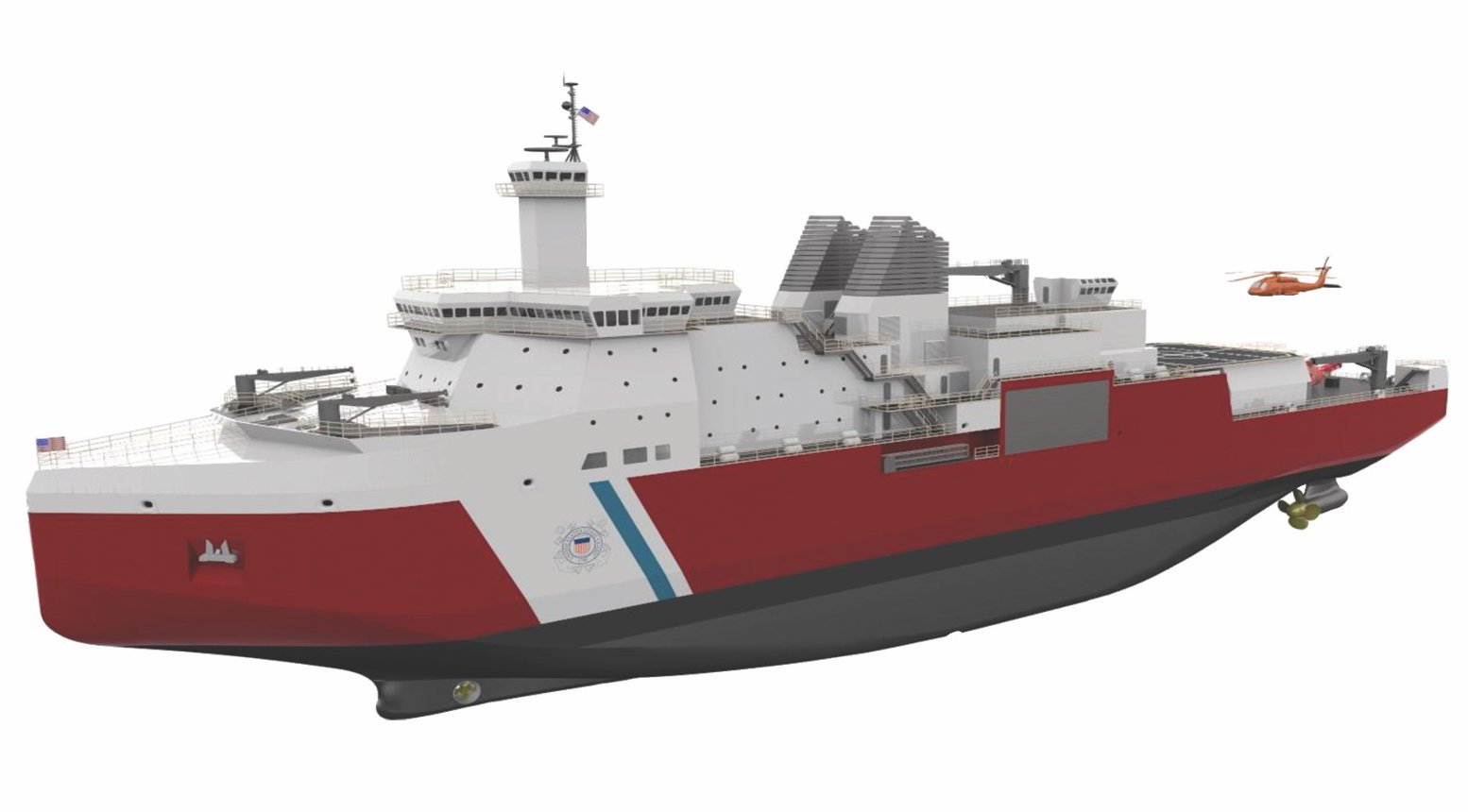
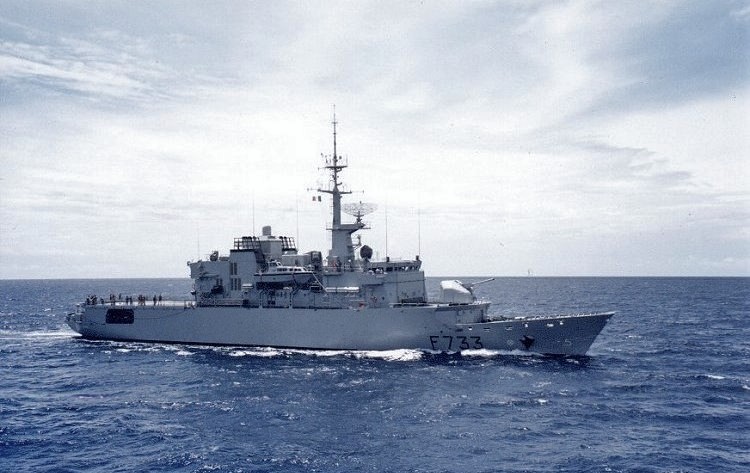
FFG(X) Contract Goes to Marinette, NSC#12 Less Likely?

200430-N-NO101-150
WASHINGTON (April 30, 2020) An artist rendering of the guided-missile frigate FFG(X). The new small surface combatant will have multi-mission capability to conduct air warfare, anti-submarine warfare, surface warfare, electronic warfare, and information operations. (U.S. Navy graphic/Released)

The Navy has announced that the contract for the first of the new FFG(X) class frigates has been awarded to Marinette Marine.

“Navy awarded a contract to design and produce the next generation small surface combatant, the Guided Missile Frigate (FFG(X)) today.  The contract for detail design and construction (DD&C) of up to 10 Guided Missile Frigates (consisting of one base ship and nine option ships) was awarded to Marinette Marine Corporation (MMC) of Marinette, Wisconsin, officials announced. “

One of the arguments for continuing the construction of the National Security Cutters (NSC) has been that it kept a production line open that might roll into production of the FFG(X). That is now no longer the case. The argument that we are replacing 12 ships, so we should build 12 is still valid to a degree.

Currently eleven NSCs are seen as replacing 12 WHECs, but we have yet to hear that 25 OPCs are not enough to replace 32 WMECs: 13 WMEC 270s, 16 WMEC210s, Alex Haley,  Acushnet, and Storis. Maybe what we need is 33 OPCs, to make up for the shortfall in replacing both 12 WHECs and 32 WMECs, 44 ships to replace 44.

Thanks to Secundius for bringing this to my attention. 

“Considerations for a Future Patrol Boat” –USNI

Photo: a Navy MkVI

The April edition of U.S. Naval Institute Proceeding has a short article written by Coast Guard Lieutenants James Martin and Jasper Campbell discussing the recapitalization of the 87 foot WPB fleet and suggesting adaptation of the Navy’s MkVI patrol boat as a replacement.

Any choice of a new class of ships for the Coast Guard must depend on how it will integrate into the legacy fleet. Choices are strongly influenced by the strengths and weaknesses of the other assets available.

Marine Protector class cutter, USCGC Barracuda (WPB-87301), USCG photo

In FY2021 the Coast Guard expects to decommission eight of the 87 foot Marine Protector class without replacement. This change is justified as follows,

 This initiative decommissions eight 87-foot Marine Protector Class CPBs. This initiative is based on the acquisition of the Fast Response Cutter (FRC) and Response Boat – Medium (RB-M), both of which are more capable than the legacy assets that they replace. Decommissioning these assets focuses patrol boat funding on operating and supporting new assets, such as the FRCs, as well as other strategic priorities. Forecasted material condition as assessed by the Coast Guard’s Patrol Boat Product Line will be a factor in identifying the specific cutter hulls to be decommissioned, ensuring that the cutters with the best material condition remain operational.

Overall fleet performance degradation will be minimized since FRCs outperform previous patrol boats and RB-Ms are more capable than previous boats. Finally, the decommissionings will focus on areas where the combination of FRCs and RB-Ms provides sufficient capability to remove the operational need for an 87-foot CPB

What they really seem to be saying is that RB-M, unlike the boats they replaced, are able to do some of the missions the WPBs were intended to do. On the other hand the 110 foot Island class WPBs were already more capable than the 87 footers so its not like the 87 footers were doing missions the 110s could not. The real difference here may be that, because we now have more larger patrol craft, both Webber and Island class than we did previously, we don’t need as many Marine Protector Class.

Nevertheless it does appear that the Coast Guard sees a need for some WPBs. The USNI article refers to a 2018 statement by the Commandant that, “Recurring Depot Availability Program (RDAP) is anticipated to extend the service life of the 87s well into 2030.”

The capability gaps between the Marine Protector class and the smaller boats below them in size, now RB-ms, has shrunk, while the gap between them and the larger Patrol craft, soon to be all FRCs, has grown. This suggests that any replacement should be, if anything, more capable than the Marine Protector class, not less. While faster and more heavily armed, than the 87 foot WPBs, it appears that the MkVI is less capable in terms of characteristics the Coast Guard values. They have less endurance, appear less seaworthy, and as currently configured, the only boats they can launch are flat bottomed rubber raiding craft.

It appears, any WPB replacement’s capabilities should move closer to those of the FRC rather than the RB-M. Still I see their role as much different from that of the Webber class. The Webbers would be used primarily on regularly scheduled patrols while the WPB replace would be the true “Fast Response Cutters,” on standby for developing emergencies. 

I offered a description of my concept of a WPB replacement earlier, including concepts of operation and manning, explaining why it should be larger, faster, and better armed. There was additional discussion about the concept here. My suggestion was that it should be one and a half to twice as large as the 87 foot WPBs and about half the size of the 353 ton Webber class…136 to 182 tons full load, or roughly 100′ (30.5 meter) to 130′ (39.6 meter) in length, not too much different from the Island class cutter, 110 feet (33.5 meter) loa and 168 tons. 

I also saw it being uniquely equipped to fill a current gap in our Port, Waterways, and Coastal Security mission, that of being able to defend our critical ports, by being able to forcibly stop any vessel, regardless of its size, speed, or maneuverability.

Such a ship would also be both of interest for Foreign Military Sales and as a reserve element for potential combat roles.

“Coast Guard Modifies Contract to Construct Second Offshore Patrol Cutter, Acquire Long Lead-Time Material for Third Offshore Patrol Cutter” –CG-9

Above: Artists rendering from Eastern Shipbuilding Group

Contract for the Second Offshore Patrol Cutter, the future USCGC Chase, and long lead time items for the third. Presumably this is a contract modification, rather than the  exercise of a contract option, because the price is higher than the original option. Still this does not look a great deal higher than the previous contract ($317.5M), for the first OPC and long lead time items for the second. Following from the Acquisitions Directorate, CG-9:

The U.S. Coast Guard modified its contract with Eastern Shipbuilding Group (ESG) April 2 to begin construction of the second Offshore Patrol Cutter (OPC) and to acquire long lead-time material (LLTM) for the third OPC. Contract delivery of the second OPC, to be named Chase, is scheduled to occur in 2023.

The total value of the construction and LLTM orders is $343 million. In addition to ordering construction of the second OPC, this contracting action also covers the initial order of components and materials necessary to support the future construction of the third OPC by acquiring propeller and steering components, marine diesel engines, the ship integrated control system, switchboards, and generators.

The lead OPC is currently in production at ESG’s shipyard in Panama City, Florida.  Production of the lead cutter, Argus, commenced January 7, 2019. Delivery of Argus is scheduled for 2022.

The OPC meets the Service’s long-term need for cutters capable of deploying independently or as part of task groups and is essential to stopping smugglers at sea, interdicting undocumented migrants, rescuing mariners, enforcing fisheries laws, responding to disasters and protecting our ports. The acquisition of 25 OPCs will complement the capabilities of the Service’s National Security Cutters, Fast Response Cutters and Polar Security Cutters as an essential element of the Department of Homeland Security’s layered security strategy.

For more information: OPC program page

“Wärtsilä to bring gate rudder technology to global market” –MarineLog

Evaluations of the innovative gate rudder assembly have shown improvements in both efficiency and maneuverability. (Image: copyright: Yamanaka Shipbuilding)

Marine Log reports that,

“Wärtsilä has signed an agreement that will enable it to integrate patented gate rudders into its propulsion product designs. Unlike the traditional arrangement of the rudder in the propeller slipstream, the gate rudder is a twin arrangement around the propeller, allowing improved fuel efficiency and reduced emissions. The concept is applicable to all current vessels equipped with conventional propellers.”

“…the rudder will realize synergies in capital and operational savings for ship owners by increasing fuel efficiency, improving maneuverability and course stability in both calm and rough sea conditions, while also reducing noise and vibration.”

You can see from the photo, when no rudder is required, that the rudder would not be in the accelerated flow behind the prop, thereby reducing drag, but when more extreme turns are required it would be, making it more effective.

The large bosses where the rudder shaft leave the hull might cause more drag than those of a normal rudder. There are of course two required, and it appears they would have to be more strongly built to deal with the torque resulting from the off-center drag on the rudder.


“Coast Guard Awards Nine Contracts for Offshore Patrol Cutter Industry Studies” –CG-9

Interest in building follow-on Offshore Patrol Cutters is definitely alive and well. The Acquisitions Directorate, CG-9, has issued nine contracts for industry studies. All these contracts went to shipbuilder. I have reproduced their report below. Hopefully this will lead to a better and more producible design. 

The Coast Guard announced the award of nine Offshore Patrol Cutter (OPC) industry studies contracts March 20, 2020. These awards support the Coast Guard’s strategy to mitigate OPC program risk and complete the program of record by establishing a new, fair and open competitive environment to complete the OPC program of record. Industry studies contracts were awarded to:

  • Austal USA, LLC of Mobile, Alabama: $2.0 million base award ($3.0 million total potential value)
  • Bath Iron Works of Bath, Maine: $2.0 million base award ($3.0 million total potential value)
  • Bollinger Shipyards Lockport LLC of Lockport, Louisiana: $2.0 million base award ($3.0 million potential value)
  • Eastern Shipbuilding Group, Inc. of Panama City, Florida: $1.1 million base award ($1.2 million potential value)
  • Fincantieri Marinette Marine of Marinette, Wisconsin: $2.0 million base award ($3.0 million total potential value)
  • General Dynamics/NASSCO of San Diego, California: $2.0 million base award ($3.0 million total potential value)
  • Huntington Ingalls, Inc. of Pascagoula, Mississippi: $2.0 million base award ($3.0 million total potential value)
  • Philly Shipyard, Inc. of Philadelphia, Pennsylvania: $2.0 million base award ($3.0 million total potential value)
  • VT Halter Marine Inc. of Pascagoula, Mississippi: $2.0 million base award ($2.9 million total potential value)

Under their respective contracts, the awardees will assess OPC design and technical data, provided by the Coast Guard, and the program’s construction approach. Based on their analyses, the awardees will recommend to the Coast Guard potential strategies and approaches for the follow-on detail design and construction (DD&C). The awardees will also discuss how they would prepare the OPC functional design for production. The awardees may also identify possible design or systems revisions that would be advantageous to the program if implemented, with strategies to ensure those revisions are properly managed.

The Coast Guard will use the industry studies results to further inform its follow-on acquisition strategy and promote a robust competitive environment for the DD&C award. Participation in industry studies is not a pre-requisite for submitting a DD&C proposal.

The OPCs will replace the service’s aging medium endurance cutters, which are becoming increasingly expensive to maintain and operate. The OPCs will bridge the capabilities of the national security cutters, which patrol the open ocean, and the fast response cutters, which serve closer to shore.

The current OPC DD&C contract is for up to four hulls. The contract was adjusted as part of a request made by the incumbent, Eastern Shipbuilding Group (ESG), for extraordinary relief under the authority of Public Law 85-804 was granted by the Department of Homeland Security. The request was a result of devastation caused when Hurricane Michael – a Category 5 storm – made landfall in Panama City, Florida, on October 10, 2018. Hurricane Michael caused extensive damage to the ESG’s shipyard and the Panama City region.

For more information: Offshore Patrol Cutter program page

“Coast Guard Polar Security Cutter (Polar Icebreaker) Program: Background and Issues for Congress” Updated 12 March, 2020, CRS

The Congressional Research Service has once again updated their report on the Polar Security Cutter. You can see the whole report here. I have reproduced the one page summary below. The entire report is a 63 page pdf. 

Summary

The Coast Guard Polar Security Cutter (PSC) program is a program to acquire three new PSCs (i.e., heavy polar icebreakers), to be followed years from now by the acquisition of up to three new medium polar icebreakers. The PSC program has received a total of $1,169.6 million (i.e., about $1.2 billion) in procurement funding through FY2020, including $135 million in FY2020, which was $100 million more than the $35 million that the Coast Guard had requested for FY2020. With the funding it has received through FY2020, the first PSC is now fully funded and the second PSC has received initial funding.

The Coast Guard’s proposed FY2021 budget requests $555 million in procurement funding for the PSC program. It also proposes a rescission of $70 million in FY2020 funding that Congress had provided for the procurement of long lead time materials (LLTM) for a 12th National Security Cutter (NSC), with the intent of reprogramming that funding to the PSC program. The Coast Guard states that its proposed FY2021 budget, if approved by Congress, would fully fund the second PSC.

The Coast Guard estimates the total procurement costs of the three PSCs as $1,039 million (i.e., about $1.0 billion) for the first ship, $792 million for the second ship, and $788 million for the third ship, for a combined estimated cost of $2,619 million (i.e., about $2.6 billion). Within those figures, the shipbuilder’s portion of the total procurement cost is $746 million for the first ship, $544 million for the second ship, and $535 million for the third ship, for a combined estimated shipbuilder’s cost of $1,825 million (i.e., about $1.8 billion).

On April 23, 2019, the Coast Guard-Navy Integrated Program Office for the PSC program awarded a $745.9 million fixed-price, incentive-firm contract for the detail design and construction (DD&C) of the first PSC to VT Halter Marine of Pascagoula, MS, a shipyard owned by Singapore Technologies (ST) Engineering. VT Halter was the leader of one of three industry teams that competed for the DD&C contract. The first PSC is scheduled to begin construction in 2021 and be delivered in 2024, though the DD&C contract includes financial incentives for earlier delivery.

The DD&C contract includes options for building the second and third PSCs. If these options are exercised, the total value of the contract would increase to $1,942.8 million (i.e., about $1.9 billion). The figures of $745.9 million and $1,942.8 million cover only the shipbuilder’s costs; they do not include the cost of government-furnished equipment (GFE), which is equipment for the ships that the government purchases and then provides to the shipbuilder for incorporation into the ship, or government program-management costs. When GFE and government programmanagement costs are included, the total estimated procurement cost of the first PSC is between $925 million and $940 million, and the total estimated procurement cost of the three-ship PSC program is about $2.95 billion.

The operational U.S. polar icebreaking fleet currently consists of one heavy polar icebreaker, Polar Star, and one medium polar icebreaker, Healy. In addition to Polar Star, the Coast Guard has a second heavy polar icebreaker, Polar Sea. Polar Sea, however, suffered an engine casualty in June 2010 and has been nonoperational since then. Polar Star and Polar Sea entered service in 1976 and 1978, respectively, and are now well beyond their originally intended 30-year service lives. The Coast Guard plans to extend the service life of Polar Star until the delivery of at least the second PSC. The Coast Guard is using Polar Sea as a source of spare parts for keeping Polar Star operational.

“Spain seen joining Greece, France, Italy on European Patrol Corvette program” –DefenseNews

Defense News reports that it appears likely that four European countries and perhaps more will join forces to build a class of 3000 ton patrol vessels.

The two firms (Italy’s Fincantieri and France’s Naval Group–Chuck) are hoping to match Italian and French navy requirements with a jointly built, modular vessel that can handle patrol and surveillance missions as well as taking second-tier roles in anti-submarine and anti-surface missions.

The vessels these ships are to replace, perform their respective countries offshore coast guard missions.

The project is one of many being supported by an EU initiative called “Permanent Structured Cooperation” (PESCO) that is to be supported by the entire EU community. It sounds like this may be heading toward a shipbuilding version of Airbus.

According to this report, Bulgaria and Portugal are also joining the program.

French Navy Floreal class surveillance Frigate, FS Ventose

The French Navy intends to replace the six ships of the Floreal class. These “surveillance frigates” are scattered among France’s overseas territories. They have no ASW capability, but are equipped with a pair of Exocet anti-ship missiles (ASCM).

Italy expects to retire the ten ships of the Cassiopea, Sirio, and Commandanti classes 2022-2025. These ships are all about 1500 tons. They have neither ASW equipment or ASCMs.

The Greeks don’t seem to have any ships in this class, but may now see a need.

Spanish Navy Meteoro class OPV Tornado. Photo from Sergio Acosta, via Wikipedia

I was a bit surprised that Spain would join in this effort. They have their own OPV designs supplied by Navantia, and they have been doing pretty well. They have been produced a class of six referred to as BAM, and were expected to procure six more of the same class. In addition they have produced corvettes for Venezuela and have been contracted to produce five corvettes for Saudi Arabia. Navantia had teamed with Bath Iron Works to provide BIW’s proposal for the USCG OPC program, and they are on BIW’s FFG(X)  team. It may be that they feel they have to join now or risk being excluded in the future.

If these ships come equipped as indicated in the diagram at the head of the article, they will be significantly better armed than the ships they replace. They will be a bit larger than the French ships being replaced and more than twice as large as the Italian ships being replaced.

It appears they will be very close in size to the Coast Guard’s Argus Class OPCs, being the same length (110 meters or 360 feet) and only slightly narrower.

For the Warship Geeks in the Group–China’s Type 055

Image Analysis of photo of Chinese shipyard showing multiple warships at various stages of … [+]H I Sutton, with permission from @Loongnaval

The US Naval War College Digital Commons has made available an evaluation of China’s new 12,000 ton cruiser, the type 055, and its place in the PLAN based primarily on Chinese sources. It looks to be balanced and talks about both the ships and the systems on board.

They are building a lot of these.


“Coast Guard Cutter Procurement: Background and Issues for Congress Updated January 28, 2020” –CRS

The Congressional Research Service has again updated its look at cutter procurement. (Note, this link will take you to the latest version of the report and is subject to change with each update.) While I cannot be sure there are no other changes, I believe the significant changes are a reflection of the result of the House and Senate Conference Committee. From page 25.

Conference In final action, the FY2020 DHS Appropriations Act became Division D of H.R. 1158, the Consolidated Appropriations Act, 2020. The explanatory statement for Division D of H.R. 1158/P.L. 116-93 of December 20, 2019, provides the funding levels shown in the appropriation conference column of Table 2. The explanatory statement for Division D of H.R. 1158 states: The agreement [for the Coast Guard’s Procurement, Construction, and Improvements account] provides an increase of $537,850,000 above the request, including … $260,000,000 for a total of four FRCs…. The bill makes available $100,500,000 for long lead time material for a twelfth National Security Cutter, consistent with the direction in the House Report….

I have reproduced Table 2 from page 21 of the report below. The following explanatory note is quoted from the CRS report:

“Source: Table prepared by CRS based on Coast Guard’s FY2020 budget submission, HAC committee report, and SAC chairman’s mark and explanatory statement on FY2020 DHS Appropriations Act. HAC is House Appropriations Committee; SAC is Senate Appropriations Committee.”

Summary of Appropriations Action on FY2020 Acquisition Funding Request

Table 2 summarizes appropriations action on the Coast Guard’s request for FY2020 acquisition funding for the NSC, OPC, and FRC programs.

Table 2. Summary of Appropriations Action on FY2020 Acquisition Funding Request Figures in millions of dollars, rounded to nearest tenth

  • Request______Request______HAC_______SAC_____Final
  • NSC program ____60 _______160.5 _______60 _____160.5
  • OPC program ___457 _______457 _______457 ______312
  • FRC program ___140 _______290 _______240 ______260
  • TOTAL _________657 ______907.5 ______757 ______732.5

So again Congress is providing funding above that requested by the administration.

The increase from two to four Webber class is consistent with previous Congressional action, and should actually result in a savings over the life of the program, in that it is in line with the current contract options and will not require a renegotiation that might have raised the cost of individual cutters by up to $10M. That means a total of 62 Webber class will have been funded. Only two additional in FY2021 are planned, for a total of 64, 58 in the program of record plus six for PATFORSWA to support CENTCOM, but I would not be surprised to see four in the final FY2021 budget.

The addition of $100.5M for Long Lead Time items for a twelfth National Security Cutter looks like a strong commitment to fund another Bertholf class National Security Cutter.

Relative to the OPC program, from page 26:

OPC Program.- The contract awarded to construct the OPC was recently amended to address increased cost estimates after the Acting Secretary determined that relief permitted under Public Law 85-804 was appropriate and necessary to the national defense. An associated delay in delivery of the first two hulls reduced the fiscal year 2020 requirement for the OPC by $145,000,000. Funds included in the agreement continue necessary program requirements. The agreement maintains the commitment to ensuring the Coast Guard can continue the program of record for these critical vessels. As a condition of the granted relief, the vendor will be subject to increased oversight, including additional scrutiny of the costs borne by the Coast Guard. The Coast Guard shall brief the Committees quarterly on the metrics used to evaluate adherence to production timelines and costs, including those attributed to reestablishing the production line and maintaining the skilled workforce required to ensure contract performance.

So Congress is going to let the decision to allow extraordinary relief to Eastern Shipbuilding go ahead. The reduction of OPC funding that had been requested is only due to delays in the program and presumably the deletion of long lead time materials for OPC #5 from the payments that had been planned for Eastern.

China’s Warship Construction. More Surface Warships Launched in 2019 than the USN has Commissioned in Five Years

Chinese warships launched in 2019.

Earlier I noted that the Chinese seemed to be building an incredible number of warships. Found this chart of surface warships launched in 2019. I have been unable to find the original source, the style appears to be from http://www.military-today.com/, but in any case, it appears to be correct.

16 Type 056 corvettes, 8 Type 052D destroyers, two type 055 destroyer/cruisers, a Type 071 LPD, and a Type 075 LHD. 28 surface warships total. It is possible some of the Type 056s are intended for export or for the China Coast Guard.

By way of comparison, over the last five years, 2015 through 2019, as nearly as I can tell, the US Navy commissioned 15 Littoral Combat Ships, five Burke class destroyers, two Zumwalt class destroyers, two LPDs, no big deck amphibs (LHD or LHA),  and one aircraft carrier. That is 25 surface warships total. The conclusion is a bit startling.

The Chinese launched more surface warships in 2019, than the US Navy commissioned in the last five years. 

The 19th and 20th Type 052D destroyers are launched in Dalian on May 10 (Image: 香港 文匯 網)

The LCS program is coming to an end, but there are still 16 to be commissioned. Generally the program has funded four per year, The FFG(X) program is expected to replace the LCS program in the Navy budget with one FFG funded in the first year followed by two frigates in each year to a total of 20. Combined with the LCS this should give the Navy 55 “small surface combatants.” The Chinese have about 50 frigates but this number is likely to decline as older ships are decommissioned, as their current frigate program, the Type 054A, is nearing completion.

The USN’s Zumwalt class destroyer program will end with three ships when the Lyndon B. Johnson is commissioned in the near future.

The Burke class DDG program was expected to continue building twelve ships over the next five years, but there has been a recent report that DOD would like to cut five ships to make room in the budget for development of more unmanned systems. Also suggested is that Ticonderoga class cruisers be retired early and that the first four LCS be decommissioned.

It is comforting to assume that Chinese systems and their training are inferior. We had similar assumptions about the Japanese before WWII. It is extremely dangerous to assume your own superiority. Plus while the US Forces spread all over the world, the Chinese are concentrated in their own theater of interest.