FierceHomelandSecurity is reporting the Coast Guard and Customs and Border Protection are admitting that Pangas smuggling north from Mexico are going around existing patrols. Shouldn’t surprise anyone, there is a lot of money in it. In addition to drugs they could be smuggling terrorist just as easily.
Perhaps we need a few of those Webber Class WPCs in the Pacific. Reportedly the administration is taking another look at border security. Its time to make our case that the water side is way too porous.
Press release announcing the planned commissioning of the seventh Fast Response Cutter, Charles W. David, Jr. (WPC-1107) (The press release says, this is “…the eighth Sentinel Class Fast Response Cutter (FRC) to arrive to Coast Guard Seventh District” but by my count this is the seventh to be commissioned. Suppose it may be possible both statement are true. Last one commissioned was Paul Clark, on 24 August.) They are coming out at approx. three month intervals.
This will be the first FRC homeported in Key West.
gCaptain is reporting Dutch Naval Architects (including some from Damen), “have teamed up to design and build the next-generation of all-weather fast rescue lifeboats for the Royal Netherlands Sea Rescue Institution (KNRM).” It features an “Axe-bow” which is claimed to reduce pitching and allow higher speeds in a seaway. They also expect the boat to be much quieter. If you look at the stern, there is what appears to be, an innovative scoop for picking up people in the water.
–
The full post, includes lots of pictures and data. At 19.3 meters (63 feet), the boat is a lot bigger than either the 47 foot MLB or the 45 foot RB-M. It is also considerably larger in displacement. It is a bit faster than the MLB, but slower than the RB-M.
“The Maritime Administration (MARAD) invites the public and other Marine Transportation System stakeholders to participate in a discussion intended to develop a robust national maritime strategy. The purpose of this public meeting is to gather ideas for improving the Nation’s cargo opportunities and sealift capacity while ensuring future sustainability. Speaker and topic proposals for the public meeting’s agenda are requested and may be submitted to the docket referenced above. The meeting agenda will be published in the docket and on the MARAD Web site at a later date, after consideration of responses received in the docket.”
Thanks to Maritime Memos for bringing this to my attention.
gCaptain reports on progress on Shell’s Floating Liquified Natural Gas Facility being built in South Korea, “a 488 meter (1600 feet long–Chuck), 600,000 dwt vessel that will eventually be moored offshore Australia to produce, liquefy, store, and offload natural gas.” (includes video)
With the US producing and exporting natural gas perhaps we will be seeing one of these off the US coast. If we do, it may represent a whole new set of challenges for the Coast Guard.
MarineLog is reporting that a German yard is building two icebreaking rescue and salvage vessels for the Russian Ministry of Transport, to be used by “the Russian State Maritime Rescue Coordination Center (SMRCC) for patrols and rescues on the northern Polar Sea route.” The ships will be 88 m x 18.5 m and will be powered by two 3.5 MW Azipods. The ships are larger but the power is very close to that of the Macknaw (WLBB-30) (73 m x 17.8 m) which uses two 3.4MW Azipods.
We have talked about Azipods before, but if you haven’t seen them before, they are quite impressive in the maneuverability they provide (see the video above). gCaptain reports the contract for the entire propulsion and electric generation system for the two almost 10,000 horsepower ships was $25M. To put this in perspective, the Wind Class icebreakers had 12,000 HP.
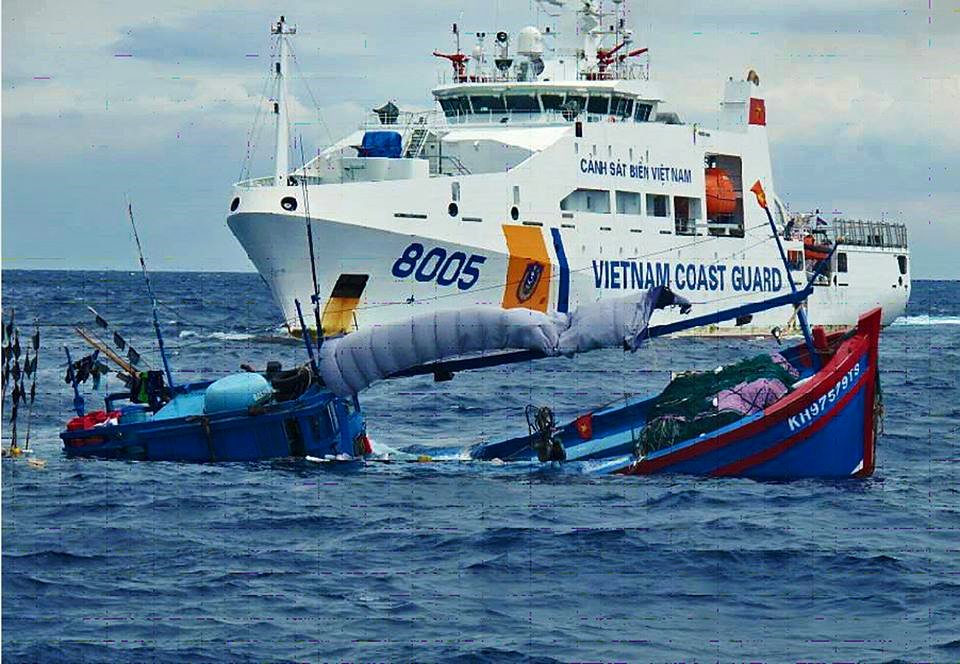
BairdMaritime provides information on a new Offshore Patrol Vessel (OPV) built in Vietnam for the Vietnam Marine Police (soon to be Vietnam Coast Guard) to a Damen design, that looks a whole lot like an Offshore Patrol Cutter (OPC). There is also information in the article about their developing relationship with the USCG.
She is reported to be 2500 tons, 90 meters (295′) in length, 14 meters (46′) of beam, 21 knots, with a crew of 70.
I think the Bollinger candidate for the OPC may be similar. This is apparently based on the Damen OPV2400. The OPC candidate is probably based on the slightly larger OPV2600 since it will probably need additional volume for fuel to provide the range the USCG requires, a couple of hundred tons heavier, 8 meters (26′) longer, and two or three knots faster because of its greater length (same horsepower).
More information about Damen designs for OPVs can be seen via the link below:
Selection of at most three shipbuilders to develop proposed contract designs for the Offshore Patrol Cutter is expected soon. MaritimeMemos is reporting the field has already been trimmed down to five.
“The unofficial word is that the Coast Guard has set the competitive range for the OPC program and has thereby eliminated at least three of the competitors – Marinette Marine, NASSCO and Vigor Industrial. If this is the case, that leaves five yards still under consideration for up to three Phase I contracts – two from the “Big Six” – Bath Iron Works and Ingalls Shipbuilding – and three from the “Second Tier” – Bollinger Shipyards, Eastern Shipbuilding and VT Halter Marine. My money’s on the three second-tier yards. September 6,2013.“
If you want to review what has been published about the conceptual designs, you can see them in an earlier post here: “Offshore Patrol Cutter Concepts” Be sure to read the comments, there is more info there. I still have not seen any information on concepts from Bath or NASSCO.

 Chuck Hill's CG Blog