A Billion Dollar, Once in a Lifetime Opportunity

IMG_4128

I have been reading over Congressional Research Service’s Specialist in Naval Affairs Ronald O’Rourke’s prepared statement before the House Transportation and Infrastructure Committee’s Coast Guard and Maritime Transportation Subcommittee Hearing on The Status of Coast Guard Cutter Acquisition Programs, February 3, 2016. The implications are a bit startling.

By using Block Buy Contracting (BBC) and Multi-Year Procurement (MYP), the Coast Guard might save as much as $1.2B. This is an opportunity that may not come again for at least 30 years.  

This breaks down to about $100M on contracting for the remaining 26 Fast Response Cutters, $100M on a contract for two heavy icebreakers, and a whopping $1B over the life of the Offshore Patrol Cutter procurement.

We have never used these contracting methods before, but the Navy has with great success in their Burke class DDG, Virginia class submarine, and LCS programs.

The Congress has already granted authority to use Multi-Year Procurement (MYP) for the Offshore Patrol Cutter program, but because of the requirement of the law covering MYP a contract under these provisions probably could not be negotiated until at least FY2022 by which time the first five ships would have already been contracted for. Block Buy Contracting would require specific enabling legislation but could allow additional savings beginning in FY2018.

I would encourage reading the entire statement. There are only seven pages of testimony and ten pages of background appendices, but I’ll provide a “Reader’s Digest” version. Hopefully the author will forgive me for re-editing his work.

“The Coast Guard has used contracts with options in cutter acquisition programs. A contract with options may look like a form of multiyear contracting, but operates more like a series of annual contracts. Contracts with options do not achieve the reductions in acquisition costs that are possible with MYP and BBC.

“MYP can reduce the unit procurement costs of ships by roughly 10%, compared to unit procurement costs under the standard or default approach of annual contracting. BBC can reduce the unit procurement costs of ships by amounts comparable to those of MYP, if the authority granted for using BBC explicitly includes authority for making economic order quantity (EOQ) purchases (i.e., up-front batch purchases) of components. If the authority granted for using BBC does not explicitly include authority for making EOQ purchases, then the savings from BBC will be less—in the range of roughly 5%. EOQ authority comes automatically with MYP authority, but must be explicitly included in legislation granting BBC authority.

BBC, unlike MYP, can be used at the outset of a shipbuilding program, starting with the lead ship in the class. (emphasis applied–Chuck) MYP, in contrast, cannot be used until the lead ship has completed construction. Thus, for a class of ships that is procured at a rate of one ship per year and in which each ship takes five years to build, BBC can be a contracting option starting with the first ship in the class, and MYP can become a contracting option starting with the fifth or sixth ship in the class. This difference is due to the requirement under the statute governing MYP (10 U.S.C. 2306b) that a program must demonstrate design stability to qualify for MYP. In a shipbuilding program, design stability is typically demonstrated by completing the construction of the lead ship in the class.

“The Coast Guard wants to procure a total of 25 OPCs, and currently plans to use a contract with options for acquiring the first 9 to 11 ships in the program. The OPC program can be viewed as a candidate for instead using BBC for the initial ships in the program, and either BBC or MYP for later ships in the program. If using BBC and MYP were to reduce the acquisition costs of OPCs by about 10% (compared to costs under a contract with options), the savings would amount to roughly $1 billion. An alternate way to characterize such savings would be to say that using BBC or MYP would enable the Coast Guard to get about two and a half of the 25 OPCs for “free,” or to pay for the acquisition of a polar icebreaker.

“The Coast Guard plans to soon award a contract with options for acquiring the final 26 ships in the 58- ship FRC program. The final 26 ships in the program can be viewed as a candidate for instead using either MYP or BBC. If using MYP or BBC were to reduce the acquisition costs of OPCs by about 10% (compared to costs under a contract with options), the savings would amount to more than $100 million. An alternate way to characterize such savings would be to say that using MYP or BBC could enable the Coast Guard to get about two and a half of the 26 FRCs for “free.”

“The Offshore Patrol Cutter (OPC) program and the polar icebreaker (PIB) program can be viewed as candidates for using BBC, and the Fast Response Cutter (FRC) program can be viewed as a candidate for using either MYP or BBC. Using MYP and BBC for all three of these programs might produce savings totaling about $1.2 billion, an amount roughly equivalent to the average annual funding level in the Coast Guard’s Acquisition, Construction, and Improvements (AC&I) account. In considering whether to grant authority for using MYP or BBC for these programs, Congress may weigh the potential savings of these contracting mechanisms against the tradeoffs…From a congressional perspective, tradeoffs in making greater use of MYP and BBC include the following:  reduced congressional control over year-to-year spending, and tying the hands of future Congresses;  reduced flexibility for making changes in Coast Guard acquisition programs in response to unforeseen changes in strategic or budgetary circumstances (which can cause any needed funding reductions to fall more heavily on acquisition programs not covered by MYP or BBC contracts);  a potential need to shift funding from later fiscal years to earlier fiscal years to fund EOQ purchases of components;  the risk of having to make penalty payments to shipbuilders if multiyear contracts need to be terminated due to unavailability of funds needed for the continuation of the contracts; and  the risk that materials and components purchased for ships to be procured in future years might go to waste if those ships are not eventually procured.”

There seems little doubt we will need all the ships currently planned. The commitment is only a minuscule percentage of the Federal Budget, and therefore constitutes an extremely small risk. Use of Block Buy and Multi-Year Procurement could bring stability to the Coast Guard’s AC&I funding and result savings equal to an entire year’s worth of AC&I funding.
More on the Navy’s New Design for Maintaining Maritime Superiority

Waesche Carat 2012

This is a post I wrote for CIMSEC. under the title “A Design for Maintaining Maritime Superiority”–A Coastie’s View.” It is an expanded version of an earlier post that appeared here. The rewrite really begins about half way down under the header, “What I Want to See.”

Recently the new Chief of Naval Operations issued a document “Design for Maintaining Maritime Superiority” that outlines how, hopefully, the US Navy can maintain a maritime superiority our foes will recognize and avoid confronting.

If you look for anything specifically regarding the Coast Guard here, you will not find it (other than the cutter in the formation on the cover). The Coast Guard is not mentioned even once, but it does talk about some things that are Coast Guard related. Perhaps the Coast Guard should not feel bad about this. It only mentions the Marine Corps once.

Three Forces that are Changing the Environment

  • The first global force is the traffic on the oceans, seas, and waterways, including the sea floor – the classic maritime system.
  • A second increasingly influential force is the rise of the global information system – the information that rides on the servers, undersea cables, satellites, and wireless networks that increasingly envelop and connect the globe.
  • The third interrelated force is the increasing rate of technological creation and adoption.

Obviously the Coast Guard facilitates and regulates marine traffic, and is tapped into the global information system. In wartime, these contacts will become essential since they will form the basis for naval control of shipping. He also talks about new trade routes opening in the Arctic. These will only be reliable if we have new icebreakers. He also talks about illegal trafficking.

“This maritime traffic also includes mass and uncontrolled migration and illicit shipment of material and people.”

A Document That Explicitly Recognizes the Competition

“For the first time in 25 years, the United States is facing a return to great power competition. Russia and China both have advanced their military capabilities to act as global powers. Their goals are backed by a growing arsenal of high-end warfighting capabilities, many of which are focused specifically on our vulnerabilities and are increasingly designed from the ground up to leverage the maritime, technological and information systems. They continue to develop and field information-enabled weapons, both kinetic and non-kinetic, with increasing range, precision and destructive capacity. Both China and Russia are also engaging in coercion and competition below the traditional thresholds of high-end conflict, but nonetheless exploit the weakness of accepted norms in space, cyber and the electromagnetic spectrum. The Russian Navy is operating with a frequency and in areas not seen for almost two decades, and the Chinese PLA(N) is extending its reach around the world.

“…Coupled with a continued dedication to furthering its nuclear weapons and missile programs, North Korea’s provocative actions continue to threaten security in North Asia and beyond.

“…while the recent international agreement with Iran is intended to curb its nuclear ambitions, Tehran’s advanced missiles, proxy forces and other conventional capabilities continue to pose threats to which the Navy must remain prepared to respond.

“…international terrorist groups have proven their resilience and adaptability and now pose a long-term threat to stability and security around the world.”

Recognizing Budgetary Limitations

“There is also a fourth ‘force’ that shapes our security environment. Barring an unforeseen change, even as we face new challenges and an increasing pace, the Defense and Navy budgets likely will continue to be under pressure. We will not be able to “buy” our way out of the challenges that we face. The budget environment will force tough choices but must also inspire new thinking.”

Throughout there is an emphasis on understanding history and the strategic concepts of the past. There is also a recognition of the need to work with partners.

“EXPAND AND STRENGTHEN OUR NETWORK OF PARTNERS: Deepen operational relationships with other services, agencies, industry, allies and partners – who operate with the Navy to support our shared interests.”

Other than the Marine Corps, the US Navy has no closer partner than the US Coast Guard. And while only about one eighth the size of the US Navy, in terms of personnel, the US Coast Guard is larger than Britain’s Royal Navy or the French Navy. The partnership has been a long and successful one, but I would like to see the Navy be a better partner to the Coast Guard. This is how the Navy can help the Coast Guard help the Navy.

What I Want to See

If we have a “run out of money, now we have to think” situation, one thing we can do is to try to get the maximum return from the relatively small investment needed to make the Coast Guard an effective naval reserve force.

WPC Kathleen_Moore

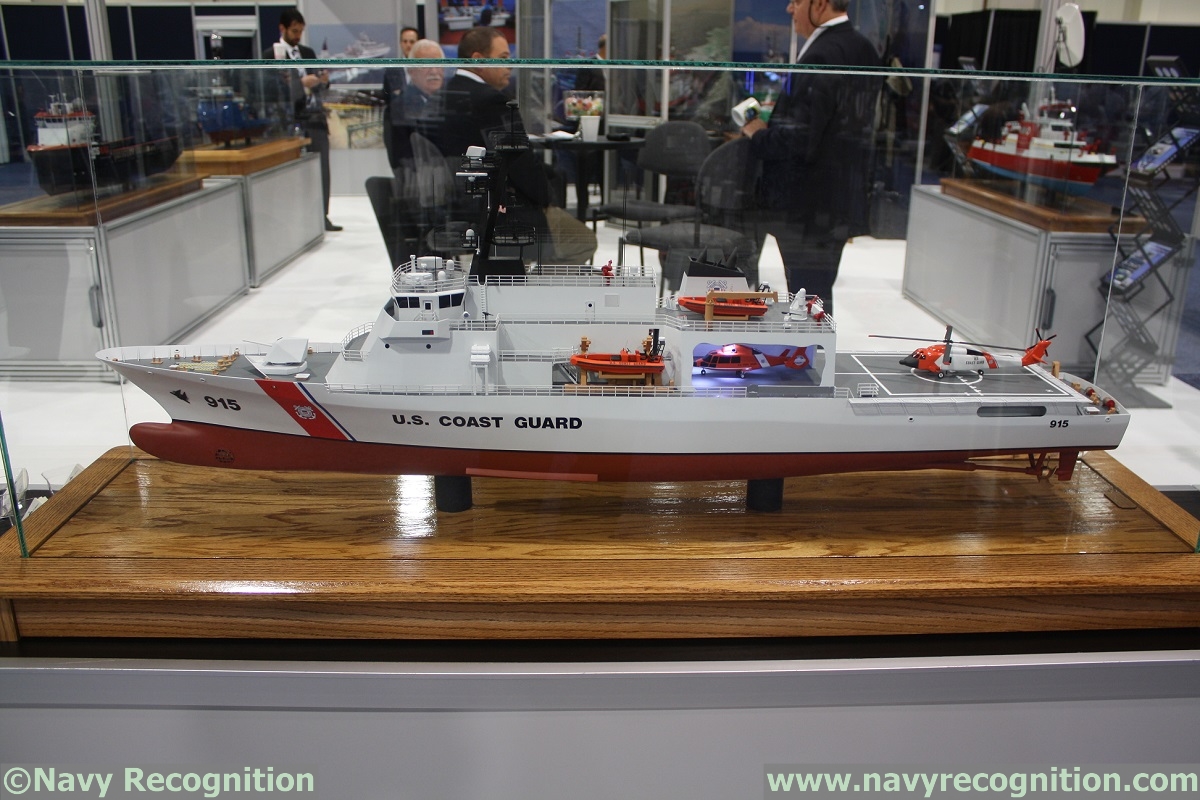
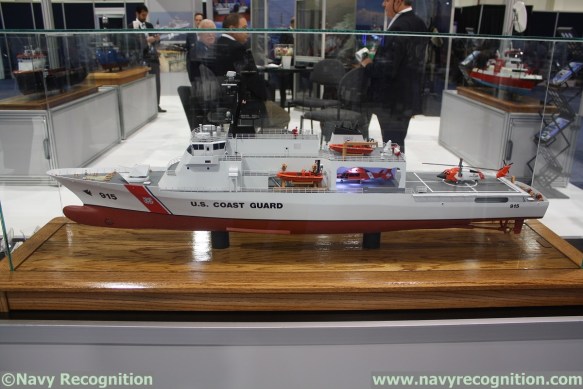
We need explicit support from the Navy at every level, particularly within Congress and the Administration, for Coast Guard recapitalization. While the Navy’s fleet averages approximately 14 years old. The Coast Guard’s major cutters average over 40. The proposed new ships, are more capable than those they replace. They are better able to work cooperatively with the Navy. The nine unit 4,500 ton “National Security Cutter”program is nearing completion with funds for the ninth ship in the FY2016 budget. The 58 unit, 154 foot, 353 ton Webber Class  program is well underway with 32 completed, building, or funded. But the Coast Guard is about to start its largest acquisition in history, 25 LCS sized Offshore Patrol Cutters. Unfortunately, it appears that while the first ship will be funded in FY2018 the last will not be completed until at least 2035. This program really needs to be accelerated.

We need an explicit statement from the Navy that they expect the Coast Guard to defend ports against unconventional threats, so that they can keep more forces forward deployed. This is in fact the current reality. The Sea Frontiers are long gone. Navy vessels no longer patrol the US coast. The surface Navy is concentrated in only a handful of ports. No Navy surface combatants are homeported on the East Coast north of the Chesapeake Bay. If a vessel suspected of being under the control of terrorists approaches the US coast the nearest Navy surface vessel may be hundreds of miles away.

We need the Navy to supply the weapons the Coast Guard need to defend ports against unconventional attack using vessels of any size, with a probability approaching 100%. These should include small missile systems like Hellfire or Griffin to stop small, fast, highly maneuverable threats and we need a ship stopper, probably a light weight anti-ship torpedoes that target propellers to stop larger threats. We need these systems on not just the largest cutters, in fact they are needed more by the the smaller cutters that are far more likely to be in a position to make a difference. These include the Webber class and perhaps even the smaller WPBs.

We need to reactivate the Coast Guard’s ASW program and ensure that all the new large cutters (National Security Cutters and Offshore Patrol Cutters) have an ASW capability, if not installed on all of the cutters, at least planned, prototyped, tested, and practiced on a few ships (particularly in the Pacific). The National Security Cutters and the Offshore Patrol Cutters are (or will be) capable of supporting MH-60R ASW helicopters. Adding a towed array likeCAPTAS-4 (the basis for the LCS ASW module) or CAPTAS-2 would give them a useful ASW capability that could be used to escort ARGs, fleet train, or high value cargo shipments. Towed arrays might even help catch semi-submersible drug runners in peacetime.

IMG_4128

The Coast Guard is the low end of America’s Naval high-low mix. It is a source of numbers when numbers are needed. The Coast Guard has more assets for low end functions like blockade than the Navy. The Navy has about 105 cruisers, destroyers, LCS, PCs, and is not expected to have more than 125 similar assets for the forseeable future. The Coast Guard has about 165 patrol cutters  including 75 patrol boats 87 feet long, about 50 patrol craft 110 to 154 feet in length (58 Webber class WPCs are planned), and about 40 ships 210 foot or larger that can be called on, just as they were during the Vietnam War, when the Coast Guard operated as many as 33 vessels off the coast in support of Operation MarketTime, in spite of the fact that the Navy had almost three times as many surface warships as they do now. The current program of record will provide 34 new generation cutters including nine 4500 ton National Security Cutters and 25 Offshore Patrol Cutters that should be at least 2500 tons.

The Coast Guard provides peacetime maritime security, but is currently under-armed even for this mission. A small investment could make it far more useful in wartime.

(Note there is another post on this looking at the “design” from a Navy point of view.)

GAO Report on Operational Test and Evaluation of the National Security Cutter

USCGC_Waesche_by_Yerba_Buena_Island

GAO has published a report on the National Security Cutters, GAO-16-148, contending, “Enhanced Oversight Needed to Ensure Problems Discovered during Testing and Operations Are Addressed.” Note, it goes beyond problems discovered during tests and evaluation, to include other problems encountered during operation.

Results are interesting. In many ways it sounds discouraging, with ten major deficiencies found during testing, but on the basis of my very limited experience with this sort of thing, I suspect it is at least no worse than average. After all, the cutter was rated as operationally effective and suitable. The Littoral Combat Ship program is very much a contemporary program, and it is also still undergoing testing.

During testing there were problems with the gantry on the stern, the single point davit, the gun, air search radar, and the Nulka decoy system. I did find it a bit troubling that essentially, all the weapon systems seemed to be having problems.

Probably more troubling are the problems encountered during operations, “…the NSC’s engines and generators have experienced persistent problems, the reasons for which are not yet known. As a result of these and other equipment casualties, the NSC has been operating in a degraded condition in some mission areas, even while having spent fewer days away from home port than planned.” Problems with the main engines include an inability to maintain full power while operating in warm water due to over heating and incidents of cracked cylinder heads at a higher than normal rate, page 31-35.  Generator bearings are overheating and failing at an unacceptable rate, page 35/36. The generator problems have resulted in ships operating with no functional back-up generator.

You can find a list of “Initial Operational Test and Evaluation Major Deficiencies and Coast Guard plans to resolve them” in Table 5, page 23/24.

Table 6, page 28 identifies “Retrofits and Design Changes for the National Security Cutter Class with Costs over $1 Million as of June 2015” totaling $202.1M. This is of course an incomplete list, in that additional changes are expected. Changes are also expected for the ammunition hoists, and the stern and side doors.

Replacement of the Gantry Crane (page 29): The crane, intended to move boats around the stern, was not designed for a salt water environment. I’m sorry, whose idea was this? How was this ever acceptable. If the shipyard picked the crane, I think they owe us at least the cost of replacement. A replacement has apparently been successfully prototyped.

Single Point Davit, page 30: The davit doesn’t work in high sea states, and it is not compatible with the Over the Horizon Boat IV so the ships end up with three different type boats. A replacement for this has also been prototyped.

Appendix II provides a “Summary of the Key Performance Parameters of the National Security Cutter,” page 42/43.

“As we found in 2015, during 2013 and 2014 the NSC fleet spent fewer days away from home port than the Coast Guard’s interim goal of 210 days. In addition, the NSCs operated in a degraded condition in one or more mission areas during a majority of their time spent in operations from 2010 to 2014 due to major equipment casualties.”

But the ships have a degree of redundancy and a depth of capability that allowed them to carry on.

“Although the NSC was often operating with major casualties during the period we examined, during the period from September 2013 through September 2015 the NSC was not mission capable as a result of maintenance needs only about 2 percent of the time, indicating that the casualties experienced during those years did not prevent the NSC from maintaining at least partial mission capability.”

Despite the lack of maturity of these assets, in terms of routing out systemic problems, that 2% figure is far better than the legacy fleet.

There was also a somewhat surprising note that the NSCs have space, weight, and power for a mine detection system.

We have Bryant’s Maritime Consulting to thank for the link to this document. 

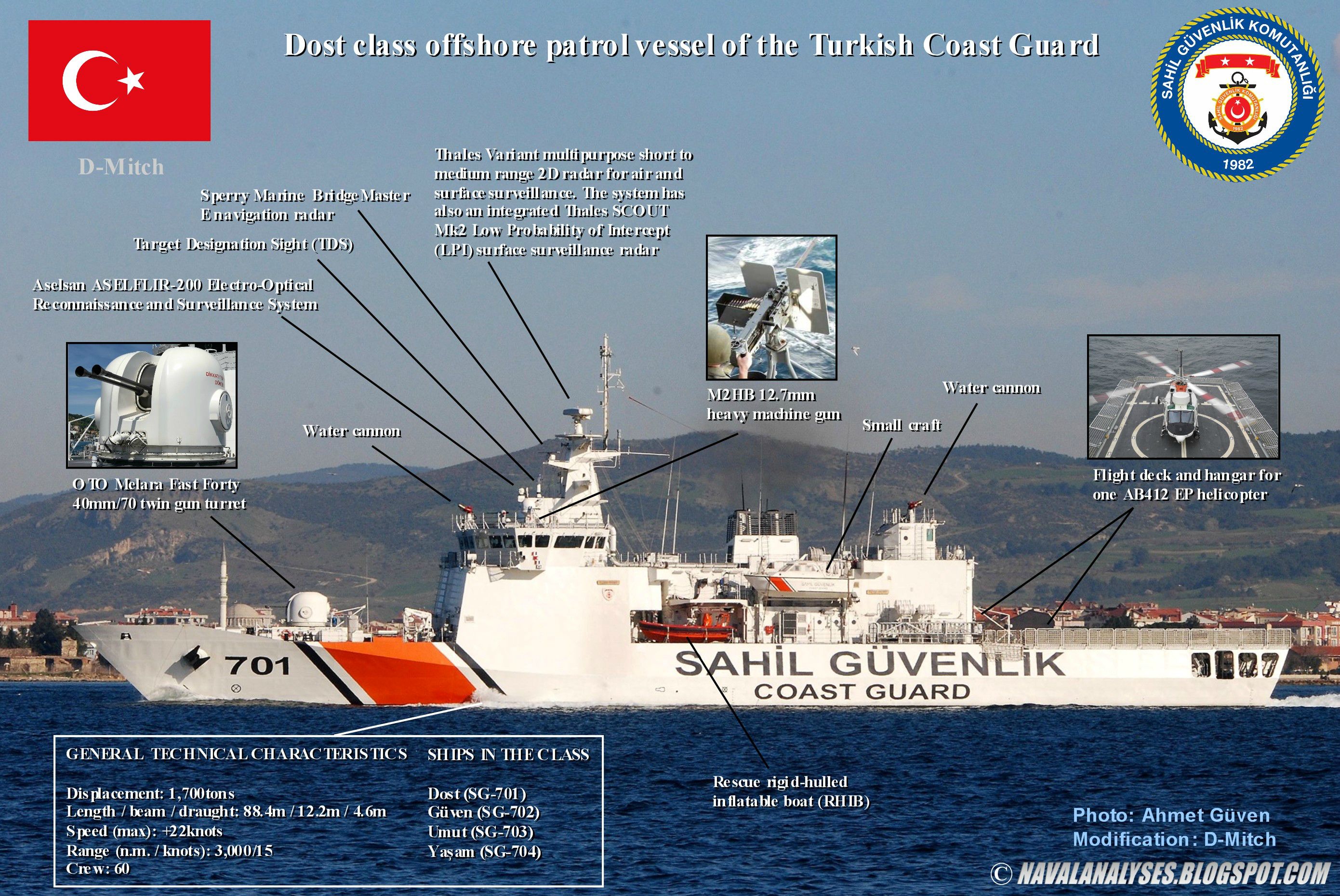
Turkey’s OPC

DOST class, Turkish CG

Photo: NavalAnalyses.Blogspot.Com. Click on the photo to enlarge

The German Navy Blog “Marine Forum,”

“5 January, Turkey, Acting on a tip-off / intelligence input, Turkish Coast Guard ships „Yasam“ and „Umut“ intercept Bolivian-flagged freighter „Joudi“ in international waters off Tobruk (Libya) … after receiving Bolivian government permission to board and search ship, boarding team finds 13 tonnes of cannabis.
“(rmks: first such action distant from Turkish waters; made feasible with induction of large DOST class patrol ships–emphasis applied–Chuck)”

So I looked up the class. The four ships of this class are the largest vessels in the Turkish Coast Guard. The next largest are only 210 tons. They are based on the Italian Sirio Class patrol vessels which operate under the Italian Navy but were paid for by the Transport and Navigation Ministry. I suspect the Sirio Class (appropriately modified) may have been the basis of the Marinette Marine’s OPC proposal.

Specs for the Turkish ships from my Combat Fleets of the World, 16th ed. with my translation to English units are:

  • Displacement: 1,700 tons (full load)
  • Overall Length: 88.4m (292 ft)
  • Length at Waterline: 80.3m (265 ft)
  • Beam: 12.2m (40.26 ft)
  • Draught: 4.6m (15.2 ft)
  • Speed: 22 knots
  • Power 4 MTU 16V, diesels, 2CP props, 14,120 BHP

The Gun: The Beda Bofors twin 40mm/70 gun is not a bad choice. It has been around for a while and it has improved over time. Current models are rated at 450 rounds per minute per barrel for 900 rounds per minute for the twin mount. That is faster than a .50 cal. M2 machine gun. The Italian Navy used this as a CIWS before switching to the improved 120 round per minute 76mm. It also has adequate range, 13,675 yards (12,500 m). This is less range than either a 57mm or 76mm, but adequate for most Coast Guard missions. There are at least four different projectiles available. The standard projectiles are about two pounds. There is also a high velocity solid tungsten alloy rod armour-piercing fin-stabilized discarding sabot (APFSDS) projectile that would probably be good for destroying fairly large diesel engines. .

If I read this correctly, the video is 380 rounds in 43 seconds.

Also from “Combat Fleets” this on the Turkish Coast Guard.

“Personnel: Approx. 2,200 total including 800 regulars and 1,400 conscripts, plus 1,050 on loan from the navy.

“Aviation: Coast Guard air assets include one Maule MX-7 light fixed-wing  and three CASA CN-235 maritime patrol aircraft (the basic airframe for the HC-144, Chuck). Three Austa-Bell AB-206B Helicopters and thirteen search and rescue configured Agusta-Bell 412 helicopters. The aircraft are pained white with an orange diagonal stripe.”

Russian Navy Primer–USNI

If you are interested in being up to speed on the Russian Navy, the US Naval Institute has provided access to an Office of Naval Intelligence (ONI) briefing book on the Russian Navy.

“Cdr Salamander” provides an intro to the publication on the US Naval Institute Blog. 

Unfortunately I did not see anything about the Russian Coast Guard in my initial scan of the document. It is a not insignificant force.

On page 5, where you see the 1000 mile rings that the document suggest the Russians have a special interest in, you might notice that one includes most of Alaska.

It is a nice, readable update.


Saudi Naval Modernization

File:Saudi Navy Desert Sheild.JPEG

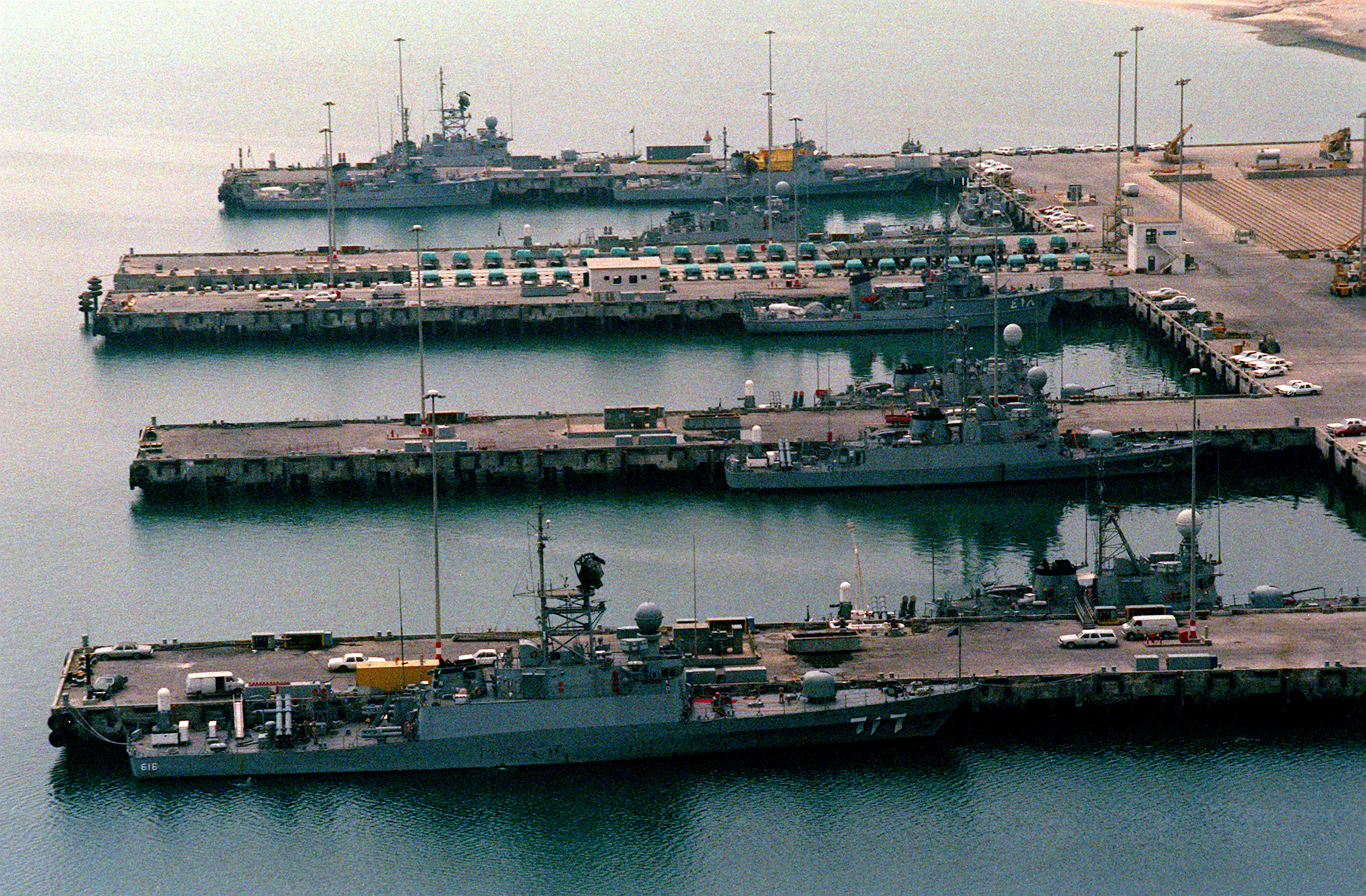
DOD Photo. Ships of the Saudi Arabian Navy are docked at the base PORT JUBAIL

Below is a post I prepared for CIMSEC. It began at Lyle’s suggestion several months ago, to be published here, considering if perhaps some of the new Coast Guard assets, the National Security Cutter, the Offshore Patrol Cutter, or the Fast Response Cutter might serve as the basis for something the Saudis would buy. It seems clear now that will probably not be the case. The Saudi’s have a very different set of priorities than those that shaped the Coast Guard’s specifications. Distances are relatively short. The likely enemy, Iran, is close at hand, and primarily uses small vessels with limited seakeeping so even moderately good seakeeping is better than that of the apparent enemy. . 

The Royal Saudi Navy is planning to replace virtually all of its Eastern Fleet. The expected price tag has been variously reported as between $11.25 and $20B. One of Saudi Arabia’s two fleets, the Eastern Fleet is based in the Persian Gulf and faces off squarely against Iran’s Navy and Revolutionary Guard Corp. The Western Fleet is based in the Red Sea and includes seven French built frigates.

The existing Eastern fleet, all American built, includes four 75 meter (246 foot), 1,038 ton corvettes and nine 58 meter (190 feet), 495 ton guided missile boats. All are nearing the end of their useful lives, having entered service in the early ’80s.

It appears Saudi Arabia is again looking to the US to build this new fleet, reportedly buying  four up-rated Lockheed Martin Freedom Class Littoral Combat Ships.  While these ships have been much in the news, they are only part of a much larger program.

In February Defense News reported that Saudi Arabia had sent a letter of request to the US Navy that outlined the entire program.  It specified:

  • Four 3,500-ton “frigate-like warships” capable of anti-air warfare, armed with an eight-to-16-cell vertical launch system (VLS) capable of launching Standard SM-2 missiles; fitted with an “Aegis or like” combat system using “SPY-1F or similar” radars; able to operate Sikorsky MH-60R helicopters; with a speed of 35 knots.
  • Six 2,500-ton warships with combat systems compatible with the frigates, able to operate MH-60R helos.
  • 20 to 24 fast patrol vessels about 40 to 45 meters long, powered by twin diesels.
  • 10 “maritime helicopters” with characteristics identical to the MH-60R.
  • Three maritime patrol aircraft for coastal surveillance.
  • 30 to 50 UAVs, some for maritime use, some to be shore-based.

This shopping list sounds remarkably specific. This suggest that they already have a good idea what they expect to buy.

Four 3,500-ton “frigate-like warships”

Plans have firmed up for the four frigates. While they will not have the Aegis like radars they will have a, “…16-cell (Mk41) VLS installation able to launch Evolved Sea Sparrow missiles, and will carry Harpoon Block II surface-to-surface missiles in dedicated launchers, and anti-air Rolling Airframe Missiles in a SeaRAM close-in weapon system. The MMSC will also mount a 76mm gun… a Lockheed Martin COMBATSS-21 combat management system, which shares some commonality with the much larger Aegis combat system, and feature the Cassidian TRS-4D C-band radar.”

Six 2,500-ton warships with combat systems compatible with the frigates, able to operate MH-60R helos.

The design for the six smaller ships hasn’t been discussed openly, so this is a bit of speculation, but at least I think we can expect something like this. The video below, from Swiftship, recently appeared without much explanation.  The similarity in design to the Freedom class is striking and it claims to be a proven hull form. If Marinette Marine is too busy to build these smaller ships in addition to the LCS and the Saudi Frigates, having Swiftships build them might be a way have having them delivered relatively quickly and it looks like it might fit the description. Note there is no mention of an ASW capability for these ships (other than the ability to embark an MH-60R). This parallels the current fleet structure where only the four largest vessels have an ASW capability and the next largest class vessels do not.

Swiftships has a record of selling vessels through “Foreign Military Sales” and the vessel in the video shares a number of systems in common with the projected Saudi frigates including a 76mm gun, RAM missiles, MH-60s, and possibly Harpoon (they show only a generic representation of an ASCM).

20 to 24 fast patrol vessels about 40 to 45 meters long, powered by twin diesels.

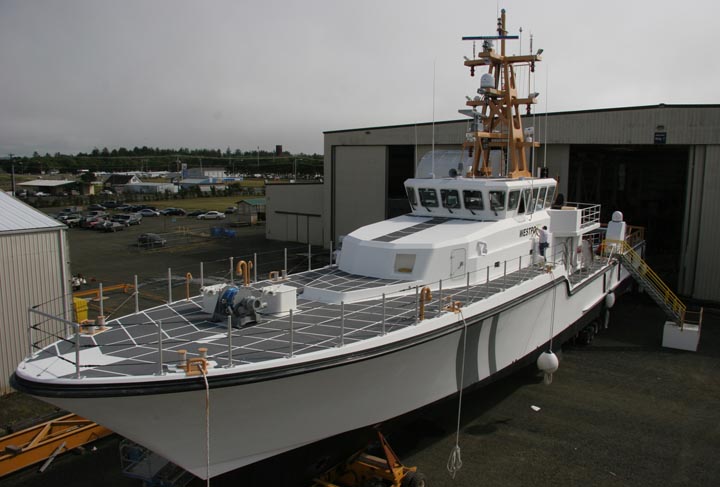
A likely choice for the patrol boat is this one, eight of which were sold to Pakistan. Reportedly these 43 meter, 143 foot vessels can make 34 knots and operate a ScanEagle UAS.

Westport143

Another possibility is this 43.5 meter vessel that was provided to Lebanon under FMS.

RiverHawk-LCSC-42

Both of these PCs have the capability to stern launch an RHIB.

10 “maritime helicopters” with characteristics identical to the MH-60R.

A request for ten MH-60Rs was submitted earlier and has beenapproved by the State Department.

Included in the buy of the helicopters are, “one-thousand (1,000) AN/SSQ-36/53/62 Sonobuoys; thirty-eight (38) AGM-114R Hellfire II missiles; five (5) AGM-114 M36-E9 Captive Air Training missiles; four (4) AGM-114Q Hellfire Training Missiles; three-hundred eighty (380) Advanced Precision Kill Weapons System rockets; twelve (12) M-240D crew served weapons; and twelve (12) GAU-21 crew served weapons.”

I note that the 380 Advanced Precision Kill Weapons System (APKWS) semi-active laser homing 70mm rockets is exactly the number to fill twenty 19 round launchers. These weapons are probably an ideal counter to the much vaunted Iranian “swarm.”

Three maritime patrol aircraft for coastal surveillance:

These are almost certainly P-8s.

30 to 50 UAVs, some for maritime use, some to be shore-based:

While there is no indication which system is favored.  This sounds like too many systems for Firescout.

ScanEagle or one of Insitu’s slightly larger systems seems more likely, and if the Swiftships Offshore Patrol Vessel video is any indication, it includes a ScanEagle launch and recovery.

Conclusion:

This will be a major upgrade to the Saudi fleet that should allow them to maintain an advantage relative to the Iranian Fleet.

  • The ships and patrol boats will be three to five times larger than those they replace and far more survivable.
  • Fleet air defense systems which have been limited to 76mm guns and Phalanx CIWS will get a basic local area defense in the form of Evolved Sea Sparrow Missile, which will be backed up by rolling airframe missiles.
  • ASW  capability will take a quantum leap with the addition of the three Maritime Patrol Aircraft (MPA), the ten MH-60R.
  • The Eastern fleet was relatively well equipped to target larger surface targets with a total of 68 Harpoon launch tubes on the existing ships, but they were less well equipped to deal with numerous Iranian small craft.  MH-60Rs  armed with Advanced Precision Kill Weapon System guided rockets should provide an effective counter to Iran’s swarm strategy.
  • MPA and Unmanned systems will enhance ISR capability.
  • The larger patrol craft should significantly improve maritime security.
  • According to my “Combat Fleets of the World,” the Saudi Navy has a Marine Corp of 3,000, but their only Amphibious Warfare ships are four LCUs and two LCMs. The addition of at least 30 ships with RHIBs, assuming the patrol craft have this capability, should allow the Saudi Navy to consider at least small scale raids and other forms of maritime Special Ops. If the six 2500 ton ships are configured like the ship in Swiftships video, with four RHIBs, it would seem particularly appropriate for this role.  The addition of ten helicopter decks where there were none before also opens up options for these types of operations.


Mexican Navy Sinks OPV as Dive Attraction

Late Note: Unfortunately I let my frustration with the slowness of out cutter replacement and my natural snarkiness color this report, leaving the impression that the Mexican Navy was replacing its ships faster than the Coast Guard, which is not the case. Rather this ship was decommissioned because it had a damaging fire.  

The German Navy blog “Marine Forum” reports,

The Mexican Navy has sunk its decommissioned patrol vessel „Uribe“ (P-121) off the Baja California coast where it will become the state’s first artificial reef (divers attraction).

I cannot help but notice this ship compared favorably to our 210s being 18 years newer, larger, faster, and better armed.

Shouldn’t this be embarrassing to someone?

Azerbaijan CG’s New WPC and WPB

AzerbaijanSaar62

Photo: Azerbaijan Coast Guard’s first Saar 62. Source: President’s Office, Azerbaijan

We have talked about these before, but now we have more details, particularly about how they are equipped.

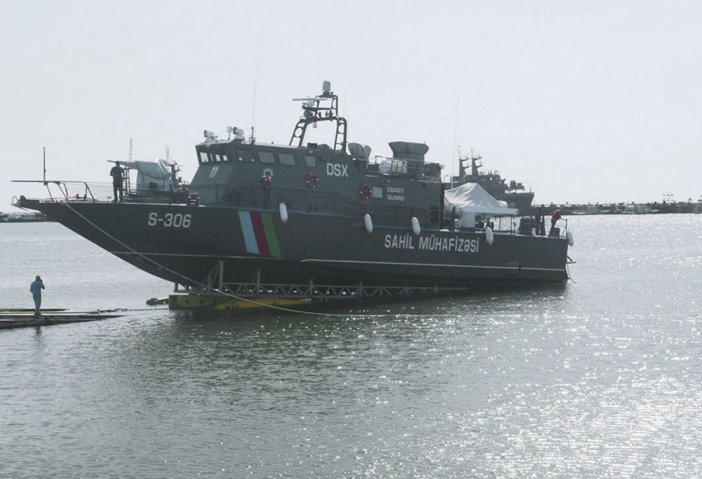
Janes 360 reports the launching of two new vessels for the Azerbaijan Coast Guard, the first of up to six helo deck equipped, 203 foot, 470 ton, 32 knot Sa’ar 62s based on the Israeli Sa’ar 4.5 missile boat, and a sixth 32.65 m-long, 95-ton Shaldag Mk V.

AzerbaijanShaldagMkVFAC

Photo: Azerbaijan Coastguard’s sixth Shaldag Mk V (Azerbaijan State Border Guard Service)

Both types use the Typhoon gun mount which is basically the same as the Mk38 mod2 used by the Coast Guard, except that, instead of using the 25 mm chain gun, these use a Soviet era 23 mm, with a higher rate of fire. Both use the Toplite Electro-Optic fire control system that is also part of the Mk38 mod2.

Most interesting, they are armed with small missile systems. the larger vessels will have an eight cell launcher for the 25 kM range Spike-NLOS.

TYPHOON MLS NLOS configuration has eight Spike NLOS missile launchers and integrated Toplite stabilized observation and target acquisition system. Photo: RAFAEL

TYPHOON MLS NLOS configuration has eight Spike NLOS missile launchers and integrated Toplite stabilized observation and target acquisition system. Photo: RAFAEL via defense-update.com

The smaller vessels have a four tube launcher for the 8 km range Spike-ER.

Azerbaijan’s neighbors on the Caspian Sea are Russia to the North, Iran to the South, and Turkmenistan and Kazakhstan on the other side of the water. They have a small navy in addition to their Coast Guard, but these will constitute a substantial reinforcement. There is appears to be a miniature naval arms race going in the Caspian Sea.