“Japan Buys Two SeaGuardians from GA-ASI” –News Release

Below is a news release from General Atomics Aeronautical Systems, Inc.

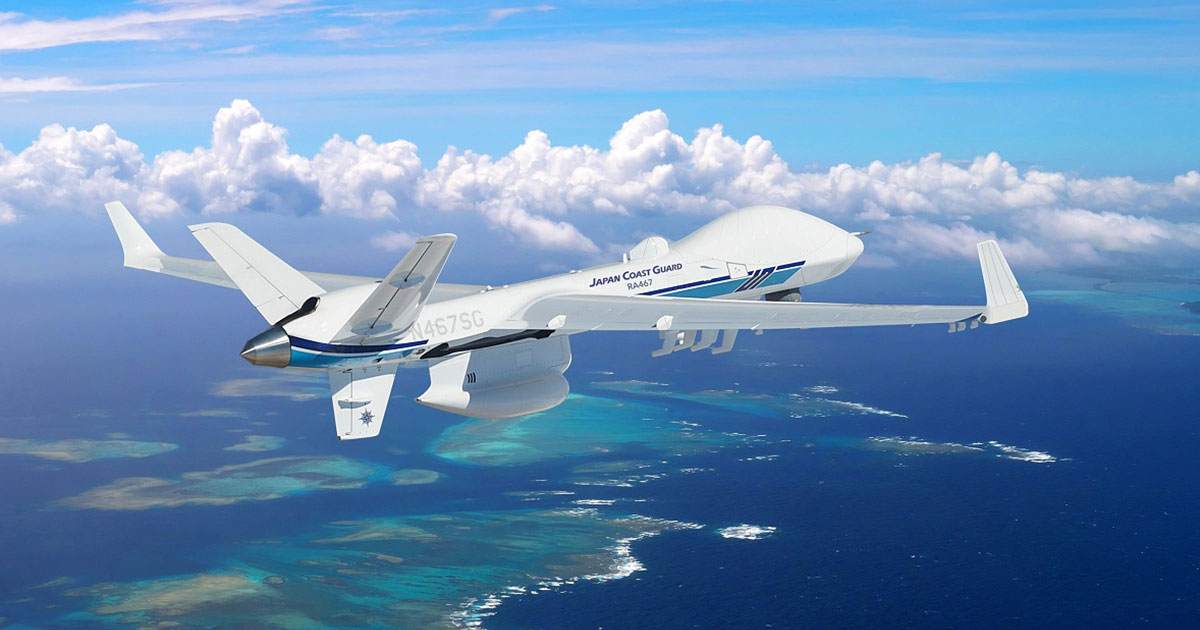
The SeaGuardian is a maritime variant of the MQ-9B that includes sense and avoid systems that allows it to operate safely in airspace with manned aircraft.

SeaGuardians are reportedly operated in a maritime role for Australia, Belgium, Canada, India, Italy, Japan, the Netherlands, and the UK.


Japan Buys Two SeaGuardians from GA-ASI

SAN DIEGO – 15 August 2024 – The Japan Coast Guard (JCG) has signed a contract for the purchase of two SeaGuardian® Remotely Piloted Aircraft (RPA) from General Atomics Aeronautical Systems, Inc. (GA-ASI), scheduled for delivery in 2025. This follows JCG’s ongoing Company-Owned, Contractor-Operated agreement with GA-ASI for operating SeaGuardian, which began in April 2022.

“Since JCG started operating SeaGuardians, they have been used for various JCG missions including supporting search and rescue and disaster response specifically during the 7.6 magnitude earthquake early this year near the Noto Peninsula of Ishikawa Prefecture and maritime surveillance during the 2023 G-7 Summit in Hiroshima, and the system has performed efficiently and effectively,” said GA-ASI CEO Linden Blue.

SeaGuardian is a medium-altitude, long-endurance RPA system that can fly for 24 hours or more, depending on the configuration.

GA-ASI has strengthened its Maritime Wide Area Surveillance (MWAS) for Japan with Optix+, which gathers information from the SeaGuardian sensors, as well as other data sources, displaying the full picture of surveillance information for its operator. This functionality makes it easy to task and direct its Intelligence, Surveillance and Reconnaissance (ISR) information in real time. GA-ASI’s Optix+ software suite rapidly correlates and exploits collected data into an easily shared common operational picture. Having multi-source correlated data enables automatic detection of anomalous behaviors over waters.

About GA-ASI

General Atomics Aeronautical Systems, Inc. (GA-ASI), an affiliate of General Atomics, is a leading designer and manufacturer of proven, reliable RPA systems, radars, and electro-optic and related mission systems, including the Predator® RPA series and the Lynx® Multi-mode Radar. With more than eight million flight hours, GA-ASI provides long-endurance, mission-capable aircraft with integrated sensor and data link systems required to deliver persistent situational awareness. The company also produces a variety of sensor control/image analysis software, offers pilot training and support services, and develops meta-material antennas.

Navy Issues Large Contract for Development of Unmanned Surface Vehicles

A U.S. Navy L3 Harris Arabian Fox MAST-13 drone boat and the U.S. Coast Guard cutter USCGC John Scheuerman transit the Strait of Hormuz on April 19, 2023. (Information Systems Technician 1st Class Vincent Aguirre/U.S. Coast Guard)

Below the break is a quote from DOD “Contracts for June 14, 2024.”
This is a big step toward procurement of an “Unmanned Surface Vehicle Family of Systems.” There can be little doubt the Coast Guard will exploit some of these developments and will probably participate in some of the testing, as they have done with 4th and 5th Fleet. 
Of the 49 partners mentioned, Bollinger is the only one I recognize as a ship builder. Could this mean we will see a Fast Response Cutter emerge as an Optionally manned or Unmanned Surface Vehicle? Probably not, but…
The funding structure is interesting. This is potentially an almost one billion dollar contract, but the initial commitment is only $49,000, $1,000 to each of the contractors. Sounds like they built in a lot of flexibility.

A multiple-award contract to support current and future unmanned surface vehicle family of systems and subsystems is awarded to the following 49 industry partners: Anduril Industries Inc.,* Costa Mesa, California (N0002424D6306); Applied Research Associates Inc., Albuquerque, New Mexico (N0002424D6307); Asymmetric Technologies LLC,* Dublin, Ohio (N0002424D6308); AT&T Corp., Oakton, Virginia (N0002424D6309); Atlas Technologies Inc.,* North Charleston, South Carolina (N0002424D6313); Autonodyne LLC,* Boston, Massachusetts (N0002424D6315); Beast Code LLC,* Fort Walton Beach, Florida (N0002424D6316); Bigelow Family Holdings LLC, doing business as Mettle Ops,* Sterling Heights, Michigan (N0002424D6317); Bollinger Shipyards Lockport LLC, Lockport, Louisiana (N0002424D6318); CACI Inc. – Federal, Chantilly, Virginia (N0002424D6319); Carnegie Robotics LLC, doing business as CR Tactical,* Pittsburgh, Pennsylvania (N0002424D6320); Cydecor Inc.,* Arlington, Virginia (N0002424D6361); DELTA Resources Inc., Alexandria, Virginia (N0002424D6363); Fairbanks Morse LLC, Beloit, Wisconsin (N0002424D6364); Teledyne FLIR Surveillance Inc., North Billerica, Massachusetts (N0002424D6365); General Atomics Aeronautical Systems Inc., Poway, California (N0002424D6366); GIRD Systems Inc.,* Cincinnati, Ohio (N0002424D6367); Herren Associates Inc.,* Washington, D.C. (N0002424D6368); Honeywell International Inc., Clearwater, Florida (N0002424D6369); IERUS Technologies Inc.,* Huntsville, Alabama (N0002424D6370); Integer Technologies LLC,* Columbia, South Carolina (N0002424D6371); KIHOMAC Inc.,* Reston, Virginia (N0002424D6372); Leonardo Electronics US Inc., Huntsville, Alabama (N0002424D6373); MAK Technologies Inc., Cambridge, Massachusetts (N0002424D6374); Marine Ventures International Inc.,* Stuart, Florida (N0002424D6375); Marinette Marine Corp., Marinette, Wisconsin (N0002424D6376); Metron Inc.,* Reston, Virginia (N0002424D6378); Microsoft Corp., Redmond, Washington (N0002424D6379); Murtech Inc.,* Glen Burnie, Maryland (N0002424D6380); NewSat North America LLC,* Indian Harbour Beach, Florida (N0002424D6381); Noblis MSD LLC, Philadelphia, Pennsylvania (N0002424D6382); Novetta Inc., McLean, Virginia (N0002424D6383); Ocean Specialists Inc.,* Stuart, Florida (N0002424D6384); PACMAR Technologies LLC,* Honolulu, Hawaii (N0002424D6377); Persistent Systems LLC,* New York, New York (N0002424D6385); Physical Sciences Inc.,* Andover, Massachusetts (N0002424D6386); Prescient Edge Corp.,* McLean, Virginia (N0002424D6387); Programs Management Analytics & Technologies Inc.,* San Diego, California (N0002424D6388); Reliability & Performance Technologies LLC,* Dublin, Pennsylvania (N0002424D6389); Saab Inc., East Syracuse, New York (N0002424D6390); Scientific Systems Co. Inc.,* Woburn, Massachusetts (N0002424D6391); Secmation, LLC,* Raleigh, North Carolina (N0002424D6392); SES Government Solutions Inc., Reston, Virginia (N0002424D6393); SIMIS Inc.,* Portsmouth, Virginia (N0002424D6394); Sparton DeLeon Springs LLC, De Leon Springs, Florida (N0002424D6395); Systems and Proposal Engineering Co.,* Manassas, Virginia (N0002424D6396); Systems Technology & Research Inc.,* Huntsville, Alabama (N0002424D6397); TDI Technologies Inc.,* King of Prussia, Pennsylvania (N0002424D6398); and Triton Systems Inc.,* Chelmsford, Massachusetts (N0002424D6399), are each awarded a firm-fixed-price, fixed-price-incentive-firm-target, cost-plus-incentive-fee, cost-plus-fixed-fee, and cost only, indefinite-delivery/indefinite-quantity contract for the procurements involving one or more functional areas, i.e. payloads, non-payload sensors, mission support systems, autonomy and vehicle control systems, ashore and host platform elements, and logistics and sustainment for the Unmanned Surface Vehicle Family of Systems. The maximum dollar value for all (total number) contracts combined is $982,100,000. Each awardee will be awarded $1,000 (minimum contract guarantee per awardee) at contract award. Work will be performed in various locations in the contiguous U.S. and is expected to be completed by February 2025. These contracts include a five-year ordering period option which, if exercised, will continue work through February 2030. Fiscal 2024 research, development, test and evaluation (Navy) funding in the amount of $49,000 will be obligated at the time of award and will expire at the end of the current fiscal year. All other funding will be made available at the delivery or task order level as contracting actions occur. These contracts were competitively procured via SAM.gov and there were 55 offers received. Naval Sea Systems Command, Washington Navy Yard, D.C., is the contracting activity.

Helicopter Door Gunner Takes Down Kamikaze Drone

French Armed Forces via X

The War Zone reports, “A French Navy helicopter used machine gun fire to shoot down a Houthi drone over the Red Sea today.”

This is a potential Coast Guard capability, given its airborne use of force capability includes a door mounted rifle caliber machine gun, though I do not know if every Coast Guard Air Station has qualified gunners. The .50 caliber sniper rifle included in the package might even be more effective than the machine gun.

I am not suggesting the Coast Guard send helicopters to the Red Sea, but when the Coast Guard provides protection for vessels transiting to sea, it has generally been done with small boats with crew served rifle caliber machine guns. Ballistic Missile submarines have been an exception. They may be escorted by 82 foot patrol boats with .50 caliber machine guns in remote weapon stations. Perhaps the Coast Guard should consider providing an armed helicopter overwatch. An armed helicopter could be effective against hostile surface systems as well as air systems.

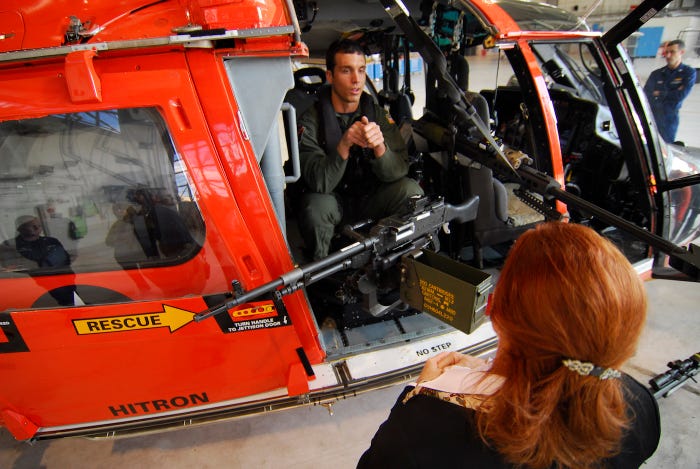
Petty Officer 2nd Class Anthony Phillips, a precision marksman at Helicopter Interdiction Tactical Squadron, displays the weaponry used by a HITRON during missions, February 23, 2010. US Coast Guard/Petty Officer 1st Class Bobby Nash

Below is a video taken by the French helicopter (an AS565 Panther, similar to the Coast Guard’s H-65s) as it shoots down the drone.

A US Navy helicopter demonstrated this capability over eight years ago. It is certainly less expensive than bringing down a drone with a missile. On the other hand, I would not want to be in a helicopter near a drone if the Navy decides to use a missile to destroy the drone.

“Army Cancels High-Speed Armed Reconnaissance Helicopter Program” –The WarZone

Sikorsky’s Raider X, advanced compound helicopter design (FARA prototype)

The Warzone reports,

The U.S. Army says it is cancelling its Future Attack Recon Aircraft (FARA) program which had been centered on the acquisition of a new type of high-speed armed scout helicopter. This is part of a larger restructuring the Army plans for its future fleets of helicopters and other crewed and uncrewed aircraft.

This is essentially half of the Army’s Future Vertical Lift program. The Coast Guard has been following the program in anticipation of development of vertical takeoff and landing aircraft that would offer “twice the range and twice the speed” of existing helicopter types. We might still see that in a version of the Bell V-280 for land-based operations.

Note this video is four years old, so the prototype has been flying for a long time. I have heard concern about the downwash, but if you look at the windsock visible from time 2:20, downwash does not seem to be excessive. My back of the envelope calculations suggests the overpressure directly under the rotor discuses would be about 67% higher under the V-280’s props compared to the H-60J’s rotor. That might be mitigated at the hoist pickup point because, unlike in the H-60, the props are not rotating over the fuselage of the V-280.

It does appear that the H-60s may have a new engine option in the future.

The FARA cancellation is part of what the Army is currently calling the Aviation Investment Rebalance. The service says it will delay production of the General Electric T901 turboshaft engine developed under the Improved Turbine Engine Program (ITEP), which had been heavily tied to FARA, as part of this plan. The immediate focus will now be on integrating T901s onto existing AH-64 Apache attack helicopters and UH-60 Black Hawk utility helicopters.

GE Aerospace claims, “The T901 engine provides 50% more power 25% better specific fuel consumption, and reduced life cycle costs -with fewer parts, a simpler design, and proven, reliable technology.” 

Basically, the Army has decided that Unmanned aircraft and Satellites can do the job of scouting better and cheaper, as well as safer, than a helicopter. This means they will be putting more money into those areas.

The Coast Guard might still benefit in its maritime domain awareness and its search function. I have not put much thought into the possibility that UAS (and perhaps satellites) might supplement or replace fixed wing for the SAR search function or MEP detection, but those are real possibilities.

I am disappointed that we are not likely to see a ship-based helicopter with twice the range and twice the speed any time soon, but on the other hand, we are already using UAS for search that have many times the endurance of the H-65 or even the H-60. For that function, endurance is more important that speed.

“Research and Development Center projects continue to enhance Coast Guard mission success” –CG-9

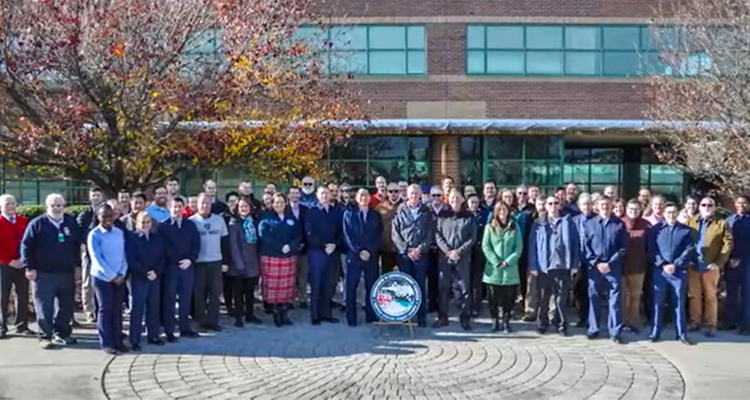
The Coast Guard Research and Development Center workforce is based in New London, Connecticut. U.S. Coast Guard photo.

Below is a news release from the Acquisitions Directorate (CG-9). If you follow the links there is a huge amount of information.

There is a lot of ongoing work, including cooperation with 4th Fleet in their efforts to operationalize unmanned systems. I had hoped the Coast Guard was doing that, and it’s gratifying to see they in fact are.

The projects listed are wide ranging and may potentially impact every mission area.

Perhaps the biggest surprise was that they are working on detect and avoid systems for small UAS. It appears they are looking at beyond visual line of sight UAS that could be used by the Fast Response Cutters and other vessels that do not have a flight deck. Apparently, they are also looking at using Unmanned Surface Vessels (USVs) to fire warning shots, presumably to stop drug runners. Would that mean they would also use USVs for disabling fire?

They are also looking at counter UAS alternatives, at ways to operate more effectively in polar regions, maritime domain awareness, and a lot more. It’s very impressive, especially when you consider how little the Coast Guard spends on R&D.


In fiscal year 2023, the Coast Guard Research and Development Center in New London, Connecticut, supported a research portfolio of 54 projects, covering the full scope of the Coast Guard’s missions. This video highlights a few of those projects, including beyond visual line of sight unmanned aircraft system detect and avoid technology, cutter-based unmanned systems integration with the Ship Control and Navigation Training System, International Maritime Organization polar code validation through advanced simulation modeling, and laser corrosion removal.

View video here.

Related: FY24 RDT&E Project Portfolio

For more information: Research and Development Center page and Research, Development, Test & Evaluation and Innovation Program page


“U.S. Approves Potential $3.9B MQ-9B UAV Sale to India” –USNI

An MQ-9 Sea Guardian unmanned maritime surveillance aircraft system flies over the Pacific Ocean during U.S. Pacific Fleet’s Unmanned Systems Integrated Battle Problem (UxS IBP) 21, April 21. UxS IBP 21 integrates manned and unmanned capabilities into challenging operational scenarios to generate warfighting advantages. US Navy Photo

The US Naval Institute News Service reports,

The State Department greenlit a potential $3.9 billion deal of General Atomics MQ-9B drones to India today…The proposed package for the Indian military includes 31 SkyGuardian unmanned aerial vehicles, 310 Small Diameter Bombs and 170 Hellfire missiles. Associated radars and anti-submarine equipment for the maritime-focused SeaGuardian variant, a derivative of the SkyGuardian, were also included.

It appears, India will join Allies Australia, Belgium, Canada, Italy, Japan (Coast Guard and Maritime Self Defense Force), the Netherlands, and the UK as operators of the MQ-9 for Maritime Domain Awareness.

$3.9B is a scary number if you are the Coast Guard, but this is a large, comprehensive, and probably multi-year procurement, probably including training and support. This is also a joint service procurement with the Indian Air Force getting eight aircraft, the Indian Army eight, and the Indian Navy sixteen.

This is what the US Coast Guard Acquistions Directorate (CG-9) says about Land-based UAS,

“The Coast Guard has validated a mission need for land-based UAS to significantly enhance ocean surveillance in support of the service’s operations. Coast Guard land-based UAS flight crews are jointly operating maritime-variant Predator UAS (Guardian) on maritime missions with Customs and Border Protection to enhance the Coast Guard’s understanding of potential land-based UAS solutions and support the development of a land-based UAS requirements package.”

That sounds suspiciously like, we are doing the same thing we have been doing for what, the last two decades? I can understand the hesitance to get into land based UAS before Sense and Avoid systems, allowing Remotely Piloted Air Systems (RPAS) to operate in the national airspace, were developed, but they are available now. Time to move on this.

We don’t have to jump in with both feet. We can do what we are still doing with Scan Eagle and use contractor owned and operated systems, but let’s at least see what the latest systems can do for us.

Maybe a detachment of land based UAS like the MQ-9B Sea Guardians in Florida or Puerto Rico, where they can support the 20 Webber class District 7 FRCs that do not have organic air assets.

Very Interesting Questions: “Drone Warfare’s New Angle: Iran’s Shaheds Become Low-Cost Anti-Ship Missiles” –Covert Shores

Shahed-136One Way Attack Uncrewed Air Vehicle (), Source: Covert Shores

Covert Shores makes some interesting observations and asks pointed questions particularly in regard to the terminal homing phase of how the low-cost slow cruise missiles make their attacks on moving targets.

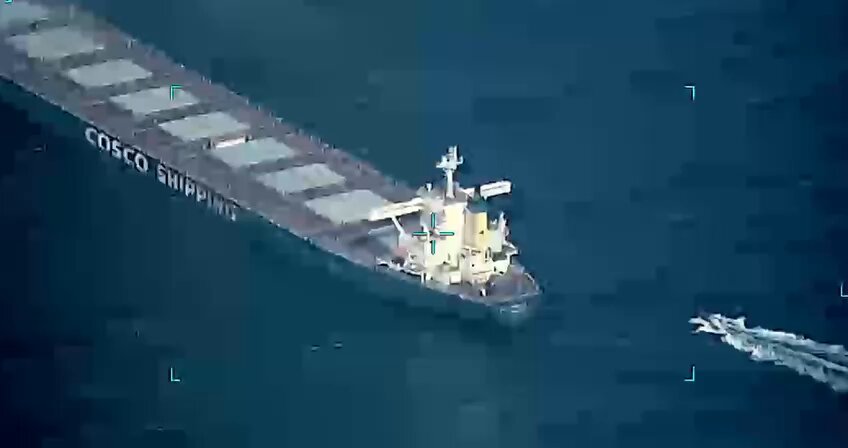
Hitting fixed target in Ukraine is very different from hitting a moving target hundreds of miles off the coast. Even an oil tanker is very small in the vastness of the ocean. The mission would need target location intelligence, and the drone would need targeting during its attack phase. The former is the same for any anti-ship weapon and can be achieved by patrol aircraft, fishing boats. Or, as possibly the case in the Chem Pluto attack, by the target broadcasting its position via AIS (automated information system).

The final phase targeting is more interesting. We do not know, at least in the public sphere, how the drones targeted the tankers. Whether it was a human-in-the-loop camera, or some form of automation.

Do they have satellite communications? Target recognition software? Home on AIS?

Presumably we have recovered at least one of the failed drones and can answer the question, but there is an even simpler solution.

Forward observers in one or more of the many Dhows that traffic the area, who call in a UAV when they have a target, and who can take over control of the drone when it arrives on scene, steering it into the target. This would be a continuation of what we saw with the Houthi remote control explosive motorboats, which unlike the USVs we are seeing in the Russo-Ukraine War, had no satellite link and were apparently steered by a second vessel within line of sight of the target and the attacking USV.  It is not unlikely the Iranians and Houthi have a network of such nondescript vessels. 

The slow speed of the UAVs does present something of a challenge in getting to the right place at the right time, but that is mitigated by the predictability of shipping lanes and the consistent speed of merchant vessels.

“Indian Navy Commandos Retake Ship In Arabian Sea” gCaptain/Reuters

The Indian Navy approaches the M/V Lila Norfolk in the Indian Ocean, January 5, 2024. Photo courtesy Indian Navy

gCaptain reports,

“An Indian Navy warship intercepted the MV Lila Norfolk on Friday afternoon, less than a day after the navy received news that it had been hijacked off Somalia’s coast in the North Arabian Sea.”

The crew of 21 had taken shelter in a citadel. By the time the Indian Navy destroyer, INS Chennai, had arrived, the pirates had fled.

The MV Lila Norfolk “was kept under continuous surveillance using MPA (Maritime Patrol Aircraft–Chuck), Predator MQ9B & integral helos.

Notably, the Indian Navy is one of several users of the MQ-9B Sea Guardian Medium Altitude Long Endurance UAS including the Japan Coast Guard, the UK, Taiwan, and Greece. The US Coast Guard after years of observation of Customs and Border Protection’s use of earlier model MQ-9 Predators, the USCG has yet to procure or even experiment with a shore based long endurance UAS.

“Coast Guard releases request for proposal for maritime unmanned aircraft system services” –CG-9

The unmanned aircraft sensor payload capability is varied based on the Coast Guard’s desired mission and search conditions: MWIR 3.5 is a mid-wave infrared for thermal imaging capability, for use at night or periods of low visibility; EO-900 is a high-definition telescopic electro-optical (EO) imager to zoom in on targets at greater distance; and ViDAR is a visual detection and ranging wide-area optical search system that is a comprehensive autonomous detection solutions for EO video. Courtesy Photo.

Below is a news release from the Acquisitions Directorate (CG-9). The solicitation is for Group 2 or 3 UAS.

The minimum performance specifications are not particularly demanding, including:

  • 50 knot cruise speed,
  • 70 knot dash speed,
  • 12 hours daily continuous coverage, but that could include two sorties,
  • Range 40 nmi in clear conditions, 35 nmi in light rain,
  • Operate from a flight deck 80 x 48 feet (Host Cutter drawings provided are for NSC, but also presumably OPCs. Not likely for icebreakers or Alex Haley because they have no air search radar, see below) within limits:  pitch +/- 3 degrees, roll +/- 5 degrees.
  • The UA must have space, weight, and power to concurrently operate vendor
    provided: Electro-Optical (EO) sensor, Infra-Red (IR) sensor, AIS, VHF/UHF
    communications relay, aeronautical transponder, and non-visible IR marker for
    the required flight endurance. (I found no minimum payload weight.)

There are some interesting specifications that may reflect how the systems are used.

  • The UA must provide a non-visible, near-IR marker or FDA approved illuminator to
    aid manned assets using NVDs for target acquisition at night
  • The UAS must be capable of operations in light icing conditions defined as
    accumulation of ¼ inch of ice in 15-20 minutes (Objective)(so not a minimum requirement–Chuck)
  • The UA must have an Infrared (IR) anti-collision lighting subsystem (providing a night visibility range of 3+ statute miles) producing energy emitted in a 360-degree pattern around the UA +30 degrees (above) and -30 degrees (below) the horizontal plane of the UA. The IR-light intensity must be at least of a Class B Night Vision Imaging System (NVIS) radiant intensity (NRIb) of 2.31 E -04 NRI. The Ground Control Station must have the capability to turn the IR anti-collision light on or off.
  • In addition to other sensor requirements identified in this document, when such a
    system is commercially available, the UA must be capable of incorporating a
    collision avoidance system (i.e. Detect and avoid (DAA) or Sense and avoid (SAA)
    systems) to extend the UA’s range beyond the host cutter’s air search radar
    envelope while maintaining compliance with international due regard. (Objective) (Not a minimum requirement. Meaning we will likely be operating these systems without a sense and avoid system, so will have to operate within the range of the cutter’s air-search radar. Also precludes operating these systems on vessels without an air-search until such a system is installed–Chuck)
  • At an operating altitude of 3,000 feet when the UAS is directly overhead of the target of interest (no slant range), the UA must be acoustically non–detectable per MIL STD-1474 (series), Level 1, requirements (quiet rural area with the closest heavily used highway and community noises at least 2.5 miles away)
  • The Contractor provided Datalinks must be capable of operating, with
    unobstructed Line of Sight (LOS), at a minimum range of 40 nautical mile
    (NM) (threshold) / 100 NM (Objective).

This sounds very much like a continuation of the Scan Eagle operations already being conducted on National Security Cutters (here, here, here, here, and here). Forgive me if I point out that I recommended we try this system back in 2011, five years before we actually did.


Coast Guard releases request for proposal for maritime unmanned aircraft system services

The Coast Guard released a request for proposal (RFP) Dec. 12 for maritime unmanned aircraft system (MUAS) services capable of deploying from Coast Guard cutters. The services sought are for contractor-owned, contractor-operated intelligence, surveillance and reconnaissance.

Requirements for the MUAS include fully automated flight operations, a minimum 12 hours of flight time a day, ability to be launched and recovered from the host cutter flight deck, and ability to provide services 24 hours a day, seven days a week. The MUAS must be capable of carrying a payload including electro-optical and infrared sensors and communications relay and be capable of providing surveillance, detection, classification and identification for all of the host cutter’s operational missions.

The Coast Guard plans to award one indefinite-delivery, indefinite-quantity firm fixed price contract. Initially, the contract will be used to continue UAS capability on the national security cutter (NSC) class; however, the contract could be used to support additional cutter classes in the future.

The full RFP is available here. Responses are due by 1 p.m. EST Jan. 11, 2024.

For more information: Unmanned Aircraft Systems Program page

VTOL System for ScanEagle and RQ-21 / ScanEagle3

A new post from “The Drive,” “RQ-21 Blackjack Can Now Strike With Miniature Precision Munitions,” prompted me to take another look at Insitu’s line of Unmanned Aircraft Systems (UAS). The weapons dropped from the RQ-21 are GPS guided, so not of much use against the moving targets the Coast Guard is more likely to be interested in, but the vertical Takeoff and Landing (VTOL) system (also usable with ScanEagle) and the RQ-21 might be useful.

There are of course other competitive systems from other vendors that also might be worth considering but Insitu’s product line is familiar and representative of possible alternatives.

The Coast Guard is currently using Insitu’s ScanEagle UAS on the National Security Cutters. It is a handy size and has good endurance. New photos show that the design has been modified with a third, central vertical stabilizer added. Still, we might benefit from a more capable UAS.

The area a UAS (or any search aircraft) can cover, looking for a moving target, is a function of the speed of the target, the speed of the search aircraft, the effective sweep width of the sensors, and the duration of the search. Greater endurance, higher search speed and greater sweep width generally allow a greater search area.

Better sensors for greater search width or increased fuel for greater endurance may be possible if the payload of the UAS is increased. In addition to the current tailless ScanEagle, Insitu now makes a ScanEagle3 with separate tail surfaces that is claimed to be capable of carrying double the payload.

The RQ-21A is now a standard US Navy UAS. It is in many ways similar to ScanEagle, but it’s an upgrade in speed, endurance, and with its greater payload, potentially better search width without much increase in footprint.

Effective search radius of a UAS may also be limited by the range of its data link but there are ways to obtain much greater range if sufficient payload is available.