
HMAS Success (AOR-304) refuelling probe goes in for a hook-up with the US Coast Guard Cutter USCGC Waesche (WMSL-751) as the Royal Australian Navy Auxilliary Oiler Replenishment Ship conducts a dual RAS (Replenishment at Sea) off the coast of Hawaii during the Sea Phase of Exercise RIMPAC 2014, 19 July 2014. (RAN Photo by Leading Seaman Brenton Freind RAN)
I know many of you do not have the time or inclination to read the strategy, although it is not particularly long for such a document, so in addition to commenting on the contents, I will provide a Coast Guard “Readers Digest” version outlining the elements that are specific to the Coast Guard.
AN OVERVIEW:
In considering this strategy, it would be good to keep in mind this is not a strategy for war; it is a strategy for maintaining the peace, the sometimes violent peace that has become the new norm. As such, it assumes the Coast Guard will continue exercising its normal peacetime priorities. It does not define Coast Guard wartime roles or suggest how the Coast Guard might be shaped to be more useful in wartime.
If you look at the title, “A Cooperative Strategy for 21st Century Seapower: Forward, Engaged, Ready,” the words cooperative, forward, and engaged are particularly relevant in describing the thrust of the strategy.
It expects US naval forces to cooperate and engage with allied and friendly force both to improve relations and strengthen and encourage these friendly forces. The Coast Guard has a major role in this, in bringing expertise in a board range of governance functions that friendly navies and coast guards can relate to.
The Navy also expects to have a substantial part of its force “forward.” Not only forward but also geographically widely distributed. This violation of the Mahanian maxim to keep your battle force concentrated has been the norm for decades, but it has been a reflection of the preponderance of the US Navy that may be eroding. It is a calculated risk that the benefits of working with allies and being on scene to deal with brush fires, outweighs the potential risk of having an isolated Carrier Strike Group or Amphibious Ready Group overwhelmed by a concentration of hostile forces.
The strategy talks about surge forces, but frankly the potential is far more limited than it was when the Navy was larger. For the Coast Guard this “forward” strategy, combined with the apparently ever increasing concentration of US Navy forces in only a few homeports, has important implications. There are long stretches of the US coast that may be hundreds of miles from the nearest US Navy surface combatant.
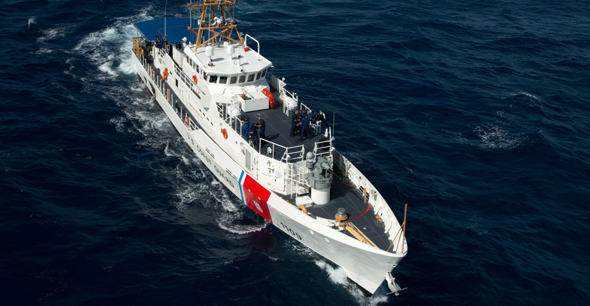
If a suspicious vessel is approaching the US, that must be boarded to determine its nature and intent, the boarding is likely to be done by a Coast Guard cutter, and not by a National Security Cutter, but by something much smaller. The cutter is also unlikely to have any heavily armed backup.
ORGANIZATION:
Section I THE GLOBAL SECURITY ENVIRONMENT, talks about geopolitical changes since the strategy was last issued, and current military challenges.
Section II FORWARD PRESENCE AND PARTNERSHIP, looks at the specific areas of operation, specifically the Indo-Asia-Pacific, Middle East, Europe, Africa, Western Hemisphere, and the Arctic and Antarctic.
Section III SEAPOWER IN SUPPORT OF NATIONAL SECURITY, talks about the strategy in terms of missions, broken down as “All Domain Access,” Deterrence, Sea Control, Power Projection, and Maritime Security.
Section IV FORCE DESIGN: BUILDING THE FUTURE FORCE, attempts to describe the future force that it contends will be “Flexible, Agile, and Ready.” It goes on to talk about Forces, People, Concepts, and Capabilities.
GEOGRAPHIC PERSPECTIVE: The plan starts getting into specifics regarding the Coast Guard when it talks about specific regions.
Indo-Asia-Pacific Region
“The Coast Guard will rotationally deploy National Security Cutters and deployable specialized forces with the Navy and Marine Corps to safeguard U.S. territorial waters and the Exclusive Economic Zone (EEZ). Additionally, the Coast Guard will work with regional partners and navies using joint and combined patrols, ship-rider exchanges, and multinational exercises to build proficient maritime governance forces, enhance cooperation in maritime safety and security, and reduce illegal, unreported, and unregulated fishing. These multinational efforts are furthered through the Oceania Maritime Security Initiative and participation in the North Pacific Coast Guard Forum.”
Now I’m not sure what the first sentence is getting at. Usually when DETs deploy with the Navy, it is not for operations in the US EEZ, unless perhaps they are talking about the occasional deployment with ships transiting the US EEZ around islands in the Western Pacific, if so they might have been more specific. I don’t know why the strategy in several places refers to the National Security Cutter rather than simply cutters. I think this might have been an attempt to sell the NSC, which is a job now complete, but it frankly does nothing to justify the Offshore Patrol Cutter which can also do this type of work.
This is the first of several mentions of the Coast Guard’s potential for capacity building with navies and coast guards of friendly nations.
Middle East
The Coast Guard will deploy personnel to build partner nation capacity for maritime governance and simultaneously conduct maritime security, infrastructure protection, and Port State Control activities. Coast Guard patrol boats and deployable specialized forces on Navy and coalition ships will counter illicit maritime activity.
It does appear that the Coast Guard patrol boats in Bahrain are expected to remain there. Does this mean these now overage boats will be replaced in the future? Will they or their replacements receive weapons upgrades similar to those of the Navy Cyclone class counterparts?
Europe–No mention of the Coast Guard. Even so the CG will probably be involved in capacity building in Eastern Europe, as it has been in the past.
Africa–the Coast Guard is again mentioned in terms of capacity development and partnership station type activities. There is also interestingly a statement that a base will be developed in Africa.
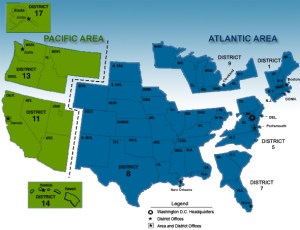
Coast Guard District and Area Organization
Western Hemisphere
We will strengthen partnerships and capacity in the Western Hemisphere to protect the homeland and to counter illicit trafficking and transnational criminal organizations. Coast Guard recapitalization efforts will produce a fleet of highly capable, multi-mission ships and aircraft, including the Offshore Patrol Cutter and the C-27J Spartan maritime patrol aircraft to counter threats, particularly in the Caribbean Sea, Gulf of Mexico, and eastern Pacific Ocean. The Navy will maintain its base at Guantanamo Bay, Cuba, to support joint and combined military operations and to enhance interagency efforts to develop regional security and cooperation. The Marine Corps will employ task forces or SPMAGTFs to support security cooperation activities that increase interoperability with regional partners and strengthen their capacity to interdict transnational criminal organizations. We will employ amphibious ships and other platforms, including Littoral Combat Ships, Joint High Speed Vessels, Afloat Forward Staging Bases, hospital ships, other Military Sealift Command ships, and Coast Guard platforms, to conduct humanitarian assistance and disaster response missions. We will also employ maritime patrol aircraft such as the P-8A Poseidon and unmanned aerial vehicles. Other ships and aircraft will provide periodic presence for recurring military-to-military engagements, theater security cooperation exercises, and other missions.
That is the entire section. Surprisingly no specific mention of using Navy ships for drug interdiction. Use of Navy vessels is mentioned only in the context of “humanitarian assistance and disaster response missions” and “military-to-military engagements, theater security cooperation exercises, and other missions.”

Competing claims in the Antarctic
Arctic and Antarctic:
Consistent with the predicted growth in maritime activity, the Sea Services will assess Arctic access and presence needs, improve maritime domain awareness, and pursue cooperation with Arctic partners to enhance the maritime safety and security of the region. This will require us to further develop our ability to operate in the Arctic, including in ice-covered and ice-obstructed waters. The Coast Guard will apply the multi-mission capabilities of the National Security Cutter to provide a tailored seasonal presence for command and control and aerial surveillance, and will begin the design process for a new, heavy icebreaking capability to support operations in both the Arctic and Antarctic. The Coast Guard will also pursue the formation of a maritime assistance, coordination, and operations group, open to members of the eight Arctic Council nations. The purpose of this group will be coordination of multinational search and rescue operations, training exercises, maritime traffic management, disaster response, and information sharing.
Again this is the entire section. DOD Maritime Domain Awareness is going to be very important here, and apparently it is already good. Looks like the Navy is content for the Coast Guard to be the face of US Naval presence in the Arctic. Again there is reference to the NSC which is not ice-strengthened and no mention of the OPC which is.
MISSION PERSPECTIVE: The Strategy refers to five essential functions–all domain access, deterrence, sea control, power projection, and maritime security.
All domain access: Not surprisingly there is no mention of a Coast Guard role in kicking in the door.
Deterrence: “The Coast Guard maintains a continuous presence in our ports, internal waterways, along our coasts, and offshore, providing an additional layer of defense against maritime threats.”
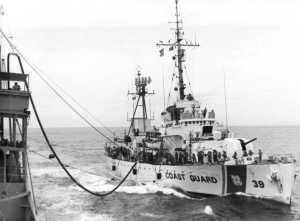
Cutter Owasco (WHEC-39) unreps while engaged in Operation Market Time off the coast of Vietnam.
Sea Control: There is no mention of a Coast Guard role in Sea Control. There should be. Sea Control frequently involves Visit, Boarding, Search and potentially Seizure of non-military vessels, e.g. merchant and fishing vessels. The Coast Guard is ideally suited for this role and has conducted this type of operation in war zones in the past, notably the Markettime Operation during the Vietnam War. In fact the common Coast Guard missions of drug and alien migrant interdiction are forms of sea control that potentially protect the US from non-state actors, but these missions are reflected in the Maritime Security mission.
When it comes to counting assets that might be used to exercise sea control, the Navy has roughly 110 cruisers, destroyers, frigates, LCS, and patrol craft and many of these, particularly the 85+ cruisers and destroyers, probably will have higher priority missions. The Coast Guard includes over 100 patrol boats and about 40 larger patrol vessels that routinely exercise sea control on an almost daily basis.
Force Projection: No mention of a Coast Guard role in Force Projection.

Maritime Security: It is here that the Coast Guard truly comes into its own.
We conduct maritime security operations by locating and monitoring vessels suspected of carrying illicit cargo or persons. If required, we intercept and board these vessels in support of U.S. law or international sanctions. Operating with the Coast Guard’s unique legal authorities, naval forces combat the illegal drug trade, human trafficking, and the unlawful exploitation of natural resources, particularly in the Western Hemisphere. Maritime security operations further support the broad maritime governance activities of the United States. These include assuring access to ice-covered and ice-obstructed waters in the Arctic and Antarctic.
Because all nations share in the collective benefits of maritime security, it is a promising area for expanded cooperation with our allies and partners. Through multinational exercises and training, we will conduct maritime security force assistance to combat transnational organized crime and protect fisheries and maritime commerce. This function supports the naval missions of defending the homeland, protecting maritime commons, and strengthening partnerships.
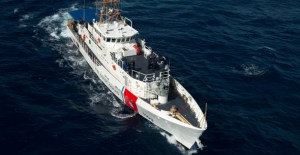
FORCE DESIGN, BUILDING THE FUTURE FORCE
There is not a lot here specific to the Coast Guard. There is discussion about acquisition and personnel policies, but they appear to reflect Navy Department aspirations.
There is potential in the concept of modularity for allowing Coast Guard assets, particularly cutters, to more rapidly transition to a wartime outfit.
This section includes a listing of projected required capabilities tied to each of the missions discussed above. It is in the Maritime Security section that we find statements relevant to the Coast Guard and its missions:
To combat terrorism, illicit trafficking, piracy, and threats to freedom of navigation in the maritime domain, we will:
■ Increase our capabilities in integrated maritime detection, monitoring, and intelligence, along with those of our allies and partners, to improve global maritime domain awareness. This involves exploring more stringent Automated Identification System reporting requirements for vessels weighing less than the currently mandated 300 tons, as well as fielding innovative technologies that enhance effectiveness against the small vessel threat.
■ Strengthen the International Port Security Program to further ensure the integrity and legitimacy of commercial vessels and cargo traveling to our shores.
■ Enhance our interoperability and capability to perform visit, board, search, and seizure in contested environments.
■ Improve interoperability between Navy and Coast Guard vessels, aircraft, and shore facilities, in accordance with the National Fleet Policy to maximize sea control and maritime security capabilities.
■ Support our allies and partners through training, exercises, and the provision of capabilities, via foreign military sales and financing, to increase their capacity to address maritime security challenges.

EVALUATION:
This is not a war plan so much as a plan for preventing war. From a Coast Guard perspective, it has largely canonized the status quo and the existing recapitalization program of record. It recognizes the Coast Guard’s unique authorities and its ability to contribute to capacity building. It seems to promise greater integration of a multiservice Maritime Domain Awareness.
On the other hand it does nothing to define Coast Guard wartime missions or how it might transition to a wartime footing. The force structure section does nothing to inform the design of Coast Guard equipment so that it might be more useful in wartime. It also does nothing to help that Coast Guard patrol boat I talked about at the beginning that is about to attempt to stop and board a potential hostile vessel that may be about to make an unconventional attack on a US port.
This is only the second iteration of the three service cooperative strategy. It is a marked improvement in specificity over the previous document. Hopefully there will be a process of continual improvement in succeeding editions.

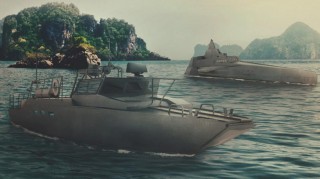


 USCGC Chock’s sistership, 65 foot tug, USCGC Swivel, by



 Chuck Hill's CG Blog