NavyRecognition reports award of a $125.6 million follow-on contract to General Dynamics Mission Systems to support Rescue 21, a system that uses VHF radio direction finders to determine the origin of distress calls. The post also provides a quick overview of the system except it doesn’t seem to include Alaska and the Western Rivers (Mississippi, Missouri, and Ohio river valleys) which are also now included in the system.
“Rescue 21 replaces the National Distress and Response System, which has been in use since the 1970s. Rescue 21 can more accurately identify the location of callers in distress via towers that generate lines of bearing to the source of VHF radio transmissions, thereby significantly reducing search time. Rescue 21 extends coverage out to a minimum of 20 nautical miles from the coastline. It improves information sharing and coordination with the Department of Homeland Security and other federal, state and local first responders, and can also identify suspected hoax calls, conserving valuable response resources.”
October 13, 1775 is the day the Navy claims as their birthday makiing this the 241st anniversary of its founding. They have a proud history, and really the Coast Guard and its preceeding services have had a role in that history. Perhaps that is why we are included in the video above. If you look at the video above, at time 0:46 you will see a pair of Coast Guardsmen on the foc’sle of an 82 foot WPB firing an M-16 and an over and under 81mm/.50 caliber in an apparent Vietnam firefight. The Navy also used a number of the over and under mounts on “Swift Boats” but they were mounted aft.
The National Cuttermen Chapter of the Surface Navy Association (formerly the Cuttermen Association) is seeking advice on what should be included in their website.
What would keep you coming back to this site?
Open Idea:
1. A place for posting research papers related to the Coast Guard and Cuttermen community. The purpose would be to encourage members (retired, active, enlisted and officer) to write. A small board can be assembled to mentor, review and edit submissions.
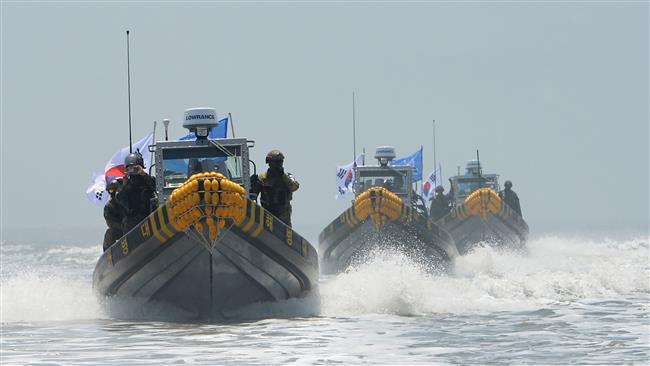
This photo released by South Korean Defense Ministry on June 10, 2016 shows South Korean patrol boats forcing Chinese fishing boats from disputed waters.(Photo by AFP)
This is one of several reports I have seen. A 4.5 ton South Korean “speed boat” (probably around 30 foot or 8 to 10 meter) has been rammed and sunk by a Chinese fishing vessel believed to have been over 100 tons. There were no casualties.
Reports are somewhat confusing, but, the way I interpret the reports, there was a large fleet of Chinese vessels fishing illegally in South Korean waters. A boarding party of eight had boarded one of the fishing vessels leaving one man still in the boat. A second Chinese fishing vessel rammed the boat as it lay alongside the fishing vessel probably crushing it. The one man aboard was recovered safely.
It is not clear to me how the boarding party got off the first fishing vessel or why the vessel was not detained.
A diplomatic protest has been filed with the Chinese.
Don’t bother to look for the Coast Guard in the listing, because we have been ignored again, but what I really wanted to address, is the use of BMI (Body Mass Index) as a standard. The standard of “fattest” was based entirely on exceeding a BMI of 25.
During my last tour, there was a petty officer I talked to frequently, who the Coast Guard was going to discharge because he was “over-weight.” In fact he was a rather large body builder, with very little fat on his frame. This was the kind of guy you want on your boarding party because he could be physically intemidating. We were going to discharge him, not because he was not in good shape, but because he was too muscular.
Body Mass Index was devised in the 1830s by Lambert Adolphe Jacques Quetelet. Let’s take a look at the formula for BMI:
weight (in kilograms)/height (in meters) squared
Note that it is height squared, but people are three-dimensional. If you really want to look at a proportional measurement you should use height cubed.
Looking at “25,” the upper edge of the nomnal normal range of BMI, the associated weight for different heights looks like this:
6’4″– 205
5’8″– 165
5′– 128
If on the other hand, if we assume the BMI chart is right for 5’8″ but made the other two weights proportional to the cube of heights, the upper limits would look like this.
6’4″– 230
5’8″– 165
5′– 113
BMI favors short people, while the tall are penalized.
At best, BMI should be used as a screening measure, but even in this role there are better formula available.
Before we destroy a service member’s career, we ought to be willing to base the decision on actual body fat content or a performance standard relivant to job performance.
Well, I already have four posts with many comments tracking China as they attempt to bully the Philippines, Japan, Vietnam, and Indonesia.
Now it seems it is time for one to track China’s attempts to Bully Singapore.
This post from the Independent, is about a proposed canal across the isthmus of Thailand, but if you read down to the second half of the post, you’ll see it is really about Chinese displeasure because Prime Minister Lee of Singapore has been standing up for a rules based international order rather than one based on force.
Take a look at this new vessel intended to support the offshore wind energy industry. For some reason this X-Bow/X-Stern configuration says “Buoytender” to me. I know the 225 WLB replacements are still a long way off, but it might be worth considering when the time comes. Like buoy tenders this type of vessel must hold position precisely and minimum pitching and vertical movement is desirable
The Navy has been talking a lot about distributed lethality lately, and “if it floats, it fights.” There is even talk of mounting cruise missiles on Military Sealift Command (MSC) ships, even though it might compromise their primary mission. But so far there has been little or no discussion of extending this initiative to include the Coast Guard. The Navy should consider investing high-end warfighting capability in the Coast Guard to augment existing force structure and provide a force multiplier in times of conflict. A more capable Coast Guard will also be better able to defend the nation from asymmetrical threats.
Why Include the Coast Guard?
A future conflict may not be limited to a single adversary. We may be fighting another world war, against a coalition, perhaps both China and Russia, with possible side shows in Africa, the Near East, South Asia, and/or Latin America. If so, we are going to need numbers. The Navy has quality, but it does not have numbers. Count all the Navy CGs, DDGs, LCSs, PCs and PBs and other patrol boats and it totals a little over a hundred. The Coast Guard currently has over 40 patrol ships over 1,000 tons and over 110 patrol craft. The current modernization program of record will provide at least 33 large cutters, and 58 patrol craft of 353 tons, in addition to 73 patrol boats of 91 tons currently in the fleet, a total of 164 units. Very few of our allies have a fleet of similar size.
Coast Guard 82 foot patrol boats interdicted coastal traffic off South Vietnam. (USCG Photo)
Coast Guard vessels routinely operate with U.S. Navy vessels. The ships have common equipment and their crews share common training. The U.S. Navy has no closer ally. Because of their extremely long range, cutters can operate for extended periods in remote theaters where there are few or even no underway replenishment assets. The Coast Guard also operates in places the USN does not. For example, how often do Navy surface ships go into the Arctic? The Coast Guard operates there routinely. Virtually all the U.S. vessels operating with the Fourth Fleet are Coast Guard. There are also no U.S. Navy surface warships home based north of the Chesapeake Bay in the Atlantic, none between San Diego and Puget Sound in the Pacific, and none in the Gulf of Mexico with the exception of mine warfare ships.
In the initial phase of a conflict, there will be need to round-up all the adversaries’ merchant ships and keep them from doing mischief. Otherwise they might lay mines, scout for or resupply submarines, put agents ashore, or even launch cruise missiles from containers. This is not the kind of work we want DDGs doing. It is exactly the type of work appropriate for Coast Guard cutters. Coast Guard ships enjoy a relatively low profile. Unlike a Carrier Strike Group or Navy SAG, they are less likely to be tracked by an adversary.
If we fight China in ten to twenty years, the conflict will likely open with China enjoying local superiority in the Western Pacific and perhaps in the Pacific in general. If we fight both China and Russia it may be too close to call.
Platforms
The National Security Cutter (NSC)
This class of at least nine and possibly ten, 418 foot long, CODAG powered, 28 knot ships, at 4,500 tons full load, are slightly larger than Perry-class frigates. Additionally they have a 12,000 nautical mile cruising range. As built they are already equipped with:
Navy certified helicopter facilities and hangar space to support two H-60 helicopters,
A 57 mm Mk110 gun,
SPQ-9B Fire Control Radar
Phalanx 20mm Close in Weapon System (CIWS)
2 SRBOC/ 2 x NULKA countermeasures chaff/rapid decoy launcher,
A Sensitive Compartmented Intelligence Facility (SCIF)
In short, they are already equipped with virtually everything needed for a missile armed combatant except the specific missile related equipment. They are in many respects superior to the Littoral Combat Ships. Adding Cooperative Engagement Capability might even allow a Mk41 equipped cutter to effectively launch Standard missiles targeted by a third party.
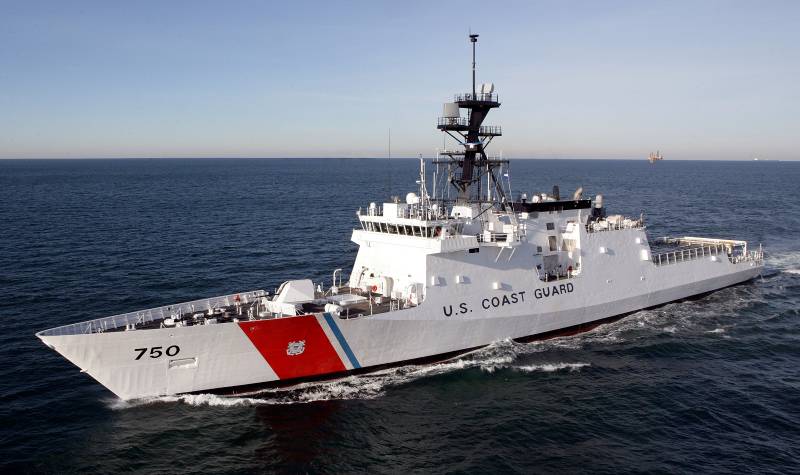
USCG National Security Cutter BERTHOLF (USCG Photo)
The ships were designed to accept 12 Mk56 VLS which launch only the Evolved Sea Sparrow missiles (ESSM). Additionally, the builder, Huntington Ingalls, has shown versions of the class equipped with eight Mk41 VLS (located between the gun and superstructure) plus eight Harpoon, and Mk32 torpedo tubes (located on the stern). Adding missiles to the existing hulls should not be too difficult.
The Mk41 VLS are more flexible in that they can accommodate cruise missiles, rocket boosted antisubmarine torpedoes (ASROC), Standard missiles, or Evolved Sea Sparrow missiles (ESSM). Using the Mk41 VLS would allow a mix of cruise missiles and ESSM with four ESSMs replacing each cruise missile, for example eight cells could contain four cruise missiles and 16 ESSM, since ESSM can be “quad packed” by placing four missiles in each cell. Development of an active homing ESSM is expected to obviate the need for illuminating radars that are required for the semi-active homing missiles. Still, simpler deck mounted launchers might actually offer some advantages, in addition to their lower installation cost, at least in peacetime.
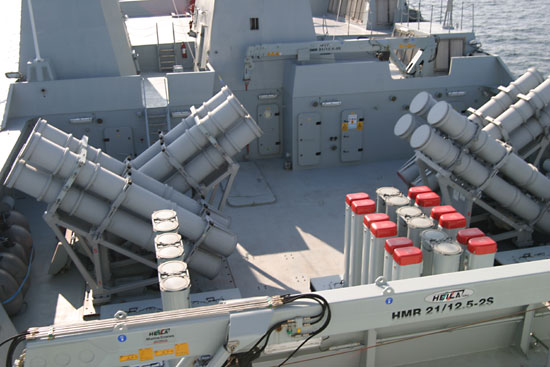
Cutters often visit ports where the population is sensitive to a history of U.S. interference in their internal affairs. In some cases, Coast Guard cutters are welcome, while U.S. Navy ships are not. For this reason, we might want to make it easy for even a casual observer to know that the cutter is not armed with powerful offensive weapons. Deck mounted launchers can provide this assurance, in that it is immediately obvious if missile canisters are, or are not, mounted. The pictures below show potential VLS to be considered.
The relatively small footprint of the Mk56 VLS system (pdf) can be seen here on a Danish Absalon-class command and support ship (beam 64 feet, by comparison the National Security Cutters’ beam is 54 feet). Two sets are visible in the foreground, one set of twelve with missile canisters with red tops in place to the right, on the ship’s centerline, and a second set of twelve without canisters to the left. The Absalon-class has three twelve-missile sets, with the third set off camera to the right. (Royal Danish Navy)
12 earlier Mk48 mod3 VLS for ESSM seen here mounted on the stern of a 450 ton 177 foot Danish StanFlex300 Flyvefisken-class patrol boat. The Mk56 launchers replace the Mk48s with an approximate 20% weight savings.
The Offshore Patrol Cutter (OPC)
The OPC program of record for provides 25 of these ships. A contract has been awarded to Eastern Shipbuilding Group for detail design and construction of the first ship, with options for eight more. The notional design is 360 feet long, with a beam of 54 feet and a draft of 17 feet. The OPCs will have a sustained speed of 22.5 knots, a range of 10,200 nautical miles (at 14 knots), and an endurance of 60-days. It’s hangar will accommodate one MH-60 or an MH-65 and an Unmanned Air System (UAS).
Notional design characteristics and performance of the OPC. (USCG Image)
It will have a space for a SCIF but it is not expected to be initially installed. As built, it will have a Mk38 stabilized 25 mm gun in lieu of the Phalanx carried by the NSC. Otherwise, the Offshore Patrol Cutter will be equipped similarly to the National Security Cutter. It will likely have the same Lockheed Martin COMBATSS-21 combat management system as the LCS derived frigates. It is likely they could be fitted with cruise missiles and possibly Mk56 VLS for ESSM as well. Additionally these ships will be ice strengthened, allowing the possibility of taking surface launched cruise missiles into the Arctic
The Fast Response Cutter (FRC)
The FRC program of record is to build 58 of these 158 foot, 28 knot, 365 ton vessels. 19 have been delivered and they are being built at a rate of four to six per year. All 58 are now either built, building, contracted, or optioned. They are essentially the same displacement as the Cyclone class PCs albeit a little slower, but with better seakeeping and a longer range. Even these small ships have a range of 2,950 nm. They are armed with Mk 38 mod2 25 mm guns and four .50 caliber M2 machine guns.
The first Sentinel-class Fast Response Cutter (FRC), USCGC Bernard C. Webber. (USCG photo)
They are already better equipped than the Coast Guard 82 foot patrol boats that were used for interdiction of covert coastal traffic during the Vietnam war. If they were to be used to enforce a blockade against larger vessels, they would need weapons that could forcibly stop medium to large vessels.
The Marine Protector Class
There are 73 of these 87 foot, 91 ton, 26 knot patrol boats. Four were funded by the Navy and provide force protectionservices for Submarines transiting on the surface in and out of King Bay, GA and Bangor, WA.
Photo: KEYPORT, Wash. (Aug. 18, 2009) U. S. Coast Guardsmen man the rails as the U.S. Coast Guard Cutter Sea Fox (WPB 87374), one of four of this class assigned to Force Protection units. (U.S. Navy photo Ray Narimatsu/Released)
If use of these vessels for force protection were to be expanded to a more hostile environment, they would likely need more than the two .50 caliber M2 machine guns currently carried. The four currently assigned to force protection units are currently equipped with an additional stabilized remote weapon station.
Weapons
Cruise Missiles
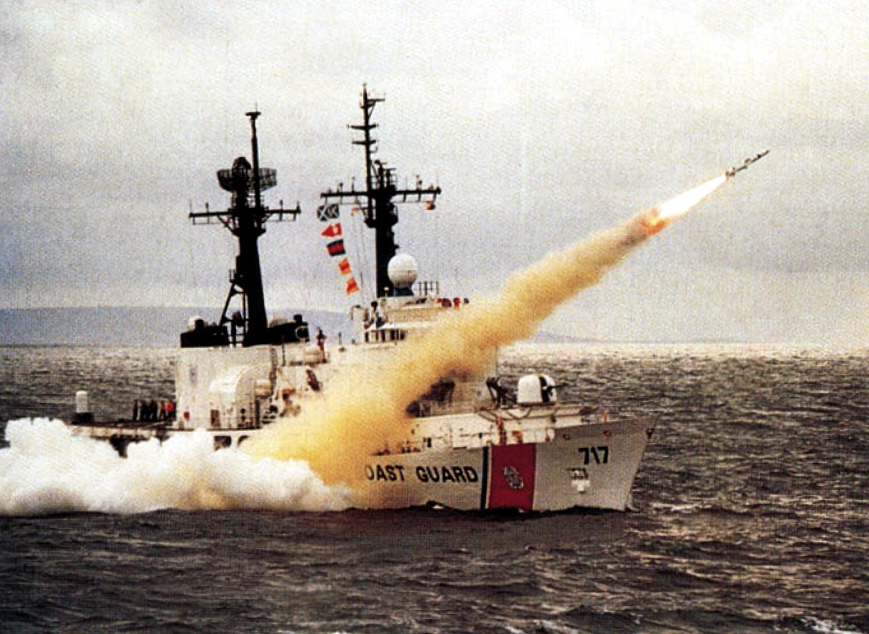
The U.S. Navy currently has or is considering four different surface launched cruise missiles: Harpoon, Naval Strike Missile (NSM), Long Range Anti-Ship Missile (LRASM), and Tomahawk. Of these, LRASM appears most promising for Coast Guard use. Tomahawk is the largest of the four and both Harpoon and NSM would be workable, but they do not have the range of LRASM. The intelligence and range claimed for the LRASM not only makes it deadlier in wartime, it also means only a couple of these missiles on each of the Coast Guard’s largest cutters would allow the Coast Guard’s small, but widely distributed force to rapidly and effectively respond to asymmetric threats over virtually the entire U.S. coast as well as compliment the U.S. Navy’s efforts to complicate the calculus of a near-peer adversary abroad
Small Precision Guided Weapons
It is not unlikely that Fast Response Cutters will replace the six 110 foot patrol boats currently based in Bahrain. If cutters are to be placed in an area where they face a swarming threat they will need the same types of weapons carried or planned for Navy combatants to address this threat. These might include the Sea Griffin used on Navy’s Cyclone-class PCs or Longbow Hellfires planned for the LCS.
Additionally, a small number of these missiles on Coast Guard patrol craft would enhance their ability to deal with small, fast, highly maneuverable threats along the U.S. coast and elsewhere
Light Weight Anti-Surface Torpedoes
If Coast Guard units, particularly smaller ones, were required to forcibly stop potentially hostile merchant ships for the purposes of a blockade, quarantine, embargo, etc. they would need something more that the guns currently installed.
The U.S. does not currently have a light weight anti-surface torpedo capable of targeting a ship’s propellers, but with Elon Musk building a battery factory that will double the worlds current capacity and cars that out accelerate Farraris, building a modern electric small anti-surface torpedo should be easy and relatively inexpensive.
Assuming they have the same attributes of ASW torpedoes, at about 500 pounds these weapons take up relatively little space. Such a torpedo would also allow small Coast Guard units to remain relevant against a variety of threats.
Conclusion
Adding cruise missile to the Coast Guard National Security Cutters and Offshore Patrol Cutters would increase the number of cruise missile-equipped U.S .surface ships by about 40 percent.
Coast Guard Patrol craft (WPCs) and patrol boats (WPBs) significantly outnumber their Navy counterparts. They could significantly increase the capability to deal with interdiction of covert coastal traffic, act as a force multiplier in conventional conflict, and allow larger USN ships to focus on high-end threats provided they are properly equipped to deal with the threats. More effective, longer ranged, and particularly more precise weapons could also improve the Coast Guard’s ability to do it Homeland security mission.
Thanks to OS2 Michael A. Milburn for starting the conversation that lead to this article.
Photo: The Government of Mexico purchased four CN235-300M aircraft (similar to the Coast Guard’s HC-144A). Oct. 1, 2010, the Foreign Military Sales program awarded a $157.9 million contract to EADS North America to produce these aircraft. The fourth and final delivery took place May 2, 2012, at EADS’ facility in Seville, Spain. Photo courtesy of Airbus Military.
CIMSEC has an interesting post that postulates a greatly expanded leadership role for the Coast Guard. In many ways it is radical, but I think it may be the way we are headed.
It suggests an enlarged role in international maritime policing and Foreign Military Sales. That probably implies intelligence collection and distribution.
“Under the umbrella of muscular law enforcement, the Coast Guard would manage not only patrols of the American coast, but also patrols off South America and Africa as well.”
That may already be close to reality in the SouthCom AOR.
The author describes a standard “frigate” that could very well be the Offshore Patrol Cutter:
“The principal requirements would be low cost, ease of maintenance, and margins for growth. The basic warship would have a simple power plant, enough systems to operate as a minimalist patrol ship, and substantial space and weight left available for additions.”
“Built cheaply and in large numbers, flotillas of these semi-modular ships would patrol for pirates off Africa, drug smugglers in the Gulf of Mexico, or vessels in distress off North America.”
He also sees a role for these ships in Amphibious Assaults.
“…the amphibious train would be escorted by frigates (based on the common hull introduced above) specialized with the maximum number of naval guns possible. With these frigates, the amphibious force would be able to defeat enemy forces in waters too constricted for the blue-water warships to operate effectively.”
We have seen a growing Coast Guard role in Foreign Military Sales with the delivery of hundreds of boats to dozens of nations, new 87 foot patrol boats going to Yemen, and maritime patrol aircraft going to Mexico. I don’t think it is too much of a stretch to see OPCs or Webber class WPCs being sold to our allies and friends, possibly funded in whole or in part by US Foreign Military Assistance.
There may be minor issues with his vision. I might argue that in accordance with the post’s logic, force protection should be under Coast Guard management, but generally his views are sound. It is surprising to see so much of a post by a former E-2C/D Hawkeye Naval Flight Officer devoted to the Coast Guard. The whole post is worth a read.
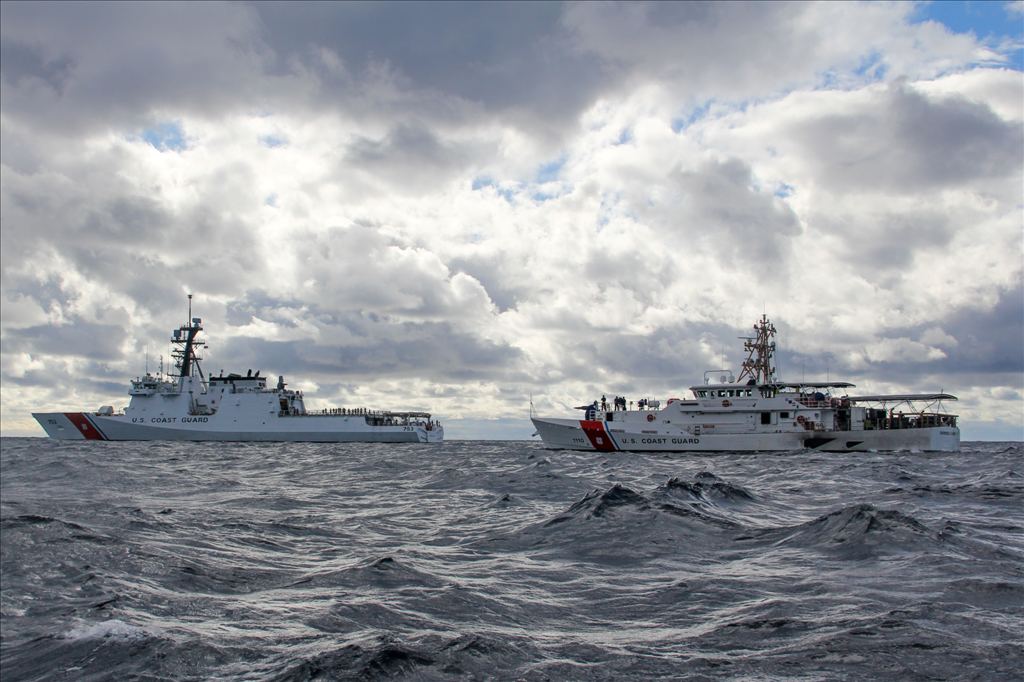
Photo: USCGC Hamilton (WMSL-753) (left) and USCGC Raymond Evans (WPC-1110)
A quick review of what is happening.
A Coast Guard aircraft has done a damage assessment in Haiti. News release here.
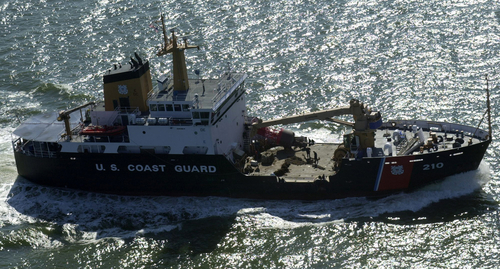
PENSACOLA BEACH, Fla. (Sept. 20, 2004)–Coast Guard cutter CYPRESS, a 225-foot buoy tender homeported in Mobile, Ala.
USCGC Cypress (WLB-210) is enroute. Additional aviation assets and two flood punt teams from Memphis, Tennessee are being staged at AVTRACEN Mobile. News release here.
Cutter Hamilton (WMSL-753) is in the area and is being augmented with additional Coast Guard medical personnel transported to GITMO by a C-130.Additionally “Coast Guard (air) crew members launched Thursday to transport personnel and supplies to support post Hurricane Matthew relief efforts in Great Inagua, Bahamas and other areas qffected by the storm.”








 Chuck Hill's CG Blog