“UNITAS LXIV to begin in Colombia” –USNAVSOUTH/4TH FLEET PUBLIC AFFAIRS

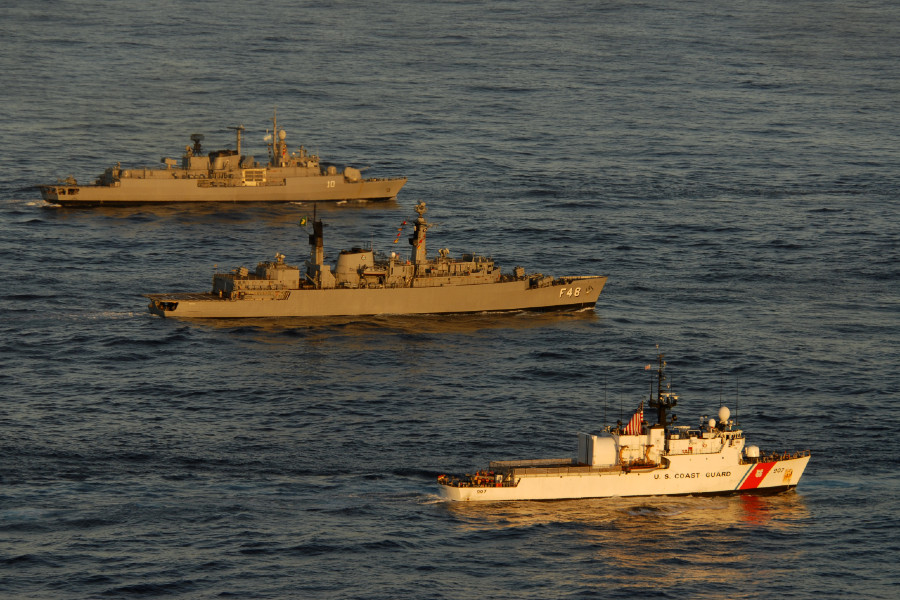
The US Coast Guard cutter USCGC Escanaba (WMEC 907), Brazlian Navy ship BNS Bosisio (F 48) and Argentinian navy ship ARA Almirante Brown (D-10) move into formation for a photo exercise during the Atlantic phase of UNITAS 52 on May 4, 2011. The formation included a total of ten ships from the US, Brazil, Mexico and Argentina. (Photo: US Navy/Mass Communication Specialist 1st Class Steve Smith)

Below is a news release announcing the start of exercise UNITAS LXIV (64 if you are not up on your Roman numerals). There is no mention of Coast Guard participation, but maybe they “simply forgot us.” Think we can bet there are some Coasties involved.

Britain’s Royal Navy also sent one of their highly regarded destroyers, HMS Dauntless.

With 26 surface vessels and three submarines participating, I think this is larger than most of the recent UNITAS exercises. In 2022 it was 19 ships, one submarine, 21 aircraft, accounting for approximately 5,500 total military personnel.

This year will see an attempt at large scale integration of unmanned systems into the exercise by 4th Fleet.


July 11, 2023

UNITAS LXIV to begin in Colombia

By USNAVSOUTH/4TH FLEET PUBLIC AFFAIRS

– U.S. Navy and Marine forces are set to arrive in Cartagena in support of UNITAS LXIV, the world’s longest-running multinational maritime exercise in the world, scheduled to start July 11, 2023.

The Colombian navy will host this year’s UNITAS, which will feature 26 warships/vessels, three submarines, 25 aircraft (fixed wing/helicopter), and approximately 7,000 people from 20 partner nations. Forces will conduct training operations off the coast of Cartagena, Colombia, and ashore in Covenas and Barranquilla, Colombia, through July 21. This year marks the 64th iteration of the exercise. Additionally, this year Colombia will celebrate the bicentennial of its navy, a historical milestone commemorating 200 years of the country’s maritime forces.

“UNITAS is so much more than a two week exercise. All participating nations have given much time, energy and effort into the months of planning leading up to what will be one of the most complex UNITAS to date,” said Rear Admiral Jim Aiken, commander U.S. Naval Forces Southern Command/U.S. 4th Fleet. “Utilizing air, surface, sub-surface, and unmanned assets, and land units, UNITAS will provide the multinational force a challenging environment in which to conduct training across the full spectrum of maritime operations. UNITAS strengthens maritime partnerships, enhances proficiency and improves interoperability of the participating forces, which is why so many partner nations are taking part this year.”

As part of the U.S. Navy’s future hybrid fleet, the Chief of Naval Operations has tasked U.S. 4th Fleet to scale unmanned platforms to the fleet level. An addition to this year’s UNITAS will include the integrated operations of unmanned air, surface, and subsurface systems into the exercise. UNITAS’ challenging training address key aspects of multinational and combined operations such as technology standardization and common operating procedures.

“This is our first opportunity to integrate unmanned systems into our operations at sea,” said Rear Adm. Aiken. “UNITAS has often served as a test bed for technology, so it is appropriate that we begin our unmanned integration campaign to operationalize the hybrid fleet here in UNITAS.”

In addition to the United States, UNITAS LXIV will bring together 19 nations from all over the world to train forces in joint maritime operations that enhance tactical proficiency and increase interoperability. Participating nations include Belize, Brazil, Canada, Chile, Colombia, Dominican Republic, Ecuador, France, Germany, Honduras, Jamaica, Mexico, Panama, Peru, Paraguay, Spain, South Korea, United Kingdom, United States, and Uruguay.

Following the UNITAS LXIV Opening Ceremony on July 12, the in port phase of the exercise will feature subject matter expert exchanges, professional symposia, ship rider exchanges, and operations meetings. During this time, Marines and Sailors will conduct expeditionary training events in Covenas to include riverine operations and diving and salvage operations.

During the UNITAS LXIV Underway Phase, forces will participate in events testing all warfare operations, to include live-fire exercises such as a SINKEX and an amphibious ship-to-shore landing and force retraction.

“Marines and Sailors from across the United States will travel to Colombia to not only train alongside our partner nations’ militaries, but to hone the skills required to operate as part of a larger maritime force focused on sea control and sea denial,” said Lt. Gen. David G. Bellon, commander, U.S. Marine Corps Forces, South, and U.S. Marine Corps Forces, Reserve. “We will be exercising command and control from a forward position as Marines set up and employ Expeditionary Advanced Base Operations to enhance naval capabilities as part of UNITAS.”

U.S. forces participating in UNITAS LXIV include USS New York (LPD 21), USS Cole (DDG 67), USS Little Rock (LCS 9), USS Pasadena (SSN 752), and USNS Burlington (T-EPF 10). Other U.S. participants include Patrol Squadron Five (VP 5), Mobile Diving and Salvage Unit (MDSU) 2, Explosive Ordnance Disposal Mobile Unit (EOD) 612, Mine Countermeasures Group 3, (MCMGRU 3), Expeditionary Mine Countermeasures EOD Company 61 (EODMU 61), East-coast based Naval Special Warfare units, Helicopter Sea Combat Squadron 22 (HSC 22), Helicopter Maritime Strike Squadron 70 Detachment 2 (HSM 70 Det 2), Joint Communications Support Element (JCSE), Fleet Surgical Team (FST) Eight, and the Meteorological Environmental Team (MET). U.S. Marine forces include 3rd Battalion, 23rd Marine Regiment (3/23), 4th Amphibious Assault Battalion (4th AABn), 8th Combat Logistic Battalion (CLB 8), 4th Combat Engineer Battalion (4th CEB), Marine Medium Tiltrotor Squadron 774 (VMM 774), Marine Light Helicopter Attack Squadron 775 (HMLA 775), Marine Aerial Refueler Transport Squadron 234 (VMGR-234), Marine Aircraft Control Group – 48 (MACG-48), and Marine Fighter Attack Squadron 112 (VMFA-112). Finally, Commander, Destroyer Squadron 40, (COMDESRON 40), Commander, Amphibious Squadron Four (COMPHIBRON FOUR), U.S Marine Corps Forces South (MARFORSOUTH), Special Operations Command South (SOCSOUTH), USNAVSOUTH/FOURTHFLT, and U.S. Southern Command (USSOUTHCOM) are participating in UNITAS LXIV.

UNITAS, which is Latin for unity, united, or oneness, was conceived in 1959 during a previous era of strategic competition when representatives at the first Inter-American Naval Conference in Panama agreed to conduct an annual maritime exercise with one another. Prior to UNITAS I in 1960, U.S. Chief of Naval Operations Adm. Arleigh Burke reviewed preparations for the multinational exercise. He commended planners for their progress, especially in building compatible communication systems among navies, and predicted that UNITAS would build strong relationships among Sailors of the Western Hemisphere.

U.S. Naval Forces Southern Command/U.S. 4th Fleet supports U.S. Southern Command’s joint and combined military operations by employing maritime forces in cooperative maritime security operations to maintain access, enhance interoperability, and build enduring partnerships in order to enhance regional security and promote peace, stability and prosperity in the Caribbean, Central and South American region.

U.S. Marine Corps Forces, South is the Marine Corps component to U.S. Southern Command, is responsible for planning exercises, operations, and overall Marine Corps support for the SOUTHCOM assigned area of responsibility.

Webber class Could be the Navy’s Light Duty Pickup Truck

Coast Guard Cutter John F. McCormick (WPC 1121) crew transits through the San Francisco Bay, Saturday, March 4, 2017, during their voyage to homeport in Ketchikan, Alaska.  Coast Guard photo by Petty Officer 2nd Class Loumania Stewart

In 2012 the US Naval Institute published an important article by then CNO Admiral Johnathan Greenert, “Payloads over platforms: Charting a new course.” It starts off, 
“We need to move from ‘luxury-car’ platforms—with their built-in capabilities—toward dependable ‘trucks’ that can handle a changing payload selection. “
He suggested that the Navy needs F150 pickups rather than Ferraris. Metaphorically the Webber class could be the Navy’s small Toyota pickup–cheap, reliable, versatile, and economical to operate. 
A strong point for the Webber class is that it is probably the smallest and cheapest combatant, being currently manufactured, that can self deploy anywhere in the world (other than the polar regions) with minimal support en route as demonstrated by their self deployment to Hawaii and Alaska and USCGC Olivier F. Berry (WPC-1124)’s successful patrol to the Marshall Islands, 2200 miles from her homeport in Honolulu.
As currently equipped there is not a lot of free space apparent on the Webber class, but removing the eight meter “over the horizon boat” would free up a large area where mission modules could be placed. We can think of it as the bed of the pickup.


180201-N-TB177-0211
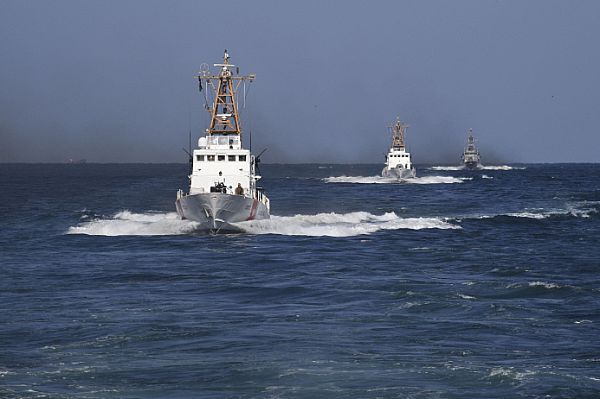
U.S. 5TH FLEET AREA OF OPERATIONS (Feb. 1, 2018) Island-class patrol boats USCGC Wrangell (WPB 1332), left, USCGC Aquidneck (WPB 1309), middle, and coastal patrol ship USS Firebolt (PC 10) patrol the open seas. Wrangell, Aquidneck and Firebolt are forward deployed to the U.S. 5th Fleet area of operations in support of maritime security operations to reassure allies and partners and preserve the freedom of navigation and the free flow of commerce in the region. (U.S. Navy photo by Mass Communication Specialist 2nd Class Kevin J. Steinberg/Released)

Potential Missions
 
Countering the Swarm: 
 
The Navy’s most likely first use of a Webber class could be as replacements for the Cyclone class in South West Asia. Countering the large number of Iranian fast inshore attack craft (FIAC) is a mission the Cyclone class is expected to do now, protecting both larger Navy vessels and the tanker traffic that must pass through the Straits of Hormuz. 

The Fletcher laser guided rocket launcher fires BAE’s 2.75 inch laser guided rockets known as the Advanced Precision Kill Weapon System. (Shawn Snow/Defense News Staff)

An earlier post, “Modifying Webber Class Cutters for Duty in SW Asia,” was aimed at this threat as applied to the Coast Guard Webber class that will be going to Southwest Asia. As a minimum the Navy will likely want some form of guided weapon, Perhaps the APKWS would suffice, if provided in sufficient numbers.

Spike LR Missile launched from a Typhoon weapon station on an Israel Navy Super Dvora Mk 2. A similar configuration was recently tested by the US Navy, from an unmanned surface vessel (USV-PEM). Photo: RAFAEL

The 25mm Mk38 Mod2/3 that are currently mounted on the Webber class might be up-gunned (30, 35, and 40mm guns are all possible) and the mount might also be modified to also launch APKWS. Alternately the Mk38 might be replaced by BAE’s 40mm/70 MK4 and the Toplite gun director c(urrently mounted on the Mk38) could be mounted on the mast to control the 40mm, as the Israelis have done with some of their installations of the system, assuming the 40mm Mk 4 does not weigh too much.  

BAE Bofors 40mm/70 mk4

Optimally, the outfit should include Longbow Hellfire. It could probably be mounted as single tube launchers affixed along the sides of the superstructure. I have seen a mockup of such a launcher. The missile itself is only about seven inches in diameter. If willing to replace the boat with missiles, its likely Lockheed could produce a 12 round launcher based on half the launcher being installed on the LCS. 

ATLANTIC OCEAN—A Longbow Hellfire Missile is fired from Littoral Combat Ship USS Detroit (LCS 7) on Feb. 28 2017 as part of a structural test firing of the Surface to Surface Missile Module (SSMM). The test marked the first vertical missile launched from an LCS and the first launch of a missile from the SSMM from an LCS. (Photo by U.S. Navy)

Anti-Ship: 
In other theaters there is likely a desire to have a larger anti-ship missile. 
The Navy has been talking a great deal about “Distributed Lethality.” The concept has its origin in a January 2015 US Naval Institute article by then-Director of Surface Warfare Requirements (OPNAV N96) Rear Admiral Tom Rowden, RAdm. Peter Gumataotao, and RAdm. Peter Fanta. 
 
Rowden’s co-author and successor at N96, Rear Admiral Pete Fanta, continued the drum beat with the memorable phrase, “if it floats, it fights,” suggesting that anti-ship missiles should be put on virtually all units. 
On the Webber class, this would most likely the Naval Strike Missile (NSM), recently chosen by the Navy to arm its LCSs and frigates. A four cell launcher could probably replace the boat. The missile is only 13 feet long. 

A Kongsberg Naval Strike Missile (NSM) is launched from the U.S. Navy littoral combat ship USS Coronado (LCS-4) during missile testing operations off the coast of Southern California (USA). The missile scored a direct hit on a mobile ship target. 23 September 2014.
U.S. Navy photo by Mass Communication Specialist 2nd Class Zachary D. Bell

Missile Truck
The Army and Marines have tracked and truck mounted missile launchers. 
 
A new missile, “Deepstrike,” is being developed for these launchers. “The missile will be able to strike targets up to 309 miles away with precision, including moving targets both on land at sea.” (see also)
 
A Webber class equipped with these could function in the same way as the Army and Marine vehicles operating in the littorals and many river systems. Targeting would be provided by offboard sensors through networking. 
Anti-Submarine Warfare (ASW)
This is probably unlikely, but there might be a place for craft that could perform ASW patrols off ports and amphibious objective areas or around choke points. 
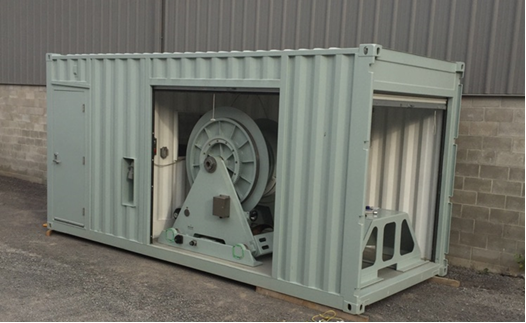
The Canadians have a small containerized towed array sensor that looks like it would fit.

TRAPS containerized active/passive towed array from GeoSpectrum Technologies.

 I have looked at how we might add torpedo tubes to the Webber class that could launch ASW torpedoes, but it is more likely aircraft, most likely helicopters, would be called in to make the actual attack. The ship would be primarily a sensor node, minimizing the requirement to keep ASW Helicopters airborne.
120mm Mortar for Naval Surface Fire Support:
Another truck like use would be to add this containerized large mortar as a way to provide naval fire support. This weapon is not currently in the US inventory but it does look promising. Guided projectiles are being developed for the 120 mm mortar.
Security for MSC’s PrePositioned Afloat Fleet

I am not sure what precautions the Navy has made to protect the ships of the MSC’s PrePositioned Afloat Fleet, but if I were an enemy there are might be strong incentive to destroy these ships that transport the most ready reinforcements of heavy equipment.

Webber class PCs might have a role in protecting these.

 Large Unmanned Surface Vessel. 

The Navy is seeking to procure a medium unmanned surface vessel (MUSV), 12 to 50 meters in length. The Webber class might be the basis for such a vessel. The modular systems described above might also be used on the MUSV. 

Visit, Search, Board, and Seizure: 

This is the mission these little ships are built for and, consequently, no change may be necessary. The mission might be stopping and boarding hundreds of small craft as was done off Vietnam as part of Operation Market Time, or it might be enforcing a blockade against Chinese shipping at the Straits providing access to the South China Sea. If resistance is expected there are a number of ways the vessels’ armament could be augmented, including missiles or torpedoes, but in most cases its likely air or backup could be called in. The real advantage is that the Navy would not need to tie down DDGs doing this work, and potentially risk it being damaged by improvised weapons on a vessel being boarded. For more challenging assignments two or three could be teamed with one or two providing boats and boarding teams and the other as a weapons carrier.

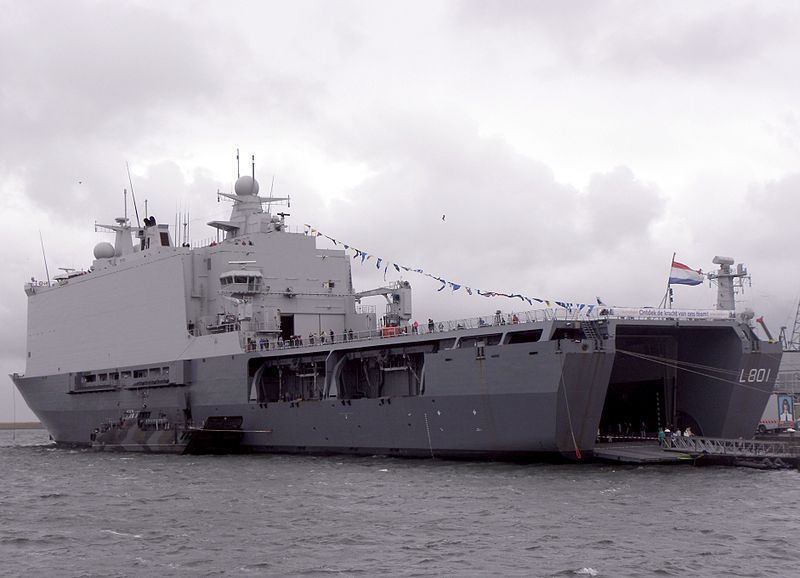
Dutch Mothership?

L 801 Johan de Witt Uploaded by Oxyman

L 801 Johan de Witt Uploaded by Oxyman

The following was reported by the German Navy blog Marine forum, “8 January, PIRACY–Anti-Piracy Forces: Sweden is preparing for another mission (M-04) in support of EU operation “Atalanta”, this time working jointly with the Netherlands navy … COMBAT BOAT 90 fast interceptor craft, helicopters and 70 personnel to embark on Netherlands Navy dock landing ship JOHAN DE WITT.”

As you may recall, I have advocated using WPCs supported by a mother ship to supplement the larger cutters for distant drug interdiction operations.

We have done cooperative counter drug operations with the Netherlands Navy in the past. Early last year, the Netherlands OPV Zeeland embarked both a CG LEDET and a CG helo det.

Perhaps we could run a test using the Johan de Witt or her sistership Rotterdam to try out the mothership concept. Their crew size is similar to that of the National Security Cutters (less than that of the Hamilton class), but they have berthing for hundreds more. They have aviation facilities for up to six helicopters. They can handle boats from both davits and a well deck. They have excellent Command and Control facilities.

“The ships have a complete Class II hospital, including an operating theater and intensive care facilities. A surgical team can be stationed on board.” That could make them welcome in a lot of ports.

Would the Dutch be interested? The Dutch Navy has already demonstrated its commitment to counter drug trafficing. They have used these ships several times for counter-piracy. Counter drug operations are not that much different, and piracy seems to be in decline. When it was being finished, there were reports that the Dutch wanted to sell the Johan de Witt. Operating off Latin America might be seen as an opportunity to demonstrate both this class and the Netherlands’ ship building expertise in an international market.

What might the experimental effort include. In addition to the mothership, perhaps three MH-65s, add a mix of Webber class WPCs, WPBs, Response Boat Mediums (RB-M), and Navy Riverine Command Boats (the US Navy version of the Combatboat 90).

In addition to its counter drug objectives, the deployment might be seen as a partnership station effort, training as well as working with the locals, and if there should be a natural disaster while they are in the area, it will be a ready made Coast Guard response.

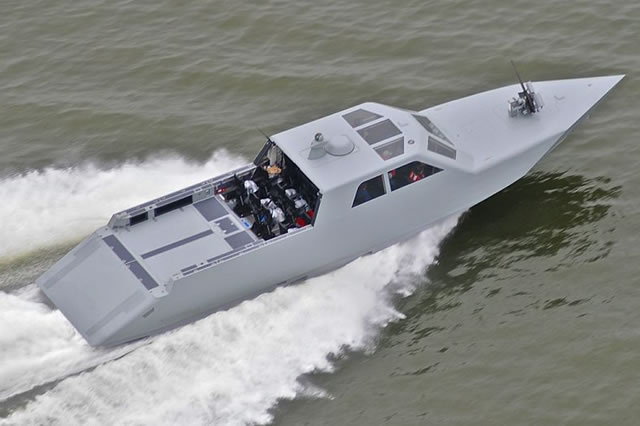
Special Operations Command, Combatant Craft, Medium

Combatant_Craft_Medium_Mark_1_CCM-Mk1_USSOCOM_2

Navy Recognition has a story on the Navy’s planned 60 foot “Combatant Craft, Medium” or CCM.

Characteristics as follows:
CCM Mk1 main characteristics (as provided by USSOCOM):
Length: approximately 60’
Speed: 40
Range: 400 nautical miles
Crew: 4
Payload: 7750 lbs.
Passengers: up to 19
Engine: Twin forced induction diesel engines driving props
Hull: Double step hull made of aluminum

See the story linked above for more photos and details.

More Lessons Learned, “Guardians of the Gulf: A History of Coast Guard Combat Operations in Support of Operation Iraqi Freedom, 2002-2004”

1024px-USCGC_Adak

Photo: USCGC Adak, part of Patrol Forces, South West Asia, note extra machinegun mount behind the pilothouse. Click on the photo to enlarge.

Not long ago we talked about the need to preserve lessons learned from atypical (usually military) Coast Guard operations like participation in the Vietnam War or operations in South West Asia. Craig Allen Jr. brought to my attention a LANTAREA historian’s publication, “Guardians of the Gulf: A History of Coast Guard Combat Operations in Support of Operation Iraqi Freedom, 2002-2004” (pdf) by William H. Thiesen, PhD, June 2009

Regarding the deployment of WPBs the study noted, “Even though the Coast Guard served a similar mission in Vietnam, there existed no operational plan to provide guidance for OIF planning and preparations.

If the Coast Guard does not yet have a contingency plan for deployment of patrol vessels there is enough detail to make a fair start on a checklist of things to be done. The experience of the WPBs deployed to the Mediterranean can leave little doubt of the Webber Class’ ability to go almost anywhere, given time to avoid bad weather.

“On May 14, the five cutters (one 378 and four 110s–Chuck) began the return trip; however, this time the smaller cutters followed Dallas across the Atlantic rather than riding on board an MSC vessel. The 5,000-mile voyage set a record as the longest transit ever completed by a 110-foot cutter. The PATFORMED fleet had performed its escort and MIO mission admirably. Moreover, the WPBs in the Mediterranean and the Arabian Gulf had set records for hours of operation with some of them deploying for over thirty days of operation.”

For the future, there might be some advantage in organizing at least a few of the Webber class in deployable divisions (3 units) and squadrons (six units) as discussed earlier, with or without augmentation since there will be several location with three or more WPCs.

Video Screens as Communications Devices

CIMSEC has an interesting post that talks about using video devices for a number of unconventional purposes in the naval environment, “Camouflage: You Ain’t Screen Nothin’ Yet.”

The post includes several innovative ideas that might stimulates thinking, but one relatively simple idea caught my eye, that of using video displays (think jumbo-tron) to communicate with another vessel possibly using multiple languages or graphics. Might be useful in boarding situations involving non-English speakers to supplement the methods currently used.