“US Navy Seizes Weapons from Fishing Vessel in the Arabian Sea” –DVIDS

U.S. Navy Seizes 1,400 Assault Rifles During Illicit Weapons Interdiction

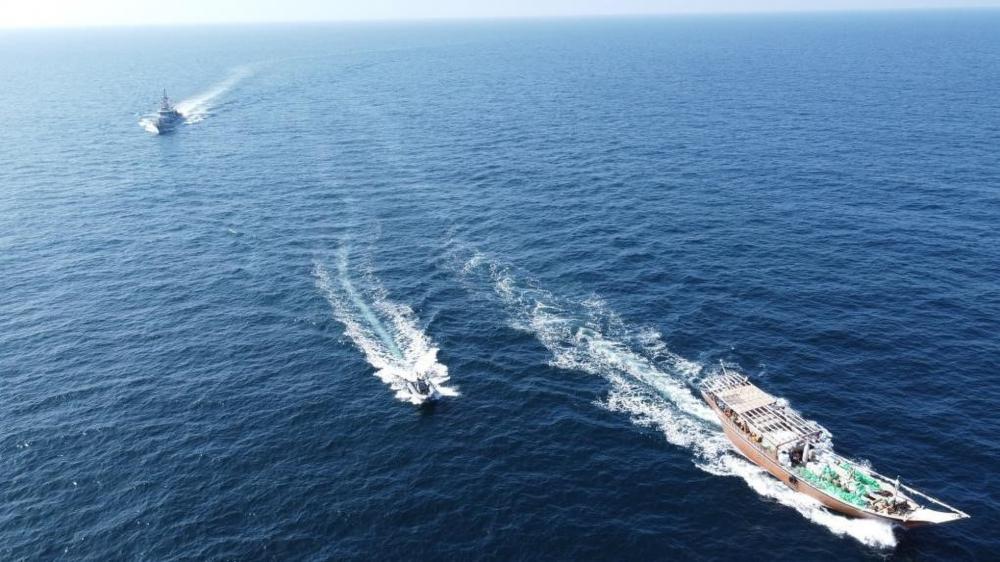
NORTH ARABIAN SEA (Dec. 20, 2021) U.S. service members from patrol coastal ship USS Typhoon (PC 5) interdict a stateless fishing vessel carrying illicit weapons while transiting international waters in the North Arabian Sea, Dec. 20. (U.S. Navy photo)

Below is a press release from Defense Visual Information Distribution Service (DVIDS). The boarding team was apparently Coast Guard. It’s likely the Webber class WPCs assigned to PATFORSWA will be doing this sort of work since the Navy PCs are being decommissioned.


U.S. 5th Fleet ships seized approximately 1,400 AK-47 assault rifles and 226,600 rounds of ammunition from a stateless fishing vessel during a flag verification boarding in accordance with customary international law in the North Arabian Sea, Dec. 20.

U.S. Navy patrol coastal ships USS Tempest (PC 2) and USS Typhoon (PC 5) found the weapons during a search conducted by embarked U.S. Coast Guard personnel. The illicit weapons and ammunition were later transported to guided-missile destroyer USS O’Kane (DDG 77) where they await final disposition.

The stateless vessel was assessed to have originated in Iran and transited international waters along a route historically used to traffic weapons unlawfully to the Houthis in Yemen. The direct or indirect supply, sale or transfer of weapons to the Houthis violates U.N. Security Council Resolutions and U.S. sanctions.

The vessel’s five crew members identified themselves as Yemeni nationals and will be returned to Yemen.

After removing the crew and illicit cargo, U.S. naval forces determined the stateless vessel was a hazard to navigation for commercial shipping and sank it.

U.S. naval forces regularly perform maritime security operations in the Middle East to ensure the free flow of legitimate trade and to disrupt the transport of illicit cargo that often funds terrorism and other unlawful activity. U.S. Navy warships operating in the U.S. 5th Fleet region have seized approximately 8,700 illicit weapons in 2021.

Guided-missile cruiser USS Monterey (CG 61) seized dozens of advanced Russian-made anti-tank guided missiles, thousands of Chinese Type 56 assault rifles, and hundreds of PKM machine guns, sniper rifles and rocket-propelled grenade launchers from a stateless vessel transiting the North Arabian Sea in May.

In February, guided-missile destroyer USS Winston S. Churchill (DDG 81) seized a cache of weapons off the coast of Somalia, including thousands of AK-47 assault rifles, light machine guns, heavy sniper rifles, rocket-propelled grenade launchers and crew served weapons. The inventory also included barrels, stocks, optical scopes and weapon systems.

The U.S. 5th Fleet area of operations encompasses approximately 2.5 million square miles of water area and includes the Arabian Gulf, Gulf of Oman, Red Sea, parts of the Indian Ocean and three critical choke points at the Strait of Hormuz, Suez Canal and Strait of Bab al Mandeb.
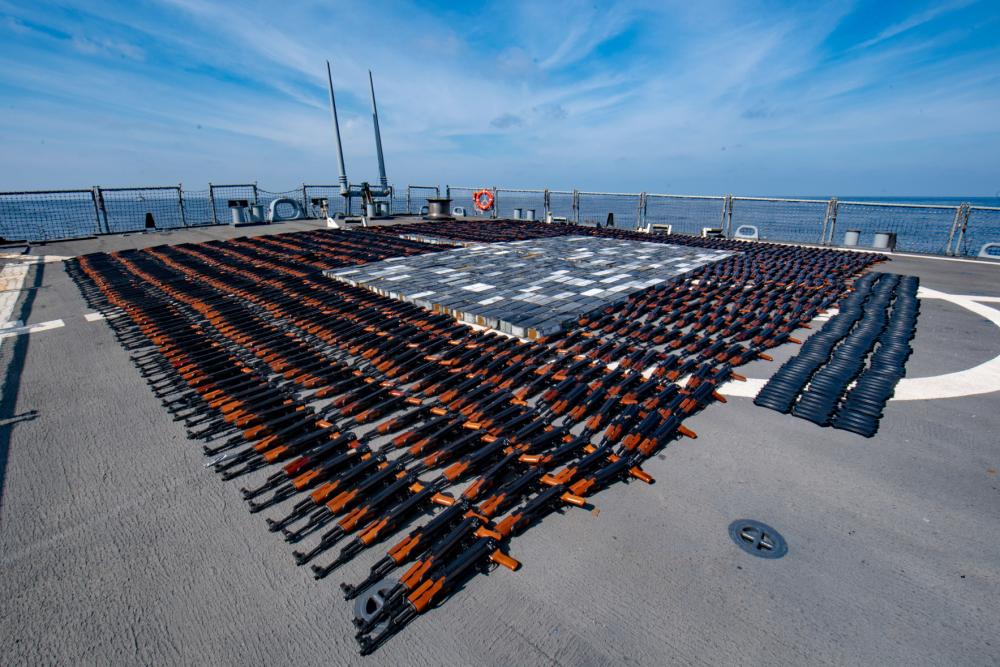
U.S. Navy Seizes 1,400 Assault Rifles During Illicit Weapons Interdiction

NORTH ARABIAN SEA (Dec. 21, 2021) Illicit weapons seized from a stateless fishing vessel in the North Arabian Sea are arranged for inventory aboard guided-missile destroyer USS O’Kane’s (DDG 77) flight deck, Dec. 21. (U.S. Navy photo by Mass Communication Specialist Seaman Elisha Smith)
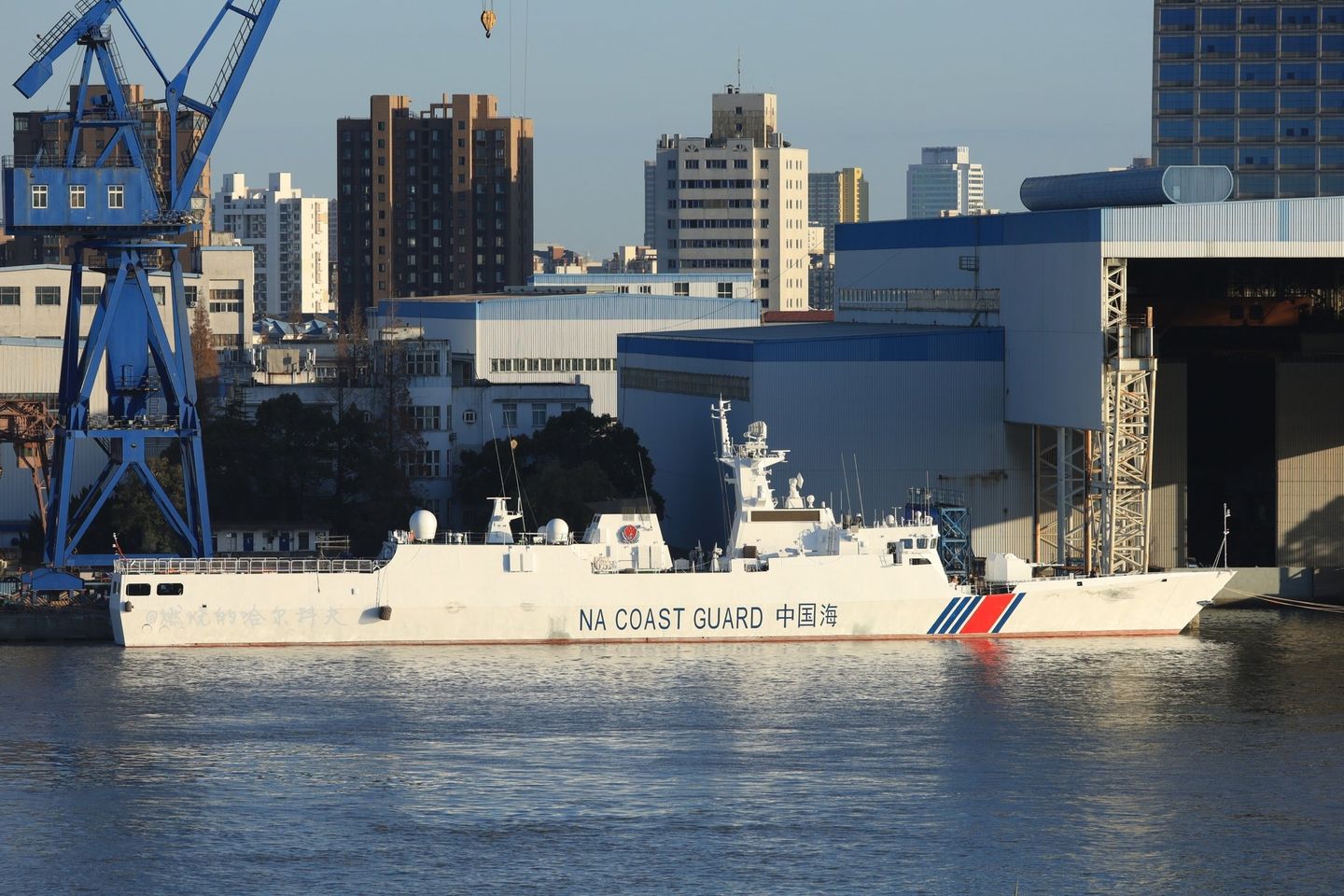
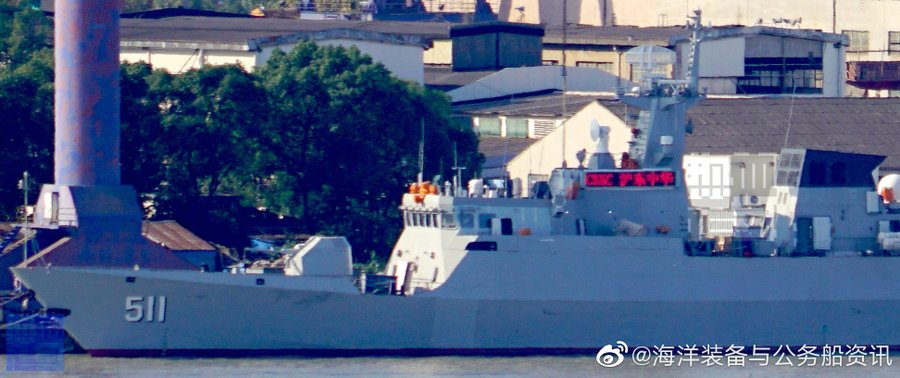
“China Transferring Navy Type 056 Corvettes To The Coast Guard” –Naval News

An ex-PLAN Type 056 corvette undergoing conversion for Coast Guard duties.

I reported transfer of 22 Type 056 covettes from the PLA Navy to the China Coast Guard back in November and discussed the implications, but now we have a better photograph and some commentary from Naval News.

The air-search radar, radar fire control, and 76mm gun remain. The ship is now equipped with fire-fighting monitors where the anti-ship cruise missiles were previously installed amidships, on the O-1 deck, above the letter “U” in GUARD.

For the first time, looking at the photo, I realized these ships are armed with an autocannon, I was not familiar with, the 30mm H/PJ-17, a single barrel optionally manned system, that is mounted on the O-1 deck aft of the bridge and below the fire control radar. As can be seen in the photo below, the bulwark can swing down to allow the gun to depress to a greater angle. This may have been in order to fire at targets at close range, or it may have been to allow the gun to continue to follow a target even when the ship is experiencing heavy rolls. I have not been able to find out much about these weapons.

Chinese H/PJ-17 30mm

Information on the Yinhe Incident referred to in the Naval News report is here.

BAE’s Bofors 40mm Mk4 –Navy Lookout

BAE Bofors 40mm/70 mk4. Click on this to enlarge. Hight of the mount is 1.9 meters or 6.32 feet.

Navy Lookout has what may be the best evaluation of the BAE Bofors 40mm/70 Mk4 mount I have seen thus far. It looks at the 40mm Mk4 in the context of it’s planned installation on the Type 31 frigate, which will also mount the same 57mm Mk 110 gun being mounted on large Coast Guard Cutters (also a BAE Bofors product).

The system can use the same 3P (Pre-fragmented, Programable, Proximity) fuse that can be used with the 57mm Mk110 mount.

Consideration is given to the mount’s role in lieu of a dedicated Close In Weapon System (CIWS). A notable feature is that the 40mm Mk4 is 60% lighter than a Phalanx mount, 5,500 pounds (including about 540 pounds of ammunition) vs 13,600 (2,500 vs 6,120 kg). The Mk38 Mod3 by comparison is 2,300 lbs. (1,042 kg). The DS30M which is apparently expected to be the Mk38 Mod4 is DS30: 2,645 lbs. (1,200 kg) with ammunition.

Compared to the 30mm guns the Royal Navy is currently using, “40-mm weapons offer significantly longer ranges, increased lethal effect in anti-aircraft/missile and anti-surface engagements.”

Effective range is more than doubled and the 40mm projectile is about 2.7 times larger than that of a 30mm Bushmaster II chain gun and more than five times larger than the 25mm fired by the Mk38.

As noted, the 40mm/70 Mk4 has a number of competitors,

“Offerings from other European manufacturers include the Thales/Nexter Rapid Fire CTA 40 (France), Lenardo Marlin 40 (Italy), Rheinmetall Millenium GDM-008 (Germany) and the Aselsan Gökdeniz (Turkey). “

To which I would add the 40 and 50mm chain gun although they currently have no deployed naval mount.

The vessel in the video is 150 tons full load and 36.53 meters (120′) in length, very similar in size to the 153 ton full load Island class cutters. Originally it was a missile boat armed with a 57mm gun and up to six Penguin Anti-ship missiles.

Thanks to Lee for bringing this to my attention. 

Ballistic Protection for .50 Caliber Gun Crews

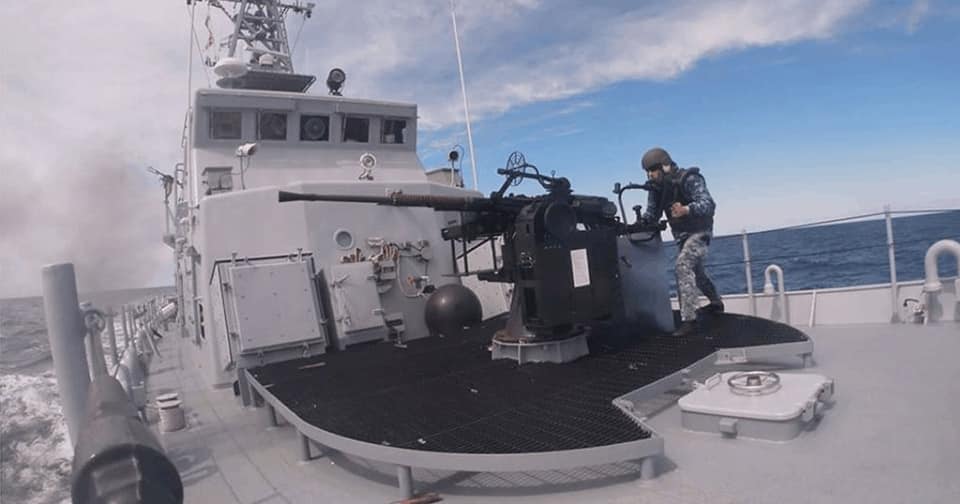
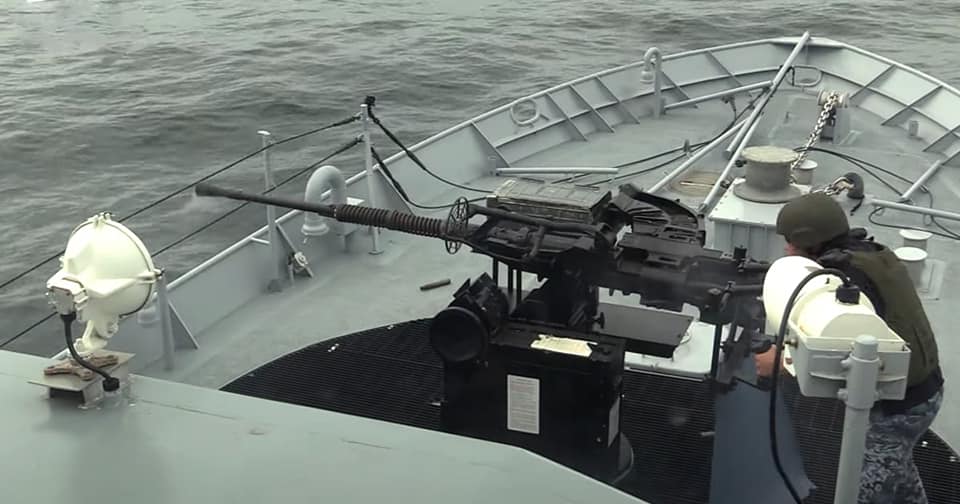
The video above is titled as a Mk38 Mod3 Live Fire, but I would like to point out the ballistic protection that is provided the .50 cal. gun crew. The .50 gun shoot starts at time 1:10 and you get a good view of the ballistic protection beginning at time 1:37.

Yes, this is a pet peeve of mine. I have posted about ballistic protection before, here, here, here. and here.

As yet I have seen no ballistic protection for Coast Guard gun crews other than small shields attached to the mounts that provide no protection for the lower body and only very limited coverage for the gun crew (as in the photo below). Clearly suitable protection is available.

Having a gun crew standing out on deck using deadly force without providing easily available protection is not just dangerous to the gun crew, in some cases it may endanger the mission, if the gun crew is disabled.

Air-cooled 0.50″ (12.7 mm) Browning Machine Gun. Picture taken aboard USS Fife DD-991 on 4 July 2002. US Navy Photograph No. 020704-N-0156B-002.

RE: 25mm Mk38 Mod3, I see there was a contract issued recently for more of these systems, for the USN and the Philippines, so DOD certainly has not moved on to a 30mm Mk38 Mod4 yet. (Late addition, see my comment below.)

Below is the written material that accompanied the video.

CARAT Indonesia 2018: GUNEX (B-Roll)

B-Roll of a live-fire exercise conducted with the Indonesian Navy during Cooperation And Readiness Afloat Training (CARAT) 2018. CARAT Indonesia, in its 24th iteration, is designed to enhance information sharing and coordination, build mutual warfighting capability and support long-term regional cooperation enabling both partner armed forces to operate effectively together as a unified maritime force.

INDONESIA, 08.13.2018, Video by Senior Airman Dhruv Gopinath ••♦♦

The Mk 38 MGS is a low cost, stabilized self-defense weapon system that dramatically improves ships’ self-defense capabilities in all weather conditions, day or night. Installed aboard 14 different classes of U.S. Navy ships and U.S. Coast Guard cutters, it is used extensively by the U.S. military as well as by NATO forces.

A major upgrade to the Mod 3 is the system’s advanced electro-optical/infrared (EO/IR) sensor which provides 330-degree surveillance capability and three fields of view. The superior optics allow sailors to monitor the seas and respond to threats even in extremely low light conditions with the benefits of a low contrast, low light level color day camera and an eye-safe laser range finder.

While the EO/IR sensor system is integrated with the Mod 3’s state-of-the-art fire control system, the Mk 38 Mod 3 is unique from other naval weapons because its surveillance system moves separately from the gun system, preventing adversaries from easily knowing they have been detected.

The Mk 38 Mod 3 also provides a range of 2.5 kilometers and selectable rates of fire from single to 180 rounds per minute, and fires all U.S. Navy-approved 25mm ammunition. It can be remotely operated from the combat information center or other protected ship structures, allowing operators to remain safe and out of harm’s way.

“Special Operations C-130 Hits Target With A ‘Rapid Dragon’ Pallet-Dropped Cruise Missile” –The Drive

Coast Guard Aircraft at War

During World War II, we all probably know that the Coast Guard surface forces had a strong record of augmenting the US Navy in anti-submarine warfare and amphibious assault operations.

Coast Guard aviation’s contribution was considerably less significant. They continued to do SAR and flew anti-submarine patrols. By the end of the war, there was at least one Coast Guard squadron dedicated to anti-submarine patrols, but while generally aircraft were more successful than surface vessels against submarines, sinking about 400 U-boats, more than half of all the U-boats destroyed during WWII, all Coast Guard submarine sinkings were done by surface vessels.

During the Vietnam war, when the Coast Guard deployed 82 foot patrol boats and High Endurance Cutters off the coast as part of Operation Market Time, and buoy tenders serviced aids in Vietnamese waters, the Coast Guard’s aviation contribution to the war was limited to exchange pilots serving with the DOD units. Coast Guard aircraft supported LORAN stations that were vital to the war effort, but I have not heard of any Coast Guard aircraft participating directly in the Vietnam War.

During the first Iraq War, I seem to recall some Coast Guard aircraft assisted TRANSCOM with logistics. In addition, Coast Guard HU-25s monitored pollution that resulted from Iraqi sabotage of Kuwaiti oil facilities.

Generally, Coast Guard aircraft have played little or no role in America’s wars. It is not too surprising since warplanes tend to be specialized.

That may be changing. 

“Bomb Bay in Box”

The Air Force has been making rapid progress on a system that would allow cargo planes, including C-130s and perhaps C-27Js and C-144s to become cruise missile carriers. (An earlier test reported here.)

The system is roll-on/roll-off and requires no integration with the aircraft. 

Interestingly the most recent test appears to have targeted a maritime target. 

We certainly are not likely to see even Air Force transports doing this sort of thing routinely unless it is a truly big war or at least the desire is to launch a devastating number of missiles in single massive assault. 

Surprisingly, Coast Guard aircraft might be seen as the best transports to do this sort of thing, since their Minotaur systems provide the possibility of updating targeting information with organic sensors and doing post attack battle damage assessment if the environment permits. 

Coast Guard aircraft use becomes more likely if the conflict is worldwide, Air Force transports are otherwise engaged, and a nation, or nations, in the Western Hemisphere decides to take advantage of US distraction and attack an ally. 

It might also happen, if there is a wartime decision to sink all hostile controlled shipping. (That might follow a warning to masters to intern the ships within a reasonable time period.)

Naval News Coverage of Defence and Security Equipment International (DSEI), Sept. 14-17. 2021

Below I have provided the Naval News coverage of DSEI 2021. There are a few segments in particular that may be of interest.

In the Day 1 coverage:

  • 07:25 – VARD 7 115 Next Generation OPV. I think you can see the similarity to the Offshore Patrol Cutter design which is a VARD 7 110.
  • 10:09 – OMT’s MPV-80/12:52 – SH Defence “The Cube” modular mission module. The Danes have been making modular naval systems for decades and this is modularity on steroids. “The Cube” is a proposed system of standard container-sized modules. The MPV-80 is a modular OPV with 32 positions for “The Cube” modules.  

In the Day 3 coverage:

  • 00:47 – Royal Navy’s NavyPODS is another container-sized module proposal. Sounds like the Royal Navy may be considering using these on their River Class Offshore Patrol Vessels. 
  • 06:46 – AEUK SeaSense variable depth sonar. This is another ASW sensor that could be deployed on very small vessels. 
  • 07:27 – BAE Systems Bofors 40Mk4 naval gun system. This would make a good choice to arm smaller cutters or for use as a secondary on larger cutters. Right now, it’s not in the USN inventory and there is no integral fire control system, so. at least an Electro-Optic system would be required. The ammunition uses the same 3P fuse used on the 57mm Mk110 gun. For decades the Italians used 40mm guns for their CIWS. Most recently they have been using 76mm guns. The Royal Navy has recently adopted this mount to use as a secondary weapon and CIWS on the Type 31 class frigate

In the Day 4 coverage:

  • 04:55 – MSI Defence Ltd Seahawk 30mm naval gun system. We talked about this gun mount earlier, since it appears it will be the USN Mk38 Mod4. It is the reason I posted this video earlier. 

Day 1 at DSEI 2021 in London, UK. We focused on new anti-ship missiles, the Sea Breaker by Rafael, the Sea Serpent by IAI and Thales UK. We then take a look at two new OPV designs: The VARD 7 115 NGOPV and the MPV 80 by OMT. We then discuss with SH Defence about “The Cube” modular mission module.

  • 00:50 – Rafael’s Sea Breaker
  • 05:03 – IAI’s Sea Serpent
  • 07:25 – VARD 7 115 Next Generation OPV
  • 10:09 – OMT’s MPV-80
  • 12:52 – SH Defence “The Cube” modular mission module.

Day 2 at DSEI 2021 in London, UK. We focused on Naval Strike Missile (NSM) with Raytheon, the new Quadome 3D radar by Hensoldt, UAS integration with Thales and the MMCM program with Thales.

  • 00:15 – Intro
  • 00:53 – Raytheon’s NSM for SSGW
  • 04:12 – Hensoldt launches new Quadome 3D radar
  • 05:30 – Thales’ Unmanned wide area surveillance
  • 07:28 – Thales MMCM program

Day 3 at DSEI 2021 in London, UK. We talked to the Royal Navy about their NavyPODS concept. We then focused on mine warfare, talking to Patria and its acoustic sweep, and Atlas Elektronik UK (AEUK) ARCIMS and its payloads. We then talked to BAE Systems Bofors to get an update on the 40Mk4 naval gun program and learn about the T-650 heavy lift UAS which can carry a lightweight torpedo.

  • 00:12 – Introduction
  • 00:47 – Royal Navy’s NavyPODS
  • 02:53 – Patria’s acoustic sweep
  • 05:17 – Atlas Elektronik UK ARCIMS
  • 06:46 – AEUK SeaSense variable depth sonar
  • 07:27 – BAE Systems Bofors 40Mk4 naval gun system
  • 09:16 – BAE Systems T-650 heavy lift UAS

Final day at DSEI 2021 in London, UK. Naval News’ Editor-in-Chief, Xavier Vavasseur, takes you around the show floor and comments some of the new systems on display. We start with MBDA who was showcasing its future missile concepts (related to FCASW) as well as current portfolio of anti-ship missiles (SPEAR, SPEAR EW, Exocet, Marte, Sea Venom and Maritime Brimstone) and naval air defense solutions (Dragonfire, Aster B1 NT and CAMM / Sea Ceptor). We then take a close look at a scale model of the XLUUV on the TKMS stand and the MSI Defence Systems’ Seahawk 30mm naval gun system which was recently selected by the US Navy. Finally we talked to IAI’s Malcolm McKenzie to learn more details about Sea Serpent.

  • 00:47 – MBDA concept missiles for FCASW
  • 01:34 – MBDA SPEAR and SPEAR EW
  • 01:57 – MBDA Exocet MM40 Block 3C
  • 02:22 – MBDA Marte ER
  • 02:38 – MBDA Sea Venom
  • 02:48 – MBDA Maritime Brimstone
  • 03:08 – MBDA Dragonfire laser weapon system
  • 03:20 – MBDA Aster 30 B1 NT
  • 03:25 – MBDA CAMM / Sea Ceptor
  • 03:45 – TKMS XLUUV
  • 04:55 – MSI Defence Ltd Seahawk 30mm naval gun system
  • 05:26 – IAI Sea Serpent anti-ship missile


Ukrainian Island Class Cutter Rearmed

Via Facebook I obtained some photos, from a Ukranian friend, of how a couple of the five Ukranian 110 foot Island class cutters have been rearmed.

The intention was to rearm the ships with the MSI Seahawk 30mm, which reportedly will be the new USN Mk38 Mod4, but apparently it is not yet available, so instead, the ships have been armed with a Soviet era 25mm gun, the 110 PM. As can be seen, control is entirely manual and lacks stabilization, sensors, electro-optics, or any kind of firecontrol computer.

It’s not much, for a Navy facing off the Russian Black Sea Fleet, but at least it essentially restores the capability they had before the transfer. In some respects, it may be superior with a higher rate of fire and a heavier projectile.

“British Navy tests new .50 machine gun mounting system ASP” –Updated, Its made in the US

After publishing my initial post about this stabilized gun mounting system, a comment from Secundius provided much better, more detailed photos of the system and gave me the manufacturer’s name, FlexForce. The FlexForce website told me they were headquartered in Portland, Oregon, and that the system is available on GSA schedule.

Their “News” page indicates the mount will be at the Work Boat Show in New Orleans,Booth 3877 aboard Lake Assault Custom Boats FP-M boat (33 foot US Navy Force Protection, Medium) December 1-3. If this becomes a standard USN system, it would make it more readily available, perhaps at Navy expense.

Below is their data sheet for maritime applications. The Coast Guard obviously knows about this mount. The first photo below is obviously of the system mounted on a Webber class WPC.

Click to access 20190115-ASP-Maritime-Datasheet.pdf

There is another better photo of the mount on a Webber class here and a photo of it mounted on a Coast Guard 25 foot boat here.

The Coast Guard has been looking for ways to make their weapons more accurate for some time. Unfortunately some of the links are broken, but I did this report back in 2014. Back in 2017, when I was able to do a tour of the Bailey Barco, the gunners mate told me they had done some weapons testing with Navy and Marine as well as Coast Guard observers aboard.

The Electro-Optic options should also help with targeting, especially at night. The remote option essentially makes this a remote weapon station meaning the operator need not be an obvious target. Significantly FlexForce claims the system is effective against UAS.

Hopefully this system or something like it will start showing up on Coast Guard cutters, most immediately those assigned to PATFORSWA.

(I wonder if it might be possible to mount the Fletcher APKWS launcher on this (with the remote option)?

Up-Gunning the China Coast Guard–Add 22 New Type 056 Corvettes

Type 056 corvette, credit 樱井千一

We have a report from Defence.PK, that 22 PLAN Type 056 corvettes are being transferred to the China Coast Guard. These ships are the early models that were completed without the more sophisticated anti-submarine warfare capabilities of the Type 056A. Rather than upgrade them, the Chinese Navy will build 22 additional Type 054A Frigates.

Reportedly they are adding a LED billboard and the missiles are being removed. Probably the torpedoes as well. But that still leaves a 120 round/minute 76 mm gun and a pair of 30mm Guns.

The China Coast Guard already has more large cutters than the US Coast Guard, despite of the fact that their EEZ is less than 20% that of the US, even if all their outrageous claims were accepted. But most of these cutters have no guns of 20mm or larger. 22 AK-176 76mm guns and 44 30mm Guns will substantially increase the China Coast Guard’s firepower.

These 1500 ton 25 knot ships are a handy size for an area like the South China Sea.

Unlike the US Coast Guard, the China Coast Guard tends to operate their cutters in groups. Three of these, snuggled up to you, at close range, could be very intimidating even to a DDG like those the US Navy uses for Freedom of Navigation Exercises. For relatively unarmed Asian Coast Guard cutters, it would be much more so.

Chinese Naval Forces don’t have a lot of naval victories in their past so the Battle of Paracel Islands, where they defeated the Vietnamese by opening fire at very close range, must assume outsized importance in their imagination.

Image

I note, the cutters China used when they recently turned back a Philippine resupply effort in the South China Sea, included at least one armed with a 76mm gun.

In case you missed it, below is a statement from the US Ambassador to the Philippines (and to China).

“British Navy tests new .50 machine gun mounting system ASP” –Navy Recognition

Russian Vyborg Shipyard laid the Purga ice class coastguard ship of project 23550 925 001

British navy sailor fires burst using gun mounting system ASP (Agile, Small-deflection, Precision) armed with a .50 heavy machine gun. (Picture source British Royal Navy)

If we don’t replace the .50 caliber machine gun and we don’t put it in a remote weapons station, we may still do something to improve its accuracy as a crew served weapon.

Navy Recognition reports the Brits have been testing a new mount.

Over a week of trials, the team put down nearly 5,000 .5 caliber rounds – 3,500 fired using the new mounting, 1,450 from a heavy machine-gun on a traditional ‘soft’ mounting to allow for comparisons. They conducted more than three dozen gunnery shoots in different scenarios and weather conditions to give both mountings a comprehensive workout.

Seven of Argyll’s ship’s companies were taught how to fire a .50 cal loaded onto the new mount. They found it easy to use – and their gunnery improved as the trials went on.

I would at least be curious about their test results.