“USCG Report: Small Cutters Prove They Can Patrol a Big Ocean” –Marine Link

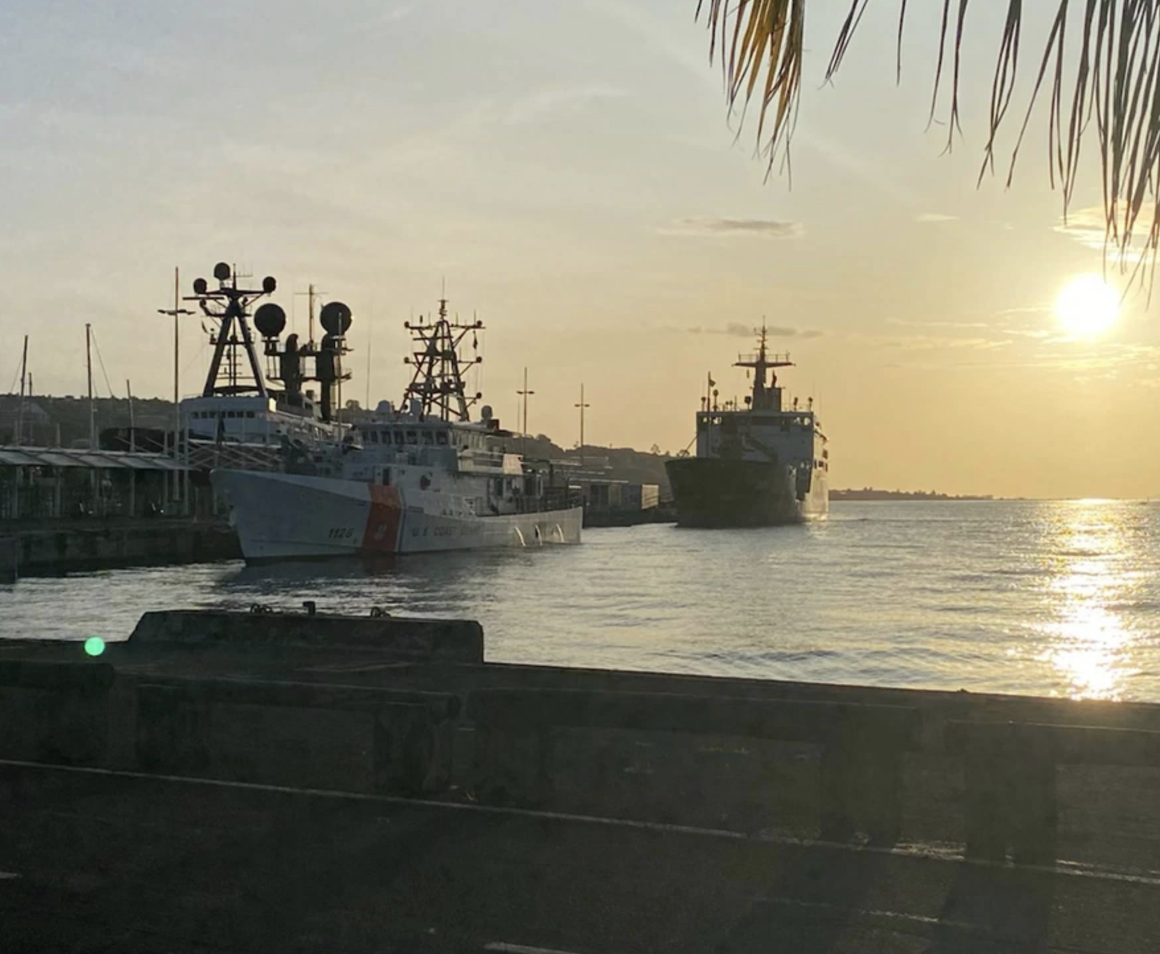
Cutters Joseph Gerczak and Juniper refuel in Papeete, Tahiti, while underway during Operation Aiga, February 6, 2022. The two cutters were in the region combating illegal, unreported, and unregulated fishing and other maritime threats on the high seas throughout the Pacific. (U.S. Coast Guard photo courtesy of the USCGC Juniper)(cropped)

Marine Link has an interesting article that recounts the methods that allow the 154 foot Webber “Sentinel” class WPCs “Fast Response Cutters, FRCs”with a nominal endurance of only five days and a range of 2500 nautical miles at 14 knots to deploy well beyond that distance.

Issues that must be dealt with other than limited storage and fuel include lack of an independent duty corpsman and carbon build-up in the engines due to operating at lower than design RPM.

When we go to Tahiti or American Samoa, there’s nothing in between. We’ll usually travel with a ‘black hull’ buoy tender in case we need to take on fuel at sea. But we have to be very careful with our fuel, and how we run our engines, and balance the need to have enough provisions for the trip and arrive safety with at least 20 percent fuel on board with the need to get down there so we can get to work.”

Sea State can also make it difficult to do a Replenishment at Sea (RAS).

The article does not reflect the current number of FRCs planned–77 rather than the 64 indicated in the article. It appears likely that the number of FRCs in Guam will increase from three to six and that additional FRCs (probably three) will be based in American Samoa.)

The article talks about future OPCs allowing National Security Cutters to spend more time in the Western Pacific but makes no mention of USCGC Harriet Lane, currently based in Oahu, or other WMECs that might be based in the Pacific in the Future.

“…in the absence of the perfect asset, the FRCs are the right asset for the job right now. “We’re making it work.”

Cutter Midgett has been busy in the Western Pacific

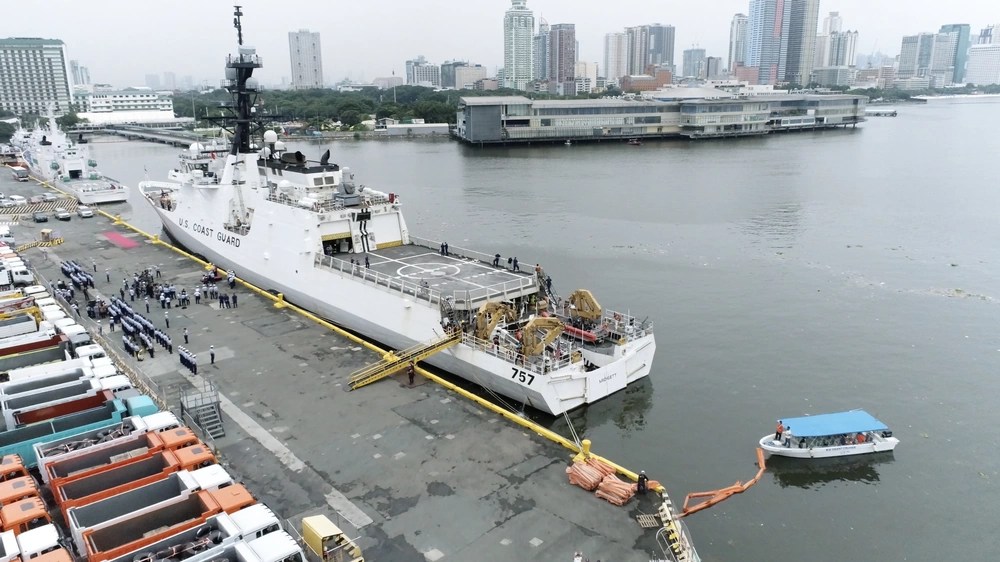
The U.S. Coast Guard Cutter Midgett (WMSL 757) moors in Manila, Philippines, Aug. 30, 2022. Midgett’s crew will engage in professional exchanges and capacity building exercises with the Philippine Coast Guard, and partner nations, and will patrol and conduct operations as directed while deployed on a months-long Western Pacific patrol under the tactical control of Commander, U.S. 7th Fleet. Philippine Coast Guard photo

Two news releases for Coast Guard News, “U.S. Coast Guard cutter visits New Zealand, conducts training and promotes maritime governance” and “U.S. Coast Guard cutter visits Tuvalu, strengthens partnerships and promotes regional security.”


Feb. 21, 2025

U.S. Coast Guard cutter visits New Zealand, conducts training and promotes maritime governance

WELLINGTON, New Zealand – U.S. Coast Guard Cutter Midgett (WMSL 757) recently concluded a month-long engagement with New Zealand, strengthening ties with the Royal New Zealand Navy (RNZN) and reinforcing the U.S. Coast Guard’s commitment to Oceania. The engagements included professional exchanges, bilateral maritime law enforcement trainings, and enhanced cooperation between the two nations in support of a peaceful, secure, prosperous, and resilient region.

During Midgett’s transit from Honolulu to Wellington, three RNZN members experienced operations aboard the cutter as part of an exchange program with the Coast Guard.

While in Wellington, Midgett’s crew participated in several events with the RNZN, the Rescue Coordination Centre New Zealand (RCCNZ), the New Zealand Maritime Police, and members of the local community. These events included a reception hosted by the RNZN, visits to the RCCNZ and the Maritime Police Base, a community event with Waka Ama’s outrigger canoes, and ship tours for more than 200 people.

The Coast Guard is an instrument of national power that bridges the divide between defense, diplomacy, and law enforcement, and creates opportunities to further national objectives and priorities. These engagements provided invaluable opportunities for personnel from both nations to interact, discuss experiences, and learn about roles in their services and communities. “The integration of our New Zealand partners into our crew was seamless and highly beneficial,” said Capt. Matthew Rooney, commanding officer of Midgett. “The professional exchanges and shared experiences, along with the friendships forged and sea stories shared, will undoubtedly enhance our ability to operate together in the future.”

The Coast Guard values New Zealand’s active engagement in international security efforts. This partnership is vital to countering destabilizing behavior in the Pacific that undermines mutual prosperity, economic well-being, and the health of the marine ecosystem. This visit builds on the Memorandum of Agreement signed with the RNZN in 2023, allowing both nations to share experiences and knowledge to cultivate best practices. The Coast Guard looks forward to continuing this partnership, based on mutual respect and shared values, to promote security and prosperity in the Indo-Pacific region.

Commissioned in 2019, Midgett is the eighth Legend-class national security cutter and is homeported in Honolulu. National security cutters are 418-feet long, 54-feet wide, and have a 4,600 long-ton displacement. They have a top speed of more than 28 knots, a range of 12,000 nautical miles, an endurance of up to 90 days and can hold a crew of up to 170.


Feb. 21, 2025

U.S. Coast Guard cutter visits Tuvalu, strengthens partnerships and promotes regional security

FUNAFUTI, Tuvalu – The U.S. Coast Guard Cutter Midgett (WMSL 757) recently concluded a successful engagement in Tuvalu, conducting joint bilateral maritime law enforcement shiprider operations and strengthening partnerships to combat illegal, unreported, and unregulated fishing in the region. This partnership underscores the U.S. Coast Guard’s unwavering commitment to maintaining a secure and prosperous Indo-Pacific, leveraging its operational expertise to enhance cooperation and strengthen its trusted partnership with Tuvalu.

During the three-day operation, Midgett participated in three at-sea boardings, including two bilateral inspections within Tuvalu’s exclusive economic zone, the first in over a decade, and one Western and Central Pacific Fisheries Commission high-seas inspection. Midgett also deployed its ScanEagle unmanned air system to enhance maritime domain awareness and support the joint effort. These joint operations provided valuable opportunities for both Tuvalu and U.S. Coast Guard personnel to exchange expertise, share best practices, and strengthen interoperability. Following the shiprider operations, Midgett hosted 13 distinguished visitors from Tuvalu, including representatives from the Fisheries Department, Maritime Police, and the Tuvalu government. Discussions focused on the positive impact of the joint boardings, emphasizing the importance of maritime security cooperation in the region.

“This operation was a tremendous success on multiple levels,” said Capt. Matthew Rooney, commanding officer of Midgett. “Not only did we work alongside our partners in Tuvalu to conduct critical maritime law enforcement operations, but the experience also provided invaluable training for our crew. From the deck plate level all the way up to command and control, integrating with our Tuvaluan counterparts was seamless and incredibly beneficial for all involved. We learned a great deal from each other, and this experience will undoubtedly pay dividends in future operations.”

The partnership between Midgett and Tuvalu underscores the U.S. Coast Guard’s commitment to supporting Pacific Island nations in their efforts to safeguard their sovereignty and manage their maritime resources effectively. A secure and prosperous Indo-Pacific requires working closely with partners such as Tuvalu to promote maritime governance.

Bilateral maritime efforts enhance governance among regional partners, improving interoperability, and strengthening readiness.

Midgett, commissioned in 2019 and homeported in Honolulu, Hawaii, is the eighth Legend-class National Security Cutter. These 418-foot vessels are equipped with advanced technology and a range of capabilities, making them ideally suited to support a wide range of missions, including maritime security, law enforcement, and search and rescue operations. Midgett’s deployment to Oceania highlights the United States’ enduring commitment to promoting a peaceful, secure, prosperous, and resilient Pacific Islands region.


Taiwan Coast Guard Vessel Arrives in Hawaii

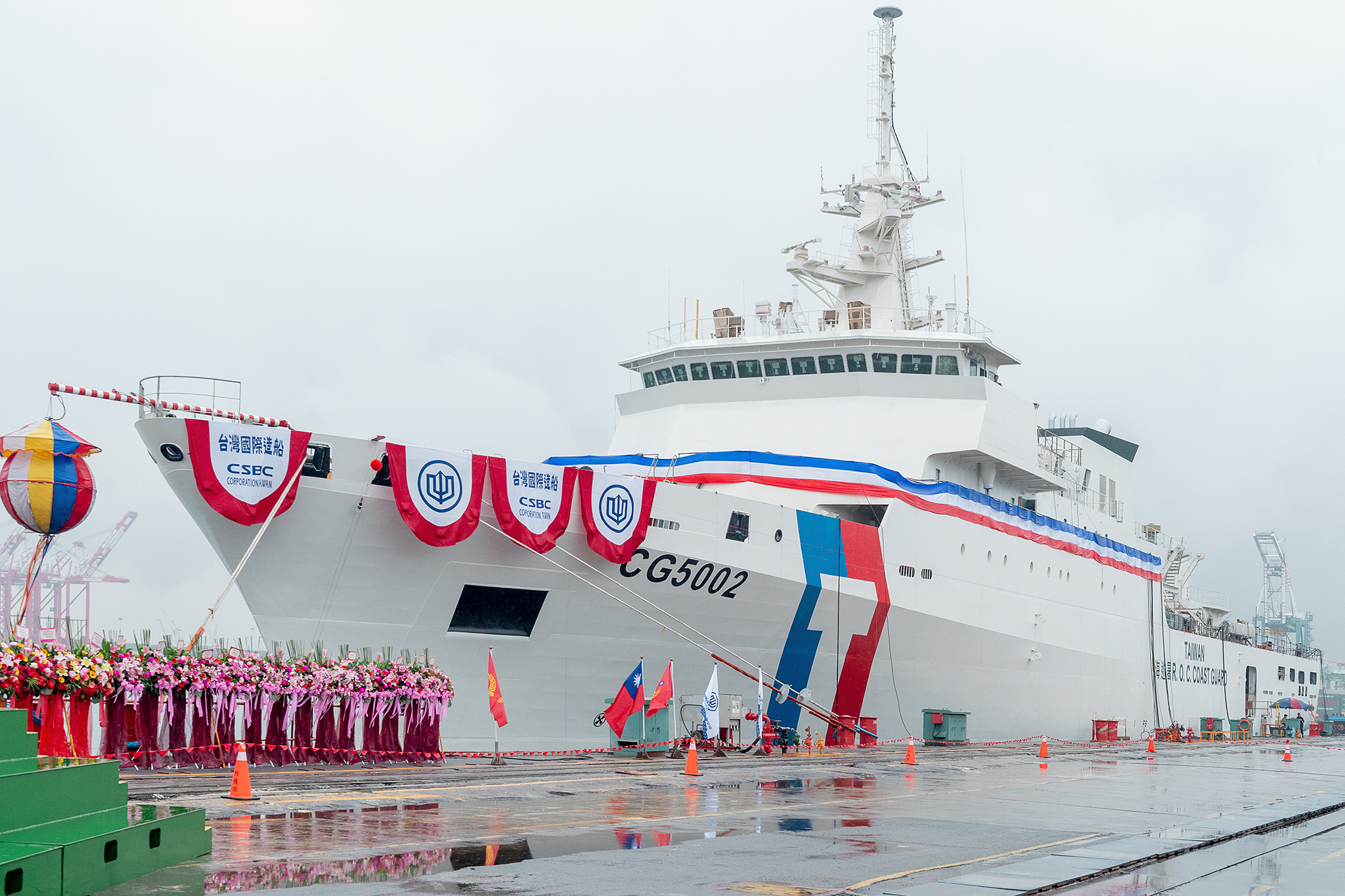
Patrol vessel of Coast Guard Administration CG 5002 Hsinchu at the launching ceremony. Official Photo by Makoto Lin / Office of the President, 28 April 2021

We have a report that a Taiwanese Coast Guard Cutter arrived in Hawaii on June 11. The vessel, Hsinchu (CG5002), one of a new class of four 5,044 ton cutters, was commissioned in December 2022.

This may be just a stop for supplies and liberty, but I suspect there will be some interaction with the US Coast Guard. Despite speculation, there was a denial that the ship would participate in RIMPAC scheduled June 26 to Aug. 2. Taiwan was not listed as a participant in a May 21 Third Fleet announcement of the exercise.

Reportedly the cutter will be engaged in fisheries management. This is well outside Taiwan’s EEZ, so I presume they will be policing and supporting the Taiwanese fishing fleet.

This background from Wikipedia,

In March 2021 the CGA and the US Coast Guard announced that they had signed a cooperation agreement, the agreement was promptly denounced by China. In May 2021 US President Joe Biden praised the cooperation agreement while speaking at the commencement of the United States Coast Guard Academy. The first bilateral meeting under the agreement occurred in August 2021.

The Félix Éboué class, a Modern, Minimalist, Medium Endurance Cutter

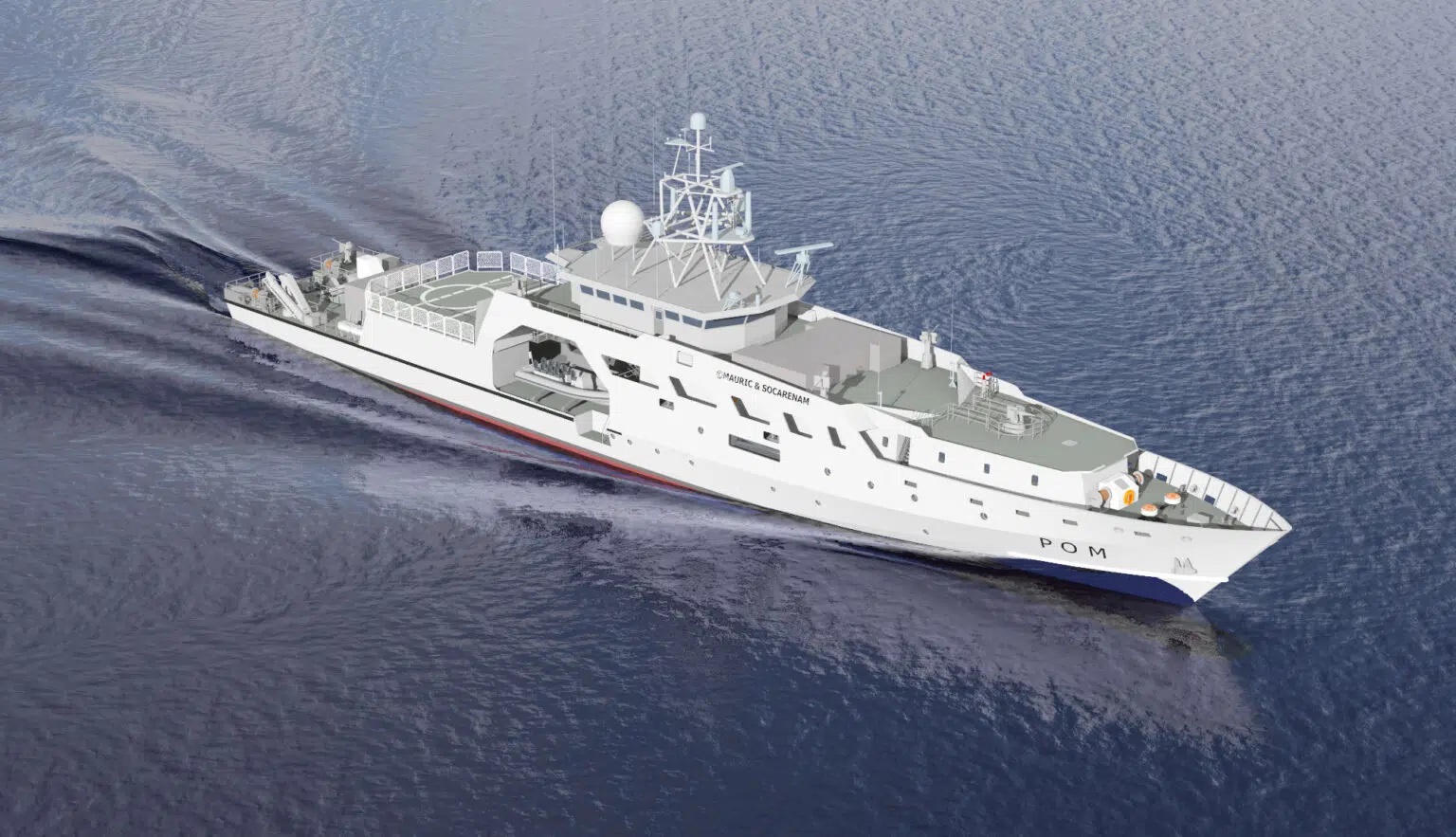
An artist’s rendering, Félix Éboué class or Patrouilleurs Outre-mer (POM)

The Offshore Patrol Cutter (OPC) is described as, “…a capability bridge between the national security cutter, which patrols the open ocean in the most demanding maritime environments, and the fast response cutter, which serves closer to shore.”

That may have been the intention, but that is not what we got.

While the National Security Cutter is better than the WHECs they replaced in almost every way, the OPCs are not only better than the WMECs they will replace, but they are also, in every way except maximum speed, better than the WHECs as well. Instead of a high/low mix of cutters, they all turned out high end. We should not be surprised the OPCs construction and operating costs approach those of the NSCs.

Construction costs are typically proportional to displacement. The OPCs’ displacement is 98% that of the NSC and 1232.8% (more than 12 times) that of the Fast Response Cutters.

This would not be a bad thing, if we had enough NSCs and OPCs to meet our large patrol cutter needs, but I don’t think we will ever get there.

We are expected to ultimately end up with only 36 large patrol cutters, fewer than we have had in decades and fewer than other Coast Guards with far smaller EEZs.

A new fleet mix study has been completed, but the results have not been made public (Why not? This is not transparency). I suspect it shows a need for substantially more than 36 large patrol cutters.

If we look at the previous “Fleet Mix Study,” now over a dozen years old, which minimized requirements because it did not consider “High Latitude regions of the ice shelf and Deployable Operations Group (DOG),” and assumed that NSCs would use the “Crew Rotation Concept” that was expected to allow them to operate 230 days per year, to meet all statutory requirements, the study indicated the Coast Guard needed 66 large cutters, 30 more than currently planned, and 91 FRCs.

If we want significantly more large patrol cutters than currently planned, perhaps we need a smaller, cheaper alternative to the OPCs that requires a smaller crew and are more economical to operate. In previous posts, I have referred to this alternative as (Cutter X).

Thinking Ahead: 

Getting funding for more than two OPCs per year is probably unrealistic. The last OPC is not expected to be commissioned until 2038, 14 years from now. If we continue to build only two large patrol cutter a year, will not be able to grow the fleet until after 2038 and then it will grow slowly because the National Security Cutters will start aging out.

We might not be able to continue to build OPC sized patrol cutter after 2038. The Coast Guard will want to build Arctic Security Cutters (or perhaps Arctic Patrol Cutters). Both the Juniper class WLBs and Keeper class WLMs will need to be replaced.

(Where is our long-range shipbuilding plan?)

If we started in the next year of two, we could be producing true medium endurance cutters in significant numbers before the planned completion of the OPC program. On a 3 for 1 or even 2 for 1 exchange for the last few OPCs, if we tried, we could start to grow the fleet perhaps as early as 2032.

That is why the Félix Éboué class is worth a look. It is, what I believe may be, the absolute minimum fully capable Offshore Patrol Vessel. It covers all the bases. It is good enough for most operating areas. That is not to say, there are no good reasons for some add–ons, but I think it is a kind of benchmark. It is also a good representation of Cutter X. There are reasons we might want to go bigger, but before you increase the quality of the individual cutters, first we need to have enough.


The French Experience

France, like the US has a huge Exclusive Economic Zone (EEZ), the largest in the world, 11,691,000 km2 (4,514,000 sq mi). The US EEZ is 11,351,000 km2.

Unlike the US, the French don’t have a coast guard that operates ocean going ships to enforce laws and protect sovereignty. The French Navy does this, and uses a fleet of Offshore Patrol Vessels, some of which are referred to as frigates.

The Félix Éboué class is their newest class of OPVs. They are intended specifically to patrol the waters of French overseas territories in the Pacific and Indian Oceans. They will be based, two each, at NouméaTahiti and La Réunion. They replace the P400 class, which are slightly larger than the Webber class WPC, which were found to be inadequate.

I have found some very good photos of the second ship of the class being fitted out, that show details I had not seen before, and would like to share them. I will also bring forward some of my earlier commentary with updates, so as to consolidate information on this interesting class.

Comparison with Webber class WPC (FRC):

Below is a comparison between the FRC and the Félix Éboué class (POM) that was included in an earlier post, updated with information about the propulsion system on the French ships.

French overseas patrol vessel (POMs) Auguste Bénébig. Photo: http://www.meretmarine.com

Like an FRC:

I always thought these looked like oversized Webber class, the proportions are similar, and the much larger POM is not much more complicated than the Webber class. The crew of the POM is 30, only six more than that of the FRC. Both have a bridge with a 360-degree view positioned well aft, minimizing vertical acceleration. Both have an 8 meter boat in a stern ramp. The armament is similar with four .50 cal. machine guns and a single medium caliber gun in the bow, a 20mm on the POM and a 25mm on the FRC. The POM uses slightly less powerful diesel engines, 2x ABC 16V DZC medium speed diesels 3.7MW each @ 1,000rpm, for a total of about 9924 HP compared to 11,600 for the FRC. (I am told the POM’s engines are also more economical and simpler to maintain.) But the French ships still manage to make 24 knots, a couple of knots more than claimed for the OPC. With similar crew and systems, they should not cost much more than the FRCs to operate.

Unlike an FRC:
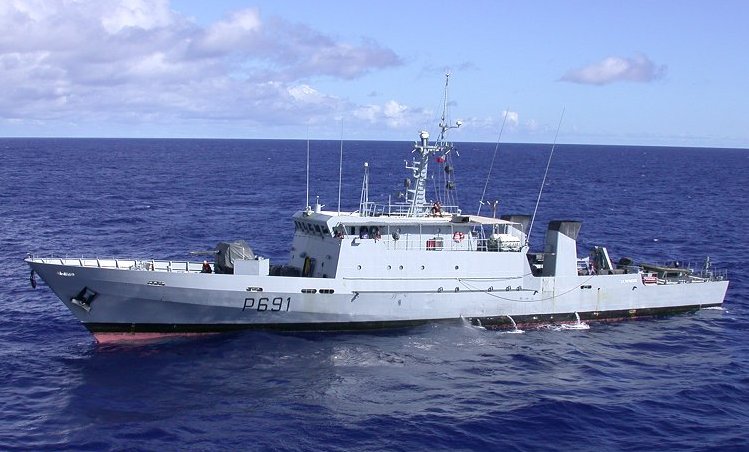
P400 patrol ship Tapageuse at sea near Tahiti (18 June 2003). Photographer: Jean-Michel Roche

While they would have been thinking of their existing 373 ton P400 class pictured above, it might appear to us that they wanted a ship to do the same sorts of missions the Webber class Fast Response cutters (FRC) are doing out of Guam, but they recognized that these ships would be far from any major naval base and that they would need to travel great distances and would be exposed to extreme weather conditions, so they needed to be larger (1300 tons vs 353 tons for the FRC) and have greater range (5500 miles vs 2500) and endurance (30 days vs 5 days).

Having chosen a larger hull, they took advantage of the greater volume and deck space to add a second RHIB, a multimode radar, space for 29 passengers (roughly a platoon of Marines), a sickbay, a dive locker, space for a 20 foot containerized mission module, a flight deck and hangar for a 700-kilogram-class rotor-blade drone (not yet deployed), and a holding area for up to six prisoners.

Some sources also indicate the French ships also have electric motors that would allow them to cruise on the ship’s service generators and secure the main propulsion engines, but I have seen no specifics.

The Photographs: 

The second of the French Navy’s six new overseas patrol vessels (POM), the Teriieroo a Teriierooiterai, which will be based in French Polynesia and has been named in tribute to a Companion of the Liberation native of this Pacific territory, Photo: http://www.meretmarine.com

The Teriieroo at Teriierooiterai fitting out at the end of July, 2023 in Boulogne. Photo: http://www.meretmarine.com

Stern ramp for 8 meter RHIB. French Navy overseas patrol vessel (POM), Teriieroo a Teriierooiterai, fitting out 2023. Photo: http://www.meretmarine.com

Second 8 meter RHIB and davit (only) on starboard side. French Navy overseas patrol vessel (POM), Teriieroo a Teriierooiterai, fitting out 2023. Photo: http://www.meretmarine.com

Aliaca aerial drone on its launch catapult. French Navy overseas patrol vessel (POM), Teriieroo a Teriierooiterai, fitting out 2023. Photo: http://www.meretmarine.com

Recovery System for Unmanned Air System, French Navy overseas patrol vessel (POM), Teriieroo a Teriierooiterai, fitting out 2023. Photo: http://www.meretmarine.com

“Media Advisory: U.S. Coast Guard Cutter Harriet Lane is scheduled to return to home port following inaugural Operation Blue Pacific Patrol in Oceania” –CG News

Australian Royal Navy personnel stand in formation on a pier as the U.S. Coast Guard Cutter Harriet Lane (WMEC-903) and crew prepare to moor at HMAS Cairns, Queensland, Australia, March 7, 2024. The Harriet Lane and crew had a five-day port call in Cairns during its inaugural 2024 Operation Blue Pacific patrol in Oceania. (U.S. Coast Guard photo by Petty Officer 2nd Class Ty Robertson)

Below is a Coast Guard News release. The release has some videos including interaction with children in Port Vila, Vanuatu (very cute).

One thing that caught my eye was the use of the plural in this statement, “The Coast Guard plans to use medium endurance cutters (emphasis applied–Chuck) for responsibilities in Hawaiian waters, as well as an increase Coast Guard presence throughout the Indo-Pacific and Oceania.”

Was this just a misstatement by the PAO or does this mean we will see more WMECs in 14th District?

I would also note that Harriet Lane apparently made this patrol without a helicopter. Barbers Point does fly H-65s, but last I heard, they only have three. Did the cutter at least have a Scan Eagle?


April 4, 2024

Media Advisory: U.S. Coast Guard Cutter Harriet Lane is scheduled to return to home port following inaugural Operation Blue Pacific Patrol in Oceania

Editor’s Note:  Media should RSVP by Monday, April 8 by 4 p.m. to Petty Officer 2nd Class Ryan Fisher at ryan.m.fisher@uscg.mil
Imagery of Harriet Lane’s patrol can be found here: Operation Blue Pacific 

Who: U.S. Coast Guard Rear Adm. Michael Day, commander U.S. Coast Guard Fourteenth District, and Cmdr. Nicole Tesoniero, commanding officer U.S. Coast Guard Cutter Harriet Lane (WMEC 903).

What: U.S. Coast Guard Cutter Harriet Lane and crew are expected to return to home port after their inaugural Operation Blue Pacific patrol in Oceania. Media are invited to watch Harriet Lane and crew moor at Pearl Harbor and families be reunited after being away for more than 70 days. Media will be able to hear remarks from Day and Tesoniero regarding Operation Blue Pacific and the increased Coast Guard presence in Oceania.

Where: Joint Base Pearl Harbor-Hickam, 1000 North Rd, Honolulu, Hawaii, 96860

When: Tuesday, April 9 at 10 a.m.  

Harriet Lane and crew partnered alongside allies and several Pacific Island countries from January to April 2024. Among those countries were Samoa, Fiji, Vanuatu, Australia, Papua New Guinea, Nauru and Marshall Islands. The focus was on advising and sharing best practices, along with bolstering our partners’ capabilities to promote and model good maritime governance in the region.

Harriet Lane and crew expanded U.S. Coast Guard presence in Oceania alongside Pacific Island countries exercising bilateral maritime law enforcement agreements with shiprider provisions to strengthen maritime domain awareness and support efforts to combat illegal fishing activities with partners with whom we have existing relationships.

The Harriet Lane is U.S. Coast Guard Pacific Area’s newest Indo-Pacific support cutter and spent more than 15 months in a Service Life Extension Program (SLEP) in Baltimore, Maryland, to prepare for the transition in missions and operations.

The Coast Guard plans to use medium endurance cutters for responsibilities in Hawaiian waters, as well as an increase Coast Guard presence throughout the Indo-Pacific and Oceania. The ship is especially suited for longer-range six-to-eight week joint operational and training patrols in the Pacific, taking pressure off shorter range Hawaii-based cutters more suited to service closer to home port.

Commissioned in 1984, Harriet Lane is a 270-foot medium endurance cutter homeported in Pearl Harbor, Hawaii, to support Coast Guard missions in the Pacific region. The service’s medium endurance cutter fleet supports a variety of Coast Guard missions including search and rescue, law enforcement, maritime defense, and protection of the marine environment.

“Hawaii-based ‘Indo-Pacific Support Cutter,’ focused on Oceania, is on its first Pacific deployment”- Stars and Stripes

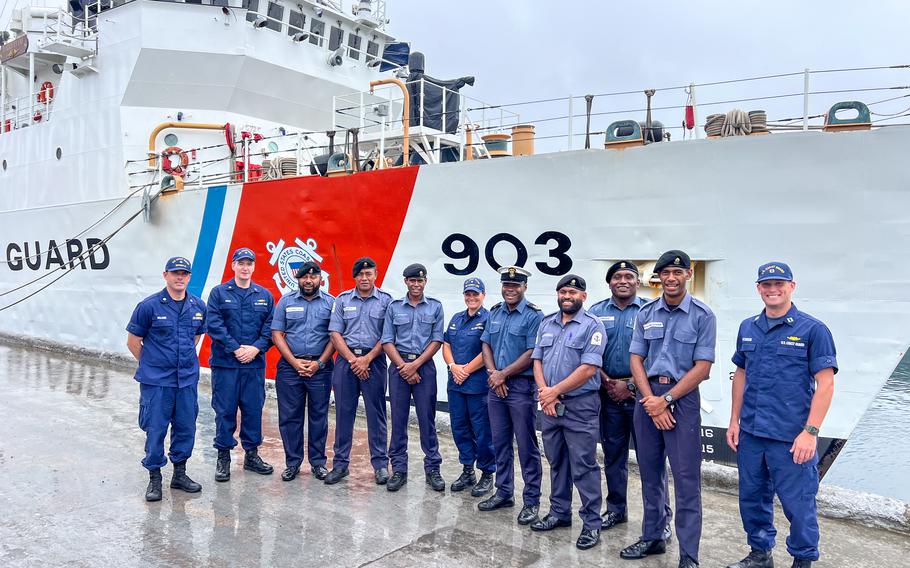
U.S. Coast Guard and Fiji Navy personnel stand in front of the U.S. Coast Guard Cutter Harriet Lane while moored in Suva, Fiji, Feb. 19, 2024. (Charly Tautfest/U.S. Coast Guard)

Stars and Stripes has a nice long article about USCGC Harriet Lane’s first Pacific deployment.

It also suggests we may have been pushing the Guam and Hawaii based Fast Response Cutters (FRS) beyond their limits for long term operation.

“But the small vessels are also limited in both how far and how long they can operate. While they can island hop, they struggle with sustained operations on the high seas, and a high operation tempo has strained the vessels. Some are in need of serious maintenance soon.” (emphasis applied–Chuck)

There is also no mention of the fact that frequently a buoy tender that is larger than Harriet Lane accompanies the FRCs on these expeditionary patrols.

While the article talks about getting new medium sized ships in the Pacific. “…Lane is a “stop gap“ until the service can send a newer, better medium-size ship to the Pacific,” the new Offshore Patrol Cutters (OPC) (more than twice as large as Harriet Lane) will not directly replace the 40 year old cutter in Hawaii. The OPCs are to be based in Long Beach and Kodiak. so rather, it will be that the OPCs relieve the two Hawaii based National Security Cutter of any need to do Alaska Patrols and frees them to do patrols in the Western Pacific.

(Forgive me for being nit picking, but the “Over the Horizon boats” are not “inflatable” even if we do call them RHIBs. For the uninitiated “inflatable” conjures up an entirely different picture.)

“U.S. Coast Guard Cutter Harriet Lane arrives at new homeport in Pearl Harbor” –News Release

USCGC Harriet Lane arrives Pearl Harbor. USCG Photo.

Below is a news release from CG News (more photos there). As part of the prototype SLEP, her 76mm Mk75 gun and Mk92 fire control system have been removed. The AN/SLQ-32 has been retained. It appears there are now additional communications antenna in place of the fire control system, and a 25mm Mk38 gun weapon system is mounted on a bandstand in place of the 76mm.


Dec. 13, 2023

U.S. Coast Guard Cutter Harriet Lane arrives at new homeport in Pearl Harbor

HONOLULU – U.S. Coast Guard Cutter Harriet Lane (WMEC 903) and crew arrived at its new homeport at Joint Base Pearl Harbor-Hickam, Wednesday, after transiting more than 8,000 nautical miles over 36-days from Portsmouth, Virginia.

The Harriet Lane is U.S. Coast Guard Pacific Area’s newest Indo-Pacific support cutter and spent more than 15 months in a Service Life Extension Program (SLEP) in Baltimore, Maryland, to prepare for the transition in missions and operations. Following reconstitution of the crew in July and returning to Portsmouth in August, the crew went through an extensive dockside period, ensuring the cutter was ready for the transit from the Atlantic Ocean to the Pacific Ocean.

“Re-homeporting U.S. Coast Guard Cutter Harriet Lane is indicative of the Coast Guard’s commitment to the Indo-Pacific – the most dynamic region in the world,” said Rear Admiral Brendan McPherson, deputy commander, U.S. Coast Guard Pacific Area. “Harriet Lane will work by, with, and through allies and partners within the Indo-Pacific region to promote capacity building and model good maritime governance.”

“The crew and I look forward to building partnerships in Oceania to enhance our capabilities, strengthen maritime governance and security while promoting individual sovereignty,” said Cmdr. Nicole Tesoniero, commanding officer of the Harriet Lane. “We plan to build upon many decades of enduring support, operating in concert with the needs of our partners.”

Harriet Lane and crew departed Coast Guard Base Portsmouth, November 2023, and during the transit, the crew conducted trainings for upcoming operations along with professional development for crewmembers. Harriet Lane transited through the Panama Canal, and had port calls in Golfito, Costa Rica and San Diego.

Harriet Lane, commissioned in 1984, is a 270-foot medium endurance cutter now homeported in Honolulu to support Coast Guard missions in the Pacific region. The service’s medium endurance cutter fleet supports a variety of Coast Guard missions including search and rescue, law enforcement, maritime defense, and protection of the marine environment.

“U.S. Coast Guard formally establishes Base Guam” –CG News

APRA HARBOR, Guam (Aug. 11, 2021) – An aerial view of U.S. Naval Base Guam shows several vessels moored in Apra Harbor, including vessels from the United Kingdom Carrier Strike Group 21, Aug. 9. The deployment is the U.K.’s first by a carrier strike group in the Indo-Pacific for almost 25 years and marks a historic achievement in the bilateral partnership between the U.S. and U.K. The Arleigh Burke-class guided missile destroyer, USS The Sullivans (DDG-68) is deployed with the strike group, as are F-35B Lightning II Joint Strike Fighters of Marine Fighter Attack Squadron 211, HMS Queen Elizabeth (R08), HMS Kent (F78), HMS Defender (D63), RFA Fort Victoria (A387), RFA Tidespring (A136), Royal Netherlands Navy frigate HNLMS Evertsen (F805). French Ship Dupuy de Lome (A759), USNS Rappahannock (T-AO 204), USNS Salvor (T-ARS 52), USS Jackson (LCS 6), USS America (LHA 6), along with the 31st Marine Expeditionary Unit (MEU), were also in Guam for a scheduled port visit. (U.S. Navy photo by Mass Communication Specialist 3rd Class Naomi Johnson)

Below is a news release from Coast Guard News. This is another step in the growing Coast Guard presence in the Western Pacific. We have gone from a WLB and two 110s in Guam to a WLB and three FRCs and occasional CG helicopter presence. (A Navy MH-60S squadron normally provides SAR coverage.) I think we may see additional resources in the near future. Coast Guard Base Guam is a tenant command of Naval Base Guam. (Thanks to Bob for bringing this to my attention.)

Nov. 7, 2023

U.S. Coast Guard formally establishes Base Guam

U.S. Coast Guard Base Guam

SANTA RITA, Guam — The U.S. Coast Guard is proud to announce the establishment of U.S. Coast Guard Base Guam on Nov. 8, 2023, in a ceremony presided over by Rear Adm. Carola List, commander of Operational Logistics Command.

Led by Cmdr. Dana Hiatt, Base Guam, will be pivotal toward enhancing the U.S. Coast Guard’s mission support logistics in the region. This strategic move aligns with the Service’s commitment to increase mission support throughout Oceania. Given Guam’s vital importance to national security, this initiative takes center stage.

The establishment of Base Guam is part of the Consolidated Appropriations Act of 2023 and expands the U.S. Coast Guard’s mission support in the Indo-Pacific region. The establishment will shift current facilities engineering, naval engineering, comptroller and base operations, health, safety, and work life, personnel support, information technology, and procurement billets and responsibility from the existing U.S. Coast Guard Forces Micronesia/Sector Guam to a new Base Guam command structure. The establishment of Base Guam will consist of 17 additional personnel billets and will rely on the realignment of existing elements to provide logistical efficiencies improving U.S. Coast Guard mission support on Guam.

U.S. Coast Guard Base Guam will operate under the direction of the Operational Logistics Command, responsible for mission support logistics across the entire U.S. Coast Guard enterprise while coexisting with U.S. Coast Guard Forces Micronesia/Sector Guam. The base is taking on the role of the lead logistics and support command, a strategic decision aimed at better serving the needs of the operational community and partners. Forces Micronesia/Sector Guam retains the role of operational authority for U.S. Coast Guard activity in the Western Pacific.

The Base crew’s responsibilities encompass contingency logistics planning for joint operational plans, integration of logistics services, and support for tactical logistics needs for deployed operational assets. Additionally, the enterprise maintains a national-level logistics common operating picture and commands the Coast Guard’s 22 existing bases, ensuring the execution of assigned tasking through each of the U.S. Coast Guard’s Logistics and Service Centers.

The establishment of Base Guam marks a significant milestone in strengthening the U.S. Coast Guard’s presence and capabilities in the region. The unit is physically located on the existing U.S. Coast Guard footprint within U.S. Naval Base Guam.

-USCG-

About the DOL commander:
Rear Adm. Carola List currently serves as the commander of Operational Logistics Command in Norfolk, Virginia, overseeing the delivery of mission support logistics and administering procurement policy, guidance, and advocacy while also providing operational procurement and contracting services for all supported commands and units.

About Forces Micronesia/Sector Guam:
U.S. Coast Guard Forces Micronesia/Sector Guam comprises more than 300 dedicated members based in Guam and the Commonwealth of the Northern Mariana Islands. Capt. Nicholas Simmons currently leads Forces Micronesia and serves as the U.S. Coast Guard Captain of the Port for Guam and the CNMI. The U.S. Coast Guard is committed to maritime safety, security, and stewardship in Oceania, operating under the U.S. Coast Guard 14th District umbrella, which oversees Central and Western Pacific operations.

“Coast Guard hosts Pacific Quadrilateral Coordinating Group on Oahu” –CG News

Below is a news release from Coast Guard News. Looks like Western Pacific fisheries is finally getting the attention it has deserved. The “Pacific Quad” mentioned here (Australia, France, New Zealand, and the US) should not be confused with “The Quad” (Australia, India, Japan, and the US) which is an informal military association.

I am still hoping to see my “Combined Maritime Security Task Force, Pacific” formed.

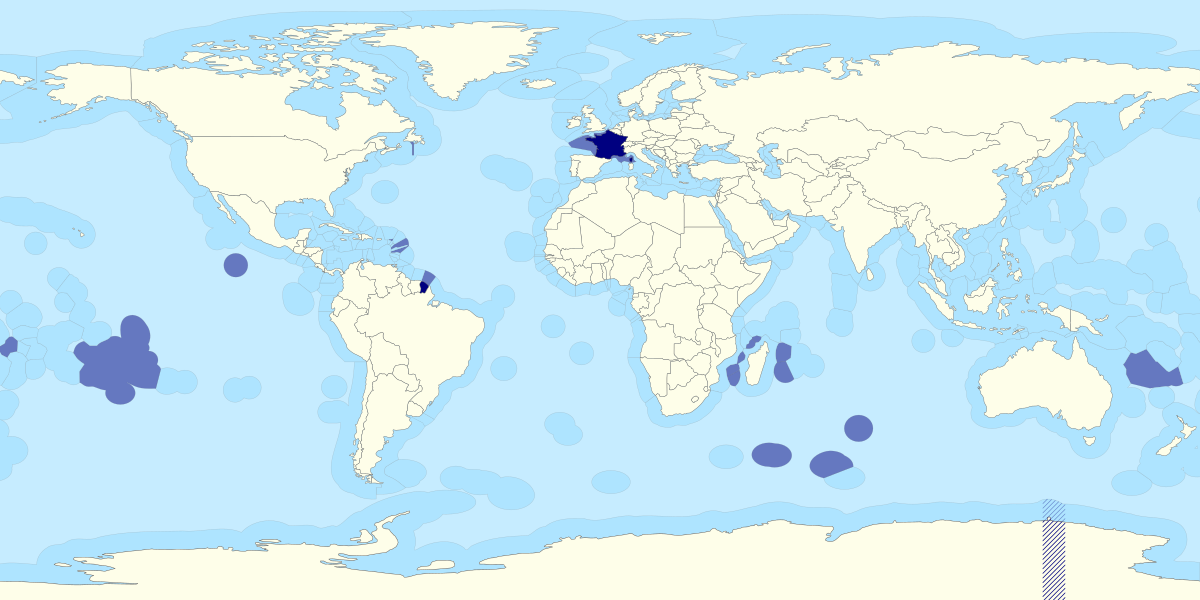
Territory of France and its Exclusive Economic Zone. (Antarctic territorial claims in lighter tone). Credit B1mbo via Wikipedia.

If you are wondering why France is in this group, take a look at their Exclusive Economic Zone, above.


Nov. 3, 2023

Coast Guard hosts Pacific Quadrilateral Coordinating Group on Oahu

HONOLULU — The U.S. Coast Guard recently hosted the Pacific Quadrilateral Defense Coordinating Group from Oct. 9 to 11, 2023, focusing on enhancing maritime security in the Pacific.

The meeting gathered leaders from Australia, France, New Zealand, the United States, and the Forum Fisheries Agency. Rear Adm. Michael Day, U.S. Coast Guard District 14 commander, emphasized the importance of this collaboration, particularly in the context of regional challenges such as climate change and security.

“These face-to-face meetings and continued cooperation among our nations are not just strategic imperatives; they are lifelines to the people of the Blue Pacific,” said Day.

He further highlighted the impact of this collaboration, emphasizing the human element and recognizing the responsibilities of the larger nations in the Pacific, “We acknowledge the historical context, and while we do not seek to rewrite the past, we are committed to a future where the sovereignty and livelihoods of Pacific Island Countries are safeguarded. Climate change, followed by regional tensions, looms large as challenges we all face, and our shared responsibility is to address these threats. Our commitment to combating illegal fishing and ensuring maritime safety is not just about security; it’s about ensuring a sustainable and secure future for the communities who call the Pacific home.”

The Pacific QUAD was established in 1998, and brings together defense and security agencies from Australia, France, New Zealand and the United States in a mutual commitment to partnering with the Pacific Island countries to collectively enhance regional security.

During the meeting, discussions covered various topics, including their annual report, training programs, tactical calendar, information sharing and support for the Forum Fisheries Agency operations. Additionally, three new principals joined the group. Brig. Gen. Yann Latil (France), Air Comm. John Haly (Australia), and Brig. Gen. Andy Shaw (Aotearoa New Zealand).

The Pacific QUAD’s mission is to combat illegal fishing in the Southwest Pacific and collaborate closely with Pacific Island nations. The group operates at both a strategic and operational level, with annual and biannual meetings, respectively.

This year, examples of their collaboration included: an agreement with New Zealand, joint gatherings and strengthening cooperation with Australian Maritime Security Advisors, a successful search and rescue operation, and an international mass rescue exercise, highlighting the positive impact of their efforts on regional stability and maritime safety.

The Pacific QUAD, consisting of New Zealand, the United States, France, and Australia, annually rotates its principal chairmanship position as part of its collaborative approach. Last year, Air Commodore Darryn Robert Webb of New Zealand handed over the role to Rear Adm. Michael Day, who has now passed it to Brig. Gen. Yann Latil, the commander of French Forces New Caledonia. Latil is expected to transfer the responsibility to Air Commodore John Haly, the Australian Joint Operations Command, Director General Operations and Plans (J3), next year. This rotation underscores the ongoing commitment of the Pacific QUAD nations to regional stability and cooperation.

“After a very successful meeting in Honolulu this year, I am happy to take over the American coordination of the Pacific Quad’s work and I look forward to hosting my fellow principals and their teams in Noumea next year,” said Brig. Gen. Yann Latil, the commander of French Forces New Caledonia.

U.S. Coast Guard District 14, covering a vast area in the Central and Western Pacific, plays a crucial role in maritime safety, resource protection, security and national defense through partnerships and international engagement.

“U.S. Coast Guard strengthens historic relationship with Philippines during landmark visit to Tacloban” –USCG Forces Micronesia/Sector Guam

Below is a U.S. Coast Guard Forces Micronesia/Sector Guam news release. We seem to be pushing the little Webber class FRCs further and further. Because they are small, they are effective good will ambassadors. Clearly, they are not there to intimidate. There are more photos at the link. 

Oct. 23, 2023

U.S. Coast Guard strengthens historic relationship with Philippines during landmark visit to Tacloban

TACLOBAN, Philippines — In a historic first, the USCGC Frederick Hatch (WPC 1143) visited partners in Tacloban, Philippines, from Oct. 19 to 23, 2023, and the crew conducted engagements marking a significant milestone in the enduring relationship between the United States and the Philippines.

This visit of several days coincided with the observance of the Battle of Leyte Gulf, a crucial event in World War II history where U.S. Coast Guardsmen were a significant part of the U.S. forces and among the first to hit the beaches as the U.S. sought to retake the Philippines.

“We are deeply honored to be part of this observance and to strengthen the bond between the United States and the Philippines,” said Lt. Patrick Dreiss, commanding officer of the USCGC Frederick Hatch. “It is a privilege to bring a U.S. Coast Guard Fast Response Cutter to the Philippines for the first time and to visit the historic city of Tacloban. My crew was excited to collaborate with the Philippine Coast Guard to deepen our connections with our fellow seagoing Service and explore this unique city and island.”

An advance team from U.S. Coast Guard District 14 and U.S. Coast Guard Forces Micronesia/Sector Guam held planning meetings in collaboration with the U.S. Embassy to prepare for this visit and the Battle of Leyte Gulf observance. Discussions revolved around mutual capabilities, training opportunities, and community engagement, part of the Coast Guard’s Operation Blue Pacific mission.

While in Tacloban, the crew, with support from the Maritime Security Response Team West, hosted a subject matter expert exchange on maritime law enforcement with Philippine Coast Guard colleagues, observed the 79th Leyte Gulf Landing Anniversary, hosted local school children and government officials, held working meetings, and experienced the culture of the Eastern Visayas region of the Philippines.

“The expanded capabilities of the Fast Response Cutter represent more than just advanced technology; they symbolize the bridge of cooperation and goodwill between nations. The FRCs and their dedicated crews regularly play a pivotal role in international diplomacy. These vessels, along with their highly trained and professional crews, are ambassadors of peace and collaboration, said Capt. Nick Simmons, commander of U.S. Coast Guard Forces Micronesia/Sector Guam. “They foster understanding and trust across borders, making the seas safer not only for our own nations but for all nations that rely on the freedom of navigation and maritime security.”

This visit is part of the USCGC Frederick Hatch’s regularly scheduled expeditionary patrol as part of the ongoing Operation Blue Pacific. It follows previous interactions between the U.S. Coast Guard and the Philippine Coast Guard, including the recent arrival of the USCGC Stratton (WMSL 752) in Manila for professional exchanges and joint operations.

The visit of Pacific Area commander Vice Adm. Andrew Tiongson in April to discuss shared challenges and opportunities for partnership further exemplifies the U.S. Coast Guard’s commitment to the region. The Service’s role as a federal law enforcement agency and an armed forces branch uniquely positions the agency’s teams to conduct security cooperation operations supporting combatant commanders, upholding governance, and ensuring regional stability. Through Operation Blue Pacific, an overarching multi-mission Coast Guard endeavor, the Service seeks to promote security, safety, sovereignty, and economic prosperity in Oceania while strengthening relationships between partner nations in the Pacific.

The Tacloban visit underscores the shared strategic efforts toward a stable and prosperous Indo-Pacific and aligns with the Pacific Area Commander’s goals to prepare a ready force, generate combined effects, and uphold governance. It also supports U.S. Coast Guard District 14 and U.S. Coast Guard Forces Micronesia/Sector Guam’s commitment to be a trusted partner in Oceania and deliver operational excellence.

-USCG-

About the U.S. Coast Guard in the Pacific Region:

The U.S. Coast Guard is a vital force ensuring maritime safety, security, and stewardship across a vast Pacific expanse, spanning six continents, 71 countries, and 74 million square miles of ocean. U.S. Coast Guard Pacific Area leads coordination and integration efforts in this vast region, promoting collaboration with partners.

Within this framework, U.S. Coast Guard District 14 oversees 14 million square miles in the Central and Western Pacific, serving as the Coast Guard’s largest district with 1,750 personnel operating 25 units. Their mission includes maritime safety, resource protection, security, and national defense, making them indispensable in the Pacific.

Reporting to District 14, the U.S. Coast Guard Forces Micronesia/Sector Guam team focuses on maritime safety, security, and stewardship in Oceania. With a base in Guam and over 300 members across Guam and the Commonwealth of the Northern Mariana Islands, they maintain a strong U.S. presence in the Micronesia sub-region and adjacent areas, closely tied to local communities.

About USCGC Frederick Hatch (WPC 1143)
The Frederick Hatch is the 43rd 154-foot Sentinel-class fast response cutter named for a surfman and lighthouse keeper who was a two-time Gold Life Saving Medal recipient. The Service commissioned the ship along with its sister ships, Myrtle Hazard (WPC 1139) and Oliver Henry (WPC 1140), in Guam in July 2021. They are currently on patrol representing the United States Coast Guard in the Indo-Pacific region, fostering international cooperation and maritime security.