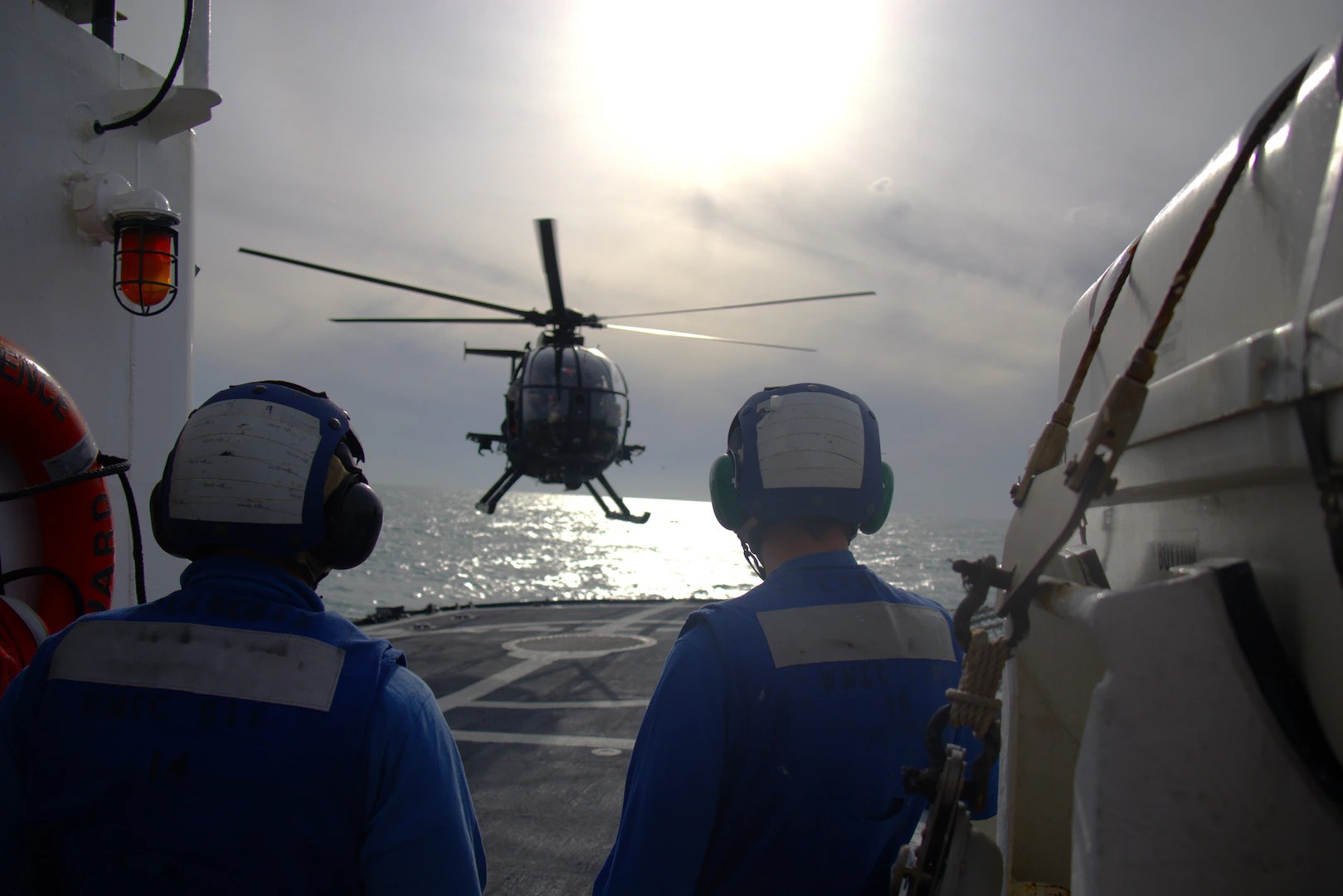
USCGC Diligence with SOAR Little Bird Attack Helicopter –Remembering Operation Prime Chance

USCGC Diligence recently completed a 52-day counterdrug patrol in the Caribbean Sea. Mostly it was a typically successful patrol, but they did do something a bit unusual.

“Diligence also conducted a joint training exercise with the Army’s 160th Special Operations Aviation Regiment (SOAR). During the exercise, the Diligence crew and pilots from SOAR completed daytime and nighttime helicopter landing evolutions.”

The Helicopters were AH-6s. The 160th SOAR has a history of flying off of floating units.

Between 1987 and 1989 the U.S. Army’s 160th Special Operations Aviation Regiment, also known as “The Night Stalkers,” flew Little Bird helicopters from barges and Navy frigates in the Persian Gulf. Operation Prime Chance paired the U.S. Army helicopters with Navy SEALs, Marines, and Special Boat Units in an undeclared war against Iranian Revolutionary Guards units harassing civilian shipping. Six Little Birds, both MH-6 utility and AH-6 attack versions equipped with SEAL snipers, rockets, and machine guns, flew patrols as low as thirty feet.

This might be a reminder that Army and Marine helicopters could be operated from Coast Guard Cutters for limited periods for Special Operations, particularly in areas where there are few Navy assets such as the high North and 4th Fleet.

Wikipedia’s report on Operation Prime Chance here.

More photos of Diligence’s operation with AH-6 here.

Thanks to Peter for prompting me to write about this. 

“New court doc sheds light on Austal’s 2022 Offshore Patrol Cutter win” –Defense News

Future USCGC Pickering (Image: Austal USA)

Defense News reports,

“The court last month ruled against Eastern Shipbuilding, which had appealed the Coast Guard’s decision. The court unsealed the case documents Dec. 14, though with some redactions.”

There is a link to the 42-page court document, but really there is a lot more here than just the decision.

Eastern’s offer was judged better in several respects, but Austal’s price and indoor assembly facility were deciding factors.

“Ultimately, Austal’s proposal came to $3.22 billion, or about $292 million per hull, according to the unsealed documents.

“Eastern’s price is redacted in the documents but is characterized as a “very large price differential.””

It was noted,

“…only one OPC could be built in the indoor facility at a time, meaning the heel-to-toe production cadence could lend itself to “notable disruptions” to schedule.”

This suggests to me, that Austal might have trouble building more than two OPCs a year if the Coast Guard wanted to accelerate OPC production.

The paragraph below may refer to the same presentation by RAdm Jacoby discussed earlier, where he expressed a sense of urgency regarding the OPC program, but there is also an admission that maintaining the Medium Endurance Cutters has become problematic.

Coast Guard acquisition chief Rear Adm. Chad Jacoby said at a recent conference there’s no current plan to have both yards build concurrently into the future but that he’d be open to it if lawmakers increased annual OPC spending, since it’s “urgent” to get OPCs into the fleet to replace “the medium endurance cutters, which are struggling to maintain operational capability right now.”


“Roadrunner Reusable Anti-Air Interceptor Breaks Cover” –The Drive

The Drive reports on a new sort of modular system that has a wide range of possible uses including as an anti-air weapon against threats from small drones to cruise missiles. It is small and relatively cheap. It can loiter. It can return and be refueled. It requires only minimal maintenance. It can be cued by a number of systems. It probably would work against surface targets too. It is jet powered, with high sub-sonic speeds.

“NATO admiral warns of Chinese, Russian threat in Arctic” –The Watch

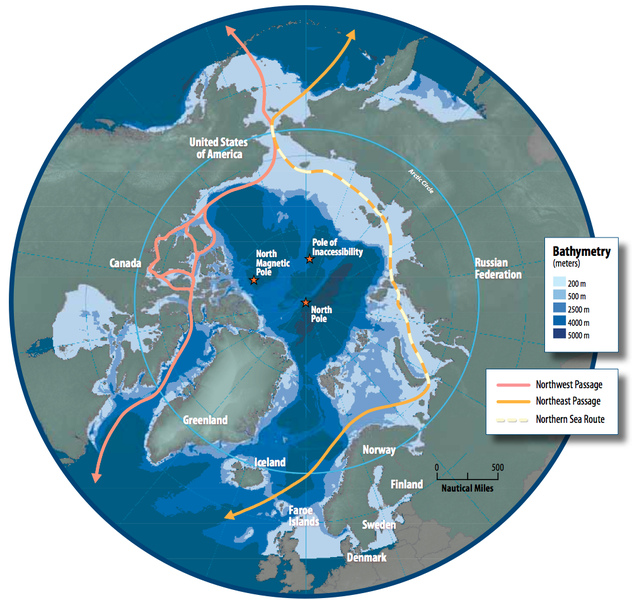
Map of the Arctic region showing shipping routes Northeast Passage, Northern Sea Route, and Northwest Passage, and bathymetry, Arctic Council, by Susie Harder

NORTHCOM’s online magazine, The Watch reports,

Adm. Rob Bauer, chair of NATO’s military committee … is concerned that the People’s Republic of China (PRC) will try to convert its current shipping through Russia’s Northern Sea Route into a military presence in the Arctic.

“We know there are military scientists on board these ships,” Adm. Rob Bauer, who chairs NATO’s military committee, told Bloomberg News on 21 October 2023. “They haven’t said they won’t go there militarily.”

The US does have a strong geographic position, in that it holds one side of the narrow Bering Strait through which any shipping (including submarines) using the direct route between the Pacific and the Arctic must pass.

The question remains, is the US strong enough to hold and exploit its geographic advantage in the event of a major conflict.


“Report: PRC fishing vessels top abusers of forced labor” –Indo-Pacific Defense Forum

PERU, 10.06.2023, Courtesy Photo
U.S. Coast Guard District 11
U.S. Coast Guard Cutter Alder raises the South Pacific Regional Fisheries Management Organization (SPRFMO) flag while patrolling the Eastern Pacific Ocean during Operation Southern Shield in October 2023. The Coast Guard recently completed the first high-seas boardings and inspections off the coast of Peru under a newly adopted multi-lateral agreement to monitor fishing and transshipment operations within the SPRFMO Convention Area, a region which encompasses nearly a quarter of the Earth’s high seas. (U.S. Coast Guard photo by Petty Officer 2nd Class Kenneth Honore)

The Indo-Pacific Defense Forum reports,

“The People’s Republic of China (PRC) is the leading abuser of forced labor on fishing vessels globally, according to a new study…The United Nations International Labour Organization estimated that 128,000 fishers worldwide were trapped into forced labor aboard vessels, according to the 2022 “Global Estimates of Modern Slavery” report. That figure, however, “likely significantly understates the full extent of the problem. The isolation of the workplace makes it difficult to reach the fishers affected, while the extreme vulnerability that comes with work at sea, as well as the risk of repercussions, can lead to reluctance on the part of fishers to report and discuss abuses,” the report stated.

This practice goes hand in hand with Illegal Unreported and Unregulated (IUU) fishing.

“The PRC’s plundering of coral, clams and fish is “theft on a grand scale, unrestricted warfare on natural resources,” Kevin Edes, a maritime security analyst for SeaLight, a project of Stanford University’s Gordian Knot Center for National Security Innovation, wrote on the SeaLight website in November 2023. Edes noted that Adm. Linda Fagan, commandant of the United States Coast Guard, described the PRC’s IUU fishing as “theft of a nation’s natural resources.”

“Cutter Healy returns home after circumnavigating the globe” –MyCG

USCGC Healy (WAGB-20) and the Norwegian Coast Guard Vessel Svalbard sail in formation while en route to conduct joint exercises in northern Norway in the Barents Sea. US Coast Guard Photo

Below is a news release from MyCG.

Dec. 20, 2023

Cutter Healy returns home after circumnavigating the globe

By Senior Chief Petty Officer Charly Tautfest, U.S. Coast Guard Pacific Area

U.S. Coast Guard Cutter Healy (WAGB 20) and crew returned to its homeport Dec. 15, 2023, after circumnavigating the globe covering 25,000 miles in 159-days in support of the 2024 Arctic science missions.

The Healy and crew made port call stops in Seward and Kodiak, Alaska; Tromsø, Norway; Copenhagen, Denmark; Reykjavik, Iceland; Charleston, South Carolina; and Ft. Lauderdale, Florida. Additionally, Healy transited the Panama Canal on its return to Seattle.

“I am incredibly proud of the crew’s performance during our 159-day deployment,” said Capt. Michele Schallip, commanding officer of Healy. “The Healy continued demonstrating the nation’s commitment to the global science community as it seeks to improve understanding of the changing Arctic, particularly in ice-covered waters difficult to reach by most research vessels. This deployment also allowed for engagements and joint exercises with Canada, Norway, The Kingdom of Denmark, and Iceland, which promoted interoperability and cooperation in the Arctic region. The crew was able to share similarities and differences with crews of ships conducting similar work to Healy for their respective nations, a special opportunity to build on these long-standing partnerships.”

The cutter’s first mission supported the Office of Naval Research’s Arctic Mobile Observing System, deploying data collection buoys, subsurface gliders, and other sensors in ice-covered waters north of Alaska. The second mission was in collaboration with the National Oceanic and Atmospheric Administration and the National Science Foundation. Healy and scientists recovered and replaced subsurface moorings with oceanographic instruments and sensors as part of the Nansen and Amundsen Basins Observational System in the East Siberian and Laptev Seas. In addition, the cutter hosted a team from the Coast Guard Research and Development Center, who conducted a broad portfolio of research to develop better techniques and technologies for operating in the Arctic environment.

While deployed, Healy conducted crew exchanges with crews from the Canadian Coast Guard Ship Sir Wilfred Laurier and the Icelandic Coast Guard Vessel Thor. The cutter and crew participated in a similar exchange with the Norwegian Coast Guard Vessel Svalbard and crew before joining in a multi-agency search and rescue exercise in Norway. In addition to these valuable engagements with Arctic partners, the cutter visited port cities on the Atlantic coast of the United States, increasing awareness of U.S. Coast Guard missions in the Arctic.

Healy is the Coast Guard’s only icebreaker designed specifically to support research and the nation’s sole surface presence routinely operating in the Arctic Ocean. Commissioned in 1999, the Healy is one of two active polar icebreakers.

“Coast Guard releases request for proposal for maritime unmanned aircraft system services” –CG-9

The unmanned aircraft sensor payload capability is varied based on the Coast Guard’s desired mission and search conditions: MWIR 3.5 is a mid-wave infrared for thermal imaging capability, for use at night or periods of low visibility; EO-900 is a high-definition telescopic electro-optical (EO) imager to zoom in on targets at greater distance; and ViDAR is a visual detection and ranging wide-area optical search system that is a comprehensive autonomous detection solutions for EO video. Courtesy Photo.

Below is a news release from the Acquisitions Directorate (CG-9). The solicitation is for Group 2 or 3 UAS.

The minimum performance specifications are not particularly demanding, including:

  • 50 knot cruise speed,
  • 70 knot dash speed,
  • 12 hours daily continuous coverage, but that could include two sorties,
  • Range 40 nmi in clear conditions, 35 nmi in light rain,
  • Operate from a flight deck 80 x 48 feet (Host Cutter drawings provided are for NSC, but also presumably OPCs. Not likely for icebreakers or Alex Haley because they have no air search radar, see below) within limits:  pitch +/- 3 degrees, roll +/- 5 degrees.
  • The UA must have space, weight, and power to concurrently operate vendor
    provided: Electro-Optical (EO) sensor, Infra-Red (IR) sensor, AIS, VHF/UHF
    communications relay, aeronautical transponder, and non-visible IR marker for
    the required flight endurance. (I found no minimum payload weight.)

There are some interesting specifications that may reflect how the systems are used.

  • The UA must provide a non-visible, near-IR marker or FDA approved illuminator to
    aid manned assets using NVDs for target acquisition at night
  • The UAS must be capable of operations in light icing conditions defined as
    accumulation of ¼ inch of ice in 15-20 minutes (Objective)(so not a minimum requirement–Chuck)
  • The UA must have an Infrared (IR) anti-collision lighting subsystem (providing a night visibility range of 3+ statute miles) producing energy emitted in a 360-degree pattern around the UA +30 degrees (above) and -30 degrees (below) the horizontal plane of the UA. The IR-light intensity must be at least of a Class B Night Vision Imaging System (NVIS) radiant intensity (NRIb) of 2.31 E -04 NRI. The Ground Control Station must have the capability to turn the IR anti-collision light on or off.
  • In addition to other sensor requirements identified in this document, when such a
    system is commercially available, the UA must be capable of incorporating a
    collision avoidance system (i.e. Detect and avoid (DAA) or Sense and avoid (SAA)
    systems) to extend the UA’s range beyond the host cutter’s air search radar
    envelope while maintaining compliance with international due regard. (Objective) (Not a minimum requirement. Meaning we will likely be operating these systems without a sense and avoid system, so will have to operate within the range of the cutter’s air-search radar. Also precludes operating these systems on vessels without an air-search until such a system is installed–Chuck)
  • At an operating altitude of 3,000 feet when the UAS is directly overhead of the target of interest (no slant range), the UA must be acoustically non–detectable per MIL STD-1474 (series), Level 1, requirements (quiet rural area with the closest heavily used highway and community noises at least 2.5 miles away)
  • The Contractor provided Datalinks must be capable of operating, with
    unobstructed Line of Sight (LOS), at a minimum range of 40 nautical mile
    (NM) (threshold) / 100 NM (Objective).

This sounds very much like a continuation of the Scan Eagle operations already being conducted on National Security Cutters (here, here, here, here, and here). Forgive me if I point out that I recommended we try this system back in 2011, five years before we actually did.


Coast Guard releases request for proposal for maritime unmanned aircraft system services

The Coast Guard released a request for proposal (RFP) Dec. 12 for maritime unmanned aircraft system (MUAS) services capable of deploying from Coast Guard cutters. The services sought are for contractor-owned, contractor-operated intelligence, surveillance and reconnaissance.

Requirements for the MUAS include fully automated flight operations, a minimum 12 hours of flight time a day, ability to be launched and recovered from the host cutter flight deck, and ability to provide services 24 hours a day, seven days a week. The MUAS must be capable of carrying a payload including electro-optical and infrared sensors and communications relay and be capable of providing surveillance, detection, classification and identification for all of the host cutter’s operational missions.

The Coast Guard plans to award one indefinite-delivery, indefinite-quantity firm fixed price contract. Initially, the contract will be used to continue UAS capability on the national security cutter (NSC) class; however, the contract could be used to support additional cutter classes in the future.

The full RFP is available here. Responses are due by 1 p.m. EST Jan. 11, 2024.

For more information: Unmanned Aircraft Systems Program page

“Head of Royal Canadian Navy Outlines Ottawa’s Pacific Strategy” –USNI

This is starting to get a little old, but I am trying to catch up.

US Naval Institute reports on a Center for Strategic and International Studies (CSIS) interview with Vice Adm. Angus Topshee, Commander, Royal Canadian Navy, Chief of the Naval Staff, that discusses their Navy’s increased emphasis on the Pacific.

I have included the video of the interview above.

Three AOPSs at pier before the commissioning ceremony for HMCS Margaret Brooke (AOPV-431). Canadian Navy photo

He discusses operating with the Coast Guard for drug interdiction, icebreaking, and fisheries beginning about time 9:00. The new Arctic Offshore Patrol Ships are expected to play important roles in these activities.

Map of the Arctic region showing shipping routes Northeast Passage, Northern Sea Route, and Northwest Passage, and bathymetry, Arctic Council, by Susie Harder

He explains why he does not see the NW Passage (which includes Alaskan waters) as a future international trade route (12:30).

He anticipates an end to the moratorium on fishing in the Arctic (14:30).

Discusses response to “Gray Zone” threats to undersea infrastructure (15:30).

Discussed war in Ukraine (19:00). Re sinking of Moskva, “Cruise missiles should not sink ships” (20:30). Drones (21:00). AI (24:50).

Where will they concentrate their efforts–Indo-Pacific (27:00). AOPS will be used for Fisheries in the Western Pacific.

Artic is an expeditionary theater, you have to bring everything with you, because there are no port facilities (29:00). Looking to create dual use facilities.

Recruiting (31:30). National Shipbuilding program (35:30), Technology sharing.

“Allies, partners tap into technology to monitor maritime domain” –Indo-Pacific Defense Forum

Winkel Tripel projection, WGS84 datum, central meridian : 150°E. Source Wikipedia Commons, Author: Eric Gaba

The Indo-Pacific Defense Forum reports,

“Maritime domain awareness (MDA) in the Indo-Pacific is moving from an abstract aspiration to a functional collective security approach for managing the region’s dynamic offshore spaces,” noted an April 2023 article in PacNet, a publication of Pacific Forum, a Hawaii-based foreign policy research institute. “Much of the cost-savings in maritime enforcement activities is due to emerging technologies including access to satellites that provide clearer and more accurate images, as well as artificial intelligence and big data platforms dedicated to vessel tracking, prediction, and anomaly detection.”

There are fusion centers in India, Singapore and Vanuatu. These fusion centers would be useful in wartime, but they are essentially a cooperative exchange of information among maritime law enforcement agencies. In addition to its importance in countering IUU and drug smuggling, better maritime domain awareness may give warning of a terrorist attack. Shouldn’t the US Coast Guard have a fusion center in Alameda under Pacific Area? Probably should be one on the West coast of South America too.