“Coast Guard accepts delivery of 49th Fast Response Cutter Douglas Denman” –D17 Press Release

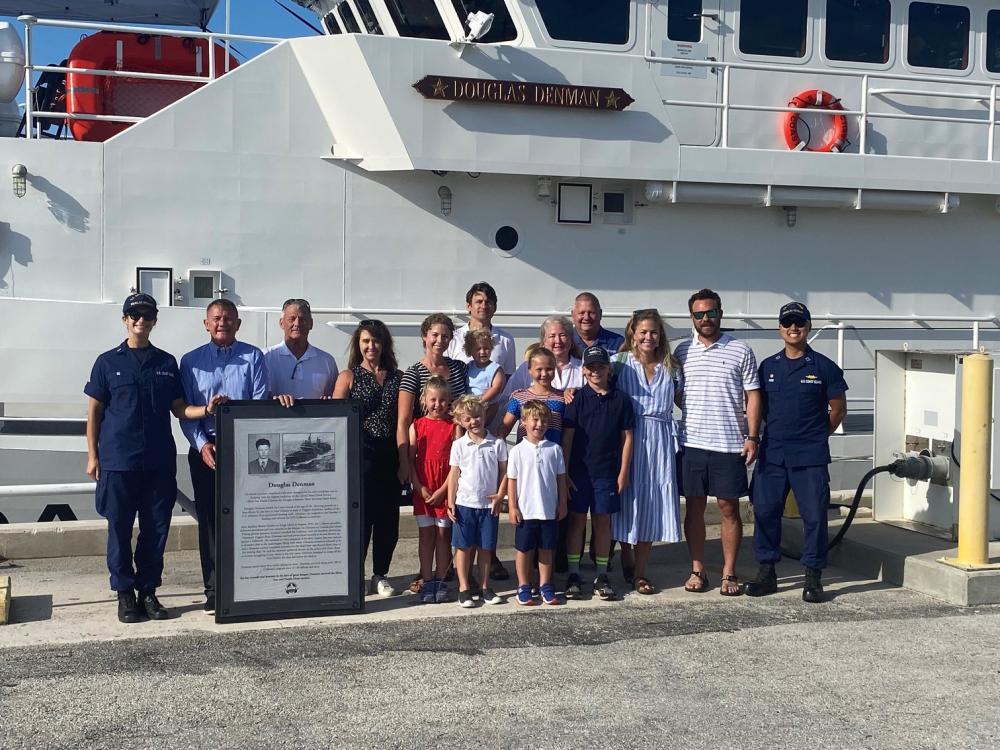
The Coast Guard accepts delivery of 49th Fast Response Cutter Douglas Denman, in Key West, Florida, May 26, 2022. The cutter will be homeported in Ketchikan, Alaska. (U.S. Coast Guard photo)

Below is a press release reporting the acceptance of the 49th Webber class Fast Response Cutter. (There is an error in that this is reported to be the “24th Fast Response Cutter built by Bollinger Shipyards” while all 49 have been built by Bollinger)

This will be the third FRC based in Ketchikan. Normally I would simply add this news as a comment on a previous post, but there is news here that I had not picked up on previously.

Earlier this year, President Joe Biden signed the Consolidated Appropriations Act for Fiscal Year 2022, which included a $130 million increase for two additional FRCs, continuing the program beyond its 64-vessel program of record. This is the second time Congress has added FRCs beyond the original 58 vessel program of record.

Bollinger typically delivers five FRCs a year, so we can expect the 17 additional FRCs to be delivered for over the next three and a half years.

The additional cutters now make it almost certain we will see FRCs based in America Samoa. Additionally we may see them in a second additional new Western Pacific base.

Photo Release

U.S. Coast Guard 17th District Alaska

Coast Guard accepts delivery of 49th Fast Response Cutter Douglas Denman
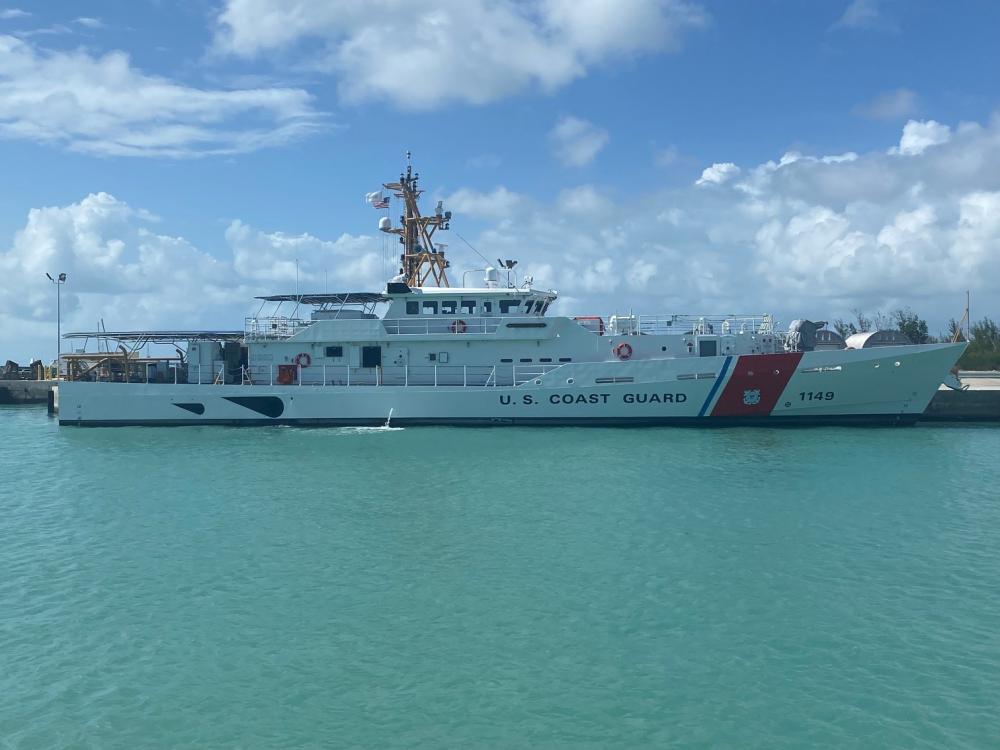
The Coast Guard accepts delivery of 49th Fast Response Cutter Douglas Denman, in Key West, Florida, May 26, 2022. The cutter will be homeported in Ketchikan, Alaska. (U.S. Coast Guard photo)

The Coast Guard accepts delivery of the 49th Fast Response Cutter Douglas Denman, in Key West, Florida, May 26, 2022, alongside the Denman family. The cutter will be homeported in Ketchikan, Alaska. (U.S. Coast Guard photo)

Editors’ Note: Click on images to download high resolution version.

 KEY WEST, Fla. — The Coast Guard accepted the Coast Guard Cutter Douglas Denman (WPC 1149), the 24th Fast Response Cutter built by Bollinger Shipyards, during a May 26 ceremony at Coast Guard Sector Key West.

“We were honored to have Douglas Denman’s son, Doug Jr. and daughter, Karen there for the momentous occasion,” said Lt. Paul Kang, commanding officer of the cutter. “In addition to that, two of Douglas Denman’s granddaughters drove down from Georgia with their families.”

The cutter, which is 154-feet long and has a crew complement of 24, will be homeported in Ketchikan, Alaska.

The Douglas Denman is scheduled for commissioning in September in Ketchikan. It is the third Fast Response Cutter to be stationed in the Coast Guard’s 17th Coast Guard District, which covers the state of Alaska and the North Pacific. The Denman will join the John McCormick (WPC 1121) and the Bailey Barco (WPC 1122), which arrived in Alaska in 2016 and 2017.

Born in Tallapoosa, Georgia, the cutter’s namesake joined the U.S. Coast Guard in 1940 and was eventually assigned as a coxswain to the USS Colhoun (DD-85), a Wickes-class destroyer in the U.S. Navy during World War I and later re-designated APD-2 in World War II. On Aug. 30, 1942, the Colhoun was positioned off the coast of Guadalcanal when it was attacked by hostile aircraft. Denman was seriously wounded during the attack but remained at his duty station. When the order was given to abandon ship, Denman and another crew member helped evacuate the crew and get life jackets to those already in the water. Because of Denman’s selfless actions, 100 of the 150 officers and staff survived the attack and sinking of Colhoun. Denman received the Silver Star and Purple Heart medals for his heroic efforts. He served for 20 years in the Coast Guard, retiring as a senior chief petty officer in 1961.

The Fast Response Cutter is replacing the aging Island-class 110-foot patrol boats and features advanced command, control, communications, computers, intelligence, surveillance, reconnaissance equipment, and an over-the-horizon cutter boat. The cutter features advanced seakeeping capabilities and can achieve more than 32 mph (28 knots). The cutter has an endurance of five days. The Coast Guard is in the middle of the FRC acquisition program.

Earlier this year, President Joe Biden signed the Consolidated Appropriations Act for Fiscal Year 2022, which included a $130 million increase for two additional FRCs, continuing the program beyond its 64-vessel program of record. This is the second time Congress has added FRCs beyond the original 58 vessel program of record.

Douglas Denman is designed for multiple missions, including law enforcement, fisheries enforcement, waterways and coastal security, search and rescue, and national defense.

For more information about this cutter, please contact 17th District Public Affairs at D17-DG-PublicAffairs@uscg.mil or Douglas Denman’s executive officer at Alicen.T.Re@uscg.mil.

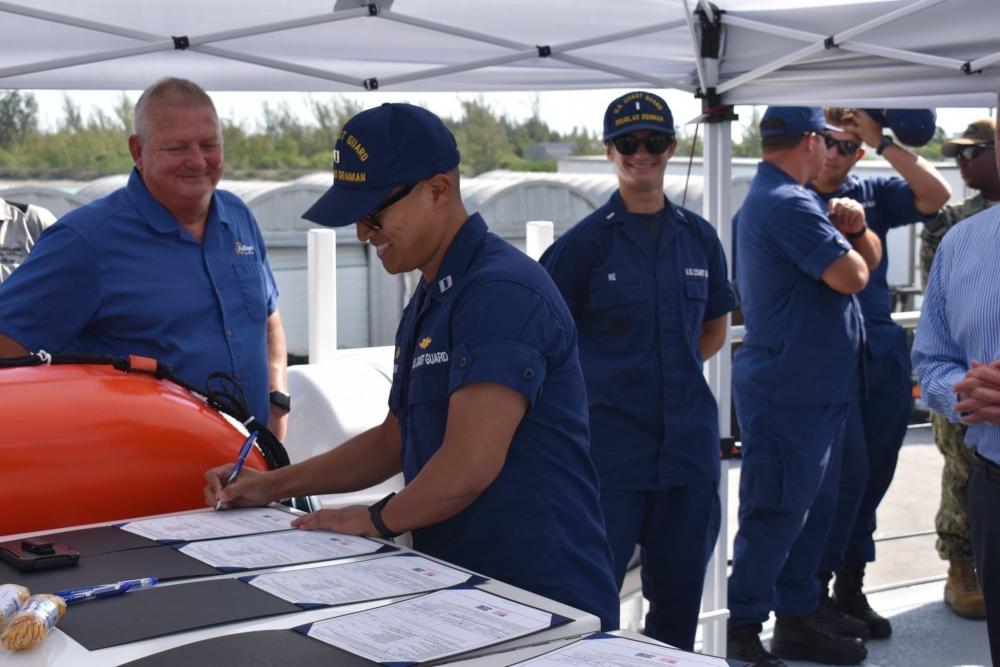
Coast Guard Lt. Paul Kang, commanding officer of Cutter Douglas Denman, accepts delivery of the 49th Fast Response Cutter Douglas Denman, in Key West, Florida, May 26, 2022. The cutter will be homeported in Ketchikan, Alaska. (U.S. Coast Guard photo)

The President Spoke at the Commandant’s Change of Command

Adm. Linda Fagan relieves Adm. Karl Schultz as the 27th commandant of the Coast Guard during a change of command ceremony at Coast Guard headquarters June 1, 2022. Fagan is the first woman service chief of any U.S. military service. U.S. COAST GUARD / Petty Officer 1st Class Travis Magee

The Navy League’s on line magazine reported on yesterday’s change of command ceremony.

It is a land mark event that a woman has become commandant, but it was also significant that the President chose to be at the event. This may be seen as an exploitation of the novelty of the transition, but it also seems to reflect the increased visibility of the Coast Guard in national security affairs.

“Taiwan’s Coast Guard Tests Its Ability To Turn Cutters Into Ship Killers” –The Drive

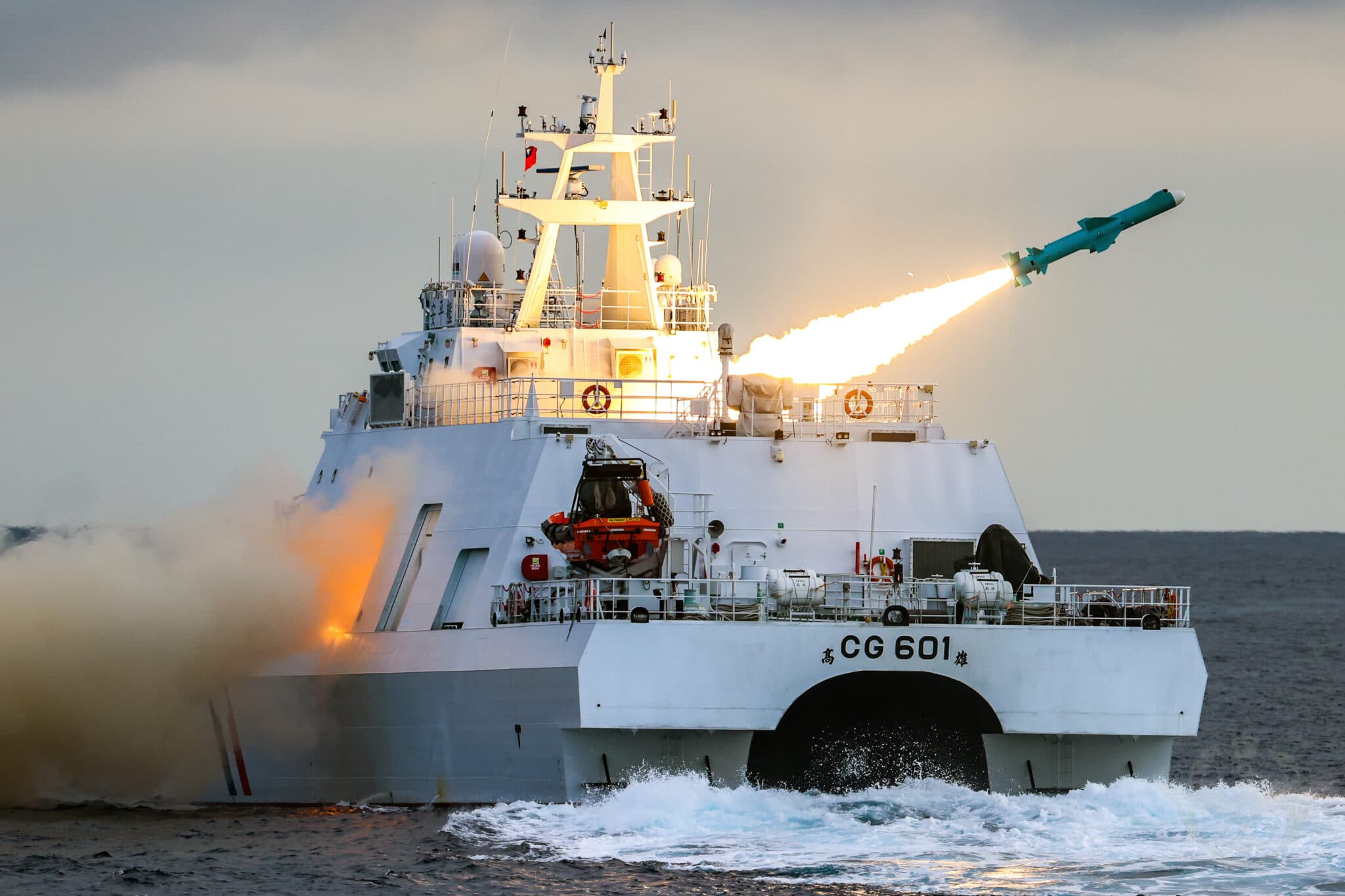
Taiwan Coast Guard Vessel Anping firing missile

The Drive/The War-Zone reports,

During the test conducted on May 23, officials said that the HF-2 missiles were launched from the cutter off the coast of the Jiupeng Base and successfully hit a target ship that was located 62 miles off the coast of Lanyu, near Orchid Island. According to Taiwan’s Liberty Times Net reporter Zheng Jingyi, “this live ammunition firing specifically verifies the integration of the naval forces and sea cruisers under the ‘peace-to-war conversion.’”

This was a test and the missile launch equipment was removed immediately after the test. The launch and control was conducted by Taiwanese Navy personnel, temporarily assigned for the test.

Since the cutters are a version of a missile equipped Taiwanese Navy corvette, there would seem little reason to believe the test would not have been successful.

Reportedly twelve corvettes and twelve cutters are planned, but the prototype Navy corvette was commissioned in 2014, the second not until 2021, and none since. On the other hand four of the cutters have entered service beginning 2020 with two more under construction.

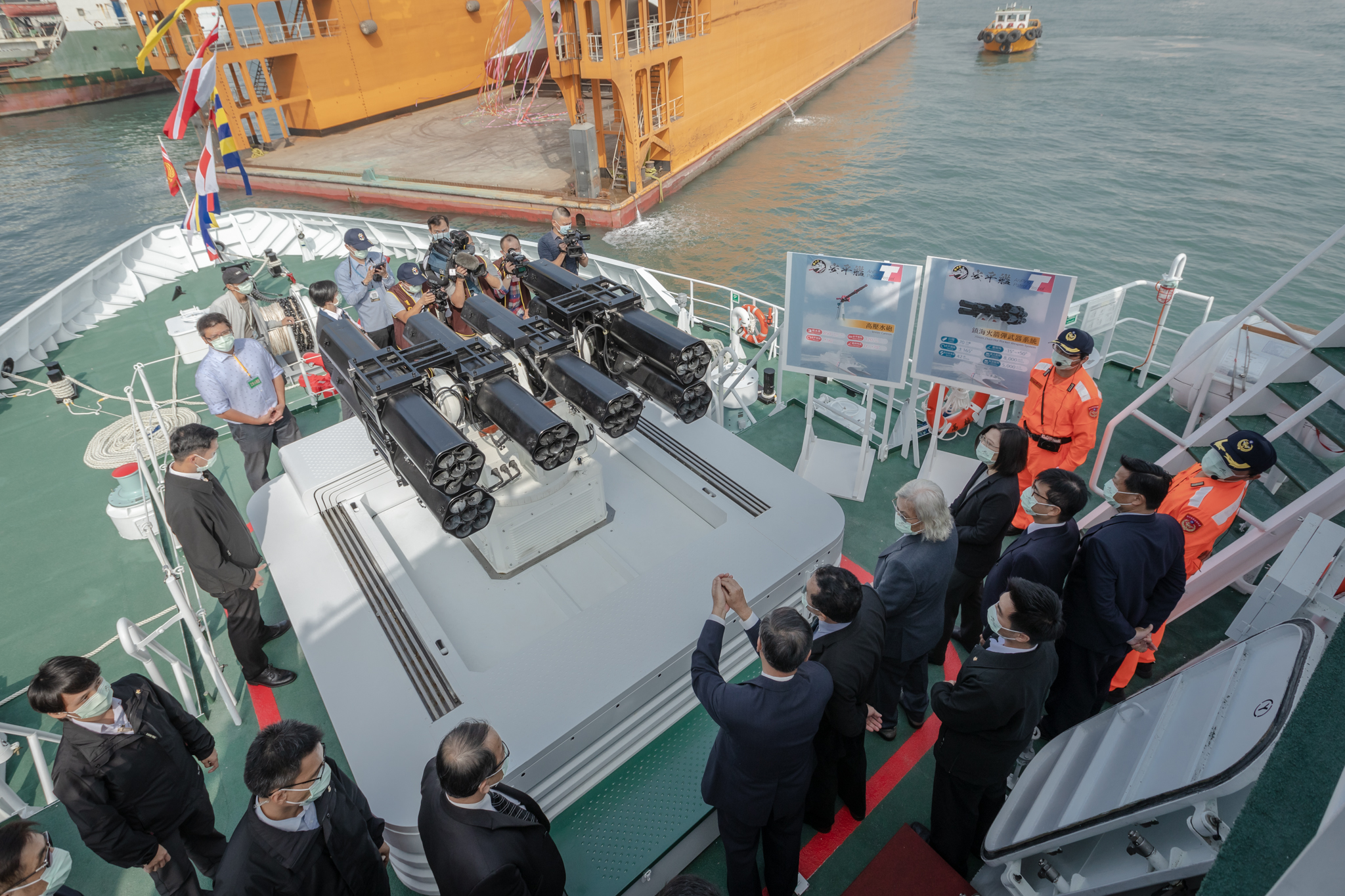
The normal armament of these and other Taiwanese cutters includes an unusual 42 round, remote controlled, “Zhenhai” 70mm/2.75″ rocket launcher. It is unclear if these rockets have a guidance system like APKWS. Photos below from Wikipedia.

Taiwan Anping-class offshore patrol vessel onboard multi-barrel Zhenhai rocket system

Anping-class offshore patrol vessel onboard 42-barrel Zhenhai rocket system, looking forward

“THREE ROUNDS OF COERCION IN PHILIPPINE WATERS” –CSIS

China CG Cutter 5203

The Center for Strategic and International Studies’ Asia Maritime Transparency Initiative brings a report of Chinese tracking and harassing vessels conducting legitimate activities in the Philippine’s Exclusive Economic Zone (EEZ) on three occasions.

There are some things worth noting about these three encounters:

  • In the first the Taiwanese Coast Guard was successful in allowing the research vessel to complete its task. In the second encounter, the Philippines appears to have surrendered preemtively while the Chinese vessel came no closer than 0,9 miles. In the third, the two Philippine vessels were successfully intimidated and turned away by China Coast Guard vessels supported by maritime militia vessels.
  • While Chinese vessels approached these vessels and came with 100 meters in the third incident, there was no indication that they attempted to ram or block movement, though blocking did appear to be the ultimate intent in the third incident. Chinese vessels have intentionally rammed in the past, but I cannot recall a Chinese government vessel ramming another government’s vessel. Chinese maritime militia have employed this tactic.
  • In the first encounter the Taiwanese Coast Guard used some of their largest ships as escorts. 5001 is more than 5000 tons full load, larger than the Bertholf class ships (4,500 tons full load). Taiwan Coast Guard’s CG129 is also relatively large at 120 meters (394 ft). It is nominally 3,000 tons, but probably over 4,000 tons full load. China Coast Guard (CCG) 5203 is reportedly 102 meters (335 ft) in length and 14 meters of beam.  It is probably around 3,000 tons full load.
  • The two Philippine Coast Guard cutters mentioned, BRP Capones and BRP Cape Engaño were both Parola class patrol boats, built in Japan and delivered in 2017 and 2018 respectiely. These 44 meter/146 ft vessels are just a bit smaller and slower than the Webber class. They were much smaller than the CCG vessels.
  • Only the Chinese employed vessels were armed with medium caliber naval guns. I was unable to find specs or photographs of CCG 5303 or 5304 but at least CCG 5203 was armed with a modern 3″ gun. The Taiwanese vessels were armed with auto-cannon of up to 40mm. The Philippine CG vessels were armed with nothing larger than .50 cal.
  • Taiwanese and Philippine CG vessels appear to have had a speed advantage, but the CCG had a speed advantage over the vessels being escorted. In the third incident any speed advantage was also largely negated by the larger number of Chinese vessels.

It should be clear that if the Philippines intends to operate in their EEZ, in areas included in the “Nine Dash Line,” they should expect the Chinese will confront them. If they intend to operate there, they need to decide to either support the effort strongly or operate not at all. Being chased out repeatedly strengthens China’s position.

Should the Philippines decide to operate in the disputed waters, it does have some advantages at least for operations of short duration. While the China CG is much larger, the Philippines has the advantage of proximity. Far from their bases, the Chinese cannot reinforce quickly. The Philippines can surge large numbers of units the short distance from their bases quickly.

The Philippines has been pushed around. Perhaps it is time to push back. Not an escalation, but a reponse in kind.

A coordinated sweep of Chinese fishing vessels fishing illegally should be possible.

To deter shouldering, size is important, so the Philippine CG should include their largest ships.

To deter the Chinese from resorting to weapons, Philippine law enforcement vesssels should be supported by Philippine Navy vessels. It would not hurt if Philippine light attack aircraft were airborne.

It would also help if vessels of other nations, including the US, were on scene to witness the encounter.

BRP Capones in Davao Gulf. Philippine Information Agency.

Thanks to Paul for bringing this to my attention.

The Indo-Pacific Partnership for Maritime Domain Awareness

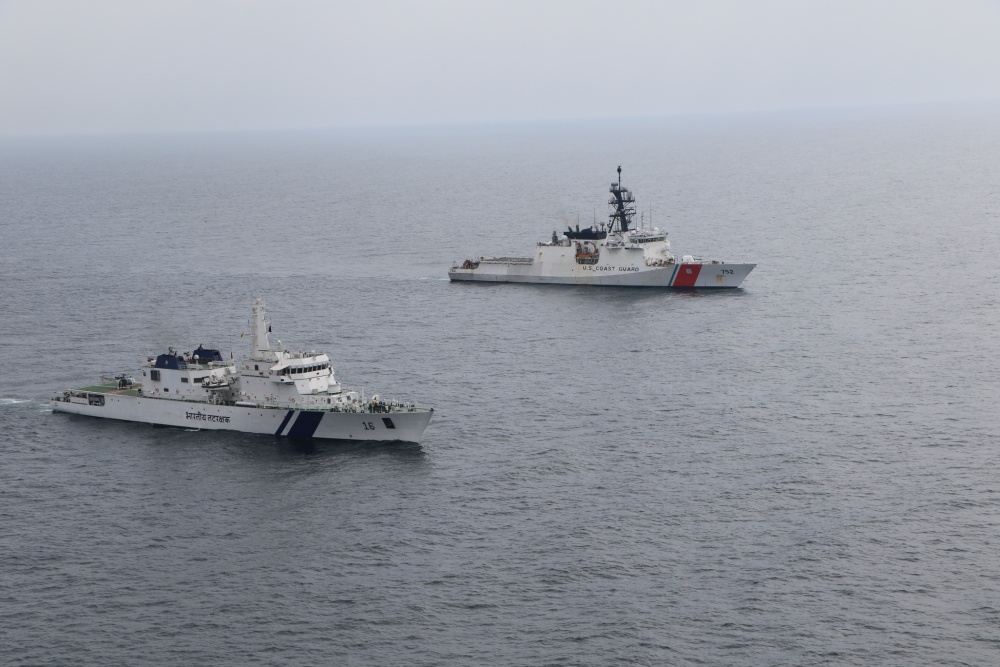
Coast Guard Cutter Stratton (WMSL 752) sales alongside the Indian coast guard ships Abheed and Shaurya (16) Aug. 23, 2019, while transiting in the Bay of Bengal off the coast of Chennai, India. The Stratton is participating in a professional exchange with the Indian coast guard that includes operational exercises at sea and on shore. (U.S. Coast Guard photo by Petty Officer 3rd Class Stephen Esterly)

Time to learn a new acronym, IPMDA, Indo-Pacific Partnership for Maritime Domain Awareness.

The Maritime Executive reports,

The Quadrilateral Security Alliance (Quad), a loose defense cooperation group composed of the U.S., India, Australia and Japan, plans to introduce a joint satellite-based tracking system aimed squarely at Chinese illegal fishing.

Real Clear Defense has another view, ““Black Ships,” the Quad and Space.

A Whitehouse “FACT SHEET: Quad Leaders’ Tokyo Summit 2022” leads of with discussion of the IPMDA. Quoting,

The Indo-Pacific Partnership for Maritime Domain Awareness  

At the Tokyo Summit, the Quad leaders will welcome a major maritime initiative: the Indo-Pacific  Partnership for Maritime Domain Awareness (IPMDA). In close consultations with regional partners, IPMDA will offer a near-real-time, integrated, and cost-effective maritime domain awareness picture. This initiative will transform the ability of partners in the Pacific Islands, Southeast Asia, and the Indian Ocean region to fully monitor the waters on their shores and, in turn, to uphold a free and open Indo-Pacific. Quad countries are committed to contributing to the region’s maritime domain awareness—a fundamental requirement for peace, stability, and prosperity—through an investment in IPMDA over five years. The partnership will innovate upon existing maritime domain awareness efforts, rapidly bringing emerging technologies to bear for the greater good of the Indo-Pacific community.

IPMDA will build a faster, wider, and more accurate maritime picture of near-real-time activities in partners’ waters. This common operating picture will integrate three critical regions—the Pacific IslandsSoutheast Asia, and the Indian Ocean region—in the Indo-Pacific. The benefits of this picture are vast: it will allow tracking of “dark shipping” and other tactical-level activities, such as rendezvous at sea, as well as improve partners’ ability to respond to climate and humanitarian events and to protect their fisheries, which are vital to many Indo-Pacific economies. IPMDA will do so by:

  • Harnessing commercially-available data using existing technologies. Through a combination of Automatic Identification System and radio-frequency technologies, Quad partners can provide an unprecedented “common thread” of activities. Because of its commercial origin, this data will be unclassified, allowing the Quad to provide it to a wide range of partners who wish to benefit.                 
  • Extending support for information-sharing across existing regional fusion centers, such as the Information Fusion Center-Indian Ocean Region, based in India; the Information Fusion Center, based in Singapore; the Pacific Islands Forum Fisheries Agency, based in the Solomon Islands, and the Pacific Fusion Center, based in Vanuatu, both of which receive support from Australia.

Quad partners will begin immediate consultations on this opportunity with partners in the region. As the initiative proceeds, the Quad will identify future technologies of promise, allowing IPMDA to remain a cutting-edge partnership that promotes peace and stability throughout the region. 

More on the Quad here.

If this works, similar systems should be extended over the Atlantic and Eastern Pacific as well. In addition to countering Illegal, Unreported, Unregulated (IUU) fishing, such systems have potential for SAR, MEP, interdiction of smuggling activities, counter piracy, disaster response, and sanctions enforcement.

In wartime such systems would have significant implications for Naval Control of Shipping and might alert us to sinkings. Access to this information would, of course, also be useful to our enemies seeking to target ships. Presumably there is planning for these eventualities.

Thanks to Paul for bringing this to my attention.

“New Drug Seizure By The French Navy In The Gulf Of Guinea” –Naval News

Naval News reports seizure of 1.7 tons of cocaine in an unusual place, the Gulf of Guinea, off the West coast of Africa. It was apparently incidental a normal French Navy deployment, not specifically a drug interdiction operation.

I found it a bit unusual that the cocaine did not appear to be well hidden. That might indicate how unlikely interception along this route may be.

Significantly this interception was conducted in cooperation with the Gulf of Guinea Interregional Network’s centers of the Yaoundé Process.

The “Landing Helicopter Dock” (LHD) Mistral, is certainly not the type vessel typically involved in drug interdiction.

The frigate involved, FS Courbet, is a Lafayette class frigate. This class always seemed similar in function to Coast Guard WHECs, because, as built, they had no ASW capability. Aside from the Anti-Ship Cruise Missiles they carried, in many respects their capabilities were similar, particularly after the WHECs were FRAMed. The French ships were built about aboout three decades after the Hamilton class. In some ways they apear to be as an intermediate design between the Hamilton class and the Bertholfs. FS Courbet is smaller (3600 tons full load), slower (25 knots), and has less range than the Bertholf class NSCs (7,000 nmi), but has been recently upgraded with a hull mounted sonar, improved point defense AAW systems, and later model Exocet ASCMs.

“Navy: Mine Countermeasures Mission Packages to Be Available for Vessels of Opportunity” –SeaPower/Coast Guard Connection?

USNS Hershel “Woody” Williams launches a Knightfish unmanned underwater vehicle (UUV) while at anchor in the Chesapeake Bay, Sept. 14, 2019. Photo: US Navy

The Navy League’s on line magazine, Seapower, reports,

“Capt. Mike Egan, branch head for mine warfare in the Office of the Chief of Naval Operations, speaking May 24 in Monterey, California, at the 2022 International Mine Warfare Technology Symposium of the Mine Warfare Association, said the MCM mission package is on track to achieve initial operational capability in the fall of 2022 and the Navy plans to procure a total of 24 packages.

“The Navy plans to equip 15 Independence-class littoral combat ships with the MCM mission package, which will leave an additional nine mission packages for use elsewhere.”

USN mine countermeasures ships are being decommissioned. Soon these mission packages will be the only US naval mine clearance assets. If a US port is mined, how will the mines be cleared?

Currently all Independence class LCS are based in San Diego. With the decision to shed all but six of the Freedom class LCS, none of which will be MCM capable, it is likely at least some Independence class will be based on the East Coast, presumably at Jacksonville. Aside from these 15 LCS mounted systems, it also appears the Navy will mount one on each of the five Lewis-B. Puller-class “Expeditionary Sea Bases” (ESB). That still leaves four MCM mission packages unclaimed.

LCSs based in San Diego and Jacksonville are still a long way from many US ports. In addition to transit time, the LCSs may be deployed or may not be available on short notice. The ESBs are all expected to be forward deployed, with one probably being assigned to each Geographic Combatant Commanders with the exception of Northern Command, e.g. Africa Command, Central Command, European Command, Indo-Pacific Command, and Southern Command, so they are unlikely to be available.

These four packages could provide mine clearance for US ports. One East Coast (perhaps Norfolk area), one West Coast (Seattle?), one Hawaii (Pearl?), and one in Alaska (Anchorage?) might be a logical distribution.

We know the disasterous effect of even short term port closures. Time is critical. The mission packages should be able to be deployed by air to the port(s) of interest. Some elements of the packages could certainly operate from shore. In many cases Coast Guard bases and air stations would be logical locations for temporary relocation of Navy assets. It is not unlikely Coast Guard fixed wing aircraft might be tasked with providing the air lift.

Some elements of the mission package, like the Unmanned Underwater Vehicles are still likely to require operation from floating units. Buoy Tenders would likely be able to fill this role. It might be worthwhile exercising this option, perhaps at RIMPAC.

“Indonesia stands up to PRC’s aggressive moves in South China Sea” –Indo-Pacific Defense Forum

A China Coast Guard ship is seen from an Indonesian naval vessel during a patrol north of Indonesia’s Natuna islands. (Antara Foto via Reuters)

Indo-Pacific Defense Forum reports,

“Indonesia has successfully defended its sovereignty off the northwest coast of the island of Borneo by standing up to aggressive incursions by the People’s Republic of China (PRC), which maintains that its widely dismissed territorial claim in the South China Sea gives it authority to enter the area unimpeded.”

Indonesia is demonstrating it is possible to resist China’s bullying without starting a war.

“Bad News” from the Navy, an Upnote for the Coast Guard

USS Zephyr (PC 8) and U.S. Coast Guard Law Enforcement Detachment Pacific personnel, conducting operations in support of JIATF-S Operation Martillo. U.S. Navy photo by MC3 Casey J. Hopkins

Texas Public Radio has a report, “A surge in Navy deserters could be a sign of a bigger problem for the military,” that also references recent suicides in the Navy. I would note that, based on their reporting, there has been no comparable surge in other armed services, and there is good news from the Coast Guard.

“But other branches of the military didn’t see a similar increase in the past three years.Desertions in the Army dropped by 47%, from 328 in 2019 to 174 in 2021, and the Marine Corps reported 59 in 2019 and 31 in 2021. The Coast Guard said it didn’t record a single deserter between 2019 and 2021.”

I would also point out, that 157 desertions out of over 340,000 active duty members is still a pretty smaller percentage (<0.046%, about one out of 2,178), only a little worse than the Army’s much improved 2021 figures, and actually much better than the Army’s 2019 figures.

The TPR report is really using this “surge” as basis for discussing the lack of early out options. While we don’t want to spend a lot of money training someone for a high paying civilian job and then release him or her as soon as they go to a job where their boss actually expects them to do their job, there are times when early separation is good for the service.

Early in my career, it was the Vietnam era. Many enlisted in the Coast Guard, not because they wanted to be there, but because it was a way to avoid the draft. The Ocean Station program was ending, so the Coast Guard decided to decommission many of its larger ships and to truncate the WHEC 378 program at 12 instead of the planned 36. The resulting downsizing meant there would be a large reduction in force. We took advantage of this by early, many times compulsary, separation of many trouble makers and poor performers. It always seemed 90% of our personnel problems were caused by fewer than 10% of our people. This purge had a wonderful effect.