“Weapons Effectiveness Testing–25 vs 30mm” Revisited

I am resurfacing this old post from 2017, because our weapons effectiveness is still an issue. I also reformatted a couple of sentences to bold type face, so the points would be harder to miss. Hopefully the Mk38 Mod4 will have at least the 30mm gun, if they don’t decide to recycle 25mm guns, as seemed to have been the case when the Mod3 changes were minimized compared to the Mod2. We really need to upgrade the older mounts to a more effective weapon, otherwise we are planning to fail. Either replace the 25mm with a more effective gun or add APKWS or Hellfire/JAGM small missile systems. Better yet, do both.


This is old. It goes back to 1992, but if they knew the results here, it raises a question, why are we still equipping the Mk38s with 25mm guns instead of 30mm (or 35mm or 40mm) guns which also fit the same mount? The results are discussed beginning at time 8:00. The 30mm does nine times the damage to the hull and five times the damage inside the hull.

At the very least we need to make sure we have available rounds that do not detonate on impact. The 25mm rounds, exploding on impact, failed to even penetrate the 1/4 inch aluminum hull of the Mk3 target boat.

Thanks to Luke for bringing this to my attention. 

“Fincantieri To Design And Build New Multirole OPV For Italian Coast Guard” –Naval News

The future multirole offshore patrol vessel (unità d’altura multiruolo) of the Italian Coast Guard.

Naval News reports the award of a contract for a new Italian CG cutter.

The order, which concludes the tender procedure and has a value of approximately 80 million euros, provides for the construction of a multirole OPV and the related temporary support services for a duration of 5 years. There is also an option for the construction of a further 2 vessels.

The Italian Coast Guard is a quarter the size of the US Coast Guard and is part of the Italian Navy. Historically, offshore Coast Guard functions were frequently performed by the Italian Navy. Their Coast Guard only began building larger specialized coast guard Offshore Patrol Vessels a little over a decade ago.

The new ship(s) appears generally similar to the two earlier Dattilo class OPVs commissioned in 2013 and 2014. At a reported 85 meters in length it will be about ten meters shorter. USCGC Hamilton exercised with a Dattilo class cutter during its European deployment back in April.

This and previous Italian OPVs appear to be derived from Offshore Support Vessel (OSV) practice. There is no indication of speed, but I would expect about 18 knots, this being the speed of previous Italian OPVs. All previous Italian OPVs had provision for taking containers aboard, so that also appears likely. There is no provision for a hangar. No mention is made of armament, but judging from the artist’s renderings and current Italian Coast Guard/Navy practice, it is likely to be an Leonardo Oto Melara/Oerlikon KBA 25 mm/80 remote weapon system which fires the same 25x137mm round as the Mk38 but at up to more than 550 rounds per minute supplemented by 7.62mm machine guns. Following previous practice, the new ship(s) is probably fitted for but not with the OTO Melara 76mm.

“Coast Guard drones can see underwater and inside vessels during response to hurricanes and extreme weather events” –MyCG

US Coast Guard Photo

US Coast Guard photo

These two photos which accompany the post appear to be of the same tank but taken from opposite sides. 

MyCG has as post about the increasing use of Unmanned Air Systems. In this case primarily concerning the use of small commercially available systems. Take a look.

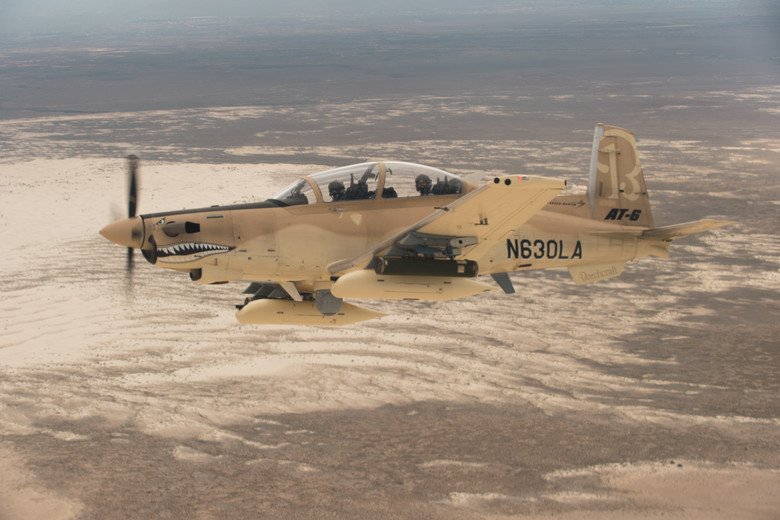
Thailand Buys AT-6 for Coast Guard Type Missions

Defense News reports that Thailand has become the first international customer for the Textron Beechcraft AT-6 light attack aircraft.

Thomas Hammoor, president and CEO of Textron Aviation Defense, said in a statement that the Royal Thai Air Force selected the Beechcraft AT-6 to conduct a broad array of missions in support of border security as well as anti-smuggling, counternarcotics and anti-human trafficking operations.

This is basically the same aircraft Coast Guard aviators train on before they get their wings, but with upgrades. I can’t help but think something like this or the similar Embraer A-29 Super Tucano could handle a lot of ISR missions more economically than what we are using now.

They could be used to scout for D7 Webber class FRCs doing drug or migrant interdiction and provide shots across the bow and over-watch in lieu of a helicopter.

The Washington DC air intercept mission in particular comes to mind. Local searches for overdue boats is another possibility. As you can see these aircraft support integrated electro-optical sensors.

An AT-6 Beechcraft is on display at the 2021 Dubai Airshow. (Agnes Helou/Staff)

Armed, these could also provide a response to terrorist attacks. My earlier ramblings on Coast Guard aircraft missions here.

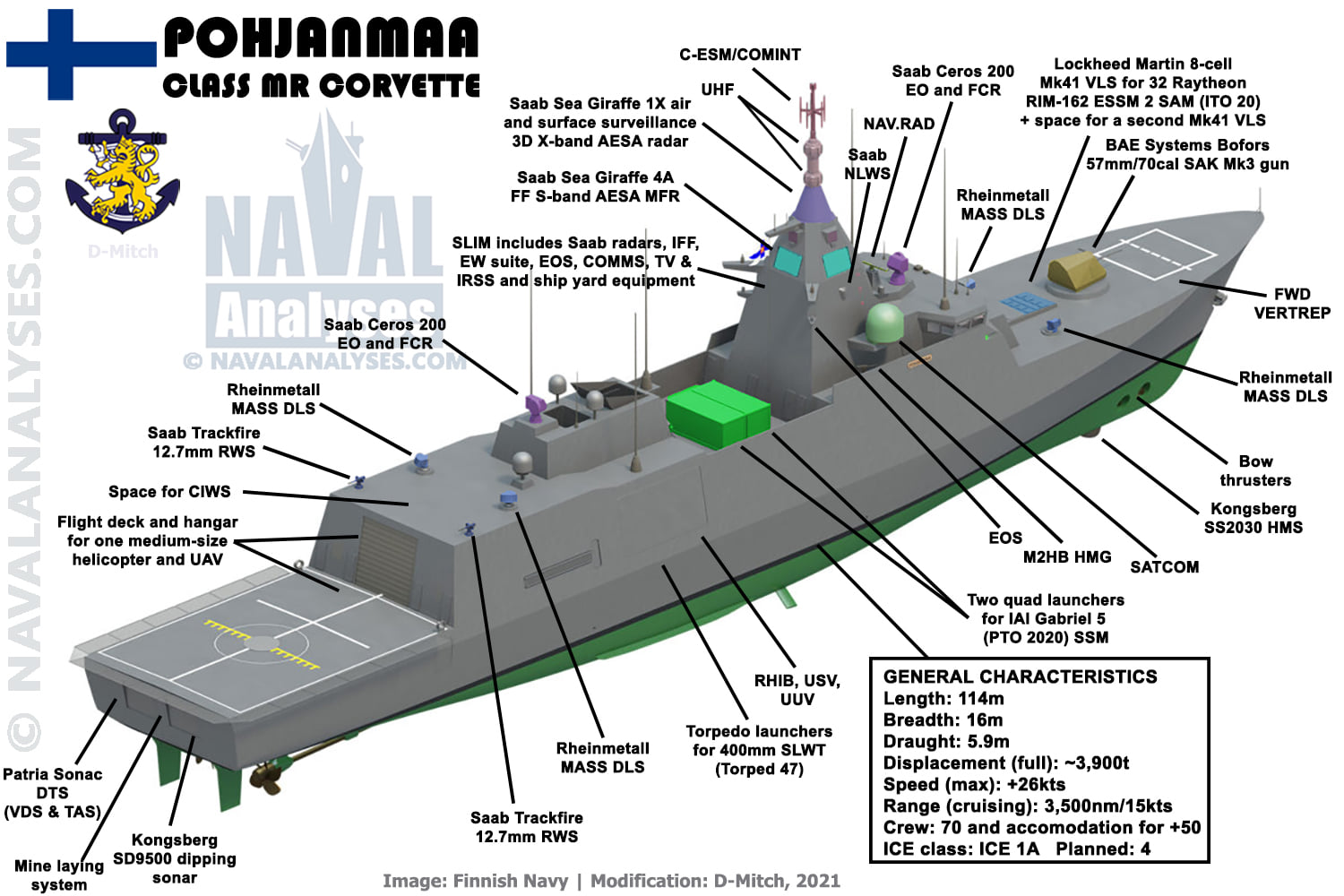
Finnish Navy Ice Strengthened Corvette

We began talking about this class of rather unique warships about six years ago. Since then, a lot of comments have been added. I wanted to pass along this info graphic.

What makes these really unique, and perhaps of interest to the USCG, is the Ice Class requirement which translates to non-consolidated (refrozen) ice channels with a thickness of 1.0 meter (3.3 ft) in the middle.

Compared to the Offshore Patrol Cutters, these ships will be a little longer (374 feet vice 360), but also a little lighter displacement (3900 tons vs 4500). They will have a much shorter range (3500 nautical miles vs over 10,000) and a much smaller crew (70 vs over 100), although the total accommodations are similar.

Predictably the Finnish ship is much more heavily armed.

“Mind the Gap: How the U.S. Coast Guard Can Navigate the Window of Vulnerability in the Indo-Pacific” –RealClearDefense

RealClearDefense has a post that offers some suggestions as to how the Coast Guard might contribute to a more positive relationship with China.

To be clear, such a partnership is not a naïve panacea; it must be implemented within a whole-of -government framework, including more forceful military approaches to withstand the “window of vulnerability.” A viable path forward sees the U.S. Coast Guard being used to forge partnerships in the maritime domain, as a powerful element of a more holistic solution. By partnering with the Chinese naval apparatus in new and unfamiliar missions, the Coast Guard can be used as an effective agent of change and diplomacy to help stabilize an intractable geopolitical problem.

One of the principles I have come to believe in strongly, is that even in conflict we should never stop talking. The other side of that is, that when you are engaged in conflict, a ceasefire as a precondition for discussion is not only unnecessary, it is frequently counter productive.

“Coast Guard, Partners Complete Cooperative Pacific Surveillance Operation” –Seapower

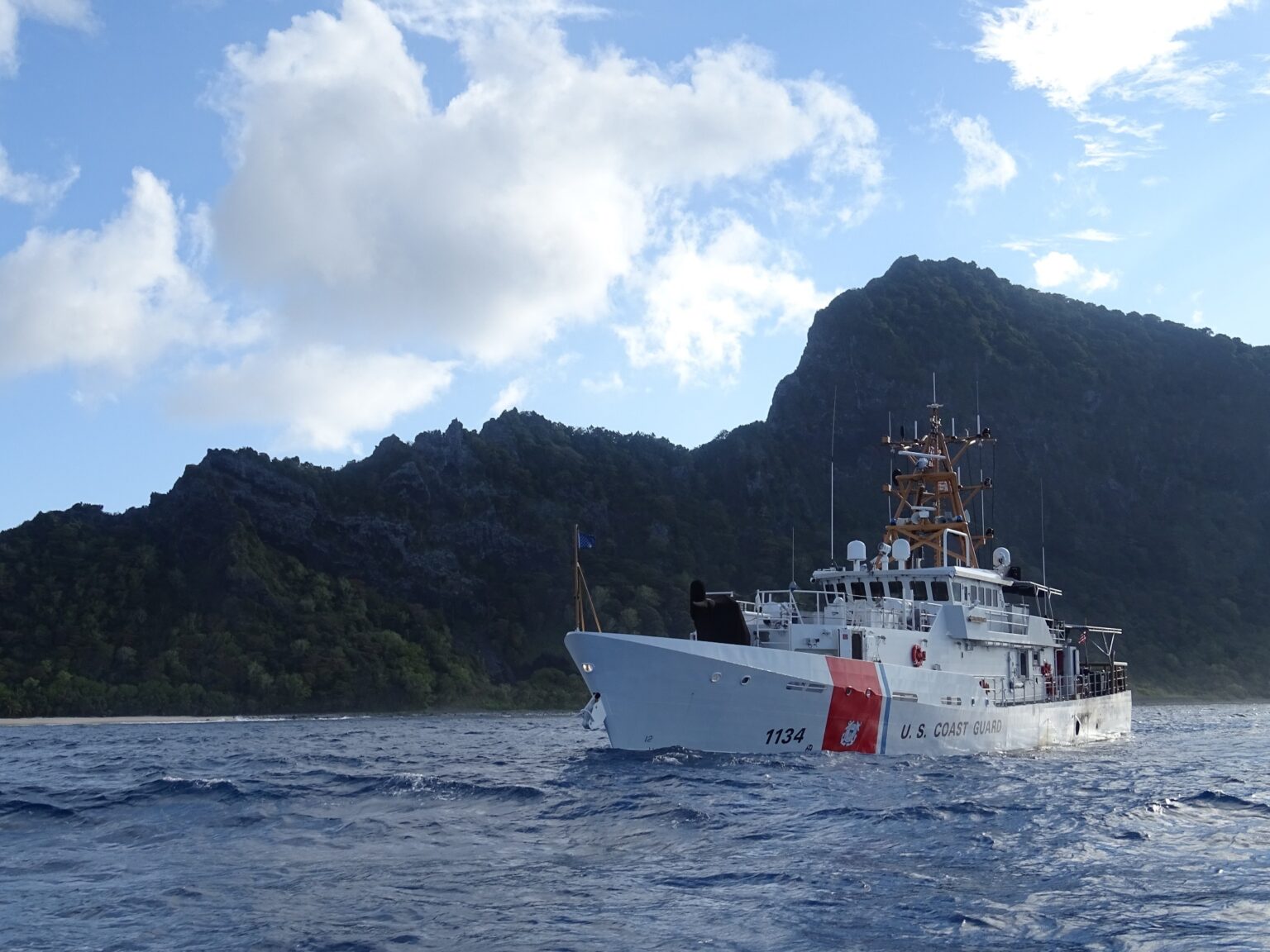
The Coast Guard Cutter William Hart participates in the Pacific Islands Forum Fisheries Agency’s (FFA) Operation Kurukuru off American Samoa, Oct. 29, 2021.
Operation Kurukuru is an annual coordinated maritime surveillance operation with the goal of combating illegal, unreported, and unregulated (IUU) fishing. (U.S. Coast Guard photo courtesy of the Coast Guard Cutter William Hart/Released)

Seapower magazine has a report on the recently completed, 12 day, Pacific Islands Forum Fisheries Agency’s (FFA) Operation Kurukuru in the Pacific, intended to counter Illegal, Unreported, and Unregulated (IUU) fishing.

“The operation included 15 Guardian Class and Pacific Patrol Boats from Pacific nations operating alongside five Australian Navy, French Navy and United States Coast Guard vessels,” said Allan Rahari, the FFA Director Fisheries Operations. “Seven aircraft from the FFA, quadrilateral and regional partners provided air surveillance, as well as satellite surveillance and use of other emerging technologies.”

US Coast Guard participants include two Webber class WPCs, USCGC William Hart, operating out Hawaii, and  USCGC Myrtle Hazard, operating out of Guam, and a CGAS Barbers Point C-130.

The Pacific class patrol boats and their Guardian class replacements were donated by Australia help Pacific Island nations police their Exclusive Economic Zones.

Panorama of three Guardian class patrol boats at Austal shipyards in Henderson, Western Australia. The ships are, from left to right, the Teanoai II (301)‎, the PSS Remeliik II‎ and the VOEA Ngahau Siliva (P302). Photo by Calistemon via Wikipedia.

“The Pacific Islands Forum‘s Forum Fisheries Agency maintains a Regional Fisheries Surveillance Centre in Honiara, Solomon Islands.”

Polar Star to Depart for Antarctica Saturday, Nov. 13 –News Release

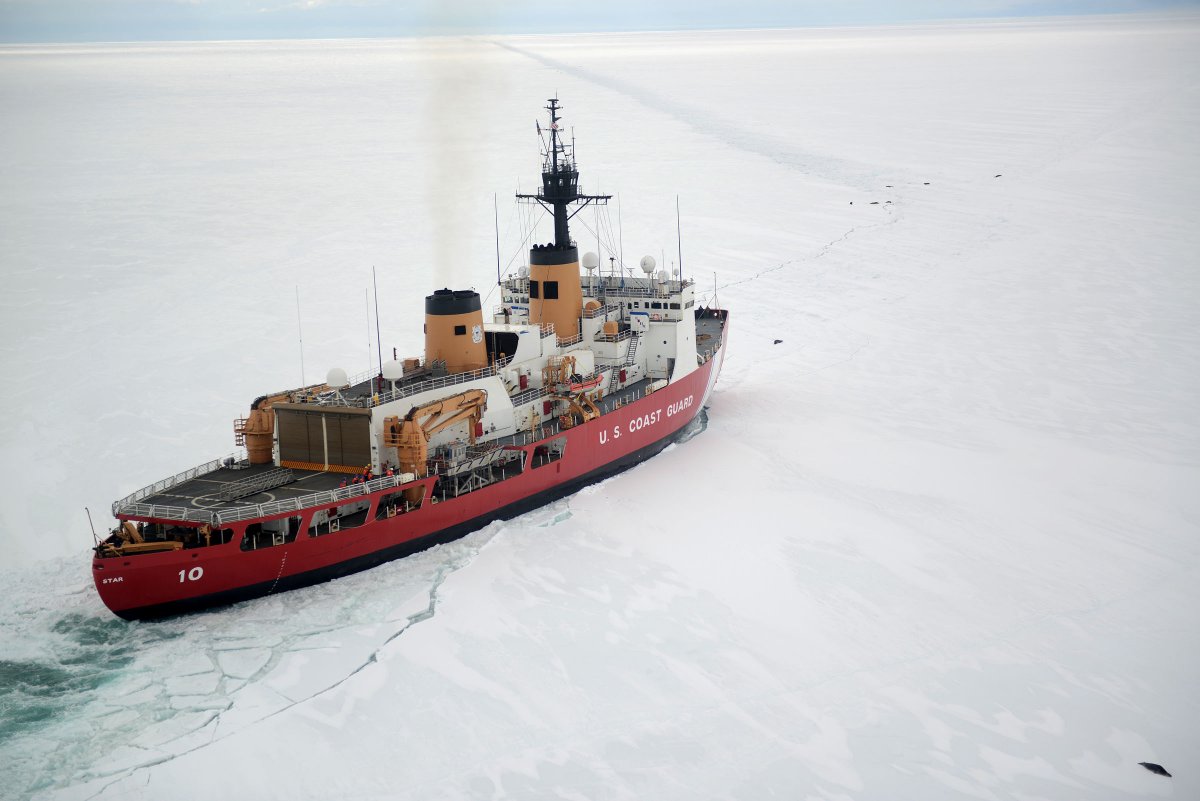
The Coast Guard Cutter Polar Star cuts through Antarctic ice in the Ross Sea near a large group of seals as the ship’s crew creates a navigation channel for supply ships, January 16, 2017. The resupply channel is an essential part of the yearly delivery of essential supplies to the National Science Foundation’s McMurdo Station.US Coast Guard photo by Chief Petty Officer David Mosley

united states coast guard

Media Advisory U.S. Coast Guard 13th District Pacific Northwest

MEDIA ADVISORY: America’s only heavy icebreaker departs Seattle homeport Saturday; bound for Antarctica

Nation's only heavy icebreaker reaches fast ice of Antarctica

Editors’ Note: Click on images to download high resolution version.

Who: U.S. Coast Guard Cutter Polar Star (WAGB-10) with crew and numerous scientists

What: Departing Seattle, en route to Antarctica in support of Operation Deep Freeze

When: Departing 1 p.m. Saturday, Nov. 13, 2021

Where: U.S. Coast Guard Base Seattle

SEATTLE — The United States’ only heavy icebreaker, Coast Guard Cutter Polar Star (WAGB-10), is scheduled to depart its homeport in Seattle Saturday.

This annual journey to Antarctica is conducted in support of Operation Deep Freeze, a joint military service mission to resupply the United States Antarctic stations of the National Science Foundation, the lead agency for the United States Antarctic Program.

The women and men aboard the Polar Star conduct this essential mission to create a navigable path through ice as thick as 21 feet, to allow refuel and resupply ships to reach McMurdo Station, the largest Antarctic station and the logistics hub of the U.S. Antarctic Program.

The U.S. Coast Guard is recapitalizing its polar icebreaker fleet to ensure access to the Polar Regions, project U.S. sovereignty, and to protect the country’s economic, environmental and national security interests. To support this endeavor, the U.S. Coast Guard is exploring options to expand Base Seattle infrastructure to support the growing icebreaker fleet.

Media are encouraged to contact Coast Guard public affairs at 206-251-3237 to arrange an escort at Base Seattle to attend the ship’s departure. The commanding officer of the Polar Star, Capt. Willaim Woityra, may be available for virtual interview on Friday morning and in-person at 11 a.m. Saturday prior to the 1 p.m. departure.