Coast Guard Polar Icebreaker Program: Background and Issues for Congress–23 May, 2018

USCGC Polar Sea

The latest edition of the Congressional Research Service report on Coast Guard Polar Icebreakers, by Ronald O’Rourke, was published on 23 May, 2018. You can see it here. 

I have reproduced the summary immediately below.  

The Coast Guard polar icebreaker program is a program to acquire three new heavy polar icebreakers, to be followed years from now by the acquisition of up to three new medium polar icebreakers. The Coast Guard wants to begin construction of the first new heavy polar icebreaker in FY2019 and have it enter service in 2023. The polar icebreaker program has received about $359.6 million in acquisition funding through FY2018, including $300 million provided through the Navy’s shipbuilding account and $59.6 million provided through the Coast Guard’s acquisition account. The Coast Guard’s proposed FY2019 budget requests $750 million in Coast Guard acquisition funding for the program.

The acquisition cost of a new heavy polar icebreaker had earlier been estimated informally at roughly $1 billion, but the Coast Guard and Navy now believe that three heavy polar icebreakers could be acquired for a total cost of about $2.1 billion, or an average of about $700 million per ship. The first ship will cost more than the other two because it will incorporate design costs for the class and be at the start of the production learning curve for the class. An April 13, 2018, Government Accountability Office (GAO) report on the polar icebreaker program states that the Coast Guard has reduced its estimated cost for the first heavy polar icebreaker to less than $900 million, which would imply an average cost of something more than $600 million each for the second and third icebreakers. When combined with the program’s $359.6 million in prior-year funding, the $750 million requested for FY2019 would fully fund the procurement of the first new heavy polar icebreaker and partially fund the procurement of the second.

The operational U.S. polar icebreaking fleet currently consists of one heavy polar icebreaker, Polar Star, and one medium polar icebreaker, Healy. In addition to Polar Star, the Coast Guard has a second heavy polar icebreaker, Polar Sea. Polar Sea, however, suffered an engine casualty in June 2010 and has been nonoperational since then. Polar Star and Polar Sea entered service in 1976 and 1978, respectively, and are now well beyond their originally intended 30-year service lives. The Coast Guard has used Polar Sea as a source of spare parts for keeping Polar Star operational.

A Department of Homeland Security (DHS) Mission Need Statement (MNS) approved in June 2013 states that “current requirements and future projections … indicate the Coast Guard will need to expand its icebreaking capacity, potentially requiring a fleet of up to six icebreakers (3 heavy and 3 medium) to adequately meet mission demands in the high latitudes….”

The current condition of the U.S. polar icebreaker fleet, the DHS MNS, and concerns among some observers about whether the United States is adequately investing in capabilities to carry out its responsibilities and defend its interests in the Arctic, have focused policymaker attention on the question of whether and when to acquire one or more new heavy polar icebreakers as replacements for Polar Star and Polar Sea.

On March 2, 2018, the U.S. Navy, in collaboration with the U.S. Coast Guard under the polar icebreaker integrated program office, released a request for proposal (RFP) for the advance procurement and detail design for the Coast Guard’s heavy polar icebreaker, with options for detail design and construction for up to three heavy polar icebreakers.

Issues for Congress for FY2019 for the polar icebreaker program include, inter alia, whether to approve, reject, or modify the Coast Guard’s FY2019 acquisition funding request; whether to use a contract with options or a block buy contract to acquire the ships; whether to continue providing at least some of the acquisition funding for the polar icebreaker program through the Navy’s shipbuilding account; and whether to procure heavy and medium polar icebreakers to a common basic design.

Navy Selects Kongberg-Raytheon Naval Strike Missile for their “Small Surface Combatants”

Kongsberg Naval Strike Missile. Kongsberg Photo

The US Naval Institute News Service is reporting the Naval Strike Missile has been selected to provide the long range surface to surface capability for the Littoral Combat Ships (LCS) and presumably the new frigate as well. This is no surprise since the other two candidates had dropped out of the competition, “…Boeing Harpoon Block II Plus and the Lockheed Martin Long-Range Anti-Ship Missile (LRASM) were both withdrawn by their respective companies from the competition last year. Both Boeing and Lockheed complained that Navy requirements for the OTH missiles did not value the networking capability of their offerings, several sources confirmed to USNI News.”

There are a couple of points to look at here.

The initial contract is for $14,856,016. This reportedly includes, “…encanistered missiles (EM) loaded into launching mechanisms (LM); and a single fire control suite (FCS). This contract consists of EMs (tactical, telemetered and inert operational); FCSs; LMs; mission support equipment, training equipment and courses; engineering services; and travel and other direct costs. This contract includes options which, if exercised, would bring the cumulative value of this contract to $847,611,857.” So it appears the initial contract includes at least one full ship set. The cumulative value is 57 times greater. There are only 52 Small Surface Combatants planned including both LCSs and the projected frigates (FFGs). Given that we would expect the price to go down in a quantity buy, it looks like these missiles may also go on other platforms as well.

We don’t know how many missiles will go on each platform, but Raytheon seems to indicate each LCS will support two quad launchers. While reportedly launchers are available for one, two, three, four, or six missiles, all the installations so far have been in the quad format. “USNI News understands the Thursday award buys about a dozen missiles.” Presumably some missiles will be expended in tests.

Raytheon Image

NSM is smaller than Harpoon, comparing NSM vs surface launched Harpoon.

  • Weight: 900 lb (410 kg) vs 1,523 lb (691 kg) with booster
  • Length: 13 ft (3.95 m) vs 15 ft (4.6 m)
  • Warhead: 276 lb (125 kg) vs 488 pounds (221 kg)
  • Range: 100 nmi (185 km) vs in excess of 67 nmi (124 km)

It is in targeting where the NSM’s superiority shines compared to the legacy Harpoons..

Navy League Tribute: “Zukunft helped usher in future of US Coast Guard”

Alan Kaplan, national president of the Navy League, offers an appreciation of out going Commandant, Admiral Paul Zukunft.

I have been impressed with the Commandant’s ability to stay on message. He has been very consistent in repeatedly hitting the same points which were highlighted in his 2015 State of the Coast Guard address. I only hope the new Commandant will be as successful in presenting the case for the Coast Guard.

Coast Guard Authorization Bill

Saw the following on the Brymar Consulting web site:

The National Defense Authorization Act for Fiscal Year 2019 (H.R. 5515) has been reported in the House of Representatives. The bill incorporates the Maritime Administration (MARAD) Authorization Act and the US Coast Guard (USCG) Authorization Act. (5/15/18) [https://www.gpo.gov/fdsys/pkg/BILLS-115hr5515rh/pdf/BILLS-115hr5515rh.pdf].

It is a huge document. The Coast Guard sections, 3521-3539, are on pages 942 to 961. It doesn’t really look like a new authorization bill to me, just changes to the existing 2010 authorization.

There was one particular requirement included that I applaud.

‘‘Not later than the date on which the President submits to Congress a budget pursuant to section 1105 of title 31, the Commandant of the Coast Guard shall make available on a public website and submit to the Committee on Transportation and Infrastructure of the House of Representatives and the Committee on Commerce, Science, and Transportation of the Senate an update on Coast Guard mission performance during the previous fiscal year.’’

Our reports of mission effectiveness, goals vs actual, have been sporadic at best. We should want to do this to tout our achievements and to identify where we need more resources to accomplish statutory missions.

Coast Guard in Space

Image result for space images

As space becomes more commercialized, parallels with the high seas become more obvious.

Breaking Defense had an interesting post suggesting that we need an organization modeled on the US Coast Guard to function in space.

The author is a Coast Guard officer,

Note on the author from the referenced post: “Michael Sinclair is an active duty Coast Guard officer with 20 years of service. In addition to eight years working as a judge advocate he has served as a patrol boat captain in the Arabian Gulf. He Is finishing a Masters of Law in National Security from Georgetown University and will soon be the Coast Guard’s legislative counsel. The views here are his own and do not reflect those of the Coast Guard or the Department of Homeland Security. For a more in-depth analysis on the prospects of a “Coast Guard” for space, read this draft of his forthcoming academic paper.”

He suggest:

“… America would be better served by consolidating all commercial launch-to-orbit-to-landing oversight and regulatory functions within the “prevention” arm of a new “Space Guard.”A Space Guard, initially conceived of by Cynthia McKinley in 2000 and later expounded on by James Bennett in 2011, should optimally mirror the organizational structure of the Coast Guard, which generally separates its mission functions into broad categories of “prevention” and “response.” Prevention authorities are essentially regulatory authorities and response authorities are best categorized as operational authorities.”

He sees a number of parallel missions

  • Regulation and facilitation of navigation
  • Derelict destruction –Space Debris Mitigation
  • Search and Rescue
  • Construction standards
  • Vessel Traffic Control

“In order to truly establish effective space governance, the U.S. government should more fully consider capabilities, capacity, and partnerships for search and rescue, and really, the full spectrum of space activity.The authority to act does not mean a whole lot if there is no capability to execute the action, or the capacity is not sufficient to prove meaningful. Specifically, in the space search and rescue context, this would likely mean some sort of (optimally international) rescue coordination center working with in-space assets that were themselves permanently stationed and in sufficient numbers so that they would be available to render assistance, as needed.”

He sees a “Space Guard” as less escalatory than a “Space Force”

“…such an agency operating under the idea that it is at its core, a humanitarian organization focused on rescue and protection of all space actors, may be sufficiently de-escalatory so as to help mitigate against a potential arms race in space—a source of concern dating back to the Soviet Union’s launch of Sputnik itself, and seemingly resurgent with the increasingly aggressive postures of both Russia and China within the domain.”

For all the parallels with the oceans, space is yet to evolve many of the mechanisms we have regulating activities a sea.

  • Much of the Coast Guard’s authority is dependent on international acceptance of the idea of territorial sea and EEZ. There is nothing comparable in space.
  • As traffic increases, who will allocate orbits to prevent collisions?
  • If we are to have standards, we will need an equivalent to the International Maritime Organization (IMO).
  • What will stop the equivalent of flags of convenience in space?

The concept of a “Space Guard” tied to the concept of a Coast Guard in space may seem innocuous to Americans, but to the Russians, a “Guards” unit is an elite military unit. Such an organization will need to be international if it is to be seen as impartial and benevolent.


Canadian SAR Helos

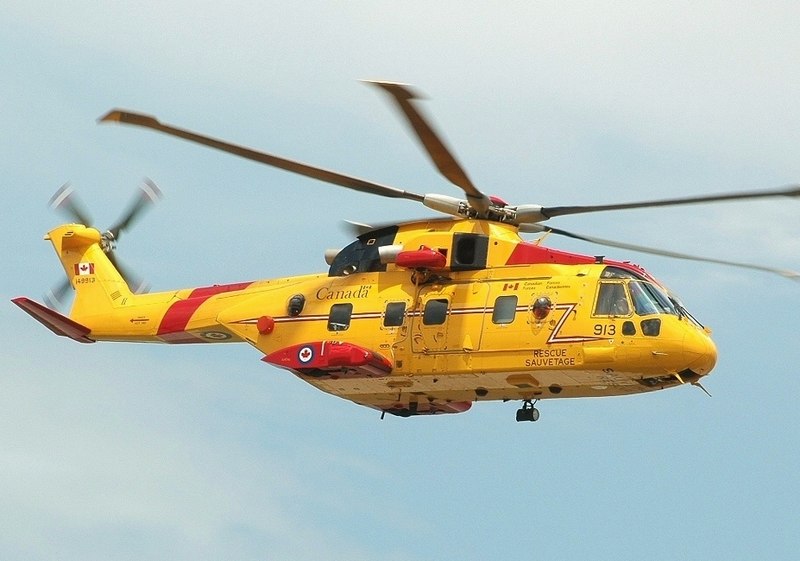
RCAF EHI CH-149 Cormorant. Photo by John Davies

The Canadian Coast Guard does not operate SAR aircraft the way the USCG does. Canadian SAR aircraft are operated by the Royal Canadian Air Force (RCAF). They have a fleet of 14 AgustaWestland AW101 (formerly EH101) helicopters. According to Wikipedia,

In June 2011, several US VH-71s, which are also based on the AW101, were purchased by Canada to be used as spare parts for the CH-149 fleet.

In 2017, the Liberal government announced funding for the mid-life upgrade of the fleet, to be led by ‘Team Cormorant’, a team composed of Leonardo Helicopters and IMP Aerospace and Defense. Estimated at around C$1.5bn, the programmes will offer a common fleet featuring latest avionic and mission systems, advanced radars and sensors, vision enhancement and tracking systems as well as a new 3,000 horsepower (2,200 kW) GE CT7-8E engine. On May 10, 2017, a report by the Senate Standing Committee on National Security and Defence recommended the government move forward with a proposal to expand the Cormorant fleet by upgrading the 14 CH-149 aircraft and converting seven VH-71 airframes currently in storage to the same operational capability. This would expand the Cormorant fleet to 21 aircraft, and keep them operational until 2040. All of the upgraded helicopters are expected to be delivered by 2024.

But now Defense News reports that Sikorsky will be offering the civilian version of their S-92 (known as the CH-148 in Canada) claiming to be “more affordable at acquisition and thoughout the entirety of the lifecycle.”

These helicopters are larger than the USCG MH-60 Jayhawks (empty weight 14,500 lb (6,580 kg)/max take-off weight  21,884 lb (9,926 kg))

  • Sikorsky S-92 (empty weight 15,500 lb (7,030 kg)/max take-off weight 27,700 lb (12,568 kg))
  • CH-149 (empty weight 23,149 lb (10,500 kg)/max take-off weight 32,187 lb (14,600 kg))

The RCAF has already begun operating the CH-148 as a replacement for 50 year old SeaKing (H-3) helicopters. Navy Recognition reports a navalized ASW variant of the S-92, has recently completed a series of test with the Canadian Navy, operating day and night from Canadian frigates HMCS Montréal and HMCS Halifax (12% larger than the National Security Cutter) in up to and including Sea State Six seas.

Key among the design features for the Cyclone, Sikorsky engineered:

a retractable probe on the belly of the aircraft to more securely cinch the 29,300-lb. Cyclone to the ship’s flight deck in high sea states;
a ground support tool with an articulating arm that, with the Recovery, Assist, Secure and Traverse (RAST) system, allows the deck crew to remotely align the aircraft’s nose prior to guiding the helicopter into the hangar.

This program was plagued by developmental delays and may have left a bad taste in the mouths of Canadian procurement personnel, but there would be undoubted advantages in operating a common type of helicopter.

A decision is expected soon.

Worth Reading–25 May, 2018

Ince Inebolu missile attack

Photo: Damage to the Turkish-flagged bulk carrier Ince Inebolu after last weeks missile attack. –Reuters

Ran across a number of post of interest to Coast Guard readers. Nothing I felt I needed to comment on, but perhaps interesting.

“IMO approves new Inmarsat advance in maritime safety services”–MarineLink”

“Pirate Attacks Grow in South America and Caribbean” MarineLink

“INMARSAT Faces US Chinese Competition in Maritime Safety” MarineLink

“Missile Struck Turkish Ship Off Yemen, EU NAVFOR Official Says” gCaptain

“Canada Announces New Measures to Enhance Safety of Marine Navigation” gCaptain

“Pence Warns Coast Guard Graduates of the Perils Facing the US” Navy Times

“Saildrones Voyage Into Remote Waters” Baird Maritime

“IMO Okays US-Russian Bering Strait Routing Plan” MarineLink

“Sinking of the US Cargo Vessel El Faro, Illustrated Digest” NTSB pdf

A couple of new boats.:


China Disinvited from Participating in 2018 RIMPAC Exercise–USNI

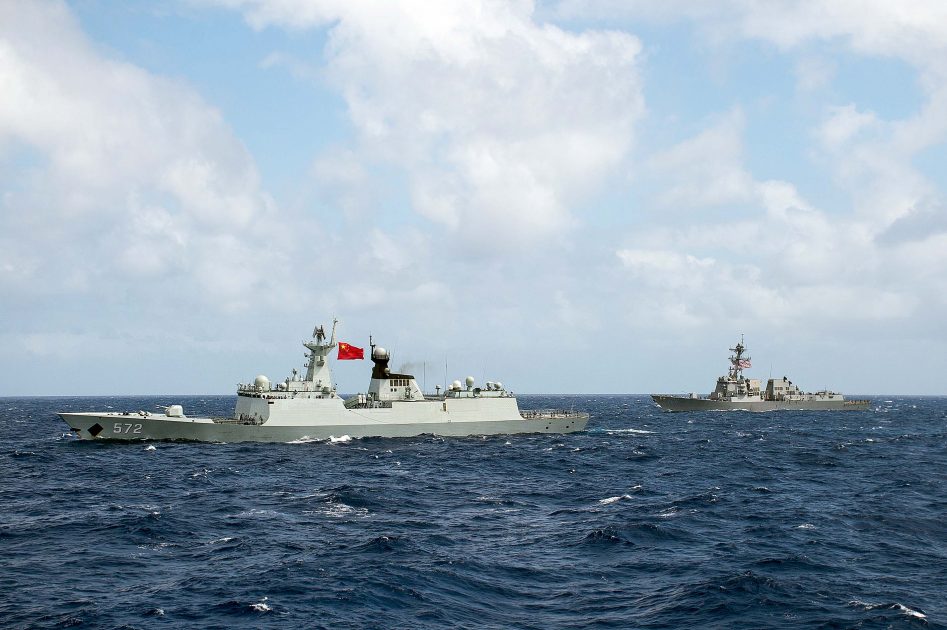
The People’s Republic of China Chinese Navy multi-role frigate Hengshui (572) and the guided-missile destroyer USS Stockdale (DDG 106) transit in formation during Rim of the Pacific 2016 on July 28, 2016. US Navy photo.

The US Naval Institute news service is reporting that the Chinese have been “disinvited” to participate in the 2018 RIMPAC exercises.

Citing actions in the South China Sea that run counter to international norms and a pursuit of free and open seas, Department of Defense spokesman Marine Lt. Col. Christopher Logan said the People’s Liberation Army Navy (PLAN) would not be participating in the exercise despite its participation in submarine safety and other non-warfighting components of the exercise in previous years.

Russia to Have Floating Nuclear Power Plant Near Alaska

CORRECTION: The MarineLink report this was based on, and the virtually identical report at gCaptain, is misleading. The town, Pevek, population less than 5,000, is not “across the Bering Strait from Alaska.” It is on the North coast of Siberia. The entire region, Chukotka, has a population of about 50,000. The Russian town on Bering Strait is Uelen, population about 720. 

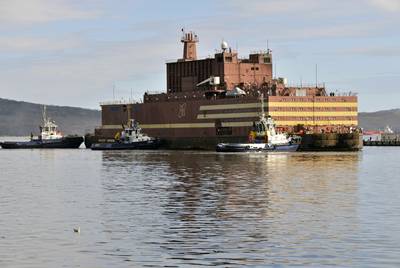
An interesting note from MarineLink. The Russians are deploying a floating nuclear power plant to a small community, the town of Pevek, on their side of the Bering Strait, 53 miles  (86 km) from Alaska.

Greenpeace is concerned.

“Nuclear reactors bobbing around the Arctic Ocean will pose a shockingly obvious threat to a fragile environment which is already under enormous pressure from climate change,” Jan Haverkamp, nuclear expert for Greenpeace Central and Eastern Europe, said in a statement last month.