Caribbean Fantasy Fire–NTBSB Report Summary

The NTSB has issued their report on the fire aboard the RO-RO ferry Caribbean Fantasy. All aboard were rescued with no serious injuries, but if this had occurred further from rescue facilities, it could have turned out tragically. You can read the abstract here.

While the Coast responded laudably, this incident was also a failure of prevention–a failure to prevent bad practices and ensure adequate training. Some of the findings:

2. The fire on the port main propulsion engine started when fuel spraying from a leaking blank flange at the end of the engine’s fuel supply line came into contact with the hot exhaust manifold and ignited.

3. Use of improper gasket material on the pressurized fuel supply end flange for the port main engine resulted in a breakdown of the gasket material and the eventual fuel spray that led to the fire.

4. The nonstandard blanking plate used on the end flange of the port main engine fuel supply system potentially exacerbated the leak that led to the fire.

5. Bolts inserted by Caribbean Fantasy engineering personnel into the quick-closing valves to prevent their closing were permanently in place for use during routine operations. (Emphasis applied–Chuck)

6. Testing during recent class surveys and port state control examinations did not adequately test the full functionality of the quick-closing valves.

9. The carbon dioxide fixed firefighting system did not extinguish the fire due to ventilation dampers that failed to properly close.

12. The abandonment process on board the Caribbean Fantasy was disorganized and inefficient.

13. Crewmembers assigned to safety-critical roles on the lifeboats were not proficient with the procedures for opening the lifeboat release hooks, which delayed the abandonment and put lives at risk.

14. The crew assigned to deploy the marine evacuation system and liferafts were not adequately trained, which delayed the abandonment.

15. The crew did not follow the manufacturer’s procedures when launching the starboard marine evacuation system liferafts, which resulted in the premature inflation of the liferafts.

16. The five ankle injuries resulted from using the marine evacuation system deployed at a steeper angle than designed.

On a positive note:

18. The presence of a passenger vessel safety specialist at Coast Guard Sector San Juan, who had trained and worked with local officials, contributed to the success of the Caribbean Fantasy mass rescue operation.

Recommendations included:

To the US Coast Guard:
1. Require operators to perform full function tests of quick-closing valves during inspections and examinations, ensuring that the associated systems shut down as designed and intended.

2. Evaluate the feasibility of creating a passenger vessel safety specialist billet at each sector that has the potential for a search and rescue activity characterized by the need for immediate assistance to a large number of persons in distress, and staff sector-level billets, as appropriate, based on the findings of that evaluation.

Thanks to Bryant’s Maritime Consulting for bringing this to my attention.
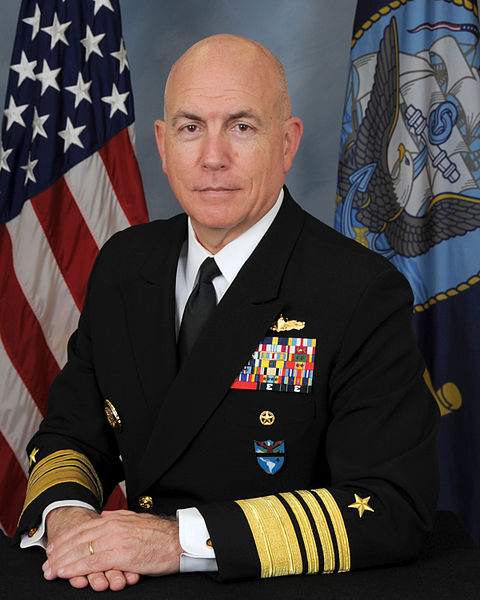
“Five key challenges for SOUTHCOM”–Military Times

Adm._Kurt_W._Tidd_2016

Photo:  Adm. Kurt W. Tidd, SOUTHCOM 

Since pretty much all of SOUTHCOM’s ships are Coast Guard, might be good to know what he is thinking. Military Times reports on Admiral Tidd address before the Association of the United States Army’s forum on June 6. He talked about five key concerns:

  1. Great power competition is happening down South.
  2. Terrorist groups are fundraising in our backyard.
  3. Terrorist recruiting and attacks are happening in the Caribbean.
  4. SOUTHCOM has responsibility for one of the world’s key transit points, the Panama Canal.
  5. The Syrian refugee crisis isn’t the only such crisis having regional effects. Just look at Venezuela.

Read the full article linked above for more detail.

“Heart of the Service” Seapower Magazine Report on Inland Fleet Recapitalization

USCGC Smilax (WLIC-315)

Seapower Magazine has a report on efforts to recapitalize the Inland Fleet of tenders. You can read it on line here. It may be hard to read when it comes up, but there is a “slide” at the bottom of the page that allows you to make the text larger.

It seems the Congress has appropriated more money than we expected, $26M. Its not really a lot, maybe not even enough to buy the first new inland tender. I think they are expected to cost about $25M apiece and the first is always more expensive.

It almost seems we are complaining. “Its five year money, so unless you have a plan to spend it, it is hard. It is also a signal to get moving quicker on this.” I am sure Commander Boda is saying it is hard to optimize and get the most out of it,  but there have been studies of how best to replace these during the previous decade including a joint study with the Army Corps of Engineers, and I believe one at the Academy. There is almost certainly a backlog of maintenance, and we have five years to spend this money on a ship type that is not really that complicated. Come on guys, don’t tell the world you don’t know how you will manage to spend this little bit of money, we will certainly find a good use for it.

A request for information for a solution to our inland cutter needs went out Feb. 14, 2018. If we fund the first new tender by FY2023 presumably we will not see the new ship before 2024 with the Smilax will be 80 years old and the fleet average 61 years old. We are supposed to be flexible. We cannot say, “We did not see this coming.”

This reminds me of when Congress appropriated money for the ninth NSC and the press started quoting a warrant officer that the Coast Guard did not want or need it. We should never give the impression that we can’t use more money.

BAE/Bofors LEMUR, a Remote Control Weapon Station/Electro-Optic Sensor for Patrol Boats

This is a Remote Control Weapon Station comparable to the Mk38 mod2 used on the Webber Class WPCs. There are many such systems, but I am highlighting it because it is already in use on a boat much smaller than the Webber class. The Combat Boat 90 (time 7:10 in the video above) is only 53 feet (16.1 meters) long and 22.6 tons full load. That is about one quarter the displacement of the 87 foot Marine Protector class, less than one fifteenth the size of a Webber class. It actually displaces a little less than the 45 foot Response Boat, Medium (RB-M). I particularly like that this system has been mated with the 30mm M230 chain gun from the Apache Helicopter that is capable of penetrating light armor (see below). That could give us serious penetrating power.

Like most of these systems, they incorporate electro-optic devices which can be used for SAR, target identification, or to enhance navigation.

Thanks to Lee for bringing this to my attention. 
Cleveland Metroparks unveils historic Coast Guard renovation (photos)

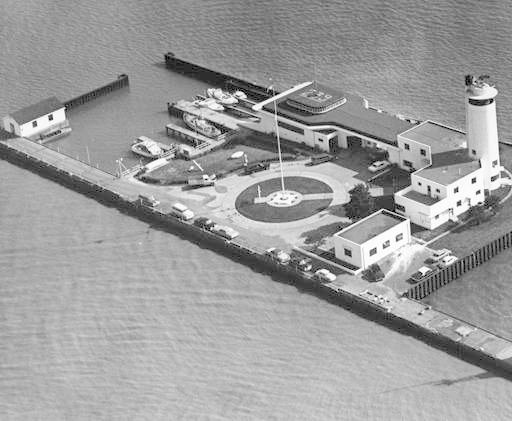
Historic former CG station on the mouth of the Cuyahoga River, at the end of a 1,000-foot pier.Photo: John Petkovic, The Plain Dealer

Cleveland.com has a story about efforts to turn the former Coast Guard Station Cleveland, abandoned in 1976, into an attraction.

Lots of photos of how it was (like the one above) and how it is now, cleaned up, but with much work still to be done.

Photo: John Petkovic, The Plain Dealer

Coast Guard Contract for sUAS for Bertholf Class Cutters

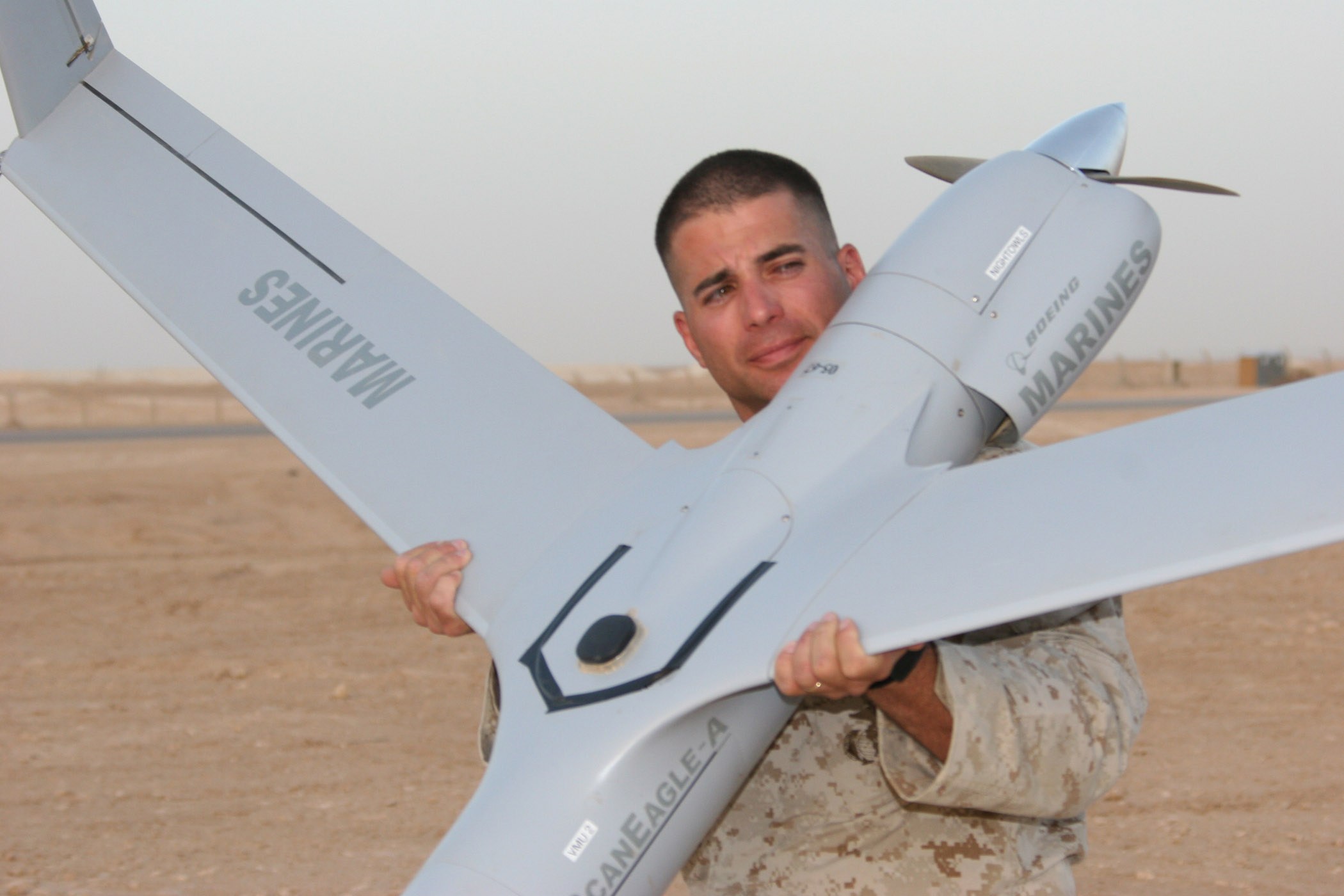
Insitu ScanEagle small Unmanned Air System (sUAS)

The Acquisitions Directorate (CG-9) has announced a contract award to Insitu, to provide a capability to operate a small unmanned air system from the Bertholf class National Security Cutters.

“…The service contract covers installation and deployment of sUAS for approximately 200 hours per 30-day operational patrol period.

“Installations of sUAS capability on NSCs are planned at a rate of about two per year. Total value of the contract including the seven option years is approximately $117 million.”

It does not say which airframe Insitu will be providing. They have more than one, but it is likely to be Scan Eagle which was the small UAS used by Stratton during the trials.

200 hours per 30 day operational patrol period might be 20 sorties of 10 hours each or 25 sorties of 8 hours, but in all probability it will include a few shorter flights to provide documentation and over-watch during boardings. 

The Coast Guard is contracting out the operation and maintenance of the systems rather than training Coastguardsmen to perform these functions. Hopefully, in time that will change.

Also there is no reason these systems should not also operate off of smaller cutters and icebreakers. Operating from 210s should be relatively easy, although it might preclude operating a helicopter, and with a little engineering they could probably operate from Webber class WPCs.

If you want to trace some of the progress on this issue, here are some earlier posts.

RIMPAC 2018 Humanitarian Assistance/Disaster Relief

120727-N-VD564-015
PACIFIC OCEAN (July 27, 2012) Ships and submarines that participated in the Rim of the Pacific (RIMPAC) exercise 2012. (U.S. Navy photo by Chief Mass Communication Specialist Keith Devinney/Released)

RIMPAC is a huge exercise. 

Twenty-six nations, 47 surface ships, five submarines, 18 national land forces, and more than 200 aircraft and 25,000 personnel will participate in the biennial Rim of the Pacific (RIMPAC) exercise scheduled June 27 to Aug. 2, in and around the Hawaiian Islands and Southern California.

It normally includes Coast Guard participation, although I have not seen any announcement about which Coast Guard Units will play, you can be sure there will be some CG presence.

There are scenarios within scenarios, but perhaps of most immediate interest to the Coast Guard, is the Humanitarian Assistance/Disaster Relief (HA/DR) portion of the exercise. The US Naval Institute “Proceedings Today” online magazine has an interesting take on how to “Improve RIMPAC,” specifically the HA/DR portion. Given the Coast Guards outsized role in Disaster Relief, its world wide relationships, and its unique position as a military service in a predominately civilian department, it probably should be deeply involved.

Japan’s US-2 Amphibious Aircraft

ShinMaywa US-2

An Asia Times article advocating the US procure some of these aircraft, has promoted me to look again at a relatively unique aircraft, Japan’s US-2 amphibian built by ShinMaywa.

It has been a while since the USCG operated amphibious aircraft. Having been a passenger on an HU-16E during a water landing as a cadet, I can attest it was interesting. I would be hard put to justify Coast Guard procurement of these, even though they share engines and propellers with the C-130Js and C-27Js. The need for urgent rescue beyond the range of our helicopters or the in flight refueled range of ARRS helicopters is very rare. Water landings at sea are inherently dangerous and impose additional costs in maintenance due to corrosion. Amphibians also tend to have aerodynamic disadvantages that effect efficiency daily, while the likelihood of being forced down at sea is now much more remote.

Still the ability to land at sea or near small islands with no airports is intriguing.  Reportedly India is buying twelve of these. Both Russia (Beriev BE-200) and China (Harbin SH-5 and AVIC AG600) build or have built amphibious aircraft of similar size.

ShinMeiwa, now ShinMaywa, has a long history or building seaplanes and amphibious aircraft. Its corporate progenitor, Kawanishi Aircraft Company, built four engine seaplane patrol bombers (H6K “Mavis” and H8K “Emily”) used in WWII as well as what may have been the best Japanese fighter of WWII.

Combined Maritime Security Task Force Pacific

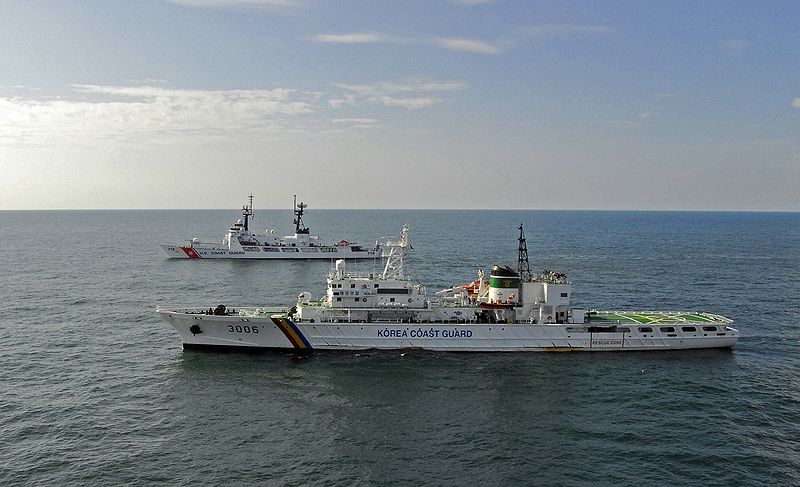
Republic of Korea Coast Guard vessel #3006 in company with U.S. Coast Guard cutter USCGC Boutwell (WHEC-719) during the North Pacific Coast Guard Forum in August 2007. This forum was created to increase international maritime safety and security in the Northern Pacific Ocean and its borders. The Boutwell worked with the Korean coast guard while on their way to Yokosuka, Japan. The Japanese coast guard is one of the six nations involved in the forum.

War on the Rocks offers a suggestion as to how to build greater cooperation and trust and support international norms in the Western Pacific.

“…establishment of a Combined Maritime Task Force Pacific that would be modeled off the Standing Naval Forces Atlantic construct that NATO operated in the 1970s and 1980s… It included 6-10 surface ships (destroyers, cruisers, frigates and support ships) that attached to the squadron for up to six months at a time…the real utility was that its permanent and consistent nature allowed contributing navies to work together to build interoperability during peacetime…it was always signaling contributing navies’ growing alignment and desire to work together.”

This seems like a pretty good idea, but I would suggest one change. Make the purpose of the force Law Enforcement (particularly fisheries), SAR, and Disaster Relief/Humanitarian Assistance and use primarily Offshore Patrol Vessels instead of conventional warships.

Signaling a shared belief in the norms of international behavior, and a determination to uphold those norms, would be the primary objective.

There are lots of potential participants beside the USCG, they might include navies or coast guards of Vietnam, Indonesia, Brunei, Singapore, Australia, India, Malaysia, Thailand, Japan, S. Korea, and the Philippines. COM7thFleet has already asked for a USCG presence, but this would not be under the COCOM. It would be a cooperative enterprise between participating nations, in most cases, coast guard to coast guard.

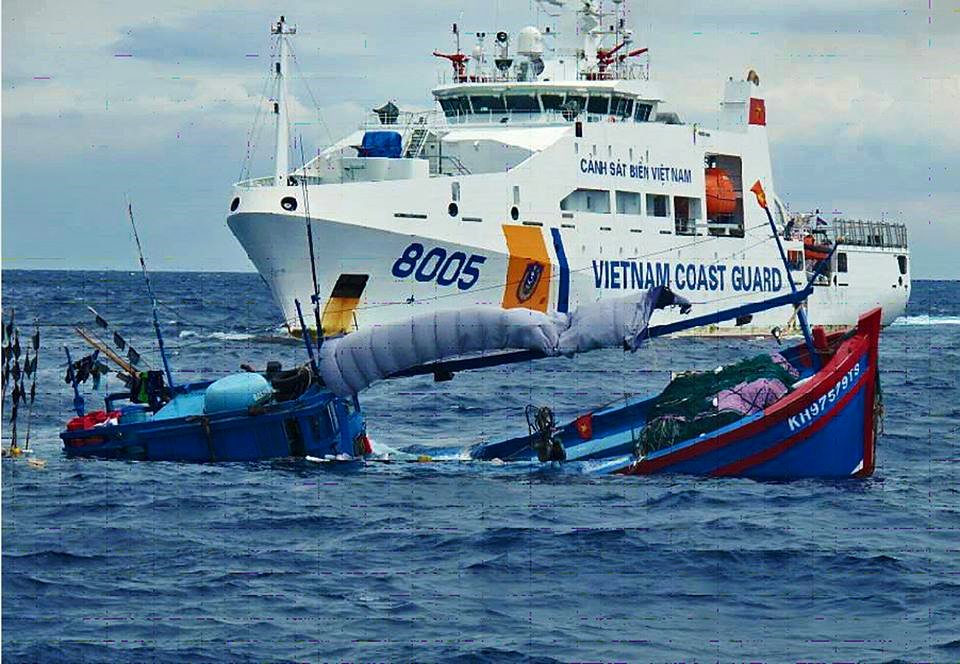
Vietnamese Coast Guard Damen 9014 Offshore Patrol Vessel. Photo: lancercell.com

All the vessels involved could host ship riders from the nation(s) where the force is operating.

We already plan to have most of the Bertholf class cutters in the Pacific, and putting three OPCs in Guam could further facilitate the arrangement.

This avoids the complications of a military alliance, but strengthens the hand of SE Asian nations that might otherwise be intimidated by China.

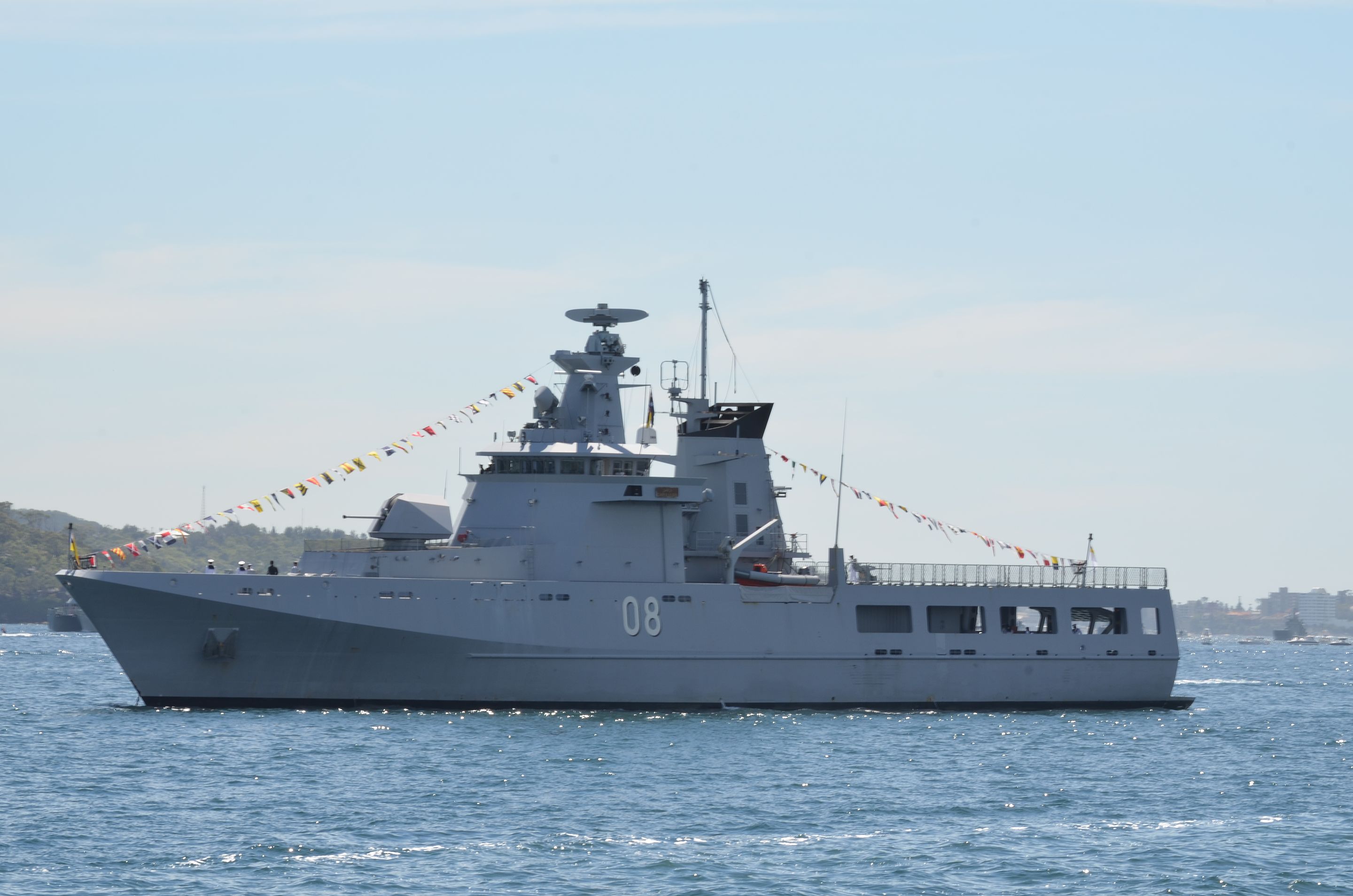
Photographs taken during day 3 of the Royal Australian Navy International Fleet Review 2013. The Bruneian patrol vessel Darulaman moored in Sydney Harbour. Australia is building 12 similar ships. Photo by Saberwyn.


Report to Congress on U.S. Coast Guard Cutter Procurement, 23 May 2018

OPC “Placemat”

Mr. O’Rourke has been busy, in addition to the report on Icebreakers, the latest edition of the Congressional Research Service report on Coast Guard Cutter Procurement, also by Ronald O’Rourke, was also published on 23 May, 2018. You can see it here. 

I have reproduced the summary immediately below.  Note that the price for the OPCs is already surprisingly low. 

The Coast Guard’s acquisition program of record (POR) calls for procuring 8 National Security Cutters (NSCs), 25 Offshore Patrol Cutters (OPCs), and 58 Fast Response Cutters (FRCs) as replacements for 90 aging Coast Guard high-endurance cutters, medium-endurance cutters, and patrol craft. The Coast Guard’s proposed FY2019 budget requests a total of $705 million in acquisition funding for the NSC, OPC, and FRC programs.

NSCs are the Coast Guard’s largest and most capable general-purpose cutters; they are intended to replace the Coast Guard’s 12 aged Hamilton-class high-endurance cutters. NSCs have an estimated average procurement cost of about $682 million per ship. Although the Coast Guard’s POR calls for procuring a total of 8 NSCs to replace the 12 Hamilton-class cutters, Congress through FY2018 has funded 11 NSCs, including two (the 10th and 11th) in FY2018. Six NSCs are now in service, and the seventh, eighth, and ninth are scheduled for delivery in 2018, 2019, and 2020, respectively. The Coast Guard’s proposed FY2019 budget requests $65 million in acquisition funding for the NSC program; this request does not include additional funding for a 12th NSC.

OPCs are to be smaller, less expensive, and in some respects less capable than NSCs; they are intended to replace the Coast Guard’s 29 aged medium-endurance cutters. Coast Guard officials describe the OPC program as the service’s top acquisition priority. OPCs have an estimated average procurement cost of about $391 million per ship. On September 15, 2016, the Coast Guard announced that it was awarding a contract with options for building up to nine ships in the class to Eastern Shipbuilding Group of Panama City, FL. The first OPC was funded in FY2018 and is to be delivered in 2021. The Coast Guard’s proposed FY2019 budget requests $400 million in acquisition funding for the OPC program for the construction of the second OPC (which is scheduled for delivery in 2022) and procurement of long leadtime materials (LLTM) for the third OPC (which is scheduled for delivery in 2023).

FRCs are considerably smaller and less expensive than OPCs; they are intended to replace the Coast Guard’s 49 aging Island-class patrol boats. FRCs have an estimated average procurement cost of about $58 million per boat. A total of 50 have been funded through FY2018. The 27th was commissioned into service on April 20, 2018. The Coast Guard’s proposed FY2019 budget requests $240 million in acquisition funding for the procurement of four more FRCs.

The NSC, OPC, and FRC programs pose several issues for Congress, including the following: 

  • whether to fully or partially fund the acquisition of a 12th NSC in FY2019; 
  • whether to fund the acquisition of four FRCs in FY2019, as requested, or some other number, such as six, which is the maximum number that has been acquired in some prior fiscal years; 
  • whether to use annual or multiyear contracting for procuring OPCs; 
  • the procurement rate for the OPC program; 
  • planned procurement quantities for NSCs, OPCs, and FRCs; and 
  • initial testing of the NSC.

Congress’s decisions on these programs could substantially affect Coast Guard capabilities and funding requirements, and the U.S. shipbuilding industrial base.