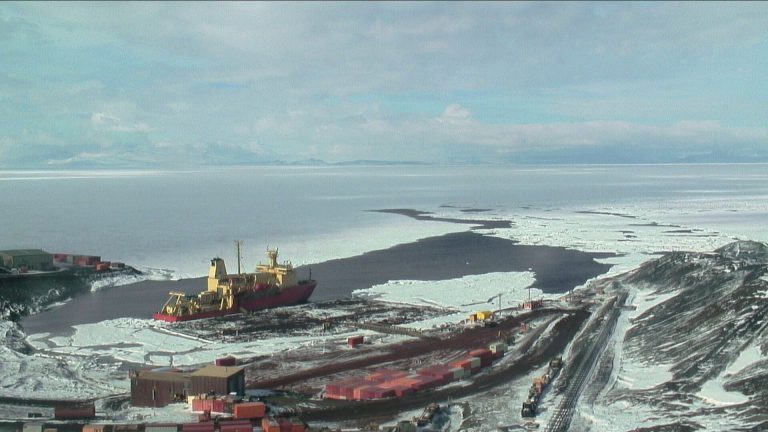
MSC M/V Ocean Giant at the ice pier, McMurdo Station
The Military Sealift Command has given us a three part series on their operations to resupply McMurdo Station
Thanks to Lee for bringing this to my attention.

MSC M/V Ocean Giant at the ice pier, McMurdo Station
The Military Sealift Command has given us a three part series on their operations to resupply McMurdo Station
Thanks to Lee for bringing this to my attention.
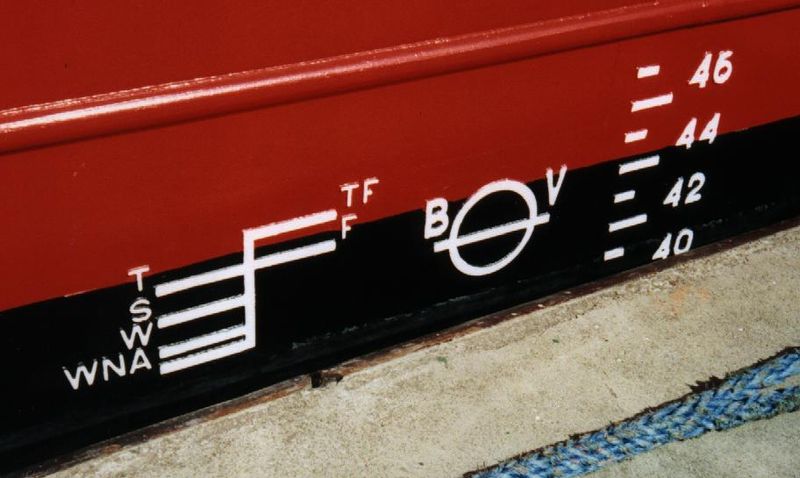
Plimsoll mark. Photo by Wualex
Here is a short well written article about how ships are marked. “The Secret Language of Ships” which appeared in the Hakai Magazine.
Thanks to gCaptain for bringing this to my attention.

Cube shaped satellite, 100mm (3.9″) on a side. This photo shows the Norwegian student satellite NCUBE2 ready for shipment to the Netherlands for integration with the ESA student satellite SSETI-Express, photographer, Bjørn Pedersen, NTNU.
National Defense is reporting that the Air Force is building two “Polar Scout” SAR satellites for the Coast Guard, expected to be launched this year.
An earlier post referenced a Acquisitions Directorate report on this R&D Center project.
These satellites, or “cubesats,” are capable of detecting transmissions from emergency position indicating radio beacons (EPIRBs), which are carried on board vessels to broadcast their position if in distress. The Coast Guard will deploy the cubesats in cooperation with the Department of Homeland Security (DHS) Science and Technology Directorate’s Polar Scout program, the Air Force Operationally Responsive Space Office, and the National Oceanographic and Atmospheric Administration (NOAA).
These two satellites will only provide intermittent coverage of EPIRB signals from the polar regions so more satellites may follow.
This appears to be first fruit of a growing cooperation between the Coast Guard’s R&D Center and the Air Force Research Laboratory which has been formalized by a recent Memorandum of Understanding (MOU) signed by the heads of the two organization on April 12, 2018.

CoastGuardNews reports that Vice President Pence is scheduled to attend the Graduation of the Coast Guard Academy class of 2018 on Wednesday, May 23rd.

Milkor high-speed 12 meter interceptor
NavyRecognition brings us a report of a proposed craft based on an innovative full form, a hydrofoil assisted catamaran.
There is more info on the design from the originator here.
They claim a 54 knot top speed. They also claim five days endurance, but it doesn’t look like that is a reasonable expectation for normal operations, since it has a crew of only four and only two bunks. It is only 12 meters (40 feet) long with a beam of 4.8 meters (15.7′).
Still this new tech is not just vaporware. The Corps of Engineers has taken delivery of a survey vessel using this technology, S/V Ewell.
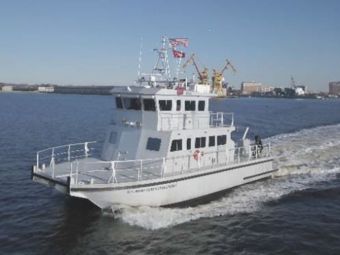
All aluminum S/V Ewell has a 61 ft 4 in length overall and 24 ft beam.
“Designed and built to Lloyd’s Register Special Service Craft rules, the Ewell is equipped with twin 985 bhp MAN V8 propulsion engines which each turn a Hamilton waterjet allowing for quick mobilization and response at high speeds in excess of 34 knots and survey speeds up to 10 knots.”
Like most aspects of Naval Architecture, there are compromises. This hull form is for vessels that can be kept light and will spend a lot of time at high cruise speeds.
A final note: The MILKOR design includes a 40mm grenade launcher as its main armament. Having tested a 40mm grenade launcher as a naval weapon, I found they are unsuitable for use against another vessel. They might be OK for laying down suppressive fire against an enemy on shore, but their long time of flight and high trajectory means they are very inaccurate against moving point targets.
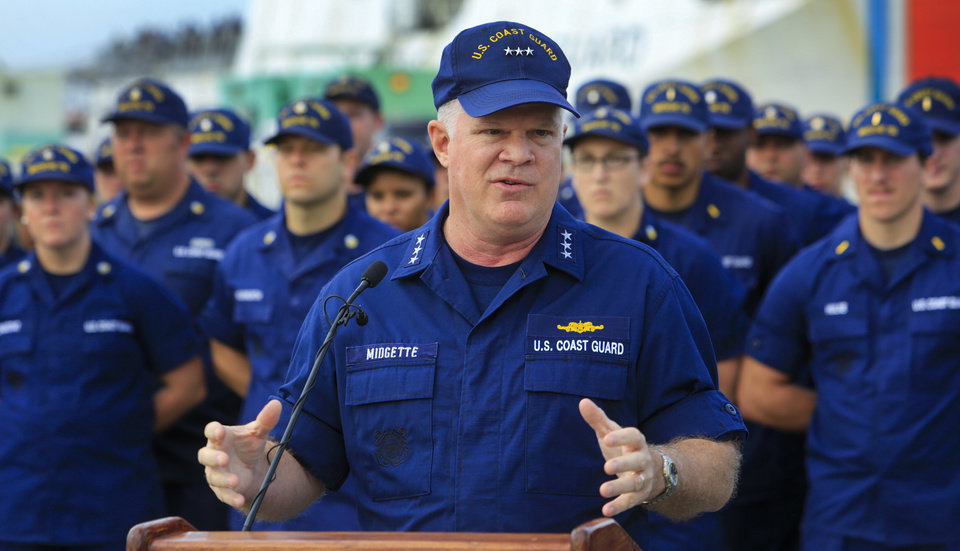
At Naval Base San Diego, Coast Guard Vice Admiral Fred Midgette, Commander, Pacific Area, Commander, Coast Guard Defense Force West answers questions during a press conference where he announced that 39,000 pounds of cocaine had been seized during the Coast Guard Cutter Waesche’s current deployment, Thursday, Oct. 27, 2016, in San Diego. The Coast Guard cutter on Thursday off-loaded narcotics that were confiscated in 25 separate busts that took place off the coasts of Central and South America over the past fiscal year. (Howard Lipin/The San Diego Union-Tribune via AP)
The San Diego Union-Tribune reports an address by Pacific Area Commander and Commander Coast Guard Defense Force West, Vice Admiral Fred M. Midgette, discussing the need to address operating budget short falls.
Incidentally, VAdm. Midgette has spent some time afloat.
“Vice Admiral Midgette has served afloat on both coasts and the Great Lakes, earning designation as a Coast Guard Cutterman and a U.S. Navy Surface Warfare Officer. He has commanded four Coast Guard cutters and served afloat on the CGC TANEY (Portsmouth, VA); USS FIFE (San Diego, CA); CGC POINT LEDGE (Fort Bragg, CA); CGC POINT WINSLOW (Eureka & Morro Bay, CA); CGC KATMAI BAY (Sault Ste. Marie, MI); CGC HARRIET LANE (Portsmouth, VA); CGC FORWARD (Portsmouth, VA); and America’s Tall Ship – the Coast Guard Barque EAGLE (New London, CT). He is the 14th Gold Ancient Mariner of the Coast Guard – an honorary position held by an officer with over ten years of cumulative sea duty who has held the qualification as a Cutterman longer than any other officer.”
Nice to see a 327 sailor made good.
Based on a Wisconsin Public Radio report, it sounds like the Coast Guard authorization bill has been stalled in the Senate over a provision that would have given the Coast Guard sole responsibility for ballast water regulation, taking the EPA out of the business of regulating this potential source of invasive species.
The US Naval Institute News service has a report on the Commandant’s appearance before Congress, Tuesday, apparently April 17. (The Commandant did not wait until the last minute to prepare his taxes like I did.)
The commentary seems to suggest there is the possibility of a block buy for all three Heavy Polar Icebreakers.
He discusses not only the Icebreakers but also the budget in general, importation of narcotics, both cocaine and other types, and the need to restore the strength of the Coast Guard Reserve.
The Commandant also reportedly put in a plug for ratification of the UN Convention of Law of the Sea (UNCLOS).
There is a misstatement in the report. ” He said Russia is now building two corvettes for its navy to add to the far northern operations of its Border Guard’s 44 icebreakers already in operation, giving it the largest maritime presence in the north.” However it was originally stated, the Russians may have 44 icebreakers, but they do not all belong to the Border Guards–the Russian equivalent of the Coast Guard. I doubt the Commandant would have made that mistake.

The GAO has issued a report on the progress of the Coast Guard and Navy’s joint efforts to procure new Heavy Polar Icebreakers.
The format seems to be a little different. This is a pdf, but instead of scrolling down, you page right (or left) at the edge of the screen. All total there are 41 pages, but most of it is in, what looks like, PowerPoint format.
Thanks to Bryant’s Maritime Blog for bringing this to my attention.
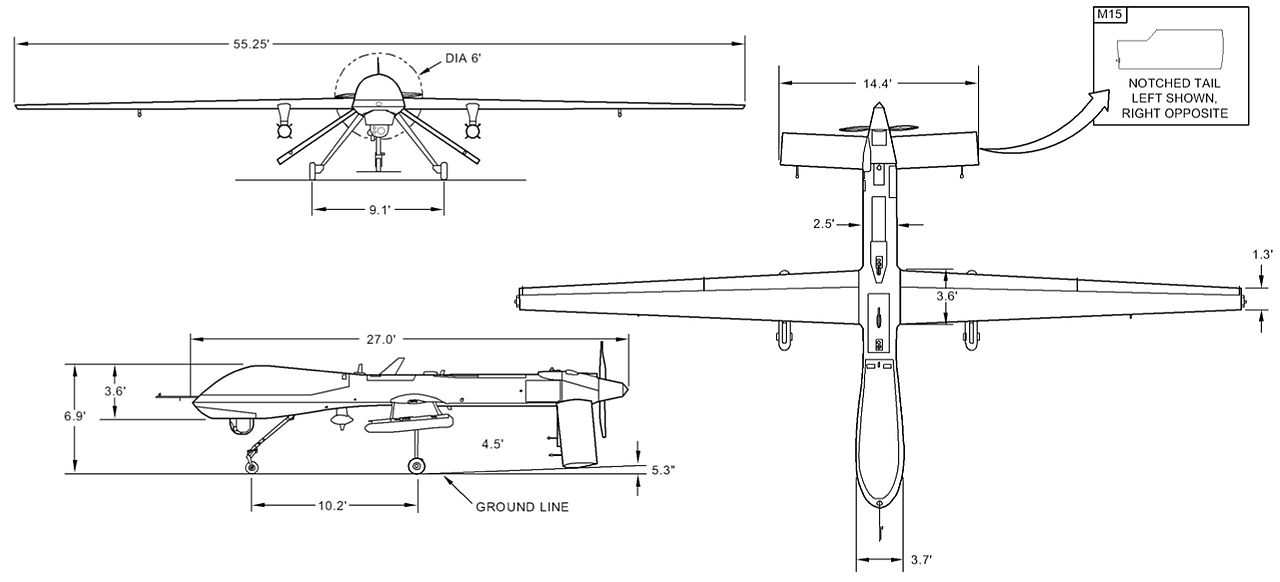
3-View line drawing and dimensions of MQ-1B Predator UAV, – Department of the Air Force, Engineering Technical Letter (ETL) 09-1: Airfield Planning and Design Criteria for Unmanned Aircraft Systems (UAS), 28 Sept 2009
The Acquisitions Directorate (CG-9) web site has three links that provide information presented at the Navy League’s 2018 Sea-Air-Space Symposium.
 Chuck Hill's CG Blog