Photo: The U.S. Coast Guard Cutter Adak passes by one of the numerous cargo dhows that travel along the Iraqi river coast. The Coast Guard has deployed four 110-foot patrol boats to the region to support U.S. Navy 5th Fleet and coalition forces during Operation Iraqi Freedom and Maritime Interception Operations to stop illegal oil smuggling and to search for terrorists. U.S. Coast Guard photo by Petty Officer 1st Class Matthew Belson.
DefenseNews reports the Islamic Revolutionary Guard Corps has been staging a series of provacative incidents in close proximity to US Navy units including US patrol coastal ships Tempest and Squall patrolling in international waters in the northern Gulf.
In referring to this video I will identify the position on the recording in the format h-hours (omitted for the first hour), m-minutes, and s-seconds (may be omitted) as 1h22m45s would indicate one hour, 22 minutes and 45 seconds into the video.
ADM. Charles Michel, Vice Commandant United States Coast Guard
Ms. Allison Stiller Principal Civilian Deputy Assistant Secretary of the Navy Research, Development and Acquisition United States Navy Department of Defense
Ms. Jennifer Grover Director Homeland Security and Justice Issues United States Government Accountability Offic
Mr. Ronald O’Rourke Specialist in Naval Affairs Congressional Research Service
Ms. Heather A. Conley Senior Vice President for Europe, Eurasia, and the Arctic Center For Strategic and International Studies
Mr. Matthew O. Paxton President Shipbuilders Council of America
Admiral Michel’s written statement for the subcommittee can be found here.
The possibility of a Mass Casualty incident in the Arctic
Single mission vs Multi-mission ships!
Military vs Civilian construction standards
I’ll try to comment on some of this. It is the nature of the hearing process that topics may be revisited at any point in the hearing, so it may a bit difficult to follow any particular topic.
Frustration
It was not a specific topic of discussion, but a high level of frustration was apparent throughout the proceeding. It was evident in Representative Hunter’s opening remarks. Check out the sarcasm at minute 13. This was followed shortly by Representative Garamendi’s remarks about the extent of planning that has failed to bear fruit. (15m30sec). There are more comments throughout the hearing. The comments between the representatives and the Vice commandant get particularly hot about 1h57m. One representative went so far as to call one of the Vice Commandant’s answers “bull shit.”
The “Gap(s)”
There was much talk about the gap. This usually referred to the expected gap between the projected end of service life for the Polar Star and the delivery of the new Polar Icebreaker (PIB), which may begin as early as 2020 or as late as 2023 and should end in 2026 with the delivery of the PIB. But if you consider the new PIB will be fully operational only in 2028, this gap may be anywhere from five to eight years. But this is not the only gap.
We want heavy icebreakers because of their capacity to operate in the Arctic year round. As long as we only have one heavy and one medium icebreaker, we will never do that, because the Heavy will always be sent to Antarctica during the Northern Hemisphere’s winter, while the medium icebreaker will be sent to the Arctic during the summer, so there will be a seasonal gap in the Arctic. We will never have “assured year round access to the Arctic” as long as we only have two icebreakers.
Because we deploy only one icebreaker to the Arctic and only one to the Antarctic there is always a gap in the capability to come to the aid of one of these icebreakers. This is a particularly serious concern with regard to sending the Polar Star to the Antarctic. There is of course great distance, and because it is probably the most capable icebreaker sent to Antarctica, it is also the most capable of getting itself in the deepest trouble. the Additionally the Polar class have never been particularly reliable.
The remaining gap that might be discussed is the difference between what we have and the three heavy and three medium icebreakers we have been saying we need.
Currently there is “No plan to address the gap” (58m). While the Vice Commandant says we are looking into alternatives, he suggests that a rolling life extension (spreading the work over successive yard periods) for Polar Star, rather than a renovation of Polar Sea appears the most likely way to retain a heavy icebreaker in service. That would of course be no improvement over our current situation (2h13m).
Three U.S. Navy icebreakers push an iceberg to clear a channel leading to McMurdo Station, Antarctica, 1965
Building Capacity:
Mr Paxton (President Shipbuilders Council of America) reported that there are ten US shipyards interested in building the PIB, and they have a demonstrated capability to work steel exceeding the thickness and quality required for Polar Icebreakers (m44-48).
Defense
Ms. Conely’s (Senior Vice President for Europe, Eurasia, and the Arctic Center For Strategic and International Studies) prepared testimony suggest that in terms of our defense posture in the Arctic, we have been living on good luck and borrowed time (m37-44). She heavily emphasized the need for infrastructure in the Arctic. I was a bit surprised at the apparent depth of concern among the Representatives for defense operations in the Arctic.
There were several unfavorable references to the comparison between our icebreaker fleet and the Russian’s, but that was mitigated somewhat by explanations for the Russian’s greater interest in the Arctic. Still the tone was that we were well behind. Additionally Representative Young expressed frustration that he had seen no progress in addressing his concern about military aspects of security (1h21m).
Discussion of Defense in the Arctic lead perhaps inevitably to questions of “Why isn’t this a Navy mission?” and a discussion of the need for Military specs for Icebreakers? (1h3m)
Infrastructure:
There was somewhat surprising support for creation of infrastructure in the form of a deepwater port and airfield (1h45m).
Leasing/Chartering
Can the Coast Guard operate leased or chartered vessels?
Ms Grover indicates that to perform certain Coast Guard mission, the vessel needs to be a “public vessel” meaning government owned or a demise (bare boat) charter (31m).
Demise charter is a contract whereby the ship owner leases its vessel to the charterer for a period of time during which the whole use and management of the vessel passes to the charterer. In such a situation, the charterer pays all expenses for the operation and maintenance of the vessel. Officers and crew become servants of the charterer. A demise charter whereby the charterer has the right to place its own master and crew on board of the vessel is called a bareboat charter.
The Vice Commandant reported that the Coast Guard had been unable to locate any heavy icebreakers available for lease or purchase and that while there were single misssion medium icebreakers built to commercial standards available there were no multi- mission icebreakers suitable for military service “without a major refit.” (55m)
There was also testimony that normally leasing would cost more than purchase over the long term. Mr O’Rourke clarified that a shorter term arrangement that he referred to as a charter was a possibility and it had been done in the past (1h53m).
It appears to me we find ourselves in an unusual circumstance. We definitely have a gap in our capabilities, and while I would agree that leasing is usually more expensive than ownership, we find ships sitting idle while their owners have abandoned the purpose for which they were built. They might be available at favorable terms.
Actually, we have a recent example of a civilian owned icebreaker being first chartered and then purchased outright for naval service.
The Royal Navy’s HMS Protector (A173) required a refit of only ten days to convert it from Norwegian civilian icebreaker. The ship was initially chartered for three years in 2011 but was then purchased outright in 2013. Over her relatively short life as a Royal Navy vessel in addition to icebreaking she has done SAR, fisheries patrols, inspection of research stations to ensure compliance with the Antarctic Treaty, resupply, hydrographic survey operations, performed training for humanitarian assistance, and patroled to demonstrate sovereignty in the waters around Britain’s South Atlantic Overseas territories.
The Navy has a lot of experience chartering ships, including having them modified for naval service.
Block Buy:
Mr. O’Rourke’s prepared testimony primarily addressed the possibility of a block buy purchase of two or more heavy icebreakers (33m to 37m). His opinion is that a block buy of two heavy icebreakers would save at least $100M and perhaps as much as $200M.
The Vice Commandant stated he could only support the construction of one heavy icebreaker (1h8m). I find it hard to understand why our leadership cannot simply state they would welcome additional resourses. (There is a pattern here, I saw the same thing happen in another hearing.) No one expects Coast Guard admirals to establish priorities across all government programs, that is the job of the civilian Administration and Congress, but when asked, if we would like more assets, and particularly if there is already an established requirement for more assets, why not say yes? It is after all other peoples’ job to decide if it will fit in the budget.
The idea of a block buy was generally well recieved. By the end of the hearing Representative John Garamendi stated that it appeared to make the most sense to proceed with block buy of two (or three) icebreakers (2h8m). He ask for assistance with the wording to be inserted into a bill to authorize a block buy. “I’m in the mode to make a decision.” (2h10m)
Canadian shipbuilder Davie’s proposal (pdf) to convert the Aiviq for the Canadian Coast Guard
Medium Icebreakers:
There is as yet, no idea when there will be a budget request for new construction medium icebreakers. The planning process is just beginning. We will build heavy icebreakers first, with the first completed by perhaps 2026. It will probably be four years more for the second and third. We probably cannot expect new construction medium icebreakers before 2032, sixteen years from now. We are not likely to see three medium icebreakers until 2034.
When the Vice Commandant stated that there were none available for lease or purchase suitable for military service without substantial refit (1h51m), that is not a final answer. It really just the start of a discussion. Considering the two potentially available domestically built icebreakers, what would be required to bring them up to our minimum standards? What would it cost? We should keep in mind that, we may have higher standard in mind for future icebreakers, but the icebreakers we currently have are not really built to current Naval Vessel Rules. If we were to assume that a new medium icebreaker will cost approximately $500M and last for forty years then, using simple math, we should be willing to pay at least $62.5M to have this capability for five years (actually it should be worth substantially more given the discounted value of money spent in out years). If we could get 20 years out of them, it should be worth $250M Apparently there is already a proposal on the table to convert the Aiviq (1h57m30s).
Single Mission vs Multi-Mission?
The Vice Commandant seemed to indicate that the Coast Guard only operates multi-mission vessels, and while I would agree that it is true, I would add that they are multi-mission because of there crews–their authorities, their skills, and their initiative.
In fact many of our vessels are single mission by design. In addition to buoy tenders and construction tenders I would include our existing icebreakers. That they incidentally do other missions as well, would also apply to any civilian owned vessel we might bring into Coast Guard service.
Does it take a military vessel?
There was a substantial discussion (1h59m30s) about whether we need a “military vessel” to do this job. I would start by saying any Coast Guard manned vessel is automatically a military vessel, by virtue of its crew. We have lots of vessels that don’t look very military, and are not built to military standards, but that does not mean they are not military.
If you have read much of my stuff, you would know that I would welcome ships with more military character, but I also recognize that the ships we have have doing icebreaking now are not particularly “military” by design. Shortly after the Polar Star was commissioned, she came down to Fleet Training Group San Diego, where I was the CG liaison officer, for a short training assist. Really her military characteristics were unimpressive at best. Additionally, the ability to launch a boat, so necessary for many CG missions was actually dangerous in anything other than relatively calm conditions.
Mass Casualties in the Arctic:
There was a great deal of interest in the preparations for the possibility of mass casualties if something should go wrong during the planned Northwest Passage cruise of the Crystal Serenity (1h14m).
Bringing the Polar Sea Back into Service:
As noted above, the Vice Commandant tentatively expects that in order to maintain a heavy icebreaker capability, the most likely solution appears to be a rolling life extension of the Polar Star, rather than renovation of the Polar Sea. He noted that the repair of the Polar Star cost $7M and that bringing back the Polar Sea would be a multiple of that.
Still, extending the life of Polar Star leaves with no improvement over the current situation:
no year round capability in the Arctic
no rescue capability in the Antarctic
a complete loss of Heavy icebreaker capability should the Polar Star suffer a major machinery casualty
To obtain those capabilities before the new PIB is operational, we need to bring Polar Sea back into service in addition to keeping Polar Star operational. Trying to restore the Polar Sea to her original condition is probably not realistic. The equipment is just too old.
Still it might be possible to do a major renovation that would make the ship as capable and more reliable than the Polar Star.
How much should it be worth to us. Logically, we would want to have it last until the third new PIB is operational (and keep the Polar Star on line until the second PIB is complete). That means the Polar Sea would need to last until at least 2030, maybe a bit longer.
If a heavy icebreaker with a service life of 40 years is worth $1B, then getting perhaps 15 years out of a major renovation may be worth up to $375M.
Expected Reports:
According to the testimony, by now, the Congress should have in their hands a new report on the condition of the Polar Sea and what it will take to fix it. For some reason I doubt that that will include the possibility of a major renovation.
By the end of the year, the Coast Guard has promised Congress a report that will include a suggested way to proceed, including a determination of what to do with Polar Sea.
Conclusion:
Is it any wonder the committee member’s patience is wearing thin?
It appears that we will continue to have only one heavy and one medium icebreaker until the new PIB is completed, hopefully in 2026, but even then it will not be fully operational until 2028.
Authorization for at least a two ship block buy appears likely.
Unless we change course, we are unlikely to reach a six icebreaker fleet until at least 2034.
What we might do:
If the Congress and and Administration really want to fix this, there are options, but it will take money. In addition to AC&I funds, it would also require additional operating funds and more personnel, both for the crews, and for support personnel, in addition to funding the ships themselves. We certainly should not sacrifice the Offshore Patrol Cutter program for this capability.
If the Congress and Administration want to get as close as possible to our professed need for three heavy and three medium icebreakers, we could conceivably have two heavy and three medium in six years of less.
That would require that keep Polar Star on line, that we bring back the Polar Sea, and that we obtain the two medium icebreakers currently available in the near term, the Aiviq and the still unfinished vessel that was being built by Edison-Chouest, and make those changes necessary to bring them into Coast Guard service.
What would this allow us to do?
Have a medium icebreaker available in the Arctic during the summer, as we do now.
Have a heavy icebreaker and a medium icebreaker available in the Arctic during the winter, something we do not currently do.
Have a heavy icebreaker in the Antarctic during the summer as we do now, but accompanied by a medium icebreaker.
A Warning:
Given the tone I heard from the Representitive, if we are not careful, and do not start showing more enthusiasm for the mission, we may find the icebreaking mission transferred, in whole or in part, to the Military Sealift Command.
NavyRecognition reports, “The State Department has made a determination approving a possible Foreign Military Sale to Qatar for Mk-V Fast Patrol Boats, equipment, training, and support. The estimated cost is $124.02 million.”
Based on the number of .50 calibers ordered, it appears that this will include four boats.
Looking back, in 2009 DefenseIndustryDaily reported the sale of ten of these craft to the Kuwaiti Navy under the Foreign Military Sales (FMS) Program for $61.6M. Saudi Arabia is also interested in these boats and is reportedly planning to buy 30 at an estimated $1.2B.
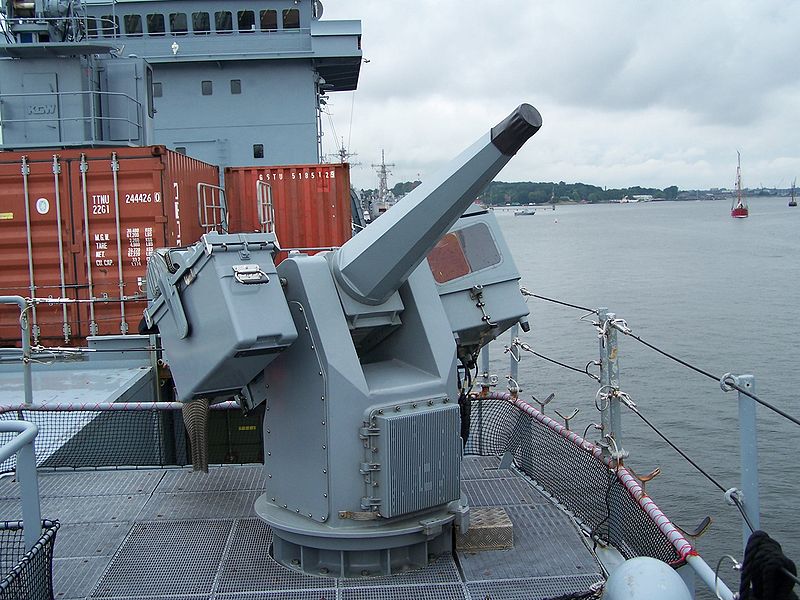
I don’t recognize the 27 mm reportedly included in the Qatar deal as a weapon in US service, but the Germans (Mauser, now Rheinmetall) do make a 27mm and this is the gun used on the Kuwati boats, and it appears to be gun used on the boats for Qatar.
MLG27 onboard Elbe Class Tender Rhein at the en:Kiel Week 2007. Photo by Rebell18190
The size of the boat seen on the stern ramp in the video is not clear.
These 90 foot boats is clearly optimized more for speed than our 87 footers. They also have a shorter range and with water jets, are probably less manuverable at the slow speeds often required for SAR.
Thought this was interesting. gCaptain has a couple of “bubble charts.” One showing the number of ships owned by different flag states and another the number of ships owned by foreigners for each flag state.
Also note the huge number of flag states that are not even identified.
Be aware this information is perhaps outdated in that it was based on data from 2007.
I don’t usually talk about SAR cases but this is unusual. The Coast Guard and local agencies have managed to remove all 512 people on board a 561 foot passenger and vehicle ferry after it caught fire just of San Juan.
An interesting observation is that the ship apparently had slides similar to those on passenger aircraft that allowed personnel to go from an upper deck to the water. You can see one of these in the photo above.
“Turkish Coast Guard vessel TCSG-25 (KAAN-15 class) (pictured above) off Istanbul collided with a merchant vessel, capsized … 3 sailors said to be trapped inside … rescue efforts underway”
In a separate incident, a Turkish Coast Guardsman was killed and a fisherman injured when they attempted to tow a life raft with two bodies aboard near the Syrian boarder.
The Philippines is in the process of a substantial upgrade of its Coast Guard and it is getting a lot of help form Japan. They already have a contract for the delivery of ten 44 meter patrol craft, that fill a role similar to our own Webber class WPCs. The first of these can be seen on sea trials in the video above.
Now we have reports that the Japanese will be building two new much larger, 295 foot (90 meter) cutters for the Philippines. These may be an entirely new design, but it is more likely it will be closely related to a existing Japan Coast Guard design.
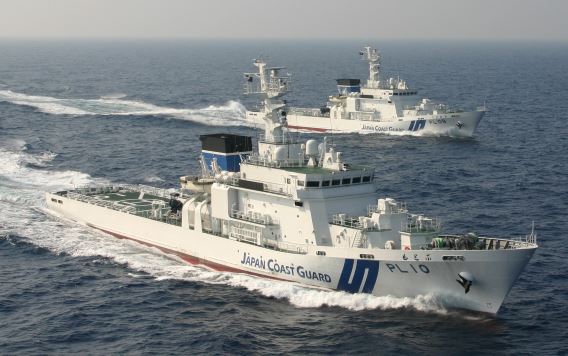
Which class seems likely? They will almost certainly be Kunigami class like the ships in the videos below.
Japan Coast Guard Kunigami class large patrol vessel TARAMA (PL-85)
I haven’t been able to find a speed for the class, but apparently they are 1,700 tons full load, 96.6 m x 11.5 m (length 317 feet, beam 38 feet). They have a helo deck, but no hangar. They appear to have three boats, two smaller ones on davits, and a larger boat launched by crane. The gun is probably a 20 mm Sea Vulcan Gatling gun.
None of the Philippine CG vessels have a weapon larger than an old 20 mm and almost all have .50 cal. (12.7 mm) M2 crew served machine guns and/or lighter weapons. If they wanted to mount something larger, the Mk38 mod2 (or 3) 25 mm is likely, since it recently entered service with the Philippine Navy.
CIMSEC “Midrats” blog radio show has an online interview with a State Department employee I was lucky enough to meet earlier, Scott Cheney-Peters, LCDR, USNR about international fisheries issues. You can find it here. Nominally it is an hour, but it took me a little longer than that because download was not seamless.
The discussion also touches on international networking/cooperation/enforcement, maritime domain awareness, human traffic, drug enforcement, and the ship rider program.
Recently recieved an email from the President of the Cuttermen Association. I am quoting it below.
Past and Present Members of the Coast Guard Cuttermen Association,
We are very excited that the Coast Guard Cuttermen Association (CGCA) and the Surface Navy Association (SNA) have agreed to merge their organizations. This will bring new members to SNA, and will provide CGCA with the full time administrative support it needs in tracking its membership and in communicating with its members through email and online. The potential merger was unanimously approved during CGCA’s Annual Meeting in January, and the details were approved by both organizations in June. For those of you who have not been as deeply involved in the administration of our organization, you may not know that SNA provided significant assistance each year since our inception, and continues to do so. There is an incredible synergy and purpose between our two organizations and our sea services, which makes this merger common sense. We are much stronger together.
We will reach out to our membership periodically in coming months to provide more information on this effort and our progress and answer any concerns. CDR Tony Russell has volunteered to spearhead a membership drive with the chapters to encourage renewal of existing members and seek new members within our cuttermen communities. We are planning a formal signing ceremony in September.
Through the merger agreement the CGCA will now be known as the National Cuttermen’s chapter of the Surface Navy Association, and the Washington Homeport of CGCA will now be the Anacostia chapter of SNA. The New London Chapter will be become the New London chapter of SNA. All financial resources of the National Cuttermen’s Association will be transferred to our new chapter within SNA under the signed agreement, and a final financial report will be made to our membership.
I am impressed by the efforts of Captain Tom Crabbs the prior President and his board to build towards this partnership with Surface Naval Association last year, which we have now finalized. As your new CGCA President I am excited about the benefits of our merger with the Surface Naval Association for both organizations, and the opportunity that this effort presents to renew and grow our organization. This partnership will resolve some of the significant administrative challenges that our organization has faced since conception.
LT Torrey Jacobsen was elected as our new Vice President. Rear Admiral (Select) Eric Jones is our newly elected Treasurer. Brian Perkins (CAPT, USCG ret.) serves in his new capacity as our Secretary, and has been the workhorse behind arranging this new SNA partnership. CAPT Tom Crabbs continues to serve on our Board as our Past President.
In the next couple of days SNA will be sending an email with procedures on how past members can rejoin and current members can affiliate with a chapter of their choice.
Thank you for your continued interest and support of our organization.
Captain Scott Clendenin
President
National Cuttermen’s Chapter
This is probably a good thing. It another small step toward recognizing the the Coast Guard’s role in the National Fleet. The Coast Guard is already well represented at the SNA’s annual symposium. For more information on the Surface Navy Association, their web site is here. Their next symposium, “Distributed Lethality: Enabling Sea Control,” is scheduled for January 10-12, 2017. Not sure the Coast Guard will have much to say about “distributed lethality” unless we start think about something like this.