980914-N-8492C-005
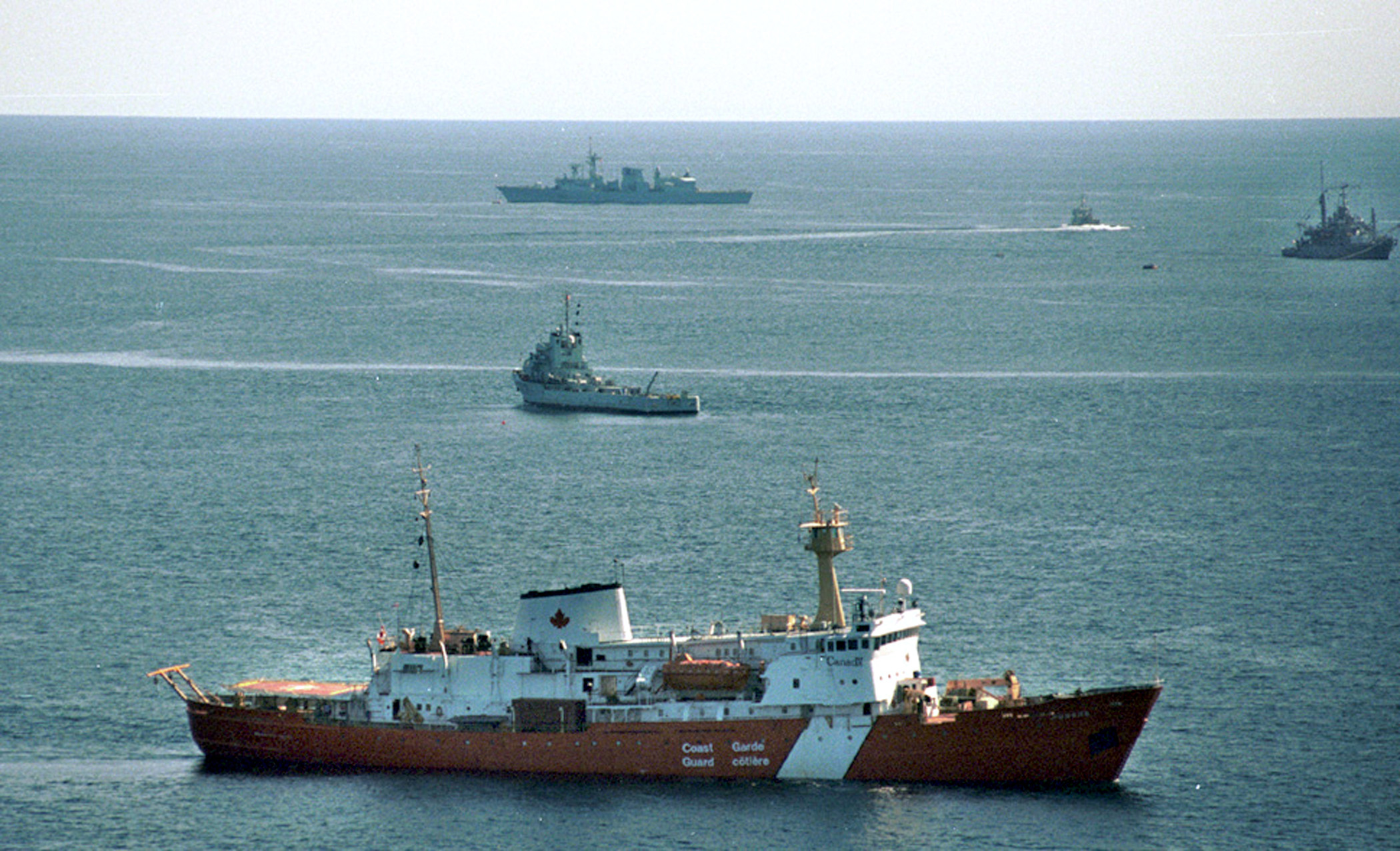
PEGGYÕS COVE, Nova Scotia (Sept. 14, 1998) Ð- Canadian Coast Guard Cutter CCGV Hudson (front) now the oldest major vessel in the Canadian Coast Guard, conducts Laser Line Scanning (LLS) operations with the latest in US Navy developed high-tech equipment at the crash site of SwissAir Flight 111. US Navy photo by PhotographerÕs Mate 1st Class Todd P. Cichonowicz. (RELEASED)
Professional Mariner has reported that a Transport Canada report found the Canadian Coast Guard ” …fleet is undermanned and desperately in need of new ships” and “that unplanned maintenance on aging Coast Guard vessels skyrocketed in 2014.”
My first reaction was of course that they have the same problems we do, but looking at the history of Canadian Coast Guard ship building it is apparent that while none of their ships are over 53 years old, with those built in the 80s the largest group, so maybe they are slightly better off. On the other hand, there was almost no large ship construction in the 1990s or later so they are facing block obsolescence.
I took a look at the documents. I have to admit, I did not read them all. They cover all modes and aspects of transportation. Volume One (pdf) is the basic report and it is 286 pages, and Volume Two (pdf) is the Appendices and it is 230 pages. However, I did use the search function to find every mention of Coast Guard and there were some interesting aspects.
For one thing, the Canadian Coast Guard is partially funded by user fees. The report then goes on to both complain that the user fees have not been raised since established and consequently have not kept up with rising demand and costs, and then also points out that user fees tend to make Canada less competitive. There is not a clear recommendation on this point.
“The government introduced user fees to recover part of the costs for navigation services, which have not changed since 1998. Approximately 15 to 30 percent of the Canadian Coast Guard’s operating costs ($27 million out of $190 million) are recovered from industry (see Figures 9 and 10); icebreaking fees are separate.”
They have a strong justification for the Coast Guard in claiming its inadequacies hurt Canada’s economic competitivenes.
“The underfunding of the Coast Guard seriously hampers its ability to discharge its mandate, which adversely affects Canada’s international competitiveness and trade. (p.13)”
The report finds that the Canadian Coast Guard’s lack of law enforcement authority (and implicitly weapons to back up that authority) results in inefficiencies.
“The Canadian Coast Guard As noted above, the Canadian Coast Guard is responsible for the safe and efficient movement of ships in Canadian coastal and inland waters. Canada is unusual in having a civilian coast guard. In other northern jurisdictions, such as Denmark, Greenland, Norway, Iceland, Finland, and Russia, and in the United States, the coast guard is a military or security organization. As a civilian body, the Canadian Coast Guard does not have the authority to enforce international and national laws and regulations pertaining to the sea, the environment, and sovereignty without RCMP officers present, even though Canadian Coast Guard vessels and staff may be the best placed to respond to critical events and detect illegal activity. This has resulted in an inefficient enforcement regime. Canada has also been slow to use maritime transport to promote development and strengthen sovereignty. Canada must ensure that it meets the challenges of increased maritime traffic in the Arctic, the St. Lawrence, the Great Lakes, the Seaway, the Pacific and the Atlantic. Because of existing governance arrangements and inadequate funding, the Canadian Coast Guard is not currently well equipped to do so.” (p.220)
The report found that current ship building plans including the requirement to buy Canadian would not addressing the problem of an aging fleet.
“As noted above and as depicted in Figures 1, 2 and 3, the Canadian Coast Guard fleet is aging, which has implications for maintenance as well as procurement. Given that 29 percent of the large vessels are more than 35 years old and close to 60 percent of small vessels are older than the design life of 20 years, it is not surprising that the number of major systems repairs required is increasing, vessel days are decreasing, and the number of ships out of service is increasing over time. The decrease in 2009 was as a result of money dedicated for repairs paid by the Economic Action Plan. Indeed, for such a critical piece of transportation infrastructure, the Canadian Coast Guard is not receiving the political attention, or the administrative and financial resources it requires. In 2014, the Commissioner of the Environment and Sustainable Development found that the Canadian Coast Guard’s icebreaking presence in the Arctic is decreasing, while vessel traffic is increasing.26 In response, the Canadian Coast Guard, Transport Canada, and the Canadian Hydrographic Service are currently advancing the Northern Marine Transportation Corridors Initiative to support responsible marine development, enhance marine navigation safety, and guide future Arctic investments.27 In addition, the 2015 Report of the Independent Review of the M/V Marathassa Fuel Oil Spill Environmental Response Operation found that the Canadian Coast Guard lacked adequate staff to respond in any part of its region at any time.28 Not only is it understaffed, but its fleet is one of the oldest in the world and urgently requires renewal (individual ships average nearly 34 years of age).29 Without such renewal it will have to pull ships from service, further reducing reliability. However, under the National Shipbuilding and Procurement Strategy, which requires the Canadian Coast Guard to purchase ships from Canadian shipyards, it can only replace one ship a year, at most. At that rate, the median age of the fleet will not decrease. Other strategies, such as outsourcing or leasing, are not part of the strategy and thus cannot be deployed to meet short-term requirements. (p.221)
There may be beaurocratic power grab here, in that Transport Canada seems to want the Canadian Coast Guard transferred under it purview rather than the Department of Fisheries and Oceans. In fact the Canadian Coast Guard had been an agency of the Department of Transportation until 1994 when it was moved to Fisheries and Oceans.
“We have been concerned for some time that the separate and distinctive roles of Transport Canada and the Canadian Coast Guard [make for] a less than efficient model for a coordinated and timely response to a maritime emergency. The situation is further compounded by CCG having been placed under the administration of the Department of Fisheries and Oceans whose role has little in common with that of CCG.” “p.231)
The Canadian Coast Guard is organizationally a mid-point between the single agency multiple tasked broad authority USCG model and the multiple specialized agencies UK model. In some respects it also incorporates elements that would correspond to duties performed in the US by NOAA and National Marine Fisheries. Apparently it, like the USCG has had a problem fitting in any one department because of its multiple missions. While it is under the Department of Fish and Oceans, since 2005 it has been designated a “special operating agency” with greater autonomy.
Notably the prevailing Canadian attitude seems to be that, if anything, the CCG needs to be given weapons and law enforcement authority, bringing it closer to the USCG model, so perhaps it is an endorsement of sorts, for the way the USCG is structured.
Perhaps the USCG needs to be a “special operating agency” or “independent agency” as it is called in the US, as well; after all, there are already 27 (or more) of them, but that is a topic for another day.
Thanks to Lee for bringing this to my attention.