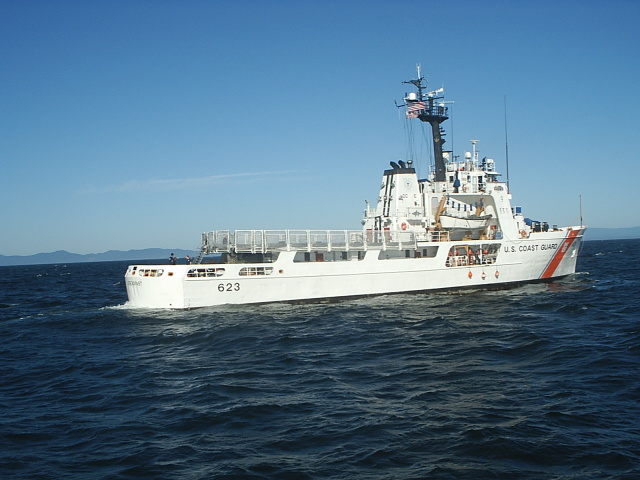
Long Range Interceptor In Action

I would not normally talk about a routine law enforcement action, but this video has some interesting aspects.

Stratton recently intercepted a second semi-submersible, that had been spotted by a Navy patrol aircraft, arresting its four crewmembers and recovering 12,000 pounds of its 16,000 pound cargo of Cocaine, before the semi-submersible sank under tow.

What I wanted to point out in the video was:

First, the instrumentation on the 35 foot Long Range Interceptor ship’s boat (time 1:12). (Correction–I made and error here, this is actually the instrumentation on a 26 foot “Over-the-Horizon (OTH) IV” of which the Coast Guard has procured 101.) It looks a lot like the “glass cockpit” of a modern light plane. Long Range Interceptors are only deployed by the Bertholf class National Security Cutters. (The OTH-IV is operated from the NSCs, WHECs, WMECs, and WPCs. Anyone know if they are also operated from WAGBs and WLBs?)

Second, was the way the boat was recovered in the stern ramp of Stratton (2:25 to 3:00). Note there is no one in the bow to attach the line that will pull the boat up onto the ramp. In 2013 we had a fatality on the Waesche because the automatic capture mechanism was not working properly and Petty Officer Travis Obendorf was on the bow of the boat. You can access the accident report here.

“Commandant Sees Bright Future for Coast Guard Acquisition Programs”

National Defense Magazine reports that the Commandant, while addressing the National Press Club on August 5, made some remarkably positive statements about his expectations for the coming budget year.

“One day after the Coast Guard’s 225th birthday, its commandant predicted that the service would be receiving a big present this year: the largest acquisition budget in its history.”

There were few details, but the Commandant did refer to the prospects for Coast Guard Icebreakers.

“’This is generating a lot of interest and I’m very optimistic that on my watch we will see — no fooling — forward progress as we look at building a national fleet of icebreakers,’ he said.”

We will have to wait to find out what this really means.  Will the OPCs be funded; will the program be accelerated? Will we ever see Multi-Year funding of the Webber Class WPCs? Will we see the four aircraft shortfall in the planned fixed wing fleet addressed (and the additional recently identified shortfall in fixed wing flight hours)? Will we see new Inland tenders and new domestic icebreakers? Will we see the obsolete shore facilities upgraded?

Certainly we will not see all the problems fixed in 2016.

Funding for an icebreaker alone could result in the largest budget ever, but I’ve seen no indication we are far enough along in the procurement process to warrant full funding in FY2016. We have authorization for the Navy to build Icebreakers for the Coast Guard. But that would not increase AC&I budget.

The FY2016 AC&I budget request was only $1,017.3M. In 2012 the AC&I budget was $1,463,968,000. I am not sure that FY2012 was the largest ever AC&I budget, but it does mean if the 2016 budget is going to be “the biggest” Congress will need to add at least $446.7M. I suppose several projects could be aggregated to come up to this amount, but there I another possibility.

Could this mean the Coast Guard will get a ninth Bertholf class? It makes a certain amount of sense. The FY2016 budget request funds not a single major cutter. The Fleet mix study has documented the need for a ninth Bertholf. We have a hot, increasingly efficient shipbuilding process, and the shipbuilder, HII, is certainly not without influence in Congress. A third NSC in Hawaii could significantly boost our presence in the Western Pacific and would make the long promised Crew Rotation Concept more nearly possible (not to say I think it could work).

Waesche Carat 2012

Just adding a Bertholf class to the FY2016 AC&I request would bump it to close to $1.7B, still short of the $2+B/year the CG needs. Will we see genuine long term movement to adequate funding for the Coast Guard?

“Sailing into the Future with the United States Coast Guard”–NavalHistory.org

Interesting piece from the US Naval Institute’s Naval History Blog.

In honor of the United States Coast Guard, which turned 225 years old this week, the Naval History Blog offers a selection from a speech delivered by A. Denis Clift, Vice President for Planning and Operations at the United States Naval Institute.

It primarily deals with the Coast Guard’s growing role in the National Intelligence organization and is a bit old, dating from 2000, but it fills in some history I was not aware of, and seems to demonstrate a lot of continuity in mission requirements. It even delves into Coast Guard Intelligence operations during Prohibition.

Thanks to Lee for bring this to my attention.

WMECs and WLBs Getting New Gyros

A small thing, but encouraging.

NavyRecognition is reporting that the Coast Guard has contracted to replace the gyros on fourteen 210 foot Reliance Class WMECs, in addition to those on ten Juniper class 225 foot WLBs that were contracted for in April.

The gyros are reported to use a new technology and be both cheaper and more reliable.

Seeing that it appears we will have most 210s around for more than another decade, at least they are getting some newer equipment.

(My only question is, there are 16 Juniper class, what about the other six?)

CG 36500, Bernie Webber’s Boat, Lives On

The Finest Hours

The Boston Globe has a nice post about the now 69 year old, 36 foot, wooden hull, motor surfboat Bernie Webber and his pick-up crew used to rescue 32 crew members trapped on the stern of an oil tanker, SS Pendleton, that had broken in half in a storm, and the people who restored and care for it.

The story of this rescue was told in a book and is being made into a movie.

I have it on good authority that the organization that maintains the boat could use some support.

Australia to Build OPVs

Australia has been talking about getting new ships for sometime, but recently they announced a policy of “continuous shipbuilding” in an effort to maintain a domestic  warship building capability.

While submarines and frigates have gotten most of the press, and will get most of the money, they also intend to build Offshore Patrol Vessels (OPVs) to replace their Armidale class patrol craft, which have proven not quite up to the demanding missions they have been assigned. (They will also be building patrol boats to be distributed to Pacific island nations.)

“The construction of offshore patrol vessels to replace the Armidale class has also been moved forward to 2018.”

2018 puts them two years ahead of the Frigates, so this may be a lead in for the more sophisticated project. I suspect they will be strongly influenced in the selection of their OPV by New Zealand’s experience. due to the frequent contact and cooperation between the Australian and New Zealand Navies.

The New Zealand OPVs, HMNZS Otago and Wellington, appear to be progenitors of Eastern’s OPC proposal, so there is a good chance the Australians will be building something like the OPC. The CG should make its selection of the final OPC design about a year before Australia has to make their OPV design selection, so perhaps they could benefit from the Coast Guard’s selection process.

Happy Coast Guard Day and Katrina–the Movie “Paratus 14:50”

Today we celebrate Coast Guard Day. The Coast Guard can point to many achievements over its history, but for me, our greatest achievement was the Coast Guard’s response to Katrina. I was out of the service by then, but I watched the news reports and felt immense pride in being associated with the service.

Katrina was ten years ago this month and a documentary will be aired late this month on PBS stations in Alabama, Mississippi, and Louisiana. The film is not a lavishly produced summer blockbuster, it is a student film, but was apparently a labor of love, the idea of a “Coast Guard brat.” You can learn more about the film and its genesis here and here.

ASuW Hellfire Test Success–Operational Late 2017

Navyrecognition reports that a successful test of modified Hellfire missiles for use in the Surface to Surface Missile Module (SSMM) planned for the Littoral Combat Ship has paved the way for operational deployment of the system in late 2017.

We have talked about these missiles before. They seem to be an ideal way to deal with the threat of small, fast, highly maneuverable boats that might be employed by terrorists, and absent more effective weapons, may provide some capability against even large vessels. Unlike gun systems, they promise high first round accuracy and lethality, with very little chance of a round going astray and hitting something unintended.

The projected SSMM would provide storage and launch facilities for up to 24 rounds. 24 rounds would weigh only about 2500 pounds. The launcher and support systems is unlikely to weigh more than that, suggesting and all up weight of about 5000 pounds, far less than either the 76mm Mk75 gun or the 57mm Mk110 (two and a half tons compared to eight or nine tons). Both of these guns are commonly used on missile and patrol boats smaller than the Webber class WPCs. Also unlike a gun system, the SSMM is unlikely to require any significant deck reinforcement.  It would almost certainly fit on all large cutters and perhaps the WPCs and WPBs as well. (It should be included on Offshore Patrol Cutters from day 1.) If the 24 round system is too large to be comfortably carried by smaller cutters, it is likely a smaller, say four round, system could be quickly and economically developed for Coast Guard use and perhaps for the Navy’s MkVI patrol boat as well.

If we take the Ports, Waterways, and Coastal Security mission seriously we really should be looking seriously at acquiring these systems, not just for the new ships as they are built, but also for the existing fleet with the idea that the systems would be transferred to the newer ships as the older ones are replaced.

The Navy should be willing to pay for these systems under existing inter-service agreements.

As noted before, if we need to stop a terrorist attack, we are far more likely to have a WPC or WPB on scene than a larger cutter. For this reason, arming some the Webber class in each homeport should be the first priority. Unfortunately the Webber Class are not geographically wide-spread, so we should look at mounting systems on existing MECs and WPBs to insure all potential targets have some protection until the entire fleet is armed.

I would say there are places where they might be mounted on Coast Guard stations ashore, to act as gate keepers for the ports against clandestine attacks, but coast defense is still an Army mission. Perhaps this is something we should be talking about too. If not Coast Guard manned defenses (which is probably the proper solution), then perhaps placement of unused SSMMs with their associated Navy crews on Coast Guard facilities or small detachments of army troops with their weapons to perform this function.