The Félix Éboué class, a Modern, Minimalist, Medium Endurance Cutter

An artist’s rendering, Félix Éboué class or Patrouilleurs Outre-mer (POM)

The Offshore Patrol Cutter (OPC) is described as, “…a capability bridge between the national security cutter, which patrols the open ocean in the most demanding maritime environments, and the fast response cutter, which serves closer to shore.”

That may have been the intention, but that is not what we got.

While the National Security Cutter is better than the WHECs they replaced in almost every way, the OPCs are not only better than the WMECs they will replace, but they are also, in every way except maximum speed, better than the WHECs as well. Instead of a high/low mix of cutters, they all turned out high end. We should not be surprised the OPCs construction and operating costs approach those of the NSCs.

Construction costs are typically proportional to displacement. The OPCs’ displacement is 98% that of the NSC and 1232.8% (more than 12 times) that of the Fast Response Cutters.

This would not be a bad thing, if we had enough NSCs and OPCs to meet our large patrol cutter needs, but I don’t think we will ever get there.

We are expected to ultimately end up with only 36 large patrol cutters, fewer than we have had in decades and fewer than other Coast Guards with far smaller EEZs.

A new fleet mix study has been completed, but the results have not been made public (Why not? This is not transparency). I suspect it shows a need for substantially more than 36 large patrol cutters.

If we look at the previous “Fleet Mix Study,” now over a dozen years old, which minimized requirements because it did not consider “High Latitude regions of the ice shelf and Deployable Operations Group (DOG),” and assumed that NSCs would use the “Crew Rotation Concept” that was expected to allow them to operate 230 days per year, to meet all statutory requirements, the study indicated the Coast Guard needed 66 large cutters, 30 more than currently planned, and 91 FRCs.

If we want significantly more large patrol cutters than currently planned, perhaps we need a smaller, cheaper alternative to the OPCs that requires a smaller crew and are more economical to operate. In previous posts, I have referred to this alternative as (Cutter X).

Thinking Ahead: 

Getting funding for more than two OPCs per year is probably unrealistic. The last OPC is not expected to be commissioned until 2038, 14 years from now. If we continue to build only two large patrol cutter a year, will not be able to grow the fleet until after 2038 and then it will grow slowly because the National Security Cutters will start aging out.

We might not be able to continue to build OPC sized patrol cutter after 2038. The Coast Guard will want to build Arctic Security Cutters (or perhaps Arctic Patrol Cutters). Both the Juniper class WLBs and Keeper class WLMs will need to be replaced.

(Where is our long-range shipbuilding plan?)

If we started in the next year of two, we could be producing true medium endurance cutters in significant numbers before the planned completion of the OPC program. On a 3 for 1 or even 2 for 1 exchange for the last few OPCs, if we tried, we could start to grow the fleet perhaps as early as 2032.

That is why the Félix Éboué class is worth a look. It is, what I believe may be, the absolute minimum fully capable Offshore Patrol Vessel. It covers all the bases. It is good enough for most operating areas. That is not to say, there are no good reasons for some add–ons, but I think it is a kind of benchmark. It is also a good representation of Cutter X. There are reasons we might want to go bigger, but before you increase the quality of the individual cutters, first we need to have enough.


The French Experience

France, like the US has a huge Exclusive Economic Zone (EEZ), the largest in the world, 11,691,000 km2 (4,514,000 sq mi). The US EEZ is 11,351,000 km2.

Unlike the US, the French don’t have a coast guard that operates ocean going ships to enforce laws and protect sovereignty. The French Navy does this, and uses a fleet of Offshore Patrol Vessels, some of which are referred to as frigates.

The Félix Éboué class is their newest class of OPVs. They are intended specifically to patrol the waters of French overseas territories in the Pacific and Indian Oceans. They will be based, two each, at NouméaTahiti and La Réunion. They replace the P400 class, which are slightly larger than the Webber class WPC, which were found to be inadequate.

I have found some very good photos of the second ship of the class being fitted out, that show details I had not seen before, and would like to share them. I will also bring forward some of my earlier commentary with updates, so as to consolidate information on this interesting class.

Comparison with Webber class WPC (FRC):

Below is a comparison between the FRC and the Félix Éboué class (POM) that was included in an earlier post, updated with information about the propulsion system on the French ships.

French overseas patrol vessel (POMs) Auguste Bénébig. Photo: http://www.meretmarine.com

Like an FRC:

I always thought these looked like oversized Webber class, the proportions are similar, and the much larger POM is not much more complicated than the Webber class. The crew of the POM is 30, only six more than that of the FRC. Both have a bridge with a 360-degree view positioned well aft, minimizing vertical acceleration. Both have an 8 meter boat in a stern ramp. The armament is similar with four .50 cal. machine guns and a single medium caliber gun in the bow, a 20mm on the POM and a 25mm on the FRC. The POM uses slightly less powerful diesel engines, 2x ABC 16V DZC medium speed diesels 3.7MW each @ 1,000rpm, for a total of about 9924 HP compared to 11,600 for the FRC. (I am told the POM’s engines are also more economical and simpler to maintain.) But the French ships still manage to make 24 knots, a couple of knots more than claimed for the OPC. With similar crew and systems, they should not cost much more than the FRCs to operate.

Unlike an FRC:

P400 patrol ship Tapageuse at sea near Tahiti (18 June 2003). Photographer: Jean-Michel Roche

While they would have been thinking of their existing 373 ton P400 class pictured above, it might appear to us that they wanted a ship to do the same sorts of missions the Webber class Fast Response cutters (FRC) are doing out of Guam, but they recognized that these ships would be far from any major naval base and that they would need to travel great distances and would be exposed to extreme weather conditions, so they needed to be larger (1300 tons vs 353 tons for the FRC) and have greater range (5500 miles vs 2500) and endurance (30 days vs 5 days).

Having chosen a larger hull, they took advantage of the greater volume and deck space to add a second RHIB, a multimode radar, space for 29 passengers (roughly a platoon of Marines), a sickbay, a dive locker, space for a 20 foot containerized mission module, a flight deck and hangar for a 700-kilogram-class rotor-blade drone (not yet deployed), and a holding area for up to six prisoners.

Some sources also indicate the French ships also have electric motors that would allow them to cruise on the ship’s service generators and secure the main propulsion engines, but I have seen no specifics.

The Photographs: 

The second of the French Navy’s six new overseas patrol vessels (POM), the Teriieroo a Teriierooiterai, which will be based in French Polynesia and has been named in tribute to a Companion of the Liberation native of this Pacific territory, Photo: http://www.meretmarine.com

The Teriieroo at Teriierooiterai fitting out at the end of July, 2023 in Boulogne. Photo: http://www.meretmarine.com

Stern ramp for 8 meter RHIB. French Navy overseas patrol vessel (POM), Teriieroo a Teriierooiterai, fitting out 2023. Photo: http://www.meretmarine.com

Second 8 meter RHIB and davit (only) on starboard side. French Navy overseas patrol vessel (POM), Teriieroo a Teriierooiterai, fitting out 2023. Photo: http://www.meretmarine.com

Aliaca aerial drone on its launch catapult. French Navy overseas patrol vessel (POM), Teriieroo a Teriierooiterai, fitting out 2023. Photo: http://www.meretmarine.com

Recovery System for Unmanned Air System, French Navy overseas patrol vessel (POM), Teriieroo a Teriierooiterai, fitting out 2023. Photo: http://www.meretmarine.com

Navy Issues Large Contract for Development of Unmanned Surface Vehicles

A U.S. Navy L3 Harris Arabian Fox MAST-13 drone boat and the U.S. Coast Guard cutter USCGC John Scheuerman transit the Strait of Hormuz on April 19, 2023. (Information Systems Technician 1st Class Vincent Aguirre/U.S. Coast Guard)

Below the break is a quote from DOD “Contracts for June 14, 2024.”
This is a big step toward procurement of an “Unmanned Surface Vehicle Family of Systems.” There can be little doubt the Coast Guard will exploit some of these developments and will probably participate in some of the testing, as they have done with 4th and 5th Fleet. 
Of the 49 partners mentioned, Bollinger is the only one I recognize as a ship builder. Could this mean we will see a Fast Response Cutter emerge as an Optionally manned or Unmanned Surface Vehicle? Probably not, but…
The funding structure is interesting. This is potentially an almost one billion dollar contract, but the initial commitment is only $49,000, $1,000 to each of the contractors. Sounds like they built in a lot of flexibility.

A multiple-award contract to support current and future unmanned surface vehicle family of systems and subsystems is awarded to the following 49 industry partners: Anduril Industries Inc.,* Costa Mesa, California (N0002424D6306); Applied Research Associates Inc., Albuquerque, New Mexico (N0002424D6307); Asymmetric Technologies LLC,* Dublin, Ohio (N0002424D6308); AT&T Corp., Oakton, Virginia (N0002424D6309); Atlas Technologies Inc.,* North Charleston, South Carolina (N0002424D6313); Autonodyne LLC,* Boston, Massachusetts (N0002424D6315); Beast Code LLC,* Fort Walton Beach, Florida (N0002424D6316); Bigelow Family Holdings LLC, doing business as Mettle Ops,* Sterling Heights, Michigan (N0002424D6317); Bollinger Shipyards Lockport LLC, Lockport, Louisiana (N0002424D6318); CACI Inc. – Federal, Chantilly, Virginia (N0002424D6319); Carnegie Robotics LLC, doing business as CR Tactical,* Pittsburgh, Pennsylvania (N0002424D6320); Cydecor Inc.,* Arlington, Virginia (N0002424D6361); DELTA Resources Inc., Alexandria, Virginia (N0002424D6363); Fairbanks Morse LLC, Beloit, Wisconsin (N0002424D6364); Teledyne FLIR Surveillance Inc., North Billerica, Massachusetts (N0002424D6365); General Atomics Aeronautical Systems Inc., Poway, California (N0002424D6366); GIRD Systems Inc.,* Cincinnati, Ohio (N0002424D6367); Herren Associates Inc.,* Washington, D.C. (N0002424D6368); Honeywell International Inc., Clearwater, Florida (N0002424D6369); IERUS Technologies Inc.,* Huntsville, Alabama (N0002424D6370); Integer Technologies LLC,* Columbia, South Carolina (N0002424D6371); KIHOMAC Inc.,* Reston, Virginia (N0002424D6372); Leonardo Electronics US Inc., Huntsville, Alabama (N0002424D6373); MAK Technologies Inc., Cambridge, Massachusetts (N0002424D6374); Marine Ventures International Inc.,* Stuart, Florida (N0002424D6375); Marinette Marine Corp., Marinette, Wisconsin (N0002424D6376); Metron Inc.,* Reston, Virginia (N0002424D6378); Microsoft Corp., Redmond, Washington (N0002424D6379); Murtech Inc.,* Glen Burnie, Maryland (N0002424D6380); NewSat North America LLC,* Indian Harbour Beach, Florida (N0002424D6381); Noblis MSD LLC, Philadelphia, Pennsylvania (N0002424D6382); Novetta Inc., McLean, Virginia (N0002424D6383); Ocean Specialists Inc.,* Stuart, Florida (N0002424D6384); PACMAR Technologies LLC,* Honolulu, Hawaii (N0002424D6377); Persistent Systems LLC,* New York, New York (N0002424D6385); Physical Sciences Inc.,* Andover, Massachusetts (N0002424D6386); Prescient Edge Corp.,* McLean, Virginia (N0002424D6387); Programs Management Analytics & Technologies Inc.,* San Diego, California (N0002424D6388); Reliability & Performance Technologies LLC,* Dublin, Pennsylvania (N0002424D6389); Saab Inc., East Syracuse, New York (N0002424D6390); Scientific Systems Co. Inc.,* Woburn, Massachusetts (N0002424D6391); Secmation, LLC,* Raleigh, North Carolina (N0002424D6392); SES Government Solutions Inc., Reston, Virginia (N0002424D6393); SIMIS Inc.,* Portsmouth, Virginia (N0002424D6394); Sparton DeLeon Springs LLC, De Leon Springs, Florida (N0002424D6395); Systems and Proposal Engineering Co.,* Manassas, Virginia (N0002424D6396); Systems Technology & Research Inc.,* Huntsville, Alabama (N0002424D6397); TDI Technologies Inc.,* King of Prussia, Pennsylvania (N0002424D6398); and Triton Systems Inc.,* Chelmsford, Massachusetts (N0002424D6399), are each awarded a firm-fixed-price, fixed-price-incentive-firm-target, cost-plus-incentive-fee, cost-plus-fixed-fee, and cost only, indefinite-delivery/indefinite-quantity contract for the procurements involving one or more functional areas, i.e. payloads, non-payload sensors, mission support systems, autonomy and vehicle control systems, ashore and host platform elements, and logistics and sustainment for the Unmanned Surface Vehicle Family of Systems. The maximum dollar value for all (total number) contracts combined is $982,100,000. Each awardee will be awarded $1,000 (minimum contract guarantee per awardee) at contract award. Work will be performed in various locations in the contiguous U.S. and is expected to be completed by February 2025. These contracts include a five-year ordering period option which, if exercised, will continue work through February 2030. Fiscal 2024 research, development, test and evaluation (Navy) funding in the amount of $49,000 will be obligated at the time of award and will expire at the end of the current fiscal year. All other funding will be made available at the delivery or task order level as contracting actions occur. These contracts were competitively procured via SAM.gov and there were 55 offers received. Naval Sea Systems Command, Washington Navy Yard, D.C., is the contracting activity.

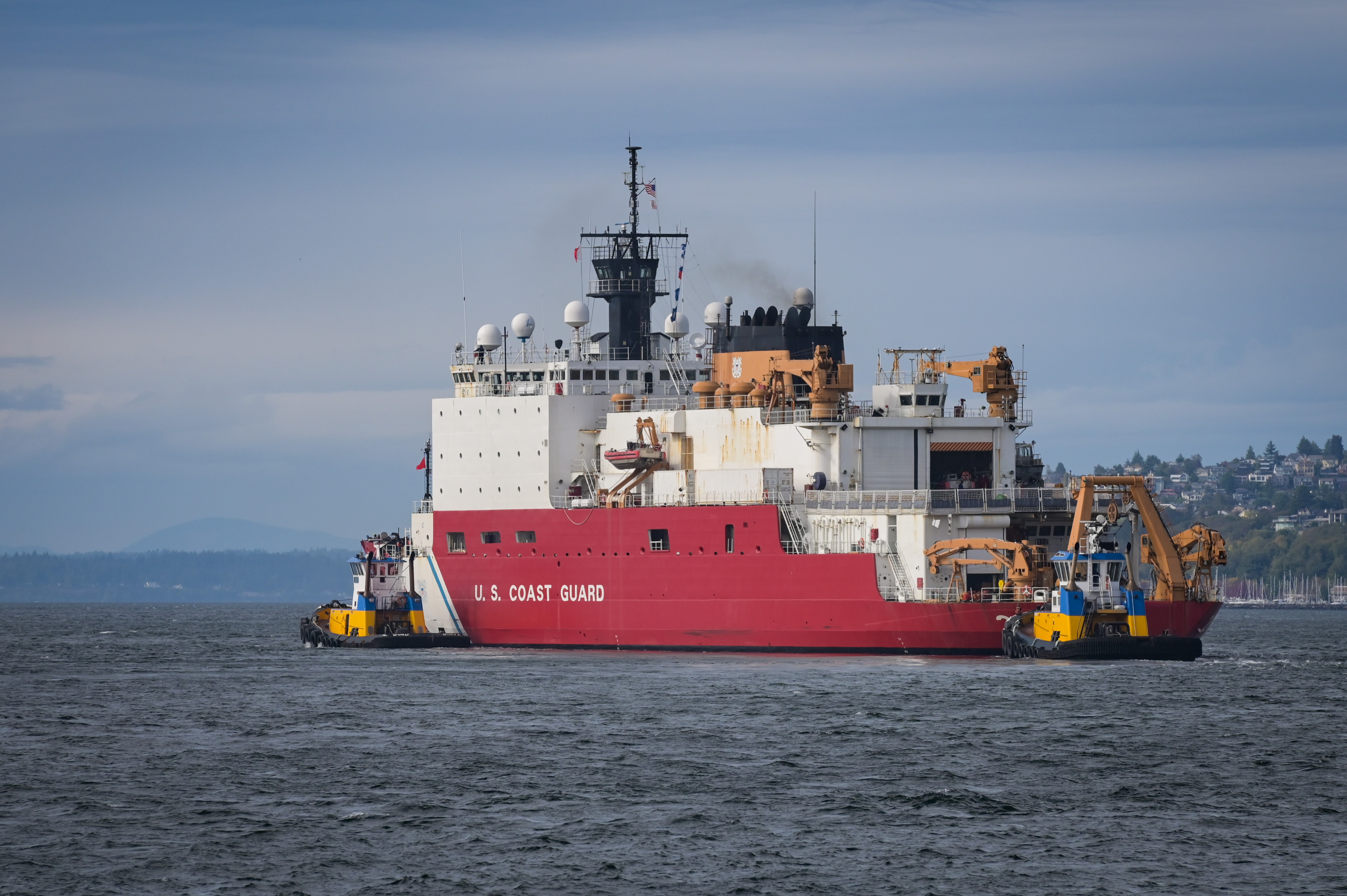
“U.S. Coast Guard Cutter Healy departs Seattle for Arctic deployment” –News Release

The spouse of a Coast Guard Cutter Healy (WAGB 20) crewmember waves goodbye as the cutter departs Base Seattle for a multi-month deployment to the Arctic, June 12, 2024. The Healy was commissioned in 2000 and is one of two active polar icebreakers in the Coast Guard’s fleet. (U.S. Coast Guard photo by Petty Officer 3rd Class Annika Hirschler)

Below is news release.


June 13, 2024

U.S. Coast Guard Cutter Healy departs Seattle for Arctic deployment

SEATTLE — U.S. Coast Guard Cutter Healy (WAGB 20) departed Seattle Wednesday, beginning their months-long Arctic deployment.

The crew will support scientists conducting three distinct science missions during Healy’s 2024 Arctic deployment.

The first mission is supporting the Arctic Observing Network, funded by the U.S. National Science Foundation (NSF). During this mission, the cutter will service subsurface moorings in the Beaufort Sea, north of Alaska, and conduct a broad-scale survey of the boundary current system from the Bering Strait to the western Canadian Arctic. This program has been ongoing for more than two decades to improve understanding of the Pacific Arctic ecosystem in a changing climate. Ancillary programs include measurements of harmful algae blooms and a variety of biogeochemical parameters.

For the second mission, Healy will embark 20 early career polar scientists and their mentors on a Polar Chief Scientist Training Cruise sponsored by the NSF and University-National Oceanographic Laboratory System to conduct multidisciplinary research. During a transit of the Northwest Passage, these early career scientists will conduct mapping to fill critical bathymetric gaps and scientific sampling across various disciplines, in addition to developing skills in shipboard leadership, coordination, and execution.

The final mission of the deployment will support the Global Ocean Ship-Based Hydrographic Investigations Program (GO-SHIP), where they aim to make the first ever single ship, single season, high-resolution transect of hydrographic observations across the Arctic basin. This global effort builds on data from as far back as the 1990s to collect repeat oceanographic data from a series of ocean basin transects around the world. The high-resolution surface-to-bottom multidisciplinary observations the team collects during this mission will be compared to earlier partial datasets to better understand the Arctic environment.

“We are excited to support three significant missions in the northern high latitudes,” said Healy’s Commanding Officer Capt. Michele Schallip. “Two of these missions are part of long-standing data collection projects, aimed at enhancing our understanding of a changing Arctic. The third mission is dedicated to inspiring future principal investigators who will continue this important work. At a time when scientific interest in the Arctic Ocean Basin is intensifying, Healy substantially enhances the American Arctic research capability. Healy’s crew have been unwavering in their efforts during our in-port maintenance period, ensuring the cutter is ready to meet the demands of these missions.”

Healy is the United States’ largest and most technologically advanced polar icebreaker and the Coast Guard’s only icebreaker designed and equipped with scientific instrumentation by the NSF to support Arctic research. The platform is ideally specialized for scientific missions, providing access to the most remote reaches of the Arctic Ocean. Healy is designed to break 4.5 feet of ice continuously at three knots and can operate in temperatures as low as -50 degrees Fahrenheit.

“First female and first Latino to take the helm of Key West Joint military command” –Joint Interagency Task Force South

Below is a news release by Public Affairs Officer, Antonia Varner Joint Interagency Task Force South


 June 6, 2024

Change of Command

First female and first Latino to take the helm of Key West Joint military command

Coast Guard Rear Admiral Jo-Ann F. Burdian assumed command of Joint Interagency Task Force South (JIATFS) today, in a change of command ceremony at the Tennessee Williams Theater in Key West, FL. JIATFS is a U.S. Department of Defense entity that detects and monitors illegal drug trafficking in international waters and air within the Western hemisphere, in support of regional security.

Rear Admiral Burdian is the eighteenth director of the 35-year-old task force, the first female, and first latino assuming command from the previous JIATFS director, Coast Guard Rear Admiral Mark J. Fedor.

A native of Queens NY, Rear Admiral Burdian is a 1997 graduate of the U.S. Coast Guard Academy where she earned a Bachelor of Science in Government. She also holds a Masters in Public Administration from Florida State University. She has been awarded numerous personal, unit, campaign, and service awards.

The Change of Command ceremony was presided over by General Laura J. Richardson, Commander of U.S. Southern Command.

Joint Interagency Task Force South (JIATFS), organized under U.S. Southern Command (SOUTHCOM), conducts detection and monitoring operations throughout its joint operations area to facilitate the interdiction of illicit trafficking in support of national and partner nation security. For more information about JIATFS, visit http://www.jiatfs.southcom.mil. For more information about SOUTHCOM, visit: http://www.southcom.mil.

Sweden Selecting New Family of Weapons for Small Craft

Swedish Combat Boat 90 (CB 90) in the port of Gothenburg. Photo by Arco Ardon

Naval News reports,

The Swedish modernization of their coastal troops is continuing, with the formal call for tenders for a new surface-to-surface anti-ship missile. The new weapon will receive the formal designation RBS 18, and unlike the current man-portable Hellfire-missile system used in the short-range anti-ship role by the Swedish marines will be mounted aboard the CB 90 combat boat.

Defense News reports,

“Sweden plans to acquire anti-aircraft guns for its fast-assault boats to counter drones and helicopters…”

Defense Industry Europe reports,

“FMV (Försvarets materielverk), the Swedish Defence Materiel Administration, announced the signing of a contract for the delivery of mortar-armed boats as part of the Amfbat 2030 programme.”

The Mortar equipped assault craft appears to be a resurrection of the previously cancelled Combat Boat 2010 program. The associated Patria 120mmAdvanced Mortar System could also be used in a direct fire mode.

The Amphibious Battalion operates between sea and land with the overall task of preventing enemy amphibious assaults. With the new maritime artillery, the fire controller on, for example, a Combat Boat 90 HSM can provide target data to the firing platform, enabling the firing of grenades at a high rate of fire while advancing, for indirect engagement of various types of ground targets. Image: FMV.

What we are seeing is a comprehensive overhaul of Sweden’s approach to littoral combat for their Amphibious Battalions (Amfibiebataljonen) of the Swedish Armed Forces from Stockholm and Gothenburg, assigned with defending the coastline, including numerous islands, against potential amphibious assaults.

While the mortars will be mounted on new construction boats, the new air defense and anti-ship missile systems will be mounted on existing CB90 (combat boat) assault craft.

The CB90 is a very popular product, used by at least nine different nations including the US, UK, and Ukraine. The Russian Navy even has what appears to be unlicensed copies of the craft. Mexico’s eight ship Oaxaca class Offshore Patrol Vessels carry a CB-90 HMN Patrol Interceptor in their well deck.

The CB90 displaces 23 tons and is 52 feet long with a 12.5 foot beam. 

If a weapon system fits on a CB90 it will certainly fit on any of the US Coast Guard’s patrol boats and larger cutters. 

In all probability the AAW weapon system will include a 30mm chain gun. Short range AAW missiles are possible. Perhaps the APKWS.

The anti-ship missile may be something entirely new. The closest to the description I know of, other than the MARTE MK2/N mentioned in the article, is the Spike NLOS.

“From the Coast Guard to NASA: How Andre Douglas Became a Rarity Among Astronauts” –Military.com

Coast Guard Academy graduate Andre Douglas, shown in a portrait taken on Dec. 3, 2021, was among 10 selected for NASA’s 2021 Astronaut Candidate Program. (Robert Markowitz/NASA photo)

Military.com reports on the life of the third US Coast Guard Academy graduate to complete NASA astronaut training.

“Stationed at Johnson Space Center in Houston, Douglas is currently working on a pressurized lunar rover and a lunar terrain vehicle, as well as designing spacesuits, He is also involved in a project to develop a new lunar space station, Gateway, to support the Artemis missions, which aim to return astronauts to the moon this decade with an eye on eventually traveling to Mars.”

The National Security Cutters as AGIs

Ingalls Shipbuilding successfully completed acceptance trials for the Coast Guard’s ninth national security cutter (NSC), Stone, in October 2020. NSC Stone was accepted Nov. 9, 2020, by the Coast Guard in a socially distanced ceremony. Photo by Lance Davis of Huntington Ingalls Industries.

During the Cold War, every US Navy task force was nearly always accompanied by a little friend, a Soviet AGI.

Oct 28, 1969 – The Soviet intelligence trawler Gidrofon underway with the attack aircraft carrier USS Coral Sea (CV-43) and her escort ships in the background.

The Soviet Intelligence Ships would provide near constant updates of the position of US carriers and the ships that were with them.

The recent transit of a group of Russian ships, shadowed by US, Canadian, and French ships and aircraft, including USCGC Stone, got me to thinking how the National Security Cutters (NSC) are an almost perfect asset to tail potentially hostile surface vessels during periods of heightened tension.

They are well equipped to keep surface threats under surveillance and provide continuous updates of their position and activities to cooperating units and the National Command Authority. They have a data link and a Sensitive Compartmented Information Facility (SCIF).

NSCs have other advantages over the typical Soviet AGI of the cold war period. They are much faster (28 knots) and are normally equipped with both manned and unmanned aircraft that could maintain surveillance for a long time even if a faster ship tried to outrun it.

Though certainly not a match for a ship like the Admiral Gorshkov, If an NSC observed a hostile act like a missile launch, it could potentially respond and might be able to inflict some damage. If a DDG were in the same position it might also be overwhelmed by a surprise attack. Having an NSC do the shadowing would allow other assets like the DDGs to remain over the horizon, complicating targeting for the adversary and insuring at least some time to respond if the situation goes hot.

“Houthi Drone Boat Strikes Ship For First Time Since Red Sea Crisis Erupted” –The War Zone

The War Zone reports,

“A Liberian-flagged bulk carrier is taking on water and not under the command of its crew after being hit by a Houthi drone boat…The Liberian bulk carrier Tutor was struck by a Houthi uncrewed surface vessel (USV) while transiting the Red Sea, the first such successful strike since the Yemen-based rebel group began attacking shipping in the region…”

The Houthi ballistic missiles and Unmanned Air Systems (UAS) have gotten a lot of press, but if you really want to hurt a ship, nothing works as well as placing large amounts of explosive next to the hull at or below the waterline.

Not impossible we will see something like this used in a terrorist attack.

“Coast Guard transfers 109 migrants to Bahamas, repatriates 196 migrants to Haiti” –D7 News Release

U.S. Coast Guard Cutter William Trump’s crew intercepts a migrant vessel 34 miles north of Île de la Tortue, Haiti, June 6, 2024. A U.S. Customs and Border Protection aircrew notified Coast Guard District 7 watchstanders who diverted a Coast Guard assets to interdict the migrants for repatriation at a later date. (U.S. Coast Guard photo by Petty Officer 2nd Class Eric Briganty)

Below is a District 7 news release. This follows a couple of reports that WMECs that had patrolled the area for almost two months each without picking up any migrants, here and here. The post includes link to documentation of steps being taken to discourage immigrant smuggling.

In the three interdictions, it appears, they were stopped close to their point of origin. I would really like to see some measures of effectiveness for this program, but it seems we are being very successful in detecting and interdicting these dangerous attempts.


June 10, 2024

Coast Guard transfers 109 migrants to Bahamas, repatriates 196 migrants to Haiti

MIAMI – U.S. Coast Guard crews returned a combined 305 migrants to the Bahamas and Haiti, Sunday and Monday, following multiple interdictions of unlawful maritime migration attempts over the last week in support of Operation Vigilant Sentry.  

The Coast Guard and its Homeland Security Task Force – Southeast federal, state, local, and international partners will continue to patrol by land, air and sea to rescue and repatriate anyone attempting to enter the U.S. unlawfully by sea.

The crews of Coast Guard Cutter Raymond Evans and Cutter Richard Etheridge transferred 109 people to the Royal Bahamas Defence Force, Sunday, following an interdiction near Anguilla Cay, Bahamas. U.S. Customs and Border Protection Air and Marine Operations (CBP-AMO) aircrews notified Coast Guard Sector Key West watchstanders of a migrant venture near Anguilla Cay and crews diverted to interdict them.

The crew of Coast Guard Cutter Thetis repatriated 196 people to Haiti, Monday, following two migrant voyage interdictions on June 5 and June 6. A CBP-AMO aircrew notified Coast Guard District Seven watchstanders, Wednesday, of a migrant venture north of Cap-Haitien, Haiti. Another CBP-AMO aircrew notified Coast Guard District Seven watchstanders, Thursday, of a migrant venture north of Île de la Tortue, Haiti. Crews diverted to interdict both vessels.

“Irregular maritime migration is unlawful and extremely dangerous. The OVS maritime border security mission is often equal parts law enforcement and humanitarian response, especially as we enter hurricane season and marine weather becomes more severe and unpredictable,” said Lt. Nick Fujimoto, Coast Guard District Seven enforcement officer. “The Coast Guard urges any potential migrants considering the journey: don’t take to the sea and risk your life just to be sent back. Use the safe, orderly and lawful pathways available like the CHNV process.”

Once aboard a Coast Guard cutter, migrants are processed to determine their identity and are provided food, water, shelter, and basic medical attention before repatriation to their country of origin or return to the country from which they departed.

For more information about Operation Vigilant Sentry including imagery, visit these links:

On June 5, the Department of Homeland Security announced that U.S. immigration enforcement and asylum procedures across the southern border are more strict. Last Tuesday, the Secretary of Homeland Security and the Attorney General jointly issued an interim final rule that generally restricts asylum eligibility for those who irregularly enter across the southern border – including the southwest land border and the southern coastal borders. These new measures are designed to increase the processing and consequences for those who cross our borders irregularly or who attempt to present themselves at Ports of Entry without authorization, allowing DHS to more quickly remove individuals who do not establish a legal basis to remain in the United States.

For more information, follow these links to Department of Homeland Security fact sheets:

For breaking news, follow us on X (formerly Twitter). For Task Force updates, follow @HSTF_Southeast on X. For additional information, find us on Facebook and Instagram.

“U.S. Coast Guard Cutters return home after successful Central American deployment” –D11 News Release

USCGC Forrest Rednour (WPC 1129) and Blackfin (WPB 87317) in Costa Rica

Below is a District 11 news release. Did an earlier post on this unusual deployment.

The 800 operational hours claimed for each vessel works out to 33.3 operational days out of 49 deployed, so I presume that means about 16 days in transit, there and back.

The Mexican Navy vessel mentioned, ARM PALENQUE, the third of ten Tenochtitlan-class patrol vessels, looks a lot like a Webber class Fast Response Cutter. It is also a Damen design, but a bit smaller (a Stan Patrol 4207 vs 4708 for the FRC). Damen has been very successful with this design. More than 50 have been built for more than a dozen agencies. (USCGC Blackfin and the other Marine Protector class patrol boats are also based on a Damen design.)

Mexican Navy ARM Palenque (PC-333) at launching March 2014. Credit Secrtaria de Marina.


June 10, 2024

U.S. Coast Guard Cutters return home after successful Central American deployment

SAN PEDRO, Calif. — U.S. Coast Guard cutters Forrest Rednour and Blackfin have returned to their homeports after a 49-day deployment in Central America, where they played a crucial role in multiple operations.

During this period, both cutters demonstrated outstanding readiness and operational capability, significantly contributing to international cooperation, search and rescue missions, and efforts to combat criminal activities. This deployment was part of a broader strategy to enhance regional security and strengthen partnerships. Throughout the mission, Forrest Rednour covered over 8,200 miles and logged 800 operational hours, while Blackfin covered over 8,300 miles and also logged 800 operational hours.

“The amount of effort and commitment from both crews during this 49-day deployment was remarkable,” said Rear Adm. Andrew Sugimoto, commander, Coast Guard District 11. “Their readiness and professional exchanges provided an invaluable experience to our partner nations and crews. The enthusiasm to lead multiple engagements with several international maritime organizations helped strengthen ties and fortify continued collaboration between all.”

Key Achievements:

Search and Rescue Exercises (SAREX):

  • Manzanillo, Mexico: Blackfin led a successful SAR operation, including helicopter rescue exercises with the Mexican Navy.
  • Puerto Quetzal, Guatemala: Hosted tours and conducted SAR exercises with the Guatemalan Navy, building stronger maritime partnerships.
  • La Union, El Salvador: Rednour led a SAR exercise and joint operations with the Salvadoran Navy, marking the first U.S. vessel visit to this port in two years.

Partnership and Training:

  • Amapala, Honduras: Engaged in discussions and training on maritime law enforcement and security with the Honduran Navy and Merchant Marine.
  • Golfito, Costa Rica: Shared knowledge on maritime governance with the Costa Rican Coast Guard, enhancing mutual understanding.
  • Rodman, Panama: Provided damage control and medical evacuation training to Panamanian forces, marking the first U.S.-Panama Coast Guard engagement in over two years.
  • PASSEX with ARM PALENQUE: Forrest Rednour and Blackfin conducted a passage exercise (PASSEX) with the Mexican Navy’s ARM PALENQUE. This included formation steaming, code exercises, and a crew exchange to enhance mutual operational understanding and cooperation.

“This patrol was truly an amazing experience and a testament to the incredible devotion to duty that the crews of the Forrest Rednour and Blackfin have,” said Lt. Kevin Ng, commanding officer of Coast Guard Cutter Forrest Rednour. “Both crews adapted and overcame several challenges leading up to and during the patrol, but never took their eyes off the main objective. As a result, the Coast Guard was able to strengthen the valuable relationships that the United States has with our international partners throughout Central America and unify our efforts to address critical maritime security initiatives in the Eastern Pacific. Thank you to crews on a job well done, District 11 and Sector Los Angeles/Long Beach for the coordination, and the families and friends of the crew for all of the support; the success of this historic patrol could not have been accomplished without them all.”

“I could not be prouder of both crews for the incredible amount of hard work they have dedicated to making this historic patrol possible. The success of this Surface Action Group is a testament to the Coast Guard’s ability to overcome dynamic challenges in the completion of unprecedented mission sets. It also signifies the Coast Guard’s steadfast commitment to advancing our vital maritime partnerships in the Eastern Pacific. The international relationships formed and strengthened during this deployment have set the groundwork for future engagements which I look forward to watching,” said Lt. j.g. James Morrison, commanding officer of Coast Guard Cutter Blackfin.

Commissioned in 2018, the Coast Guard Cutter Forrest Rednour is one of the Coast Guard’s Sentinel-class fast response cutters homeported in San Pedro, California. Sentinel-class cutters are 154 feet long and 25 feet wide and have a 353 long-ton displacement. They have a top speed in excess of 28 knots and a range of 2,500 nautical miles. They can hold a crew of up to 24. The namesake of the Forrest Rednour is Petty Officer 2nd Class Forrest O. Rednour, who heroically rescued survivors from the torpedoed USAT (US Army Transport–Chuck) Dorchester during World War II and was posthumously awarded the Navy and Marine Corps Medal.

Commissioned in 2000, the USCGC Blackfin is one of the Coast Guard’s Marine Protector-class patrol boats homeported in Santa Barbara, California. Marine Protector-class patrol boats are 87 feet long and 19.5 feet wide and have a 100 long-ton displacement. They have a top speed of 25 knots and a range of 900 nautical miles. They can hold a crew of up to 10. The Blackfin is equipped with advanced electronics and navigation systems for multi-mission operations, including search and rescue, law enforcement, and homeland security. The Blackfin shares the name of the USS Blackfin (SS-322), a submarine that participated in World War II and the Korean War.