“In focus: the Bofors 57mm Mk 3 gun” (That Equips the NSCs and OPCs) –Navy Lookout / I Think MAD-FIRES Is Dead

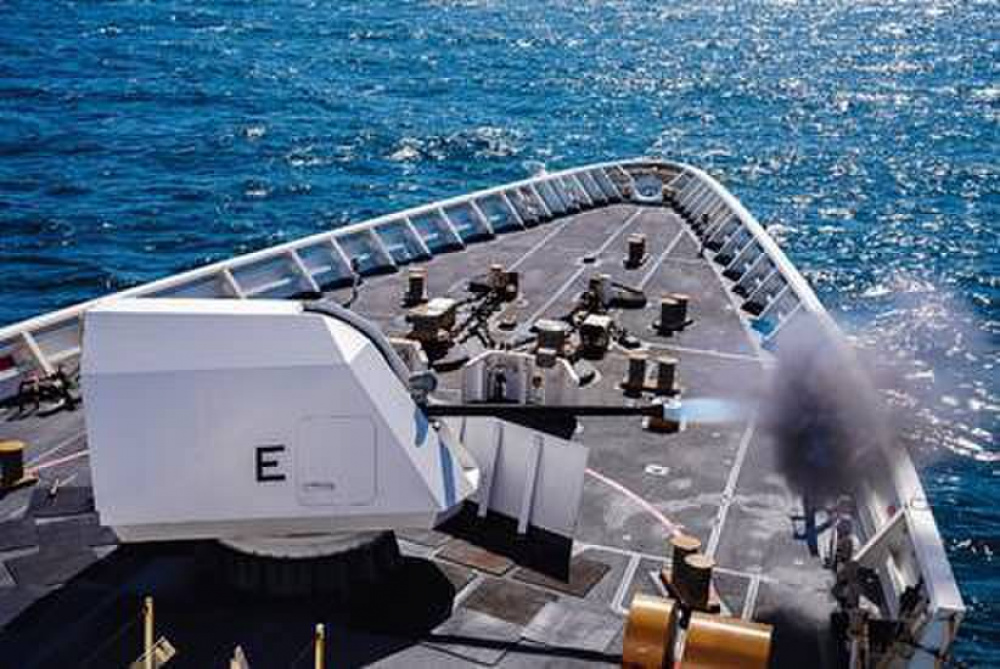
Coast Guard Cutter Stratton fires its MK 110 during a gunnery exercise in the Bering Sea April 28, 2021. U.S. Coast Guard photo courtesy Ensign Molly Dolan.

The Royal Navy has chosen the BAE Bofors 57mm Mk3 to arm a new class, the Mk31 general purpose Frigates. This is the same gun that arms National Security Cutters (NSCs) and Littoral Combat Ships (LCSs) and which will arm the Offshore Patrol Cutters (OPCs) and the new Constellation class guided missile frigates.

UK based Navy Lookout has published an independent evaluation of the weapon and its ammunition. This is almost two years old, but it is well done. It makes some good points discussing the both the advantages and limitations of the weapon. I would point out that they note, “The days of medium calibre guns being used against other ships are long gone…” It is adequate for signaling by firing across the bow and for engaging small craft, but maybe we might want to think about adding a weapon suitable for use against ships since that should be part of even our peacetime skill set.

Unfortunately, their hopes for the “Multi- Azimuth Defense Fast Intercept Round Engagement System” (MAD-FIRES) guided round will not be realized. It seems the MAD-FIRES round was a non-starter. I checked both the Raytheon/RTX and the DARPA websites and neither had any mention of MAD-FIRES. I thought perhaps the MAD-FIRES program had failed when Northop Grumman was awarded a contract to develop a maneuvering 57mm round, but even in that case, it was intended for use against “fast moving surface threats, drones and swarming threats” not cruise missiles as was the case for MAD-FIRES.

Poster Download: “2024 Ships and Submarines of the United States Navy” –RTX

For 27 years, RTX (formerly Raytheon) has created a poster every year with the names of every ship and graphical representations of every ship class in the US Navy. It’s a giveaway at trade shows but is also available as a download. They have a story about its origin and the person who created it with a link to download a pdf copy here.

I downloaded a copy. I did have to enlarge it a bit (ctrl +) to make it readable on my laptop. It does also include ships under construction with no apparent differentiation.

“Third temporary channel opens for vessels to Baltimore port after bridge collapse” –WRAL News

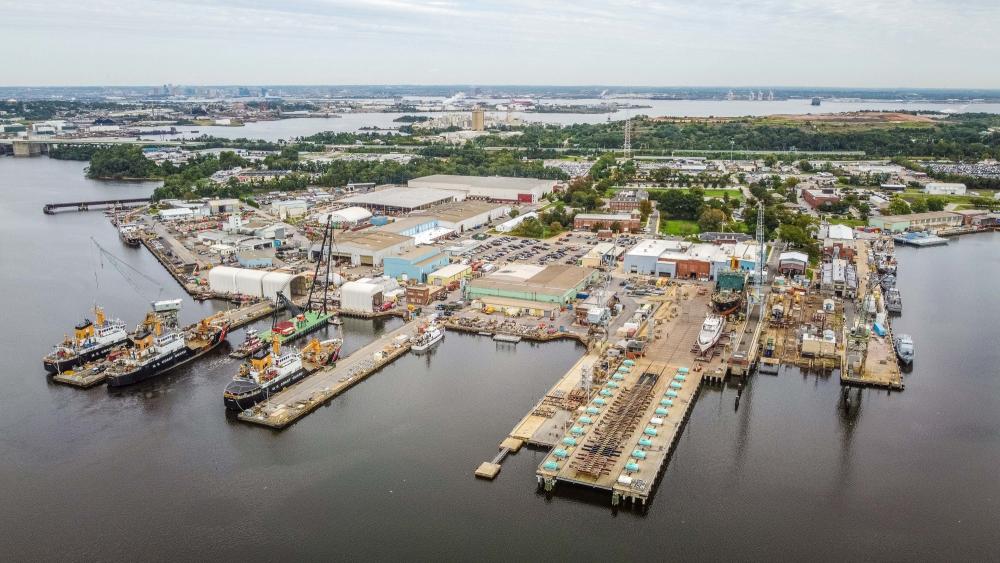
Coast Guard Yard, Curtis Bay, MD.

WRAL News reports,

“A third temporary channel for boats to enter and depart the Port of Baltimore has opened…The new temporary path, with a controlling depth of 20 feet (6.1 meters), a horizontal clearance of 300 feet (91.4 meters) and a vertical clearance of 135 feet (41.2 meters), allows a greater variety of vessels to access the port while crews work to reopen the main channel, Coast Guard and port Capt. David O’Connell said in a news release.”

I added a comment noting this development on the earlier post about Coast Guard ships being trapped at the Coast Guard Yard, but on second thought I realized this was worth a separate post. As I noted in the comment, “With a controlling depth of 20 feet this should be sufficient for all Coast Guard vessels except the National Security Cutters. USCGC Eagle might have a problem with the vertical clearance, 135 feet. Reportedly fore and main mast height is 147.3 feet, but they can be lowered 13 feet. Probably at low tide, Eagle could transit the temporary channel OK, but it would look exciting. Maybe at high tide the NSCs could use it too.” (Please forgive the stream of thought approach.)

Before writing this post, I went to United States Coast Guard News hoping to quote the news release in full (surely it would be there) but for some reason there was no news release. Curious? Could this be because its Saturday?

“Marine News’ 2024 US Shipbuilding Report” –Marine Link

Future USCGC Argus at launch Eastern Shipyard. Presumably the furture USCGC Chase in the background. 

Marine Link has a report that gives us a look at how shipbuilders look at their industry and their relationship with Government.

This includes comments from both Ben Bordelon, president and CEO of Bollinger Shipyards that is building the Fast Response Cutters and the new Polar Security Cutters, and Joey D’Isernia, the chairman and CEO of Eastern Shipbuilding Group that is building the first four Offshore Patrol Cutters.

There is also a good deal of discussion about new technology being applied to tugs that the Coast Guard might want to consider if we choose to replace the 65 foot and 140 foot icebreaking tugs.

This banner hangs over a passageway in one of the shops at Bollinger’s Lockport shipyard.

“How Does Sweden and Finland Joining NATO Affect the U.S. Coast Guard?” –By Peter Ong

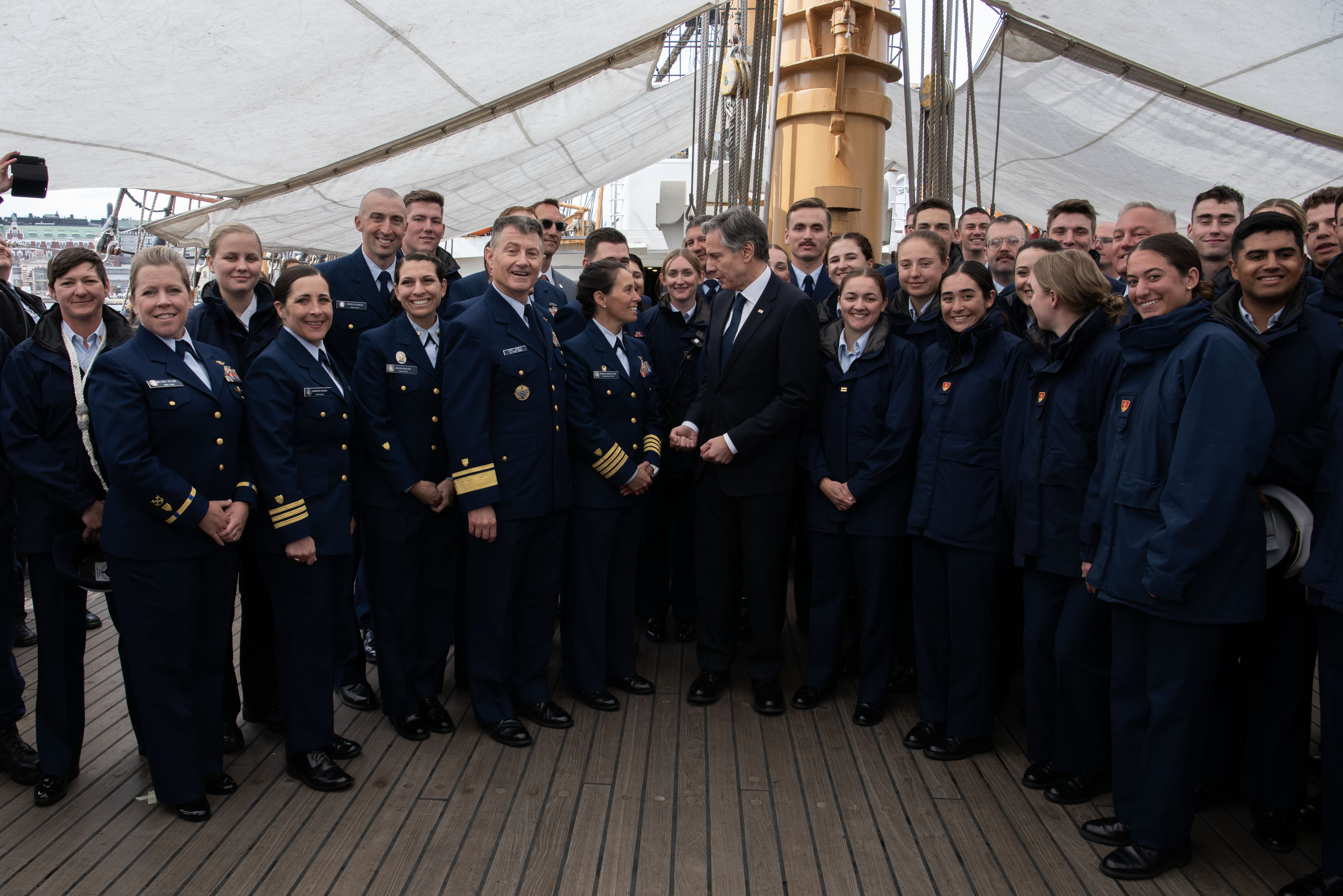
U.S. Secretary of State Antony Blinken, middle, takes a photo with the USCGC Eagle’s crew during a reception aboard the cutter, June 2, 2023, in Helsinki, Finland. Eagle is a tall ship used as a training platform for future Coast Guard Academy officers as well as a vessel utilized for establishing and maintaining domestic and international relationships. (U.S. Coast Guard photo by Petty Officer 3rd Class Carmen Caver)

Guest author Peter Ong provides a look at the continuing relationship between the Coast Guard and new NATO members Sweden and Finland. 

With the war in Ukraine affecting current economic and security situations in 2022-2024 Europe, the North Atlantic Treaty Organization (NATO) welcomed its two newest members, Finland and Sweden, both Arctic nations. Finland became a member of NATO on 4 April 2023. Sweden joined NATO on 7 March 2024.

NATO’s European members and when they joined the NATO alliance. Source: Wikipedia

I sent a media inquiry to the USCG’s Headquarters, Public Affairs Office, Washington D.C., asking how Sweden and Finland becoming NATO’s newest members might influence the U.S. Coast Guard in terms of icebreaking, cutter designs, exercises, training, enforcement, and maritime security.

The USCG replied, “From a regional perspective, this will increase cooperation and improve interoperability.  Information sharing, exercises, and operations will be much easier to coordinate with all the Nordics now in NATO.”


U.S. Coast Guard Petty Officer 1st Class Arthur Flaherty, a boatswain’s mate assigned to the USCGC Hamilton (WMSL 753), prepares to transfer Hamilton crewmembers onto the Swedish Coast Guard vessel Amfitrite in the Baltic Sea, Oct. 31, 2022. Hamilton was on deployment in the U.S. Naval Forces Europe area of operations. (U.S. Coast Guard photo by Petty Officer 3rd Class Alejandro Rivera)

The United States Coast Guard has a history of visiting and working with partner Baltic nations to improve relationships, training, interoperability, communications, intelligence, and coordination. Even before they entered NATO the US Coast Guard had a long-standing relationship with Sweden and Finland through the Arctic Coast Guard Forum.

U.S. Coast Guard Lt. Cmdr. Tanya Kuprak, engineering officer aboard USCGC Hamilton (WMSL 753), gives a tour of the engine room to Swedish Coast Guard members while underway in the Baltic Sea, Oct. 30, 2022. Hamilton was deployed with U.S. Naval Forces Europe and U.S. Sixth Fleet. (U.S. Coast Guard photo by Petty Officer 3rd Class Alejandro Rivera)

Recent interactions include:

United States’ relationship with Finland has benefitted in the area of model testing and consulting on the current Great Lakes icebreaker, Mackinaw, regarding its design and Azipod propulsion.

RIMPAC Preparation

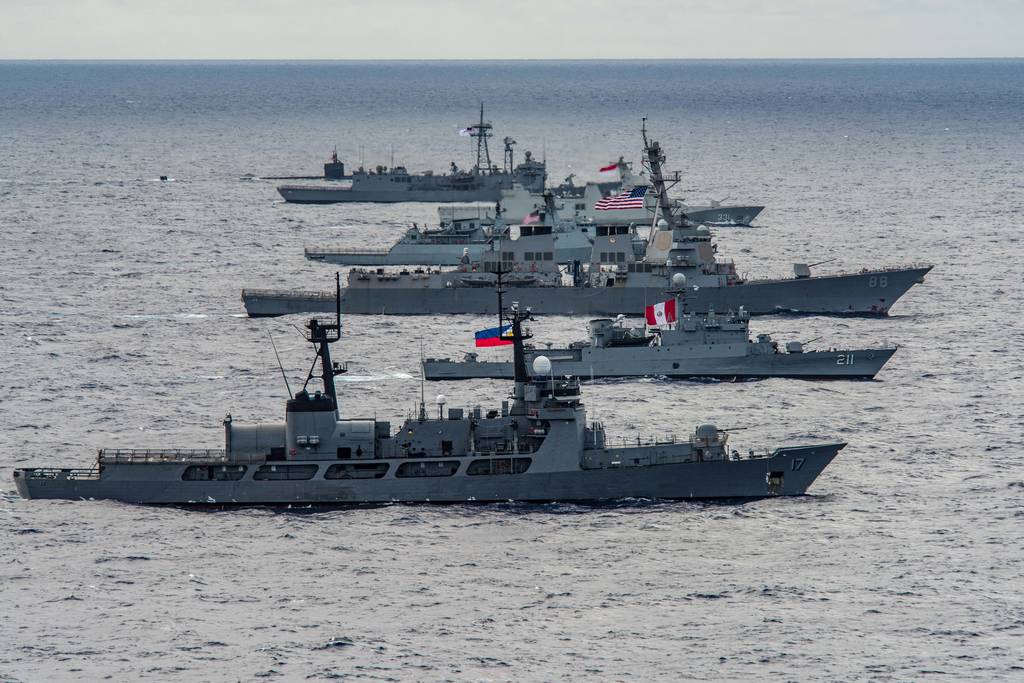
Navy ships assemble to form a multinational fleet for a photo exercise off the coast of Hawaii during the Rim of Pacific (RIMPAC) exercise on July 26, 2018. Twenty-six nations, more than 45 ships and submarines, about 200 aircraft and 25,000 personnel are participating in RIMPAC. (MC3 Dylan Kinee/U.S. Navy)

The biannual RIMPAC exercise is regularly the largest naval exercise in the world, and the Coast Guard is a regular participant. During the last two RIMPACs National Security Cutters did some interesting stuff, including commanding a task force and hosting Navy MH-60R and MH-60S Helicopters.

In addition, the Coast Guard will have a role in securing the safety of participating units.

It is almost certain we will see some former US Coast Guard cutters participating since they are now in the navies or coast guards of Colombia, Sri Lanka, Nigeria, the Philippines, Vietnam, and Bangladesh.

I hold out hope that Coast Guard units may be able to participate in a SINK-EX. even if the target is a former Coast Guard patrol boat, but it’s not likely.

Using the comments section, I will use this post to pass along information on preparation for the exercise. Below are posts that give us some previews of what to expect.

“A New Weapon Of War: Killer Underwater Drones” –Video

Wanted to pass this along. A little less than a half hour, but a good way to get up to speed on an emerging weapons technology. It also includes a lot of background on torpedoes.

I would only add that these are likely to be used as terrorist weapons as well as weapons of war.

H. I. Sutton is probably the leading unclassified source for information on unconventional naval warfare systems and has also been a great source on maritime drug smuggling technology. He has a website, “Covert Shores,” that is included on my “Recommended Blogs” page. He is also widely published in the popular press including by the US Naval Institute and in Naval News. He has also published several books.

“Down 2,500 Recruits, Coast Guard Overhauls Talent Management” –USNI

The US Naval Institute News Service reports on how the Coast Guard is attempting to remedy its personnel shortage.

Recruiting had never been an issue for the Coast Guard, Vice Adm. Paul Thomas, deputy commandant for mission support, said at separate Sea Air Space panel. People would come to the service, and they met the necessary numbers with little effort. Now, the service has to revamp its approach.

The Commandant has asked people to think outside the box and it looks like we are beginning to see results. We can’t expect that every new idea will work, but at least the Coast Guard is trying new ideas.  

“MEDIA AVAILABILITY: US Coast Guard to commission newest national security cutter, named for first Master Chief Petty Officer of the Coast Guard, in North Charleston, South Carolina” –news release

USCGC Calhoun 759 arrives Charleston.

Below is a news release from Coast Guard News.


April 16, 2024

NORTH CHARLESTON, S.C.  — The Coast Guard is scheduled to hold a commissioning ceremony for the U.S. Coast Guard Cutter Calhoun (WMSL 759), the service’s newest national security cutter, Saturday, in North Charlston. The event will be presided over by Coast Guard Commandant Adm. Linda Fagan. The cutter’s namesake comes from the first Master Chief Petty Officer of the Coast Guard, Charles L. Calhoun. The commissioning ceremony’s date of April 20 is in honor of Calhoun’s birthday.

WHO: Coast Guard Commandant Adm. Linda Fagan; Master Chief Petty Officer of the Coast Guard Heath Jones; Capt. Timothy Sommella, the commanding officer of the Calhoun; and Calhoun crew members.

WHAT:  Commissioning ceremony for the Coast Guard’s newest national security cutter.

WHEN: Saturday, April 20, 2024, at 10 a.m.

WHERE: Federal Law Enforcement Training Center, 2000 Bainbridge Ave., North Charleston, SC 29405.

Editors’ Note: Interested media are requested to RSVP by emailing a list of members’ names to Ensign Cody Meyers at Cody.L.Meyers@uscg.mil for base access no later than 5 p.m. Wednesday. Credentialed media are asked to arrive no later than 9 a.m. Saturday with a driver’s license and proof of insurance to clear security. 

APKWS Affordable Counter UAS System

The War Zone (TWZ) reports on a new NAVAIR contract for Counter UAS systems.

See the four fixed radar antenna on top of the cab? Look familiar?

From the Company web site: RPS-42 is an S-Band tactical hemispheric air surveillance radar system. It is a member of the non-rotating, solid-state, digital radar family Multi-mission Hemisphere Radar (MHR), developed by RADA Electronic Industries Ltd.
The RPS-42 is a pulse Doppler, software-defined radar platform, that can detect, classify and track all types of aerial vehicles – including fighters, helicopters, UAVs, transport aircraft, etc. at tactical ranges. A single radar platform provides 90º azimuth coverage. Hemispheric coverage is achieved when four radars are employed as a system. Mobile or stationary, the system can be integrated with any C⁴I system and other radars and sensors. The software is able for On-the-Move (OTM) Operation. The radar can operate either as a stand-alone or as part of a large-scale surveillance system.
The Antenna is an Active Electronically Scanned Array (AESA) based on Galliumnitrid (GaN) Amplifiers. Its diameter is 50.4 cm, the max width is 16.5 cm.
The achievable range for detection of the smallest drones (known as Nano UAV) is 3.5 km.

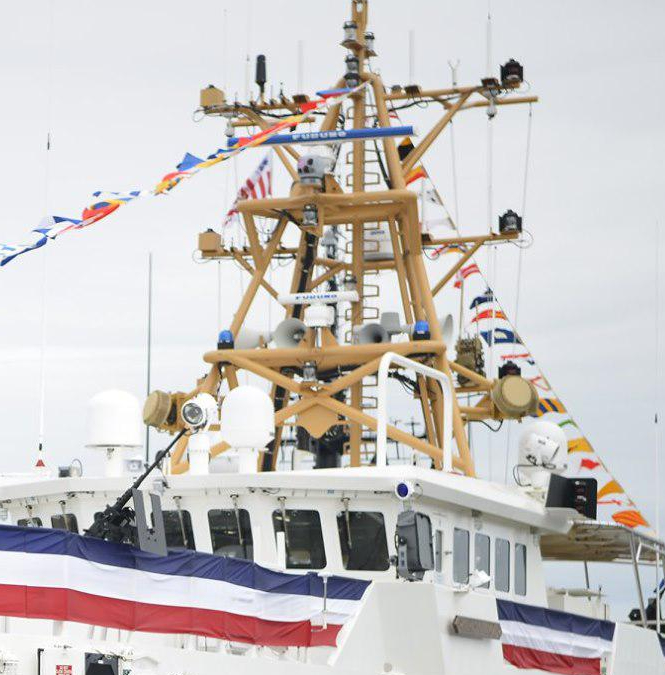
Looks like they or close cousins are on PATFORSWA cutters. (Click on the photo below to enlarge.) They are on the mast.

USCGC Charles Moulthrope (WPC-1141) prior to departure for PATFORSWA.

The TWZ post has a bit of cost comparison as well.

The laser-guided rockets are modular and low-cost, with the guidance section designed to slot in between existing standardized 70mm warheads and rocket motors. The unit cost of the APKWS II guidance section is around $25,000, with the warhead and rocket motor together typically only costing a few thousand dollars more depending on their exact types, according to Navy budget documents. For comparison, the cost of a single Coyote Block 2 interceptor, another counter-drone weapon currently deployed to help protect U.S. Forces in the Middle East, is reportedly roughly around $100,000. Current generation Stinger short-range heat-seeking surface-to-air missiles, which include new features to improve their effectiveness against drones, have a unit cost of around $400,000.

For comparison, an Alamo round of 57mm costs about $29,500.

The MSI news release is here. More on MSI’s Vehicle Integration Kit (VIK).