“USNI News Fleet and Marine Tracker: Aug. 14, 2023” –USNI

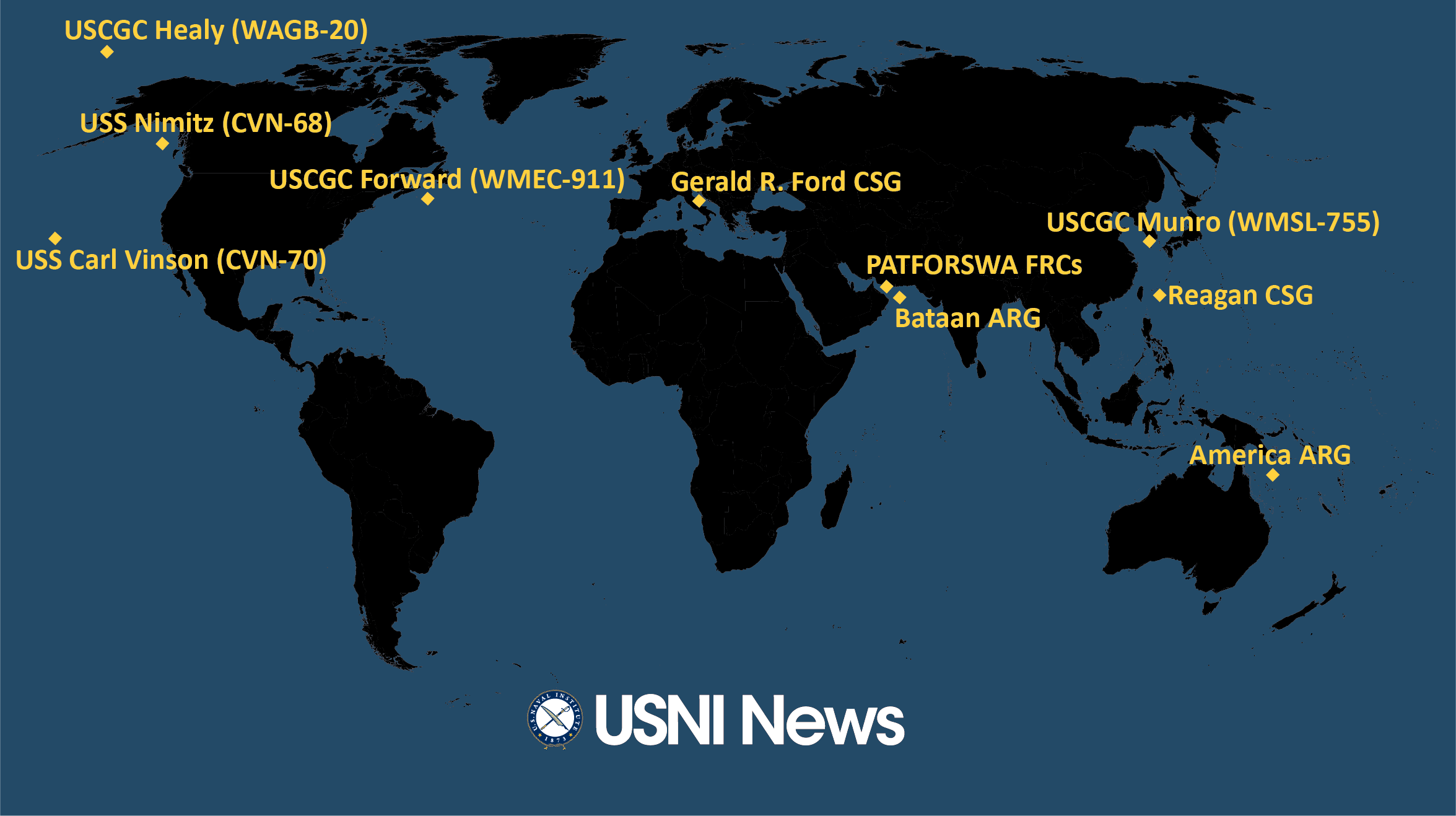
The US Naval Institute News Service “Fleet Marine Tracker” continues to report atypical Coast Guard activities. It continued to report on USCGC Healy’s Arctic deployment and mentioned PATFORSWA as they have since they have since they began including Coast Guard units in May.

This week, they included some activity I have not seen reported elsewhere.

“Legend-class National Security Cutter USCGC Munro (WMSL-755) departed Fleet Activities Yokosuka (CFAY) and is now in South Korea.”

“Coast Guard Cutter Forward (WMEC-911) is currently supporting Operation Nanook. Operation Nanook is an annual Canadian-led exercise that fosters international cooperation and shared responsibility in the Arctic and the northern Atlantic Regions.”

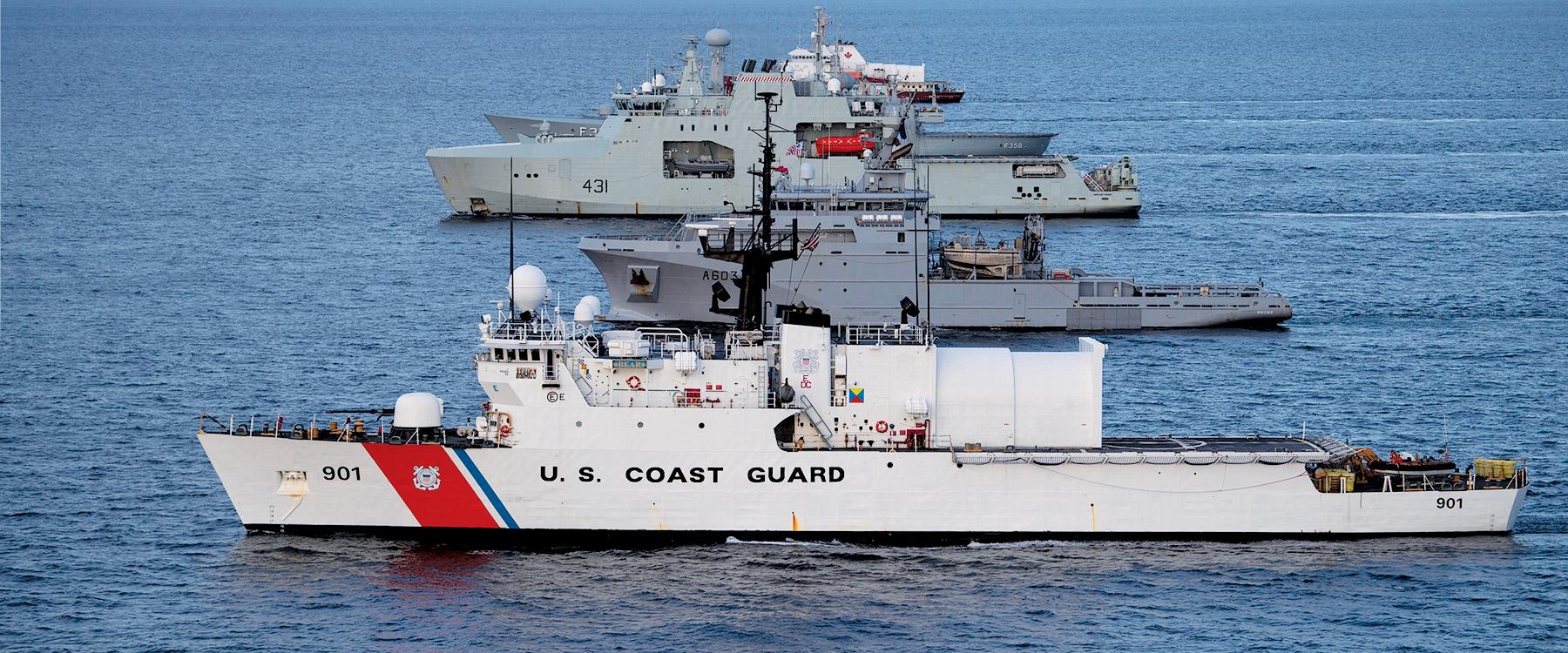
The USCGC Bear (WMEC-901) and allied ships from Canada, Norway, France, and Denmark steam in formation in the North Atlantic Ocean during last year’s Operation Nanook in August 2022. 

“U.S.-Philippine Coast Guard Patrols: Time To Provoke the Provocateur” –Real Clear Defense

Chinese fishing vessel fleet (Photo: The Maritime Executive)

Real Clear Defense has a post by the J. C. Wylie Chair of Maritime Strategy at the Naval War College, Dr. James R. Holmes, discussing the implications of the planned Philippine/US Coast Guard joint patrols in the South China Sea.

It is a thought-provoking article but I would argue for a change of emphasis. The Chinese consider what is happening war without gunsmoke, but if we engage on that basis we are already at war. Rather I would suggest we see this as purely law enforcement vigorously applied–which is of course the reason it is the US Coast Guard rather than the USN that will be conducting these joint patrols.

  • If foreign vessels fishing in the Philippine EEZ without a license is not already illegal, make it so. The Philippines should make sure the Chinese know that is how it will be viewed and act accordingly.
  • No foreign vessels should be allowed to impede Philippine vessels conducting legal activities.
  • No foreign vessels should be allowed to exploit the resources of the Philippine EEZ without a license.
  • No foreign vessels should be allowed to damage resources in the Philippine EEZ.

The Chinese maritime militia has been very useful, but they may also be viewed as China’s weakness, since they are officially civilians. As civilians violating Philippine law, they should be subject to vigorous law enforcement action.

CRASH AVERTED This photo taken on April 23, 2023 shows BRP Malapascua (right) maneuvering as a Chinese coast guard ship cuts its path at Second Thomas Shoal in the Spratly Islands. AFP PHOTO

If a vessel chooses to block a Coast Guard vessel and violates the Rules of the Road in the process, if a collision results and their engineroom floods, it was their violation of the Rules of the Road that caused the collision.

This is lawfare, not warfare, and the law is on the side of the Philippines. The Chinese are acting as a gang of thieves stealing from their weaker neighbors. Diplomatically the US and the Philippines need to work toward something similar to the Combined Maritime Forces organization in SW Asia and fielding a law enforcement alliance like my proposed Combined Maritime Security Task Force Pacific. (“Combined” used this way means multi-national.)

“Defending the Dutch Caribbean: An Assessment” –Geopolitical Monitor

Willemstad, Feb. 2022. The Netherlands the royal family was transported from Aruba to Curacao aboard the Holland-class offshore patrol vessel HNLMS Holland (P-84).

Geopolitical Monitor discusses the six islands of the Dutch Caribbean, part of the Kingdom of the Netherlands.

The Netherlands has been a good partner in drug interdiction operations in the Caribbean. The four ships of the Holland class are in many ways similar in size and characteristics to the Offshore Patrol Cutters. The Netherlands Navy tends to keep one of these ships in the Caribbean, and they frequently host US Coast Guard Law Enforcement teams. At least once they also hosted a Coast Guard H-65 airborne use of force helicopter.

The post talks about the Dutch Caribbean Coast Guard (DCCG, or Kustwacht Caribisch Gebied: KCG),

“…which has facilities in Aruba, Curaçao, and Sint Marteen. This agency carries out missions involving search and rescue, law enforcement, and maritime interdiction. The DCCG’s fleet includes three Damen Stan Patrol 4100 cutters (slightly smaller but similar to the Webber class–Chuck), Jaguar, Panther, and Puma, five Boston Whaler Justice 20 craft, and 12 Metal Shark Defiant interceptor vessels. In addition, in April 2022, the Dutch organization for defense equipment (Defensie Materieel Organisatie) announced that two helicopters were acquired from Bristow Helicopters and will be delivered in 2023. The DCCG currently operates two DHC-8 aircraft and two AgustaWestland AW139 helicopters.”

They even have had long range, medium altitude unmanned search aircraft assigned, something the US Coast Guard still does not have,

“The DCCG’s surveillance capabilities were expanded in late March 2022, with the arrival to Curaçao of three General Atomics MQ-9A Reaper unmanned aerial vehicles and two ground stations. The Reapers assist Dutch Caribbean military personnel in combating organized crime and illegal fishing, among other activities. They will remain in Curacao until 1 July 2023.”

The post alludes to Venezuelan’ threats to Dutch Caribbean islands that lay off the Venezuelan coast (Aruba, Curaçao, and Bonaire). While the Venezuelan military is far more powerful than the forces the Netherlands keeps in the Caribbean, it is hard to take these threats seriously since, an attack on even one of the islands, would be an attack on NATO.

On a personal note, really enjoyed a stopover in Aruba in the early 80s while it was snowing back in our Portland, Maine homeport–my wife will never let me forget.

Thanks to Lee for bringing this to my attention.

“US to Deploy Coastguard Ship to Papua New Guinea” –The Defense Post

The USCGC Oliver Henry (WPC 1140) crew arrives in Manus, Papua New Guinea, on Aug. 14, 2022, from Guam as part of a patrol headed south to assist partner nations in upholding and asserting their sovereignty while protecting U.S. national interests. The U.S. Coast Guard is participating with partners to support the Pacific Islands Forum Fisheries Agency-led Operation Island Chief and the larger Operation Blue Pacific through patrols in the Western Pacific in August and September 2022. (U.S. Coast Guard photo by SW3 Victor Villanueva, NMCB-FOUR)

(Sorry, this is a couple of weeks old.)

The Defense Post reports,

US Defense Secretary Lloyd Austin on Thursday announced the deployment of a US Coastguard ship to Papua New Guinea, as Washington seeks to boost its military footprint in the region amid fierce competition for influence with China…“A US Coastguard cutter will be here in August,” Austin said as he became the first Pentagon boss to visit Papua New Guinea.

Again, the Coast Guard is being used as an instrument of foreign policy. That is not a bad thing, but it is a fact.

It is not like the Coast Guard has not been there before. The photo is from 2022, but the US and Papua New Guinea are seeking closer, mutually beneficial ties.

For Papua New Guinea this means improvements to dual use (military and civilian) infrastructure (ports and airfields), increased economic activity, and help with preventing IUU fishing.

For the US, the diplomatic activity is prompted by Chinese attempts to obtain influence in Oceania that seemed to have been demonstrated when the Soloman Islands failed to respond to a request for a routine replenishment stop for USCGC Oliver Henry (pictured above).

Thanks to Paul for bringing this to my attention. 

“INSIDE LOOK aboard HMCS Harry DeWolf” –Video

Just a short video, made at least a couple of years ago, but particularly wanted to feature the “cable deck,” time 1:27 to 1:45, where you see mooring and anchoring gear conspicuously missing from the foc’sle. Keeping this gear inside the ship is critical to keeping it operational in the Arctic environment.

A total of eight ships of the class are planned, six for the Canadian Navy and two for their Coast Guard. Navy or Coast Guard, these “Arctic Offshore Patrol Ships” (AOPS) essentially perform what we view as Coast Guard missions. They are 6,615 ton ships, 340 feet (103.6 meters) in length. Four diesel generators provide power to two electric motors that provide 12,000 HP for a 17 knot max speed. Range is 6,800 nautical miles at 14 knots. The crew is 65 with accommodations for 87. The gun seen in the video is a weatherized version of the 25mm Mk38. They are Polar Class 5.

Damage Resulting from Ukrainian USV Attacks –The Drive

The Drive provides information showing the results of Ukrainian Unmanned Surface Vessel (USV) attacks on a small Russian tanker and a Russian Navy LST. Reportedly the USVs were equipped with 450 kg of explosives (about 1000 pounds). The explosions occurred essentially at the waterline. Had the explosions occurred well below the waterline, or particularly below the keel, the effect would have been greater. Even in the photo above, it appears the explosion cause more damage below the waterline than above. Had it been well above the waterline, the effect on the ship would probably have been less, but similar sized bomb or missile hits on the superstructure would likely have caused more personnel casualties.

Our First Look At Hole Blasted Into Russian Tanker By Ukrainian Drone Boat

“TEXTRON SYSTEMS AWARDED UNCREWED AIRCRAFT SYSTEM (UAS) CONTRACTOR-OWNED/CONTRACTOR-OPERATED CONTRACT FOR THREE LITTORAL COMBAT SHIPS (LCS) BY U.S. NAVY” –Textron Systems

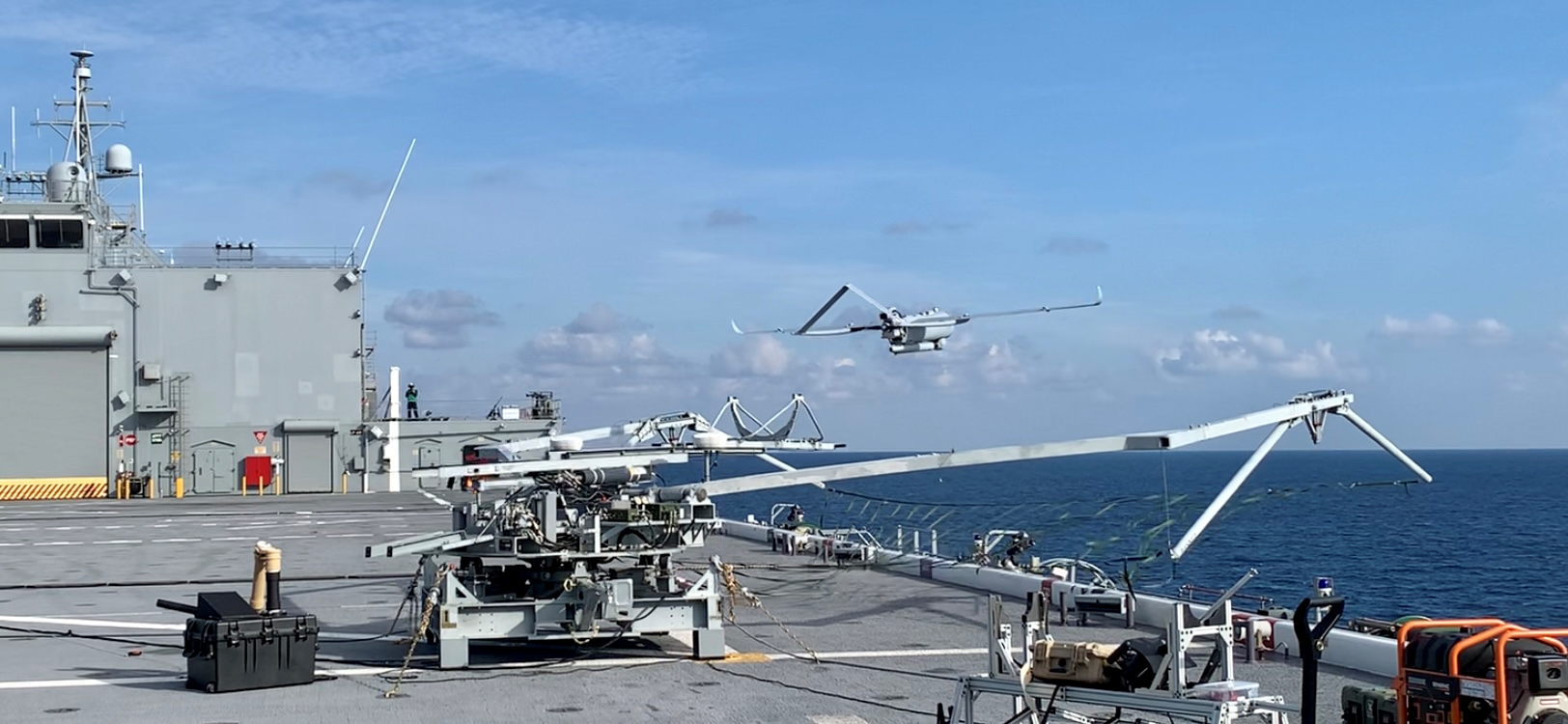
Aerosonde launch from USS Miguel Keith (ESB-5)

Below is a news release from Textron Systems.

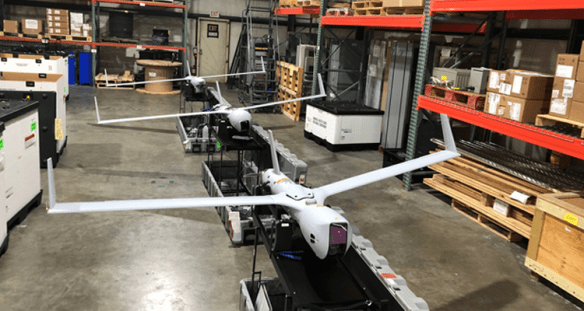
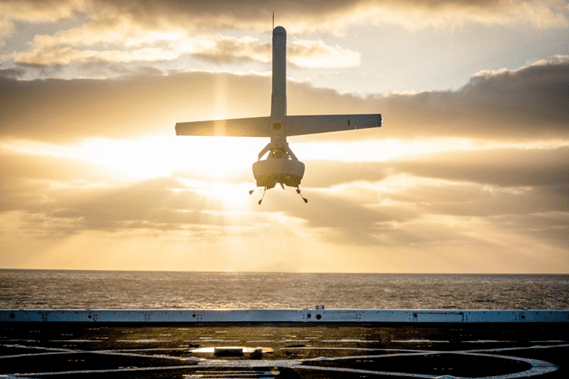
It is not clear which version of Aerosonde is to be deployed on the LCSs. There are now hybrid quad versions that can take off and land vertically (see the video) without the supporting catapult and capture gear (top photo), but those with VTOL capability do sacrifice some endurance, speed, and payload as a result of greater weight and increased drag. It is likely the catapult launched version, which we know is on ESB-5, will also be used on the LCSs. Why did the Navy choose the Aerosonde over the Scan Eagle chosen by the Coast Guard? Let’s compare the two catapult launched UAS:

  • Type                                     Aerosonde Fixed Wing            Scan Eagle
  • Max Payload (pounds/kg):              20/9                                    11/5
  • Endurance (hours)                           14+                                     20+
  • Air Speed  (knots)                          45-65                                  60-80
  • Power (HP)                                        4                                        1.5

The Aerosonde’s only immediately apparent advantage is the greater payload. Perhaps the Navy has a sensor, or sensors that may be more capable but heavier that those included in the Coast Guard’s Scan Eagles, but if so, I can’t tell you what they are.

Incidentally, the payload capacity for the vertical takeoff and landing Hybrid Quad version of Aerosonde is 15 pounds, so it could presumably use the same sensor suite used on Coast Guard Scan Eagles.


AEROSONDE® UNCREWED AIRCRAFT SYSTEM (UAS) SUPPORTING SEVENTH U.S. NAVY SHIP WITH EXTENDED RANGE ISR SERVICES

Hunt Valley, Maryland, AUGUST 9, 2023 – Textron Systems Corporation, a Textron Inc. (NYSE:TXT) company, announced today that it has been awarded an initial contract valued at up to $19.5 million by the U.S. Navy’s Naval Air Systems Command (NAVAIR) to provide UAS operational support to two Independence Class LCS and one Freedom Class LCS variants. This award joins the Expeditionary Sea Base (ESB)-4 and ESB-5, as well as two DDG- class ships, bringing the total number of U.S. Navy ships supported by the Aerosonde® UAS system to seven.

Textron Systems will deploy its Aerosonde UAS to provide mission overwatch and extended intelligence, surveillance and reconnaissance (ISR) services with enhanced mission payloads as seen aboard the ESB-5.

“Contractor-owned/contractor-operated contracts like this support the Navy’s continued investments in uncrewed assets for their ships,” said Wayne Prender, Senior Vice President, Air Systems. “We’ve seen the benefits of our Aerosonde UAS for DDG and ESB- class ships already, and we’re honored to be expanding into this new ship class, allowing us to continue supporting maritime domain awareness and missions while delivering operational and logistical capabilities.”

The Aerosonde system continues to set the standard for mission readiness and ease of use, amassing more than 600,000 flight hours serving multiple U.S. customers and allies. It is designed for expeditionary land- and sea-based operations with both fixed-wing and vertical takeoff and landing (VTOL) options. Textron Systems has provided turnkey, UAS operations for customers around the world for more than 10 years.

NAVAIR Public Release 2023-538 Distribution Statement A – “Approved for public release; distribution is unlimited”

“Japan to supply 5 countries with free patrol boats to counter China” –Navy Recognition

Japanese Aso-class patrol vessel Dewa. (Picture source: Japanese government)

Navy Recognition reports,

For 2024, the OSA (Japan’s Official Security Assistance program–Chuck) has earmarked nations such as Vietnam, Indonesia, the Philippines, Papua New Guinea, Mongolia, and Djibouti. Notably, the first three have ongoing maritime disputes with China in the South China Sea…To strengthen its oversight of territorial waters and skies, Japan is considering equipping these nations with patrol boats, radar tech, drones, and communication tools.

While the US has transferred a lot of overage Coast Guard cutters, the Japanese generally supply new ships on very favorable financial terms. This helps maintain Japan’s shipbuilding capacity.

Japan has already supplied the Philippines with two large patrol cutters and ten smaller patrol craft. Japan has an agreement with Vietnam to build six cutters based on the Aso class pictured above. Japan has gifted at least one older cutter to Malaysia

It is not clear if the patrol boats mentioned in the title are actually free or if they refer to new or previously arranged programs.

Thanks to Lee for bringing this to my attention. 

“Shield AI Collaborates with Sentient Vision Systems to Offer AI-Enabled Wide Area Motion Imagery Capability” –News Release

The unmanned aircraft sensor payload capability is varied based on the Coast Guard’s desired mission and search conditions: MWIR 3.5 is a mid-wave infrared for thermal imaging capability, for use at night or periods of low visibility; EO-900 is a high-definition telescopic electro-optical (EO) imager to zoom in on targets at greater distance; and ViDAR is a visual detection and ranging wide-area optical search system that is a comprehensive autonomous detection solutions for EO video. Courtesy Photo.
I am passing along this vender’s news release. It references two systems we have discussed in the past, Vidar and the V-Bat UAS. The Coast Guard has a history with these systems.

 Shield AI Collaborates with Sentient Vision Systems to Offer AI-Enabled Wide Area Motion Imagery Capability

SAN DIEGO (Aug. 10, 2023) – Shield AI, an American defense technology company building the world’s best AI pilot, and Sentient Vision Systems (Sentient), an Australia-based leader in AI-enabled passive wide area search, are pleased to announce a strategic collaboration aimed at delivering a wide area motion imagery (WAMI) solution for Department of Defense (DoD), Australian Defense Forces (ADF) and other international customers.

The companies will jointly develop and integrate a ViDAR-enabled, wide-area-search capability onto Shield AI’s V-BAT unmanned aircraft, which will enable Shield AI’s V-BAT to intelligently classify, track, and read-and-react to targets in dynamic missions. Shield AI plans to fly the capability on V-BAT next year.

“This work with our Australian partner, Sentient, is a unique opportunity to fuse the innovation prowess of two companies from allied countries on opposite sides of the world. Together, we are shaping the future of defense technology,” said Brandon Tseng, Shield AI’s President, Co-founder, and former U.S. Navy SEAL.

ViDAR is Sentient’s AI system, which uses an Electro-Optic or Infrared (EO/IR) sensor to detect and classify targets in the imagery stream that would be invisible to a human operator or to a conventional radar. With these enhanced capabilities, V-BAT will be even more proficient in executing the most challenging missions, offering a level of capability that significantly bolsters threat deterrence, thereby reinforcing international peace and security.

“Sentient is excited and proud to be working with Shield AI on this truly breakthrough solution,” said Mark Palmer, Sentient’s Chief Technology Officer. “We look forward to combining the AI expertise and operational understanding of our two great teams to deliver superior ISR capabilities for today’s rapidly changing defense and security environment.”

About Shield AI 
Founded in 2015, Shield AI is a venture-backed defense technology company whose mission is to protect service members and civilians with intelligent systems. In pursuit of this mission, Shield AI is building the world’s best AI pilot. Its AI pilot, Hivemind, has flown a fighter jet (F-16), a vertical takeoff and landing drone (V-BAT), and a quadcopter (Nova). The company has offices in San Diego, Dallas, Washington DC and abroad. Shield AI’s products and people are currently in the field actively supporting operations with the U.S. Department of Defense and U.S. allies. For more information, visit www.shield.ai. Follow Shield AI on LinkedIn, Twitter, and Instagram.

Media contact: media@shield.ai

About Sentient Vision Systems                                                                                      Sentient Vision Systems specializes in passive, modular optical sensors for persistent, wide area motion imagery. Sentient’s artificial Intelligence (AI)-enabled edge solutions better detect and identify small objects in real time, on land and at sea. With more than 20 years of development in moving target indication, AI computer vision and machine learning, Sentient has deployed thousands of systems worldwide in the field of Intelligence, Surveillance, Search and Rescue, enhancing situational awareness, accelerating informed decisions, and saved numerous lives. For more information, visit www.sentientvision.com. Follow Sentient on LinkedIn, Twitter and YouTube.

Media contact: media@sentientvision.com

Editorial enquiries :

Shield AIMedia contact: media@shield.ai

Sentient Vision Systems Media contact: media@sentientvision.com

“Drone Boat Leading Navy Ships In The Strait Of Hormuz A Sign Of Things To Come” –The Drive

Strait of Hormuz, August 6, USS Thomas Hudner (DDG-116), Lewis and Clark class cargo ship USNS Amelia Earhart (T-AKE-6) and USCGC Charles Moulthrope (WPC-1141) with L3Harris Arabian Fox uncrewed surface vessel (USV) in the foreground.

The Drive has a post discussing 5th Fleet/NAVCENT’s pioneering work with Unmanned surface systems (UAS) and the creation of Task Force 59.

Coast Guard Webber class patrol craft are prominent in the operation as they have been in previous UAS operations. I suspect this is because the WPCs are readily available to the 5th Fleet commander. Their size and maneuverability make them easier to operate in close proximity to the small UAS (and in the vicinity of Iranian Revolutionary Guard Corp (IRGC) small craft). They are heavily armed enough to prevent the IRGC from stealing the UAS. They have tried to do it in the past

Specs on the 13 foot L3 Harris Arabian Fox (40 knot maximum speed and 36 hour endurance) lend credibility to the long-range reported for Ukrainian Kamikaze UAS, up to 450 nautical miles (approximately 833 km).