Claims the Ninth NSC is just Pork–Washington Examiner

USCGC_Waesche_by_Yerba_Buena_Island

The WashingtonExaminer reports,

“The 2009-page $1.1 trillion omnibus spending bill before Congress this week includes a $640 million earmark for a Coast Guard ship the Coast Guard doesn’t want, but K Street does.”

They point to an earlier post that advocated a 9th NSC and this statement,

“The [program of record] provides the capabilities needed to execute our missions. While these assets have proven to be highly effective and capable, the Coast Guard has not identified a need for additional NSCs at this time,” said a Coast Guard spokesman Chief Warrant Officer Chad Saylor.

Presumably, CWO Saylor was just saying it was not in the budget or in the program of record. Saying the Coast Guard does not need or cannot use a ninth Bertholf class could not be more wrong.

The National Security Cutters have been repeatedly identified as replacements for the 378 foot WHECs. But even under the most optimistic assumption of the “Crew Rotation Concept,” eight NSCs are not enough to provide the same number of days away from homeport as twelve WHECs. Even assuming each NSC would be available 230 days a year, they could provide only 1840 days as compared to 2220 for twelve WHECs, each available 185 days per year. Even nine NSCs still leaves us 150 days short. To provide the same or more days away from homeport under the crew rotation concept, even if it worked would require ten ships and 13 crews.

The Fleet Mix study completed in 2009 and made public in 2012, indicated that the Coast Guard needs far more ships than included in the “Program of Record,” if it were to fully meet all our statutory missions.   Each of the four progressively larger force levels (each progressively larger than the program of record) was intended to address a mission short fall. In every case the desired force level for National Security Cutters was nine. 


A European Union Coast Guard?

We have a press release from the European Union announcing the formation of an EU Border and Coast Guard.

From the description, this will not be a Coast Guard in the way we think of it, rather it will be the marine side of a border protection supervisory agency. They will still depend heavily on the various national agencies. They will, in some respects, combine functions we associate with Immigration and Customs Enforcement and Customs and Border Protection. While SAR is mentioned, the primary consideration is addressing problems that have emerged in the on-going immigration crisis.

The proposed budget and staffing are relatively small, but given that they are authorized to purchase their own equipment, this may be another indication of increasing federalization of EU powers.

” For the first time the Agency will be able to acquire equipment itself and to draw on a pool of technical equipment provided by the Member States…The new Agency’s human resources will more than double that of Frontex, to reach 1,000 permanent staff, including field operatives, by 2020.”

“The Agency will be able to assess the operational capacity, technical equipment and resources of Member States to face challenges at their external borders and require Member States to take measures to address the situation within a set time-limit in case of vulnerabilities.”

“…the Commission will be able to adopt an implementing decision determining that the situation at a particular section of the external borders requires urgent action at European level. This will allow the Agency to step in and deploy European Border and Coast Guard Teams to ensure that action is taken on the ground even when a Member State is unable or unwilling to take the necessary measures.”

Coast Guard surveillance: National coastguards will be part of the European Border and Coast Guard to the extent that they carry out border control tasks. The mandates of the European Fisheries Control Agency and the European Maritime Safety Agency will be aligned to the new European Border and Coast Guard. The three Agencies will be able to launch joint surveillance operations, for instance by jointly operating Remotely Piloted Aircraft Systems (drones) in the Mediterranean Sea.”

The explanation is expanded upon in a Q&A format.

“Its strengthened mandate will include monitoring and supervisory responsibilities, as well as the capacity to intervene in urgent situations either at the request of a Member State or when a Member State is unable or unwilling to act…. The role of the Agency to contribute to search and rescue operations will also be significantly strengthened.”

“Today’s proposals will entail a gradual increase of the Agency budget from the €143 million originally planned for 2015 up to €238 million in 2016 to €281 million in 2017, reaching€322 million in 2020 when all additional staff will be recruited…In order to implement its new tasks the Agency should reach 1000 staff members by 2020, compared to 402 staff members at the start of 2016… Member States will have to make available at least 1500 border guards to be deployed by the Agency in rapid border interventions within days.”

“As a general rule, European Border and Coast Guard teams will act only in the presence of host Member State staff. Any disciplinary action against them would be subject to the disciplinary measures of the home Member State.”

Russian Navy Primer–USNI

If you are interested in being up to speed on the Russian Navy, the US Naval Institute has provided access to an Office of Naval Intelligence (ONI) briefing book on the Russian Navy.

“Cdr Salamander” provides an intro to the publication on the US Naval Institute Blog. 

Unfortunately I did not see anything about the Russian Coast Guard in my initial scan of the document. It is a not insignificant force.

On page 5, where you see the 1000 mile rings that the document suggest the Russians have a special interest in, you might notice that one includes most of Alaska.

It is a nice, readable update.


More Ships than the Program of Record?

The Navy League’s publication, Seapower Magazine, is reporting the Commandant, ADM Paul F. Zukunft, speaking at a special topic breakfast, on Dec. 15, sponsored by the Navy League and PricewaterhouseCoopers, sounded remarkably positive.

Regarding the Bertholf Class, “…We said eight National Security Cutters, now we’re negotiating a ninth…Sometimes it’s very difficult to stop at what that program of record is.”

“We will see an appropriation today, and, quite honestly, I will not be surprised if we see a ninth [National Security Cutter] because it won’t penalize the largest acquisition in our history, the Offshore Patrol Cutter…” Of the NSC, he said, “These ships are more than paying for themselves.

Regarding the Offshore Patrol Cutters, he confirmed that he expected construction to begin on the first of class during 2017, but he went on to suggest that there was a good possibility that it was possible, additional ships beyond the 25 planned might added “to the program of record as the cutters demonstrate their worth.”

Regarding new icebreakers, “The good news is that we’ve got great bipartisan support to invest in this…We will find the money,” he said. “This isn’t as expensive as an SSBN [ballistic-missile submarine], but it is an investment that we need to make.”

Observations:

A ninth Bertholf class makes a lot of sense right now. Plus it should ramp up the CG AC&I budget to something more realistic.

I hope we will build more than 25 OPCs, after all the plan is to go from 44 large cutters (not right now, but in the recent past) to 33 (34 if we get a ninth NSC), but that is on a very distant horizon. Right now, the plan is to fund one OPC in FY 2017, 2018, and 2019 and only two per year aft that, until the program is complete. Hopefully, the rate of construction will go to at least three a year after the first of class is tested. The MECs we have now are just not going to last until 2035.

The Commandant has not suggested that the first new icebreaker will be funded before 2020. Even if funded then, we are going to have a problem bridging the gap between now and the commissioning of that icebreaker which, presumably will not be until at least 2024.

It does seem the CG budget is getting some attention, but we will have to wait to see if good intentions materialize in the form of a reasonable AC&I Budget.

A ninth NSC would be a good first step.

Thanks to Daniel for bringing this to my attention.

Coast Guard Polar Icebreaker Modernization: Background and Issues for Congress–Updated

POLAR SEA and POLAR STAR side by side in McMurdo Sound, Antarctica

The US Naval Institute News Service has provided a copy of the Dec. 14, 2015 Congressional Research Service report, “Coast Guard Polar Icebreaker Modernization: Background and Issues for Congress,” by Naval Ronald O’Rourke.

This updates a series of earlier reports.

It is quite clear from the report that even if things go as planned, which I doubt it will, we will have a period of two to six years when we will have only one medium icebreaker and no heavy icebreakers.

If we do as currently planned, we will not see a new icebreaker until at least 2024.

We have looked at alternatives that might carry us through until the US can truly recapitalize its current fleet.

We can renovate Polar Sea. Clearly Congress is running out of patience waiting for a decision about what to do with this ship. We ought to ask for the funds to renovate it one way or the other.

We can lease one or two of these excess icebreakers. We could put one in the Great Lakes to satisfy those interests and it could in worst case exit the Great Lakes and go to the assistance of a polar icebreaker or break into resupply Thule airbase in Greenland.

Both of these are relatively low cost options. They deserve serious consideration.

USNI Publishes “Arctic Issue”

The US Naval Institute, has, for what I believe is the first time, published an issue of “Proceedings” that is dominated by discussion of the Arctic.

Pages 18 to 37 are devoted to the Arctic, including four articles and a sidebar. I think that is at least as much as they devoted to the Coast Guard, in the “Coast Guard Issue.”

Only one of these articles is available on line to non-members, “Geopolitical Icebergs,” by Dr. Auerswald, a professor of security studies at the National War College.

The other articles, also available on-line to members are:

  • “Defending Polar Access”
  • “More Access for the Arctic”
  • “A Mechanism for Arctic Crisis Response”

Throughout there is a call for more resources, particularly icebreakers.

The last short article, “A Mechanism for Arctic Crisis Response,” advocates positioning a structure in the Chukchi Sea. I can’t help but think putting the resources on land might be a bit easier in the long run.

Or alternately, modify the Polar Sea, as I have suggested, and use her for that purpose.

Another Competitor for Canada’s Fixed Wing SAR Aircraft

635853520416533029-DFN-Canada-Embraer.jpg

Photo: Embraer KC-390, company photo

DefenseNews is reporting another competitor is set to enter the competition to replace Canada’s aging fixed wing SAR aircraft fleet, the Embraer KC-390.

In the photo, this aircraft looks small, but it actually has a greater max gross weight and cargo capacity than a C-130J. It has better than 90% of the J model’s range and is faster.

They claim, it was intended as a SAR aircraft from it inception.

“Geraldo Gomes, vice president of business development for Embraer Defense and Security, said … the KC-390 was designed to be a search-and-rescue aircraft and that one of its strong selling points is its low life-cycle costs.”

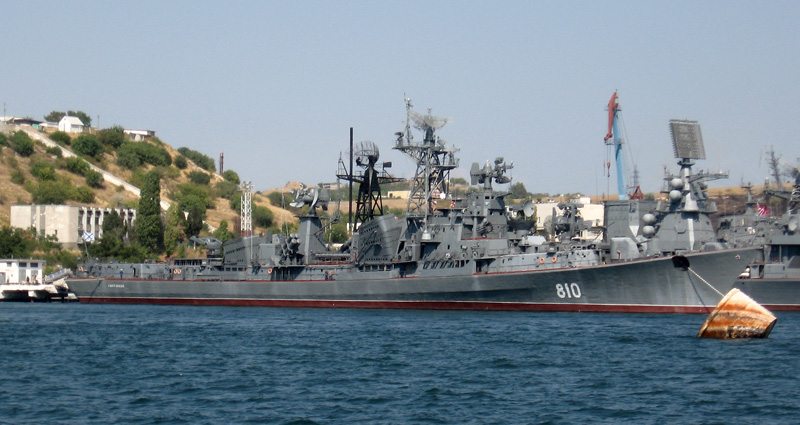
Russian Destroyer Fires Warning Shots to Scare Off Turkish F/V

File:Smetlivyy2007Sevastopol.jpg

Photo: Smetlivyy seen here in Sevastopol. Attribution: Водник

BBC reports that a Russian Destroyer (reported as a frigate), the Smetlivy, used small arms fire to drive off a Turkish fishing vessel that was approaching it as the Russian destroyer lay at anchor near a Greek island in the Aegean Sea.

Given the tensions with the Turks and the possibility of Daesh retaliation for Russian involvement in Syria, they were probably thinking about the USS Cole attack.