“Lasers Belong at Sea”–DefenseMediaNetwork

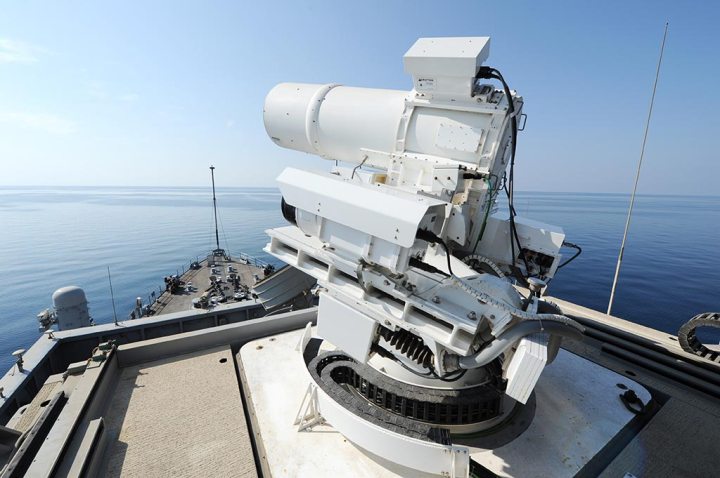
The Afloat Forward Staging Base (Interim) USS Ponce (ASB(I) 15) conducts an operational demonstration of the Office of Naval Research (ONR)-sponsored Laser Weapon System (LaWS) while deployed to the Arabian Gulf. U.S. Navy photo by John F. Williams

The Afloat Forward Staging Base (Interim) USS Ponce (ASB(I) 15) conducts an operational demonstration of the Office of Naval Research (ONR)-sponsored Laser Weapon System (LaWS) while deployed to the Arabian Gulf. U.S. Navy photo by John F. Williams

DefenseMediaNetwork has an interesting article about progress on weaponizing Lasers for use afloat. Some points that might be of particular interest to the Coast Guard were:

The Laser can be a less than lethal deterrent,.

“A laser offers scalable effects, from deter-and-dissuade to degrade or destroy. LaWS can address multiple threats using a range of escalating options, from non-lethal measures such as optical “dazzling” and disabling, up to lethal destruction of small attack boats and UAVs.”

The accompanying optics have other uses,

“The systems provide better high-resolution imagery than what existing shipboard EO/IR sensors provide now. With upgraded optics, a system like CLWS can bring targets as close as 1 kilometer or as far as 37 kilometers into clear focus. ‘The system enhances intelligence missions without engaging targets,’ …”

Thanks for a Successful 2015

81mm50caloverunderCWOElmerLHicksUSCG

Now that it is over, looking back on 2015, I would like to thank the readers and contributors for making the effort very rewarding for me. This is a remarkably civil and knowledgeable group. Nice to see that all experience and knowledge levels are respected. Top five contributors by number of comments were x, Leesea, Tups, James WF, and Nicky. I got a number of suggestions by e-mail too.

The previous year, 2014, was a remarkably good year for the blog. The award of the preliminary Offshore Patrol Cutter contracts prompted a lot of interest, but still the blog enjoyed some growth. The blog had 213,556 views,  5.4% more last year.

In 2015, there were 277 new posts, growing the total archive of this blog to 1,452 posts. Top posts, by number of views were:

  1. What Does It Take to Sink a Ship (March 2011)
  2. The Navy’s New Patrol Boat (May 2012)
  3. OPV to OPC (July 2012)
  4. Case for the Five Inch Gun (November 2012)
  5. Three Nations Share German OPV Design (April 2014)
  6. What Might Coast Guard Cutters Do in Wartime, Part 2, Coast Guard Roles (February 2012)
  7. Ireland’s New OPV, Samuel Beckett (May 2014)
  8. Two More New Medium Icebreaker–Not for the Coast Guard (March 2015)
  9. Alternate Weapons for New Large Cutters? (May 2012)
  10. Offshore Patrol Cutter Concepts (June 2013)

As you can see, nine out of ten of these were published in previous years. I hope this is not a reflection of declining quality, but it is gratifying to know that these posts are still of continuing interest.

I am told by WordPress that readers came from 169 different countries. I suspect some of these were just spammers. Still, 38 countries were reported to have at least 200 views. The top five, after the US, were the UK, Canada, the Philippines, Netherlands, and Australia.

I would also like to particularly thank Thinkdefence, the Center for International Maritime Security (CIMSEC) “Next War Blog”Eaglespeakfor linking to this website and bringing more readers here.

Thanks for the interest.


NavyRecognition’s Ten Best

With New Years “Best of…” Lists are perhaps inevitable. This one, from NavyRecognition, while you might argue with the selection is at least interesting.

Perhaps most interesting for us are #6 BAE Systems Unveils the ORKA One Shot One Kill Round for 57mm Gun at Sea-Air-Space 20 and #3 Design of Future TKMS Built Saar 6 MEKO A100 Corvettes for Israeli Navy Unveiled.

#1 At NAVDEX 2015 Navantia unveiled its F-538 Frigate Design for the Peruvian Navy is interesting, as a cutter sized warship, but it is still only a proposal. 

Rebuttal to Economic Case Against OPVs

Toro_air_view

Photo: Chilean Navy photo of OPV Toro, 2012

A German blogger I worked with earlier on a project for CIMSEC, Sven Ortmann, has written a post contending that building dedicated Offshore Patrol Vessels (e.g. Coast Guard cutters) does not make sense, that it is more economical to have a navy’s warships, augmented as necessary by law enforcement officers, perform these peacetime functions. He is planning to publish the post, 24 December at 6:00PM Eastern, at his Defense and Freedom Blog here.

Sven asked if I would like to write a rebuttal, and this is the product of that query.

Terminology:

For the purposes of this post, I will lump fisheries, law enforcement, and SAR together as coast guard work, or for brevity CG work.

I would contend at least some OPVs are really warships, and on the other hand, that navy auxiliaries, not normally considered warships, might also be used also be used to perform CG work, as the British Royal Navy has done, but for the sake of avoiding repeated long explanations I will lump the ships that might do this work into two categories as Sven has done: “warships” and “OPVs.”

The Contentions: Sven’s argument is based on a number of questionable assumptions. I will try to address each of these.:

  • That OPVs are not warships and that they have no value in wartime.
  • That if a nation builds a proper sized navy, it will include enough warships to also do CG work.
  • That those warships will be in geographic positions that will allow them to do CG work.
  • That a Navy crew, supplemented as necessary by a law enforcement team, can do CG work as effectively as a crew whose primary task is CG work.

Waesche Carat 2012

US Navy photo

That OPVs are not warships and that they have no value in wartime. “What do you need in war (and for deterrence of war)? Combat capability. Warships are built for it, OPVs are mere targets in combat.”

This assumes OPVs have no role in wartime. The truth of this statement depends a great deal on:

I did an earlier post which examines what Coast Guard cutters, and by extention, what OPVs might do in wartime, “What Might Coast Guard Cutters do in Wartime? Part 2, Coast Guard Roles.”  Their potential missions include Maritime Security, Blockade/Quarantine, Sea Control, Administrative Escort, Combat SAR, Deception, Special Warfare support, Naval Surface Fire Support. and with suitable modification, MCM and ASW. I would add that in the case of China’s very large OPVs, they might also be used as Attack Transports, being equipped, as they are, with extra accommodations, a number of boats, and facilities for large helicopters.

Why China Is Building The World's Largest "Coast Guard" Cutter

Image from FoxtrotAlpha, “Why China is Building the World’s Largest ‘Coast Guard’ Cutter”
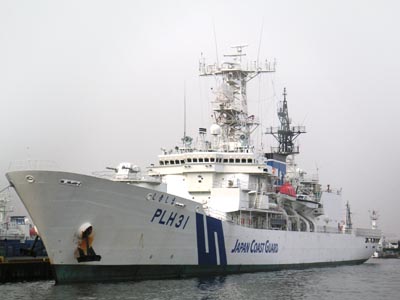
Photo: Japanese Coast Guard Cutter Shikishima, this class of two are currently the largest offshore patrol vessels in the world. China is building even larger OPVs. Photo from Japanese Wikipedia; ja:ファイル:JapanCoastGuard Shikishima.jpg

In many cases the only difference between what people see as OPVs and frigates or corvettes is how the ship is equipped.  If an OPV is upgraded and people start to see it as a frigate, is it no longer an OPV? I don’t don’t think so. Offshore Patrol is a job to do, rather than a type of vessel, though a certain type of vessel is typically used as an OPV. World wide, the typical vessel built to perform OPV duties is 1500 to 2500 tons, has a medium caliber gun, some machine guns, and a helicopter deck. Some are better equipped than others. Some even include anti-ship cruise missiles Usually they don’t have some of the more sophisticated equipment found on warships, because of both initial cost and manning requirements, but given some time, frequently they can be upgraded.

ProposedPolishCorvette

Photo: Spanish BAM, Meteoro Class OPV

That if a nation builds a proper sized navy it will include enough warships to also do CG work. “Scenario A: A fleet with warships, no OPVs. Result: Enough warships for war’s needs, enough ships for policing and rescue.”

This is what I believe Sven suggests is the best choice, but it assumes there are enough warships for marine policing and rescue, but this is not necessarily the case.

We must ask how many ship-days we need to effectively perform the CG work. Then we must ask how many ship-days the navy will have remaining after maintenance, work-up, exercises, and out of area deployments.

PacificEEZ

EEZs in the Pacific (partial)

A nation’s wealth, its perception of threat, and the size of its EEZ are not necessarily proportionate.

Germany is a wealthy nation, with a potential great power adversary relatively close at hand. It has a substantial navy and a relatively small EEZ. Consequently using a small part of their navy a small part of the time may be sufficient to perform CG tasks.

Comparing the total number of cruisers, destroyers, frigates, corvettes LCS, and OPVs, Germany has about 20. The US has a lot more, about 140, or seven times the number, but the US EEZ is 197 times larger than that of Germany. Additionally, while the German Navy’s primary operating area is near or within their territorial sea and EEZ, the US Navy’s primary operating areas are far from US Waters. The circumstances are very different. The US could not be able to build a proportionately large number of pure warships to also patrol its EEZ.

SLNS-SamuduraSriLanka

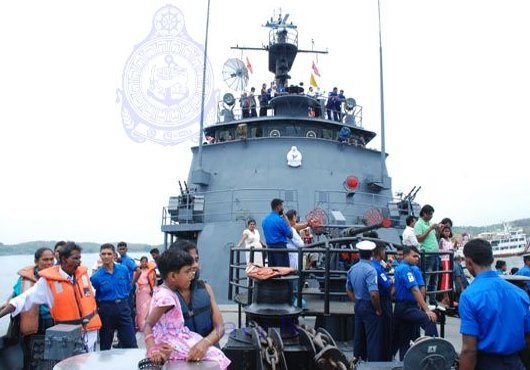
SLNS-Samudura, SriLanka

Photo: Former USCGC Courageous (WMEC-622)

There are other nations that feel relatively little threat and see little need for a navy, but have relatively large EEZs that are a major source of economic prosperity. They need to patrol their waters, they may very rationally build OPVs and they can mitigate any apprehension about their naval position by giving their OPVs more warlike capabilities.

That those warships will be in geographic positions that will allow them to do CG work. “Why the warships’ manning and fuel expenses are sunk costs? Simple; the warship would be out at sea for training anyway. Warship fuel and manning expenses may be (slightly or very much) greater in this case, but they’re sunk costs!” This assumes that policing and SAR does not interfere with the warship’s training and missions.

CG missions tend to require wide distribution of assets. Warships tend to operate in teams that are geographically concentrated. During workup they need to use the services of training facilities which are in only a few areas.

The US chooses to regularly deploys virtually all of its Navy ships far from the US EEZ as soon as they are fully worked up. If instead they hung around the US, they might be able to perform some CG missions, but it would require a change of national priorities. As it is, there are very few Navy vessels available to conduct counter-drug operations in the Forth Fleet Area (Latin America/Caribbean), and we very seldom see US Navy ships in Alaskan Waters

If we took the resources to maintain the Coast Guard’s offshore fleet and diverted it to additional Navy vessels,

  • first, there would be fewer of them, because of their higher cost and greater manning requirement
  • second, because of their more complex nature they would be available few days per ship because of the additional training they require.

I suspect Sven’s position is largely influenced by the frequent argument that OPVs should be used for counter piracy operations off Samalia. Actually we agree that using warships that are deployed to the area for other reasons, to do counter-piracy is perfectly reasonable.

On the other hand, if a nation wanted to keep its high cost navy units close to home where they can be used for defense, but it also felt an obligation to participate in counter-drug or counter-piracy operations far from any serious threat, OPVs are a relatively cheap way to fulfill the obligation without the diversion of more expensive assets.

I will note that OPVs also tend to become obsolete more slowly than more sophisticated warships. Currently the average age of USCG OPVs is over 40 years, while the average age of USN ships is about 14 years. This was not good policy, but it was possible because of the less sophisticated requirements of the OPV’s missions. In some cases frigates or corvettes are stripped of obsolete weapons and sensors and become OPVs as has been done by Spain, Portugal, and Italy.

Photo: Ship of the Spanish Navy Infanta Cristina, commissioned in 1980 as corvette with pennant F-34; in 2000 she was reclassified as oceanic patrol ship, pennant P-77, by José María Casanova Colorado, importé par Takashi kurita

That a Navy crew, supplemented as necessary by a law enforcement team, can do CG work as effective as a crew whose primary task is CG work. This will depend very much on the support provided by the command team on the ship, but I believe there is more of a tendency for those who view themselves first and foremost as warriors to view the CG missions as a distraction. They are less likely to view their career success as tied to the way they do these peacetime missions. The larger and more powerful the warship, the less likely they are to assign priorities to CG missions. This suggests a separate service, like the USCG, but at least navy officers assigned to smaller ships and OPVs that are dedicated to CG missions must feel greater pressure to succeed in these missions than those assigned to ships where these missions are well down the priority list.

121203-G-XX000-001_CPO Terrell Horne

There is another advantage to ships that are clearly intended for peacetime missions. The perception that the US Coast Guard cutters are law enforcement and search and rescue assets rather than military units, make them welcome in many places where Navy ships are not. This has opened doors for the Coast Guard that are closed to Navy ships.

File:Bad Bramstedt (BP24).jpg

Photo: German Police Coastguard ship Bad Bramstedt (BP24), by Hans Hillewaert

In conclusion. Sven’s prescription may be right for Germany, but for other nations different circumstances including EEZ size and threat perception may make OPVs a good choice. But even Germany has seen the need for at least three small OPVs (pictured above, as Sven pointed out to me).

FY2016 Budget Comparison

USCGC_Waesche_by_Yerba_Buena_Island

Earlier I quoted the law that enacted the FY2016 budget. Now I’ll attempt to put it in context by comparing it to earlier budget allocations including the FY2014 budget, the FY2015 budget request, the FY2015 budget enacted, and the FY 2016 budget request.  If you want to look back as far as FY2013 enacted and the 2014 request you can look here. There are some area where I do not have information, so I have left them blank. Hopefully I will be able to fill them later as more info becomes available.

…………….(Note all amounts in $000, unless indicated otherwise)

Acquisitions, Construction, and Improvement (AC&I):

  • FY 2014 Actual…………………$1,373,135
  • FY 2015 President’s Budget……1,084,193
  • FY 2015 Actual…………………..1,225,223
  • FY 2016 President’s Budget……1,017,269
  • FY 2016 Actual………………….$1,945,169

Operations and Maintenance (O&M):

  • FY 2014 Actual………………….$6,782,607
  • FY 2015 President’s Budget…….6,750,733
  • FY 2015 Actual……………………6,830,318
  • FY 2016 President’s Budget…….6,821,503
  • FY 2016 Actual…………………..$7,061,490

ENVIRONMENTAL COMPLIANCE AND RESTORATION:  

  • FY 2014 Actual…………………….$13,164
  • FY 2015 President’s Budget……..$13,214
  • FY 2015 Actual………………………
  • FY 2016 President’s Budget……..$13,269
  • FY 2016 Actual…………………… $13,221

RESERVE TRAINING:

  • FY 2014 Actual…………………….$120,000
  • FY 2015 President’s Budget……..$109,605
  • FY 2015 Actual………………………
  • FY 2016 President’s Budget……..$110,614
  • FY 2016 Actual…………………….$110,614

RESEARCH, DEVELOPMENT, TEST, AND EVALUATION: 

  • FY 2014 Actual…………………….$19,200
  • FY 2015 President’s Budget……..$17,947
  • FY 2015 Actual………………………
  • FY 2016 President’s Budget……..$18,135
  • FY 2016 Actual…………………….$18,019

Mandatory (non-discretionary) appropriations (primarily retired pay):

  • FY 2014 Actual…………………..$1,754,148
  • FY 2015 President’s Budget……..1,662,373
  • FY 2015 Actual…………………….1,663,548
  • FY 2016 President’s Budget……..1,823,819
  • FY 2016 Actual………………………

Total budget:

  • FY 2014 Actual…………………….$10,321,874
  • FY 2015 President’s Budget………..9,810,468
  • FY 2015 Actual……………………..10,041,720
  • FY 2016 President’s Budget………..9,963,914
  • FY 2016 Actual:.(I do not have full information, but it should be about $11.2B)

Taking a closer look at AC&I particularly:

FY 2016 President’s Budget requests:

  • Acquisition, Construction and Improvements (AC&I) $1.01B which included:
  • $533,900 for vessels
  • $200,000 for aircraft,
  • $101,400 for shore projects

FY2016 Actual

  • Acquisition, Construction and Improvements (AC&I) $1,945,169,000
  • $1,264,400 for vessels
  • $295,000 for aircraft
  • $181,600 for shore projects

Note the AC&I for vessels was increased $90.5M more than the $640M for the ninth NSC. Six Webber class WPCs were in the plan from the beginning so they do not account for the difference. Hopefully it restored the funding needed to keep the Offshore Patrol Cutter on track, and perhaps included a bit more for moving forward on the planned Icebreaker.

Capital Investment Plan, This is another document of interest. You can find the latest one, FY2016-2020 here. Hopefully we will see a revised one soon.

Finland Seeks Unique Warship

Hamina-luokka_Hanko

Photo: Hamina class missile boat Hanko (82) by kallerna, 2009

NavyRecognition reports, the Finnish Navy is looking for some small warships with unique characteristics.

Finnish Minister of Defence, Jussi Niinistö, has given the Defence Forces a mandate to start the Finnish Navy project, Squadron 2020. The aim of the Squadron 2020 project is to construct four new corvette-size fighting ships for year-round operation in the special weather and ice conditions at the Baltic Sea (emphasis applied–Chuck).

The Request for Information informs shipyards about the project and inquires know-how and price information from shipbuilders and suppliers to base the Request for Quote on. The RFI was sent out on 18 December 2015 and answers are requested by the end of March next year.

The expected cost for the four is 1.2B Euros or abut $1.31 B. Right now the Offshore Patrol Cutter is probably the closest thing to what they are looking for, but in all probability the final design will be both smaller and much better armed. The Finns have shown an ability to cram a lot of fight into very small packages, but then, they have no need for the long range that is a characteristic of most Coast Guard or US Navy ships.

Their Hamina class patrol craft (wikipedia here) which are smaller than our Webber class (268 tons vs 353 tons fl) are equipped with a 57 mm gun, both a radar and an optronic fire control system, an EADS-TRS-3D multi-mode radar just like the National Security Cutter, an eight cell vertical launch system for anti-aircraft missiles, four anti-ship cruise missiles, ESM, and sonar. They have an aluminum hull, a composite superstructure, and NBC protection. They also have an RHIB ramp in the stern.

The FY2016 Budget

The following is quoted from the Consolidated Appropriations Act, 2016 (H.R. 2019), pp 259-261. 

COAST GUARD OPERATING EXPENSES

For necessary expenses for the operations and maintenance of the Coast Guard, not otherwise provided for; purchase or lease of not to exceed 25 passenger motor vehicles, which shall be for replacement only; purchase or lease of small boats for contingent and emergent requirements (at a unit cost of no more than $700,000) and repairs and service-life replacements, not to exceed a total of $31,000,000; purchase or lease of boats , necessary for overseas deployments and activities; purchase or lease of other equipment (at a unit cost of no more than $250,000); minor shore construction projects not exceeding $1,000,000 in total cost on any location; payments pursuant to section 156 of Public Law 97– 377 (42 U.S.C. 402 note; 96 Stat. 1920); and recreation and welfare; $7,061,490,000, of which $500,002,000 shall be for defense-related activities, of which $160,002,000 is designated by the Congress for Overseas Contingency Operations/Global War on Terrorism pursuant to section 251(b)(2)(A)(ii) of the Balanced Budget and Emergency Deficit Control Act of 1985; of which $24,500,000 shall be derived from the Oil Spill Liability Trust Fund to carry out the purposes of section 1012(a)(5) of the Oil Pollution Act of 1990 (33 U.S.C. 2712(a)(5)); and of which not to exceed $23,000 shall be for official reception and representation expenses: Provided, That none of the funds made available by this Act shall be for expenses incurred for recreational vessels under section 12114 of title 46, United States Code, except to the extent fees are collected from owners of yachts and credited to this appropriation: Provided further, That to the extent fees are insufficient to pay expenses of recreational vessel documentation under such section 12114, and there is a backlog of recreational vessel applications, then personnel performing non-recreational vessel documentation functions under subchapter II of chapter 121 of title 46, United States Code, may perform documentation under section 12114: Provided further, That of the funds provided under this heading, $85,000,000 shall be withheld from obligation for Coast Guard Headquarters Directorates until a future-years capital investment plan for fiscal years 2017 through 2021, as specified under the heading ‘‘Coast Guard, Acquisition, Construction, and Improvements’’ of this Act, is submitted to the Committees on Appropriations of the Senate and the House of Representatives: Provided further, That funds made available under this heading for Overseas Contingency Operations/Global War on Terrorism may be allocated by program, project, and activity, notwithstanding section 503 of this Act: Provided further, That without regard to the limitation as to time and condition of section 503(d) of this Act, after June 30, up to $10,000,000 may be reprogrammed to or from Military Pay and Allowances in accordance with subsections (a), (b), and (c) of section 503.

ENVIRONMENTAL COMPLIANCE AND RESTORATION

For necessary expenses to carry out the environmental compliance and restoration functions of the Coast Guard under chapter 19 of title 14, United States Code, $13,221,000, to remain available until September 30, 2020.

RESERVE TRAINING

For necessary expenses of the Coast Guard Reserve, as authorized by law; operations and maintenance of the Coast Guard reserve program; personnel and training costs; and equipment and services; $110,614,000.

ACQUISITION, CONSTRUCTION, AND IMPROVEMENTS

For necessary expenses of acquisition, construction, renovation, and improvement of aids to navigation, shore facilities, vessels, and aircraft, including equipment related thereto; and maintenance, rehabilitation, lease, and operation of facilities and equipment; as authorized by law; $1,945,169,000; of which $20,000,000 shall be derived from the Oil Spill Liability Trust Fund to carry out the purposes of section 1012(a)(5) of the Oil Pollution Act of 1990 (33 U.S.C. 2712(a)(5)); and of which the following amounts shall be available until September 30, 2020 (except as subsequently specified): $21,000,000 for military family housing; $1,264,400,000 to acquire, effect major repairs to, renovate, or improve vessels, small boats, and related equipment; $295,000,000 to acquire, effect major repairs to, renovate, or improve aircraft or increase aviation capability; $65,100,000 for other acquisition programs; $181,600,000 for shore facilities and aids to navigation, including facilities at Department of Defense installations used by the Coast Guard; and $118,069,000, to remain available until September 30, 2016, for personnel compensation and benefits and related costs: Provided, That of the funds provided by this Act, not less than $640,000,000 shall be immediately available and allotted to contract for the production of the ninth National Security Cutter notwithstanding the availability of funds for post-production costs: Provided further, That the Commandant of the Coast Guard shall submit to the Congress, at the time the President’s budget proposal for fiscal year 2017 is submitted pursuant to section 1105(a) of title 31, United States Code, a future-years capital investment plan as described in the second proviso under the heading ‘‘Coast Guard, Acquisition, Construction, and Improvements’’ in the Department of Homeland Security Appropriations Act, 2015 (Public Law 114– 4), which shall be subject to the requirements in the third and fourth provisos under such heading.

RESEARCH, DEVELOPMENT, TEST, AND EVALUATION

For necessary expenses for applied scientific research, development, test, and evaluation; and for maintenance, rehabilitation, lease, and operation of facilities and equipment; as authorized by law; $18,019,000, to remain available until September 30, 2018, of which $500,000 shall be derived from the Oil Spill Liability Trust Fund to carry out the purposes of section 1012(a)(5) of the Oil Pollution Act of 1990 (33 U.S.C. 2712(a)(5)): Provided, That there may be credited to and used for the purposes of this appropriation funds received from State and local governments, other public authorities, private sources, and foreign countries for expenses incurred for research, development, testing, and evaluation.

RETIRED PAY

For retired pay, including the payment of obligations otherwise chargeable to lapsed appropriations for this purpose, payments under the Retired Serviceman’s Family Protection and Survivor Benefits Plans, payment for career status bonuses, concurrent receipts, and combat-related special compensation under the National Defense Authorization Act, and payments for medical care of retired personnel and their dependents under chapter 55 of title 10, United States Code, $1,604,000,000, to remain available until expended.

We have Bryant’s Maritime Consulting to thank for the link. 

The Great Atlantic Hurricane, September 1944

Photo: Date: 31 March 1927; USCG Photo #: 16079-A Photographer: J. N. Heuisy (U.S. Coast Guard photo). USCGC Jackson soon after her commissioning.

14/15 September, 1944 were not good days for the Coast Guard. We lost two cutters and a light ship, along with 59 of their crewmen.

Two “buck and a quarter,” 125 foot cutters, USCGC Jackson (WSC-142) and the Bedloe (WSC-128) were going to the aid of a torpedoed freighter. Lightship 73 was simply in the path of a Category-4 monster.

File:USS Warrington DD-383.jpg

The Coast Guard was not the only service to suffer losses due to this Hurricane. The  Destroyer USS Warrington (DD-383) was lost 13 September, with 248 of her crew, only 73 survived. She was East of West Palm Beach, FL, and NE of the Bahamas as the storm moved North.

The minesweeper YMS-409 was lost with all hands, not far from the Coast Guard ship, the night of 14/15 Sept.